Τι είναι η επικύρωση συσκευασίας στη φαρμακευτική βιομηχανία? Ένας πλήρης οδηγός για κατασκευαστές φαρμάκων
Τι είναι η επικύρωση συσκευασίας στη φαρμακευτική βιομηχανία? Ένας πλήρης οδηγός για κατασκευαστές φαρμάκων
Απρίλιος 29, 2026
Δεν υπάρχουν σχόλια
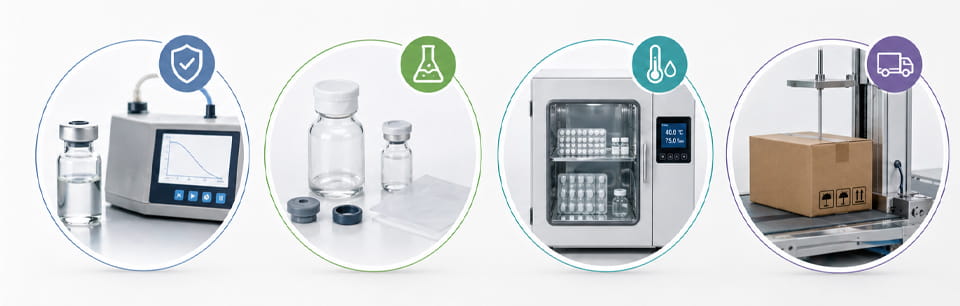
Στη φαρμακοβιομηχανία, επικύρωση συσκευασίας είναι ένα κρίσιμο υποσύνολο του επικύρωση διαδικασίας επικεντρώθηκε στη διασφάλιση ότι ο εξοπλισμός και οι διαδικασίες συσκευασίας προστατεύουν με συνέπεια την ποιότητα των φαρμακευτικών προϊόντων. Περιλαμβάνει ένα τεκμηριωμένο πρόγραμμα προσόντων (Εγκατάσταση, Επιχειρήσεων, Εκτέλεση) και δοκιμές (π.χ.. ακεραιότητα κλεισίματος δοχείου, σταθερότητα, μεταφορά) να αποδείξει ότι τα συστήματα συσκευασίας λειτουργούν όπως προβλέπεται υπό τις συνθήκες GMP. Η αποτελεσματική επικύρωση συσκευασίας προστατεύει την ασφάλεια των ασθενών (με την πρόληψη της μόλυνσης, υποβάθμιση ή μπερδέματα) και διασφαλίζει τη συμμόρφωση με τους κανονισμούς (FDA, EMA, ΠΟΥ, εγώ, ISO). Αυτός ο οδηγός εξηγεί το ορισμός, βήματα, δοκιμές, πρότυπα, και βέλτιστες πρακτικές για την επικύρωση φαρμακευτικής συσκευασίας, και δείχνει πώς αυτοματοποιημένος εξοπλισμός (σαν μηχανήματα Jinlu Packing) έχει σχεδιαστεί για να ανταποκρίνεται σε αυτές τις αυστηρές απαιτήσεις.
Ορισμός επικύρωσης συσκευασίας
Επικύρωση συσκευασίας σε φαρμακευτικά μέσα αποδεικνύοντας με τεκμηριωμένα στοιχεία ότι η διαδικασία συσκευασίας (εξοπλισμό και υλικά) παράγει αξιόπιστα μια συσκευασία που προστατεύει το φαρμακευτικό προϊόν. Στην πράξη, εφαρμόζει τις ίδιες αυστηρές έννοιες επικύρωσης που χρησιμοποιούνται στην κατασκευή (IR/WH/PQ) να πρωταρχικός, δευτερεύων, και τριτογενείς συσκευασίες επιχειρήσεις. Σύμφωνα με τις οδηγίες GMP του ΠΟΥ, "Οι διαδικασίες και ο εξοπλισμός συσκευασίας χρειάζονται επικύρωση/πιστοποίηση με τον ίδιο τρόπο όπως κάθε άλλο μέρος της επεξεργασίας σε μια φαρμακευτική εγκατάσταση.". Με άλλα λόγια, η επικύρωση συσκευασίας διασφαλίζει την σύστημα κλεισίματος δοχείων, τιτλοφόρηση, και γραμμές συσκευασίας πληρούν με συνέπεια τις προδιαγραφές ποιότητας και τις κανονιστικές απαιτήσεις. Ο στόχος είναι η διατήρηση της ισχύος του φαρμάκου, καθαρότητα και σταθερότητα μέσω της συσκευασίας, διανομή και διάρκεια ζωής, ενώ αποτρέπονται τα μπέρδεμα, πλαστά, ή ζημιά.
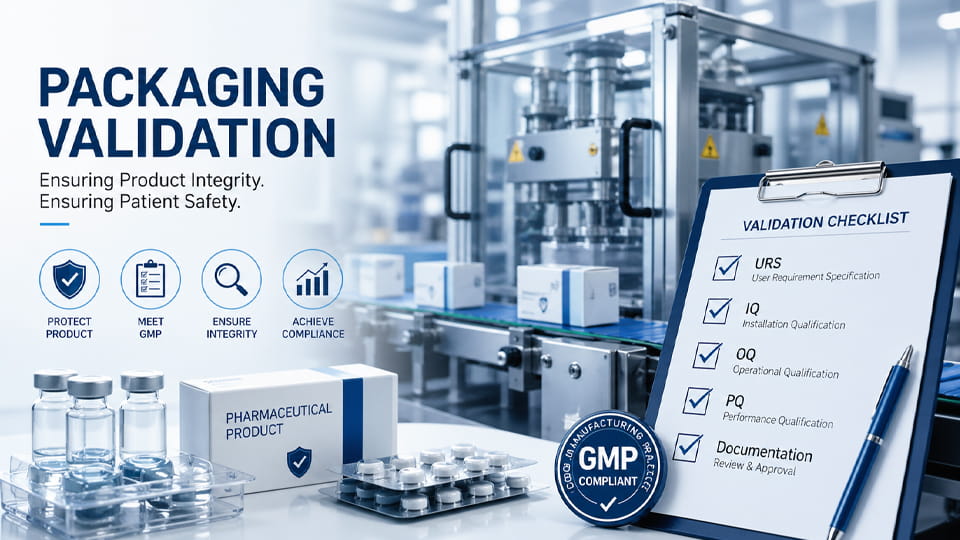
Τα τυπικά παραδοτέα στην επικύρωση συσκευασίας περιλαμβάνουν α Προδιαγραφές Απαιτήσεων Χρήστη (URS) (το σχέδιο & ποιοτικά κριτήρια), Πρωτόκολλα πιστοποίησης εγκατάστασης/λειτουργίας/απόδοσης, και αρχεία δοκιμών. Η διαδικασία επικύρωσης καλύπτει:
Πρωτογενής συσκευασία (το δοχείο ή το φράγμα που έρχεται σε άμεση επαφή με το φάρμακο, π.χ.. φιαλίδια, κοιλότητες φυσαλίδων, φακελάκια)
Κάθε επίπεδο πρέπει να προστατεύει το προϊόν. Για παράδειγμα, ορίζει το αυστραλιανό TGA “Κύρια συσκευασία” (το δοχείο που καλύπτει αμέσως τα εμπορεύματα) και διακρίνει δευτερεύουσα συσκευασία ως εξωτερικό κουτί ή περιτύλιγμα. Τελικά, η επικύρωση συσκευασίας συνδέεται με την GMP – διασφαλίζοντας ότι Τα δοχεία και τα πώματα δεν αλλοιώνουν το φάρμακο και «παρέχουν επαρκή προστασία από εξωτερικούς παράγοντες» κατά την αποθήκευση και χρήση.
Γιατί η επικύρωση συσκευασίας είναι κρίσιμη στο Pharma
Η φαρμακευτική συσκευασία είναι η τελική άμυνα για την ποιότητα του φαρμάκου. Η επικύρωση των διαδικασιών συσκευασίας είναι ζωτικής σημασίας γιατί:
Εξασφαλίζει την ασφάλεια και την ακεραιότητα του προϊόντος: Η σωστά επικυρωμένη συσκευασία αποτρέπει τη μόλυνση, εισροή υγρασίας, ή έκθεση σε οξυγόνο που θα μπορούσε να αποικοδομήσει τα ενεργά συστατικά. Για παράδειγμα, διαρροές ή αστοχίες στεγανοποίησης θα μπορούσαν να επιτρέψουν την είσοδο μικροβίων ή αερίων, αλλοίωση της στειρότητας ή της ισχύος.
Κανονιστική Συμμόρφωση: Πρακτορεία (FDA, EMA/I, ΠΟΥ) απαιτούν επικυρωμένη συσκευασία. ΜΑΣ. του FDA 21 CFR 211.94 απαγορεύει τα κλεισίματα που αλλάζουν την ποιότητα του φαρμάκου και επιβάλλει το κλείσιμο «παρέχουν επαρκή προστασία από προβλέψιμους εξωτερικούς παράγοντες». Παράρτημα GMP της ΕΕ 1 ομοίως επιμένει ότι «Τα εμπορευματοκιβώτια θα πρέπει να κλείνουν με κατάλληλα επικυρωμένες μεθόδους» (με 100% δοκιμή ακεραιότητας για προϊόντα κλειστά με σύντηξη). Ο ΠΟΥ δηλώνει ρητά ότι τα συστήματα συσκευασίας πρέπει να είναι κατάλληλα όπως κάθε άλλη διαδικασία GMP. Η μη συμμόρφωση μπορεί να σημαίνει ανακαλεί, απορρίψεις εισαγωγής ή αναφορές ελέγχου.
Παρατείνει τη διάρκεια ζωής: Τα υλικά συσκευασίας και οι σφραγίδες που έχουν επικυρωθεί υπό συνθήκες σταθερότητας βοηθούν στον καθορισμό ακριβών αξιώσεων διάρκειας ζωής. Η καθοδήγηση του ICH Q1A διευκρινίζει μάλιστα ότι οι μελέτες σταθερότητας πρέπει να γίνονται στο “σύστημα κλεισίματος κοντέινερ” προτείνεται για το προϊόν. Εάν η συσκευασία αποτύχει, Τα δεδομένα σταθερότητας δεν είναι έγκυρα.
Σειριοποίηση και Καταπολέμηση της Παραχάραξης: Οι σύγχρονες φαρμακευτικές συσκευασίες συχνά περιλαμβάνουν σειριοποίηση, σφραγίδες που δεν παραβιάζονται, και χαρακτηριστικά κατά της παραχάραξης. Επικύρωση αυτών των χαρακτηριστικών (π.χ.. δυνατότητα σάρωσης barcodes, ακεραιότητα των ταινιών παραβίασης) βοηθά στη διασφάλιση της εφοδιαστικής αλυσίδας. Ένα σφάλμα στην επισήμανση ή τη σειριοποίηση μπορεί να εμποδίσει την κυκλοφορία του προϊόντος.
Ποιότητα και αποδοτικότητα κόστους: Οι αποτελεσματικές επικυρωμένες γραμμές μειώνουν τα ελαττώματα (αστοχίες, σφάλματα ετικέτας, θρυμματισμένα χαρτοκιβώτια) και σκραπ. Αυτοματοποιημένοι έλεγχοι (συστήματα όρασης για έλεγχο σφραγίδας/ετικέτας) αποτελούν συχνά μέρος επικυρωμένων ελέγχων. Ολικός, Οι επικυρωμένες διαδικασίες συσκευασίας ελαχιστοποιούν τον κίνδυνο για τον ασθενή και διασφαλίζουν τη συνεπή παροχή αποτελεσματικών, αυθεντικά φάρμακα.
Βασικά προγράμματα οδήγησης για επικύρωση
Ασφάλεια Ασθενούς: Η ακατάλληλη συσκευασία μπορεί να βλάψει τους ασθενείς (π.χ.. μολυσμένα ενέσιμα). Η επικύρωση τεκμηριώνει το φράγμα ασφαλείας.
Ρυθμιστικός Μετριασμός Κινδύνου: Οι μη επικυρωμένες διαδικασίες είναι υψηλού κινδύνου για ανακλήσεις ή κυρώσεις. Οι ρυθμιστικές αρχές αναμένουν δεδομένα πιστοποίησης για κάθε γραμμή παραγωγής.
Παγκόσμια Διανομή: Τήρηση διεθνών προτύπων (FDA/EMA/WHO) απαιτεί επικυρωμένη συσκευασία σε όλες τις αγορές.
Επιχειρησιακή συνέχεια: Αστοχίες συσκευασίας κατά τη διανομή απορριμμάτων προϊόντος και χρόνου. Η επικύρωση εξασφαλίζει “Σωστά-πρώτη φορά” λειτουργία βάσει της GMP.
Ετοιμότητα ελέγχου: Οι έλεγχοι από τις Αρχές Ποιότητας ή τις ρυθμιστικές αρχές πελατών θα ελέγχουν τα αρχεία επικύρωσης συσκευασίας και τα προσόντα του εξοπλισμού ως μέρος των επιθεωρήσεων GMP.
Πεδίο Επικύρωσης Φαρμακευτικής Συσκευασίας
Η επικύρωση συσκευασίας καλύπτει όλα τα στάδια συσκευασίας. Τυπικά, διακρίνουμε:
Επικύρωση κύριας συσκευασίας: Επικεντρώνεται στο κλείσιμο του δοχείου (φιαλίδια, αμπούλες, κοιλότητες φυσαλίδων, μπουκάλια). Οι δοκιμές περιλαμβάνουν την ακεραιότητα της σφραγίδας, συμβατότητα υλικού (εκχυλίσιμα/εκπλυμένα) και απόδοση κλεισίματος δοχείων. Για αποστειρωμένα προϊόντα, δοκιμές ακεραιότητας κλεισίματος δοχείων (CCIT) είναι υποχρεωτικά για τη διασφάλιση της διατήρησης της στειρότητας.
Επικύρωση δευτερεύουσας συσκευασίας: Καλύπτει την άμεση εξωτερική συσκευασία (χαρτοκιβώτια, ετικέτες, φυλλάδια, αποξηραντικά). Αυτό περιλαμβάνει ελέγχους αναγνωσιμότητας/ακρίβειας της ετικέτας, δοκιμές πτώσης χαρτοκιβωτίων, και δοκιμές συμπίεσης κιβωτίων (για μεταφορά). Η επαλήθευση ετικέτας διασφαλίζει ότι οι σωστές πληροφορίες ασθενούς εφαρμόζονται με συνέπεια.
Επικύρωση Τριτογενούς Συσκευασίας: Περιλαμβάνει συσκευασία χύδην/μεταφοράς. Εδώ, δοκιμές απόδοσης όπως οι κραδασμοί, πτώση, και θερμική ανακύκλωση (κρύα αλυσίδα) προσομοίωση τάσεων αποστολής για να επαληθευτεί ότι οι παλέτες και τα χαρτοκιβώτια αποστολής διατηρούν την ακεραιότητα και την επισήμανση του προϊόντος κατά τη διανομή. Τυπικά πρωτόκολλα όπως το ASTM D4169 (προσομοίωση μεταφοράς) χρησιμοποιούνται συχνά.
Κάθε επίπεδο απαιτεί αξιολόγηση κινδύνου και κατάλληλη δοκιμή: για παράδειγμα, πρωταρχικός η συσκευασία μπορεί να περιλαμβάνει USP <1207>-τεστ ακεραιότητας στυλ, ενώ δευτερεύων Οι δοκιμές συσκευασίας μπορεί να περιλαμβάνουν αντοχή σε χαρτοκιβώτιο και πρόσφυση της ετικέτας, και τριτογενής Η συσκευασία χρησιμοποιεί πρωτόκολλα δοκιμής ISTA/ASTM. Όλα πρέπει να τεκμηριώνονται στο σχέδιο επικύρωσης.
Βασικά βήματα στη διαδικασία επικύρωσης συσκευασίας
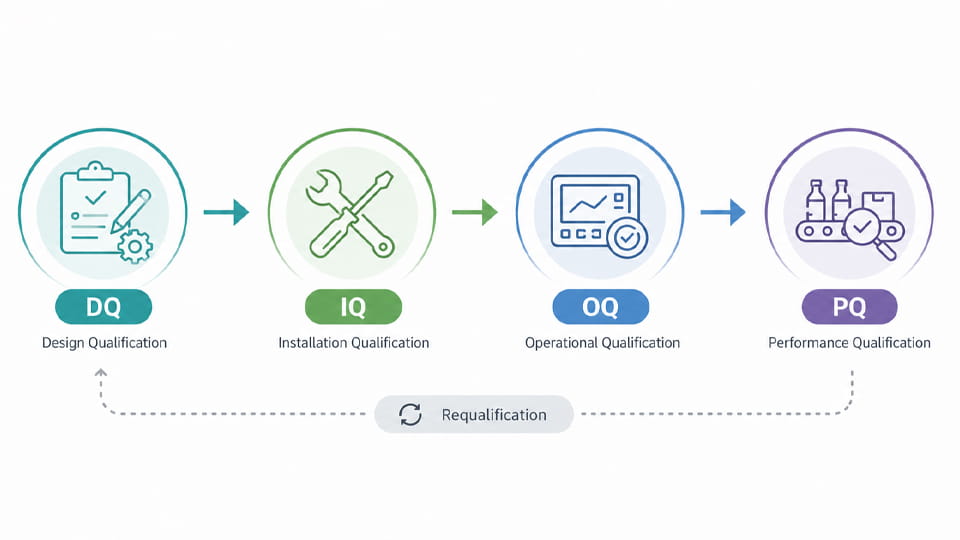
Η επικύρωση της συσκευασίας ακολουθεί συνήθως τον κύκλο ζωής της πιστοποίησης του εξοπλισμού/διαδικασίας, συχνά περιγράφεται ως DQ/IQ/OQ/PQ. Αυτά τα στάδια διασφαλίζουν ότι μια νέα ή τροποποιημένη γραμμή συσκευασίας πληροί τις απαιτήσεις σε κάθε στάδιο.
Προσόντα Σχεδιασμού (DQ): Πρώιμη φάση όπου ο σχεδιασμός αξιολογείται έναντι του URS (Προδιαγραφές Απαιτήσεων Χρήστη) και τις οδηγίες GMP. Όλες οι πτυχές του σχεδιασμού (λειτουργίες του μηχανήματος, υλικά, καθαριότητα, συμβατότητα με προϊόντα/υλικά συσκευασίας) επανεξετάζονται. Τα έγγραφα περιλαμβάνουν το URS και τις προδιαγραφές σχεδιασμού (Προδιαγραφές λειτουργικού σχεδιασμού FDS, Προδιαγραφές σχεδίασης υλικού/λογισμικού). Συχνά μια εκτίμηση κινδύνου (π.χ.. DFMEA) γίνεται για να προβλεφθούν οι τρόποι αποτυχίας συσκευασίας.
Προσόντα εγκατάστασης (IQ): Επαληθεύει ότι το μηχάνημα/γραμμή έχει εγκατασταθεί σωστά σύμφωνα με τις προδιαγραφές του προμηθευτή. Το IQ περιλαμβάνει λίστα ελέγχου που επαληθεύει τη σωστή τοποθεσία, υπηρεσίες κοινής ωφέλειας (εξουσία, αέρας, νερό), περιβαλλοντικών συνθηκών, και σωστή συναρμολόγηση. Όλα τα εξαρτήματα είναι παρόντα και άθικτα. Ελέγχεται η βαθμονόμηση των συσκευών μέτρησης. Παραδοτέα: Πρωτόκολλα IQ και αναφορά, πιστοποιητικά βαθμονόμησης.
Επιχειρησιακά Προσόντα (OQ): Επαληθεύει ότι το μηχάνημα λειτουργεί όπως προβλέπεται υπό όλες τις καθορισμένες συνθήκες. Κρίσιμες παράμετροι (εύρη ταχύτητας, θερμοκρασίες, πιέσεις, επίπεδα κενού, ροπή, και τα λοιπά.) αμφισβητούνται στις ελάχιστες/μέγιστες ρυθμίσεις ή στη χειρότερη περίπτωση. Οι δοκιμές στο OQ μπορεί να περιλαμβάνουν σφράγιση σε ακραίες ταχύτητες, λειτουργίες αισθητήρα/συναγερμού, αλλαγές ταχύτητας μεταφορέα, ακρίβεια ετικέτας, ακρίβεια αντλίας πλήρωσης. Το πρωτόκολλο OQ καταγράφει ότι κάθε λειτουργική δοκιμή πληροί τα κριτήρια αποδοχής.
Προσόντα Απόδοσης (PQ): Το αποδεικνύει αυτό υπό κανονικές συνθήκες παραγωγής, η σειρά παράγει σταθερά προϊόντα που πληρούν τις προδιαγραφές ποιότητας. Το PQ γίνεται σε πραγματικές ποσότητες/παρτίδες παραγωγής. Περιλαμβάνει τη λειτουργία της γραμμής για καθορισμένο χρόνο ή ποσότητα και τη δειγματοληψία της εξόδου. Τυπικές δραστηριότητες: λειτουργία πολλαπλών χαρτοκιβωτίων με κυψέλη, μπουκάλια ή φακελάκια και διεξαγωγή δοκιμών QC σε δείγματα (Π.χ., ακεραιότητα κλεισίματος δοχείου (CCIT), ελέγχους βάρους, οπτική επιθεώρηση ελαττωμάτων, αντοχή σφράγισης). Το PQ δείχνει ότι η γραμμή μπορεί να λειτουργεί συνεχώς διατηρώντας παράλληλα την ποιότητα του προϊόντος.
Ο παρακάτω πίνακας συνοψίζει τα στάδια DQ–IQ–OQ–PQ:
Στάδιο
Σκοπός
Βασικά Έγγραφα
Παράδειγμα Δραστηριοτήτων/Τεστ
Προσόντα Σχεδιασμού (DQ)
Επαληθεύστε ότι ο σχεδιασμός του συστήματος συσκευασίας πληροί τις URS/GMP
Εξασφαλίστε σταθερή ποιότητα κατά τη διάρκεια της παραγωγής
Πρωτόκολλο PQ, αρχεία παρτίδας, κριτήρια έκδοσης
Η παραγωγή τρέχει; δοκιμή δείγματος (CCIT, γεμίστε το βάρος, οπτική επιθεώρηση)
Όπως δείχνει το διάγραμμα, Η επικύρωση συσκευασίας είναι μια διαδικασία κύκλου ζωής από το σχεδιασμό έως την απόδοση. Σημειώστε ότι επανεπιλογή μπορεί να χρειαστεί μετά από σημαντικές αλλαγές ή περιοδικά.
Βασικές δοκιμές στην επικύρωση συσκευασίας
Κατά την επικύρωση της συσκευασίας εκτελούνται συνήθως αρκετές εξειδικευμένες δοκιμές:
Δοκιμή ακεραιότητας κλεισίματος δοχείων (CCIT)
Το CCIT είναι απαραίτητο για στείρα και ακόμη και μη αποστειρωμένα προϊόντα. Αξιολογεί εάν το σύστημα κλεισίματος δοχείων (π.χ.. φιαλίδιο+πώμα+πώμα, αμπούλα, σφραγίδα φυσαλίδων) σχηματίζει ένα τέλειο εμπόδιο. Οι μέθοδοι περιλαμβάνουν αποσύνθεση υπό κενό, αποσύνθεση πίεσης, εισροή βαφής, ή μικροβιακή πρόκληση. Όπως εξηγεί μια πηγή του κλάδου, «Δοκιμή ακεραιότητας κλεισίματος κοντέινερ (CCIT) είναι μια ανάλυση που αξιολογεί την επάρκεια των συστημάτων κλεισίματος δοχείων για τη διατήρηση ενός αποστειρωμένου φραγμού έναντι πιθανών ρύπων.». Κανονιστικά έγγραφα (USP <1207>, FDA, Παράρτημα EMA 1) τονίστε τη δοκιμή της ακεραιότητας κλεισίματος για να διασφαλίσετε ότι δεν υπάρχουν διαρροές ή παραβιάσεις. Για παράδειγμα, USP <1207> παρέχει οδηγίες για την επιλογή μεθόδων δοκιμής διαρροής για την πιστοποίηση σφραγισμένων συσκευασιών.
Υλικά συσκευασίας (πλαστικά είδη, γαλότσες, μελάνια, κόλλες) δεν πρέπει να αλληλεπιδρά δυσμενώς με το φαρμακευτικό προϊόν. Εκχυλίσιμα και εκπλυόμενα μελέτες προσομοιώνουν τη μακροχρόνια επαφή: Τα εκχυλίσιμα είναι χημικά που απομακρύνονται από τη συσκευασία υπό σκληρές συνθήκες, και εκπλυσίματα είναι εκείνα που πραγματικά μεταναστεύουν στο προϊόν υπό κανονικές συνθήκες. Αυτές οι δοκιμές διασφαλίζουν ότι η συσκευασία δεν εισάγει τοξικές ακαθαρσίες ή ακαθαρσίες που επηρεάζουν τη σταθερότητα. Φαρμακευτική και FDA καθοδήγηση (π.χ.. USP <661>, Q3E) περιγράψτε τη δοκιμή E/L για συστήματα κλεισίματος εμπορευματοκιβωτίων. Στην πράξη, κάποιος ελέγχει ότι το πολυμερές, επιστρώσεις, και τα υλικά ετικέτας πληρούν τα φαρμακοποιητικά πρότυπα (π.χ.. Τύπος γυαλιού USP, Προδιαγραφές κλεισίματος από καουτσούκ ISO). Ο ΠΟΥ σημειώνει ότι τα πρότυπα φαρμακοποιίας για το κλείσιμο (σαν λαστιχένια πώματα) εκτάριο «Ελάχιστες απαιτήσεις» και δίνει έμφαση στις μελέτες σταθερότητας για την απόδειξη της καταλληλότητας.
Δοκιμή σταθερότητας στη συσκευασία
Σύμφωνα με το ICH Q1A, μελέτες σταθερότητας πρέπει να γίνει στο φαρμακευτικό προϊόν στην τελική του διαμόρφωση συσκευασίας. Κατά την επικύρωση, αξιολογείται ο αντίκτυπος της συσκευασίας στη σταθερότητα: για παράδειγμα, η τελική συσκευασία υπόκειται σε επιταχυνόμενη γήρανση (υψηλή θερμοκρασία/υγρασία) και συνθήκες σε πραγματικό χρόνο για να μην υπάρχει υποβάθμιση (π.χ.. εισροή υγρασίας σε συσκευασίες blister, διείσδυση οξυγόνου σε φιάλες). Δοκιμασίες που δείχνουν σταθερότητα (χημική και μικροβιακή) εκτελούνται. Συσκευασία που δεν προστατεύει το προϊόν υπό πίεση ακυρώνει τους ισχυρισμούς για τη διάρκεια ζωής. Ετσι, Η επικύρωση περιλαμβάνει την επιβεβαίωση ότι η επιλεγμένη συσκευασία πληροί τις απαιτήσεις διάρκειας ζωής (αυτό επικαλύπτεται με τα ρυθμιστικά πρωτόκολλα σταθερότητας).
Δοκιμές μεταφοράς και διανομής
Τριτογενής συσκευασία οι δοκιμές προσομοιώνουν τις πραγματικές συνθήκες αποστολής. Οι τυπικές δοκιμές περιλαμβάνουν δοκιμές ύψους πτώσης, δόνηση (προσομοίωση φορτηγού/σιδηροδρόμου), συμπίεση (βάρος στοίβαξης), και την ανακύκλωση της θερμοκρασίας (ειδικά για κρύα αλυσίδα). Για παράδειγμα, ASTM D4169 (για συσκευασμένα προϊόντα) ή πρωτόκολλα ISTA μπορούν να χρησιμοποιηθούν. Ένα ισχυρό σχέδιο επικύρωσης συσκευασίας επαληθεύει ότι τα χαρτοκιβώτια, θήκες και κιβώτια προστατεύουν τις πρωτεύουσες συσκευασίες κατά το χειρισμό: επαλήθευση ότι δεν υπάρχει θραύση, ξεφλούδισμα ετικέτας, ή ζημία υγρασίας συμβαίνει υπό συνθήκες διανομής. Για κρύα αλυσίδα, Η χαρτογράφηση θερμοκρασίας και οι επικυρωμένοι μονωμένοι αποστολείς ελέγχονται για τη διατήρηση των απαιτούμενων θερμοκρασιακών περιοχών κατά τη διάρκεια της μεταφοράς.
Κανονιστικά πρότυπα και κατευθυντήριες γραμμές
Η επικύρωση της φαρμακευτικής συσκευασίας πρέπει να ανταποκρίνεται σε πολλαπλές ρυθμιστικές προσδοκίες:
Κανονισμοί cGMP: Στις Η.Π.Α, του FDA 21 Μέρος CFR 211 (υποτμήμα J) διέπει τα δοχεία και τα πώματα. Τμήμα 211.94(διαφήμιση) διευκρινίζει ότι οι περιέκτες/τα πώματα δεν μπορούν να αλλάξουν την ποιότητα του φαρμάκου και πρέπει να προστατεύουν από προβλέψιμη μόλυνση.
GMP της ΕΕ: Ευρωπαϊκές κατευθυντήριες γραμμές (EudraLex Vol. 4) απαιτούν αυτό «Τα εμπορευματοκιβώτια θα πρέπει να κλείνουν με κατάλληλα επικυρωμένες μεθόδους» (Παράρτημα 1) και ότι οι διαδικασίες συσκευασίας ακολουθούν την GMP (Παράρτημα 15 κατά την επικύρωση). Παράρτημα GMP της ΕΕ 11 επιβάλλει την επικύρωση του ηλεκτρονικού συστήματος (συμπεριλαμβανομένων γραμμών συσκευασίας με ηλεκτρονικά χειριστήρια).
ΠΟΙΟΣ GMP: Σειρά Τεχνικών Αναφορών του ΠΟΥ 902 (Παράρτημα 9) δηλώνει ρητά ότι ο εξοπλισμός συσκευασίας χρειάζεται επικύρωση όπως κάθε άλλο στάδιο επεξεργασίας. Ο ΠΟΥ παρέχει επίσης καθοδήγηση σχετικά με την ακεραιότητα του πακέτου (παρόμοια με EU/ICH).
Κατευθυντήριες γραμμές ICH: Αν και ICH (Ε7, Ε8, Ε9, Q10) δεν έχετε συγκεκριμένο έγγραφο επικύρωσης συσκευασίας, επιβάλλουν τη διαχείριση κινδύνων (Ε9) και ποιότητα ανά σχέδιο (Q8/Q10) αρχές που ισχύουν. Για παράδειγμα, αξιολόγηση κινδύνου (I Q9) πρέπει να καλύπτει χαρακτηριστικά συσκευασίας (τύπος κλεισίματος, έλεγχος ετικέτας) που επηρεάζουν τα CQA προϊόντων.
Πρότυπα: Για αποστειρωμένα προϊόντα, ISO 11607 (για τελικώς αποστειρωμένη συσκευασία ιατροτεχνολογικών προϊόντων) χρησιμοποιείται συχνά κατ' αναλογία; Μέρος 2 του ISO 11607 καθορίζει τις απαιτήσεις επικύρωσης για τις διαδικασίες διαμόρφωσης/σφράγισης, που σχετίζεται με παρεντερικές συσκευασίες ή αμπούλες φαρμάκων με κυψέλες. Φαρμακοποιίες (USP, Ph. Eur.) περιέχει επίσης κεφάλαια δοκιμής συσκευασίας (π.χ.. USP <381> για πώματα από καουτσούκ, <1207> για έλεγχο διαρροής).
Συνοπτικά, οποιαδήποτε γραμμή συσκευασίας πρέπει να συμμορφώνεται με τα εθνικά πρότυπα φαρμακοποιίας και τα περιφερειακά πρότυπα GMP. Οι λίστες ελέγχου συμμόρφωσης συνήθως αναφέρουν τον FDA, GMP της ΕΕ, ΠΟΥ και σχετικά πρότυπα ISO, και συχνά ζητούν πλήρως τεκμηριωμένα SOP και γενικά σχέδια επικύρωσης που καλύπτουν τη συσκευασία.
Κοινές προκλήσεις στην επικύρωση συσκευασίας
Η επικύρωση της συσκευασίας θέτει μοναδικές προκλήσεις σε σύγκριση με τις διαδικασίες παραγωγής:
Τύπος δεδομένων και δειγματοληψία: Η επιτυχία της γραμμής συσκευασίας συχνά καθορίζεται από διακριτά αποτελέσματα (π.χ.. περάσω/αποτυχία για σφραγίδα, σχίσιμο) παρά συνεχείς μετρήσεις. Όπως σημειώνει ένας ειδικός, «Το είδος των δεδομένων που λαμβάνονται… δημιουργεί μια σημαντική πρόκληση. Η επιτυχία ή η αποτυχία συχνά καθορίζεται από ελαττώματα (κλάματα, τρύπες, μουτζούρες, ή σφραγίδες που διαρρέουν)… Αυτή η έλλειψη μετρήσιμων (μεταβλητός) Τα δεδομένα απαιτούν συχνά πολύ μεγάλα μεγέθη δειγμάτων για να επικυρωθεί στατιστικά μια διαδικασία συσκευασίας.». Με άλλα λόγια, μπορεί να χρειαστείτε πολλά δείγματα για να αποδείξετε την αξιοπιστία.
Ποικιλία Τεχνολογίας: Υπάρχουν πολλές τεχνολογίες συσκευασίας (φουσκάλες, χαρτοκιβώτια, ετικετοποιητές, συσκευαστές θήκης, και τα λοιπά.) από διαφορετικούς προμηθευτές. Το καθένα έχει διαφορετικά προφίλ κινδύνου, καθιστώντας αδύνατο ένα σχέδιο επικύρωσης ενός μεγέθους.
Αλλαγή ελέγχου: Οι γραμμές συσκευασίας εκτελούν συχνά πολλούς τύπους προϊόντων (δισκία, υγρά, σκόνες) και μεγέθη συσκευασίας στον ίδιο εξοπλισμό (χρησιμοποιώντας αλλαγή εξαρτημάτων ή μορφών). Κάθε αλλαγή ενδέχεται να απαιτεί εκ νέου επικύρωση ή αγκύρωση στο σχέδιο επικύρωσης. Διαχείριση αυτού (ο μήτρα επικύρωσης) μπορεί να είναι πολύπλοκη.
Περιβαλλοντικοί έλεγχοι: Κάποια συσκευασία (π.χ.. συσκευασία blister ευαίσθητων στην υγρασία φαρμάκων) απαιτεί ελεγχόμενη υγρασία ή αδρανή ατμόσφαιρα. Η επικύρωση αυτών των στοιχείων ελέγχου προσθέτει πολυπλοκότητα.
Ενοποίηση με τη διαδικασία Upstream: Η επικύρωση της συσκευασίας εξαρτάται από τη συνέπεια ανάντη. Εάν οι κόκκοι του φαρμάκου ποικίλλουν σε μέγεθος, μπορεί να επηρεαστεί η αλλαγή της μηχανής συσκευασίας (π.χ.. γεμίστε μαρμελάδα). Αυτή η αλληλεξάρτηση μπορεί να περιπλέξει την ανάλυση της βασικής αιτίας των αστοχιών συσκευασίας.
Serialization/Tracking: Σύγχρονοι κανονισμοί (π.χ.. DSCSA, ΕΕ αφθώδης πυρετός) απαιτούν σειριοποίηση και ιχνηλασιμότητα. Διασφάλιση της σωστής παρακολούθησης των αυτοματοποιημένων γραμμών κάθε μονάδας (και επικύρωση αυτής της συλλογής δεδομένων) προσθέτει ένα επιπλέον επίπεδο προσόντων (επικύρωση λογισμικού, δοκιμές σαρωτή γραμμωτού κώδικα, ελέγχους βάσης δεδομένων).
Κανονιστική ασάφεια: Παραδοξώς, υπάρχει περιορισμένη ρητή καθοδήγηση του FDA/EMA αποκλειστικά για την «επικύρωση συσκευασίας,Έτσι, οι εταιρείες πρέπει συχνά να ερμηνεύουν τις γενικές οδηγίες επικύρωσης GMP και διαδικασίας για τη συσκευασία. Αυτό μπορεί να προκαλέσει αβεβαιότητα σχετικά με το ακριβές πεδίο εφαρμογής ή τις απαραίτητες δοκιμές.
Παρά αυτές τις προκλήσεις, η βασική αρχή παραμένει: αντιμετωπίζετε τη συσκευασία όπως κάθε άλλη κρίσιμη διαδικασία, με ενδελεχή πιστοποίηση και ισχυρούς ελέγχους QC. Όπως καταλήγει το έγγραφο του ISPE, επικύρωση συσκευασίας "διαφέρω(μικρό) ελάχιστα από την επικύρωση των διαδικασιών που χρησιμοποιούνται για την παρασκευή φαρμάκων»..
Βέλτιστες πρακτικές για την επικύρωση φαρμακευτικής συσκευασίας
Για να ξεπεραστούν οι προκλήσεις και να διασφαλιστεί η επιτυχής επικύρωση, ακολουθήστε αυτές τις βέλτιστες πρακτικές:
Πρώιμη Εκτίμηση Κινδύνου: Χρησιμοποιήστε τη Διαχείριση Κινδύνων Ποιότητας (I Q9) από τη φάση του σχεδιασμού. Προσδιορίστε κρίσιμα χαρακτηριστικά συσκευασίας (π.χ.. στειρότητα, παραποίηση αποδεικτικών στοιχείων, προστασία από το φως) και ιεραρχήστε τις δοκιμές ανάλογα. Λειτουργία αποτυχίας & Ανάλυση Επιπτώσεων (FMEA) συνιστάται κατά τη διάρκεια του DQ για τον προγραμματισμό του εύρους επικύρωσης.
Προδιαγραφές Απαιτήσεων Χρήστη (URS): Τεκμηριώστε με σαφήνεια όλες τις απαιτήσεις εκ των προτέρων: παραγωγική ικανότητα, μορφές συσκευασίας, σημεία ένταξης (π.χ.. σύνδεση μιας μηχανής κυψελών με ένα χαρτόνι), περιβαλλοντικών συνθηκών, απαιτήσεις καθαρισμού. Ένα καλά καθορισμένο URS διατηρεί την επικύρωση σε καλό δρόμο.
Τυπικές Λειτουργικές Διαδικασίες (Κοφτερός): Διατηρήστε λεπτομερείς SOP για τη λειτουργία του εξοπλισμού, καθάρισμα, μετάβαση, και συντήρηση. Η επικύρωση θα πρέπει να αναφέρεται σε αυτά τα SOP για να διασφαλιστεί η συνεπής χρήση.
Αυτοματοποιημένη επιθεώρηση και έλεγχοι: Ενσωματώστε ελέγχους ποιότητας σε σειρά (π.χ.. συστήματα όρασης για επιθεώρηση εκτύπωσης/ετικέτας, σταθμοί ελέγχου, σαρωτές γραμμωτού κώδικα, ανιχνευτές διαρροών). Αυτά δεν είναι μόνο εργαλεία QA αλλά και μέρος της επικύρωσης με τον εντοπισμό ελαττωμάτων σε πραγματικό χρόνο.
Ολοκληρωμένη Τεκμηρίωση: Προετοιμάστε ένα γενικό σχέδιο επικύρωσης που περιγράφει τη στρατηγική, και να εξασφαλίσει όλα τα πρωτόκολλα πιστοποίησης (IR/WH/PQ) έχουν σαφή κριτήρια αποδοχής. Διατηρήστε λεπτομερή αρχεία καταγραφής όλων των εκτελέσεων, αποκλίσεις, και ξαναδοκιμάζει. Χρησιμοποιήστε λίστες ελέγχου για να βεβαιωθείτε ότι τίποτα δεν παραβλέπεται.
Εκπαίδευση και Προσωπικό: Οι χειριστές και το προσωπικό QC πρέπει να είναι εκπαιδευμένοι τόσο στον εξοπλισμό όσο και στις διαδικασίες επικύρωσης. Μόνο εξειδικευμένο προσωπικό θα πρέπει να διεξάγει δοκιμές επικύρωσης και να καταγράφει τα αποτελέσματα.
Λογισμικό και Ηλεκτρονικά Αρχεία: Για μηχανογραφικούς ελέγχους, ακολουθήστε τον FDA 21 CFR Μέρος 11/Παράρτημα GMP 11: επικύρωση λογισμικού, ίχνη ελέγχου, ηλεκτρονικές υπογραφές (εξασφαλίσει ασφάλεια, αντίγραφα ασφαλείας). Ακόμη και οι μη αποστειρωμένες γραμμές συσκευασίας έχουν συχνά PLC/HMI που χρειάζονται επικύρωση.
Σχεδιασμός για επικύρωση: Όποτε είναι δυνατόν, επιλέξτε μηχανήματα με χαρακτηριστικά που απλοποιούν την επικύρωση: π.χ.. σερβομηχανές με ψηφιακά χειριστήρια (για ακριβεια, αναπαραγώγιμες παραμέτρους), υγιεινά κουφώματα από ανοξείδωτο χάλυβα (για εύκολο καθάρισμα), εξαρτήματα που αλλάζουν εύκολα (για μείωση της προσπάθειας καθαρισμού μεταξύ των μορφών), και αρθρωτό σχεδιασμό (για να περιορίσετε τον αριθμό των διαμορφώσεων που απαιτούν δοκιμή).
Επαλήθευση σε εξέλιξη: Η επικύρωση της συσκευασίας δεν είναι "μια φορά και τελειωμένη". Εφαρμόστε ενδείξεις περιοδικής επανεξέτασης ή επανεπικύρωσης (π.χ.. μετά από μεγάλη συντήρηση, αναβαθμίσεις εξοπλισμού, ή σημαντική απόκλιση διαδικασίας). Χρησιμοποιήστε στατιστικό έλεγχο διαδικασίας (SPC) σε βασικές μετρήσεις (διακύμανση βάρους γεμίσματος, ποσοστό ελαττώματος) για να πιάσετε νωρίς τις τάσεις.
Ακεραιότητα δεδομένων: Εφαρμόστε τις αρχές ALCOA+: όλα τα δεδομένα επικύρωσης (αρχεία δοκιμών, Αναφορές QC, βαθμονομήσεις) πρέπει να αποδοθεί, ευανάγνωστος, σύγχρονος, πρωτότυπο, και ακριβής. Χρησιμοποιήστε δεμένα σημειωματάρια ή επικυρωμένα ηλεκτρονικά συστήματα.
Με την ενσωμάτωση της σκέψης επικύρωσης σε κάθε στάδιο – από το σχεδιασμό έως την καθημερινή λειτουργία – οι κατασκευαστές μπορούν να διασφαλίσουν ότι οι γραμμές συσκευασίας παρέχουν προϊόντα που ανταποκρίνονται στις προσδοκίες ποιότητας και συμμόρφωσης.
Ο ρόλος των μηχανών συσκευασίας στην επικύρωση
Η επιλογή και ο σχεδιασμός του εξοπλισμού συσκευασίας επηρεάζουν σε μεγάλο βαθμό την επιτυχία της επικύρωσης. Οι μηχανές συσκευασίας υψηλής ποιότητας έχουν κατασκευαστεί για να πληρούν τις απαιτήσεις GMP και να υποστηρίζουν την εύκολη πιστοποίηση. Για παράδειγμα, Jinlu Packing's τα αυτοματοποιημένα μηχανήματα κατασκευάζονται με χαρακτηριστικά που απλοποιούν την επικύρωση:
Ακρίβεια και συνέπεια: Jinlu's μηχανές φυσαλίδων, Τα χαρτοκιβώτια και τα πληρωτικά χρησιμοποιούν σερβοκινητήρες και μηχανικούς ακριβείς μηχανισμούς για να εξασφαλίσουν σταθερή πίεση θερμικής σφράγισης, γεμίζουν τόμους, και ευρετηρίαση. Αυτή η επαναληψιμότητα είναι ζωτικής σημασίας για την επιτυχία των δοκιμών OQ και PQ (π.χ.. η σερβοκατευθυνόμενη συσκευή τροφοδοσίας παρέχει "ακριβής τοποθέτηση" στη γραμμή blister τους).
Υγιεινή Σχεδιασμός: Τα υλικά και οι επιφάνειες είναι από ανοξείδωτο χάλυβα ή πλαστικά συμβατά με την FDA, σχεδιασμένο για εύκολο καθάρισμα. Λείος, οι κεκλιμένες επιφάνειες εμποδίζουν τις παγίδες σκόνης. Αυτό υποστηρίζει τη συμμόρφωση με GMP και απλοποιεί την επικύρωση καθαρισμού.
Προσαρμοστικότητα σε Μορφές: Το Jinlu προσφέρει προσαρμοσμένους τροφοδότες και οδηγούς για διαφορετικούς τύπους συσκευασιών (βλέπω Προσαρμοσμένοι τροφοδότες στις σελίδες προϊόντων). Η ύπαρξη των σωστών εργαλείων μειώνει τις διακυμάνσεις και επιταχύνει την αλλαγή μορφής, που μειώνει τις ανάγκες επανειδίκευσης κατά την εναλλαγή μορφών.
Ολοκληρωμένα χειριστήρια: Οι σύγχρονες γραμμές Jinlu διαθέτουν χειριστήρια PLC/HMI που μπορούν να δημιουργήσουν ηλεκτρονικά αρχεία παρτίδας. Για παράδειγμα, η μηχανή πλήρωσης υγρών έχει ένα AI Siemens PLC/HMI για απλο, ανιχνεύσιμη λειτουργία. Τέτοιοι ψηφιακοί έλεγχοι υποστηρίζουν την καταγραφή δεδομένων (σύμφωνα με 21 CFR Μέρος 11/Παράρτημα 11) – ζωτικής σημασίας για την επικύρωση ότι τα σημεία ρύθμισης και οι συναγερμοί λειτουργούν όπως έχουν σχεδιαστεί.
Τεκμηρίωση επικύρωσης: Το Jinlu παρέχει πλήρη τεκμηρίωση (Φύλλα δεδομένων, εγχειρίδια, και τα λοιπά.). Για παράδειγμα, λίστα σελίδων προϊόντων τους “Πλήρη σειρά τεχνικών εγγράφων” και δίνουν έμφαση στην παροχή λεπτομερούς τεκμηρίωσης σχεδιασμού και δοκιμών. Ένας προμηθευτής που είναι πρόθυμος να παράσχει δοκιμή αποδοχής εργοστασίου (ΛΙΠΟΣ) πρωτόκολλα ή κιτ IOQ διευκολύνουν σημαντικά το βάρος επικύρωσης του χρήστη.
Πιστοποιήσεις Ποιότητας: Jinlu μεταφέρουν μηχανές CE, cGMP και άλλες πιστοποιήσεις, δηλώνοντας ότι πληρούν ορισμένα πρότυπα ποιότητας και ασφάλειας (δείτε το λογότυπο cGMP στις εικόνες προδιαγραφών του προϊόντος). Η χρήση πιστοποιημένου εξοπλισμού μπορεί να βελτιστοποιήσει τη ρυθμιστική αναθεώρηση.
Στην πράξη, μπορεί να περιλαμβάνει μια επικυρωμένη γραμμή συσκευασίας: ένα Τζινλού μηχάνημα συσκευασίας φουσκάλου συνδέεται με α μηχάνημα χαρτοκιβωτίου και μετρώντας/γεμίζοντας γραμμές. Κάθε εξοπλισμός πρέπει να είναι κατάλληλος (IR/WH/PQ). Τα συστήματα της Jinlu έχουν σχεδιαστεί για να συνεργάζονται απρόσκοπτα (π.χ.. “Υψηλά αυτοματοποιημένη σειρά χαρτοκιβωτίων με κυψέλες” μέχρι και 320 χαρτοκιβώτια/λεπτό), μείωση των προβλημάτων ολοκλήρωσης κατά την επικύρωση. Προσφέρουμε επίσης περιπτωσιολογικές μελέτες (π.χ.. ένα πλήρες γραμμή καταμέτρησης και εμφιάλωσης, ή ένα αυτόματο χαρτοκιβώτιο & γραμμή επισήμανσης) που παρουσιάζουν επικυρωμένες λύσεις από άκρο σε άκρο.
Μηχάνημα συσκευασίας κυλίνδρων DPH-270Max
Με τη συνεργασία με την Jinlu ή παρόμοιους κατασκευαστές, οι εταιρείες επωφελούνται από εξοπλισμό δηλαδή "Συμβατό με cGMP", υποστηρίζει έναν πλήρη κύκλο ζωής επικύρωσης, και συνοδεύεται από υποστήριξη μετά την πώληση (θέση σε λειτουργία, εκπαίδευση) για να διασφαλίσετε ότι η γραμμή παραμένει επικυρωμένη.
Σύναψη
Επικύρωση συσκευασίας είναι απαραίτητη για την ποιότητα και τη συμμόρφωση του φαρμάκου. Αντιμετωπίζοντας τις εργασίες συσκευασίας τόσο αυστηρά όσο και τα βασικά βήματα κατασκευής, οι εταιρείες διασφαλίζουν ότι τα προϊόντα τους φτάνουν στους ασθενείς με ασφάλεια. Η διαδικασία καλύπτει τον ορισμό (URS, αξιολόγηση κινδύνου), προσόν (DQ/IQ/OQ/PQ), δοκιμασία (CCIT, σταθερότητα, μεταφορά), και συνεχής παρακολούθηση. Διέπεται από κανονισμούς GMP (FDA, EMA, ΠΟΥ) και τα βιομηχανικά πρότυπα.
Ο σύγχρονος αυτοματοποιημένος εξοπλισμός συσκευασίας – όπως οι μηχανές της Jinlu Packing – διαδραματίζει βασικό ρόλο στην επικύρωση. Σχεδιασμένο για ακρίβεια, υγιεινής και ηλεκτρονικής ιχνηλασιμότητας, βοηθούν τους κατασκευαστές να πληρούν αποτελεσματικά τα κριτήρια επικύρωσης. Κατά την επιλογή γραμμών συσκευασίας, εξετάστε τους προμηθευτές που παρέχουν πλήρη τεκμηρίωση επικύρωσης και υποστήριξη.
Τελικά, ενδελεχής επικύρωση συσκευασίας είναι «η τελική διασφάλιση για την ποιότητα των προϊόντων και την ασφάλεια των ασθενών», ευθυγράμμιση τόσο με τις ρυθμιστικές απαιτήσεις όσο και με τους επιχειρηματικούς στόχους.
Συχνές ερωτήσεις σχετικά με την επικύρωση συσκευασίας στη φαρμακευτική βιομηχανία
Ποια είναι η διαφορά μεταξύ της επικύρωσης συσκευασίας και της επικύρωσης διαδικασίας?
Η επικύρωση διαδικασίας αναφέρεται συνήθως στα βήματα που παράγουν τη φαρμακευτική ουσία ή το χύμα φαρμακευτικό προϊόν (π.χ.. μίξη, κοκκοποίηση, συμπίεση). Η επικύρωση συσκευασίας εφαρμόζει συγκεκριμένα τις αρχές επικύρωσης στις εργασίες συσκευασίας (σφράγιση, τιτλοφόρηση, γέμιση χαρτοκιβωτίου, και τα λοιπά.). Ωστόσο, και τα δύο ακολουθούν τις ίδιες απαιτήσεις κύκλου ζωής DQ/IQ/OQ/PQ και GMP. Ουσιαστικά, Η επικύρωση συσκευασίας διασφαλίζει τη διαδικασία συσκευασίας (όχι μόνο τη διαδικασία παραγωγής) ικανοποιεί σταθερά τις απαιτήσεις ποιότητας.
Ποιες δοκιμές απαιτούνται για την επικύρωση της φαρμακευτικής συσκευασίας?
Οι βασικές δοκιμές περιλαμβάνουν την ακεραιότητα του κλεισίματος του δοχείου (CCIT) για επαλήθευση σφραγίδων, συμβατότητα υλικού (Μελέτες εξαγώγιμων/εκπλυθέντων), δοκιμές σταθερότητας (φάρμακο στην τελική συσκευασία υπό πίεση), και δοκιμές διανομής (σοκ, δόνηση, θερμοκρασία για τη μεταφορά). Πρόσθετοι έλεγχοι καλύπτουν την ακρίβεια της ετικέτας, συστήματα οπτικής επιθεώρησης, βάρος / έλεγχος ζύγισης, και τυχόν δοκιμές για συγκεκριμένες συμβάσεις (π.χ.. αντοχή αποστειρωμένου φιλμ). Όλες οι δοκιμές θα πρέπει να έχουν προκαθορισμένα κριτήρια αποδοχής και να τεκμηριώνονται.
Πόσος χρόνος διαρκεί συνήθως η επικύρωση της συσκευασίας?
Το χρονοδιάγραμμα εξαρτάται από την πολυπλοκότητα (αριθμός μορφών, εξοπλισμός, τοποθεσίες). Ένα IQ/OQ/PQ μιας γραμμής μπορεί να κυμαίνεται από μερικές εβδομάδες έως μερικούς μήνες. Παράγοντες: τον αριθμό των δοκιμών παραμέτρων OQ, απαιτούμενα μεγέθη δείγματος σε PQ, και χρόνος για την εκτέλεση της δοκιμής (π.χ.. Η σταθερότητα σε επιταχυνόμενες συνθήκες διαρκεί εβδομάδες). Σχεδιασμός παράλληλων δραστηριοτήτων (όπως η προετοιμασία των πρωτοκόλλων κατά την άφιξη του εξοπλισμού) μπορεί να εξοικονομήσει χρόνο.
Ποια έγγραφα διέπουν την επικύρωση της συσκευασίας?
Οι κύριες αναφορές είναι οι κανονισμοί GMP: 21 Μέρος CFR 211 (FDA των ΗΠΑ), EudraLex Vol. 4 (GMP της ΕΕ, Παράρτημα 1 και 15), και παράρτημα ΠΟΥ GMP 9. Το ICH Q7/Q10 παρέχει γενικές αρχές επικύρωσης, Το ICH Q9 καλύπτει τη διαχείριση κινδύνου για αποφάσεις συσκευασίας, και ISO 11607-2 ισχύει για την επικύρωση της διαδικασίας αποστειρωμένων συσκευασιών. Φαρμακευτικά πρότυπα (USP, Ph. Eur.) και τοπικές οδηγίες (π.χ.. Κινεζικό NMPA, Πρόγραμμα Ινδίας Μ) επηρεάζουν επίσης τις απαιτήσεις συσκευασίας. Να ευθυγραμμίζεστε πάντα με τους κανονισμούς της αγοράς-στόχου.
Πώς το Jinlu Packing υποστηρίζει την επικύρωση συσκευασίας?
Οι μηχανές συσκευασίας της Jinlu είναι κατασκευασμένες για GMP. Παρέχουν έγγραφα σχεδιασμού (URS, FDS), πιστοποιητικά βαθμονόμησης, και υποστήριξη OQ/PQ. Ο εξοπλισμός τους (μηχανές φυσαλίδων, χαρτοκιβώτια, γραμμές πλήρωσης) διαθέτει ακριβή έλεγχο σερβομηχανισμού και σχεδιασμό υγιεινής για να πληροί τις προδιαγραφές επικύρωσης. Όπως φαίνεται στον ιστότοπο του Jinlu, τα μηχανήματα φέρουν λογότυπα cGMP/CE και συνοδεύονται από σετ τεχνικής τεκμηρίωσης. Το Jinlu προσφέρει επίσης υποστήριξη εγκατάστασης και επικύρωσης, προσαρμοσμένες λύσεις, και εκπαίδευση για να βοηθήσει στην εφαρμογή επικυρωμένων γραμμών συσκευασίας. Για περισσότερες πληροφορίες, δείτε τις σελίδες Jinlu's Blister Packing Machine ή Cartoning Machine.
Πέτι Φου, Ιδρυτής της Jinlupacking, φέρνει πάνω 20 χρόνια εμπειρίας στον τομέα των φαρμακευτικών μηχανημάτων. Υπό την ηγεσία του, Η Jinlu έχει εξελιχθεί σε έναν αξιόπιστο προμηθευτή που ενσωματώνει το σχεδιασμό, παραγωγή, και πωλήσεις. Ο Petty είναι παθιασμένος με το να μοιράζεται τις βαθιές του γνώσεις στον κλάδο για να βοηθήσει τους πελάτες να πλοηγηθούν στην πολυπλοκότητα της συσκευασίας φαρμάκων, εξασφαλίζοντας ότι δεν λαμβάνουν μόνο εξοπλισμό, αλλά μια πραγματική συνεργασία ενιαίας εξυπηρέτησης προσαρμοσμένη στους στόχους παραγωγής τους.