
Απαιτήσεις φαρμακευτικής επισήμανσης ορίστε τις πληροφορίες που πρέπει να εμφανίζονται στη συσκευασία του φαρμάκου για την υποστήριξη της αναγνώρισης του προϊόντος, ασφαλής χρήση, κανονιστική συμμόρφωση, και ιχνηλασιμότητα. Ανάλογα με την αγορά και τον τύπο του προϊόντος, μια φαρμακευτική ετικέτα μπορεί να περιλαμβάνει το όνομα του προϊόντος, δραστικό συστατικό(μικρό), δύναμη, δοσολογική μορφή, ποσότητα, αριθμός παρτίδας ή παρτίδας, ημερομηνία λήξης, όροι αποθήκευσης, προειδοποιήσεις, και πληροφορίες για τον κατασκευαστή ή την άδεια κυκλοφορίας. Στις Η.Π.Α, οι απαιτήσεις καθορίζονται μέσω των κανονισμών του FDA όπως π.χ 21 Μέρος CFR 201, ενώ η επισήμανση των φαρμάκων της ΕΕ διέπεται από την ευρωπαϊκή φαρμακευτική νομοθεσία, συμπεριλαμβανομένης της οδηγίας 2001/83/ΕΚ. Οι ακριβείς απαιτήσεις μπορεί να διαφέρουν ανά κατηγορία φαρμάκου, μορφή συσκευασίας, και αγορά-στόχος, έτσι δεν υπάρχει πρότυπο μεμονωμένης ετικέτας που να λειτουργεί παντού.
Για κατασκευαστές φαρμακευτικών προϊόντων και ομάδες συσκευασίας, η συμμόρφωση δεν αφορά μόνο τη δημιουργία του σωστού έργου τέχνης. Πρέπει επίσης να εφαρμόζονται οι εγκεκριμένες πληροφορίες, έντυπος, επιθεωρήθηκε, και ελέγχεται σωστά σε όλη την παραγωγή. Αυτό γίνεται ιδιαίτερα σημαντικό για τις συσκευασίες με κυψέλες, μπουκάλια, χαρτοκιβώτια, και άλλες μορφές όπου ο χώρος είναι περιορισμένος ή πρέπει να προστεθούν μεταβλητά δεδομένα, όπως αριθμοί παρτίδας και ημερομηνίες λήξης κατά τη συσκευασία. Σύγχρονος γραμμές συσκευασίας μπορεί να χρησιμοποιήσει μηχανές σήμανσης, συστήματα κωδικοποίησης παρτίδας, barcode ή αναγνώστες DataMatrix, και συστήματα επιθεώρησης όρασης που βοηθούν στην επαλήθευση της εφαρμογής των σωστών πληροφοριών στο σωστό προϊόν. Σε αυτόν τον οδηγό, θα αναλύσουμε τις βασικές απαιτήσεις επισήμανσης φαρμακευτικών προϊόντων, συγκρίνετε τις κύριες απαιτήσεις του FDA και της ΕΕ, εξετάστε τις ειδικές εκτιμήσεις για διαφορετικές μορφές συσκευασίας, και εξηγήστε πώς ο εξοπλισμός σήμανσης και κωδικοποίησης μπορεί να υποστηρίξει μια πιο αξιόπιστη φαρμακευτική διαδικασία συσκευασίας.
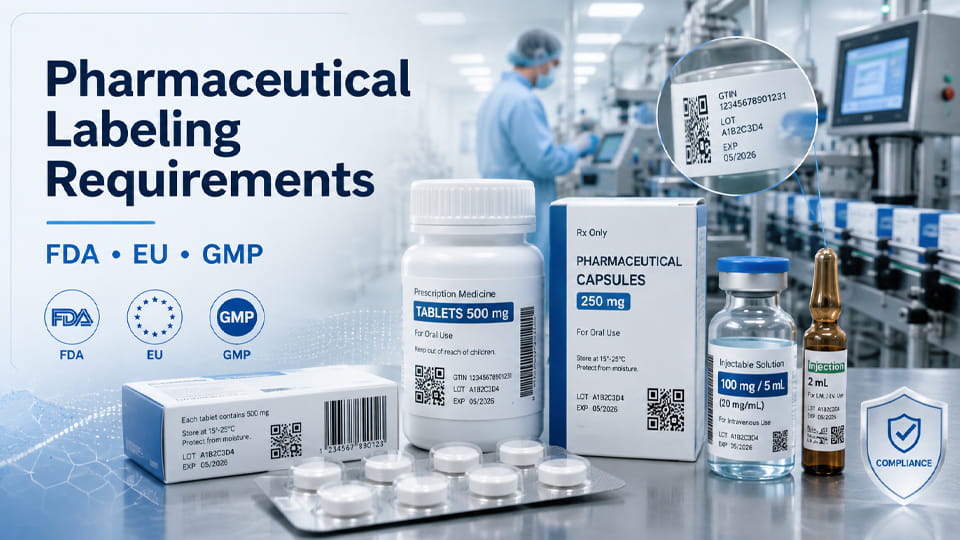
Οι «Απαιτήσεις φαρμακευτικής επισήμανσης» είναι οι κανόνες που διέπουν ποιες πληροφορίες πρέπει να τυπώνονται στη συσκευασία του φαρμάκου. Στις Η.Π.Α, Οδηγίες FDA (και 21 Μέρος CFR 201) ορίστε τις απαιτούμενες δηλώσεις ετικετών και τη μορφή. Για παράδειγμα, Η καθοδήγηση του FDA σημειώνει ότι όλες οι ετικέτες συνταγογραφούμενων φαρμάκων πρέπει να συμμορφώνονται με 21 CFR 201.56(ρε) & 201.57, που καλύπτει το περιεχόμενο και τη μορφή. Με κανονισμό, Η «επισήμανση» των συνταγογραφούμενων φαρμάκων περιλαμβάνει τρία στοιχεία: τις επαγγελματικές πληροφορίες συνταγογράφησης (ένθετο συσκευασίας), τις ετικέτες του χαρτοκιβωτίου και του περιέκτη, και επισήμανση ασθενών. Με πρακτικούς όρους, Οι απαιτήσεις επισήμανσης διασφαλίζουν ότι κάθε συσκευασία προσδιορίζει σαφώς το φάρμακο και τη χρήση του: το εμπορικό σήμα και το γενικό όνομα, δραστικό συστατικό(μικρό), δύναμη, δοσολογική μορφή, ποσότητα, και πρέπει να εμφανίζεται το όνομα/η διεύθυνση του κατασκευαστή, μαζί με πληροφορίες ασφαλείας (προειδοποιήσεις, ενδείξεις) και κωδικούς ιχνηλασιμότητας (σύνολο παραγωγής, λήξη). Αυτοί οι κανόνες προστατεύουν την ασφάλεια των ασθενών και επιτρέπουν ανακλήσεις προϊόντων αν χρειαστεί.
Με άλλα λόγια, Οι απαιτήσεις επισήμανσης θέτουν ελάχιστα πρότυπα για ευανάγνωστες και πλήρεις πληροφορίες σχετικά με τη συσκευασία των φαρμάκων. Στόχος τους είναι να αποτρέψουν τα λάθη της φαρμακευτικής αγωγής και να εξασφαλίσουν ότι ο καθένας (ασθενής, φροντιστή ή επιθεωρητή) μπορεί να επαληθεύσει το προϊόν. Για παράδειγμα, Η FDA αναφέρει ρητά την ημερομηνία λήξης και τον κωδικό παρτίδας ως υποχρεωτικά (ανατρέξτε στο πλαίσιο «Η ετικέτα επίσης σας λέει» παρακάτω), και η νομοθεσία της ΕΕ απαιτεί παρτίδες και λήξη σε χαρτοκιβώτια. Οδηγίες υγειονομικής περίθαλψης (EMA, ΠΟΥ) και τα βιομηχανικά πρότυπα όπως το GS1 προσδιορίζουν περαιτέρω τις μορφές (π.χ.. Barcodes DataMatrix) για την υποστήριξη της παγκόσμιας ιχνηλασιμότητας. Ολικός, Συμμόρφωση σημαίνει ότι οι ετικέτες σας πρέπει να ταιριάζουν με τα πλαίσια ελέγχου στον παρακάτω πίνακα.
| Στοιχείο ετικέτας | Σκοπός |
| Όνομα προϊόντος (μάρκα & γενικός) | Προσδιορίστε το φάρμακο με το όνομα, μειώσει τη σύγχυση. |
| Δραστικό συστατικό(μικρό) | Προσδιορίστε τη σύνθεση και τις περιεκτικότητες του φαρμάκου. |
| Δύναμη (δόση) | Αναφέρετε τη δοσολογία (π.χ.. mg ανά δισκίο/mL). |
| Δοσολογική μορφή (δισκίο, και τα λοιπά.) | Περιγράψτε το σκεύασμα (δισκίο, κάψουλα, υγρό). |
| Καθαρά περιεχόμενα (καταμέτρηση/όγκος) | Εμφάνιση ποσότητας στη συσκευασία (π.χ.. 30 δισκία). |
| Αριθμός παρτίδας/παρτίδας | Ενεργοποιήστε την ιχνηλασιμότητα και ανάκληση εάν χρειάζεται. |
| Λήξη (λήξη) ημερομηνία | Βεβαιωθείτε ότι το φάρμακο χρησιμοποιείται πριν χάσει την ισχύ του. |
| Όνομα κατασκευαστή & διεύθυνση | Προσδιορίστε την πηγή λογοδοσίας. |
| Συνθήκες αποθήκευσης | Οδηγίες για τη θερμοκρασία, φως, υγρότητα. |
| Προειδοποιήσεις/Προσοχή | Προειδοποιήσεις για την ασφάλεια (Π.χ., “Να φυλάσσεται μακριά από παιδιά”). |
| Οδός χορήγησης | Προσδιορίστε τη χρήση (Π.χ., του στόματος, ενέσιμο). |
| Χρήση/Ένδειξη | (Προαιρετικός) Υποδείξτε τι αντιμετωπίζει (esp. OTC). |
| Κανονιστικοί κώδικες (NDC/MA Αρ.) | ΜΑΣ. Αριθμός άδειας κυκλοφορίας NDC ή ΕΕ. |
| Ειδοποίηση προφανής για παραποίηση | (Δήλωση «προφανούς παραβίασης» εάν απαιτείται). |
| Barcode/DataMatrix | Κωδικοποιεί το GTIN, σύνολο παραγωγής, λήξη για σάρωση. |
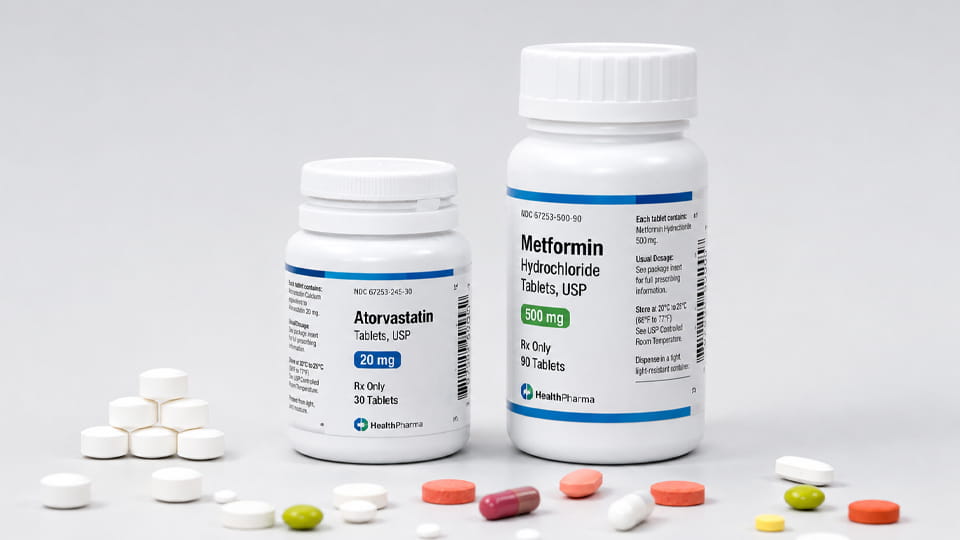
Κάθε στοιχείο έχει έναν ξεκάθαρο λόγο. Για παράδειγμα, το όνομα του προϊόντος και τα συστατικά βοηθούν τους ασθενείς να λάβουν το σωστό φάρμακο; δύναμη, μορφή και οδός εξασφαλίζουν τη σωστή δοσολογία; η αποθήκευση και οι προειδοποιήσεις προστατεύουν την ασφάλεια; Η παρτίδα/παρτίδα και η λήξη παρέχουν ιχνηλασιμότητα; και barcodes (GS1 DataMatrix) αφήστε τα μηχανήματα να σαρώσουν και να επαληθεύσουν το πακέτο. ρυθμιστικές αρχές (FDA, EMA, και τα λοιπά.) απαιτούν ουσιαστικά όλα αυτά τα στοιχεία. Ο παραπάνω πίνακας παραθέτει τα κοινά πεδία και τη λειτουργία τους. Σε όλες τις περιπτώσεις, οι ετικέτες πρέπει να είναι ευανάγνωστες (επαρκές μέγεθος γραμματοσειράς, αντίθεση) και χρησιμοποιήστε τυπικές μορφές (π.χ.. Διάταξη «Drug Facts» του FDA για OTC φάρμακα).
Στις Ηνωμένες Πολιτείες, Κανονισμοί FDA (21 Μέρος CFR 201) και οι οδηγίες περιγράφουν λεπτομερώς το περιεχόμενο της ετικέτας για τα φάρμακα. Συνταγή (Rx) ναρκωτικά: Οι βασικές απαιτήσεις περιλαμβάνουν τα καθιερωμένα (γενικός) όνομα του φαρμάκου (21 CFR 201.50), δοσολογική μορφή, καθαρό περιεχόμενο, και οδηγίες (21 CFR 201.55). Οι ετικέτες πρέπει επίσης να αναγράφουν το όνομα και τη διεύθυνση του κατασκευαστή/συσκευαστή/διανομέα (201.1), τον Εθνικό Κώδικα Φαρμάκων (201.2), και τη δήλωση «Μόνο Rx» εάν ισχύει. Τα κρίσιμα αναγνωριστικά όπως ο αριθμός παρτίδας και η ημερομηνία λήξης διέπονται από 21 CFR 201.17-18. Για παράδειγμα, 201.17 ορίζει τη θέση της ημερομηνίας λήξης στη συσκευασία, και 201.18 απαιτεί έλεγχο (παρτίδα) αριθμός για αναγνώριση. Στην πράξη, Ο FDA επιμένει να εκτυπώνει καθαρά τον αριθμό παρτίδας ή παρτίδας και να λήγει τόσο στο άμεσο δοχείο όσο και στο χαρτοκιβώτιο. Για παράδειγμα, Η καθοδήγηση του FDA για τα «Στοιχεία για τα ναρκωτικά» σημειώνει ρητά ότι η παρτίδα (σύνολο παραγωγής) Ο κωδικός και η ημερομηνία λήξης πρέπει να εμφανίζονται στις ετικέτες OTC, και η ίδια λογική ισχύει και για τα φάρμακα Rx.
OTC φάρμακα (Πίνακας στοιχείων για τα ναρκωτικά): Όλα τα μη συνταγογραφούμενα φάρμακα πρέπει να φέρουν την τυποποιημένη ετικέτα «Στοιχεία φαρμάκων» του FDA για να βοηθήσουν τους καταναλωτές. Αυτός ο πίνακας ακολουθεί μια σταθερή μορφή με ενότητες όπως το Active Ingredient(μικρό), Σκοπός(μικρό), Χρήσεις, Προειδοποιήσεις, Οδηγίες, και Ανενεργά Συστατικά. Στόχος είναι η συνέπεια και η σαφήνεια (την ίδια δομή για αναλγητικά, φάρμακα για την αλλεργία, και τα λοιπά.). Για παράδειγμα, το «Δραστικό Συστατικό(μικρό)Η γραμμή παραθέτει τη θεραπευτική ουσία και τη δύναμη, Το "Purpose" δίνει την κατηγορία του, και "Προειδοποιήσεις/Οδηγίες" παρέχουν οδηγίες χρήσης. Εκτός από αυτές τις ενότητες, κάθε ετικέτα OTC πρέπει να εμφανίζει ημερομηνία λήξης (ή προεπιλεγμένος κανόνας λήξης 3 ετών) και κωδικός παρτίδας, μαζί με το όνομα/διεύθυνση του κατασκευαστή και την καθαρή ποσότητα. Η σελίδα του FDA για τα OTC Drug Facts επιβεβαιώνει: «Η ετικέτα σάς λέει επίσης… την ημερομηνία λήξης … την παρτίδα ή τον κωδικό παρτίδας… Όνομα και διεύθυνση του κατασκευαστή… Καθαρή ποσότητα». Η μη συμπερίληψη αυτών σε μια ετικέτα OTC θα παραβιάζει τους κανόνες επισήμανσης του FDA.
Οι κανονισμοί του FDA απαριθμούν πολλές λεπτομερείς δηλώσεις επισήμανσης. Για παράδειγμα, 21 CFR 201.50-201.56 και 201.100-201.128 ετικέτες καλύμματος δοχείων και ετικέτες χαρτοκιβωτίων. Μερικά κυριότερα σημεία περιλαμβάνουν:
Πέρα από το CFR, Η καθοδήγηση του FDA διευκρινίζει αυτούς τους κανόνες. Ιδιαίτερα, Η FDA ορίζει τώρα την επισήμανση συνταγογραφούμενων φαρμάκων ως τρία μέρη: τις επαγγελματικές πληροφορίες συνταγογράφησης (ένθετο συσκευασίας), τη φυσική ετικέτα στο χαρτοκιβώτιο/περιέκτη, και οποιοδήποτε φυλλάδιο που απευθύνεται στον ασθενή. Η ίδια η ετικέτα του περιέκτη πρέπει να φέρει την καθιερωμένη ονομασία του φαρμάκου, δύναμη, δοσολογική μορφή, δοσολογικές μονάδες, αριθμός παρτίδας, ημερομηνία λήξης, NDC, και όνομα/διεύθυνση επιχείρησης – ουσιαστικά καλύπτει όλα τα πλαίσια ελέγχου στον παραπάνω πίνακα μας. Αυτά διασφαλίζουν ότι τα φαρμακεία διανέμουν το σωστό προϊόν και οι ασθενείς βλέπουν βασικές πληροφορίες ασφάλειας.
Στην Ευρωπαϊκή Ένωση, Οδηγία 2001/83/ΕΚ (όπως τροποποιήθηκε) και σχετικοί κανονισμοί διέπουν την επισήμανση των φαρμάκων. Οι κανόνες είναι σε γενικές γραμμές παρόμοιοι με τις ΗΠΑ αλλά με ορισμένες διαφορές (π.χ.. γλωσσικές απαιτήσεις, στοιχεία άδειας κυκλοφορίας). Αρθρο 54 του 2001/83 καθορίζει τι πρέπει να υπάρχει στην εξωτερική συσκευασία (ή άμεση συσκευασία εάν δεν υπάρχει εξωτερικό κουτί). Πρέπει να εμφανίζει το πλήρες όνομα του προϊόντος, δύναμη, φαρμακευτική μορφή, και οδός χορήγησης. Θα πρέπει να αναφέρει εάν το προϊόν προορίζεται για ενήλικες ή παιδιά, εάν χρειάζεται, και αναφέρετε τυχόν ειδικές προειδοποιήσεις ή προφυλάξεις (π.χ.. θερμοκρασία αποθήκευσης). Κρίσιμα, Αρθρο 54 απαιτεί την ημερομηνία λήξης και τον αριθμό παρτίδας στην εξωτερική συσκευασία, μαζί με τη διεύθυνση του κατόχου της άδειας κυκλοφορίας (MAH) και τον αριθμό άδειας κυκλοφορίας της ΕΕ. Στην πράξη, Αυτό σημαίνει ότι τα χαρτοκιβώτια της ΕΕ πρέπει να φέρουν ουσιαστικά τις ίδιες πληροφορίες με τις ετικέτες των ΗΠΑ: όνομα, συστατικά, δύναμη, ποσότητα, προειδοποιήσεις, λήξη, και παρτίδα, συν την επαφή MAH.
Καθοδήγηση και πρότυπα EMA (Δηλώσεις QRD) ευθυγραμμιστεί με αυτούς τους κανόνες. Για κεντρικά εξουσιοδοτημένα προϊόντα, QRD (Ποιοτικός έλεγχος εγγράφων) τα πρότυπα τυποποιούν τη διατύπωση των βασικών δηλώσεων. Ο EMA ασχολήθηκε επίσης πρόσφατα με τη σύγχρονη τεχνολογία: Επιτρέπει προαιρετικούς κωδικούς QR ή τεχνολογία σάρωσης στις ετικέτες, εάν εγκριθεί. Σήμανση Braille (Άρθρο 56α) απαιτούνται για τους περισσότερους χαρτοκιβώτια φαρμάκων (αναφέροντας το όνομα του προϊόντος, δύναμη, μορφή σε Braille) ως χαρακτηριστικό ασφαλείας για άτομα με προβλήματα όρασης. Κάθε χώρα της ΕΕ απαιτεί επίσης επισήμανση στην επίσημη γλώσσα της(μικρό). Η ουσία: Ετικέτες ΕΕ (πρωτογενής ή δευτερογενής) πρέπει να μεταφέρει όλες τις κρίσιμες λεπτομέρειες του φαρμάκου με σαφείς όρους (συχνά πολλές γλώσσες), παρόμοια με τις απαιτήσεις των ΗΠΑ, αλλά με πρόσθετη έμφαση στην ταυτότητα του ΚΑΚ, ρυθμιστικούς αριθμούς, και πολύγλωσσα φυλλάδια.
Πρωτεύουσες μορφές συσκευασίας όπως κυψέλες, τα μπουκάλια και τα φιαλίδια θέτουν ιδιαίτερες προκλήσεις.
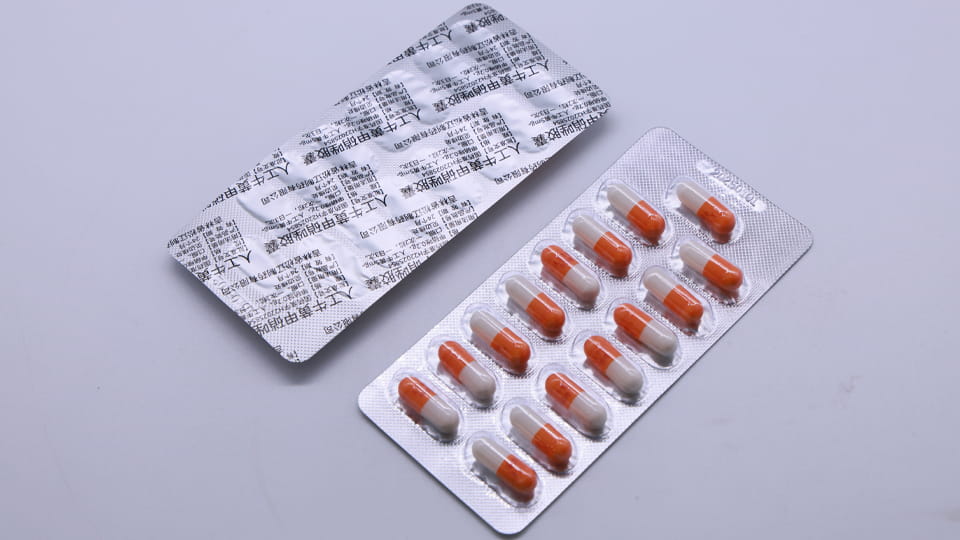
Φουσκάλες: Με σχέδιο, μια φουσκάλα (λωρίδα από σφραγισμένες τσέπες) έχει περιορισμένο χώρο. Οι ρυθμιστικές αρχές το αναγνωρίζουν αυτό: Η ΕΕ επιτρέπει συχνά τη συντομευμένη επισήμανση σε μεμονωμένες κοιλότητες κυψέλης, εάν τα πλήρη στοιχεία αναγράφονται στο κουτί (χρησιμοποιώντας μια ετικέτα ή φυλλάδιο «σημαία».). Στις Η.Π.Α, ετικέτες blister (π.χ.. αλουμινόχαρτο) πρέπει να περιλαμβάνει ακόμα το όνομα του φαρμάκου, δύναμη, αριθμός παρτίδας και ημερομηνία λήξης. Σημειώσεις περίληψης ενός κλάδου: "Συσκευασία φουσκάλας Οι ετικέτες πρέπει να περιλαμβάνουν ιδιόκτητο/γενικό όνομα, δύναμη, παρτίδα, λήξη… και συμμορφωθείτε με τις απαιτήσεις του FDA, όπως ελάχιστο ύψος κειμένου και αντίθεση.» Στην πράξη, Τα φύλλα κυψέλης έχουν συχνά το όνομα και τον κωδικό τυπωμένο σε κάθε κοιλότητα ή σε μια χάρτινη ετικέτα που τυλίγεται γύρω. Μερικές φορές μια κάρτα blister θα φέρει μια αποσπώμενη ετικέτα που καλύπτει πολλαπλές δόσεις, αλλά χρειάζεται ακόμα τις ίδιες πληροφορίες. Οι αποδείξεις παραβίασης είναι εγγενείς στις σφραγισμένες κυψέλες, αλλά αν χρησιμοποιηθεί, μια παραποιημένη δήλωση (π.χ.. «Μην το χρησιμοποιείτε εάν σπάσει η σφράγιση») απαιτείται.
Μπουκάλια και Φιαλίδια: Τα στρογγυλά μπουκάλια χρησιμοποιούν συνήθως ετικέτες μπροστά και πίσω. Η μπροστινή ετικέτα δείχνει συνήθως το όνομα του προϊόντος, δύναμη και ποσότητα για γρήγορη αναγνώριση, και η πίσω ετικέτα έχει οδηγίες, προειδοποιήσεις και ρυθμιστικές λεπτομέρειες. Μηχανές επισήμανσης on the fly (δείτε παρακάτω) εφαρμόστε αυτές τις ετικέτες σε μπουκάλια. Ένα παράδειγμα από το φυλλάδιο του Jinlu Packing: η μηχανή ετικετών TBJ-120 έχει σχεδιαστεί για στρογγυλά μπουκάλια (20– Διάμετρος 110 mm) και περιλαμβάνει έναν εν σειρά κωδικοποιητή κορδέλας για εκτύπωση παρτίδας/λήξης. Αυτό διασφαλίζει ότι η αυτοκόλλητη ετικέτα κάθε φιάλης λαμβάνει επίσης τον σωστό αριθμό παρτίδας και τη λήξη όπως απαιτείται. Και για κυψέλες και για μπουκάλια, Το μέγεθος της γραμματοσειράς και η χρωματική αντίθεση πρέπει να πληρούν τα νομικά πρότυπα (π.χ.. του FDA 21 CFR 201.15 σχετικά με την αναγνωσιμότητα). Εν συντομία, Οι ροές εργασιών για την επισήμανση κυψελών και φιαλών έχουν σχεδιαστεί για να πληρούν τους ίδιους κανόνες περιεχομένου — όνομα, συστατικά, παρτίδα και λήξη — ακόμη και αν η μέθοδος παράδοσης (ξεφλούδισμα, απευθείας εκτύπωση, ή αυτοκόλλητο) διαφέρει.
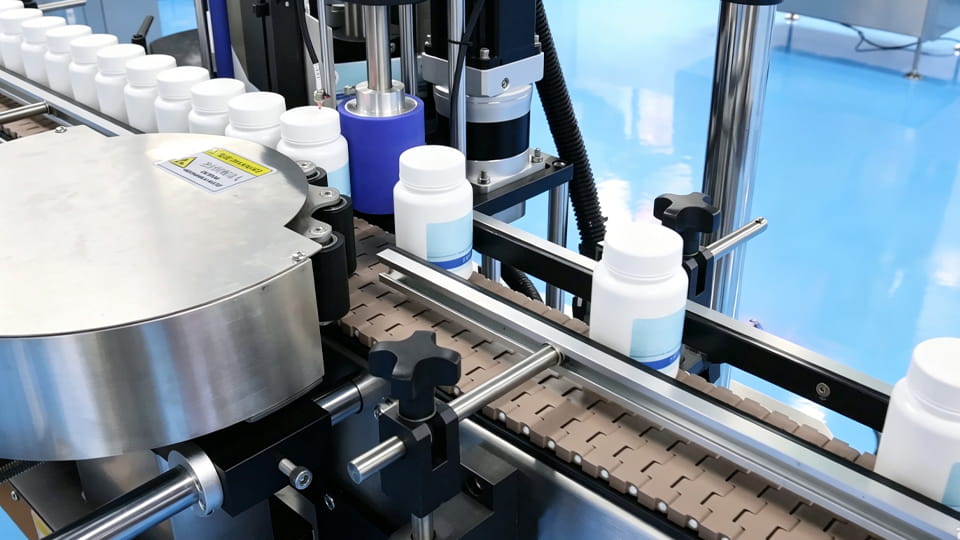
Εικόνα: Φαρμακευτικές φιάλες με ετικέτα σε γραμμή παραγωγής. Οι ετικέτες των φιαλών πρέπει να αναγράφουν ξεκάθαρα την ταυτότητα του προϊόντος (όνομα, δραστικό συστατικό, δύναμη) και βασικά κανονιστικά δεδομένα (αριθμός παρτίδας, λήξη, κατασκευαστής) έτσι ώστε κάθε μεμονωμένο φιαλίδιο ή φιάλη να μπορεί να επαληθευτεί.
Η εκτύπωση αριθμών παρτίδας/παρτίδας και ημερομηνιών λήξης είναι ένα κρίσιμο μέρος της επισήμανσης. Σε φαρμακευτικές σειρές, Ο ειδικός εξοπλισμός κωδικοποίησης χρησιμοποιείται για την αποτύπωση αυτών των πληροφοριών σε υψηλή ταχύτητα. Οι κοινές τεχνολογίες περιλαμβάνουν Συνεχής Inkjet (CIJ) εκτυπωτές, Θερμικό Inkjet (ΤΟΥ) εκτυπωτές, Εκτυπωτές θερμικής μεταφοράς (TTO) και Κωδικοποιητές λέιζερ.
Αυτοί οι εκτυπωτές συνήθως ενσωματώνονται αμέσως μετά την τοποθέτηση ετικετών. Για παράδειγμα, ένα μπουκάλι μπορεί να περάσει κάτω από έναν κωδικοποιητή inkjet αμέσως μετά την τοποθέτηση της ετικέτας, που εκτυπώνει την παρτίδα και λήγει στην ετικέτα στη σειρά. Η μηχανή Jinlu TBJ-120 (πάνω από) περιλαμβάνει α μηχάνημα κωδικοποίησης κορδέλας για να σφραγίσετε κωδικούς σε κάθε ετικέτα. Ανεξαρτήτως μεθόδου, Τα έντυπα δεδομένα πρέπει να είναι ευανάγνωστα και τοποθετημένα όπως απαιτείται από τους κανονισμούς (π.χ.. κοντά στο κάτω μέρος της οθόνης για την ημερομηνία λήξης). Μορφές αναγνώσιμες από τον άνθρωπο (όπως το YYMMDD) πρέπει να ταιριάζει με τυχόν δεδομένα γραμμωτού κώδικα. Πάντως, είτε με inkjet είτε με λέιζερ, ο βασικός στόχος είναι ο ίδιος: Κάθε μεμονωμένη συσκευασία πρέπει να φέρει τον αριθμό παρτίδας και την ημερομηνία λήξης για να συμμορφώνεται με την ιχνηλασιμότητα της GMP. Συστήματα επιθεώρησης (δείτε παρακάτω) θα επαληθεύσει ότι κάθε εκτυπωμένος κωδικός είναι παρών και σωστός.
Οι σύγχρονοι κανονισμοί απαιτούν συχνά αναγνώσιμους από μηχανή κωδικούς για την ιχνηλασιμότητα και την καταπολέμηση της παραχάραξης. Το παγκόσμιο πρότυπο είναι το GS1 DataMatrix 2D barcode, που μπορεί να κωδικοποιήσει πολλαπλά στοιχεία δεδομένων σε ένα μικρό τετράγωνο σύμβολο. Στην υγειονομική περίθαλψη, το πρότυπο GS1 καθορίζει την κωδικοποίηση τεσσάρων βασικών χαρακτηριστικών: GTIN (Παγκόσμιος αριθμός αντικειμένου εμπορίου), ημερομηνία λήξης, αριθμός παρτίδας/παρτίδας, και αύξων αριθμός. Το GTIN προσδιορίζει μοναδικά το προϊόν, ενώ τα άλλα τρία επιτρέπουν την παρακολούθηση και την επαλήθευση σε κάθε πακέτο.
Στις Η.Π.Α, ο 2013 Νόμος για την ποιότητα και την ασφάλεια των φαρμάκων (DQSA) επιβάλλει τη σταδιακή σειριοποίηση των συνταγογραφούμενων φαρμάκων. Με 2023, ο νόμος για την ασφάλεια της αλυσίδας εφοδιασμού φαρμάκων απαιτεί ένα αναγνωριστικό προϊόντος σε κάθε μονάδα (που περιλαμβάνει παρτίδα και λήξη) ώστε τα φαρμακεία να μπορούν να επαληθεύουν τα προϊόντα κατά την παραλαβή. Στην Ε.Ε, την οδηγία για τα ψευδεπίγραφα φάρμακα (Οδηγία 2011/62/ΕΕ) ήδη απαιτεί μοναδικούς σειριακούς αριθμούς σε πολλές συσκευασίες συνταγογραφούμενων φαρμάκων. Τα πακέτα ΕΕ πρέπει να φέρουν GS1 DataMatrix που να περιέχει το GTIN, τον σειριακό αριθμό που έχει εκχωρηθεί από τον κατασκευαστή, λήξης και παρτίδας (αναγνωριστικά εφαρμογής 17, 10). Η καθοδήγηση GS1 κατευθύνει ρητά τους κατασκευαστές: "Κωδικοποιήστε το GTIN σας, παρτίδα και ημερομηνία λήξης στον γραμμωτό κώδικα GS1 DataMatrix και τοποθετήστε τον στο προϊόν”. Μερικές αγορές (Βραζιλία, Ινδία, άλλοι) υιοθετούν επίσης παρόμοιες απαιτήσεις σειριοποίησης.
Εκτός από το DataMatrix, Οι εταιρείες μπορούν να χρησιμοποιούν κωδικούς QR ή RFID σε ετικέτες για την αφοσίωση των καταναλωτών ή τη διαχείριση αποθεμάτων, αλλά η ρυθμιστική εστίαση παραμένει στους 2D γραμμωτούς κώδικες για συμμόρφωση. Αυτοί οι κωδικοί εκτυπώνονται από εξειδικευμένα μηχανήματα ετικετών ή κωδικοποιητές στη συσκευασία. Για παράδειγμα, μια μέθοδος είναι να προσθέσετε έναν εκτυπωτή λέιζερ ή ετικετών το DataMatrix μετά την εφαρμογή της κύριας ετικέτας. Στη συνέχεια, τα συστήματα Vision σαρώνουν το DataMatrix για να διασφαλίσουν ότι διαβάζεται σωστά. Με κωδικοποίηση παρτίδας και λήξης στο barcode, σάρωση σε οποιοδήποτε σημείο (διανομή, διανομή) επαληθεύει αμέσως αυτές τις τιμές. Συνοπτικά, σειριοποίηση σημαίνει το καθένα συσκευασία μονάδας δόσης έχει έναν μοναδικό σαρώσιμο κωδικό που το συνδέει με τα δεδομένα παραγωγής του.
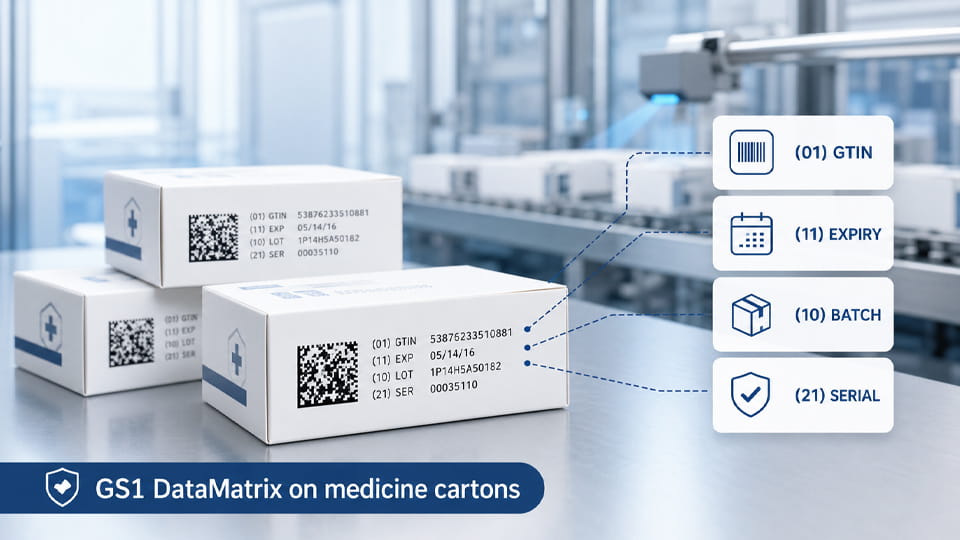
Εικόνα: Κωδικός GS1 DataMatrix σε κουτιά φαρμάκων που περιέχουν (01)GTIN, (11)λήξη, (10)σύνολο παραγωγής, (21)σειράς. Οι φαρμακευτικές συσκευασίες συχνά φέρουν GS1 DataMatrix (2D barcode) με το GTIN, κωδικοποιημένη ημερομηνία λήξης και αριθμός παρτίδας/παρτίδας. Αυτό επιτρέπει τη σάρωση υψηλής ταχύτητας και την επαλήθευση όλων των βασικών δεδομένων παρακολούθησης.
Τα αυτοματοποιημένα μηχανήματα είναι απαραίτητα για την εφαρμογή όλων των απαιτούμενων ετικετών και κωδικών με ταχύτητα γραμμής. Μια τυπική ροή εργασίας φαρμακευτικής συσκευασίας με επισήμανση μπορεί να μοιάζει με αυτό:
Πλήρωση/Φόρτωση δοχείων → Αυτόματη μηχανή ετικετών → παρτίδα & Κωδικοποιητής λήξης → Barcode/Serialization Marking → Vision Inspection Station → Cartoning / Δευτερεύουσα Συσκευασία

Εικόνα: Αυτόματο μηχάνημα ετικετών με διαχωριστικό μπουκαλιών και κωδικοποιητή (Τζινλού Μηχανή ετικετών JL-TBJ-120). Οι αυτόματες ετικέτες εφαρμόζουν αυτοκόλλητες ετικέτες σε μπουκάλια, ενώ ένας ενσωματωμένος εκτυπωτής σφραγίζει την παρτίδα/λήξη. Τα σύγχρονα μηχανήματα ετικετών μπορούν να λειτουργήσουν με υψηλή ταχύτητα (Π.χ., 120 μπουκάλια/λεπτό) με ακρίβεια, και συχνά περιλαμβάνουν εκτυπωτές κωδικών για inkjet/θερμική εκτύπωση παρτίδας και ημερομηνίας. Αυτά τα μηχανήματα διασφαλίζουν ότι οι ετικέτες και οι κωδικοί εφαρμόζονται με συνέπεια σε κάθε δοχείο.
Με την ενσωμάτωση αυτών των βημάτων, μια σειρά φαρμακευτικής συσκευασίας διασφαλίζει ότι από την πλήρωση μέχρι την τελική συσκευασία, κάθε μονάδα επισημαίνεται σωστά και μπορεί να εντοπιστεί. Χρησιμοποιώντας ένα συνδεδεμένο σύστημα (ή σειρά συγχρονισμένων μηχανών) ελαχιστοποιεί το ανθρώπινο λάθος. Για κρίσιμο έλεγχο, οι κάμερες όρασης ελέγχουν ότι κάθε πακέτο πληροί τη συμμόρφωση. Τελικά, εξοπλισμός σήμανσης υψηλής ποιότητας (από τροφοδότες φιαλιδίων έως συσκευές εφαρμογής ετικετών έως κωδικοποιητές) καθιστά εφικτή σε μεγάλη κλίμακα την τήρηση των κανόνων της ετικέτας FDA/EMA.
Έστω και με προσοχή, μπορεί να προκύψουν σφάλματα επισήμανσης. Τα κοινά ζητήματα περιλαμβάνουν:
Οι στρατηγικές μετριασμού περιλαμβάνουν: αυστηρά πρωτόκολλα μετάβασης (ελέγχετε διπλά τις ετικέτες όταν αλλάζετε προϊόντα), ελέγχους κατά τη διαδικασία (χειροκίνητοι επιτόπιοι έλεγχοι στο διαδίκτυο), και 100% επιθεώρηση όρασης. Οι αυτοματοποιημένοι αναγνώστες κώδικα επαληθεύουν ότι κάθε εκτυπωμένος κώδικας ταιριάζει με το αρχείο παραγωγής. Πολλές γραμμές διαθέτουν επίσης εφεδρικούς σαρωτές γραμμωτού κώδικα για να διασφαλίσουν ότι οι εκτυπώσεις παρτίδας/λήξης είναι ευανάγνωστες. Η διατήρηση των αρχείων έργων τέχνης ενημερωμένα και η παρακολούθηση των λιστών ελέγχου γλώσσας αποτρέπει τα σφάλματα περιεχομένου. Τελικά, η παροχή ετικετών και μελανιών θα πρέπει να ταιριάζει με τις απαιτήσεις του συστήματος (π.χ.. Μελάνι ανθεκτικό στην υπεριώδη ακτινοβολία εάν χρειάζεται). Μια ισχυρή διαδικασία QA θα εντοπίσει τα ελαττώματα της ετικέτας νωρίς πριν από την κυκλοφορία.
Χρησιμοποιήστε αυτήν τη λίστα ελέγχου για να βεβαιωθείτε ότι κάθε ετικέτα και συσκευασία πληροί τις απαιτήσεις:
| Σημείο ελέγχου σήμανσης | Ολοκληρώθηκε το? |
| Όνομα προϊόντος (μάρκα & γενικός) παρόν | ☐ |
| Δραστικό συστατικό(μικρό) παρατίθενται (με δύναμη) | ☐ |
| Δύναμη (δοσολογία) δηλώνεται ξεκάθαρα | ☐ |
| Δοσολογική μορφή (δισκίο, διάλυμα, και τα λοιπά.) συμπεριλαμβανομένος | ☐ |
| Αριθμός παρτίδας/παρτίδας τυπωμένος και ευανάγνωστος | ☐ |
| Η ημερομηνία λήξης είναι τυπωμένη και ευανάγνωστη | ☐ |
| Κατασκευαστής (όνομα & διεύθυνση) παρόν | ☐ |
| Αναφέρονται οι συνθήκες αποθήκευσης (π.χ.. "Κατάστημα <25°C”) | ☐ |
| Περιλαμβάνονται δηλώσεις προειδοποίησης/προσοχής | ☐ |
| Barcode/DataMatrix (GTIN+λήξη+παρτίδα) παρόν | ☐ |
| Καθαρά περιεχόμενα (ποσότητα ή όγκο) υποδεικνύεται | ☐ |
| Κανονιστικοί κώδικες (NDC, αριθμός άδειας) συμπεριλαμβανομένος | ☐ |
| Το μέγεθος/αναγνωσιμότητα γραμματοσειράς πληροί τους κανονισμούς | ☐ |
| Προφανής δήλωση (Εάν απαιτείται) | ☐ |
Ελέγξτε κάθε παραπάνω σημείο σε σχέση με τις εκτυπωμένες ετικέτες σας. Για παράδειγμα, Η FDA απαιτεί ρητά την ημερομηνία λήξης και τον αριθμό παρτίδας, και οι κανονισμοί της ΕΕ επιβάλλουν το όνομα του προϊόντος, δύναμη και περιεχόμενο. Εάν κάποιο στοιχείο λείπει ή είναι δυσανάγνωστο, η συσκευασία δεν είναι συμβατή. Αυτή η λίστα ελέγχου μπορεί να χρησιμεύσει ως πίνακας αναφοράς για ποιοτικούς ελέγχους.
Η ακριβής επισήμανση είναι ένα αδιαπραγμάτευτο μέρος της φαρμακευτικής παραγωγής. Κατανοώντας τις παραπάνω απαιτήσεις, μπορείτε να σχεδιάσετε ετικέτες και ροές εργασίας που συμμορφώνονται με τον FDA, EMA και παγκόσμιοι κανόνες. Θυμηθείτε τα βασικά στοιχεία της ετικέτας (ταυτότητα προϊόντος, συστατικά, πληροφορίες ασφαλείας, και κωδικοποίηση) και ελέγξτε τα με βάση τη λίστα ελέγχου συμμόρφωσης. Οι σύγχρονες γραμμές συσκευασίας χρησιμοποιούν αυτοματοποιημένες ετικέτες, κωδικοποιητές και συστήματα όρασης για να διατηρούν τα ποσοστά σφαλμάτων κοντά στο μηδέν.
Εάν χρειάζεστε στιβαρό εξοπλισμό για σήμανση και κωδικοποίηση, εξετάστε τις λύσεις της Jinlu Packing. Το Jinlu προσφέρει μια σειρά από μηχανές συσκευασίας φαρμακευτικών προϊόντων – από αυτόματες μηχανές σήμανσης φιαλών (π.χ.. τη σειρά TBJ) να κωδικοποιητές παρτίδας/λήξης και πλήρης γραμμές χαρτοκιβωτίου – όλα σχεδιασμένα για Συμμόρφωση GMP. Τα μηχανήματα μας ενσωματώνουν ετικέτες, εκτύπωση και επιθεώρηση για να σας βοηθήσει να ανταποκριθείτε στις απαιτήσεις ετικετών εύκολα. Για παράδειγμα, Η μηχανή ετικετών στρογγυλής φιάλης Jinlu χειρίζεται φιάλες 20–110 mm έως 120 bpm, εφαρμογή ετικετών και εκτύπωση κωδικών ημερομηνίας/παρτίδας με ένα πέρασμα. Εξερευνήστε τις μηχανές ετικετών και τις μηχανές χαρτοκιβωτίου της Jinlu για περισσότερες λεπτομέρειες. Συνδυάζοντας καλές διαδικασίες με τον κατάλληλο εξοπλισμό, μπορείτε να βεβαιωθείτε ότι κάθε συσκευασία φαρμάκου έχει τη σωστή σήμανση για ασφάλεια και συμμόρφωση.
Οι απαιτήσεις φαρμακευτικής επισήμανσης είναι οι κανόνες που καθορίζουν ποιες πληροφορίες πρέπει να εμφανίζονται στην ετικέτα ενός φαρμάκου, δοχείο, χαρτοκιβώτιο, ή φύλλο οδηγιών χρήσης. Μπορεί να καλύπτουν το όνομα του προϊόντος, ενεργά συστατικά, δύναμη, δοσολογική μορφή, αριθμός παρτίδας, ημερομηνία λήξης, προειδοποιήσεις, όροι αποθήκευσης, στοιχεία κατασκευαστή, και άλλες κανονιστικές πληροφορίες. Οι απαιτήσεις διαφέρουν ανάλογα με τη χώρα, είδος φαρμάκου, και μορφή συσκευασίας.
Μια φαρμακευτική ετικέτα μπορεί να χρειαστεί να περιλαμβάνει το όνομα του προϊόντος, δραστικό συστατικό, δύναμη, δοσολογική μορφή, περιεχόμενα, αριθμός παρτίδας ή παρτίδας, ημερομηνία λήξης, πληροφορίες για τον κατασκευαστή ή την άδεια κυκλοφορίας, όροι αποθήκευσης, προειδοποιήσεις, και άλλες λεπτομέρειες σχετικά με την αγορά. Οι ακριβείς πληροφορίες εξαρτώνται από το ισχύον κανονιστικό πλαίσιο και την κατηγορία προϊόντων.
Στις Ηνωμένες Πολιτείες, Οι ετικέτες φαρμάκων πρέπει να συμμορφώνονται με τους ισχύοντες κανονισμούς επισήμανσης του FDA, συμπεριλαμβανομένου 21 Μέρος CFR 201. Οι απαιτήσεις διαφέρουν μεταξύ συνταγογραφούμενων και μη συνταγογραφούμενων φαρμάκων. Η επισήμανση των συνταγογραφούμενων φαρμάκων ακολουθεί απαιτήσεις όπως π.χ 21 CFR 201.56 και 201.57, ενώ τα προϊόντα OTC χρησιμοποιούν γενικά την τυποποιημένη μορφή Drug Facts κάτω από 21 CFR 201.66.
Οι απαιτήσεις της ΕΕ για τη φαρμακευτική επισήμανση απαιτούν γενικά βασικές πληροφορίες, όπως το όνομα του φαρμάκου, δύναμη, φαρμακευτική μορφή, δραστικές ουσίες, περιεχόμενα, σχετικά έκδοχα, ημερομηνία λήξης, και αριθμός παρτίδας. Μπορούν να ισχύουν πρόσθετες απαιτήσεις ανάλογα με το προϊόν και την αγορά. Το πλαίσιο της ΕΕ περιλαμβάνει επίσης απαιτήσεις για φυλλάδια οδηγιών και χαρακτηριστικά προσβασιμότητας, όπως το Braille στη συσκευασία.
Ναί, Η αναγνώριση παρτίδας ή παρτίδας είναι σημαντικό μέρος της φαρμακευτικής συσκευασίας και της ιχνηλασιμότητας. Για παράδειγμα, Οι κανόνες της ΕΕ απαιτούν συγκεκριμένα τον αριθμό παρτίδας σε ορισμένες άμεσες συσκευασίες, συμπεριλαμβανομένων των συσκευασιών blister, μαζί με πληροφορίες όπως το όνομα του προϊόντος και η ημερομηνία λήξης. Οι συγκεκριμένες απαιτήσεις μπορεί να διαφέρουν ανάλογα με την αγορά και τον τύπο του προϊόντος.
Σε πολλές συσκευασίες φαρμακευτικών προϊόντων απαιτείται ημερομηνία λήξης και αποτελεί βασικό στοιχείο αναγνώρισης του προϊόντος και ασφαλούς χρήσης. Για παράδειγμα, Οι απαιτήσεις της ΕΕ καθορίζουν πληροφορίες ημερομηνίας λήξης για άμεση συσκευασία, όπως συσκευασίες κυψέλης και μικρές μονάδες συσκευασίας. Η ακριβής μορφή και η τοποθέτηση εξαρτώνται από τις ισχύουσες απαιτήσεις της αγοράς.
Οι απαιτήσεις σε συσκευασία blister εξαρτώνται από την αγορά και τη διαμόρφωση της συσκευασίας. Σύμφωνα με τους κανόνες της ΕΕ, Οι συσκευασίες blister που τοποθετούνται μέσα σε μια εξωτερική συσκευασία πρέπει να φέρουν βασικές πληροφορίες, συμπεριλαμβανομένης της ονομασίας του φαρμακευτικού προϊόντος, κάτοχος άδειας κυκλοφορίας, ημερομηνία λήξης, και αριθμός παρτίδας. Οι πληροφορίες πρέπει επίσης να είναι ευανάγνωστες, κατανοητός, και ανεξίτηλη.
Η φαρμακευτική σειριοποίηση είναι η εκχώρηση και διαχείριση ενός μοναδικού αναγνωριστικού για μια μεμονωμένη συσκευασία εμπορεύσιμων φαρμάκων για την υποστήριξη της αναγνώρισης και της ιχνηλασιμότητας του προϊόντος. Η σειριοποίηση λειτουργεί συνήθως με δισδιάστατους κωδικούς και άλλα συστήματα αναγνώρισης προϊόντων, αλλά οι ακριβείς απαιτήσεις εξαρτώνται από την αγορά-στόχο και τους ισχύοντες κανονισμούς.
Ο κοινός εξοπλισμός σήμανσης και κωδικοποίησης φαρμακευτικών προϊόντων περιλαμβάνει αυτόματες μηχανές σήμανσης, μηχανές σήμανσης φιαλών, συστήματα κωδικοποίησης παρτίδας, εκτυπωτές inkjet ή laser, σαρωτές γραμμωτού κώδικα, συστήματα επιθεώρησης όρασης, και εξοπλισμό σειριοποίησης. Η σωστή ρύθμιση εξαρτάται από τη μορφή συσκευασίας, ταχύτητα παραγωγής, σχέδιο ετικέτας, απαιτήσεις μεταβλητών δεδομένων, και απαιτούμενο επίπεδο επιθεώρησης.
Οι κατασκευαστές θα πρέπει πρώτα να προσδιορίσουν τις απαιτήσεις για κάθε αγορά και προϊόν-στόχο, στη συνέχεια εγκρίνετε το γραφικό της ετικέτας και τα μεταβλητά δεδομένα πριν από την παραγωγή. Η γραμμή συσκευασίας θα πρέπει επίσης να ελέγχει την επιλογή της ετικέτας, εκτύπωση παρτίδας και ημερομηνίας λήξης, γραμμωτός κώδικας ή δεδομένα σειριοποίησης, τοποθέτηση ετικέτας, επιθεώρηση όρασης, και απόρριψη λανθασμένων προϊόντων. Οι διαδικασίες GMP θα πρέπει να υποστηρίζουν τεκμηρίωση, διάκενο γραμμής, έλεγχος μετάβασης, και ιχνηλασιμότητα.
Αναφορές:
1.Συχνές ερωτήσεις σχετικά με την επισήμανση των συνταγογραφούμενων φαρμάκων —— ΜΑΣ. Υπηρεσία Τροφίμων και Φαρμάκων
2.Πόροι επισήμανσης χαρτοκιβωτίων και εμπορευματοκιβωτίων —— ΜΑΣ. Υπηρεσία Τροφίμων και Φαρμάκων
3.TRS 902 – Παράρτημα 9: Οδηγίες για τη συσκευασία φαρμακευτικών προϊόντων —— ΠΟΥ
4.Απαιτήσεις προϊόντος-πληροφοριών —— Ευρωπαϊκός Οργανισμός Φαρμάκων
5.Παράρτημα της κατευθυντήριας γραμμής της Ευρωπαϊκής Επιτροπής σχετικά με τα «Έκδοχα στην επισήμανση και το φύλλο οδηγιών χρήσης των φαρμακευτικών προϊόντων για ανθρώπινη χρήση’ —— Ευρωπαϊκός Οργανισμός Φαρμάκων
6.21 CFR § 201.66 – Απαιτήσεις μορφής και περιεχομένου για εξωχρηματιστηριακά (OTC) επισήμανση του φαρμακευτικού προϊόντος. —— Ινστιτούτο Νομικών Πληροφοριών