Consistent tablets require control of four key quality attributes: Gewicht, Härte, Dicke, Und Bröckeligkeit. These physical tablet quality attributes (CQAs) play important roles in dose consistency, mechanische Festigkeit, and downstream performance, einschließlich Tablettenüberzug, Verpackung, Und Arzneimittelfreisetzung. But controlling one property does not guarantee overall tablet quality. A tablet can meet its target weight but still be too soft, too thick, or too fragile to withstand handling. Increasing compression force may improve hardness and reduce friability, but it can also decrease tablet thickness and affect disintegration or dissolution. The goal is not to maximize one property at the expense of another. It is to keep all relevant tablet quality attributes within their established ranges while maintaining consistent production.
Also, how do you achieve that balance? You need to understand how powder properties, die Füllung, Vorkomprimierung, main compression force, Und Turmgeschwindigkeit influence tablet quality. This guide brings those relationships together in a practical CQA map, explains how to troubleshoot conflicting quality results, and shows how the right tablet press configuration can help manufacturers maintain consistent tablet quality at production speed.
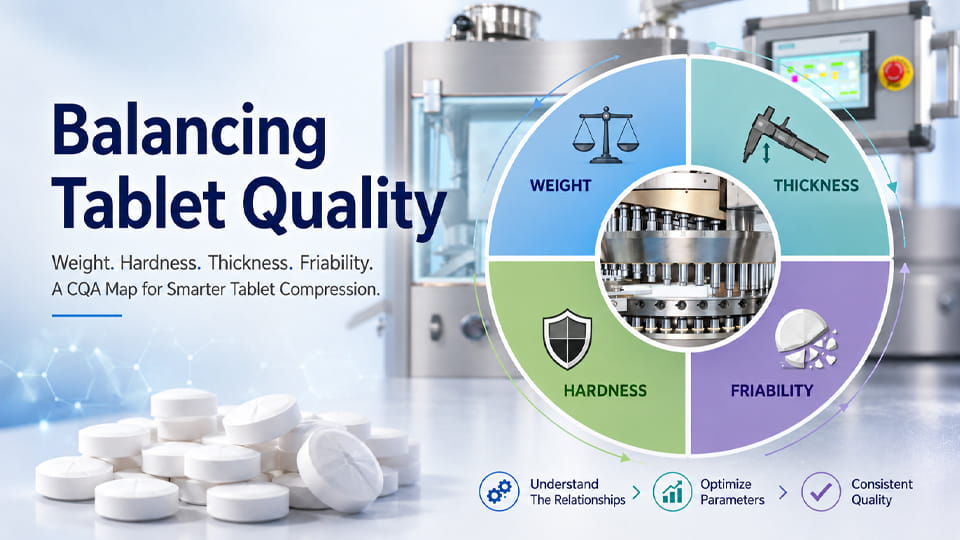
In Quality-by-Design terms, A Critical Quality Attribute (CQA) is any property of the drug substance, Hilfsstoffe, or drug product that “should be within an appropriate limit, range, or distribution to ensure the desired product quality.”. For solid oral tablets, typical product CQAs include potency (Dosierung), Auflösung, Stabilität, und vor allem physical attributes like weight uniformity, Härte, Dicke, und Bröckeligkeit. These attributes affect purity, Stärke, and drug release.
Zusammen, these four CQAs – weight, Härte, Dicke, friability – form the primary physical performance profile of a tablet. They link back to upstream material attributes (z.B. Pulverfluss, Partikelgröße, binder levels) and process parameters (z.B. Fülltiefe, Kompressionskräfte, Geschwindigkeit). Later, we will present a CQA map that connects raw material traits and process variables to each tablet attribute. But first, let’s see how these four attributes influence each other.
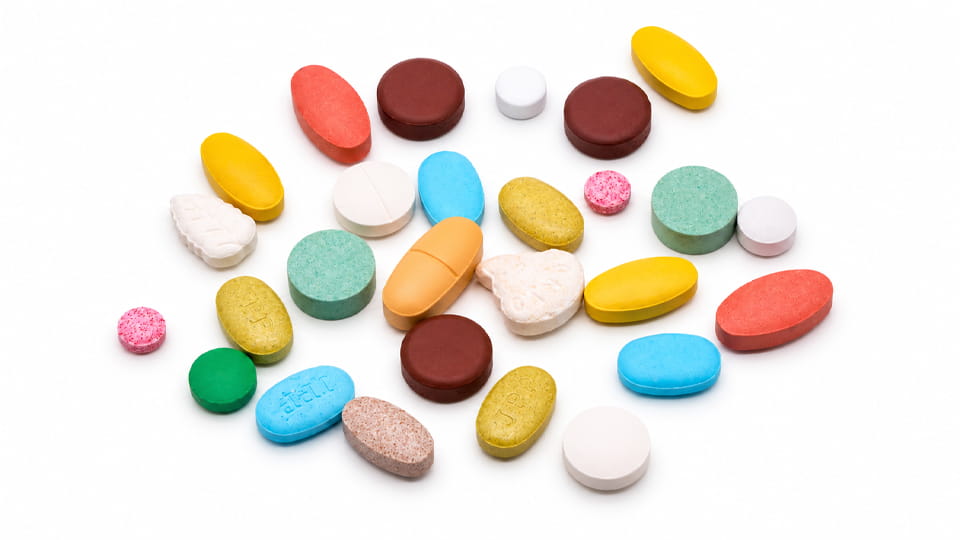
These tablet attributes are not independent. Changes to one often ripple into the others:
Given these interdependencies, we recommend mapping out the relationships. The diagram below (A CQA map) illustrates how key material attributes and compression parameters influence each tablet CQA:
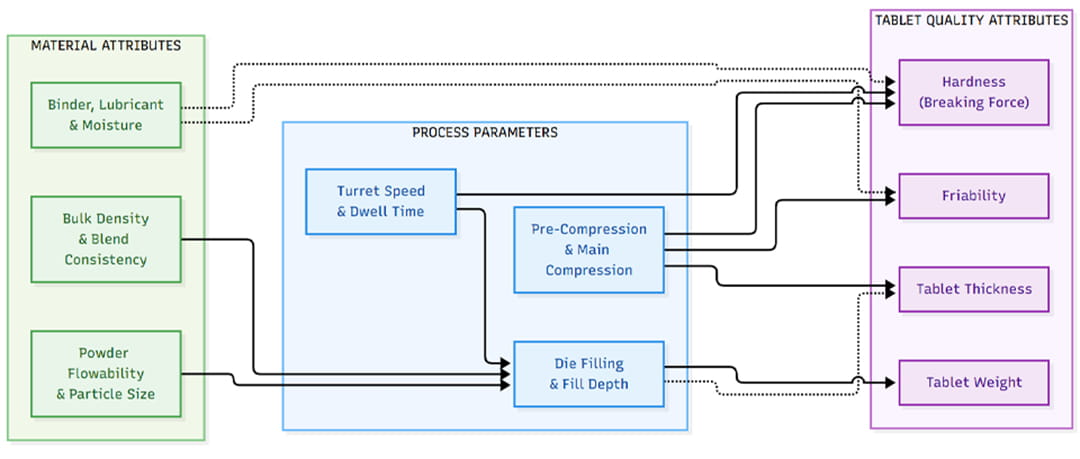
Figur: How tablet weight, Härte, Dicke, and friability are related during compression. Fließfähigkeit des Pulvers, Partikelgröße, Schüttdichte, and formulation characteristics influence die filling and compaction behavior. Process parameters such as fill depth, Kompressionskraft, Turmgeschwindigkeit, and dwell time affect tablet weight, Dicke, Bruchkraft, und Bröckeligkeit. These relationships are interconnected and formulation-dependent, so manufacturers should evaluate the four attributes together rather than optimize them independently.
Understanding tablet CQAs means controlling the Critical Process Parameters (CPPs) on the tablet press. Key CPPs include fill depth (die fill volume), main compression force, Turmgeschwindigkeit (press output rate), and dwell/pre-compression settings. Table below (from JinLu’s reference guide) summarizes how each parameter influences tablet quality:
| Parameter | Technical Meaning | Auswirkungen auf die Tablet-Qualität | Fehlerbehebung |
| Fill Depth (Volumen) | Depth of powder in the die before compression | Sets tablet weight (Dosis) und Dicke; key source of weight variation | Incorrect feeder cam or poor powder flow causes weight shifts. Adjust cam profile or improve flow. |
| Hauptkompressionskraft | Punch pressure (KN) exerted on tablet | Directly increases hardness and density; higher force generally lowers Bröckeligkeit. Too much force can cause capping or lamination. | Wenn Tabletten zu weich sind, raise force; if capping occurs, reduce force or add pre-compression. |
| Verweilzeit (Compression Duration) | Time powder is under pressure (related to press speed) | Longer dwell (slower speed or twin-stage press) improves interparticle bonding and hardness. Very short dwell at high speed risks poor compaction (Capping). | Slow down press or use two-stage (pre-comp) if tablets split or are weak. |
| Turmgeschwindigkeit (U/min) | Rotation speed of the turret | Increases output but can degrade quality if too fast. High speed reduces fill time and can worsen weight uniformity and hardness consistency. | Balance speed with powder flow. Slow down if weight/hardness fluctuate. |
| Vorkompression | Initial low-force compression before main press | Helps remove air and make a more uniform tablet core. It generally erhöht sich final hardness and reduces capping/friability. | Add or adjust pre-compression if capping or lamination occurs (allows trapped air to escape). |
These relationships mean, Zum Beispiel, Das zunehmende Kompressionskraft will raise hardness and lower friability (good up to a point). Jedoch, pushing force too far risks tablet failure modes (Laminierung, tool wear). Umgekehrt, changing the fill depth (to control weight) will shift thickness and may alter hardness indirectly. Wie die Tabelle zeigt, setting each parameter requires balancing trade-offs, and troubleshooting often involves small tweaks (z.B. “try 1–2 kN more force” or “add a second compression stage” until tablets meet spec).
In der Praxis, you usually optimize one attribute at a time, while monitoring the others. Here’s a practical sequence to balance the four key CQAs:
Throughout this optimization, good communication with formulation ist lebenswichtig. Zum Beispiel, if you find you need excessive force to hit hardness, you might ask R&D to boost binder or granule density. If weight variation persists, consider re-granulating the blend for better flow. By following this sequence – fix weight, set hardness, validate friability, tweak thickness – you ensure the core quality needs are met first, then polish the tablet robustness.
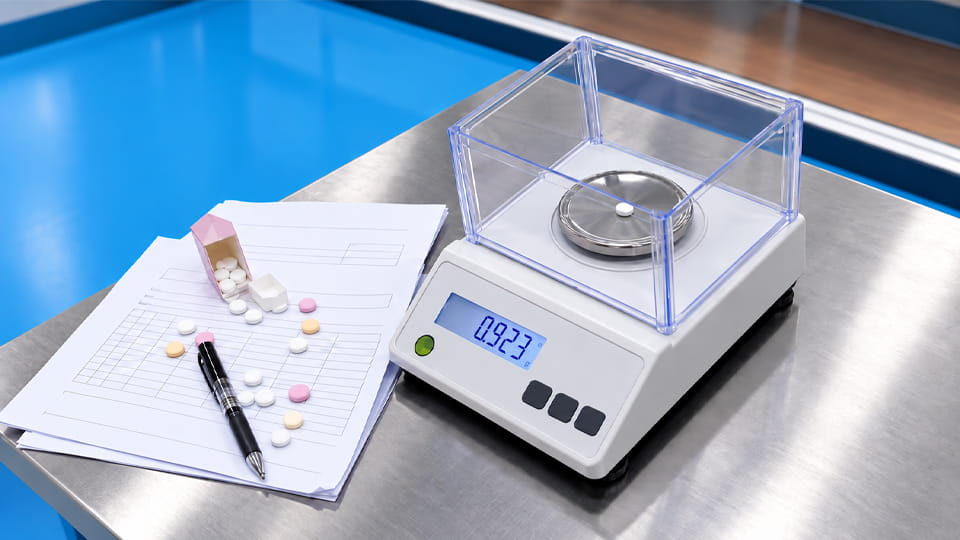
Even with careful planning, Tablet-Defekte happen. Here are common issues and quick fixes, organized like a decision tree:
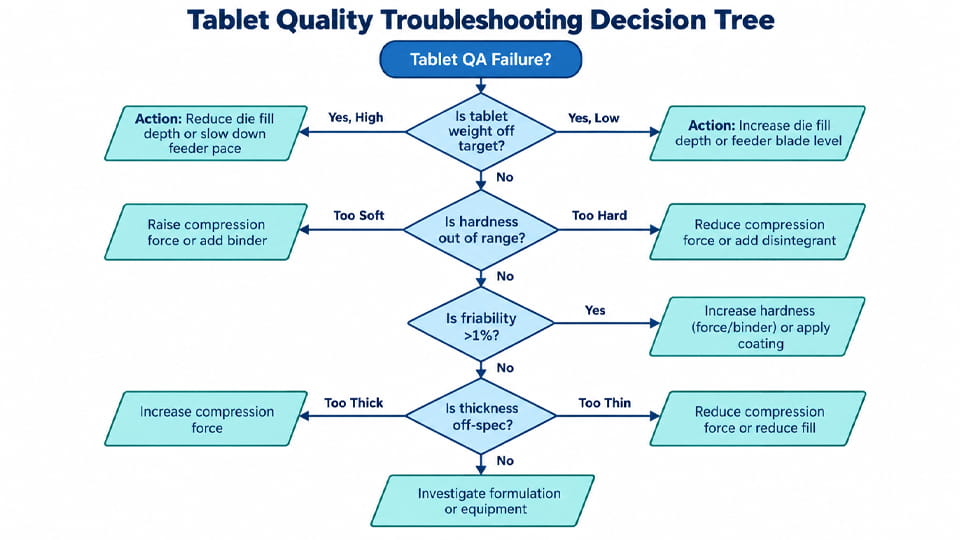
Interpretation: First check weight and thickness. High weight usually means overfill – reduce fill depth. Low weight means underfill – raise it. If weight is good, look at hardness. Weich (geringe Härte) tablets need higher force or formulation tweaks (mehr Bindemittel). Very hard tablets can cause downstream issues (like slow dissolution), so you might back off force or tweak disintegrant. If hardness is okay, test friability. Brüchigkeit >1% typically means surface bonding is weak, so increasing hardness (Gewalt) or applying a thin coating can help. Endlich, check thickness: overly thick tablets often mean under-compression, so increase force; too thin suggests over-compression or excessive fill. Each step should be followed by a small batch check to confirm the fix.
Zusätzlich, be alert for mechanical defects common on a press:
Remember that hardness and friability are critical flussabwärts QC checks, not just in-compression values. Hart, durable tablets are easier to coat and package without breaking. Zum Beispiel, high friability means tablets will shed dust and chips in a coating pan or on packaging lines, causing visual defects and yield loss. Umgekehrt, a tablet with the right hardness but uneven thickness could lead to over- or under-application of coating solution or inconsistent Blisterpack Kompression.
In der Praxis, ensuring tablets have acceptable weight and strength beforehand streamlines coating. Tablets that meet hardness and friability specs typically survive the rigors of coating (spray and tumbling) and automated packaging. Umgekehrt, if tablets are too soft (geringe Härte), you will see breakage and dust in the coating pan; too hard (hohe Kompression) might mean incomplete film formation (coatings may crack). Ideal, tablet thickness should also be uniform so that coating weight is even. The Jinlu case study notes that “hardness (Bruchkraft) checks internal strength, while friability checks surface durability… Both properties affect downstream processing – from how tablets are compressed to how they are coated and finally packed.”. Mit anderen Worten, always consider these attributes in the context of the whole line: a tablet that fails packing (broken pieces) or has streaked coating is often a symptom of poor compaction quality upstream.

Modern rotary tablet presses are built with features that make balancing these CQAs easier:
By leveraging these machine features — automatic weight adjustment, Vorkomprimierung, forced feeders, and servo feedback — a production line can maintain consistent tablet CQAs even under stress (hohe Geschwindigkeit) or raw material variability. The net effect is fewer out-of-spec tablets and smoother coating/packing later on.

Balancing tablet weight, Härte, thickness and friability is a classic Quality-by-Design challenge. By understanding how raw materials and compression settings drive each quality attribute, you can set up a robust control strategy. Use in-process checks on weight, Härte, and thickness to detect drift early, and perform the official friability test on finished batches to verify mechanical durability. Modern Rotationstablette (like the JinLu ZP-series) offer features — servo-driven cam control, weight-feedback, two-stage compression, forced feeders — that make this balancing act much easier.
Ready to streamline your tablet production? Kontaktieren Sie JinLu Packing to explore our high-performance Rotationstablettenpressen, equipped with automatic weight control and compression monitoring. We can arrange sample testing on your formulation to optimize your tablet quality attributes.
Pharmakopöen (like USP) require each tablet be close to the average weight. A common spec is that no more than 2 von 20 tablets can deviate outside ±5% of the average (für Tabletten >80mg). For very small tablets (<80mg), the limit is ±10%. Jedoch, your own specification may be tighter depending on the API dose and potency. Always refer to USP or for your dosage form.
Tablettenhärte (Bruchkraft) is measured by a hardness tester (manual or electronic). The tester compresses a single tablet until it cracks, reporting the peak force (in kg or Newtons). Modern digital testers often record diameter and thickness at the same time. According to USP , you take an average of multiple tablets and set a min/max range. In Produktion, hardness is usually monitored continuously and adjusted via the press settings as needed.
Erste, reduce the compression force in small steps. Also check if you can decrease binder (or increase disintegrant). Very high hardness can slow dissolution or make tablets hard to swallow. After adjusting, always re-test friability and disintegration.
High friability usually means tablets are under-compressed or poorly bonded. Increase tablet hardness by raising compression force or improving formulation (mehr Bindemittel, Granulation). Adding a thin film coating often solves minor friability, but the root is densification. Also ensure you have adequate dwell/pre-compression time to fully consolidate the tablet.
Ja. Different shapes (round vs oblong, single vs double convex) distribute compression force differently. Zum Beispiel, very thick or tall tablets tend to be harder, whereas thin tablets may need less force. If you change tooling or die dimensions, you should re-qualify the fill and force settings. Always measure thickness for new tablet shapes, and watch how that impacts hardness and friability in trials.
It depends on regulatory guidance and risk. Typischerweise, Tafelgewicht (or content) is sampled at least every hour (or more frequently) during a run. Hardness and thickness can be spot-checked similarly (z.B. 3–5 tablets per shift) or even continuously on-line if you have automatic testers. Friability is usually checked on a full batch at release. Good practice is to set in-process controls for weight and hardness with acceptance criteria, and only do friability at the end (since it’s destructive).
Ensure the blend has good flow (consider slugging or granulation if not). Adjust the feed frame height and paddle, or use a forced feeder. Check the punch and die alignment. If variation persists, a servo press can actively control weight via a feedback loop. Zusammenfassend: improve flow + fine-tune feeder cam.
The USP chapters are (Weight Variation/Content Uniformity), (Tablet Breaking Force, d.h. Härte), Und (Bröckeligkeit der Tablette). These give standard methods (like number of tablets, rotation count for friability, usw.). We follow those protocols in our QC lab. Zum Beispiel, USP friability test is described in JinLu’s resource.
Referenzen:
1.ICH Q8 (R2) Pharmaceutical development —— Europäische Arzneimittel-Agentur
2.Qualitätsrisikomanagement —— ICH Q9(R1)
3.Pharmaceutical Quality System —— ICH Q10
4.Tablet Compression Force as a Process Analytical Technology (KLOPFEN): 100% Inspection and Control of Tablet Weight Uniformity —— PubMed
5.Tablet disintegration performance: Effect of compression pressure and storage conditions on surface liquid absorption and swelling kinetics ——PubMed
6.Einheitlichkeit der Dosierungseinheiten —— USP <905>