

A capsule passes dissolution testing after production, but several months later the same product fails during a stability study. What changed? أ capsule dissolution failure does not automatically mean the واجهة برمجة التطبيقات or formulation is the problem. In gelatin capsules, the shell itself can change over time. Reactive compounds such as aldehydes, together with heat, رطوبة, formulation–shell interactions, وظروف التخزين, can promote gelatin cross-linking. The shell may then form a thin, poorly soluble membrane known as a pellicle, slowing or preventing the capsule from opening and releasing its contents. But cross-linking is only one possible cause—poor API solubility, excipient interactions, أداء التعبئة والتغليف, and even the dissolution method also need to be investigated. في هذا الدليل, we will work through these factors step by step and show how to identify the root cause, choose the right testing approach, and reduce the risk through better formulation, تخزين, يعالج, والتعبئة.
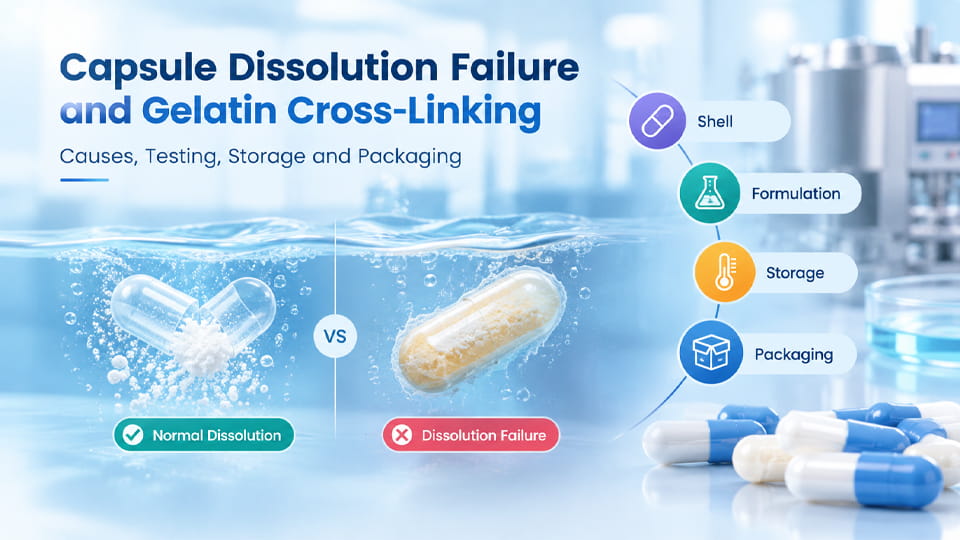
أ capsule dissolution failure occurs when a capsule product does not meet its specified dissolution acceptance criteria under the applicable test conditions. In a normal dissolution test, the capsule should become wetted, open or disintegrate, release its fill, and allow the active drug to dissolve into the test medium.
In simplified terms: Wetting → shell swelling → shell rupture → fill release → API dissolution
لكن, these steps can be disrupted by problems with the capsule shell, صياغة, ظروف التخزين, التعبئة والتغليف, or dissolution method. على سبيل المثال, a gelatin capsule exposed to certain reactive compounds, درجة حرارة, or humidity may develop gelatin cross-linking and a poorly soluble membrane known as a pellicle. The shell may then swell or become rubbery instead of opening normally, تأخير إطلاق الدواء.
It is important to distinguish disintegration vs dissolution. Disintegration refers to the capsule breaking apart or dissolving its shell; dissolution refers to the active drug solubilizing in the medium. A capsule can disintegrate (crack open) yet still fail to meet dissolution criteria if the API itself doesn’t dissolve quickly. على العكس, a capsule that never disintegrates obviously can’t release its drug. When we talk about “capsule dissolution failure,” it generally means the filled capsule as a whole failed the dissolution test – often because the shell did not open (or the drug didn’t come out) within the required time.
Common signs of capsule dissolution failure include:
These observations can help determine whether the problem is more likely related to the قذيفة كبسولة, صياغة, تخزين, التعبئة والتغليف, or dissolution test method. جامعة جنوب المحيط الهادئ <711> provides the general dissolution testing framework, بينما جامعة جنوب المحيط الهادئ <1094> addresses dissolution testing and related quality attributes for capsules.
A major cause of delayed dissolution is gelatin capsule cross-linking. Chemically, cross-linking is when reactive groups form covalent bonds between gelatin polymer chains, making the shell much less soluble. In the presence of tiny amounts of aldehydes or similar reactive compounds, or under high temperature/humidity, gelatin molecules can form bridges that are essentially irreversible. وهذا يخلق رقيقة, زجاجي pellicle on the inside (and/or outside) of the capsule shell, instead of the shell simply dissolving. The pellicle blocks water penetration and holds the fill inside, so the drug cannot be released into the medium. The result is a typical chain of events: Gelatin cross-linking → pellicle formation → delayed shell rupture → delayed fill release → capsule dissolution failure.
A simple flowchart illustrates the difference:
في الممارسة العملية, cross-linked capsules often leave a thin gelatinous membrane (pellicle) after the test. Researchers note that in dissolution testing, cross-linked gelatin is “characterized by a bridge across the peptide backbone… which creates water insoluble membranes or pellicles”. Another study describes that cross-linking leads to “the formation of a pellicle on the internal or external surface of the gelatin capsule shell that prevents the capsule fill from being released”. The key point: cross-linking makes the capsule shell harder, water-resistant, and slow to open. Any fill trapped inside will release only very slowly, if at all.
Capsule dissolution problems can stem from multiple factors. In the case of gelatin cross-linking, primary causes are reactive chemicals and environment. But formulation and testing issues also play a role. Key causes include:
طاولة 1 summarizes how different observations may suggest different causes:
طاولة 1. Observations vs. Possible Causes in Dissolution Failure
| Observation | Likely Cause(ق) |
| Capsule remains intact or only swells | Gelatin cross-linking (shell issue) |
| رفيع, jelly-like membrane (pellicle) on shell | Cross-linked gelatin (صدَفَة) |
| Capsule opens normally but drug dissolves slowly | Formulation/API issue (poor solubility, طلاء) |
| Fresh product passes, aged sample fails | Storage-related change (cross-linking or degradation) |
| High variability between capsules | Inconsistent mixing or non-uniform cross-linking |
| Only some packaging formats fail | Packaging or handling (moisture/oxygen differences) |
When dissolution fails, it’s crucial to tell whether the قذيفة كبسولة أو صياغة ملء هو على خطأ. The table below compares key indicators.
| Indicator/ Test | Shell Problem (Cross-Link) | Formulation Problem |
| Capsule Switch Test | Old (aged) قذائف + fresh fill fail; fresh shells + old fill pass. Indicates shell caused slow release. | Opposite: fresh shells + old fill still fail. Both fresh and old shells fail if fill is culprit. |
| Appearance After Test | Gelatin shell shows pellicle/swelling: rubbery, slimy film on capsule. Fill may remain dry-trapped. | Capsule shell disintegrates normally; irregular chunks of undissolved drug may sink. |
| Enzyme-assisted Test | Significant improvement: adding pepsin (لكل USP <711>) restores dissolution, since enzyme breaks cross-links. | Little change: enzymes act on shell only, so fill dissolution remains poor if due to API/excipient. |
| ملف تعريف الذوبان | Highly variable among units: some capsules may dissolve faster if less cross-linked. | Uniform slow release across units (if content uniform); may see dose dumping or tailing. |
| Disintegration Test | Prolonged tablet disintegration time; may not fully break down within test time. | Normal or mildly delayed disintegration consistent with formulation properties. |
| API Content/ CQ | API content usually within spec (shell issue doesn’t alter dose). | Check assay: formulation errors may cause content-out-of-spec (على سبيل المثال. الفصل). |
| Exposure to Aldehydes | Likely present: check excipients, مواد لاصقة, VpCI. | Unlikely relevant. Test compatibilities. |
طاولة 2: How to distinguish capsule shell cross-linking vs formulation issues in dissolution failure. Use a capsule-switch test for a definitive clue. If moving the contents to a fresh shell normalizes dissolution, the problem was the old shell.
When dissolution fails, we follow a diagnostic workflow. A decision tree helps isolate the root cause. أولاً, re-run the test under controlled conditions. Inspect the capsules: if many remain intact with a pellicle, shell cross-linking is likely. If the shells opened normally but the powder is undissolved, the issue is probably the formulation or API.
Troubleshooting steps:
A concise decision tree helps:
طاولة 3 below provides further cues on what to check in each area:
طاولة 3. Investigation Checklist for Capsule Dissolution Failure
| منطقة | What to Check / فعل |
| Capsule Shell | نوع المادة (الجيلاتين مقابل HPMC), محتوى الرطوبة, integrity of shell. Examine for thin film or gelatin mass after test. If suspected, perform capsule shell switch test. |
| صياغة | Compatibility of API/excipients with gelatin. Check for reactive aldehydes (على سبيل المثال. from oxidized PEG or sweeteners) and reducing sugars. Test drug solubility and disintegration of fill. |
| Dissolution Test | Verify apparatus and method: medium pH, surfactant use, paddle speed. Check if enzymes (pepsin/pancreatin) rescue dissolution (Tier II test). |
| Stability/Storage | Compare “time-zero” vs accelerated samples. Review actual storage conditions (temperature/RH). Measure capsule moisture (LOD). Identify any temperature or humidity excursions. |
| التغليف | Assess container/barrier properties. Is there desiccant or oxygen absorber? Check seal integrity. More humidity-sensitive drugs need higher-barrier packages. |
| شروط العملية | Document RH and temperature during filling and drying. Note any extended hold times or shell damage during handling. Verify cleaning agents that might leave residues. |
| Analytical Checks | Run additional tests: capsule shell moisture, NIR or FTIR to detect cross-link, or transfer contents to fresh shell to compare dissolution. |
These structured checks and the decision tree guide the investigation. في الممارسة العملية, confirming cross-linking vs formulation هو المفتاح. على سبيل المثال, if capsules open normally but release is still slow, adding digestive enzymes to the medium often does لا help, indicating the problem lies in the formulation or drug solubility, not gelatin cross-linking. USP and scientists emphasize this point: adding enzymes is only justified when evidence points to cross-linked gelatin, not as a default fix.
The USP <711> “Dissolution” chapter (and related USP 1094 capsule guidance) lays out how to test hard capsules. The standard test (Tier I) uses compendial media (على سبيل المثال. 0.1 N HCl or buffers, often with gentle agitation). If a batch fails Tier I, one must first confirm that the equipment and method are correct. If a cross-linked shell is suspected (انظر أعلاه), USP allows a Tier II test using digestive enzymes to break down the gelatin pellicle.
باختصار, Tier II dissolution is a two-stage test: first incubate capsules in enzyme medium (no surfactant) for a short time, then complete dissolution (often adding surfactant afterward). If Tier II passes, it confirms that the cross-linked gelatin was impeding release. لكن, passing Tier II does not automatically excuse a formulation; it simply documents that the standard test failure was due to shell chemistry, not drug potency.
Storage conditions greatly impact capsule dissolution behavior. درجة حرارة و الرطوبة النسبية have the strongest effects on gelatin shells. دافيء, humid warehouses or tropical climates can quickly induce cross-linking. Even short excursions (على سبيل المثال. during shipping) can start irreversible reactions in susceptible shells. The ICH accelerated stability condition (40 درجة مئوية/75% رطوبة نسبية) is a useful stress test. If a batch fails after just 3–6 months at these conditions, cross-linking is highly likely.
An illustrative case: One manufacturer found that a capsule blend passed dissolution at release but dramatically slowed after 3 months at 40 درجة مئوية/75% رطوبة نسبية. The rate change correlated with visible pellicle on the capsules. This mirrors FDA experience: in one drug application review, dissolution failures at accelerated stability prompted enzyme testing, confirming gelatin cross-linking (despite acceptable initial results).
وقت is also a factor. Cross-linking can continue to develop over a product’s shelf life. A few months on shelf in a warm warehouse can change dissolution. Regular testing at intermediate stability points (3, 6 شهور) أمر بالغ الأهمية. If even the “real-time” condition (على سبيل المثال. 25°C/60%RH) is above normal room humidities, some formulations may gradually cross-link.
في ملخص, whenever a capsule batch unexpectedly fails dissolution after storage, بسأل: Were they exposed to heat or humidity? If the failure is stability-dependent (fresh ok, aged not), focus on packaging and environment.
Packaging is the customer’s first line of defense against cross-linking. The right container-closure system can limit moisture and reactive gas ingress, significantly preserving dissolution performance. Key strategies include:
طاولة 4. Packaging Considerations for Capsule Stability
| مخاطرة / حساسية | Packaging Recommendation |
| Moisture-sensitive formulation | Use high barrier packaging (PVDC/PCTFE/Alu blisters or bottle + المجففة); control headspace RH. |
| Oxygen/oxidation-sensitive API | Use O₂-barrier materials; add oxygen scavenger or inert gas fill. |
| Light-sensitive drug | Use opaque containers or aluminum foil barriers. |
| High ambient humidity transport | Test packaging under tropical conditions; use strongest barrier (Alu-Alu blister or sealed bottle). |
| Distribution in hot climates | Emphasize stability testing at 30–40°C; incorporate desiccant; consider refrigerated storage instructions. |
| Notable cross-linking risk | Monitor headspace, use activated carbon or highly inert closure, avoid reactive liners/coatings. |
(ملحوظة: For more on capsule primary packaging options, انظر جينلو Capsule Packaging Guide.)
في الممارسة العملية, the packaging decision often comes down to balancing cost vs. حماية. أ خط تعبئة الكبسولة (مثل جينلو Packing machines) can be outfitted to إضافة المجففات, induction seals, and to leak-test زجاجات أو بثور. Proper packaging line controls (like vacuum chambers for induction sealing, controlled humidity filling) help ensure the intended barrier is achieved on every unit.
Mitigation is best done early in development and during production. هنا 7 preventive steps:
These steps form a quality-by-design approach. By anticipating cross-linking as a risk, we can build in controls to keep capsules robust through their shelf-life.
Capsule dissolution failure is often a multi-factor issue. Don’t assume early failures are formulation problems only – check the shell. Gelatin capsule cross-linking is an infamous culprit: small amounts of aldehydes or a hot, humid environment can trigger it, forming a pellicle that traps the drug. Identifying cross-linking requires careful observation (looking for membranes on the shell), comparison of fresh vs aged samples, and possibly a dissolution retest with enzymes. Once diagnosed, the solution is multifaceted: optimize formulation to eliminate reactive impurities, control manufacturing humidity, و choose a strong packaging system (على سبيل المثال. bottles with desiccant or foil blisters).
For capsule drug manufacturers, it’s critical to integrate dissolution checks throughout development and to think holistically: shell chemistry + صياغة + يعالج + packaging = final performance. If you’re planning or upgrading a capsule production line, Contact JinLu Packaging for comprehensive solutions. ملكنا كبسولة ملء آلات, induction sealing equipment, و خطوط التعبئة والتغليف نفطة are designed with precision controls (رطوبة, ختم, in-line inspection) to help you avoid issues like cross-linking and dissolution failure.
Cross-linking occurs when gelatin’s protein chains bind through covalent bridges, typically triggered by aldehyde groups or prolonged heat/humidity exposure. على سبيل المثال, formaldehyde from excipient degradation or residual in gelatin reacts with amino groups. High storage temperature (على سبيل المثال. 40°C) and humidity catalyze these bonds. UV or dyes can also have a minor effect.
If the API/mixture is poorly soluble or improperly formulated, the dissolution rate will be low independent of the shell. في هذه الحالة, capsules disintegrate normally, but the drug remains in pellets or agglomerates. Check formulation factors (like surfactant in formulation) if only drug release is slow while shell dissolves.
Perform a capsule-switch test: empty the suspect shell and re-fill with fresh placebo, and put the drug blend into a fresh shell. If the old shell causes failure even with placebo, the shell is the culprit. If fresh shells fail with your drug blend, then check formulation.
It’s a USP-specified backup test. If Tier I (standard test) fails due to gelatin issues, you repeat the dissolution with pepsin enzyme added (عادة 750,000 U/L). This breaks down cross-linked gelatin, allowing drug release. If dissolution passes with enzyme, the product can meet spec (in vitro), since studies show it still releases in vivo.
HPMC capsules do not cross-link in the gelatin sense. لكن, they contain less moisture and can become brittle if over-dried, or sticky if extremely humid. HPMC shells dissolve slower and sometimes require surfactants to meet USP tests. Stability issues for HPMC capsules are usually about moisture content and mechanical strength, not cross-linking.
Packaging defines the capsule’s storage micro-environment. High-barrier blisters or sealed bottles keep humidity low. For gelatin capsules (which “can become brittle or soft if humidity control is poor”), a blister pack isolates each dose, minimizing moisture ingress and oxygen contact. Using desiccants and moisture-barrier laminates dramatically slows down the cross-linking process. في المقابل, a loosely capped bottle will allow moisture shifts that often trigger dissolution issues later.
As early as formulation development: include accelerated (40درجة مئوية/75% رطوبة نسبية) and intermediate (30°C/65%RH) شروط. If you see any dissolution slowdown (or visible pellicles) after 1–3 months at 40°C, it indicates long-term risk. This testing will reveal problems before they occur at room temperature and guide your packaging and storage specs.
Key measures include: sourcing high-purity gelatin and low-impurity excipients; controlling humidity in production/warehouse; using moisture-resistant packaging (على سبيل المثال. PVDC/Alu-Alu blisters and desiccants); and conducting routine dissolution checks on stability samples. Also consider an enzymatic stress test on early batches. By “designing out” cross-link risk and monitoring storage conditions, you greatly reduce the chance of a failure.
مراجع:
1.Capsules—Dissolution Testing and Related Quality Attributes —— جامعة جنوب المحيط الهادئ <1094>
2.Enzymes in the Dissolution Testing of Gelatin Capsules —— المكتبة الوطنية للطب
3.Crosslinking studies in gelatin capsules treated with formaldehyde and in capsules exposed to elevated temperature and humidity —— مجلات
4.اختبار ثبات المواد والمنتجات الدوائية الجديدة —— أنا س1أ(R2)
5.The effect of gelatin cross-linking on the bioequivalence of hard and soft gelatin acetaminophen capsules —— مجلات
6.Influence of enzymes and surfactants on the disintegration behavior of cross-linked hard gelatin capsules during dissolution —— مجلات