Capsule band sealing (also called banding) adds a thin polymer band around the joint of a two-piece hard capsule. To jest not always required but is beneficial when liquid or flowable fills pose a leakage risk, when extra tamper-evidence is desired, or when improved oxygen/moisture protection is needed.
Capsule band sealing (capsule banding) can prevent leaks and make capsule tampering obvious, but it does not replace full tamper-resistant packaging. FDA recognizes banding as an acceptable tamper-evident step for two-piece capsules. Jednakże, even banded capsules still require an additional tamper-evident feature on the package. W rzeczywistości, banding is most valuable for liquid-filled and sensitive formulations. Banding a liquid or oily fill “prevents leakage of liquid products, reduces oxidation of the capsule’s contents, and minimizes odor”. Podobnie, capsule manufacturers have long used gelatin bands to secure oil- or drug-filled capsules after filling.
This article explains the capsule band sealing process, compares it with other sealing methods, and outlines the key factors in deciding when to seal. An easy lista kontrolna and comparison tables will help manufacturers and production engineers quickly assess sealing needs. We also cover common banding defects and selection of banding equipment.
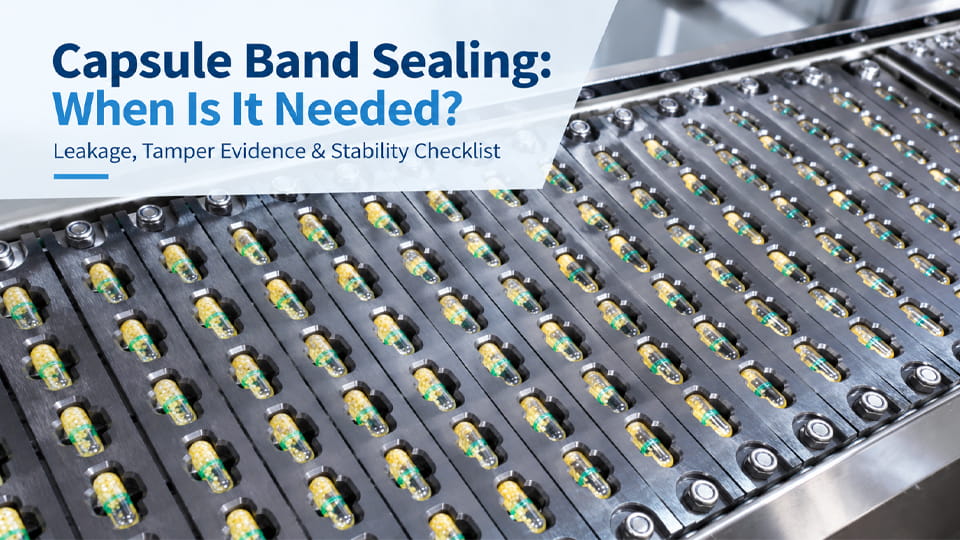
Capsule band sealing is the process of applying a narrow adhesive band around the cap-body junction of a two-piece hard capsule after filling. The band is usually a thin film of gelatin or other polymer that is applied by a specialized wypełniacz kapsułki Lub maszyna do bandażowania. After application, the band is dried or cured to form a secure, visible seal. This extra band locks the cap and body together, improving physical integrity and leak resistance.
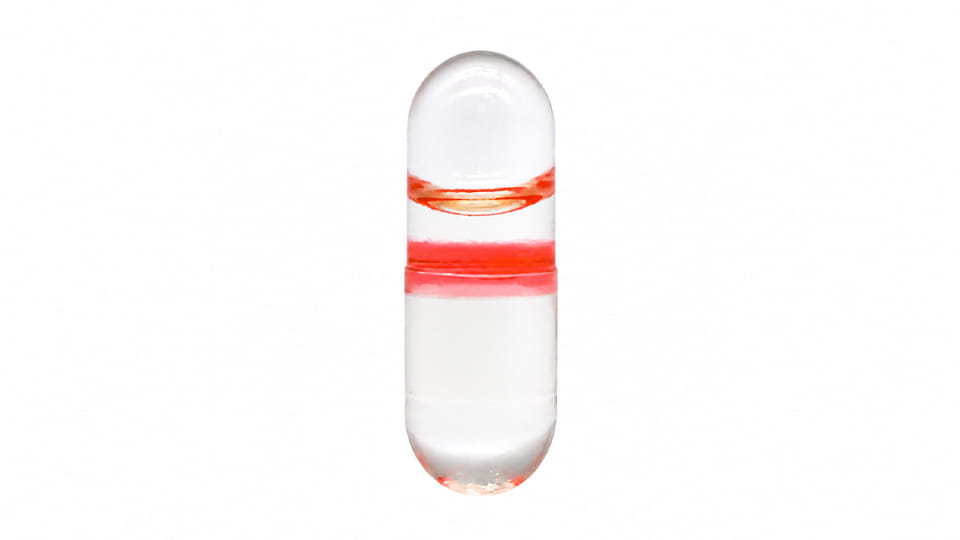
Jak to działa: In a typical liquid-filled capsule line, capsules are filled and closed in a continuous process. A banding station is usually placed after the filling station. In that station, a small wheel or roller dips into a warmed adhesive solution (often gelatin or a polymer blend) and transfers it to the capsule seam. As capsules rotate, the roller deposits a complete or partial band around the circumference of the joint. The capsules then pass through a drying tunnel or warm air chamber so the band sets into a solid seal. The sealed capsule is then inspected for uniform band thickness and dryness. You can think of banding as a “secondary gluing” step – Jinlu’s liquid capsule machine, Na przykład, wykorzystuje secondary gluing technology to achieve a firm seal.
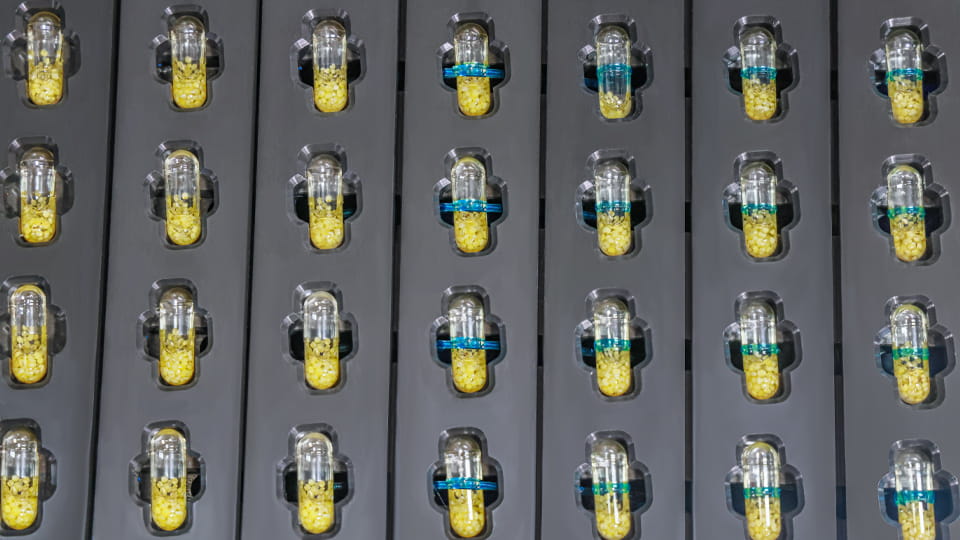
Capsule locking and capsule band sealing serve different purposes. A locking mechanism uses the design of the capsule cap and body to keep the two halves together after filling. Dla kontrastu, band sealing adds a sealing material around the cap-body joint to provide additional protection at the seam.
Dla wielu dry powder or pellet-filled capsules, a properly designed locking mechanism may provide sufficient closure for normal handling. Jednakże, when leakage resistance, capsule integrity, or specific tamper-evident requirements are important, an additional sealing process may be considered.
For liquid or flowable formulations, sealing becomes particularly important because the contents can migrate through the cap-body interface if the closure is not suitable for the formulation and process conditions. Banding is one established option, while fusion sealing and other technologies may also be appropriate depending on the capsule shell, sformułowanie, equipment and production requirements.
| Metoda | Jak to działa | Główne zalety | Main Limitations |
| Blokowanie kapsułki | Mechanical engagement between the cap and body keeps the capsule closed | Prosty; no additional sealing material or drying step | Provides mechanical closure but does not add the same seam protection as an external seal |
| Band Sealing | A sealing material is applied around the cap-body seam | Improves leakage resistance; can provide visible evidence of opening; suitable for many conventional capsule designs | Adds an application and drying process; band material and shell compatibility must be considered |
| Fusion Sealing | The cap and body are joined at the overlap area using a controlled sealing process | Can provide a continuous seal with strong seam integrity; suitable for selected liquid-filled applications | Requires compatible capsule materials and tighter process control |
| Ultrasonic Sealing | Ultrasonic energy is used to join compatible capsule components | Solvent-free process; no conventional external band is required | Requires specialized equipment and suitable capsule design |
The key difference is simple: capsule locking keeps the capsule closed, while band sealing adds protection around the cap-body seam. The need for additional sealing should be determined by the formulation, leakage risk, otoczka kapsułki, regulatory requirements and final packaging system.
Na przykład, NAS. regulations for covered OTC human drug products require applicable two-piece hard gelatin capsules to use an acceptable tamper-evident sealing technology. The capsule seal should also be considered separately from the tamper-evident feature of the final retail package.
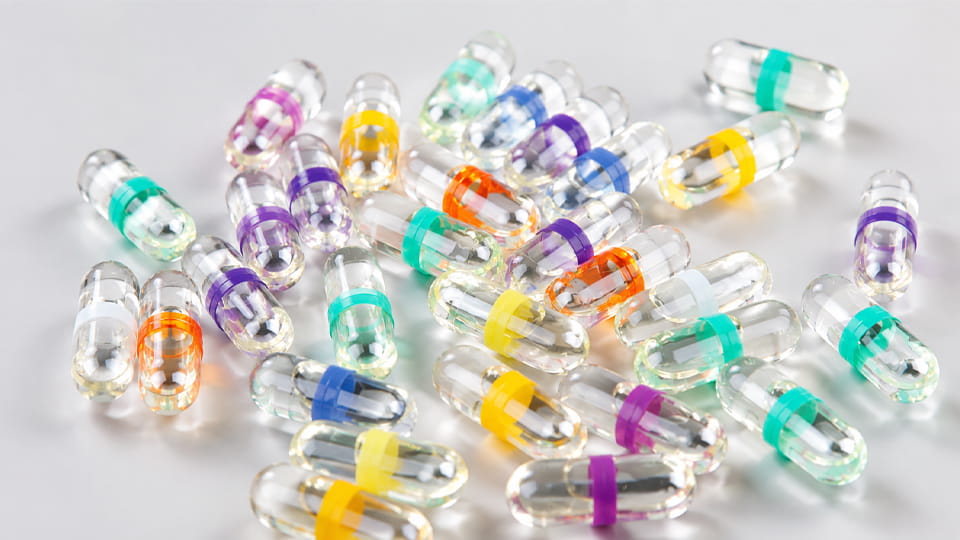
Not every hard capsule must be band sealed. The key factor is the fill’s flowability at ambient conditions. If the filled material can flow at room temperature, then sealing is almost always required. Innymi słowy, any oil, płyn, or semi-solid that can run out of the capsule if tilted needs that band. Dla kontrastu, proszki, pellets or non-flowable granules typically do not need banding (their own mass and capsule lock usually suffice). The decision depends on formuła produktu, risk factors, and regulatory or market requirements. Below are the key scenarios where banding is most often needed:
Krótko mówiąc: Whenever leakage risk or regulatory/safety concerns exist, band sealing should be used. If you have only dry powder or non-flowable granules, and no tamper rules, banding is usually unnecessary and adds cost/time.
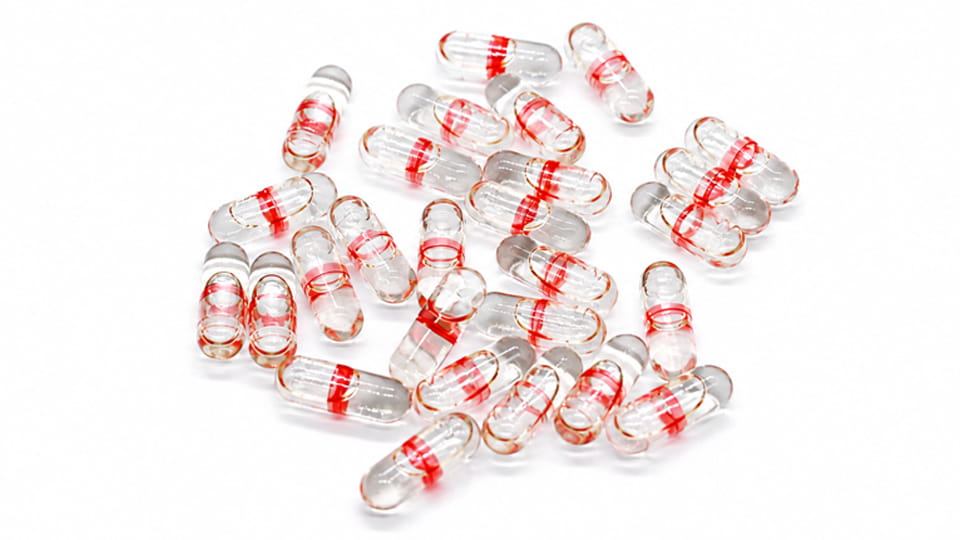
The simple answer is NIE – most dry-powder capsules do not strictly require a band if they meet quality standards. The need for banding depends on the capsule fill and product requirements. Dla jasności, here is a quick decision table mapping fill types to sealing need:
| Typ wypełnienia | Seal Required? | Dlaczego |
| Dry Powder | NIE | Dry powders stay contained; capsule lock suffices, no risk of run-out. |
| Granules/Pellets | No/Maybe | Free-flowing granules mostly safe, but very fine dusty granules might shift; consider case-by-case. |
| Półstały (waxy) | Tak | Even if solid at room temp, heat during shipping can liquefy it. |
| Flowable Liquid/Emulsion | Tak | Clearly flows; without a band, liquid will leak out of the seam. |
| Low-Viscosity Oil | Tak | Thin oils (np. Olej MCT) readily leak; need banding or formulation change. |
| High-Viscosity Gel | Często | If it stays put, banding is safer in case any portion flows under stress. |
| Hygroscopic Liquid | Tak | Moisture uptake can swell the fill/capsule and breach the lock; banding adds protection. |
| OTC Drug (dwuczęściowy) | Tak | Zgodnie z prawem (21 CFR 211.132), must have an “acceptable tamper-evident” seal. |
| Softgel-style fill | Tak | Softgel liquids (like fish oil) in a hard shell need sealing as well. |
Jeśli masz wątpliwości, perform a ocena ryzyka. Evaluate the product’s formulation (liquid vs. solidny), the operating conditions (wilgotność, temperatura), and how the capsules will be packaged and handled. Na przykład, most capsules containing liquids or gels use banding as a standard practice. W przeciwieństwie do tego, a simple vitamin tablet capsule might skip banding if it’s not required by the customer or regulation.
Expert Tip: If you see even minor seepage during prototype filling, fix the root cause (prawidłowa objętość napełnienia, capsule selection) before adding a band. Banding should be a preventive step, not a patch for a flawed process.
Unsealed capsules can leak for several reasons. The cut-line where the cap meets the body is inherently the weakest point. Even slight misalignment or imperfection lets liquid creep out. Common leakage causes include:
The best ultimate leak-fix is banding. As one capsule expert bluntly states: “The final and most effective method of capsule leakage prevention is to band the capsule with a capsule banding machine.” Innymi słowy, if other controls aren’t enough, add a band. This “fuses” the capsule into one piece, eliminating the cut-line leak path.
Before deciding to band-seal, run through this checklist of questions. (Use it as a quick reference.)
| Check | Question | Dlaczego to ma znaczenie |
| Formulation Flowability | Is the fill liquid/flowable at RT? | Tak: High leak risk; banding likely needed. NIE: May skip banding. |
| Capsule Material | Żelatyna lub HPMC? | Material affects gel compatibility: np. an aqueous band may not stick to some capsules. |
| Joint Integrity | Have you seen any seam leakage during trials? | Indicates capsule fit issues. If seals ever fail, banding gives a second barrier. |
| Fill Sensitivity | Is the product oxygen/moisture sensitive? | Banding improves barrier: protects sensitive oils from air. |
| Tamper Requirements | Is tamper-evident packaging required? | For OTC or regulated markets, an approved capsule seal is required. |
| Logistyka | Will the product face rough shipping/handling? | Bands add mechanical strength, reducing risk of capsules jarring open. |
| Processing Feasibility | Do you have equipment to apply and dry bands? | Need a bander/dryer or integrated filler-bander. Lack of drying control can ruin bands. |
| Drying Control | Can you control humidity/temperature after banding? | Proper drying is critical for a solid seal; too much moisture or heat breaks it. |
| QC Inspection | How will you test seal integrity? | Plan for visual checks, vacuum/leak tests or dye tests to confirm the band is intact. |
| Packaging Plan | Can the sealed capsules be put in TRP pack? | Even sealed capsules need a tamper-evident packaging system. |
This table is designed to be “featured-snippet” friendly: short questions and answers for quick scanning.
Band sealing can zwiększyć stabilność by bolstering the capsule’s barrier properties. By covering the cap-body joint, a band reduces pathways for oxygen and moisture. Jinlupacking notes that a banded seal typically shows “a significant reduction in oxygen diffusion” across the capsule. W praktyce, this can slow the degradation of air-sensitive ingredients. Na przykład, if a vitamin D oil capsule is very prone to oxidation, a properly applied band (often pigmented or opaque) może pomóc.
Dodatkowo, by preventing minute leaks, banding ensures the labeled dose stays contained. “Sealing transforms a filled capsule into a finished dosage form capable of withstanding handling, transport, and storage”. Without sealing, even an otherwise robust shell could allow slow evaporation or seepage under stress, shortening shelf life and altering potency.
Jednakże, it’s important to set realistic expectations. Banding contributes to protection, but it does not guarantee stability on its own. The overall stability of a product depends on the combination of shell material, składniki aktywne, substancje pomocnicze, i ostateczne opakowanie (butelka, pęcherz, itp.). Innymi słowy, banding is one part of a proper container-closure system. It’s often tested alongside the final packaging in stability studies. If a stability study shows unexpected degradation, band integrity should be reviewed – but investigators also check the primary bottle seal, osuszacze, itp.
Potential Risks: If the band is applied poorly, it could create stress at the capsule joint or even trap moisture inside before drying. Uniform drying is crucial. Gruby, slowly-set band might retain moisture longer (although usually band adhesives are mostly water or alcohol that evaporates). In rare cases, an incompatible adhesive could interact with the shell. Aby tego uniknąć, ensure the band formula is pharmaceutically acceptable (USP/FDA-compliant ingredients) and validated in trials.
Podsumowując, capsule banding is generally stability-positive — it improves physical integrity and barrier function. For hygroscopic or oxidation-prone fills, banding is a prudent step in the stability toolkit.
Once capsules are banded, quality control is vital. Here are common tests and methods:
By combining these methods, you ensure every banded capsule truly holds its seal. Jinlu’s modern machines (np. NJY-1000C) even feature built-in leak detectors that halt filling if an empty or failed seal is detected.
Even with banding, issues can arise. The table below lists common symptoms, likely causes, and how to address them:
| Problem | Możliwa przyczyna | Szybka poprawka |
| Thin or Patchy Band | Band wheel misaligned or wrong height/angle; roller speed too high; temperature too low. | Adjust band wheel height and angle to just touch the seam; set roller speed for full width; warm gelatin ~40–45 °C. |
| Slanted or Off-Center Band | Capsules misaligned before banding (np. from a locking issue). | Check capsule feed and locking station; calibrate guides so each capsule enters bander straight. Ensure closures are seated flat. |
| Band Peeling or Not Adhering | Liquid spilled on seam (capsule was wet) or band solution too cool. | Verify fill is dry before banding (no leaks at fill stage). Ensure band gel is at right temp and concentration. Dry band fully in the tunnel before exit. |
| Capsule Cracks Near Band | Band heated/sealed too aggressively or capsule wall too brittle. | Reduce gel temperature or contact time; use thinner band. Consider HPMC capsules if gelatin is fracturing. Kontroluj wilgotność. |
| Shrink or Wrinkling | Over-drying in tunnel (capsule loses moisture). | Lower drying air temperature or time. Fine-tune dryer so only band sets without dehydrating capsule. |
| Excessive Residue | Gelatin feed has debris or wrong mix. | Filter banding solution; use clean, pure band material. Replace old solution. |
(Adapted from Jinlu’s troubleshooting guidelines.) We wszystkich przypadkach, double-check both the machine settings and material quality. A good practice is to run empty capsules through the bander during setup to ensure the band appears perfect before adding product.
If your product calls for band sealing, you need the right equipment. Rozważać:
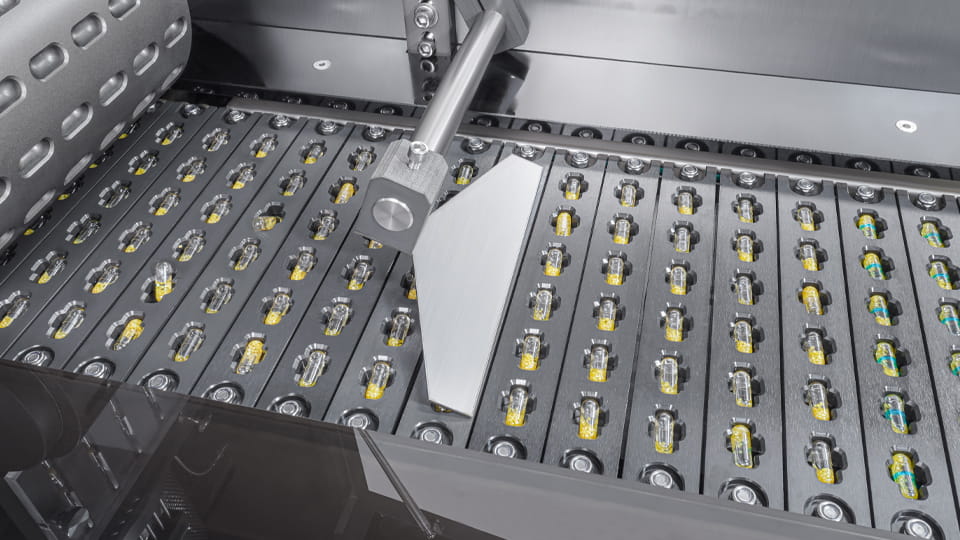
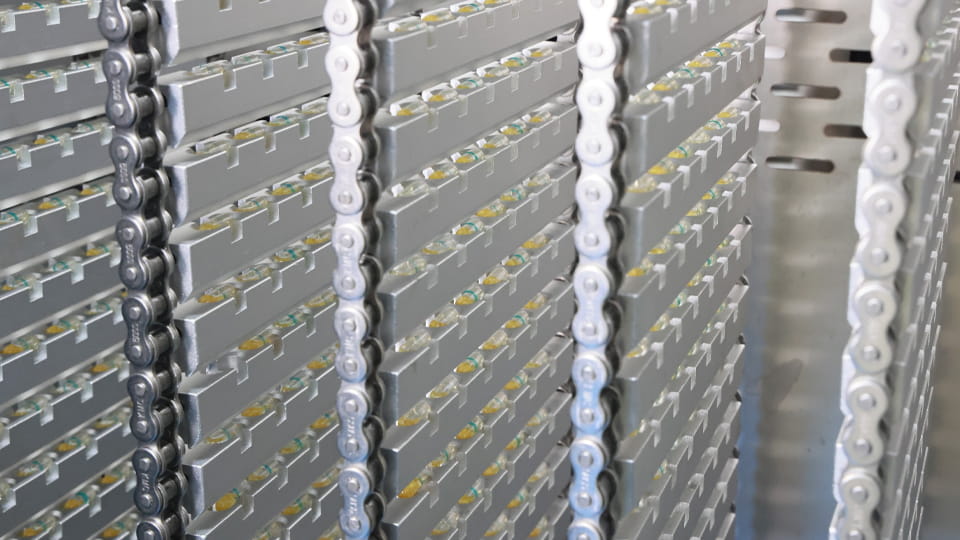
Krótko mówiąc, select a machine that fits your capsule type, speed and quality needs. Whether you choose an automatic line (like NJY-1000C) or a semi-auto bander (like CGN-208L), ensure it can produce consistent, leak-proof seals. Na przykład, Jinlu’s machines emphasize quality: the NJY-1000C has a patented sealed capsule design that automatically fine-tunes band parameters, and the CGN-208L touts “no leakage” even at high speeds thanks to its innovative locking mechanism.
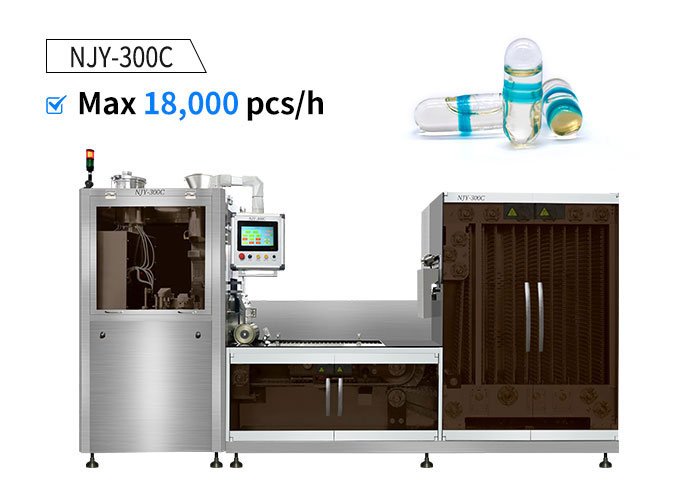
Podsumowując, capsule band sealing is a targeted solution for hard capsules that contain liquids or other problematic fills. It’s not always needed – but when your formulation can flow or when tamper regulations apply, banding is a smart choice. Cienki, dried gel band around the seam prevents leaks during drying, storage and transport, boosts capsule strength, I provides tamper evidence.
Use the above decision table and checklist to guide your decision. If you decide to band-seal, focus on proper machine setup, wysuszenie, i inspekcja. And when it’s time to buy equipment, consider integrated solutions that Jinlu Packing offers: Na przykład, nasz NJY-1000C Automatic Liquid Capsule Filler can dose the liquid, close the capsules, band-seal each capsule, and dry them on-line. For smaller batches, nasz CGN-208L Semi-Auto Liquid Filler uses a novel locking design that achieves “no leakage” even before banding. We wszystkich przypadkach, choosing a banding-capable system will give you peace of mind.
For tailored advice on capsule band sealing and the best equipment for your needs, skontaktuj się z Jinlu Packing or get a quote. Our engineers can help you evaluate whether capsule banding or other sealing technology is right for your formulation, and supply the capsule filling and banding machines suited to your output and quality goals.
NIE. Not every hard capsule requires band sealing. Many powder-filled capsules can be manufactured without an additional sealing step, while liquid-filled, flowable, or leakage-sensitive formulations may have a stronger need for capsule sealing. The decision should be based on the product’s formulation, ocena ryzyka, and intended packaging system.
Liquid-filled hard capsules are more sensitive to leakage at the cap-body junction because the formulation can flow through small gaps between the two capsule halves. Sealing creates an additional barrier around this joint, making it particularly useful for liquid, olej, and other flowable formulations.
It’s unusual. Powder doesn’t leak, so banding gives no functional benefit and wastes effort. Only consider it if you want extra tamper-evidence for powders (rare case).
Capsule locking is the normal snap-fit closure; banding is an additional polymer wrap. Locking alone doesn’t stop leaks, while banding does. W istocie, banding “fuses” the cap onto the body.
Kiedy zostało to zrobione poprawnie, it dramatically reduces leakage risk. It creates a mostly hermetic seal. Jednakże, if the band is poorly applied or the capsule shell is compromised, leaks can still happen. Always validate with leak tests.
Tak. HPMC (wegetariański) capsules can be band sealed using a water-based HPMC band solution. The process is similar to gelatin bands, though drying conditions may differ. Ensure your band material is compatible with HPMC shells.
Common causes include inconsistent capsule positioning, incorrect banding parameters, unsuitable sealing-material viscosity, inadequate drying, damaged capsule shells, excessive fill volume, and poor cap-body fit. Leakage can also originate from the filling process rather than the banding operation, so troubleshooting should evaluate the complete capsule filling and sealing process rather than the banding machine alone. Research on liquid-filled capsules has found that filling volume and process conditions can affect leakage.
When selecting a capsule banding machine, consider capsule size compatibility, zdolności produkcyjne, sealing-material compatibility, band uniformity, drying control, capsule positioning, wymagania dotyczące czyszczenia, and integration with the existing capsule filling line. For liquid-filled hard capsules, particular attention should be given to seal integrity and repeatability under actual production conditions.
Referencje:
1.Sekcja CPG. 450.500 Wymagania dotyczące opakowań odpornych na manipulacje dla niektórych dostępnych bez recepty produktów leczniczych dla ludzi —— FDA
2.Kapsułki twarde wypełnione płynem: Obecny wpływ podawania leków na technologię farmaceutyczną —— PubMed
3.Challenges and opportunities in the encapsulation of liquid and semi-solid formulations into capsules for oral administration —— PubMed
4.A comparative evaluation of the mechanical strength of sealed and unsealed hard gelatin capsules —— ScienceDirect
5.Physical stability and resistance to peroxidation of a range of liquid-fill hard gelatin capsule products on extreme long-term storage —— PubMed
6.Method for banding hard capsules using hydroxypropylmethyl cellulose (HPMC) as a base —— Patenty Google’a