

Met vloeistof gevulde capsules (ook wel met vloeistof gevulde harde capsules of LFHC's genoemd) zijn in essentie tweedelige capsules met harde schaal (gelatine of HPMC) die zijn gevuld met een op olie gebaseerde of vloeibare formulering. Na het vullen, de dop en het lichaam zijn afgedicht – vaak met een dunne gelatineband – om lekken te voorkomen. Met andere woorden, LFHC's zijn een hybride vorm: een stevig capsuleomhulsel met daarin een vloeibare dosis. Daarentegen, softgelcapsules worden in één stap gemaakt als een enkel, flexibele schaal uit één stuk dat al gevuld is met een vloeistof of halfvaste stof. Softgels gebruiken geplastificeerde gelatine (met glycerine of sorbitol) zacht maken, afsluitbaar membraan. Ze worden bijvoorbeeld doorgaans gebruikt voor zeer vette of oplosbare ingrediënten, visolie of in vet oplosbare vitamines (D, E, K) komen bijna altijd in softgels.
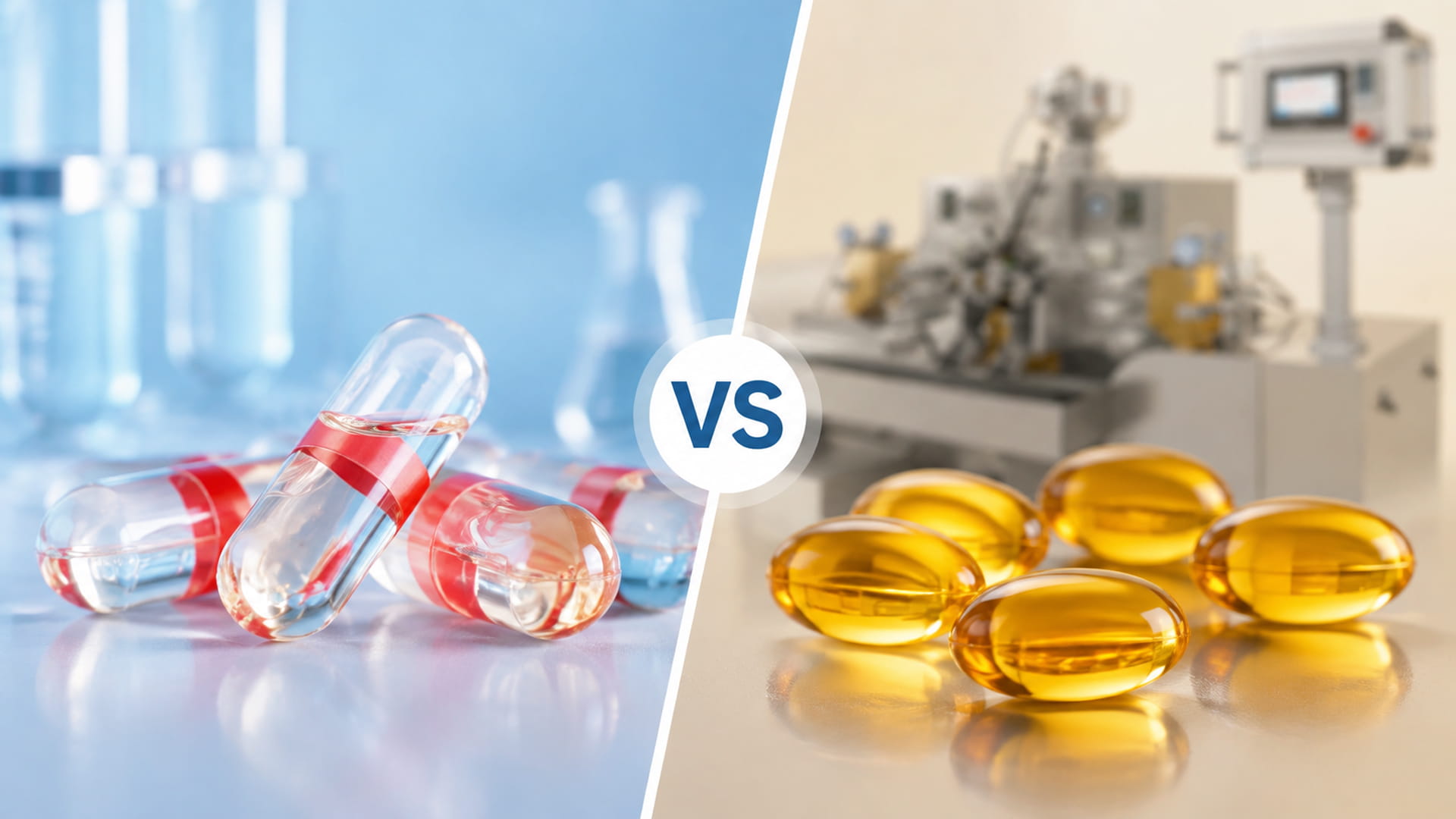
In praktische termen, beide formaten kunnen vloeibare medicijnen of supplementen leveren, maar hun ontwerp en productie aanzienlijk verschillen. De belangrijkste verschillen zijn onder meer de capsulestructuur, schaal materialen, compatibele vullingen, en productiestappen. Als u deze begrijpt, kunnen farmaceutische fabrikanten de juiste vorm voor hun product kiezen. Hieronder zetten we de belangrijkste verschillen en voordelen van elk op een rij.
Met vloeistof gevulde harde capsules (LFHC's) zijn standaard tweedelige capsulehulzen (kap en lichaam) gevuld met een vloeibare of op olie gebaseerde formulering nadat de schelpen zijn gemaakt. De schalen kunnen gemaakt zijn van gelatine of plantaardig HPMC (voor vegetarische capsules). In productie, een precieze dosis vloeistof (vaak een olie-oplossing, suspensie of zelf-emulgerende mix) wordt in het open capsulelichaam geïnjecteerd, vervolgens wordt de dop aan de bovenkant gesloten en verzegeld. Speciale afdichtingsmethoden zorgen ervoor dat er niets lekt (Bijvoorbeeld, het aanbrengen van een dunne gelatineband rond het gewricht, zogenaamde “bandafdichting”).
Dankzij deze tweedelige aanpak kunnen LFHC's de voordelen van vloeistoffen en capsules combineren. U krijgt de snelle afgifte en hoge biologische beschikbaarheid van een opgeloste vloeistof, met het gemakkelijke slikken en het maskeren van de smaak die capsules bieden. LFHC-shells zijn voorgefabriceerd, er is dus geen kostbaar smelten van gelatinevellen nodig tijdens het vullen. Bijvoorbeeld, De vloeibare capsulevuller NJY-300C van JinLuPacking vult vloeistoffen automatisch in harde schelpen van maat #00–#4 en sluit ze af met een band in één snelle lijn.
Figuur: Met vloeistof gevulde harde capsules (elk heeft een gekleurde band die de verbinding tussen dop en lichaam afdicht). Deze tweedelige capsules bevatten olie of vloeistof in een vaste gelatine/HPMC-omhulling.
Softgelcapsules (vaak maar gebeld softgels) Zijn uit één stuk, gelgecoate capsules met een vloeibare of halfvaste vulling. Ze worden gemaakt op een roterende matrijsinkapselingsmachine die zich vormt, vult, en sluit elke capsule in één stap af. In de machine, twee linten geplastificeerde gelatine (gelatine gemengd met glycerine of sorbitol) worden gegoten en samengeperst terwijl er een gedoseerde stroom vloeistof tussen wordt geïnjecteerd. Elke capsule wordt tegelijkertijd gesneden en verzegeld door verwarmde matrijzen. Het resultaat is een gladde, ovaal, luchtdichte capsule die in de volksmond wordt gebruikt voor op olie gebaseerde supplementen (denk aan vitamine E of omega-3-pillen).
Softgels zijn ideaal voor oliën en gevoelige vloeistoffen. Omdat de hele capsule hermetisch wordt afgesloten wanneer deze wordt gevormd, er is geen aparte sealstap nodig. Hierdoor zijn ze zeer beschermend tegen zuurstof en vocht. Veel visolie, vitamine D/K, en botanische olieproducten gebruiken softgels vanwege hun gemak en houdbaarheid. In werkelijkheid, Uit onderzoeken blijkt dat omega-3- en vetoplosbare vitaminesupplementen meestal als softgels worden geleverd.
Figuur: Amber softgelcapsules op een theelepel naast een pillenflesje (gebruikelijk voor visolie of vitamine D).
| Functie | Met vloeistof gevulde capsules (LFHC's) | Softgels |
| Structuur | Tweedelig (dop & lichaam) | Verzegelde capsule uit één stuk |
| Shell-materiaal | Gelatine of HPMC (vegetarische optie) | Geplastificeerde gelatine (gelatine + weekmaker) |
| Productiemethode | Vullen en vervolgens afdichten (op capsulevuller + bendes) | Inkapseling van roterende matrijzen (vorm-vul-zegel) |
| Apparatuurkosten | Lager (standaard capsulevullers) | Hoger (speciale softgellijn) |
| Schaal (MOQ) | Lage minima (geschikt voor kleine batches) | Meestal is een hoger volume vereist |
| Vegetarische optie | Ja (HPMC-shells beschikbaar) | Beperkt (nu wat zetmeel/vegetarische opties) |
| Afdichting | Mechanische afdichting (banding/fusie) | Ingebouwde afdichting (hermetisch afgesloten door matrijs) |
| Lekkagerisico | Laag (eenmaal goed afgesloten) | Zeer laag (geen naad die kan lekken) |
| Productieflexibiliteit | Hoog (kan poeders of pellets met vloeistof mengen) | Medium (alleen vloeibare/pastavullingen) |
| Opschaling | Eenvoudig (maakt gebruik van standaard capsulemachines) | Complexer (gespecialiseerd drogen, enz.) |
Beide vormen leveren vloeibare of op olie gebaseerde actieve stoffen en kunnen een hoge biologische beschikbaarheid bieden door het geneesmiddel opgelost in een lipide aan te bieden.. Echter, LFHC's gebruiken eenvoudigere lijnen (schelpen zijn vooraf gemaakt) terwijl softgels kook- en droogstappen vereisen voor de gelatinelinten.
Belangrijkste afhaalmaaltijd: Softgel-machines formulier, vullen, en in één stap snijden (drogen noodzakelijk), terwijl LFHC-lijnen kant-en-klare schalen vullen en afdichten (het overslaan van een langdurige uithardingsfase). Zoals een branchegids opmerkt, “Softgels drogen 2-4 dagen na het vullen uit. LFHC’s hebben geen uithardingsstap… batchverliezen als gevolg van mislukte vulling zijn groter voor softgels”.
Met vloeistof gevulde capsules bieden verschillende productie- en productvoordelen:
Deze voordelen maken LFHC's aantrekkelijk in zowel farmaceutische als nutraceutische markten.
Softgels hebben ook sterke voordelen die ze populair maken voor veel supplementen:
Industrieën die softgels gebruiken, zijn onder meer farmaceutische producten (medicijnen op oliebasis), nutraceutica (voedingssupplementen), cosmetica (nutraceutische schoonheidsoliën), en zelfs veterinaire producten. Bijvoorbeeld, veganistische of halal softgels gemaakt van zetmeel/gellan zijn in opkomst.
| Ingrediënt / Vullen | Met vloeistof gevulde capsule | Softgelcapsule |
| Visolie / Omega-3 | ✓ Geschikt | ✓ Geschikt |
| CBD of Cannabisolie | ✓ Geschikt | ✓ Geschikt |
| Curcumine (Kurkuma-extract) | ✓ Geschikt | ✓ Geschikt |
| Vitamine D (olie) | ✓ Geschikt | ✓ Geschikt |
| Vloeibare kruidenextracten | ✓ Geschikt | ✓ Geschikt |
| Probiotica | ✓ (indien gesuspendeerd in olie) | Nee (vocht doodt bacteriën) |
| Vochtgevoelige API's | ✓ (vooral in HPMC-capsules) | ✗ (shell hoge vochtigheid) |
Beide capsuletypen kunnen goed omgaan met in olie oplosbare actieve stoffen. Gebruikelijke nutraceutische oliën (visolie, vitamine D, Kruidenuittreksels, CBD, enz.) worden effectief geleverd door LFHC's of softgels.
Opmerkelijk, droge of vochtgevoelige ingrediënten zijn beter in met vloeistof gevulde harde capsules. Bijvoorbeeld, probiotica of watergevoelige API's zijn onpraktisch in softgels. Daarentegen, HPMC harde capsules kunnen niet-waterige suspensies van probiotica of zeer droge formuleringen bevatten, omdat HPMC een lage vocht- en gasdoorlaatbaarheid heeft. Softgelschalen bevatten ongeveer 30% water en een hogere zuurstofdoorlaatbaarheid, die dergelijke ingrediënten kunnen afbreken.
Kortom, gebruik LFHC’s wanneer flexibiliteit en productie in kleine volumes van belang zijn; kies softgels vanwege de schaal en de uitstraling van een premium schap.
Vanuit het perspectief van een fabrikant, de beslissing hangt vaak af van de schaal, investering, en strategische doelen:
Onderstaande tabel vat de keuze per scenario samen:
| Bedrijfstype / Situatie | Aanbevolen formaat |
| Kleine startup of R&D-project | Met vloeistof gevulde capsules (lage MOQ, flexibele) |
| Niche-supplementenlijn, <10k eenheden | Met vloeistof gevulde capsules |
| Contractfabrikant (flexibiliteit) | Met vloeistof gevulde capsules |
| Grote farmaceutische producent | Softgels (hoge doorvoer, consistent) |
| Hoogvolume omega-3 of vitamines | Softgels |
| Product waarvoor een veganistische capsule nodig is | Met vloeistof gevulde capsules (HPMC-schelpen) |
Figuur: Close-up van een vulmachine voor vloeibare capsules die vloeistof in capsules doseert.
JinLuPacking produceert een volledig assortiment capsuleapparatuur. Bijvoorbeeld, ons NJY-300C vloeibare capsulevuller lijn verwerkt vloeibare vullingen, en wij bieden ook zachte gelcapsulemachines voor productie in één stap. Deze machines voldoen aan de cGMP-normen voor farmaceutisch en nutraceutisch gebruik.
Op het einde, beide met vloeistof gevuld harde capsules En softgels zijn goed ingeburgerd, effectieve doseringsvormen. Softgels blinken uit in het leveren van oliën en in olie oplosbare actieve stoffen die snel oplossen, verzegelde verpakking. Met vloeistof gevulde harde capsules bieden flexibiliteit, sneller R&D-schaal, en eenvoud van productie. Door hun verschillen te begrijpen, voordelen en productievereisten, fabrikanten kunnen het capsuletype kiezen dat het beste past bij de chemie en zakelijke behoeften van hun product.
Als u een nieuwe formulering ontwerpt of uw productielijn upgradet, overweeg beide opties zorgvuldig. Klaar om uw capsuleproductie te optimaliseren? Jinlu Packing biedt toonaangevende apparatuur voor beide formaten (Bijvoorbeeld, onze NJP-1000C kan vol raken 60,000 harde capsules per uur) en kan u adviseren over de beste oplossing voor uw product. Neem contact met ons op om uw project te bespreken, vraag een offerte aan, of leer meer over onze vloeibare capsule en softgel verpakkingslijnen.
Ja. Gespecialiseerde capsulevullers (zoals de vulmachines voor vloeibare capsules van JinLuPacking) kan oliën of vloeistoffen in lege harde capsules injecteren, die vervolgens worden verzegeld (bijv. door banding) zodat ze de vloeistof veilig vasthouden. Hierdoor ontstaat een ‘met vloeistof gevulde harde capsule’.
Geen van beide is universeel ‘beter’ – ze dienen verschillende behoeften. LFHC's winnen op kosten, snelheid, en flexibiliteit (vooral voor kleine batches), terwijl softgels een naadloze afdichting en een vertrouwd formaat bieden voor oliesupplementen. De beste keuze hangt af van uw vulmateriaal, productievolume, en markt.
Goed afgesloten LFHC's lekken niet. Na het vullen, de verbinding tussen kap en lichaam wordt hermetisch afgesloten door het aanbrengen van een gelatine- of HPMC-band (of met behulp van fusieafdichting). Wanneer correct gedaan, de capsules houden de vloeistof stevig vast tijdens het drogen, opslag, en gebruik. Kwaliteitslijnen testen en polijsten elke batch om de integriteit te garanderen.
Beide kunnen een uitstekende biologische beschikbaarheid bieden voor op olie gebaseerde actieve stoffen. De vulformulering (olie soort, emulgatoren) dicteert meestal de absorptie, niet het shell-type. Softgels lossen snel op (~10–20 minuten), terwijl capsules met harde schaal (LFHC) iets langzamer oplossen (30–60 min). In de praktijk, goed ontworpen vullingen in beide vormen kunnen een vergelijkbare werkzaamheid bereiken.
Ja. Plantaardige HPMC-omhulsels worden veel gebruikt voor met vloeistof gevulde capsules. Het lage vochtgehalte en de sterke structuur van HPMC laten olieachtige vloeistoffen binnen. In werkelijkheid, het gebruik van HPMC-schalen is een manier om een vegetarische capsule in vloeibare vorm aan te bieden, die standaard gelatine-softgels niet kunnen bieden.
Bedrijven noemen redenen zoals lagere productiekosten, kortere doorlooptijden, en formuleringsflexibiliteit. Bijvoorbeeld, een R&Het D-team kan snel de doses aanpassen of ingrediënten in LFHC's combineren zonder aanpassingen te hoeven doen. Ook, Met VFHC's kunnen productlijnen eenvoudig worden uitgebreid (omdat dezelfde capsules met verschillende vloeistoffen kunnen worden gevuld).
Algemeen, Ja. Voor de productie van softgels is dure apparatuur nodig (gelatine kooktoestellen, roterende matrijzen, drogers) en meer arbeid over meerdere dagen. LFHC's gebruiken eenvoudiger vulstoffen en minder energie. Volgens brancherapporten kosten LFHC's 15-35% minder per eenheid om te produceren dan softgels. Echter, bij zeer hoge volumes kunnen softgels nog steeds kosteneffectief zijn.
Vloeibare ingrediënten worden gevuld met behulp van een vulmachine voor vloeibare capsules (vaak een opzetstuk of variant van een standaard capsulevuller). Bijvoorbeeld, De machines uit de NJY-serie van JinLuPacking maken gebruik van precisiepompen (keramische zuiger of micropomp) om olie in capsules te doseren. Deze machines kunnen hoge snelheden bereiken (enkele duizenden caps per uur) met nauwkeurigheid beter dan ±1%.
Meestal niet-waterig, vullingen op olie- of oplosmiddelbasis. Veelvoorkomende voorbeelden: visolie, vitamine E olie, vloeibare vitamines, kruidenolie-extracten, emulsies, en bepaalde zelf-emulgerende systemen voor medicijnafgifte. De vulling moet verpompbaar zijn en in het algemeen niet corrosief. Vloeistoffen op waterbasis worden vermeden (ze kunnen zeehonden verzwakken). De vulviscositeit moet worden gecontroleerd om spatten of druppelen tijdens het vullen te voorkomen.
Ja. Veel capsulemachines zijn converteerbaar: door het doseersysteem te verwisselen, ze kunnen poeders/korrels of vloeistoffen afvullen. In de praktijk, De poederdoseerplaat van een standaard capsulevuller is vervangen door een vloeistofvulkop en pompsysteem. Deze veelzijdigheid betekent dat één enkele lijn kan schakelen tussen poeder- en LFHC-productie.
Referenties:
1.Vloeistofgevulde en verzegelde harde gelatinecapsules —— Taylor & Franciscus Online
2.Zachte gelatinecapsules (Softgels) —— WetenschapDirect
3.Temperatuureffecten op lintkarakteristieken bij de vervaardiging van zachte gelatinecapsules —— Nationale Bibliotheek voor Geneeskunde
4.Uitgebreid overzicht van zachte gelatinecapsules: Industriële productie, Technologische vooruitgang, en regelgevingsperspectieven —— Tijdschrift voor drugsbezorging & THERAPEUTICA
5.Vloeistofgevulde harde gelatinecapsule —— Tijdschrift voor drugsbezorging & THERAPEUTICA
6.Bepaling van de optimale hoeveelheid water in vloeistofvulmassa's voor harde gelatinecapsules door middel van textuuranalyse en experimenteel ontwerp —— Nationale Bibliotheek voor Geneeskunde