×
온라인 서비스
✉️이메일: 💬WhatsApp: +86 18011793320
💡
  • 블로그
  • 액체 충전 캡슐과 소프트젤: 주요 차이점, 이익, 제조 공정 & 선택 방법

액체 충전 캡슐과 소프트젤: 주요 차이점, 이익, 제조 공정 & 선택 방법

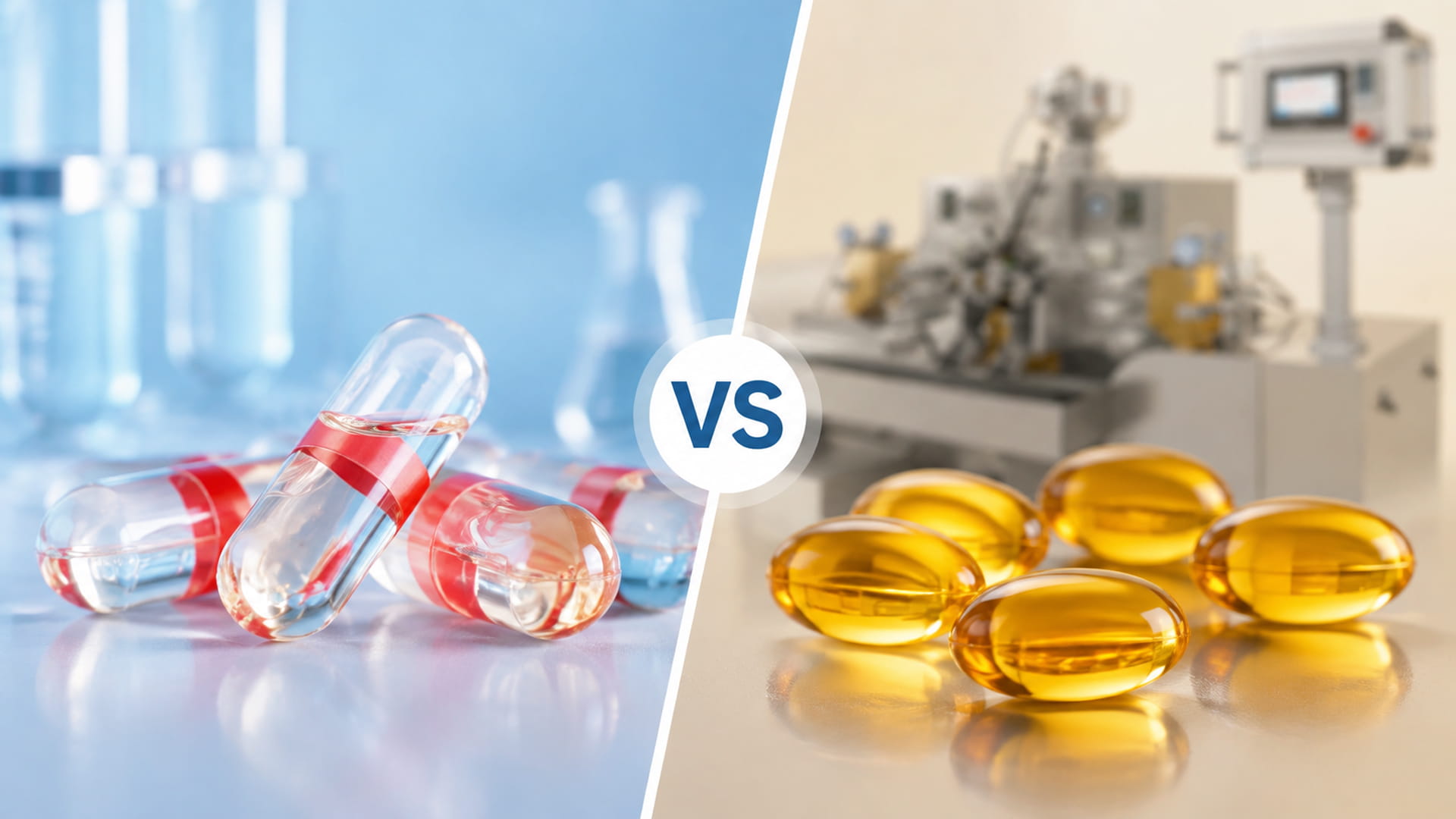
액체로 채워진 캡슐 (also called liquid-filled hard capsules or LFHCs) are essentially two-piece hard-shell capsules (젤라틴 또는 HPMC) that have been filled with an oil-based or liquid formulation. 충전 후, the cap and body are sealed – often with a thin gelatin band – to prevent leaks. 다시 말해서, LFHCs are a hybrid form: a solid capsule shell containing a liquid dose inside. 대조적으로, 소프트젤 캡슐 are made in one step as a 하나의, flexible one-piece shell that is already filled with a liquid or semi-solid. Softgels use plasticized gelatin (with glycerin or sorbitol) to make a soft, sealable membrane. They are typically used for very oily or soluble ingredients – for example, fish oil or fat-soluble vitamins (디, 이자형, 케이) almost always come in softgels.

액체 충전 캡슐과 소프트젤

실용적인 측면에서, both formats can deliver liquid drugs or supplements, but their design and production differ significantly. Key differences include capsule structure, 쉘 재료, compatible fills, 및 제조 단계. Understanding these helps pharma manufacturers choose the right form for their product. Below we break down the main distinctions and benefits of each.


What Are Liquid-Filled Capsules?

액체로 채워진 경질 캡슐 (LFHC) 표준이다 two-piece capsule shells (모자와 몸) filled with a liquid or oil-based formulation after the shells are made. The shells can be made of gelatin or plant-based HPMC (for vegetarian capsules). 생산 중, a precise dose of liquid (종종 오일 용액, suspension or self-emulsifying mix) is injected into the open capsule body, then the cap is closed on top and sealed. Special sealing methods ensure nothing leaks (예를 들어, applying a thin gelatin band around the joint, called “band sealing”).

This two-piece approach allows LFHCs to combine the benefits of liquids and capsules. You get the quick-release and high bioavailability of a dissolved liquid, with the easy swallowing and masking of taste that capsules offer. LFHC shells are pre-manufactured, so no costly melting of gelatin sheets is needed during fill. 예를 들어, JinLuPacking’s NJY-300C liquid capsule filler automatically fills liquids into size #00–#4 hard shells and band-seals them in one fast line.

액체로 채워진 경질 캡슐 (each has a colored band sealing the cap-body joint)

수치: 액체로 채워진 경질 캡슐 (each has a colored band sealing the cap-body joint). These two-piece capsules hold oil or liquid inside a solid gelatin/HPMC shell.


What Are Softgels?

소프트젤 캡슐 (often just called 소프트젤) ~이다 원피스, gel-coated capsules containing a liquid or semi-solid fill. They are made on a rotary-die encapsulation machine that forms, 채우다, and seals each capsule in a single step. In the machine, two ribbons of plasticized gelatin (gelatin mixed with glycerin or sorbitol) are cast and pressed together while a metered stream of liquid is injected between them. Each capsule is simultaneously cut and sealed by heated dies. 결과는 매끄럽다, 타원형, airtight capsule popularly used for oil-based supplements (think vitamin E or omega‑3 pills).

Softgels are ideal for oils and sensitive liquids. Because the entire capsule is hermetically sealed when it’s formed, no separate sealing step is needed. This makes them very protective against oxygen and moisture. Many fish oil, vitamin D/K, and botanical oil products use softgels for their convenience and shelf stability. 사실은, surveys show Omega-3 and fat-soluble vitamin supplements are most often delivered as softgels.

Amber softgel capsules on a teaspoon next to a pill bottle

수치: Amber softgel capsules on a teaspoon next to a pill bottle (common for fish oil or vitamin D).


액체 충전 캡슐과 소프트젤: 주요 차이점

  • 캡슐 구조: Liquid-filled hard capsules are 투피스 units – a cap and body – that are joined after filling. The cap can in principle be removed (밀봉하기 전에), making them reopenable in the filling line. Softgels are a 원피스 sealed pouch with no separable parts. Once a softgel is formed, it’s hermetically sealed and can’t be opened without breaking the shell.
  • Shell Material: Hard capsules are made of gelatin or vegetarian polymer (like HPMC) 플러스 물, without added plasticizers. Softgel shells contain gelatin 가소제 포함 (예를 들어. glycerin or sorbitol) to keep them elastic. This means softgel shells are softer and more pliable, whereas hard capsule shells are firmer and dry.
  • 채우기 유형: Standard hard capsules typically hold 건조 분말, 과립, mini-tablets or pellets. 대조적으로, softgels contain 액체, 석유 기반, or semi-solid 채우다. Liquid-filled hard capsules bridge the gap: they use a hard capsule shell but are filled with liquid or suspension, similar to what softgels hold. 실제로, softgels handle pure oils and solutions; LFHCs can also accept suspensions or combination fills (예를 들어. tiny tablets plus oil).
  • 제조 공정: Hard capsule production is a two-step process. 첫 번째, empty capsule shells are formed (by dipping molds in gelatin), then later filled and sealed. Softgels are made in a single continuous process on a rotary-die machine: molten gelatin sheets are cast, meet at a filling station where the liquid is injected, and then the capsules are cut and sealed in one motion. 요약:
    • 경질캡슐 (LFHC): Shells are pre-made; filling and sealing are done later (liquid is pumped into each capsule body, then cap is put on and sealed).
    • 소프트젤: Shell formation, 충전재, and sealing happen together on a specialized machine.
  • Drying/Curing: Softgels require post-fill drying. The freshly-made softgel shells are moist and need to be tumbled and then tray-dried for hours to reduce moisture to the target level. This curing can take 2–4 days in total. 액체로 채워진 경질 캡슐 do not need this drying step: once filled and sealed, they can move straight to inspection or packaging.
  • Hermetic Seal: Softgels have a continuous hermetic seal by design (the two gelatin layers fuse completely), giving them very low oxygen permeability. LFHCs must use special sealing: typically a thin gelatin band or fusion at the cap-body joint. A band seal provides a strong barrier against leaks, though it is a mechanical patch rather than a continuous shell.
  • Production Equipment: Softgel manufacturing requires expensive rotary die encapsulation lines, climate-controlled rooms, and skilled operation. LFHC production can use standard 캡슐 충전 기계 (with an added liquid pump) which are simpler and often already available in-house. 사실은, a typical LFHC line can run a complete batch in a single day, whereas softgels need multi-day gelatin preparation and drying cycles.
  • Regulatory/Marketing: Because LFHCs use 채식주의 껍질 (like HPMC) by default, they easily meet vegan/halal standards. Traditional softgels (소/돼지 젤라틴) ~이다 ~ 아니다 halal/vegan, unless using specialty fish gelatin or non-gelatin alternatives. Softgels are widely recognized in the supplement market (consumers expect fish oil in softgels, 예를 들어), while LFHCs look like standard capsules and can be customized in color and printing.
특징 Liquid-Filled Capsules (LFHC) 소프트젤
구조 투피스 (캡 & 몸) One-piece sealed capsule
Shell Material Gelatin or HPMC (vegetarian option) Plasticized gelatin (젤라틴 + 가소제)
Manufacturing Method Fill then seal (on capsule filler + 갱단) Rotary die encapsulation (양식 채우기 봉인)
Equipment Cost 낮추다 (standard capsule fillers) 더 높은 (dedicated softgel line)
규모 (MOQ) Low minimums (fits small batches) Usually higher volume required
Vegetarian Option 예 (HPMC shells available) 제한된 (now some starch/veg options)
밀봉 Mechanical sealing (banding/fusion) Built-in seal (hermetically sealed by die)
Leakage Risk 낮은 (once sealed properly) 매우 낮음 (no seam to leak)
생산 유연성 높은 (can mix powders or pellets with liquid) 중간 (only liquid/paste fills)
Scale-Up 쉬운 (uses standard capsule machines) 더 복잡함 (specialized drying, 등.)

Both forms deliver liquid or oil-based actives and can offer high bioavailability by presenting the drug dissolved in a lipid. 하지만, LFHCs use simpler lines (shells are pre-made) whereas softgels require cooking and drying steps for the gelatin ribbons.

Liquid-Filled Capsules and Softgels with a glass of water


Manufacturing Process Comparison

  • Liquid-Filled Capsules: Two-piece shells are pre-fabricated. In the filling line, empty capsules are separated, bodies are filled via metered pumps, then caps are attached and the seam is sealed by banding or fusion. 있다 no multi-day curing step. Finished capsules go straight to inspection and packaging. This streamlined process (fill one day, seal same day) makes LFHC production very fast.
  • 소프트젤: The process starts with making a gelatin melt: 젤라틴 (plus glycerin/sorbitol and colorant) is mixed into a molten syrup. Two ribbons from this gelatin mass are formed on heated drums. 액체 채우기 (기름, 보류, 등.) is injected between the ribbons, and the ribbon is cut/sealed into capsules. Crucially, each softgel batch must then dry for 2–4 days before packaging to stabilize its moisture. This drying period adds time and requires controlled humidity rooms. Quality control can only occur after drying (longer lead time).

Key takeaway: Softgel machines 형태, 채우다, and cut in one step (necessitating drying), while LFHC lines fill pre-made shells and seal them (skipping a lengthy curing stage). 업계 가이드 중 하나는 다음과 같습니다., “Softgels cure 2–4 days post-fill. LFHCs have no curing step… batch losses from fill failure are higher for softgels”.


Advantages of Liquid-Filled Capsules

Liquid-filled capsules offer several manufacturing and product advantages:

  • Improved Bioavailability for Tough Drugs: LFHCs excel at delivering poorly soluble, low-dose or potent actives. Formulating the API in an oil or lipid solution enhances solubility and absorption compared to a powder. 예를 들어, heat-sensitive or waxy compounds can be dissolved in oil and quickly absorbed, often leading to a faster or stronger effect.
  • Flexible Development & 투약: Adjusting dose strengths is easy with liquids. You simply change the concentration of active in the fill. This “quick and simple dose adjustment” makes R&D faster and scale-up smoother. A company can fill the same capsule shell with different concentrations as needed, streamlining clinical and commercial batch changes without new tooling. Prototype batches can even be done in-house with benchtop fillers rather than expensive softgel pilot lines.
  • 더 빠르게, Lower-Cost Production: Since hard capsule shells are made separately, LFHC production avoids the multi-day gelatin cooking/drying of softgels. An LFHC batch (채우다 + 밀봉하다) can be completed in 시간 or a single day, versus 3–4 days for a softgel line. The equipment is simpler (standard capsule filling machine with a liquid pump). 이는 다음을 의미합니다. lower capital investment, 더 작은 설치 공간, and higher output per shift. There’s also minimal waste: softgel lines can lose up to ~40% of the gelatin web to trim, whereas LFHCs waste virtually none of the shell material.
  • Better Product Stability: LFHC shells (특히 HPMC) have lower moisture and oxygen permeability than softgel gelatin shells. HPMC capsules can support very dry fills and block moisture ingress. When combined with hermetic band sealing, LFHC products often have a longer shelf life and are more stable in harsh conditions. 실용적인 측면에서, the reduced water content and permeability preserve sensitive oils or vitamins better over time.
  • Combination Formulations: Because they are two-piece, LFHCs can combine multiple forms in one capsule. You can put a tablet, 작은 공, or powder along with the liquid fill. 예를 들어, a single capsule might hold an oil-based vitamin E liquid and a separate dry tablet of herbal extract. This multi-particulate flexibility is not possible in a one-piece softgel. It lets companies create innovative fixed-dose combos or keep product families with one dosage form.

These advantages make LFHCs attractive in both pharmaceutical and nutraceutical markets.


Advantages of Softgel Capsules

Softgels also have strong benefits that make them popular for many supplements:

  • Excellent Oxygen/Moisture Barrier: The hermetic seal of a softgel (the two ribbons are fused) means almost no air or water penetrates. This is ideal for oxygen-sensitive oils (예를 들어. 생선 기름, 비타민 D) because it prevents oxidation. Many manufacturers trust softgels to keep oils fresh and odor-free for longer.
  • High Bioavailability: Like LFHCs, softgels deliver actives in liquid form, which often boosts absorption. The liquid or self-emulsifying fills can provide rapid drug release in the GI tract. Studies show softgels dissolve in ~10–20 minutes, making the active quickly available.
  • 삼키기의 용이성: 소프트젤은 부드럽습니다., rounded shape and slip down easily with water. This can enhance patient compliance, especially for larger doses. Many people find softgels more pleasant than hard pills.
  • Premium Appearance and Customization: Softgel shells can be made opaque, colored, or shaped for branding. 예를 들어, tri-color or unique shapes can distinguish a product line. This “cosmetic” advantage adds perceived value on retail shelves.
  • Versatile Liquid Fills: Softgels can hold complex formulations – oils, 서스펜션, or even dissolved powders – without issue. They can encapsulate delicate botanical extracts (예를 들어. CBD 오일, aloe vera) or oil-soluble vitamin blends. 부드러운, pliable shell also masks unpleasant tastes or odors of the fill.
  • Consumer Familiarity: Softgels are an industry-standard for popular supplements (생선 기름, vitamin E, prenatal vitamins, 등.), so consumers often expect and accept this format.

Industries using softgels include 의약품 (oil-based medications), 기능식품 (건강 보조 식품), 화장품 (건강기능식품 뷰티 ​​오일), and even veterinary products. 예를 들어, vegan or halal softgels made from starch/gellan are on the rise.


Which Ingredients Are Best for Each Capsule Type?

재료 / 채우다 액체로 채워진 캡슐 Softgel Capsule
Fish Oil / 오메가-3 ✓ Suitable ✓ Suitable
CBD or Cannabis Oil ✓ Suitable ✓ Suitable
커큐민 (Turmeric Extract) ✓ Suitable ✓ Suitable
비타민 D (기름) ✓ Suitable ✓ Suitable
Herbal Liquid Extracts ✓ Suitable ✓ Suitable
프로바이오틱스 (if suspended in oil) 아니요 (moisture kills bacteria)
Moisture-Sensitive APIs (especially in HPMC capsules) (shell high moisture)

Both capsule types handle oil-soluble actives well. Common nutraceutical oils (생선 기름, 비타민 D, 약초 추출물, CBD, 등.) are effectively delivered by either LFHCs or softgels.

특히, dry or moisture-sensitive ingredients are better in liquid-filled hard capsules. 예를 들어, probiotics or water-sensitive APIs are impractical in softgels. 대조적으로, HPMC hard capsules can hold non-aqueous suspensions of probiotics or very dry formulations, since HPMC has low moisture and gas permeability. Softgel shells contain about 30% water and higher oxygen permeability, which can degrade such ingredients.


Which Industries Prefer Each Format?

  • 액체 충전 경질 캡슐: Widely used in 기능식품 그리고 의약품, especially for new or small-batch products. Startups or 계약 제조업체 often favor LFHCs for R&D flexibility and lower initial cost. They’re also used in 화장품 (nutraceutical beauty products) 그리고 veterinary supplements where ingredient flexibility is needed.
  • 소프트젤: Favored by large pharmaceutical and supplement companies producing high-volume, established products. Many omega‑3, multivitamin, and prescription oil medications come as softgels due to their consumer recognition and shelf-life. Softgels are also standard for any liquid prescription drug where hermetic sealing is critical.

요컨대, use LFHCs when flexibility and low-volume production matter; choose softgels for scale and premium shelf appeal.


Which Is Better for Manufacturers?

From a manufacturer’s point of view, the decision often depends on scale, investment, and strategic goals:

  • New or Small Producers: Liquid-filled capsule lines have lower startup costs and smaller equipment needs. Because they use standard capsule fillers (with a liquid dosing unit), the same machines can serve existing powder capsule processes with a simple changeover. This keeps capital investment low. 또한, LFHC require smaller minimum orders and shorter lead times, making them ideal for limited runs and fast market entry.
  • Large Producers or High-Volume Products: 소프트젤, though costlier to set up, shine when volumes are huge. High-speed rotary die machines can churn out thousands of softgels per minute once commissioned. For very high-demand items (예를 들어. top-selling fish oil brands), the per-unit cost of softgels can eventually be lower despite higher overhead. The hermetic sealing also means less risk of manufacturing rejects from leaks.
  • Contract Manufacturers: Many CMOs offer both options today. They may steer clients toward LFHCs for early-stage or niche products (due to quick turn-around), and toward softgels for blockbuster formulations that justify dedicated lines.

The table below summarizes the choice by scenario:

Company Type / Situation Recommended Format
Small startup or R&D project Liquid-Filled Capsules (low MOQ, 유연한)
Niche supplement line, <10k units Liquid-Filled Capsules
계약제조업체 (유연성) Liquid-Filled Capsules
Large pharmaceutical producer 소프트젤 (높은 처리량, 일관된)
High-volume omega-3 or vitamins 소프트젤
Product needing vegan capsule Liquid-Filled Capsules (HPMC 쉘)


Equipment Required

  • For Liquid-Filled Capsules: 표준 capsule-filling line (either semi or fully automatic) 사용된다, 와 liquid filling attachment. Key equipment includes a 액체 캡슐 충전물 기계 (예를 들어. JinluPacking’s NJY-300C or NJY-1000C) that meters and injects the oil into empty capsules. 충전 후, 에이 banding machine applies a gelatin (또는 HPMC) seal around the capsule seam. 마지막으로, dryers and polishers finish the line. JinLuPacking offers dedicated 액체 캡슐 충전물 기계 that integrate pumps, 노즐, and banders on one platform.
    Close-up of a liquid capsule filling machine dispensing liquid into capsules수치: Close-up of a liquid capsule filling machine dispensing liquid into capsules.
  • For Softgels: 완전한 rotary die 소프트젤 캡슐화 기계 필요하다 (예를 들어. JinLuPacking’s softgel line), along with associated units. The softgel line includes a gelatin mixer/pelletizer, 젤라틴을 녹이다, 주조 드럼, rotary die module, and conveyors. 캡슐화 후, the capsules enter a tumble or drying tunnel (for 24–72 hours) 그리고 polishing/sorting machine. Softgel equipment investment is significant, but it produces finished capsules in one flow.

    Softgel 캡슐화 기계의 측면도
    수치: Softgel 캡슐화 기계의 측면도

JinLuPacking manufactures a full range of capsule equipment. 예를 들어, 우리의 NJY-300C 액체 캡슐 필러 line handles liquid fills, and we also provide soft gel capsule machines for one-step production. These machines meet cGMP standards for pharmaceutical and nutraceutical use.


결론

결국, both liquid-filled 하드 캡슐 그리고 소프트젤 are well-established, 효과적인 투여 형태. Softgels excel at delivering oils and oil-soluble actives with a quick-dissolving, 변조 방지 패키지. Liquid-filled hard capsules offer flexibility, faster R&D scaling, and manufacturing simplicity. 차이점을 이해함으로써, benefits and production requirements, manufacturers can pick the capsule type that best fits their product’s chemistry and business needs.

If you’re designing a new formulation or upgrading your production line, consider both options carefully. Ready to optimize your capsule production? Jinlu Packing offers industry-leading equipment for both formats (예를 들어, our NJP-1000C can fill up to 60,000 hard capsules per hour) and can advise on the best solution for your product. 저희에게 연락하십시오 당신의 프로젝트를 논의하기 위해, 견적을 요청하다, or learn more about our liquid capsule and softgel 포장 라인.


FAQs on Liquid-Filled Capsules vs Softgels

Can hard capsules be filled with liquid?

예. Specialized capsule fillers (like JinLuPacking’s liquid capsule filling machines) can inject oils or liquids into empty hard capsules, which are then sealed (예를 들어. by banding) so they hold the liquid securely. This creates a “liquid-filled hard capsule.”

Are liquid-filled capsules better than softgels?

Neither is universally “better” – they serve different needs. LFHCs win on cost, 속도, 그리고 유연성 (especially for small batches), while softgels offer a seamless seal and familiar format for oil supplements. The best choice depends on your fill material, 생산량, and market.

Do liquid-filled capsules leak?

Properly sealed LFHCs do not leak. 충전 후, the cap-body joint is hermetically sealed by applying a gelatin or HPMC band (or using fusion sealing). 올바르게 완료되면, the capsules hold the liquid tight during drying, 저장, 그리고 사용. Quality lines test and polish each batch to ensure integrity.

Which capsule type has better bioavailability?

Both can offer excellent bioavailability for oil-based actives. The fill formulation (oil type, 유화제) usually dictates absorption, not the shell type. Softgels dissolve quickly (~10–20 min), while hard shell capsules (LFHC) dissolve slightly slower (30–60 min). 실제로, well-designed fills in either form can achieve similar efficacy.

Can HPMC capsules hold liquid?

예. Plant-based HPMC shells are widely used for liquid-filled capsules. HPMC’s low moisture and strong structure allow oily liquids inside. 사실은, using HPMC shells is one way to offer a vegetarian capsule in liquid form, which standard gelatin softgels cannot provide.

Why do supplement companies choose liquid-filled capsules?

Companies cite reasons like lower manufacturing costs, 더 짧은 리드타임, and formulation flexibility. 예를 들어, R&D team can quickly adjust doses or combine ingredients in LFHCs without retooling. 또한, VFHCs allow extending product lines easily (since the same capsules can be filled with different liquids).

Are softgels more expensive than LFHCs?

일반적으로, 예. Softgel production requires expensive equipment (gelatin cookers, 로터리 다이, 건조기) and more labor over multiple days. LFHCs use simpler fillers and less energy. Industry reports note LFHCs cost 15–35% less per unit to produce than softgels. 하지만, at very high volumes softgels can still be cost-effective.

Which machine is used for liquid capsule filling?

Liquid ingredients are filled using a liquid capsule filling machine (often an attachment or variant of a standard capsule filler). 예를 들어, JinLuPacking’s NJY series machines use precision pumps (ceramic piston or micro-pump) to meter oil into capsules. These machines can reach high speeds (several thousand caps per hour) with accuracy better than ±1%.

What liquids can be filled into capsules?

Mostly non-aqueous, oil-based or solvent-based fills. Common examples: 생선 기름, 비타민 E 오일, 액체 비타민, herbal oil extracts, 유제, and certain self-emulsifying drug delivery systems. The fill must be pumpable and generally non-corrosive. Water-based liquids are avoided (they can weaken seals). Fill viscosity should be controlled to prevent splashing or dripping during fill.

Can capsule filling machines fill both powder and liquid?

예. Many capsule machines are convertible: by swapping the dosing system, they can fill powders/granules or liquids. 실제로, a standard capsule filler’s powder dosing plate is replaced with a liquid fill head and pump system. This versatility means a single line can switch between powder and LFHC production.


참고자료:
1.액체로 채워지고 밀봉된 경질 젤라틴 캡슐 —— Taylor & 프란시스 온라인
2.연질 젤라틴 캡슐 (소프트젤) —— 사이언스다이렉트
3.Temperature effects on ribbon characteristics in soft gelatin capsule manufacture —— 국립 의학 도서관
4.Comprehensive Review on Soft Gelatin Capsules: Industrial Manufacturing, Technological Advancements, and Regulatory Perspectives —— Journal of DRUG DELIVERY & THERAPEUTICS
5.액체 충전 경질 젤라틴 캡슐 —— Journal of DRUG DELIVERY & THERAPEUTICS
6.Determination of the optimal amount of water in liquid-fill masses for hard gelatin capsules by means of texture analysis and experimental design —— 국립 의학 도서관

이 기사를 공유하세요:
사진 사소한 푸
사소한 푸

사소한 푸, 진루패킹 창업자, 가져오다 20 제약 기계 부문에 대한 다년간의 전문 지식. 그의 리더십 아래, Jinlu는 디자인을 통합하는 신뢰할 수 있는 공급업체로 성장했습니다., 생산, 그리고 판매. Petty는 고객이 제약 포장의 복잡성을 헤쳐나갈 수 있도록 깊은 산업 지식을 공유하는 데 열정을 갖고 있습니다., 장비뿐만 아니라 제품도 받을 수 있도록 보장, 생산 목표에 맞춘 진정한 원스톱 서비스 파트너십.

목차

문의 보내기

답장을 남겨주세요

귀하의 이메일 주소는 공개되지 않습니다. 필수 입력란이 표시되어 있습니다 *

무료 견적 받기

*우리는 귀하의 기밀성을 존중하며 모든 데이터는 보호됩니다. 귀하의 개인정보는 JL 솔루션을 위해서만 사용 및 처리됩니다..