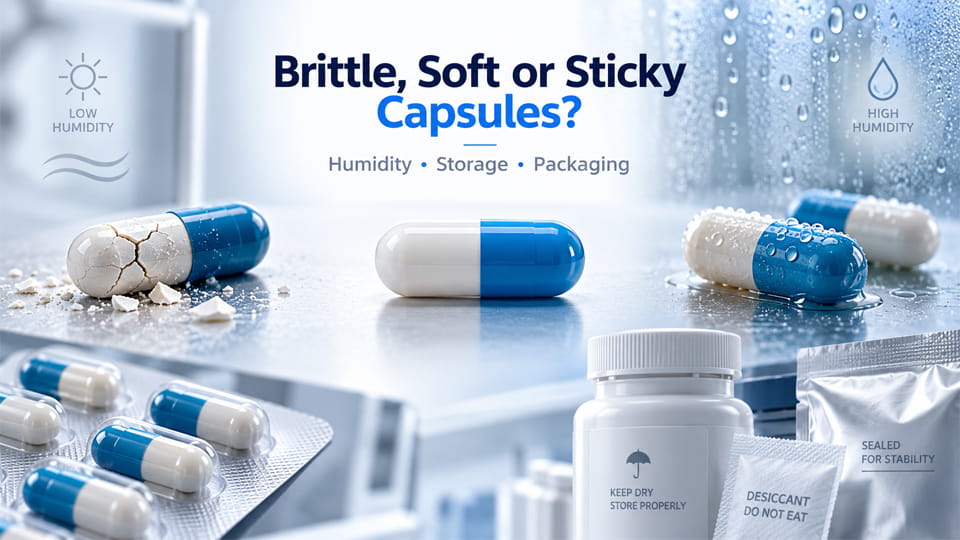

지연 방출 캡슐 그리고 장용 코팅 캡슐 are related but not identical. “Delayed-release” is a broad pharmaceutical category for any design that postpones drug release, while “enteric-coated” refers specifically to a pH-sensitive polymer barrier. 실제로, all enteric-coated capsules are delayed-release, but delayed-release products can use other triggers (시간, 효소, 등.). Manufacturers can achieve delayed release by:
Each route has trade-offs in equipment, 유연성, 그리고 복잡성. 예를 들어, enteric-coated pellets allow multiple release phases in one capsule, but require precise pellet dosing on the 캡슐 충전 기계. Key production considerations include capsule shell compatibility (gelatin vs HPMC), coating adhesion, and fill equipment settings. We compare each approach below to help you select the right strategy for your formulation.
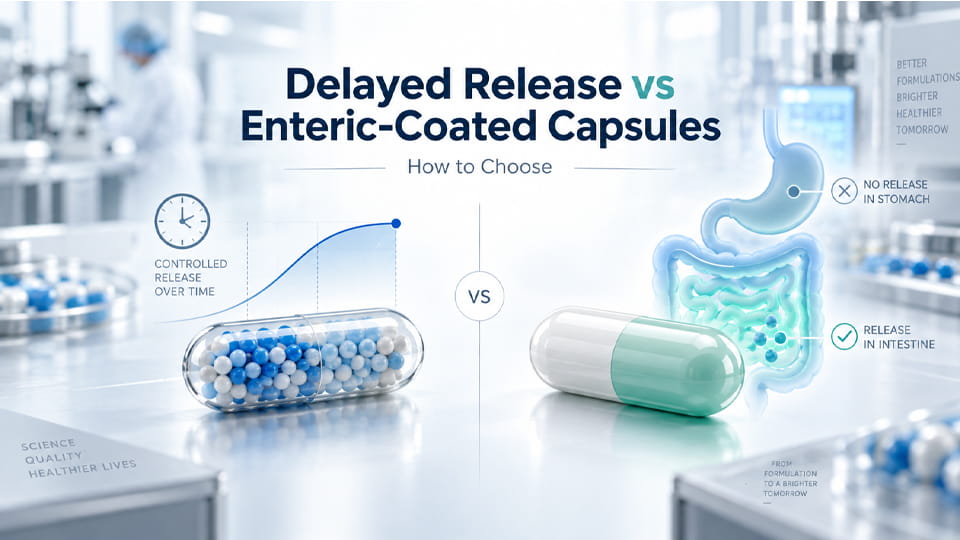
“Delayed-release (DR)” is a general term for any oral dosage form engineered to hold its contents for a period after ingestion. 다시 말해서, 그것 통제 수단 언제 the drug is released. 예를 들어, an HPMC (히드록시프로필 메틸셀룰로오스) capsule with an extra-thick wall may dissolve more slowly, delaying the release of its API. The goal is often to reduce stomach irritation or target delivery to a later point in the GI tract.
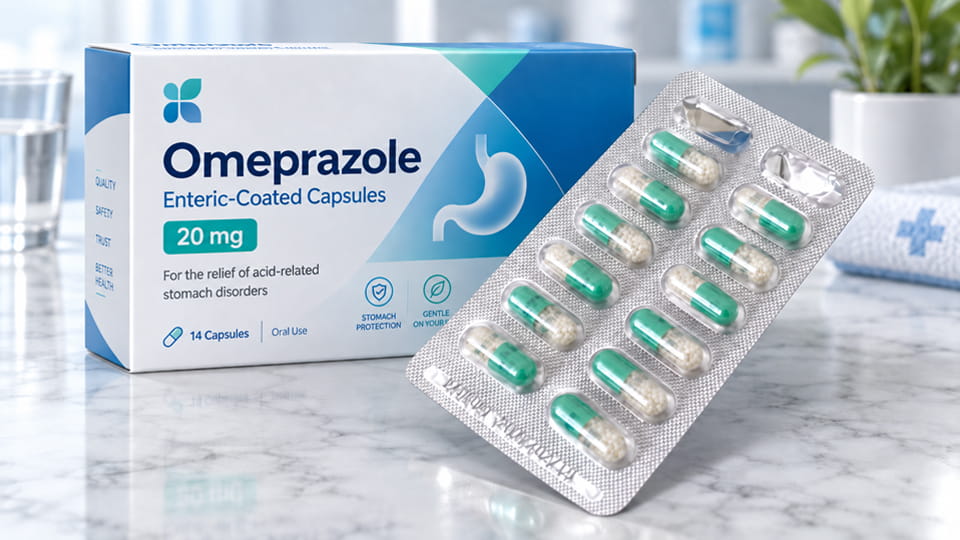
안 장용 코팅된 (Acid-Resistant) capsule is one specific way to achieve delayed release. “Enteric” means intestine. These capsules are given a specialized polymer coating that is insoluble in stomach acid but soluble at higher pH (the small intestine). 실제로, the capsule stays intact in the stomach (pH ~1.5–3.5) and only dissolves when it reaches the small intestine (pH ~6.0–7.5). This precisely controls 어디 the drug releases. 장용 코팅 protect acid-labile drugs (예를 들어. PPIs like omeprazole) and also protect the stomach lining from irritants (예를 들어. 아스피린).
확장 릴리스 (이다) 캡슐: Forms that release drug slowly over an extended period (시간) to maintain steady blood levels. Not the same as delayed release. ER systems (hydrophilic matrices, 삼투압 펌프, 등.) control the rate of release from the moment of ingestion, rather than imposing an initial lag. 예를 들어, an ER capsule might gradually release drug over 8–24 hours. Delayed release simply imposes a delay, whereas extended release modulates release rate (아니면 둘 다).
요컨대, all enteric-coated capsules are delayed-release, but not all delayed-release capsules are enteric-coated. Delayed-release covers any mechanism (thicker shell, polymer matrix, 염주, 등.) that shifts the release profile. Enteric-coated is the most common method, using pH-dependent coatings. Both ensure drugs aren’t released immediately, but delayed-release focuses on timing, while enteric-coated focuses on bypassing the stomach.
The table below summarizes the major differences between delayed-release and enteric-coated capsules:
| 기인하다 | Delayed-Release Capsules | 장용 코팅 캡슐 |
| 기구 | 시간- or shell-thickness controlled delay; uses slower-dissolving shell (예를 들어. HPMC) | pH-triggered polymer barrier; dissolves at intestinal pH |
| 통제 수단 | 언제 release occurs (lag time) | 어디 (in GI tract) release occurs |
| Acid Resistance | Depends on material; typically not specifically acid-resistant unless formulated that way | Engineered for gastric resistance; remains intact in stomach (pH<5.5) |
| Release Trigger | Intrinsic (mechanical/ time) or enzymatic factors | Alkaline pH (예를 들어. pH ≥5.5–6.5) in small intestine |
| 사용 사례 / 응용 | General delayed effect, reduced GI side effects (예를 들어. 생선 기름, reflux-protecting NSAIDs, berberine) | Acid-sensitive APIs or intestine-targeted drugs (예를 들어. PPI, pancreatic enzymes, 프로바이오틱스) |
| Typical Polymers/ Materials | HPMC 또는 젤라틴 껍질 (thicker or crosslinked); fillers like starch, 셀룰로오스; timed-release beads (예를 들어. 에틸셀룰로오스) | Enteric polymers: 셀룰로오스 아세테이트 프탈레이트 (캡), HPMC phthalate, 유드라짓 L/S (methacrylates), 때리다; 가소제 (TEC, phthalates) |
| 릴리스 프로필 | Lag phase (often 30–60 min or longer) then rapid release | No release in acid; complete release after pH rise (often 2–4 hrs after dosing) |
| 안정 | Typically stable; moisture control if using HPMC (낮은 수분) | Stability depends on polymer (some absorb moisture); enteric capsule shells may have low water content (4-10%). Both need humidity control. |
| 제조 복잡성 | Moderate – standard capsule filling, no coating step (if using HPMC shells) | Higher – extra steps (polymer mixing, spray coating or specialized shells) |
| 비용 | 보통의 (standard capsule materials) | 더 높은 (enteric polymers and processes add cost) |
| Regulatory/ Tests | Tested with standard dissolution (예를 들어. USP 711) after lag time | Requires multi-stage testing: disintegration in pH 1.2 (no release), then dissolution at pH 6.8 (풀어 주다) |
This table captures the core contrasts. Delayed-release “postpones” release based on material and thickness, while enteric capsules add a chemical barrier that only dissolves at intestinal pH. 실용적인 측면에서, use delayed-release if the goal is 타이밍 (예를 들어. reduce reflux or provide convenience) and use enteric-coated if the API is acid-sensitive or targeted to the intestines.
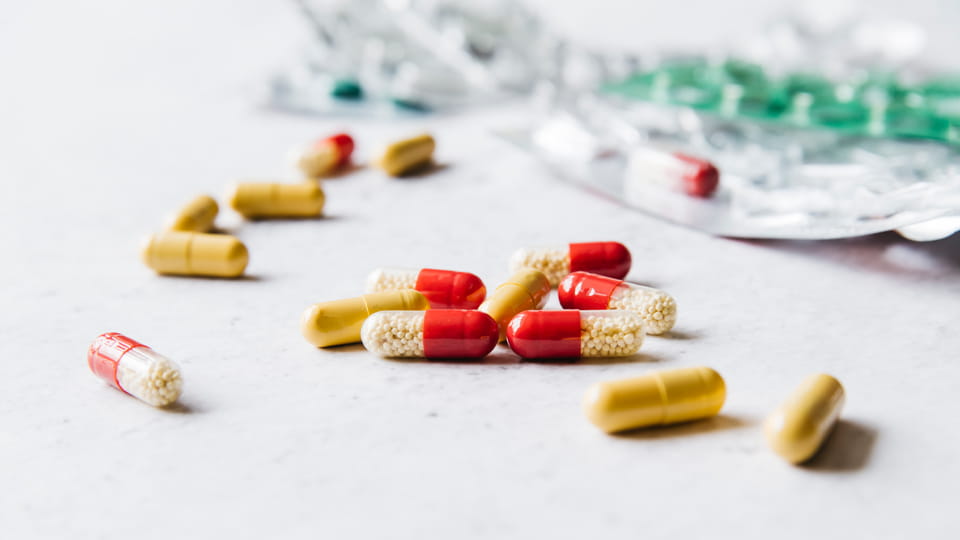
At a mechanistic level, delayed-release capsules often rely on the 캡슐 껍질 itself and fillers:
The science: gastric pH (~1–3) keeps the film intact (no release), but once the capsule passes to the small intestine (pH ~6–7), the enteric film swells and dissolves, liberating the drug. 예를 들어, omeprazole is formulated as a delayed-release capsule ~와 함께 장용 코팅; without the coating it would be destroyed by stomach acid.
요약, delayed-release encapsulates the broad concept (“hold the drug back”), whereas enteric coating is the technology to achieve that for stomach-sensitive cases.
Delayed-Release Capsule Examples: Delayed-release capsules are often used for ingredients that benefit from a lag but are not damaged by acid. 일반적인 예는 다음과 같습니다 오메가-3 오일 or certain botanicals which can cause reflux if released immediately. Some probiotics (acid-tolerant strains) or peptides fall here if you only need to reduce dose frequency or stomach upset. 본질적으로, if the API irritates the stomach (like an NSAID) but isn’t itself acid-sensitive, delayed-release can improve tolerance.
Enteric-Coated Capsule Examples: Enteric-coated capsules are chosen for acid-labile drugs and targeted GI delivery. Classic examples: 양성자 펌프 억제제 (오메프라졸, esomeprazole) and other stomach-acid-sensitive drugs, digestive enzymes (예를 들어. pancrelipase for cystic fibrosis), 그리고 프로바이오틱스 (so the bacteria survive to the gut). They’re also used for vitamins/herbals when needed (예를 들어. SAMe supplements) and some rectally-targeted medications. Many OTC aspirin or ibuprofen products have “enteric-coated” versions to protect the stomach lining. 핵심은: if your API or ingredient is inactivated or irritating in acid, enteric is the way to go.
Pharmaceutical manufacturers have several routes to create a delayed-release capsule. Below is an overview of four common approaches, from most to least traditional. Each route has a different process flow, equipment need, 그리고 유연성:
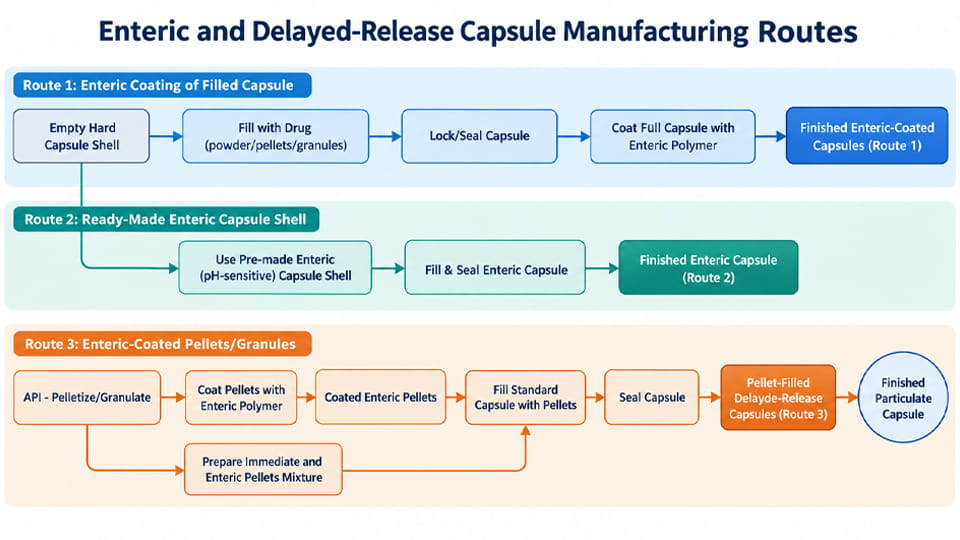
수치: Four main routes to achieve delayed-release capsules. 노선 1 coats the filled capsule; 노선 2 uses a ready-to-fill enteric shell; 노선 3 fills with enteric-coated pellets; 노선 4 (not shown) is a combination of pellets with other formats.
Each route requires appropriate downstream steps. 예를 들어, all routes above except Route 2 include a standard capsule locking/finishing step. Routes 1 그리고 3 both include a dedicated enteric-coating operation (on capsules or pellets). 노선 2 may use a simple sealing machine if special shells come pre-gelled. See the Mermaid chart for flows.

Each piece of equipment must be validated for uniformity. High-shear spray nozzles and precise temperature/humidity control are critical to avoid defects (예를 들어. “orange peel” surface, 열분해).
QC is crucial for both capsule types. 주요 테스트에는 다음이 포함됩니다.:
According to Kolmar’s overview, “rigorous testing is conducted to ensure each batch meets industry standards for content uniformity, 용해, and stability”. 실제로, especially for enteric-coated forms, the combined disintegration/dissolution test is paramount.
When scaling production from lab to commercial batches:
Common problems (especially with enteric coatings) 포함하다:
일반적으로, start by examining in-process moisture (too high makes coatings sticky), spray droplet size, and batch-to-batch consistency of excipients. 많은 coating defects can be prevented with careful validation and controls.
To decide which is right for your product, 고려하다:
A quick 체크리스트:
Choosing early in development is critical. Using the wrong capsule can ruin stability or dissolution and be costly to fix later. Work closely with formulation experts and equipment engineers to make the right call.
요약, 지연 출시 is a broad strategy (any way to postpone release), ~하는 동안 장용 코팅 캡슐 are one specific method (acid-resistant film). To design the right delayed-release capsule, first define your release target (예를 들어. intestinal absorption, 위 보호) and practical constraints (existing equipment, formulation properties). Then pick a route: coat the filled capsule, use a pH-sensitive shell, fill with coated pellets, or a hybrid approach. Each route will affect your capsule filling process: 예를 들어. pellet fills need pellet-dosing modules, enteric shells require sourcing special capsules, and coated capsules require post-fill coating.
No matter which path you take, remember to test rigorously. Dissolution in acid and buffer, fill-weight uniformity, pellet integrity, and stability are critical checkpoints. 현대식 캡슐 충전 기계 (like JinLu’s automatic capsule fillers) are quite versatile and can handle either route. They support powders, granules and pellets in hard capsules, making implementation feasible on the production floor.
If you’re evaluating delayed-release options for your product, we encourage you to send us your formulation details (캡슐 크기, 재료, 채우기 유형, target dose, 등.). Our engineering team can then advise which approach fits best and offer sample tests on our equipment. Use the information above to frame your questions, and let us help you choose the safest, most cost-effective manufacturing route for your delayed-release capsules.
정확하지 않음. “Delayed-release” is a general term meaning the drug isn’t released immediately after swallowing. Enteric-coated capsules are one common way to achieve delayed release (by using an acid-resistant coating). So all enteric-coated capsules are delayed-release forms, but delayed-release could also include time-release systems or special multiparticulate designs.
Plain gelatin or standard HPMC capsules dissolve in the stomach and provide immediate release (HPMC may dissolve a bit slower, but still in acid). They have no inherent delay. To achieve delayed release, you need either an enteric coating on the capsule or fill (shell polymers or pellets) that resist acid. 예를 들어, Capsugel’s Vcaps® Enteric (HPMC with added polymers) are specially manufactured shells that confer acidity resistance.
Manufacturers can use several routes. They may apply an enteric coating to a filled capsule, use a ready-to-fill functional capsule shell, fill a standard capsule with enteric-coated pellets or granules, or combine coated pellets, 미니 태블릿, and other fill materials. The best route depends on the required release profile and production setup.
예. Hard gelatin capsules can be coated with suitable enteric polymers, but the coating formulation and process conditions must be optimized for adhesion, capsule integrity, 수분, 건조, and the cap-body joint. The finished product should then be tested to confirm that the required delayed-release or gastro-resistant performance is achieved.
예. Filling enteric-coated pellets or granules into standard gelatin or HPMC capsules is a widely used approach for delayed or gastro-resistant drug delivery. 생산 중, manufacturers need to control pellet flow, 투약 정확도, mechanical handling, and coating damage because excessive abrasion can affect the intended release profile.
보통 그렇습니다, but compatibility depends on the capsule shell, fill material, 입자 특성, 정량, 생산 속도. An automatic capsule filling machine may require different dosing configurations for powder, 과립, 펠릿, 아니면 미니 태블릿. Pellet-filled products also need gentle handling and accurate dosing to protect the functional coating.
Testing normally evaluates whether the dosage form resists the required acidic stage and then releases the drug appropriately under the specified later-stage conditions. Manufacturers may also assess dissolution, 분해, coating integrity, fill-weight consistency, pellet damage, 안정성. The exact acceptance criteria should follow the applicable product specification, pharmacopoeial method, 규제 요구 사항.
Both can become brittle if too dry. Gelatin shells usually have higher moisture, giving them a bit more flexibility (unless exposed to extreme dry conditions). HPMC shells tend to be drier and can crack if mishandled. Monitor humidity during storage and filling. 일반적으로, handle HPMC shells more gently and consider humidifying capsules slightly before filling if brittleness is a concern. Ensure filling machines run under controlled climate (some lines use humidifiers to protect HPMC shells).
Manufacturers should consider capsule size and material, powder or pellet fill type, 투약 정확도, pellet handling, capsule separation and locking, 생산 능력, changeover requirements, 청소, 및 검증 지원. For pellet-based delayed-release products, the filling system should be able to dose the pellets consistently without damaging their functional coating.
There are several common approaches: coating the filled capsule with an enteric polymer, using a ready-to-fill enteric-resistant capsule shell, filling standard capsules with enteric-coated pellets or granules, and combining immediate- and delayed-release components in one capsule. The best route depends on the formulation, 장비, release target, 생산 요구 사항.
참고자료:
1.Oral Gastro-resistant Formulations – State of the Art, Advances and Prospects: A Review —— 스프링거 자연
2.Fish Oil Containing Omega-3 Acids Delayed-Release Capsules —— USP
3.장용 코팅된 HPMC 캡슐의 시험관 내 평가 - 제품 성능에 대한 제제 인자의 영향 —— PMC
4.Exploring Immersion Coating as a Cost-Effective Method for Small-Scale Production of Enteric-Coated Gelatin Capsules —— PMC
5.Enteric coated HPMC capsules designed to achieve intestinal targeting —— PMC
6.Guidance for Industry SUPAC-MR: Modified Release Solid Oral Dosage Forms —— 우리를. 식품의약품안전청



