×

オンラインサービス

💬WhatsApp: +86 1801179332
💡
  • ブログ
  • 薬と薬: 医薬品の製造と包装における主な違い

薬と薬: 医薬品の製造と包装における主な違い

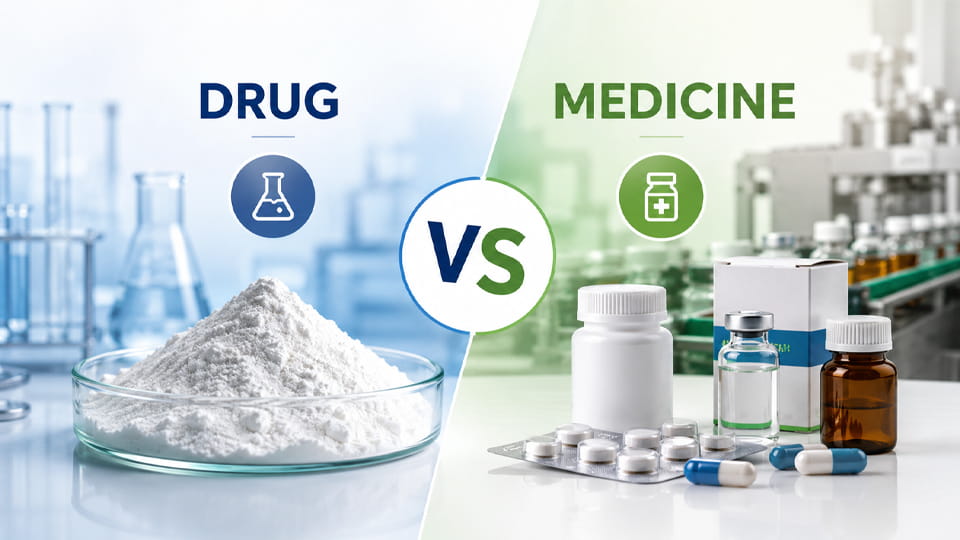
In everyday language “drug” そして “medicine” are often used interchangeably. In the pharma industry, しかし, they usually imply different stages of the product lifecycle. a is generally the active pharmacological substance (API) that provides therapeutic effects. a (と呼ばれることもあります medicinal product) is the finished product – the drug formulated and packaged for patient use. This distinction affects how products are developed, 製造された, そしてパッケージ化された. 簡単に言うと, every medicine begins with a drug (有効成分), but not every drug ends up as a marketable medicine. The differences in these terms can influence 剤形 デザイン, regulatory status, そして choice of packaging machinery.

薬と薬 - 主な違い


What Is a Drug?

In pharmaceutical terms, ある is an active chemical or biological substance used to diagnose, 治す, 軽減する, 扱う, あるいは病気を予防する. The FDA defines a drug broadly as “A substance intended for use in the diagnosis, 治す, 緩和, 処理, または病気の予防” in humans or animals. 実際に, “drug” often refers to the pure active ingredient (API) itself. 例えば, ibuprofen or amoxicillin as a powder would be called a drug substance before it’s made into a tablet or capsule.

Key points about 薬物 in pharma manufacturing:

  • 有効成分 (API): A drug is usually the pharmacologically active component (the API). This API is what actually produces the desired effect in the body. 例えば, アセトアミノフェン (パラセタモール) is the drug substance that relieves pain or reduces fever.
  • Regulatory Definition: Per FDA, a drug includes any substance recognized in official pharmacopeia or intended to affect body structure/function. The EPA/EMA have similar definitions. It explicitly includes therapeutics (and excludes most foods).
  • Broad Usage: Beyond medicinal use, “drug” can be broader. One source explanation notes that drugs may have non-therapeutic contexts (例えば. experimental or recreational). しかし, in pharma manufacturing we focus on drugs with medical intent.
  • Early in Lifecycle: In R&D and production, we talk about a drug when referring to APIs or experimental compounds. この段階で, it may not be in final form or fully regulated.

要約すれば, ある is the raw therapeutic substance or API – the “what” that gives a medicine its effect. This term is common in formulation development and regulation.

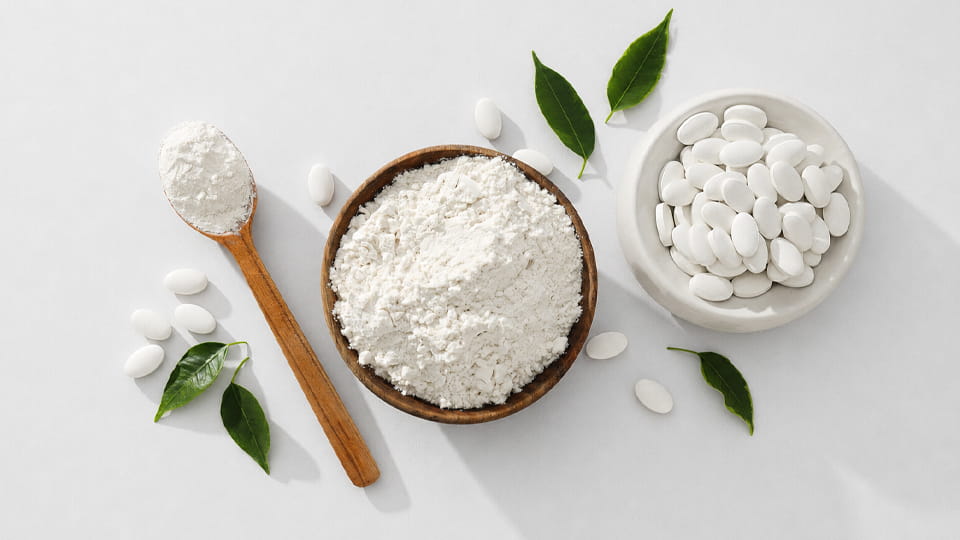
drug powder and tablets with a spoon


What Is a Medicine?

a (または medicinal product) です finished pharmaceutical product intended for patient use. It contains one or more drugs (API) plus inactive components (賦形剤) and is packaged for safe dispensing and use. 言い換えると, once a drug is formulated into a dosage form (錠剤, カプセル, 液体, 等) and labeled in a container, it becomes a medicine ready for sale.

  • Finished Dosage Form: A medicine is the end-product such as a tablet, カプセル, シロップ, or injectable vial. It usually includes the active drug + バインダー, フィラー, コーティング, stabilizers (賦形剤). 例えば, a 500 mg paracetamol tablet (with starch, セルロース, 等) is a medicine, whereas pure paracetamol powder is a drug substance.
  • Regulatory Term – Medicinal Product: In the EU/UK, 用語 “medicinal product” is defined by law as any substance presented for treating/preventing disease. The EMA further describes a medicinal product as a completed pharmaceutical product (例えば. 錠剤, カプセル, 注射). This aligns with “medicine” being the regulated product given to patients.
  • Designed for Use: Medicines are rigorously tested for safety and efficacy, formulated in precise doses, and manufactured under Good Manufacturing Practices (GMP). They are designed to restore or maintain health when used properly.
  • Packaging and Labeling: Unlike a raw drug, a medicine comes with packaging (ボトル, 水膨れ, box) and a label or leaflet. The packaging contains dosage information, 有効期限, 説明書, および規制データ. The medicine is what patients or pharmacies handle.

簡単に言うと, ある is the packaged, patient-ready product used to diagnose or treat a condition. It includes the drug as the star ingredient, but also all the other stuff (賦形剤, 容器, ラベル).

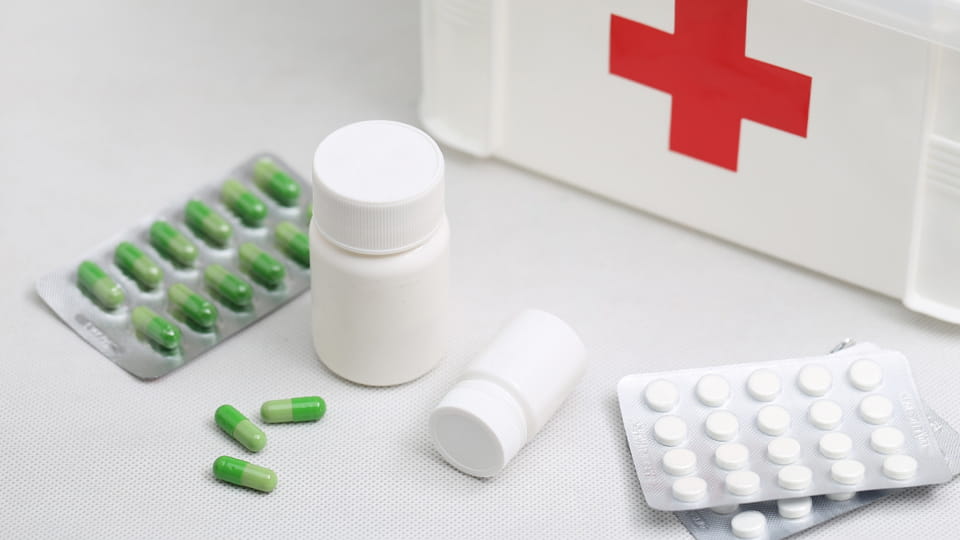
 a medicine is the packaged, patient-ready product used to diagnose or treat a condition


薬と薬: 重要な違い

Below is a summary of the key distinctions between a drug and a medicine. The differences are subtle in plain language but important in manufacturing and regulatory contexts:

側面 Medicine (Medicinal Product)
Basic meaning Active substance (API) with therapeutic effect Finished product containing the drug, ready for patient use
ステージ Often refers to early-stage ingredient or research compound Refers to the final dosage form once formulated and packaged
構成 The pure active ingredient (例えば. aspirin powder) Includes API + 賦形剤, 容器, ラベル (例えば. aspirin tablet in blister)
Use context 製造業, R&D, 規制上の (approval process) Clinical use, prescribing, dispensing (in healthcare settings)
規制 Broad FDA “drug” definition includes APIs Strictly regulated finished products (FDA/EMA approvals, GMP)
Ibuprofen API, insulin protein (bulk substance) Ibuprofen tablets, insulin injections in vials

分かりやすく言うと: a is the active chemical/biological substance with a pharmacological effect. a is that drug plus formulation and packaging, intended for safe use by patients. As one pharma source put it, “Every medicine begins as a drug, but not every drug becomes a medicine”. 例えば, pure morphine is a drug substance; once formulated into injectable doses with saline and sealed in vials, it becomes a medicine (a pain relief product).

The crucial point is that implies a regulated, consumable product, 一方 can mean just the raw active substance or a broader class of compounds. The table above highlights these differences.


薬, 原薬, Drug Product, and Medicine

To fully understand “drug vs medicine,” it helps to clarify related terms often used in pharma:

  • 原薬 (Active Pharmaceutical Ingredient – API): The pure active component (molecule) that produces the drug’s effect. The FDA defines an API as “any substance intended for incorporation into a finished drug product and intended to furnish pharmacological activity”. 実際に, 原薬 = API. 例えば, acetaminophen powder or recombinant insulin protein are drug substances.
  • Drug Product (Finished Dosage Form): The complete, final form that contains one or more drug substances and other ingredients, ready for distribution. The FDA defines drug product as “the finished dosage form that contains a drug substance” (with other active/inactive ingredients as needed). 例: a 250 mL vial of ceftriaxone injection, a bottle of cough syrup, a blister of aspirin tablets.
  • Medicine (Medicinal Product/Pharmaceutical Product): Essentially synonymous with drug product in many regulations. The EU’s definition of “medicinal product” closely matches a drug product: “any substance … presented as having properties for treating or preventing disease”. 米国では, medicines are just the approved drug products (brand-name or generic) dispensed to patients.
  • Pharmaceutical Product: A broad term covering any marketed drug or medicine, including prescription and over-the-counter(OTC). It emphasizes the commercial and regulatory aspect of the product.

結論: In pharma manufacturing, “drug substance” is the API, “drug product” is the formulated dosage form (錠剤, カプセル, 注射, 等), そして “medicine” is what you call the drug product once it is a market-ready therapeutic product. 例えば, metformin is a drug substance, a 500 mg metformin tablet is the drug product, and that tablet (in its packaging) is the medicine the patient takes.

Understanding these terms is vital: once we know a drug product’s dosage form, we can select the right 包装ライン to turn it into a stable medicine.


Why the Difference Matters in Manufacturing

定式化 & Dosage Form Development: A raw 原薬 by itself isn’t patient-ready. It must be formulated into a suitable dosage form (錠剤, カプセル, シロップ, 注射, 等) – this is a major part of manufacturing development. Each dosage form requires specific excipients and processing (混合, 顆粒, 殺菌) to become a drug product. 例えば, sensitive APIs for injectable biologics need aseptic processing, whereas a stable API for a pill goes through drying and tablet compression.

規制当局の承認: Agencies like the FDA or EMA review data on the drug substance そして the drug product/medicine. They assess the API’s safety and the final formulation’s efficacy. The finished medicine must meet strict standards (GMP, 安定性, ラベリング). FDAの CGMP rules explicitly cover packaging processes and equipment – so how you package a medicine (even more than a raw drug) is highly regulated.

Packaging and Labeling: The distinction dictates packaging needs. A drug substance typically has minimal packaging (ドラム, vials for storage). A medicine, しかし, 必要 一次包装 that protects dosage (例えば. ブリスターパック, ボトル, バイアル) そして 二次包装 (カートン) for information and traceability. 例えば, 錠剤 (finished product) need moisture-proof blister packs or bottle-and-closure systems to ensure shelf-life. An injectable medicine needs sterile glass vials or ampoules plus tamper-evident seals. Each combination of API and dosage form has a matching packaging solution.

機器の選択: If you only think of APIs, you might consider reactors or mixers. But once a substance is a drug product needing packaging, you need the right packaging line. ブリスター包装機, カプセル充填機, 液体充填剤, バイアル充填ライン, 箱詰め機 – all become relevant. Recognizing “medicine” means packaged product prompts procurement of these machines.

要するに, understanding “drug vs medicine” helps project teams know when and how to integrate packaging into the production workflow. It ensures that the drug product is not just formulated, but properly protected and presented to the market.


How Packaging Turns a Drug Product Into a Market-Ready Medicine

Packaging is the last critical step that transforms a formulated drug into a medicine patients can use safely. で 医薬品の包装, 一次包装 is in direct contact with the dosage (the drug product) and provides the first barrier to degradation. 例えば, hard gelatin capsules and tablets often go into aluminum–plastic ブリスターパック, while liquid syrups go into プラスチック (PET/HDPE) ボトル. Injectable drugs are filled into sterile glass vials or ampoules. Each primary container is chosen for its inertness and barrier properties.

Once primary packaging is sealed, 二次包装 (カートン, ラベル, チラシ) provides patient information and batch data. 例えば, blister packs or vials are grouped into branded cardboard cartons with instruction leaflets, バッチ番号, and barcodes – crucial for compliance and patient safety.

At JinLuPacking, our machines automate these steps. An automatic ブリスター包装機 can seal thousands of tablets into blisters per hour; ある カプセル充填機 doses the drug into capsules; ある bottle filling and capping line counts tablets or fills syrups into bottles; そして 箱詰め機 wraps and boxes the finished products. All these stages – filling, キャッピング, wrapping – ensure the final medicine is accurately dosed, 安全, and ready for distribution.

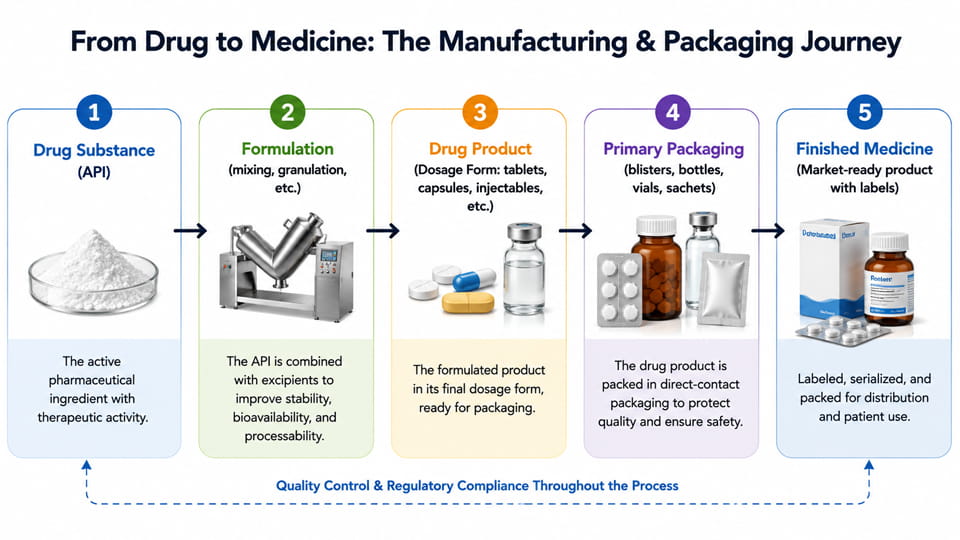
Flowchart of Drug to Medicine

形: Flowchart of Drug → Medicine: The active 原薬 (API) is formulated into a drug product (specific dosage form). Then it moves into 一次包装 (例えば. blister packs for tablets, bottles for syrups, glass vials for injectables). ついに, it becomes a finished medicine with secondary packaging (cartons/labels) for patient use.

Common Dosage Forms and Packaging

Different dosage forms require different packaging solutions. The table below summarizes typical pairings:

剤形 Common Primary Packaging Example JinLuEquipment
タブレット (Solid Oral) ブリスターパック (PVC/PVDC foil), またはプラスチック ボトル with screw caps ブリスター包装機; 錠剤の数を数える & 瓶詰めライン
カプセル (オーラル) ブリスターパック, or bottles similar to tablets 自動カプセル充填機; ブリスターマシン
Oral Liquid (Syrups) プラスチック (PET/HDPE) ボトル with child-safe caps Liquid Filling and Capping System; ボトルアンスクランブラー
粉 / サシェ Single-dose sachet packs (foil or laminate pouches) Sachet/Stick Pack Packing Machine; Premade Pouch Line
注射剤 (Sterile) ガラス バイアル, アンプル, or prefilled syringes, plus foil seals Vial/Ampoule Filling & Stoppering Line; 誘導シーラー
Ointments/Creams Laminated tubes (aluminum or plastic) Tube Filling and Sealing Machine
ソフトジェルカプセル ボトル (ペット) またはブリスターパック Softgel Capsule Blister Machine; Counting Line

The choice depends on factors like dose form stability, 無菌性, 患者の利便性. 例えば, 錠剤やカプセルがよく使われる ブリスターマシン または ボトル充填ライン, while liquids need bottle rinsers, 充填, and capping machines. Injectable drugs require sterile filling systems under cleanroom conditions. Each solution is supported by specialized packaging machinery to ensure the drug product becomes a protected, ラベルが貼られた that meets GMP基準.


Drug vs Medicine Examples

To make it concrete, here are a few examples showing how specific drugs turn into medicines:

  • Tablet Example: The drug substance アセトアミノフェン (パラセタモール) is mixed with excipients and compressed into tablets. These tablets are primary-packaged in aluminum–plastic blister packs or PET bottles with screw caps. The final packaged product (with labeling) is a medicine for fever or pain relief. JinLuPacking’s タブレットブリスター包装機 is designed for this exact scenario.
  • Capsule Example: オメプラゾール (a drug) can be filled into ゼラチンカプセル. The capsules are sealed in blister packs to protect from moisture. A machine like 自動カプセル充填機 fills the drug and the ブリスター包装機 seals them into packs. The packed capsules become the medicine for acid reflux (例えば. ulcer treatment).
  • Syrup Example: An antibiotic drug (例えば. アモキシシリン) might be formulated as a syrup. The liquid medicine is filled into PET bottles with child-resistant caps. JinLuPacking’s bottle filling line can rinse, 埋める, キャップ, and label bottles to turn the bulk syrup into packaged medicine bottles.
  • Injectable Example: A drug like ceftriaxone is dissolved and sterilized. The sterile solution is filled into glass vials or ampoules in a cleanroom. These are sealed and labeled. The final cartons of vials/ampoules are the injectable medicine for hospital use. a vial filling & stoppering line from JinLu would handle this process.
  • Powder Sachet Example: A drug for oral rehydration (like electrolytes) can be in powder form. The powder is measured into 単回用量の小袋 (スティックパック). a サシェットパッキングマシン packages each dose. Patients then mix the 小袋 contents with water at home.

Each example shows: (API) → 定式化 (打錠, 充填, 等) → 包装 (水膨れ, ボトル, バイアル, 小袋) → Medicine (end product with label).


Is Every Drug a Medicine?

必ずしもではありません. Every medicine starts from a drug, but not every drug becomes a medicine. Many chemical or biological compounds (薬物) never reach patients. Some drugs remain in R&D or are only used for research, and others are used outside medical settings (例えば. recreational drugs). Only when a drug is formulated, テストされた, and approved does it become a medicine.

  • Not all drugs are medicines: Substances like cocaine or methamphetamine are drugs by the broad definition, but they are not legal medicines in normal practice. They have abuse potential and no accepted therapeutic approval (except rare exceptions under strict control).
  • Investigational drugs: Many drug candidates fail clinical trials or are not pursued. They never turn into medicines.
  • Dual-use drugs: Some substances can be both a medicine and an illegal drug depending on context. 例えば, morphine is a potent drug substance, but when formulated into painkiller injections or tablets, it’s a regulated medicine. When misused illicitly, it’s called a narcotic drug.

As one FAQ answer notes, “Aspirin is both a drug and a medicine. It is a drug in its chemical form (acetylsalicylic acid) and becomes a medicine when formulated and used to treat fever, pain, or inflammation”. The key is the intended use and presentation: use as a patient-ready product makes it a medicine.

要約すれば, only approved, patient-intended products are medicines. Understanding this helps manufacturers and regulators distinguish between experimental substances and real market products.


結論

要約すれば, “drug” usually refers to the active ingredient or any pharmaceutical agent, その間 “medicine” (medicinal product) refers to the finished, patient-ready product containing that drug. This distinction is important for pharmaceutical manufacturing: it guides R&D, regulatory status, and packaging choices. Understanding these terms helps ensure we move a drug substance through formulation and パッケージング properly to become a stable, compliant medicine.

いつ developing a new dosage form, 覚えて: the right packaging line (ブリスターパッカー, カプセルフィラー, ボトルライン, vial filler, 箱詰め業者, 等) is essential for protecting the medicine and meeting GMP. 例えば, tablet manufacturers rely on ブリスター包装機 そして 行を数える/埋める, while injectable products require vial/ampoule filling and capping machines and secure secondary packing. JinLuパッキング offers a full range of pharma packaging machinery tailored to each dosage form – from 錠剤 & capsule blisteringsachet packing そして 箱詰め.

Ready to turn your drug into a market-ready medicine? Explore our solutions: 錠剤 & capsule blister packaging machines for solid doses, capsule filling machines for powder/液体カプセル, 小袋 & premade pouch machines 粉体用, and cartoning machines for final boxing. Our equipment helps protect product quality, ensure patient safety, and streamline your production line from drug to finished medicine.


FAQs on Drug vs Medicine

Is a drug the same as a medicine?

Not exactly. In casual conversation they overlap, but technically a drug often means the active ingredient or any pharmacological substance, whereas a medicine is the finished product given to patients. One can say “every medicine contains a drug, but a drug by itself may not be a medicine until formulated”.

What is the difference between a drug product and a medicine?

They are essentially the same concept in most pharmaceutical contexts. A drug product is the completed dosage form (錠剤, カプセル, 注射) ready for sale. A medicine is what the drug product is called when it’s packaged for patient use. 実際に, approved drug products (with labeling) are medicines.

What is a drug substance vs a drug product?

A drug substance (またはAPI) is the pure active ingredient – the chemical or biologic that has the therapeutic effect. A drug product is the final formulation containing that substance, plus excipients, in a dosage form (ピル, 解決, 等). Think of salt and saltshaker: the salt (原薬) is the ingredient; the salt with anti-caking agent in a bottle (drug product) is the usable product.

How does packaging matter for drugs vs medicines?

Packaging is crucial for turning a drug into a medicine. As the JinLuPacking resources note, 医薬品の包装 (ブリスターパック, バイアル, ボトル) protects the drug product’s stability and dosage, and ensures compliance with regulations. Proper packaging and labeling transform a loose drug substance into a safe, user-friendly medicine.

Can the same compound be both a drug and a medicine?

はい. A compound like ibuprofen or acetaminophen is a drug substance. When it is made into an OTC tablet with instructions, it is also a medicine. It depends on form and use. 上で述べたように, aspirin is chemically a drug but is called medicine once it’s in tablets for pain relief. It’s the same with many pain relievers, 抗生物質, 等.

Why do doctors say “drug” instead of “medicine”?

Doctors often use “drug” in the neutral sense of any pharmaceutical agent. In clinical jargon and law (like the FDA Act), “drug” is the official term for a therapeutic substance. It covers everything from cough syrup to chemotherapy. その間, “medicine” is more patient-friendly. So a doctor might prescribe ibuprofen (薬) as a pain reliever (薬).


参考文献:
1.Drugs@FDA Glossary of Terms - 私たち. 食品医薬品局
2.Classification of Products as Drugs and Devices and Additional Product Classification Issues - 私たち. 食品医薬品局
3.用語集 (P terms: pharmaceutical product, 賦形剤, starting material) - 誰が
4.Prequalification Glossary - 誰が
5.剤形 | FDA - 私たち. 食品医薬品局
6.Q7A 医薬品有効成分に関する適正製造基準ガイダンス - 私たち. 食品医薬品局

この記事をシェアする:
の写真 ペティフー
ペティフー

ペティフー, 金魯包装の創設者, もたらす 20 製薬機械分野における長年の専門知識. 彼のリーダーシップの下で, Jinlu はデザインを統合する信頼できるサプライヤーに成長しました, 生産, と販売. ペティは、クライアントが医薬品包装の複雑さを乗り越えられるよう、業界の深い知識を共有することに情熱を持っています。, 機器だけでなく確実に受け取れるようにする, しかし、生産目標に合わせて調整された真のワンストップ サービス パートナーシップ.

目次

お問い合わせを送信してください

関連記事

返信を残す

あなたのメールアドレスは公開されません. 必須フィールドにマークが付いています *

無料見積もりを取得する

*私たちはあなたの機密性を尊重し、すべてのデータは保護されます. あなたの個人データは、JL ソリューションのためにのみ使用および処理されます。.