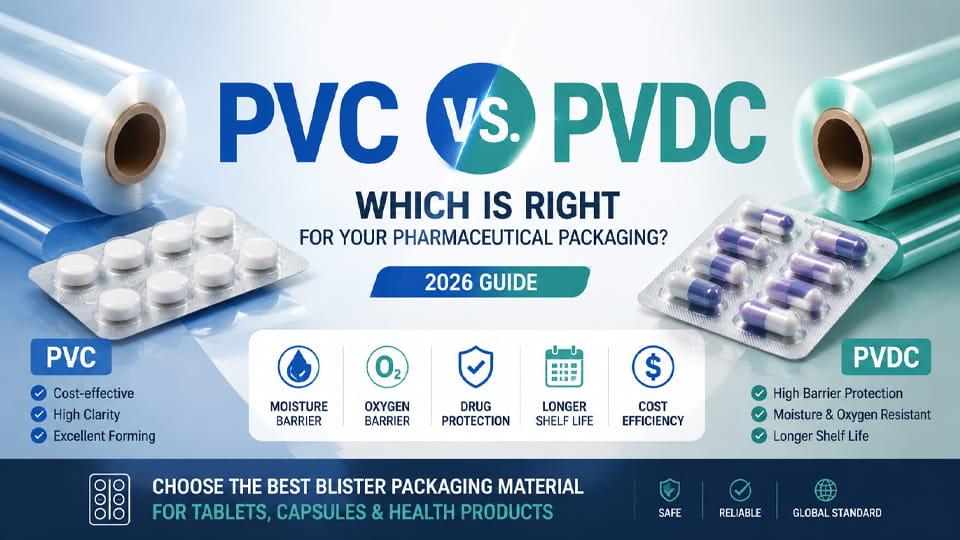
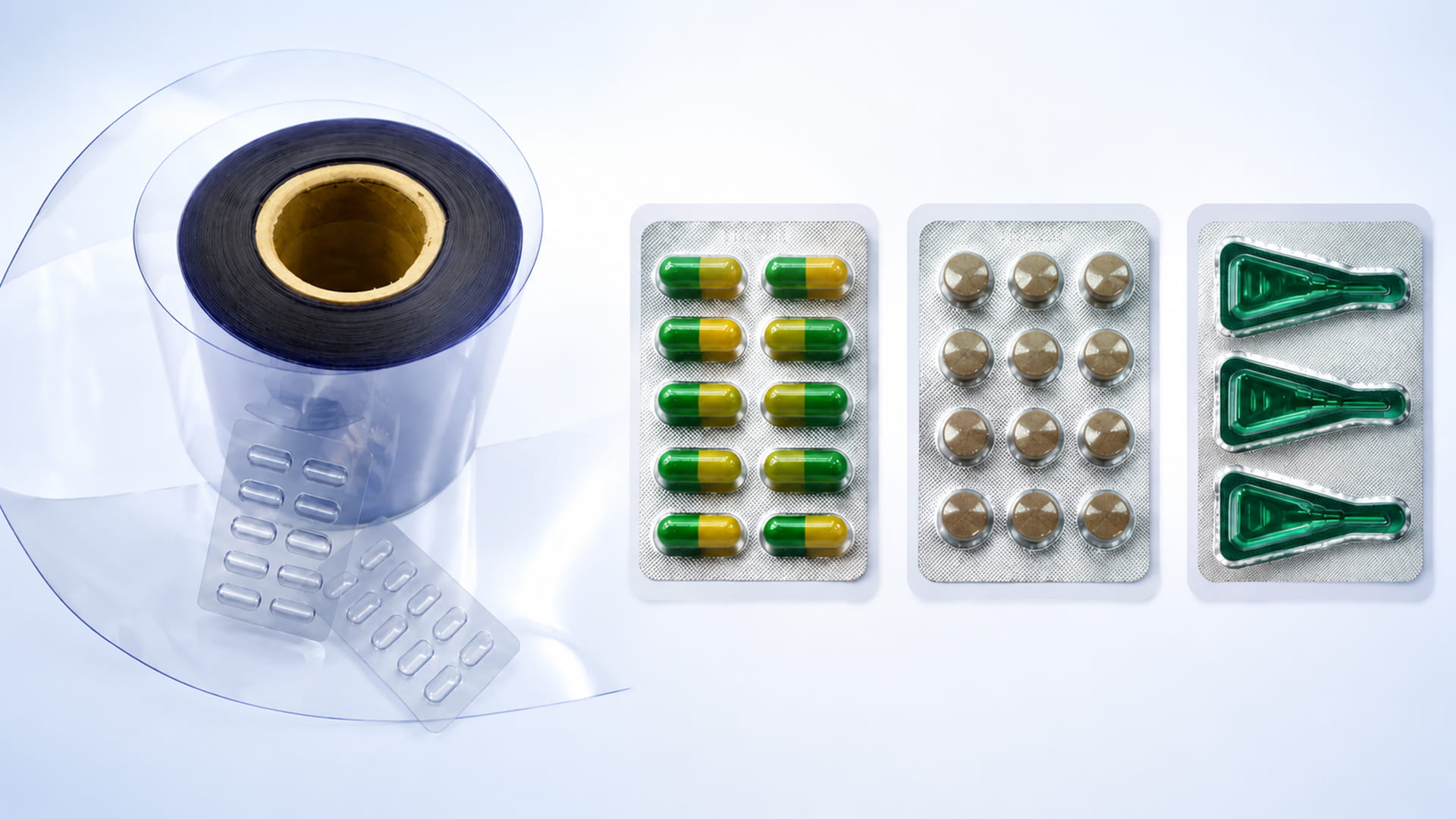
Emballage blister pharmaceutique (par exemple. comprimés et gélules) utilise couramment des films en PVC transparent ou en PVC/PVDC scellés avec du papier d'aluminium. Choisir le bon film blister est une décision importante pour tout producteur pharmaceutique. Le PVC et le PVDC peuvent se ressembler, mais leurs propriétés barrières à l'humidité et à l'oxygène, durée de conservation, les coûts et les besoins de traitement sont très différents. Si vous travaillez dans la fabrication ou l'approvisionnement pharmaceutique, vous avez probablement demandé: Le PVC ou le PVDC sont-ils le meilleur choix pour nos plaquettes thermoformées de médicaments? Ce guide convivial compare le PVC et le PVDC pour les emballages pharmaceutiques. Nous expliquerons ce qu’est chaque matériau, comment leurs propriétés de barrière et de coût diffèrent, et des conseils pratiques pour bien choisir son film blister. À la fin, vous saurez s'il s'agit de PVC ordinaire ou de PVC enduit de PVDC (parfois appelé PVC/PVDC) répond aux besoins de votre produit – ou si une solution hybride est la plus logique.
PVC (chlorure de polyvinyle) est un clair, plastique souple, le matériau de blister le plus courant pour comprimés et gélules. Dans des blisters pharmaceutiques, « PVC » signifie toujours non plastifié, PVC rigide. Le film PVC typique a une épaisseur de 200 à 300 μm (souvent 250 μm). Il sert de couche de base formable de la cloque. Les principaux avantages du PVC sont faible coût et facilité de thermoformage. Il est clair (excellente transparence), durable, et se moule rapidement sur une ligne de thermoformage. Les fabricants adorent le PVC pour les produits ordinaires comme les comprimés en vente libre, vitamines et génériques stables.
Le film blister en PVC fournit bonne structure et visibilité. Vous pouvez voir et compter les pilules à travers la plaquette, et poussez-les facilement. Le PVC est également chimiquement stable contre de nombreux excipients et a été approuvé dans les pharmacopées (Ph.. euros. et USP) pour les médicaments, contactez. En bref: Le PVC est un matériau fiable, Film blister « bourreau de travail » pour sensible aux coûts, produits résistants à l'humidité.
PVDC (chlorure de polyvinylidène) est un polymère à haute barrière souvent appliqué comme revêtement sur un film PVC. Film PVDC pur (non couché) est difficile à thermoformer seul, donc dans les blisters, il apparaît comme une couche de film très fine (dans des structures duplex ou triplex). La couche PVDC contient beaucoup plus de chlore dans sa structure chimique (CH₂CCl₂), lui conférant une résistance exceptionnelle à l’humidité et à l’oxygène.
En pratique, PVC enduit de PVDC est la norme pour les blisters à haute barrière. Par exemple, un film duplex typique est du PVC de 250 μm avec un revêtement PVDC de 40 à 120 g/m². PVDC plus épais (g/m² plus élevé) donne un WVTR inférieur (aussi bas que 0,25 g/m²/jour) et un OTR proche de zéro. Le formage est très similaire au PVC – vous faites passer le film composite sur la thermoformeuse – mais vous devez contrôler la température du four pour que la couche de PVDC ne durcisse pas trop rapidement..
Le revêtement PVDC est généralement appliqué par émulsion (à base d'eau) revêtement, en plusieurs passages. Il existe des grades de PVDC « standard » et « super-barrière ». Les grades super-barrière donnent plus de deux fois la résistance à l'humidité/O₂ par gramme de revêtement. Les structures finales courantes comprennent:
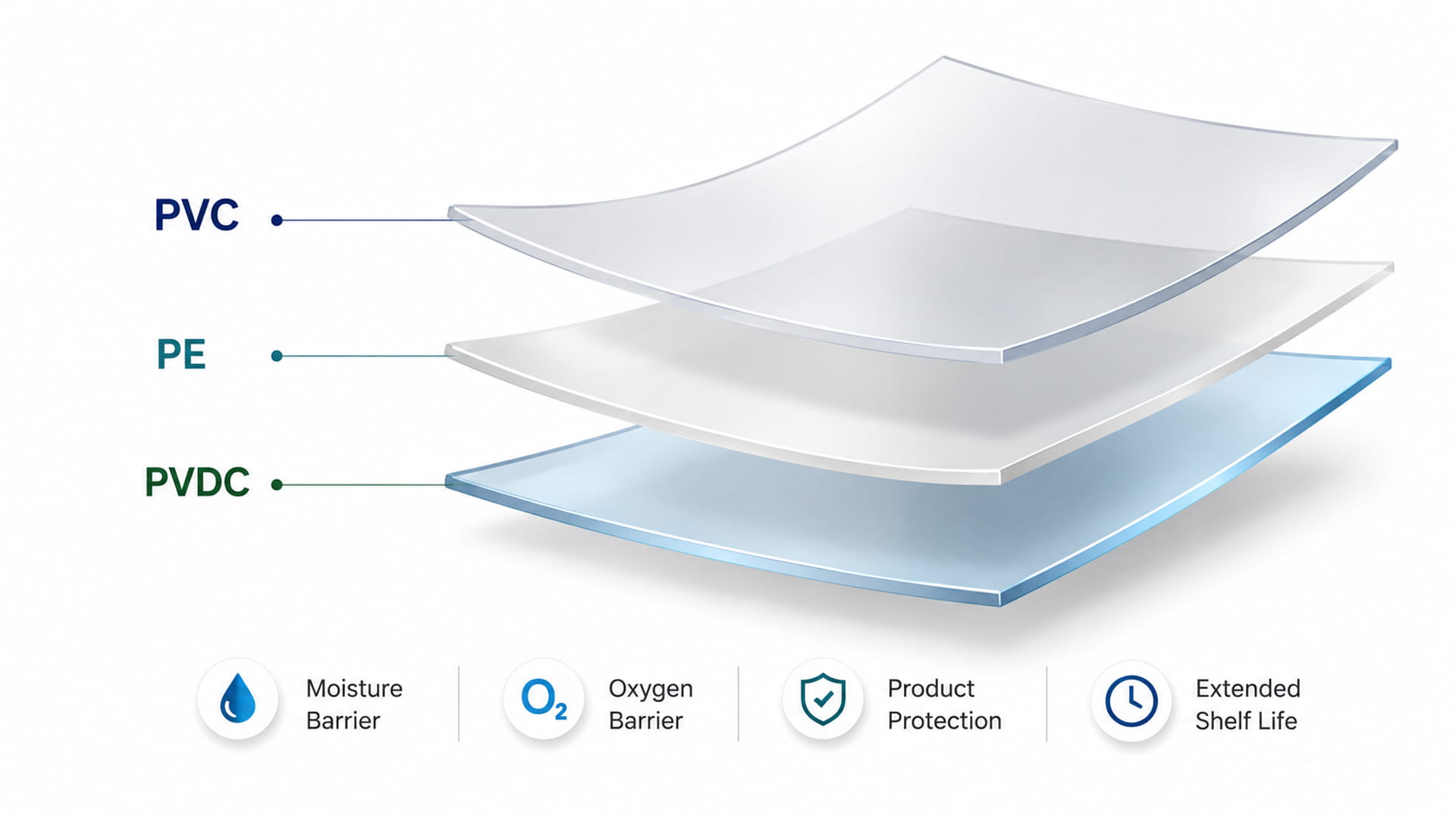
En termes simples: Le PVC donne la forme du blister, tandis que le PVDC le scelle hermétiquement. Un blister en PVC uni (avec support en aluminium) est économique et clair, mais n'offre qu'une protection de base. Un pack PVC/PVDC coûte plus cher mais ralentit considérablement la pénétration de l'humidité et de l'oxygène., protéger les médicaments sensibles plus longtemps.
| Fonctionnalité | PVC (non couché) | PVC/PVDC (recouvert) |
| Barrière contre l'humidité | ★★☆☆☆ (modéré) | ★★★★★ (haut) |
| Barrière d'oxygène | ★★☆☆☆ (faible) | ★★★★★ (haut) |
| Coût | Faible | Moyen à élevé |
| Clarté (Transparence) | Excellent | Excellent |
| Durée de conservation (dans un emballage) | Modéré (plus court) | Long (étendu) |
| Facilité de thermoformage | Facile | Facile (avec des paramètres ajustés) |
| Médicaments sensibles (humidité/O₂) | Non (pas idéal) | Oui (recommandé) |
| Marchés d'exportation/tropicaux | Adéquation limitée | Bonne adéquation |
| Produits courants | Vitamines en vente libre, comprimés | Médicaments sensibles à l'humidité, exportations |
Tableau: Comparaison des films blister PVC et PVC/PVDC. (★ = indice barrière, plus d'étoiles = meilleure protection.)
Cette comparaison rapide montre pourquoi le PVDC est choisi pour les applications difficiles. Le PVC non enduit convient à un usage général, mais le PVC/PVDC donne une bien meilleure protection.
La protection des médicaments est avant tout une question performance de la barrière. L'humidité et l'oxygène peuvent dégrader les API, affecter la puissance, provoquer une agglomération, ou déclencher des changements chimiques. Le PVC seul ne fournit que protection modérée: à 38°C/90%HR, un film PVC standard de 250 μm laisse passer environ 3.0 g/m²/jour d'eau. Cela signifie qu'une grande quantité d'humidité peut s'infiltrer à travers une ampoule en PVC si elle est exposée.. En revanche, un film PVC/PVDC bien enduit (par exemple. 250 µm PVC + 80 GSM PVDC) pourrait seulement permettre 0.30 g/m²/jour (10× moins d'humidité). La même histoire vaut pour l’oxygène: L’OTR du PVC est d’environ 20 ml/m²/jour, tandis que le PVC/PVDC peut chuter à ~0,1-1 ml/m²/jour.
Pourquoi est-ce important? Un WVTR/OTR inférieur signifie durée de conservation et stabilité plus longues. Un ingrédient sensible à l'humidité (comme un granule effervescent ou un probiotique) peut se détériorer en seulement 6 à 12 mois à l'intérieur du PVC, mais restent stables 2 à 3 ans en PVC/PVDC. Piste des fabricants de médicaments WVTR (taux de transmission de la vapeur d'eau) et OTR (taux de transmission de l'oxygène) lors du développement d'emballages. Des valeurs plus faibles signifient que le film constitue une barrière plus résistante.
En bref: Les films recouverts de PVDC protègent bien mieux les médicaments. Si votre produit est sensible à l'humidité ou nécessite une date de péremption longue, Le PVC/PVDC ou un autre film à haute barrière vaut généralement le coût supplémentaire. Le PVC seul est un compromis – c’est OK jusqu’à ce que le pire des cas en matière de climat ou d’exigence en matière de conservation dise le contraire..
Utilisez un film blister en PVC ordinaire pour:
Le PVC est le cheval de bataille des objets du quotidien. Pense Comprimés de vitamine C dans une pharmacie de ville, ou aspirine dans un climat hivernal. Ces produits tolèrent un peu d’humidité et ne se gâteront pas rapidement si l’emballage fuit un peu. Selon les meilleures pratiques pharmaceutiques, film PVC standard 250 µm (RPVC) est utilisé lorsque rentabilité et facilité sont des priorités.
Exemple: Une entreprise qui emballe des comprimés de vitamines pourrait choisir du PVC de 250 µm avec un couvercle en aluminium.. Les comprimés ont une durée de conservation de 12 mois et sont commercialisés sur les marchés locaux.. Le faible coût et la clarté du PVC le rendent idéal.
Utilisez des films PVC/PVDC pour:
Si vos pilules ne tolèrent pas l’humidité ou l’oxygène, Le PVC/PVDC est généralement requis. Par exemple, un antibiotique pédiatrique à destination d'un climat tropical pourrait être expédié de Singapour au Brésil. Utilisation de PVC 250 µm avec 80 à 100 g/m² de PVDC (un film « duplex ») peut réaliser un 12+ durée de conservation en mois même dans des conditions de 30°C/75%HR, selon des études de cas.
Exemple: Comprimés effervescents de vitamine C (qui produisent du pétillant dans l'eau) sont extrêmement sensibles à l’humidité. Un fabricant utiliserait des plaquettes thermoformées en PVC de 250 µm/PVDC de 80 g/m² pour garantir que les comprimés restent solides tout au long de leur distribution en Asie.. Le coût plus élevé du film est justifié par la prévention des défaillances du produit.
Au-delà du PVC et du PVDC, d'autres matériaux de blister incluent Aclar® (PCTFE) et De tout le temps (aluminium moulé à froid). Voici comment ils se comparent:
| Matériel | Résistance de la barrière | Niveau de coût | Utilisation typique |
| PVC | Moyen | $ | Tablettes standards, gélules (domestique) |
| PVC/PVDC | Haut | $$ | Médicaments sensibles à l'humidité, exportations |
| PVC + Aclar® | Très élevé | $$$$ | Biotechnologie spécialisée, pharmacie haut de gamme |
| De tout le temps | Maximum (zéro lumière/humidité) | $$$$$ | Hormones, oncologie, climats extrêmes |
Pour la plupart des utilisations pharmaceutiques, PVC, Le PVC/PVDC et parfois le PVC/Aclar® suffisent. Alu-Alu est une niche pour les API ultra-sensibles. (Consultez notre tableau ci-dessus pour une comparaison rapide.) En pratique, Le PVC/PVDC est l’option haute barrière la plus courante, équilibrer performances et coûts.
Lors de l'évaluation des matériaux, budget et durabilité pèsent souvent aux côtés de la performance:
La plupart des plaquettes pharmaceutiques que vous voyez quotidiennement sont en fait PVC/PVDC plutôt que du PVC pur. La raison: Le PVDC fournit cette barrière supplémentaire sans sacrifier la visibilité et la formabilité du PVC. Voici quelques formats courants:
En pratique, le Blister PVC/PVDC/Alu est le cheval de bataille pour de nombreux comprimés et gélules qui nécessitent une durée de conservation plus longue. Si on lui demande « qu'est-ce qui est le meilleur ?, Blister PVC ou PVDC?», rappelez-vous que ce n’est souvent pas l’un ou l’autre – c’est la combinaison qui gagne.
Voici quelques questions et réponses directrices pour choisir entre les films PVC et PVDC dans le secteur pharmaceutique.:
Que vous conditionniez des comprimés ou des gélules, les choix de matériaux se chevauchent. Un scénario courant:
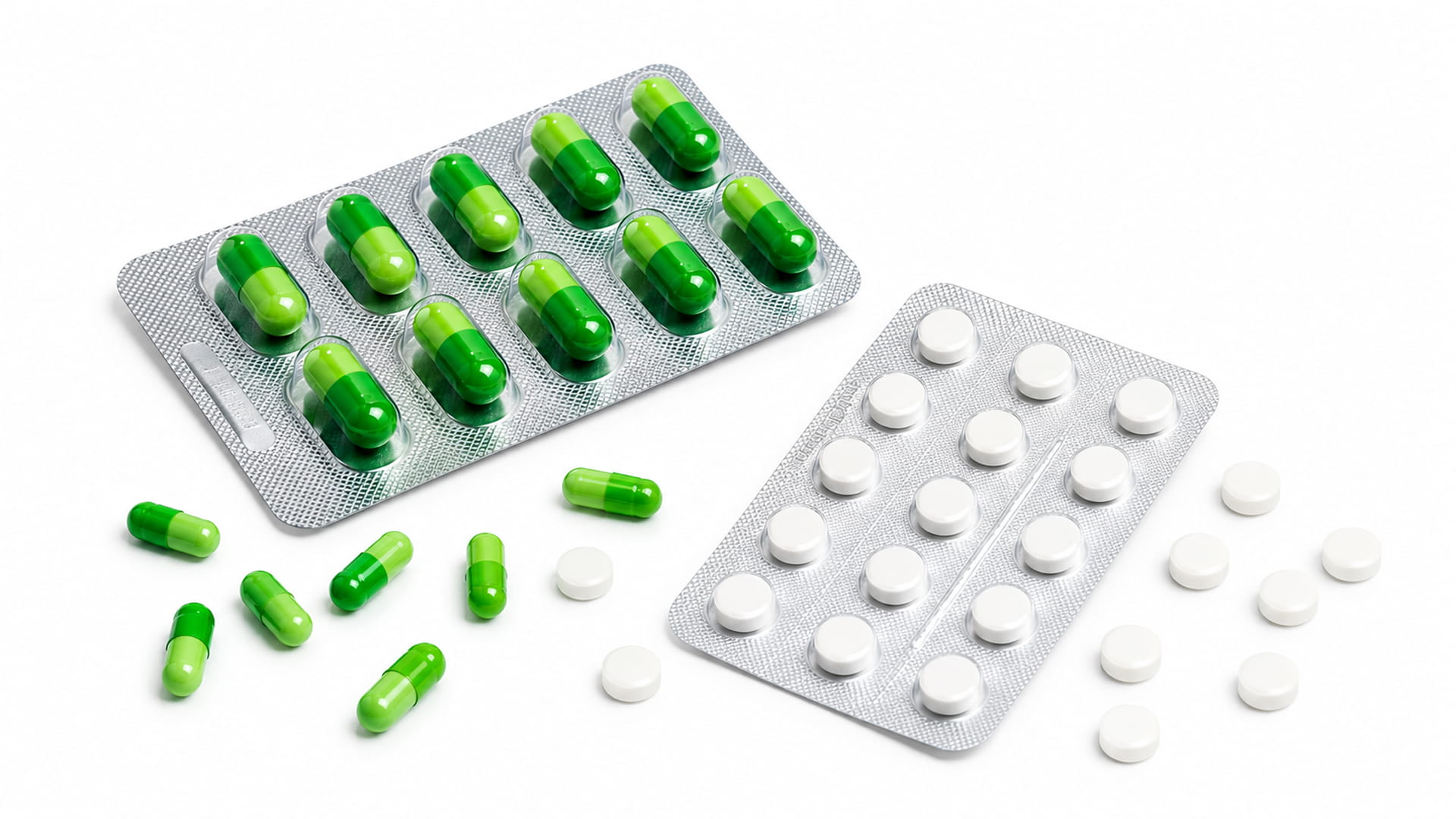
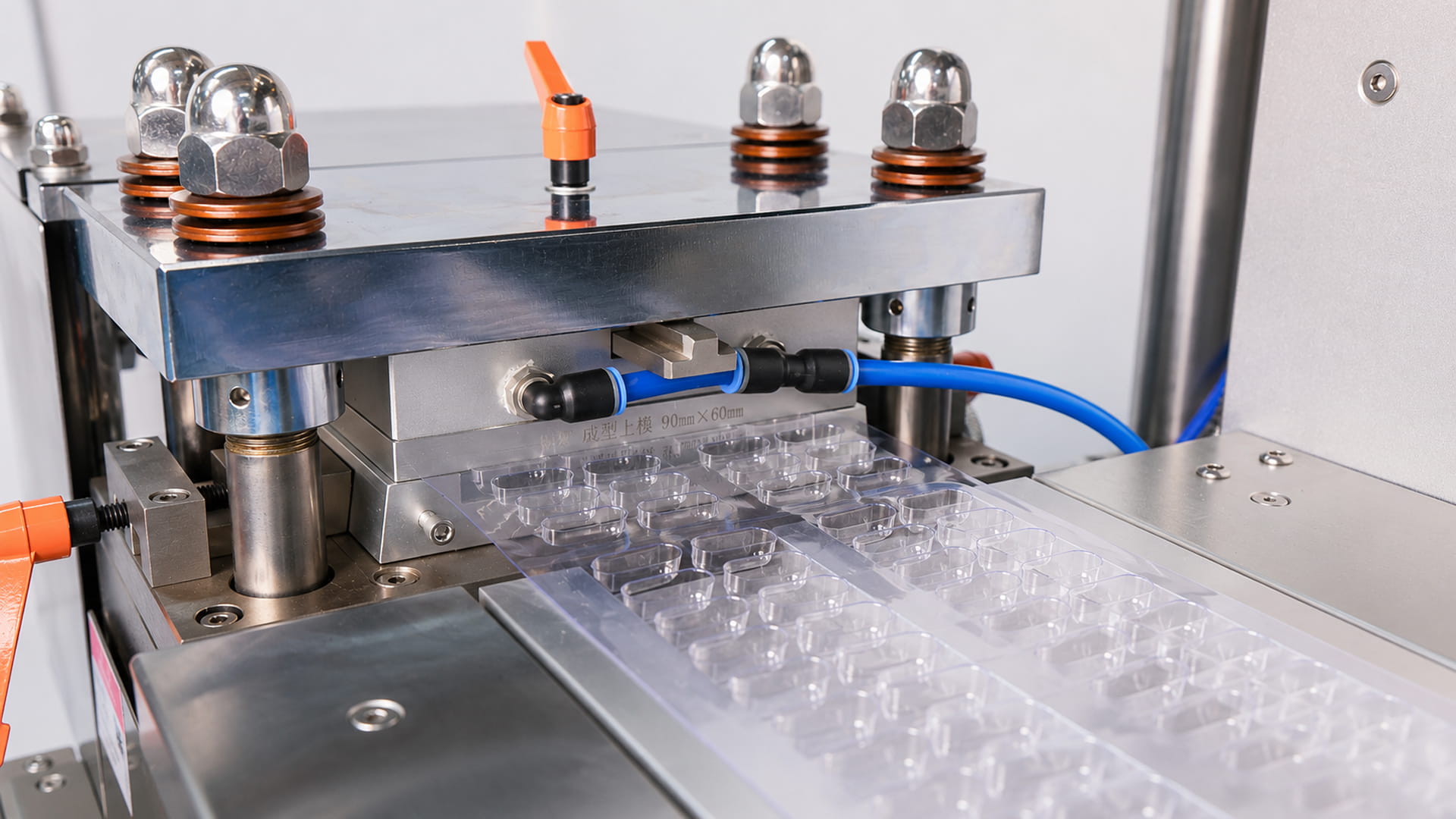
Dans les deux cas, le format en dose unitaire isole chaque dose, et la cavité transparente permet aux utilisateurs de voir le médicament. Vous pourriez vous interroger sur machines d'emballage en cloque: les lignes modernes peuvent former des cavités à partir de films PVC ou PVDC. La principale différence est que le PVC enduit de PVDC peut nécessiter des réglages de chauffage légèrement différents sur la matrice de thermoformage.. Consultez le manuel de votre équipement ou votre fournisseur pour composer les bons paramètres.
Oui. Machines d'emballage sous blister sont généralement compatibles avec les deux matériaux. Vous n'avez pas besoin de machines séparées pour le PVC et le PVC/PVDC. Cependant, toi il faut ajuster le processus:
Machines modernes (comme celui de JinLuPacking DPP-160 ou DPP-270Max thermoformeuses) poignée en PVC, PVC/PVDC et même aluminium moulé à froid. Ils vous permettent de basculer entre les films en ajustant le profil de température et la profondeur de formage. Par exemple, lors de l'exécution de PVC/PVDC, un technicien pourrait réduire les lampes du four de 10-20% par rapport au PVC ordinaire. Dans l'ensemble, la transition est simple pour un opérateur expérimenté.

Les machines blister de JinLuPacking sont conçues pour traiter tous les principaux films blister pharmaceutiques – PVC, PVC/PVDC, PVC/PE/PVDC, aluminium, même les stratifiés à haute barrière. Leurs commandes PLC et leur système de recettes facilitent la sauvegarde des paramètres pour chaque type de film. En bref, une machine peut être votre solution tout-en-un tant que vous le configurez correctement pour les matériaux PVC vs PVDC.
Le choix entre le PVC et le PVDC dépend des besoins de votre produit. Les films PVC sont rentable et clair, idéal pour de nombreux comprimés et capsules standards. Les films enduits de PVDC offrent barrière supérieure, crucial pour l’humidité- ou médicaments sensibles à l'oxygène nécessitant une longue durée de conservation. En pratique, le approche hybride PVC/PVDC gagne souvent: il utilise la clarté et la formabilité du PVC tout en ajoutant la barrière du PVDC là où cela compte.
En cas de doute, évaluer des facteurs tels que la stabilité des médicaments, durée de conservation requise, budget, et objectifs de durabilité. Par exemple, un choix courant est celui des plaquettes thermoformées en PVC/PVDC pour les médicaments exportés, et blisters PVC-Alu unis pour les locaux, produits à court terme. Pensez toujours au mode de défaillance: si votre produit perd de sa puissance 10% trop tôt, qu'est ce que ça coûterait? Cette évaluation des risques détermine souvent si un film à barrière plus élevée est justifié.
Prêt à optimiser votre emballage pharmaceutique? Contacter JinluPacking pour des conseils d'experts et les bonnes solutions d'emballage blister. Notre équipe peut vous aider à sélectionner le film idéal (PVC, PVDC, ou composites avancés) et recommandons la configuration de la machine d'emballage sous blister qui correspond. Que vous ayez besoin de plaquettes thermoformées standard ou de gélules spécialisées avec sécurité enfant, nous veillerons à ce que votre emballage assure la sécurité et la conformité des médicaments jusqu'à la toute fin.
PVC (Chlorure de polyvinyle) et PVDC (Chlorure de polyvinylidène) sont deux matériaux couramment utilisés pour les emballages blister pharmaceutiques. Le PVC est principalement utilisé comme film de base pour le thermoformage car il offre une excellente transparence, formage facile, et à faible coût.
Le PVDC est généralement appliqué comme couche de revêtement sur un film PVC pour améliorer les performances de la barrière contre l'humidité et l'oxygène.. Comparé à un emballage blister en PVC standard, Le blister en PVC/PVDC offre une meilleure protection pour les médicaments sensibles et peut contribuer à prolonger la durée de conservation.
PVDC (Chlorure de polyvinylidène) est un matériau polymère à haute barrière largement utilisé dans les applications d'emballage pharmaceutique et alimentaire. Il présente une excellente résistance à la vapeur d’eau et à la transmission de l’oxygène., ce qui le rend adapté à la protection de produits nécessitant une stabilité améliorée.
Sous blister pharmaceutique, Le PVDC est couramment utilisé comme couche de revêtement sur un film PVC plutôt que comme matériau de formage autonome.. La combinaison PVC/PVDC crée un film blister à haute barrière offrant de meilleures performances de protection médicamenteuse..
Les films PVC et PVDC peuvent être difficiles à distinguer visuellement car les deux matériaux sont généralement transparents et utilisés dans des structures d'emballage blister similaires..
Les principales méthodes d'identification comprennent:
• Structure matérielle: Le PVC est normalement le film de thermoformage de base, tandis que le PVDC est un mince revêtement barrière appliqué sur le PVC.
• Performances de la barrière: Les films enduits de PVDC offrent une bien meilleure protection contre l'humidité et l'oxygène que le PVC standard.
• Spécification technique: Les fabricants identifient généralement le matériau par des étiquettes de structure telles que le PVC., PVC/PVDC, ou PVC/PE/PVDC.
Pour les achats et la production pharmaceutique, vérifier le fournisseur’La fiche de spécifications des matériaux est la méthode la plus fiable.
En termes de barrière à l’humidité et à l’oxygène, Oui. PVDC (comme revêtement) offre une barrière beaucoup plus élevée que le PVC ordinaire. Mais le PVDC est plus cher, donc c'est « mieux » seulement si vous avez besoin de cette protection supplémentaire. Pour simple, produits stables, Le PVC convient généralement.
La résine PVDC coûte plus cher à produire, et l'application du revêtement est un processus en plusieurs étapes. Vous ajoutez essentiellement du matériel supplémentaire (le revêtement) et traitement supplémentaire. La performance supplémentaire est à ce prix.
Oui. Le PVDC peut améliorer la durée de conservation des produits pharmaceutiques en réduisant la pénétration de l'humidité et de l'oxygène dans le blister..
De nombreux produits pharmaceutiques, y compris les comprimés sensibles à l'humidité, probiotiques, et certains produits nutraceutiques, nécessitent un emballage barrière plus solide, car l'humidité et l'oxygène peuvent affecter la qualité et la stabilité du produit.
Cependant, la durée de conservation réelle dépend de la formulation du médicament, structure d'emballage, conditions de stockage, et les résultats des tests de stabilité.
Le PVC/PVDC et le PVC/PE/PVDC sont tous deux des structures d'emballage blister à haute barrière..
PVC/PVDC:
Une structure duplex standard où le revêtement PVDC est appliqué directement sur le PVC. Il offre une meilleure protection contre l’humidité et l’oxygène.
PVC/PE/PVDC:
Une structure triplex qui ajoute une couche PE entre le PVC et le PVDC. Cette structure améliore la flexibilité et les performances de formage, spécialement pour les cavités d'ampoules plus profondes.
Le meilleur choix dépend des exigences du produit, conception de la cavité, et capacité de la machine d'emballage.
C'est un film PVC avec une fine couche de PVDC sur une face. Le PVC offre formabilité et résistance; la couche PVDC fournit une barrière contre l'humidité et l'oxygène. Ensemble, ils forment une double couche (duplex) ou à trois couches (triplex) structure.
Oui. Blistereuses modernes (comme les modèles de JinLuPacking) sont conçus pour le PVC, PVC/PVDC et autres films thermoformables. Vous sélectionnez simplement les bons paramètres. La clé est de contrôler la température du four et les paramètres de formage pour le film spécifique.
Pour les marchés d’exportation chauds/humides, PVC/PVDC (ou encore PVC/Aclar ou Alu-Alu) est recommandé. Le PVC seul échoue souvent dans les climats tropicaux.
Références:
1.Systèmes de fermeture de conteneurs pour le conditionnement de médicaments et de produits biologiques à usage humain —— NOUS. Administration des aliments et des médicaments
2.Systèmes d'emballage en plastique et leurs matériaux de construction —— Pharmacopée des États-Unis
3.Emballage blister pharmaceutique, Partie 1 Justification et matériaux —— Coup de vent
4.Chlorure de polyvinylidène —— ScienceDirect
5.Approches chimiques pour l'identification du PVC et du PVDC dans les matériaux d'emballage pharmaceutique —— Porte de recherche
6.QUALIFICATION DU MATÉRIAU PVC SOUPLE / PVC – PVDC DANS L'INDUSTRIE PHARMACEUTIQUE —— revistajrg.com