

Capsules remplies de liquide (également appelés gélules remplies de liquide ou LFHC) sont essentiellement capsules à coque dure en deux parties (gélatine ou HPMC) qui ont été remplis d'une formulation à base d'huile ou liquide. Après avoir rempli, le capuchon et le corps sont scellés – souvent avec une fine bande de gélatine – pour éviter les fuites. Autrement dit, Les LFHC sont une forme hybride: une enveloppe de capsule solide contenant une dose liquide à l'intérieur. Par contre, gélules molles sont réalisés en une seule étape célibataire, coque flexible monobloc déjà rempli d'un liquide ou d'un semi-solide. Les gélules utilisent de la gélatine plastifiée (avec de la glycérine ou du sorbitol) faire un doux, membrane scellable. Ils sont généralement utilisés pour les ingrédients très gras ou solubles – par exemple, huile de poisson ou vitamines liposolubles (D, E, K) viennent presque toujours sous forme de gélules.
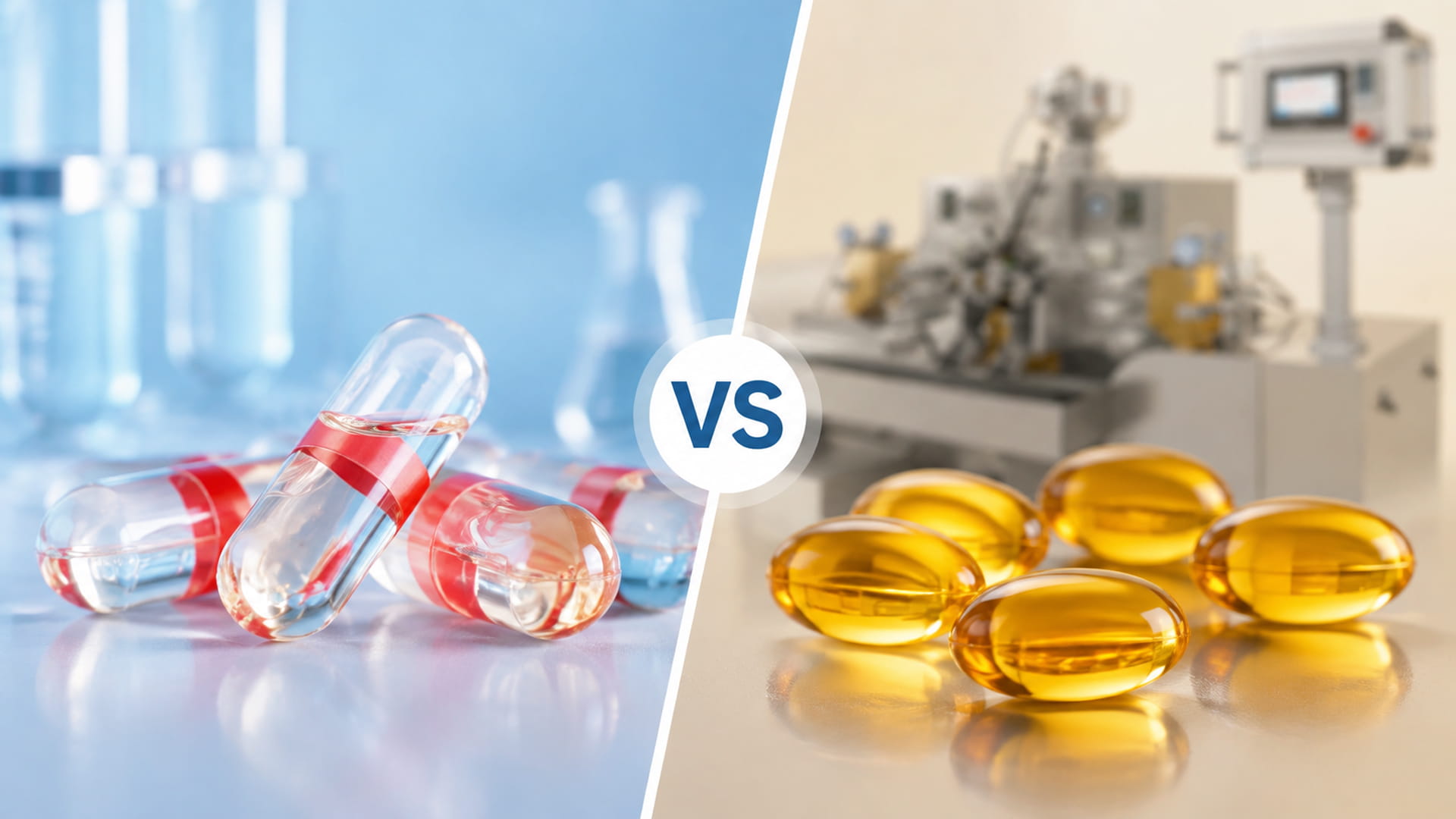
En termes pratiques, les deux formats peuvent délivrer des médicaments liquides ou des suppléments, mais leur conception et réalisation diffèrent considérablement. Les principales différences incluent la structure de la capsule, matériaux de coque, remplissages compatibles, et étapes de fabrication. Comprendre ces éléments aide les fabricants pharmaceutiques à choisir la forme adaptée à leur produit.. Nous détaillons ci-dessous les principales distinctions et avantages de chacun.
Gélules dures remplies de liquide (LFHC) sont standards coques de capsules en deux parties (casquette et corps) rempli d'une formulation liquide ou à base d'huile après la fabrication des coquilles. Les coques peuvent être en gélatine ou en HPMC végétal (pour capsules végétariennes). En production, une dose précise de liquide (souvent une solution d'huile, suspension ou mélange auto-émulsionnant) est injecté dans le corps de la capsule ouverte, puis le capuchon est fermé sur le dessus et scellé. Des méthodes d'étanchéité spéciales garantissent qu'il n'y a aucune fuite (Par exemple, appliquer une fine bande de gélatine autour du joint, appelé « scellement en bande »).
Cette approche en deux parties permet aux LFHC de combiner les avantages des liquides et des capsules. Vous bénéficiez de la libération rapide et de la haute biodisponibilité d'un liquide dissous, avec la facilité d'ingestion et le masquage du goût qu'offrent les capsules. Les coques LFHC sont préfabriquées, donc aucune fusion coûteuse des feuilles de gélatine n'est nécessaire pendant le remplissage. Par exemple, Le remplisseur de capsules de liquide NJY-300C de JinLuPacking remplit automatiquement les liquides dans des coques dures de taille #00 à #4 et les scelle avec une bande en une seule ligne rapide.
Chiffre: Gélules dures remplies de liquide (chacun a une bande colorée scellant le joint capuchon-corps). Ces capsules en deux parties contiennent de l'huile ou du liquide à l'intérieur d'une coque en gélatine solide/HPMC.
Gélules molles (souvent juste appelé gélules) sont une pièce, capsules enrobées de gel contenant une charge liquide ou semi-solide. Ils sont fabriqués sur une machine d'encapsulation à filière rotative qui forme, remplit, et scelle chaque capsule en une seule étape. Dans la machine, deux rubans de gélatine plastifiée (gélatine mélangée à de la glycérine ou du sorbitol) sont coulés et pressés ensemble tandis qu'un flux dosé de liquide est injecté entre eux. Chaque capsule est simultanément découpée et scellée par des matrices chauffées. Le résultat est un lisse, ovale, capsule hermétique couramment utilisée pour les suppléments à base d'huile (pensez aux pilules de vitamine E ou d'oméga-3).
Les gélules sont idéales pour les huiles et les liquides sensibles. Parce que la capsule entière est hermétiquement fermée lors de sa formation, aucune étape de scellage séparée n'est nécessaire. Cela les rend très protecteurs contre l’oxygène et l’humidité. Beaucoup d'huile de poisson, vitamin D/K, et les produits à base d'huile végétale utilisent des gélules pour leur commodité et leur stabilité en conservation.. En fait, des enquêtes montrent que les suppléments d'oméga-3 et de vitamines liposolubles sont le plus souvent livrés sous forme de gélules.
Chiffre: Capsules molles ambrées sur une cuillère à café à côté d'un flacon de pilules (commun pour l’huile de poisson ou la vitamine D).
| Fonctionnalité | Capsules remplies de liquide (LFHC) | Gélules |
| Structure | Deux pièces (capuchon & corps) | Capsule scellée d'une seule pièce |
| Matériau de la coque | Gélatine ou HPMC (option végétarienne) | Gélatine plastifiée (gélatine + plastifiant) |
| Méthode de fabrication | Remplir puis sceller (sur le remplisseur de capsules + les gangs) | Encapsulation par filière rotative (formulaire-remplir-sceller) |
| Coût de l'équipement | Inférieur (remplisseuses de capsules standards) | Plus haut (ligne dédiée aux softgels) |
| Échelle (Quantité minimale de commande) | Minimums bas (convient aux petits lots) | Volume généralement plus élevé requis |
| Option végétarienne | Oui (Coques HPMC disponibles) | Limité (maintenant quelques options féculents/légumes) |
| Scellage | Etanchéité mécanique (cerclage/fusion) | Joint intégré (hermétiquement fermé par matrice) |
| Risque de fuite | Faible (une fois bien scellé) | Très faible (aucune couture qui risque de fuir) |
| Flexibilité de production | Haut (peut mélanger des poudres ou des granulés avec du liquide) | Moyen (seul le liquide/pâte se remplit) |
| Mise à l'échelle | Facile (utilise des machines à capsules standard) | Plus complexe (séchage spécialisé, etc.) |
Les deux formes délivrent des actifs liquides ou à base d'huile et peuvent offrir une biodisponibilité élevée en présentant le médicament dissous dans un lipide.. Cependant, Les LFHC utilisent des lignes plus simples (les coques sont préfabriquées) alors que les softgels nécessitent des étapes de cuisson et de séchage pour les rubans de gélatine.
À retenir: Machines à gélules formulaire, remplir, et coupé en une seule étape (nécessitant un séchage), tandis que les lignes LFHC remplissent des coques préfabriquées et les scellent (sauter une longue étape de durcissement). Comme le note un guide de l’industrie, « Les gélules durcissent 2 à 4 jours après le remplissage. Les LFHC n’ont pas d’étape de durcissement… les pertes de lots dues à un échec de remplissage sont plus élevées pour les gélules.”.
Les capsules remplies de liquide offrent plusieurs avantages en matière de fabrication et de produit:
Ces avantages rendent les LFHC attractifs sur les marchés pharmaceutiques et nutraceutiques.
Les gélules présentent également de puissants avantages qui les rendent populaires pour de nombreux suppléments.:
Les industries utilisant des gélules comprennent médicaments (médicaments à base d'huile), produits nutraceutiques (compléments alimentaires), produits de beauté (huiles de beauté nutraceutiques), et même des produits vétérinaires. Par exemple, les gélules végétaliennes ou halal à base d'amidon/gellane sont en hausse.
| Ingrédient / Remplir | Capsule remplie de liquide | Gélule molle |
| Huile de poisson / Oméga-3 | ✓ Convient | ✓ Convient |
| CBD ou huile de cannabis | ✓ Convient | ✓ Convient |
| Curcumine (Extrait de curcuma) | ✓ Convient | ✓ Convient |
| Vitamin D (huile) | ✓ Convient | ✓ Convient |
| Extraits liquides de plantes | ✓ Convient | ✓ Convient |
| Probiotiques | ✓ (si suspendu dans l'huile) | Non (l'humidité tue les bactéries) |
| API sensibles à l'humidité | ✓ (surtout dans les capsules HPMC) | ✗ (coquille très humide) |
Les deux types de capsules gèrent bien les actifs solubles dans l’huile. Huiles nutraceutiques courantes (huile de poisson, vitamin D, extraits à base de plantes, CBD, etc.) sont efficacement administrés soit par des LFHC, soit par des gélules.
Notamment, ingrédients secs ou sensibles à l'humidité sont meilleurs dans les gélules remplies de liquide. Par exemple, les probiotiques ou les API sensibles à l'eau ne sont pas pratiques dans les gélules. En revanche, Les gélules HPMC peuvent contenir des suspensions non aqueuses de probiotiques ou des formulations très sèches, puisque le HPMC a une faible perméabilité à l'humidité et aux gaz. Les coquilles de softgel contiennent environ 30% perméabilité à l'eau et à l'oxygène plus élevée, qui peut dégrader ces ingrédients.
En bref, utiliser les LFHC lorsque la flexibilité et la production à faible volume sont importantes; choisissez les gélules pour leur ampleur et leur attrait haut de gamme.
Du point de vue d’un fabricant, la décision dépend souvent de l'échelle, investissement, et objectifs stratégiques:
Le tableau ci-dessous résume le choix par scénario:
| Type d'entreprise / Situation | Format recommandé |
| Petite startup ou R&Projet D | Capsules remplies de liquide (faible MOQ, flexible) |
| Ligne de suppléments de niche, <10k unités | Capsules remplies de liquide |
| Fabricant sous contrat (flexibilité) | Capsules remplies de liquide |
| Grand producteur pharmaceutique | Gélules (haut débit, cohérent) |
| Oméga-3 ou vitamines en grande quantité | Gélules |
| Produit nécessitant une capsule végétalienne | Capsules remplies de liquide (Coques HPMC) |
Chiffre: Gros plan d'une machine de remplissage de capsules liquides distribuant du liquide dans des capsules.
JinLuPacking fabrique une gamme complète d'équipements pour capsules. Par exemple, notre NJY-300C remplisseuse de capsules liquides la ligne gère les remplissages de liquide, et nous fournissons également machines à capsules de gel mou pour une production en une seule étape. Ces machines répondent aux normes cGMP pour une utilisation pharmaceutique et nutraceutique.
À la fin, tous deux remplis de liquide gélules et gélules sont bien établis, formes posologiques efficaces. Les gélules excellent dans la fourniture d'huiles et d'actifs solubles dans l'huile avec une dissolution rapide, emballage inviolable. Les gélules remplies de liquide offrent de la flexibilité, plus rapide R&Mise à l'échelle D, et simplicité de fabrication. En comprenant leurs différences, avantages et exigences de production, les fabricants peuvent choisir le type de capsule qui correspond le mieux à la chimie de leur produit et aux besoins commerciaux.
Si vous concevez une nouvelle formulation ou modernisez votre ligne de production, réfléchissez attentivement aux deux options. Prêt à optimiser votre production de capsules? Jinlu Packing propose des équipements de pointe pour les deux formats (Par exemple, notre NJP-1000C peut remplir jusqu'à 60,000 gélules par heure) et peut vous conseiller sur la meilleure solution pour votre produit. Contactez-nous pour discuter de votre projet, demander un devis, ou apprenez-en plus sur nos capsules liquides et nos gélules lignes de conditionnement.
Oui. Remplisseurs de gélules spécialisés (comme les machines de remplissage de capsules liquides de JinLuPacking) peut injecter des huiles ou des liquides dans des capsules dures vides, qui sont ensuite scellés (par exemple. en baguant) afin qu'ils retiennent le liquide en toute sécurité. Cela crée une « capsule dure remplie de liquide ».
Ni l’un ni l’autre n’est universellement « meilleur » – ils répondent à des besoins différents. Les LFHC gagnent en termes de coûts, vitesse, et flexibilité (surtout pour les petits lots), tandis que les gélules offrent un joint homogène et un format familier pour les suppléments d'huile. Le meilleur choix dépend de votre matériau de remplissage, volume de production, et le marché.
Les LFHC correctement scellés ne fuient pas. Après avoir rempli, la jonction capuchon-corps est hermétiquement fermée par application d'une bande de gélatine ou d'HPMC (ou en utilisant un scellement par fusion). Quand c'est fait correctement, les capsules retiennent hermétiquement le liquide pendant le séchage, stockage, et utiliser. Les lignes de qualité testent et polissent chaque lot pour garantir l'intégrité.
Les deux peuvent offrir une excellente biodisponibilité pour les actifs à base d’huile. La formulation de remplissage (type d'huile, émulsifiants) dicte généralement l'absorption, pas le type de coque. Les gélules se dissolvent rapidement (~10 à 20 minutes), tandis que les capsules dures (LFHC) se dissoudre légèrement plus lentement (30–60 minutes). En pratique, des remplissages bien conçus, sous l'une ou l'autre forme, peuvent atteindre une efficacité similaire.
Oui. Les coques HPMC à base de plantes sont largement utilisées pour les capsules remplies de liquide. La faible humidité et la structure solide du HPMC permettent aux liquides huileux de pénétrer à l'intérieur. En fait, utiliser des coques HPMC est une façon de proposer une capsule végétarienne sous forme liquide, ce que les gélules standard ne peuvent pas fournir.
Les entreprises citent des raisons telles que la baisse des coûts de fabrication, des délais de livraison plus courts, et flexibilité de formulation. Par exemple, un R&L’équipe D peut ajuster rapidement les doses ou combiner les ingrédients dans les LFHC sans réoutillage. Aussi, Les VFHC permettent d'étendre facilement les gammes de produits (puisque les mêmes capsules peuvent être remplies de liquides différents).
En général, Oui. La production de softgels nécessite un équipement coûteux (cuiseurs à gélatine, matrices rotatives, séchoirs) et plus de travail sur plusieurs jours. Les LFHC utilisent des charges plus simples et moins d'énergie. Des rapports de l'industrie indiquent que les LFHC coûtent 15 à 35 % de moins par unité à produire que les gélules. Cependant, à très haut volume, les gélules peuvent toujours être rentables.
Les ingrédients liquides sont remplis à l'aide d'une machine de remplissage de capsules liquides (souvent un accessoire ou une variante d'un remplisseur de capsules standard). Par exemple, Les machines de la série NJY de JinLuPacking utilisent des pompes de précision (piston en céramique ou micro-pompe) doser l'huile dans des capsules. Ces machines peuvent atteindre des vitesses élevées (plusieurs milliers de capsules par heure) avec une précision meilleure que ±1 %.
Surtout non aqueux, remplissages à base d'huile ou de solvant. Exemples courants: huile de poisson, huile de vitamine E, vitamines liquides, extraits d'huiles végétales, émulsions, et certains systèmes d'administration de médicaments auto-émulsifiants. Le remplissage doit être pompable et généralement non corrosif. Les liquides à base d'eau sont évités (ils peuvent affaiblir les sceaux). La viscosité du remplissage doit être contrôlée pour éviter les éclaboussures ou les gouttes pendant le remplissage..
Oui. De nombreuses machines à capsules sont convertibles: en échangeant le système de dosage, ils peuvent remplir des poudres/granulés ou des liquides. En pratique, la plaque de dosage de poudre d'un remplisseur de capsules standard est remplacée par une tête de remplissage de liquide et un système de pompe. Cette polyvalence signifie qu'une seule ligne peut basculer entre la production de poudre et la production de LFHC..
Références:
1.Capsules de gélatine dure remplies et scellées de liquide —— Taylor & François en ligne
2.Capsules de gélatine molle (Gélules) —— ScienceDirect
3.Effets de la température sur les caractéristiques du ruban lors de la fabrication de capsules de gélatine molle —— Bibliothèque nationale de médecine
4.Examen complet des capsules de gélatine molle: Fabrication industrielle, Avancées technologiques, et perspectives réglementaires —— Journal de LIVRAISON DE MÉDICAMENTS & THÉRAPEUTIQUE
5.Capsule de gélatine dure remplie de liquide —— Journal de LIVRAISON DE MÉDICAMENTS & THÉRAPEUTIQUE
6.Détermination de la quantité optimale d'eau dans les masses de remplissage liquide pour capsules de gélatine dure au moyen d'une analyse de texture et d'un plan expérimental —— Bibliothèque nationale de médecine