×

خدمات آنلاین

💬 واتس اپ: +86 1801179332
💡
  • صفحه اصلی
  • وبلاگ ها
  • نحوه انجام ممیزی تامین کننده از تولید کنندگان تجهیزات دارویی: راهنمای کامل GMP

نحوه انجام ممیزی تامین کننده از تولید کنندگان تجهیزات دارویی: راهنمای کامل GMP

در تولید دارو, تضمین می کند equipment suppliers meet GMP standards is as critical as vetting raw material vendors. A thorough supplier audit helps pharmaceutical companies verify an equipment manufacturer’s quality systems, مستندات, and processes, reducing the risk of defective or noncompliant machines entering production. Regulatory guidance (FDA, EMA, من, سازمان بهداشت جهانی) emphasizes a risk-based supplier quality program: perform supplier qualification audits for critical vendors, review their quality management system and compliance history, and follow up with corrective actions and approvals. This article explains why and when to audit equipment suppliers, outlines a step-by-step audit process (with a flowchart), provides an equipment-focused audit checklist, compares on-site vs. remote audits, and shows how FAT/SAT and IR/WH/PQ fit into supplier qualification. Tables summarize audit types and risk levels, and practical advice (with real-world examples and regulatory citations) will help procurement, QA and engineering teams execute successful audits. به طور خلاصه, a structured audit program—supported by مستندات جامع from a GMP-savvy supplier—ensures your new machines arrive “audit-ready” for IQ/OQ qualification and GMP use.

ممیزی تامین کننده سازندگان تجهیزات دارویی


Why Audit Your Equipment Suppliers?

In regulated pharma, nothing can be left to chance. Even if a machine is well-built, any quality lapse at the supplier (poor QMS, undocumented changes, uncalibrated instruments, و غیره) can compromise your product. Because drug manufacturers are ultimately responsible for final product quality and compliance, regulators expect them to audit critical suppliers. به عنوان مثال, FDA’s ICH Q10 guidance notes that contract-givers “should be responsible for assessing the suitability and competence” of suppliers, and all quality-related activities must be defined in written agreements. در عمل, this means auditing equipment vendors to ensure they follow GMP-like controls. همانطور که یکی از کارشناسان صنعت توضیح می دهد, supplier audits are regular inspections that improve the raw materials, تجهیزات, and supplies a company receives…and help achieve compliance with strict regulatory requirements.

Key reasons to audit equipment suppliers include:

  • تضمین کیفیت: Audit findings can catch issues early (به عنوان مثال. undocumented machine designs, lack of validation support) before they affect your process. Regular audits help maintain کیفیت محصول ثابت and prevent costly delays or recalls.
  • انطباق نظارتی: Both FDA and EU GMP explicitly call for equipment qualification and supplier controls. FDA 21 CFR 211.25 و ضمیمه GMP اتحادیه اروپا 15, به عنوان مثال, mandate that critical equipment be qualified before use. Auditing ensures suppliers deliver machines with necessary GMP documentation (like FAT/SAT and calibration records) so you can meet these regulations.
  • Risk Management: Using a risk-based approach means focusing audits on the most critical suppliers. High-risk vendors (به عنوان مثال. makers of sterile-grade filling machines) get thorough audits, while low-risk ones may be assessed less intensively. This aligns with FDA Q10, which recommends a risk-based supplier program that includes audits tailored by supplier criticality.
  • Supplier Partnership: Audits aren’t just policing; they’re also opportunities to collaborate. A capable supplier can demonstrate robust QA practices, help you write URS (user requirements), and support FAT or validation, ultimately smoothing downstream processes. As one trade article notes, “the right supplier supports your validation process and helps ensure your system remains consistent over time”.

“A supplier audit is an independent assessment of a supplier’s processes or products against benchmarked criteria… meant to uncover opportunities to improve a product, فرآیند, یا سیستم,” explains a quality industry source. در داروسازی, this means checking that your equipment vendor’s quality manual, تغییر کنترل, CAPA, and documentation all meet GMP expectations. A solid audit program (initial and periodic) helps verify that equipment will function safely under GMP conditions.


When and What to Audit

Audits should be planned at key stages. Typical timings include:

  • Initial (صلاحیت) Audit: Before approving a new equipment supplier, perform a full audit. This is part of supplier qualification. It verifies that the vendor’s QMS and processes can meet your needs from the start.
  • Periodic (Surveillance) Audits: Audits scheduled (برای مثال, annually or biennially) to ensure ongoing compliance. High-risk suppliers get more frequent reviews. FDA guidance explicitly recommends periodic supplier audits as part of ongoing monitoring.
  • For-Cause Audits: Triggered by problems. به عنوان مثال, if a machine arrives with missing documentation, or after a major change at the supplier (new management, major redesign), or in response to a compliance issue (warning letter, CAPA failure).
  • Follow-Up Audits: After an audit finds nonconformities, a follow-up audit checks that corrective actions were completed.
  • Remote Assessments: گاهی اوقات, an audit may be done remotely (via video calls, documentation review, virtual tour), especially as a stop-gap. EMA notes that remote or ‘paper-based’ assessments can help in a risk-based strategy, اما cannot replace on-site audits for critical suppliers (جدول زیر را ببینید).

The table below summarizes common audit types and their purposes:

Audit Type هدف
Initial (صلاحیت) Assess a جدید supplier before approval; verify QMS, مستندات, and capabilities.
Periodic (برنامه ریزی شده است) Re-evaluate an existing supplier (به عنوان مثال. سالانه) to ensure continued compliance.
For-Cause (Trigger) Investigate specific issues (به عنوان مثال. complaints, انحرافات, 483 مشاهدات) at a supplier.
Follow-Up Verify that corrective/preventive actions (CAPA) from prior audit have been implemented.
Remote/Desk Audit Review supplier quality systems and docs virtually; lower cost/faster, but limited scope.

در تمام موارد, use a risk-based approach to decide scope. High-risk suppliers (critical equipment) warrant deeper, on-site audits, while low-risk ones may only need desk reviews or sampling. EMA’s Q&A reminds us that even if a supplier has a GMP certificate or inspection report, the manufacturer’s legal responsibility isn’t met until it conducts its own audit program. به عبارت دیگر, use external assessments to inform your priority list, but trust – and verify – through your own audits.

Risk-Based Supplier Risk Matrix

A simple risk matrix helps categorize suppliers and guide audit frequency. به عنوان مثال:

Risk Level نمونه ها Audit Actions
عالی Aseptic liquid fillers, استریل کننده ها, پرکننده های کپسول; first-time or single-source suppliers Thorough initial on-site audit; annual or biennial audits; full scope (QMS, facility, documents, چربی).
واسطه Non-sterile packaging machines (به عنوان مثال. تاول ها, کارتن سازها); second vendors or known suppliers Detailed initial audit; site audits every 2–3 years; moderate scope (focus on critical processes, plus documentation).
کم Auxiliary equipment (به عنوان مثال. نوار نقاله ها, basic pumps); commodity vendors Basic qualification (docs review, questionnaires); on-site audits only if issues arise; periodic reassessment (3–5 years or as needed).

This risk assessment should consider تاثیر (how critical is the equipment to product safety/quality?) و likelihood (has the supplier had past issues? new design? complex technology?). به عنوان مثال, a new capsule-filling line in a sterile drug plant is high-impact (direct contact, دقت بالا), so it stays in the high-risk category and demands full audits. در مقابل, a simple conveyor that never contacts product directly might be low-risk – a remote audit or questionnaire may suffice initially, with on-site checks only if the risk level changes.


Step-by-Step Audit Process

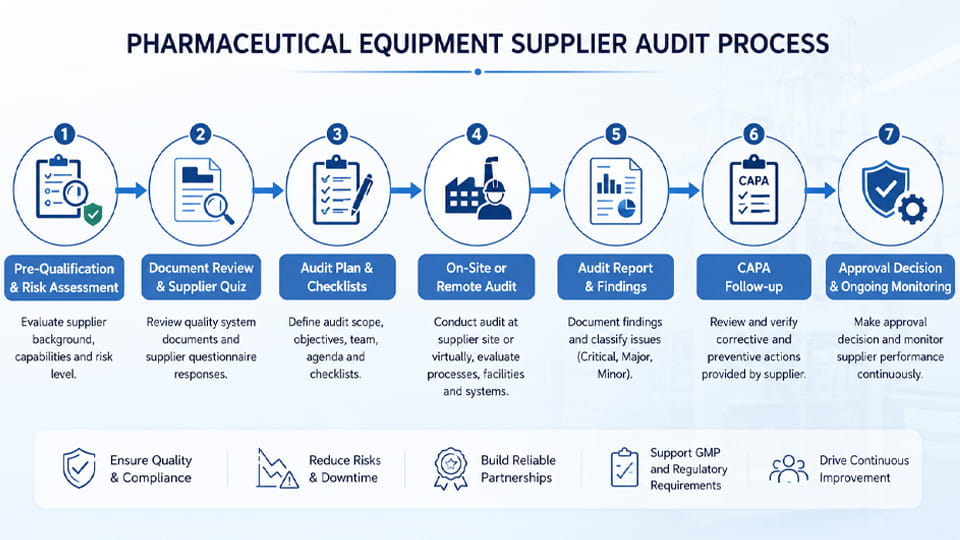
Below is a high-level flowchart of the audit process, followed by details on each step:

PHARMACEUTICAL EQUIPMENT SUPPLIER AUDIT PROCESS

Each step is outlined below:

  1. Pre-Qualification & ارزیابی ریسک: Before scheduling any audit, gather basic information on the supplier. Review their certifications (ISO 9001, ISO 13485, CE markings, و غیره), regulatory history, financial stability, and whether they’ve supplied similar machines before. Define the audit scope and objectives based on risk. For high-risk machines, aim for a full on-site audit; for lower-risk items, a partial or remote audit may suffice. Create a checklist or supplier questionnaire upfront to cover key topics (see next step).
  2. Document Review & Supplier Questionnaire: Request and review critical documentation in advance. This usually includes the supplier’s Quality Manual, organizational chart, SOPs for design control, تغییر کنترل, کالیبراسیون, نگهدار, and their CAPA processes. Obtain copies of recent validation protocols (FAT/SAT/IQ/OQ), calibration certificates for major instruments, and evidence of staff training programs. Also get past audit reports or any regulatory inspection reports if available. اغلب, a simple pre-audit questionnaire can help confirm which documents exist and highlight any glaring gaps. Document review helps the audit team tailor on-site questions and saves time at the factory.
  3. Audit Planning & Checklists: Form an audit team with appropriate expertise (QA/validation engineers, technical specialists, maybe a third-party GMP auditor if needed). Develop a detailed audit plan: confirm dates, personnel to interview, areas and machines to inspect, and document references. Create or adapt audit checklists covering GMP-related topics (see next section for checklist items). Ensure auditors have protective gear (به عنوان مثال. lab coats, safety shoes) ready. Pre-communicate the agenda with the supplier.
  4. On-Site (or Remote) Audit: Conduct the audit. If on-site, inspect the supplier’s facilities, observe production and testing, and interview their staff. Typical audit activities include:
  5. Opening Meeting: Introduce the audit team, review scope and objectives, and confirm logistics.
  1. Facility Tour: Walk through manufacturing areas. Check for cleanliness, proper segregation of production stages, equipment maintenance logs, and how sensitive equipment is handled (به عنوان مثال. whether there is dust control, clean utilities, و غیره).
  2. Quality System Audit: Using the checklists, systematically review the supplier’s Quality Management System. Example focus areas:
    • Organization & پرسنل: Are responsibilities (for QA, QC, مهندسی, خدمات) clearly defined? Are personnel trained and qualified for their roles?
    • Document Control: Are procedures and forms properly controlled? Can they show master documents vs. master copies vs. change logs?
    • کنترل را تغییر دهید: How does the supplier approve design or process changes? Are any past changes (به عنوان مثال. to the machine design or software) documented and approved?
    • تعمیر و نگهداری تجهیزات & کالیبراسیون: Are maintenance schedules followed? Check calibration certificates for critical machines. Lack of calibration is a common finding.
    • Production/Assembly Processes: Observe how machines are assembled, welded, or painted. Are stainless parts properly cleaned? (همانطور که یکی از راهنماها اشاره می کند, pharmaceutical machines should use 316L SS with proper polishing and passivation.)
    • کنترل کیفیت & تست: Review how the supplier tests each machine (به عنوان مثال. pressure tests, تست های نشت, functional tests). Confirm test equipment is calibrated. Verify protocols exist for FAT (آزمون پذیرش کارخانه) and SAT (آزمون پذیرش سایت).
    • Documented Procedures: Check that key processes (welding, تمیز کردن, software testing) have written SOPs and are followed.
    • Change Management: Ask about recent any deviations or nonconformities, and how corrective actions were handled.
    • Equipment Validation Support: Confirm the supplier provides IQ/OQ templates and participates in FAT/SAT. Jinlu notes that experienced suppliers deliver machines with complete FAT/SAT/IQ/OQ protocols to streamline your validation.
  3. Collecting Evidence: Auditors should gather objective evidence: interview notes, photos (if allowed), and copies of reviewed documents. Note any observations that relate to GMP compliance.
  4. Wrap-Up Meeting: Before leaving, hold a closing meeting to verbally present major observations. Agree on the timeline for the final audit report and CAPA plans.

If conducting a remote audit, focus on document review, live video walkthroughs, and interviews. As EMA notes, remote audits can inform your audit program, but they are not as thorough as on-site inspections for high-risk suppliers. Always aim to do full on-site audits for truly critical equipment.

  1. Audit Report & Findings: Compile a written report summarizing the audit scope, findings (nonconformities and observations), and evidence. Use clear language to describe each issue. Classify findings by severity (major vs. minor) در صورت امکان. به عنوان مثال, a missing calibration certificate for a critical sensor is a major finding; a missing data entry on a checklist might be minor. Include photos or document excerpts as needed (ensuring no sensitive info is shared). The report should reference specific GMP or design requirements behind each finding. Provide the supplier a reasonable deadline to submit corrective action plans (CAPAs) for each issue.
  2. CAPA Verification: Review the supplier’s CAPA responses. Verify that corrective actions are adequate and implemented. This may require follow-up (به عنوان مثال. reviewing updated documents, re-testing a machine, or even a quick re-audit of the issue area). Document that each finding is closed before approving the supplier. If critical issues are not resolved, you may require additional audits.
  3. Supplier Approval & Ongoing Monitoring: Once corrective actions are verified, make a formal approval decision. به عنوان مثال, add the supplier to your Approved Vendor List (with any restrictions noted), or classify them as qualified under certain conditions. Communicate the decision to procurement and QA. Update internal records (به عنوان مثال. supplier risk rating, next audit date). Then continue to monitor supplier performance – track delivered machine quality, late deliveries, service issues, و غیره. High-risk suppliers should be re-audited more frequently, as indicated by FDA: “high-risk suppliers… may require more frequent audits… based on a risk assessment”.


Pharmaceutical Equipment Audit Checklist

Below is a condensed checklist of key areas and sample questions to consider during an equipment supplier audit. (Adapt this to your specific machine and risk level.)

  • سیستم مدیریت کیفیت (QMS):
    • Is the supplier ISO 9001 (یا 13485) certified? Inspect the certificate validity.
    • Review their Quality Manual and organizational chart. Are QA/QC roles clearly defined?
    • How is document control handled? Check if procedures have revision history and approvals.
    • Examine records of internal audits and management reviews. Are issues followed up?
    • آموزش: Are personnel trained on GMP/standards relevant to pharmaceutical equipment?
  • انطباق نظارتی:
    • Does the supplier understand FDA/EU GMP? (Look for a quality policy or training records.)
    • Check relevant certifications: CE mark, ul, FDA 510(ک) (for medical device equipment), و غیره.
    • Equipment Design: Are materials 316L SS or other pharma-grade materials, with proper polishing?
    • Ask if the supplier’s machines have design features requested in your URS (به عنوان مثال. تمیز در محل, laminar flow compatibility).
  • طراحی & کنترل را تغییر دهید:
    • Do they have a formal design control process? (Review a sample machine’s design spec vs. output.)
    • How are design changes documented and approved? Look at a recent change order log.
    • Check if engineering drawings match the delivered machine (welds, حسگر, cable routes, و غیره).
  • تولید & Assembly Processes:
    • Observe production flow: does it match written procedures? (به عنوان مثال. sequence of welding, painting, assembly)
    • Verify cleanliness of welding and finishing: no paint overspray on critical surfaces, welds are smooth.
    • Check for segregation of parts (part labeling, شماره های سریال) to maintain traceability.
    • Inspect spare parts handling and stores (are critical spares logged and controlled?).
  • کنترل کیفیت & تست:
    • Review Factory Acceptance Test (چربی) پروتکل ها. Were FAT tests defined for all critical functions?
    • Check calibration logs for test equipment (pressure gauges, جریان سنج, و غیره). Expired calibrations are a common audit finding.
    • Inspect any machine-specific test records (به عنوان مثال. motor run-time, temperature calibration) to confirm pass criteria were met.
    • Ensure there is a Site Acceptance Test (SAT) plan for re-verifying functions after installation.
  • قابلیت ردیابی & مستند سازی:
    • Are material certificates and welding certificates available for contact parts? (For highly regulated products, traceability per ASME BPE or FDA guidance is expected.)
    • Ensure there are Master Validation Plans for IQ/OQ/PQ on file and templates for protocols.
    • Check if each delivered machine has a DQ/IQ/OQ package, including wiring diagrams, mechanical drawings, and calibration data.
  • CAPA & بهبود مداوم:
    • Look at past nonconformance reports or CAPA logs. How effectively were problems investigated and resolved?
    • Verify that any repeat issues are being analyzed for root cause (به عنوان مثال. recurring leak failure, repeated calibration errors).
  • Facilities & تجهیزات:
    • Tour the supplier’s site: Are manufacturing areas climate-controlled as claimed? (Some equipment requires specific environments.)
    • Check maintenance records for major production equipment (آسیاب ها, lathes, welders). Breakdowns or poor maintenance could affect machine quality.
    • Evaluate safety and housekeeping – while not directly GMP, a messy shop floor may signal poor discipline.
  • خدمات & پشتیبانی کنید:
    • Ask about the supplier’s service infrastructure: Do they have a local service team or spare parts warehouse?
    • How do they handle updates or upgrades? (SOPs for software updates, hardware retrofits).

This checklist is a starting point. Tailor it to the specific equipment: برای مثال, a blister packer audit would focus on heater calibration, date coders, and film handling, while a capsule filler audit would emphasize dose accuracy checks and capsule lock verification. The goal is to assess both what’s on paper (رویه ها, records) و what happens on the floor (observed practice).


Common Audit Findings

When auditing equipment suppliers, some of the most frequently observed issues include:

  • مستندات ناقص: Missing SOPs for critical processes (به عنوان مثال. painting, electrical testing), or incomplete FAT records.
  • Calibration Gaps: Devices (gauges, حسگر, ترازو) used in testing not calibrated or calibration expired.
  • Poor Change Control: Modifications to a machine design not properly authorized or documented (به عنوان مثال. a new sensor added without updating drawings).
  • Training Records: Lack of evidence that assembly or QA personnel received relevant training on GMP or equipment-specific procedures.
  • CAPA Ineffectiveness: Repeated failures (به عنوان مثال. multiple breakdowns of a component) with no trending or preventive measures.
  • Facility Issues: Unauthorized personnel in restricted areas, or raw materials stored near finished machines.
  • یکپارچگی داده ها: Audit trails or logs not printed or saved (Jinlu notes the importance of confirming logs and audit trails during validation).

If you encounter any of these, work with the supplier to develop corrective plans. Properly closing out audit findings is crucial before final approval. Always record action items and follow up – a supplier is not qualified until all critical CAPAs are verified.


On-Site vs. Remote Audits

جنبه On-Site Audit Remote Audit
Scope Full access (امکانات, people, documents). Limited to documents, records, and virtual tours.
Depth of Inspection عالی: can physically inspect machines, housekeeping, unseen practices. معتاد: mainly documentation review and interviews.
هزینه & زمان بالاتر (travel time and expense, scheduling challenges). پایین (no travel; quicker scheduling).
Effectiveness Most thorough (preferred for high-risk suppliers). Good for follow-ups or low-risk vendors; interim solution for urgent needs.
انعطاف پذیری کمتر انعطاف پذیر (must sync schedules/availability). انعطاف پذیرتر (can often audit multiple sites via video).
Audit Evidence Direct observation of processes, photo/video; easier to spot discrepancies. Reliant on what the supplier shows; risk of missing hidden issues.

به طور کلی, on-site audits remain the gold standard, especially for high-risk or newly qualified suppliers. Regulators note that remote “paper-based” audits do not fully replace the assurance of being on-site. با این حال, remote audits can be useful (برای مثال, as a temporary measure if travel is restricted) and can efficiently review the supplier’s quality records. A hybrid approach is common: use remote audits for basic documentation review, then schedule an on-site visit for the final deep-dive, or alternate between on-site and remote for routine checks.


آزمون پذیرش کارخانه (چربی), آزمون پذیرش سایت (SAT) and IQ/OQ

Equipment audits should pay special attention to validation documentation. قبل از خرید, confirm that the supplier has a robust FAT procedure. A complete FAT verifies the machine works to your URS under controlled conditions. During the audit, review the supplier’s past FAT reports for similar machines: check that test criteria and results are clearly documented and meet specifications. Also ensure a formal SAT plan will be executed after installation. These acceptance tests are critical for qualification.

به همین ترتیب, ensure the supplier provides full IQ/OQ support. Jinlu’s experience shows that trustworthy vendors deliver machines “with full IQ/OQ/PQ support and turn-key validation services”. در عمل, this means they should give you IQ checklists, OQ test scripts, and example PQ protocols for your review. The vendor often performs the FAT and can assist with IQ by pre-aligning and installing the machine under controlled conditions. But remember: در buyer’s QA team is ultimately responsible for completing on-site IQ/OQ/PQ. Your audit should confirm the supplier has trained staff or contractors available to support validation and will supply necessary reports, نقاشی ها, and calibration records.

Ask direct questions, برای مثال: “Do you have a FAT protocol based on our URS?”, “Will you witness the IQ/OQ tests on site, and provide validated documentation afterwards?”. A good supplier will be prepared with templates and will treat this as routine – it’s part of GMP readiness.


Common Buyer Questions (Checklist Highlights)

During the audit (or pre-audit discussions), buyers often ask suppliers:

  • انطباق نظارتی: Can you demonstrate compliance to GMP or ISO standards? Do you have a quality certificate or registration?
  • مستند سازی: Will you supply complete machine documentation (راهنماها, نقاشی ها, FAT/SAT reports, IQ/OQ templates)?
  • تجربه: Have you supplied this machine model to other pharma plants? Can you provide references or case studies?
  • کنترل را تغییر دهید: How do you handle changes requested after order (به عنوان مثال. URS updates)?
  • Spare Parts/Service: What is your spare parts plan and service response time? Do you have local service engineers?
  • پشتیبانی پس از فروش: Do you assist with installation and qualification? Do you offer training for my operators?
  • Quality History: Can you share recent audit reports, NCMR (nonconformance) logs or CAPA statistics? Any recalls or warning letters?

The answers to these help gauge the supplier’s maturity. به عنوان مثال, an experienced supplier should readily show QA certificates (ISO 9001/13485) and have no trouble detailing their validation process. If a supplier hesitates or deflects these questions, it could indicate gaps in their system.


CAPA and Approval

After auditing and collecting responses, the final step is supplier approval. Once all audit findings are closed or otherwise resolved, formally approve the supplier in your quality system. This may include setting them up on an Approved Vendor List and specifying any conditions (برای مثال, “Initial orders require my QA sign-off after SAT”). Communicate this approval to procurement and project teams, so they know the supplier is qualified. Ensure the supplier understands any remaining expectations (like providing updated CAPA evidence or performance metrics in future reports).

Even after approval, continue monitoring. Keep tracking key supplier metrics (on-time delivery, field issues, audit scores). Integrate new FDA or EMA requirements as they come (if regulations change, you may need to re-audit or ask for new documentation). اساسا, the audit program doesn’t stop at approval—it becomes part of your ongoing quality assurance for every piece of critical equipment.


نتیجه گیری

A structured supplier audit program is an investment in product safety and regulatory confidence. By methodically checking an equipment manufacturer’s quality system, مستندات, and processes—guided by GMP principles—you minimize surprises and ensure only compliant machines enter your line. به یاد داشته باشید: joint accountability کلیدی است. The supplier should bring GMP-ready machines with complete FAT/SAT/IQ/OQ packages, but your company must verify them before production. A risk-based approach focuses effort where it matters, and any findings must lead to CAPAs and final approval decisions.

و انتخاب jeinlu, we understand the rigor of GMP audits: our packaging machines are designed and documented to meet those needs. Each machine is delivered with a full validation kit (FAT/SAT/IQ/OQ protocols) to streamline your qualification. By choosing a supplier experienced in pharma compliance, you simplify audits and keep your projects on track.

Ready to audit with confidence? با بسته بندی جینلو تماس بگیرید for pharma-grade equipment that comes audit-ready. Our team can help define your URS, run FATs, and provide turnkey IQ/OQ/PQ documentation so your supplier audit and qualification go smoothly.


سوالات متداول در Supplier Audit in Pharmaceutical Manufacturing

What Is a Supplier Audit in Pharmaceutical Equipment Manufacturing?

A supplier audit is a systematic evaluation of a pharmaceutical equipment manufacturer’s quality systems, فرآیندهای تولید, technical capabilities, and compliance practices. The goal is to verify that the supplier can consistently deliver machinery that meets GMP requirements, استانداردهای کیفیت, and project specifications.

Why Is a Supplier Audit Important Before Purchasing Pharmaceutical Equipment?

A supplier audit helps pharmaceutical companies reduce project risks, verify supplier capabilities, assess compliance readiness, and ensure the equipment manufacturer can provide the documentation and validation support required for GMP-regulated production.

Without a proper supplier audit, buyers may face issues such as delayed validation, poor machine performance, incomplete documentation, or regulatory compliance challenges.

What documents should be reviewed during a supplier audit?

Key documents include the supplier’s quality manual, سس (CAPA, تغییر کنترل, و غیره), ISO/GMP certifications, batch records for a sample product, training records, maintenance/calibration logs, and any previous audit reports. Certificates of analysis (CoAs) for recent batches and the supplier’s stability data are also important. اساسا, review everything that demonstrates their quality systems and product release controls.

Can a Pharmaceutical Equipment Supplier Audit Be Conducted Remotely?

بله. Remote supplier audits can be performed using video conferencing, digital document reviews, and virtual factory tours.

با این حال, for critical pharmaceutical equipment such as capsule filling machines, پرس های تبلت, دستگاه های بسته بندی تاول, and aseptic processing equipment, on-site audits are generally recommended because they allow buyers to directly assess manufacturing practices, کنترل های کیفیت, and facility conditions.

What is the difference between supplier qualification and a supplier audit?

Supplier qualification is the overall process of approving a vendor (includes questionnaires, document review, تست نمونه, and audits). A supplier audit is one specific step in that process (or in periodic monitoring). Qualification uses both paperwork and on-site audits. After a successful qualification, audits become a recurring check (صلاحیت مجدد).

How do regulators view supplier audits in pharma?

Both FDA and EMA expect drug makers to control their supply chain. FDA’s Q10 emphasizes risk-based supplier evaluation and specifically calls for supplier audits to verify supplier quality. GMP اتحادیه اروپا (ضمیمه 16 and Part I Chapter 7) requires that audits of all sites involved in making or testing the product be available to the Qualified Person. من Q7 (for APIs) and PIC/S guidelines likewise mandate strong supplier oversight. به طور خلاصه, regulators assume you are auditing your suppliers as part of GMP compliance.

How often should supplier audits be conducted?

Frequency depends on supplier risk and past performance. High-risk suppliers (API ها, sterile components) often get annual audits, while lower-risk suppliers might be every 2-3 سال. Also audit after major changes or quality events. Your quality management system should define specific intervals by risk category. Keep in mind that poor performance or safety events at a supplier warrant a “for-cause” audit regardless of schedule.

What Is FAT and Why Is It Important During Supplier Qualification?

چربی (آزمون پذیرش کارخانه) is a formal test performed at the supplier’s facility before equipment shipment.

The FAT verifies that:
• The machine meets user requirements
• Critical functions operate correctly
• Safety systems perform as expected
• Documentation is complete
A successful FAT helps reduce installation risks and simplifies later qualification activities.

What Questions Should Be Asked During a Pharmaceutical Equipment Supplier Audit?

Some important questions include:
• How many pharmaceutical projects have you completed?
• Can you provide FAT, SAT, and IQ/OQ documentation?
• How do you manage design changes?
• What certifications does your company hold?
• How do you handle customer complaints and CAPA?
• What is your spare parts support policy?
• What training services are available after installation?
• How do you ensure traceability and documentation control?
These questions help buyers evaluate both technical competence and long-term partnership potential.

How Can Buyers Evaluate the Engineering Capability of a Pharmaceutical Equipment Manufacturer?

Buyers should assess:
• Engineering team experience
• Automation expertise
• PLC and HMI programming capability
• Customization experience
• GMP design knowledge
• Previous pharmaceutical projects
• Validation support experience
A supplier’s engineering capability often has a direct impact on machine reliability, scalability, and long-term performance.


مراجع:
1.سیستم کیفیت دارویی ICH Q10 – راهنمای علمی - آژانس دارویی اروپا
2.Q10 Pharmaceutical Quality System - ایالات متحده. سازمان غذا و داروی
3.اودرالکس – حجم 4 – عمل تولید خوب (GMP) دستورالعمل ها - European Commission
4.VDI 6306 – Supplier Audits in the Pharmaceutical Industry – VDI Verein Deutscher Ingenieure e.V.

این مقاله را به اشتراک بگذارید:
تصویر از مد کوچک
مد کوچک

مد کوچک, بنیانگذار Jinlupacking, به ارمغان می آورد 20 سالها تخصص در بخش ماشین آلات دارویی. تحت رهبری او, جینلو تبدیل به یک تامین کننده قابل اعتماد با طراحی یکپارچه شده است, تولید, و فروش. پتی مشتاق به اشتراک گذاری دانش عمیق خود در صنعت است تا به مشتریان کمک کند تا پیچیدگی های بسته بندی دارو را طی کنند., اطمینان حاصل شود که آنها نه تنها تجهیزات را دریافت می کنند, اما یک مشارکت خدمات یک مرحله ای واقعی متناسب با اهداف تولید آنها.

فهرست مطالب

درخواست خود را ارسال کنید

یک پاسخ بگذارید

آدرس ایمیل شما منتشر نخواهد شد. فیلدهای الزامی مشخص شده اند *

یک نقل قول رایگان دریافت کنید

*ما به محرمانه بودن شما احترام می گذاریم و همه داده ها محافظت می شوند. اطلاعات شخصی شما فقط برای راه حل JL استفاده و پردازش می شود.