En muchos líneas de embalaje, bolsitas, bolsas, o bolsas pequeñas salen de las máquinas anteriores en un revoltijo aleatorio – pilotes superpuestos entre sí, orientado inconsistentemente. Clasificarlos a mano es lento y propenso a errores. Los trabajadores deben separar y voltear cada bolsa., que requiere mucha mano de obra y corre el riesgo de contar errores (las superposiciones conducen a errores de cálculo). Esta inconsistencia puede entonces morir de hambre o atascarse Equipos posteriores, como máquinas encartonadoras o empacadoras de cajas.. encima de eso, La manipulación manual aumenta el riesgo de contaminación: una gran preocupación para los productos farmacéuticos y alimentarios..
A máquina clasificadora de bolsas resuelve estos puntos débiles. Se separa automáticamente, alinea, secuencias, y cuenta bolsas o bolsitas dispuestas al azar antes de introducirlas en la siguiente máquina. En efecto, convierte un lote caótico de bolsas en un ordenado, secuencia de un solo archivo. El resultado es suave, flujo continuo en estuchadoras o empacadoras de cajas, con un mínimo toque humano.
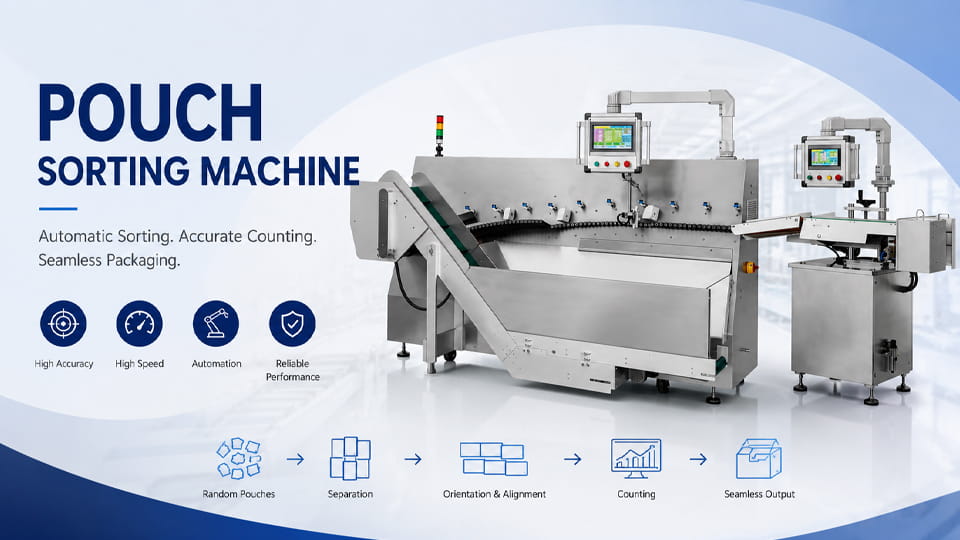
Cifra: La clasificación manual de sobres requiere mucha mano de obra y es propensa a errores. un automatico máquina clasificadora de bolsas maneja esta tarea de forma rápida y precisa, Alimentación de bolsas de forma constante en la línea de envasado..
¿Qué es una máquina clasificadora de bolsas??
A máquina clasificadora de bolsas (o clasificador de bolsas) es una máquina industrial automatizada diseñada para organizar pequeños paquetes flexibles – bolsas, bolsitas, paquetes de palos, o bolsas pequeñas – que salen desordenados de una máquina llenadora o empacadora. En términos simples, toma la salida de un máquina envasadora de bolsas o bolsitas y secuencias los artículos: separar las bolsas superpuestas, orientándolos uniformemente, contándolos, y alimentándolos a la siguiente etapa.
puesto de otra manera, Es un alimentador/organizador especializado para la línea de embalaje.. Maneja tareas que de otro modo requerirían muchos operadores.. Por ejemplo, Máquina clasificadora de bolsitas de JinLu “organiza automáticamente, orienta, tipo, y cuenta” sobres desordenados (polvo, líquido, tableta, tipos de gel) a velocidades de hasta 100 a 420 bolsas por minuto. Estas máquinas están construidas para 24/7 producción: la mayoría utiliza pantallas táctiles PLC para una fácil operación y se adaptan sobre la marcha a diferentes tamaños de bolsas.
Un clasificador de bolsas resuelve problemas comunes: él coordinados bolsas mezcladas, elimina dobles (dos bolsas pegadas), corrige la orientación, y cuenta cada pieza con precisión. La salida es una secuencia de un solo archivo consistente que las máquinas posteriores pueden manejar.. En la práctica, esto significa que las cajas se llenan uniformemente (no faltan bolsas), y se eliminan el conteo manual y la alimentación. Básicamente se convierte en un buffer y alimentador automatizado que reemplaza una mesa de clasificación manual..
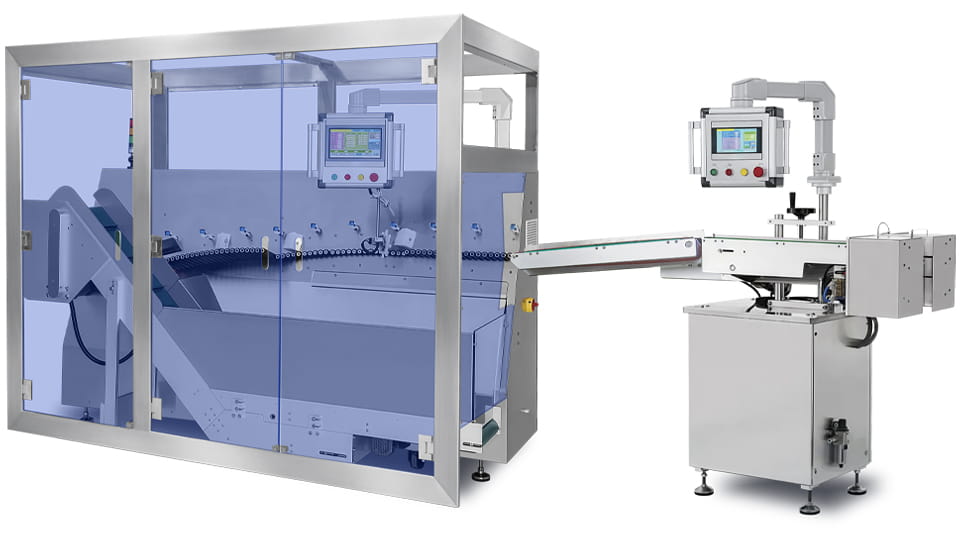
¿Cómo funciona una máquina clasificadora automática de bolsas??
Una moderna máquina clasificadora de bolsas funciona en varios pasos., proceso totalmente automatizado. Cada paso está sincronizado mediante un sistema de servocontrol y sensores de alta velocidad.. El flujo de trabajo general se ve así:
- Alimentación en bolsa (Cargando): Las bolsas se cargan primero en una tolva o área de alimentación., ya sea manualmente o desde una máquina de embalaje previa. La tolva suele tener una gran capacidad y un perfil bajo para facilitar la carga.. Por ejemplo, algunos clasificadores tienen una altura ajustable, 300-Tolva de un litro que alimenta constantemente bolsas al sistema.. La máquina utiliza un sistema de alimentación sincronizado de varias etapas para sacar las bolsas de la tolva sin atascos ni restos de bolsillos.
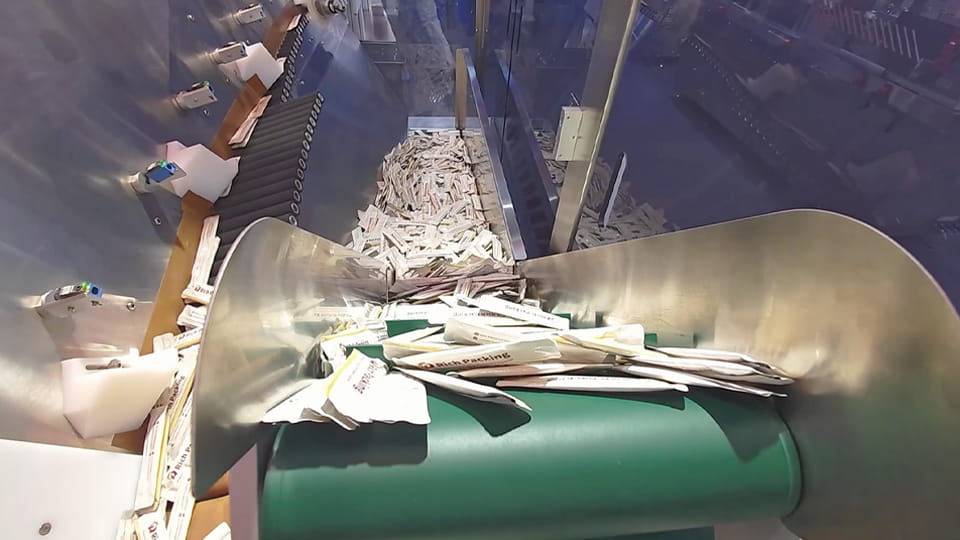
- Separación de bolsas: A medida que las bolsas salen de la tolva, a menudo salen superpuestos o apilados. la maquina sistema antiapilamiento los separa para que solo pase una bolsa a la vez. Esto evita la doble alimentación.. Por ejemplo, El diseño de JinLu "garantiza que sólo pase una bolsa a la vez"., eliminando por completo los errores causados por el paso de dos o más bolsas simultáneamente”. La separación generalmente se realiza con rodillos o transportadores especializados que separan suavemente las bolsas atascadas..
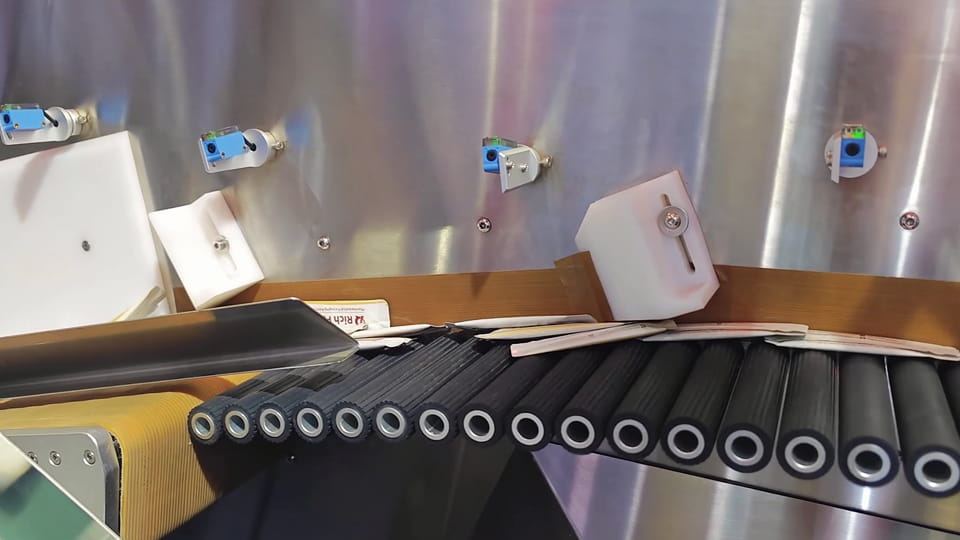
- Orientación y alineación de la bolsa: Próximo, la maquina orienta cada bolsa en una dirección uniforme (p.ej. todos los lados de la etiqueta hacia arriba o todos los sellos hacia un lado). Esto generalmente se hace con rodillos o correas servoaccionados.. Los servomotores de alta precisión giran y posicionan cada bolsa a medida que viaja.. A prueba de polvo, Los rodillos antiestáticos agarran la bolsa y la alinean.. Por ejemplo, un diseño utiliza 11 servomotores de accionamiento directo para sincronizar los movimientos de los rodillos, para que las bolsas “se muevan en perfecta sincronización, sin resbalar ni saltar,“manteniéndolos alineados. El resultado es una corriente de bolsas, todas orientadas en la misma dirección..
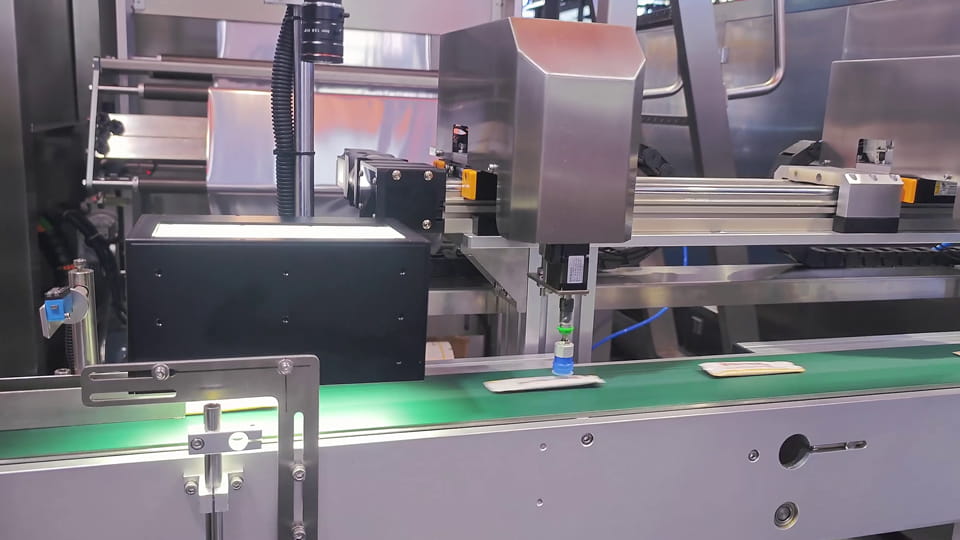
- Detección de sensores: Durante todo el proceso, Sensores fotoeléctricos o de visión monitorean cada bolsa.. Los sensores detectan la presencia de una bolsa, orientación, y cualquier anormalidad (como una superposición perdida o alimentación en ángulo). Si una bolsa no está correctamente alineada o si está atascada, Los sensores activan inmediatamente una respuesta.. Estos sensores envían datos en tiempo real al sistema de control.. En una máquina de alta calidad, cada posición en la línea tiene sensores que garantizan sin puntos ciegos cobertura. El circuito de retroalimentación mantiene el proceso de clasificación libre de errores.
- Clasificar y contar: Una vez alineado, las bolsas pasan por una estación final de clasificación y conteo. Aquí, La máquina garantiza que las bolsas se introduzcan una por una en un transportador o conducto de descarga.. Él cuenta cada bolsa con extrema precisión, a menudo superando 99.97% exactitud. Los sistemas avanzados incluso marcan la hora o codifican el conteo con códigos de barras. El contador de alta velocidad garantiza que se conozca el número exacto de bolsas y puede activar una alerta si hay alguna discrepancia.. Esta precisión reduce en gran medida los errores de conteo posteriores.
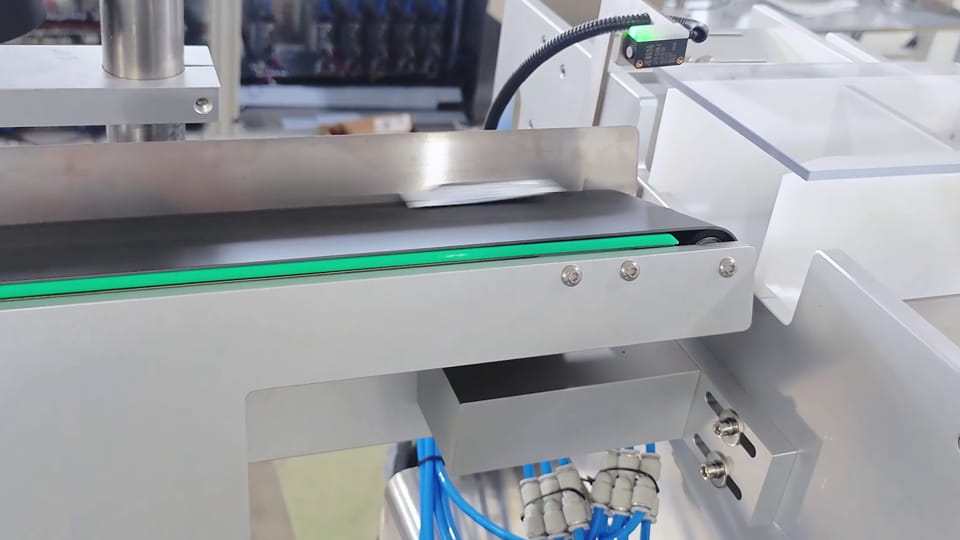
- Rechazo de Defectos: Cualquier bolsa que todavía esté desalineada, departamento (horizontal), o defectuoso es expulsado mediante un mecanismo de rechazo. Por ejemplo, si una bolsa está plana en lugar de vertical, un sistema de “rechazo de bolsa horizontal” la desviará de la línea. Similarmente, Los sensores pueden detectar bolsas rotas o mal llenas., desencadenando un rechazo automático. Por aquí, solo correctamente orientado, bolsas individuales proceden. Todo el proceso garantiza que no lleguen bolsas atascadas o mal clasificadas a la estuchadora o a la máquina de cajas..
Cada paso se realiza automáticamente con una mínima intervención humana.. Las máquinas modernas combinan estos pasos en un sistema compacto.. Por ejemplo, uno máquina clasificadora de servo completo está construido sobre un solo marco: una tolva alimenta las bolsas, Las correas servo y los rodillos los alinean., múltiples sensores los inspeccionan, y un transportador los descarga en orden, todo en un flujo continuo.
[jl_youtube src=»https://www.youtube.com/embed/NxTAzsZIx-s»]
Beneficios clave de utilizar una máquina clasificadora de bolsas
La implementación de una máquina clasificadora automática de bolsas aporta beneficios inmediatos a cualquier línea de envasado. Las principales ventajas incluyen:
- Mayor eficiencia de producción: La automatización acelera drásticamente la clasificación. Un clasificador de bolsas de alta velocidad puede manejar cientos de bolsas por minuto, mucho más allá de la capacidad humana. Por ejemplo, El clasificador de JinLu corre hasta 420 bolsas/min, y otros modelos manejan 400 o más. Este continuo, La producción rápida mantiene sus máquinas empacadoras alimentadas a máxima velocidad.. El resultado es un rendimiento por hora mucho mayor. En la práctica, Las operaciones ven cómo las tasas de producción aumentan y los tiempos de entrega se reducen una vez que reemplazan la clasificación manual con un sistema automático..
- Precisión de clasificación mejorada: Los clasificadores automáticos eliminan los errores que cometen los humanos. Las superposiciones y las bolsas perdidas se vuelven prácticamente inexistentes. Las máquinas de alta gama cuentan con una precisión de conteo superior a la 99.9% (tasas de error a continuación 0.009%). Las funciones especializadas, como los sistemas antiapilamiento y los sensores fotoeléctricos, mantienen las tasas de error ultrabajas. Esto significa que no habrá más doble alimentación., no hay conteos perdidos, y muy pocos atascos. En una línea automatizada, cada bolsa es rastreada y contada, para que sus recuentos finales de paquetes sean confiables. Como resultado, Los empacadores evitan costosas retiradas del mercado o trabajos de reenvasado debido a errores de conteo..
- Costos de mano de obra reducidos: Reemplazando tareas manuales, estas máquinas reducen las necesidades de personal. Los operadores que solían clasificar y contar manualmente pueden ser reasignados. Por ejemplo, una planta nutracéutica informó un 90% caída del trabajo de clasificación manual después de instalar un clasificador automatizado. Se necesitan menos operadores para supervisar el proceso; a menudo, solo un supervisor para varias máquinas.. Con el tiempo, este retorno de la inversión es significativo.: ahorras en salarios y reduces la fatiga o el error humano.
- Mejor higiene y cumplimiento: Minimizar el contacto humano es especialmente importante en las líneas farmacéutica y alimentaria.. Los clasificadores de bolsas están diseñados para entornos limpios: Las piezas de contacto suelen ser 304 o 316 acero inoxidable y las superficies son lisas y fáciles de lavar. Por ejemplo, El clasificador de JinLu utiliza 316L para el contacto con el producto y 304 para estructura, reunión CGMP estándares. El diseño cerrado (a menudo con ventanas de vidrio de seguridad) También ayuda a mantener una barrera higiénica.. Las características de fácil limpieza de la máquina y sus pocos rincones permiten desinfectarla rápidamente.. Esto reduce en gran medida el riesgo de contaminación en comparación con la manipulación manual..
- Fácil integración con líneas de envasado: Una máquina clasificadora de bolsas está diseñada para encajar en su línea. Puede descargar bolsas en varias orientaciones. (departamento, vertical, o apilados) para coincidir con la siguiente máquina. Por ejemplo, Puede ajustar la altura o el ángulo de descarga para que las bolsas se introduzcan directamente en un máquina estuchadora, a cálculo/transportador de acumulacion, o una empacadora de cajas. Muchas máquinas vienen con alturas de transportador estandarizadas o kits de montaje.. En la práctica, puede “conectar y usar” el clasificador en un sistema existente con un cambio mínimo de diseño. Esto agiliza la automatización: simplemente conecte la salida del clasificador al transportador de entrada de su estuchadora. El resultado es una perfecta, Línea automatizada de extremo a extremo desde el llenado hasta el embalaje final..
Aplicaciones de las máquinas clasificadoras de bolsas
Los clasificadores de bolsas tienen un uso amplio en todas las industrias: en cualquier lugar donde sea necesario contar bolsas o bolsitas pequeñas o alimentarlas de forma ordenada. Las áreas de aplicación clave incluyen:
- Embalaje farmacéutico: Este es un caso de uso importante. Las líneas farmacéuticas suelen envasar polvos, gránulos, o líquidos en bolsitas y bolsas. Un clasificador de bolsas asegura cada dosis (p.ej. bolsita de medicina, suplemento en polvo embalar) se maneja correctamente. Proporciona la precisión y el cumplimiento necesarios para los medicamentos.. Por ejemplo, Estas máquinas manejan habitualmente sobres de medicación, paquetes de vitaminas, bolsas de líquido oral, e incluso pequeños blisters de aluminio. porque se encuentran Estándares GMP y contar con precisión, Son ideales para líneas de farmacia donde la precisión y la trazabilidad son fundamentales.. Muchos fabricantes farmacéuticos utilizan clasificadores para alimentar a las encartonadoras o envasadores de blister sin manipulación humana.
- nutracéutico & Embalaje de suplemento: Piense en mezclas de bebidas vitamínicas., sobres de proteína en polvo, paquetes de suplementos de salud, probióticos, etc.. Estos productos suelen estar en bolsita o paquete de barras forma. Los clasificadores de bolsas manejan productos como sobres de proteína en polvo, mezclas de bebidas vitamínicas, y paquetes de probióticos. Se aseguran de que cada porción se cuente y alinee antes del boxeo.. Las líneas nutracéuticas valoran el rendimiento adicional, ya que la demanda puede ser alta. Un clasificador ayuda a mantener la calidad y la velocidad del producto para artículos como polvos energéticos instantáneos o bolsitas de colágeno..
- Alimento & Envasado de bebidas: Los clasificadores de bolsas son comunes en las líneas de alimentos.. Por ejemplo, ellos clasifican paquetes de café o té en barra, bolsitas de azúcar o condimentos, mezclas de bebidas instantáneas, bolsas de salsa y condimentos. Algunas líneas de snacks los utilizan para bolsas individuales de nueces o especias., también. El suave manejo del clasificador (rodillos suaves y avances controlados) significa que los frágiles sobres de comida no se dañan. En la práctica, líneas con embalaje de alta velocidad (p.ej. llenadoras de sobres de varios carriles) Necesita un clasificador para acumular la producción para embalaje de cartón/caja.. Por clasificación previa, Las máquinas evitan atascos posteriores y garantizan el recuento exacto. (p.ej. 10 bolsitas de té por caja) esta con.
- Cuidado personal y productos químicos para el hogar: La clasificación de bolsas no es sólo para alimentos y productos farmacéuticos. También aplica para el cuidado personal y productos químicos.. Por ejemplo, bolsitas de mascarillas cosméticas, paquetes de muestra de champú/acondicionador, cápsulas de detergente para ropa en bolsas, o sobres de enjuague bucal líquido todo se puede ordenar, incluyendo productos químicos diarios (enjuague bucal, detergente) y cosmética (mascarillas, lociones) bolsas. Cualquier industria que utilice envases de un solo uso (desde probadores de lociones hasta envases de minidetergentes) puede beneficiarse. La máquina clasificadora garantiza que estas bolsas de diferentes formas (bolsas con cremallera, paquetes de almohadas, etc.) se introducen correctamente en la siguiente máquina.

Los clasificadores de bolsas de Jinlupacking sirven a una amplia gama de industrias, desde bolsas para refrigerios y café hasta bolsitas de detergente y cosméticos., reflejando la amplia aplicabilidad de la tecnología de clasificación de bolsas.
En resumen, si su producto está en un sobre pequeño, bolsa, o bolsa y necesita contarlos y alimentarlos de manera confiable, una máquina clasificadora de bolsas es una solución candidata. Su flexibilidad cubre casi todos los formatos de bolsa utilizados hoy en día..
Cómo elegir la máquina clasificadora de bolsas adecuada
La selección del clasificador ideal depende de los requisitos de su producto y línea.. Estos son los principales factores a considerar.:
- Tamaño de la bolsa: Verifique el largo y ancho aceptados por la máquina.. Por ejemplo, El clasificador de JinLu procesa bolsas de hasta 185 mm de largo y 110 mm de ancho. Si sus bolsas son significativamente más grandes, necesitas un modelo diferente. Considere también la forma: la mayoría de los clasificadores pueden manejar bolsas tipo almohada, paquetes de palos, y sobres rectangulares, pero las formas muy altas o inusuales pueden requerir personalización.
- Velocidad de producción requerida: Haga coincidir la velocidad del clasificador con su línea. Calcula cuantas bolsas por minuto (BPM) que necesita en función de sus objetivos de relleno y embalaje. Los clasificadores vienen en diferentes niveles: algunos ejecutan ~100–150 BPM, mientras que los modelos de gama alta alcanzan entre 300 y 400 BPM. Recordar, una mayor velocidad a menudo depende del tamaño más pequeño de la bolsa o del tipo de producto. Si tu línea es de alto volumen, opte por un clasificador de alta velocidad; si tu línea es más pequeña, una unidad de menor velocidad puede ser suficiente.
- Material de la bolsa: Considere la película o el material.. Frustrar, laminado plastico, y las bolsas de papel se comportan de manera diferente. Las películas laminadas y recubiertas pueden ser resbaladizas o propensas a la estática.. Compruebe si la máquina tiene características antiestáticas o rodillos texturizados (p.ej. a prueba de polvo, rodillos antiestáticos). Algunos clasificadores tienen presión de rodillo ajustable o materiales de superficie para diferentes texturas de bolsas.. Si tus bolsas son muy ligeras o muy rígidas, mencione esto al seleccionar para que el fabricante pueda ajustar los mecanismos de manejo.
- Equipos aguas abajo: Piense en lo que alimentará el clasificador.. ¿Es una estuchadora automática?? una empacadora de cajas? Un transportador de conteo? Esto afecta el formato de descarga.. Por ejemplo, si alimenta a un estuchador que espera sobres planos apilados, El clasificador debe producir bolsas planas.. Si alimenta un transportador de conteo de bolsas, es posible que los quieras en posición vertical. La mayoría de las máquinas permiten configurar la altura y orientación de descarga.. Considere también los puntos de conexión. (p.ej. compatibilidad con controles y altura del transportador).
- Requisitos de higiene y limpieza: Para uso farmacéutico o alimentario., comprobar la construcción. Buscar 304/316 acero inoxidable, motores cerrados, y diseños fáciles de limpiar. El clasificador debe cumplir estándares como GMP o CE si es necesario.. Características como cintas transportadoras de liberación rápida, rodillos sellados, y CIP (limpieza en el lugar) la compatibilidad puede ser importante. Por regla general, cuantas menos grietas, mejor para la limpieza. Si tu industria es farmacéutica, Insistir en una construcción compatible con cGMP.
Haciendo coincidir cuidadosamente las especificaciones de la máquina (velocidad, rango de tamaño, manejo de materiales) a su producto y línea, Encontrarás el modelo más eficaz.. En la práctica, Los proveedores le preguntarán las dimensiones de su bolsa., rendimiento deseado, y lo que viene después: use esa información para obtener el clasificador óptimo.
Máquina clasificadora automática de bolsas versus clasificación manual de bolsas
Elegir entre clasificación manual y automática es una obviedad cuando las comparas una al lado de la otra.:
| Característica |
Clasificación manual |
Clasificación automática de bolsas |
| Requisito laboral |
muy alto (varias personas) |
Bajo (un operador o ninguno) |
| Velocidad de clasificación |
Limitado (decenas de bolsas/min) |
muy alto (100–400+ bolsas/min) |
| Precisión de conteo |
Dependiente del operador (propenso a errores) |
Automatizado de alta precisión (99.9%+) |
| Operación continua |
Difícil (fatiga, se rompe) |
24/7 operación continua |
| Contacto humano |
Directo (riesgos de contaminación) |
Mínimo (máquina cerrada) |
| Integración |
Limitado (se necesita traspaso) |
Fácil (salida directa del transportador) |
Esta tabla destaca las diferencias clave. La clasificación manual puede funcionar para volúmenes muy bajos o líneas lentas., pero rápidamente se vuelve inviable a escala. Automatización no sólo acelera la producción sino que también proporciona consistencia y trazabilidad. En casi cualquier planta de envasado moderna, invertir en un clasificador automático vale la pena aumentando la producción y reduciendo los errores.
Conclusión
A máquina clasificadora de bolsas es una herramienta de automatización clave para cualquier industria que empaqueta productos en bolsas o bolsitas pequeñas. Al organizar automáticamente, alineando, cálculo, y alimentando tus bolsas, elimina los cuellos de botella manuales y aumenta el rendimiento de la producción. Obtienes una operación más rápida (cientos de bolsas por minuto), precisión de conteo casi perfecta, menores costos laborales, y una mejor higiene, todo ello evitando atascos en las estuchadoras o empacadoras de cajas posteriores..
Si necesita una alta calidad clasificadora automática de bolsas para sobres farmacéuticos, bolsitas de comida, barras de líquido u otras bolsas pequeñas, considere las soluciones de JinLu Packing. Ofrecemos maquinas (como el JL-PA-420) que manejan hasta 420 bolsas/min con >99.97% exactitud. Nuestras máquinas se integran perfectamente con los equipos de encartonado y conteo.. Nuestro equipo de ingeniería puede personalizar un sistema de clasificación según el tamaño de su bolsa., velocidad, y diseño de la línea de embalaje.
Para una automatización personalizada, contáctanos para discutir sus necesidades de clasificación de bolsas. JinLu Packing ofrece soluciones integrales para líneas de envasado de bolsas/bolsitas, desde la clasificación hasta el llenado, estuchado, y más. Deje que nuestros expertos diseñen el sistema ideal de clasificación y alimentación para que pueda lograr resultados consistentes., alta velocidad, operación totalmente automatizada en su línea.
Preguntas frecuentes sobre la máquina clasificadora de bolsas
¿Qué tipos de bolsas puede manejar una máquina clasificadora de bolsas??
Los clasificadores de bolsas modernos son versátiles. Pueden clasificar sobres planos., paquetes de palos, ponerse de pie (doy) bolsas, bolsas con cremallera, bolsas con pico, e incluso bolsas de formas irregulares. Por ejemplo, Las máquinas a menudo admiten bolsas selladas por tres lados y por cuatro lados., bolsas con pico, bolsas con cremallera de pie, paquetes de palos, y bolsas con forma. Si sus bolsas se encuentran dentro del rango de tamaño de la máquina y son flexibles, debería manejarlos. Asegúrese de especificar cualquier forma o grosor de bolsa inusual al proveedor..
¿Puede una máquina clasificadora de bolsas clasificar sobres farmacéuticos??
Absolutamente. Sobres farmacéuticos (para polvos, gránulos, o líquidos) son una aplicación principal. Estas máquinas están construidas para cumplir con los estándares farmacéuticos. (acero inoxidable, Cumplimiento de las buenas prácticas de fabricación (cGMP)). Proporcionan la alta precisión y el diseño sanitario necesarios para los medicamentos.. En la práctica, Muchos fabricantes de medicamentos utilizan clasificadores de bolsas para introducir paquetes de dosis en cajas de cartón sin contacto manual..
¿Cuál es la diferencia entre una máquina clasificadora de bolsas y una máquina contadora de bolsas??
Una máquina clasificadora de bolsas no solo cuenta sino que también alinea y secuencia bolsas dispuestas al azar. Puede ser complicado, superposición de entrada y salida de forma ordenada, flujo ordenado. En contraste, una máquina contadora de bolsas (o transportador de conteo) Normalmente se supone que las bolsas ya están alineadas en una línea.; simplemente los cuenta y clasifica por peso o mediante sensores fotoeléctricos a medida que pasan. La máquina contadora no separa ni orienta las bolsas mixtas.. Entonces, si necesita manejar entradas desordenadas, se requiere un clasificador; si tus bolsas ya están en orden y solo necesitas contar, puedes usar una máquina de contar.
¿Se puede conectar la máquina a una máquina estuchadora??
Sí. De hecho, Los clasificadores de bolsas están diseñados para alimentar equipos posteriores, como estuchadoras automáticas o empacadoras de cajas.. A menudo se puede montar un transportador desde el clasificador directamente a la entrada de una estuchadora.. Muchos clasificadores permiten ajustar la altura u orientación de la descarga. (plano vs.. vertical) para coincidir con la siguiente máquina. Esta transferencia perfecta crea una línea continua, por ejemplo, directamente desde una llenadora de bolsitas → clasificadora de bolsas → estuchadora automática, sin pasos manuales intermedios.
¿Qué tan rápido puede funcionar una máquina clasificadora automática de bolsas??
Las velocidades varían según el modelo y el tamaño del producto.. Los rangos típicos son de aproximadamente 100 paquetes por minuto (ppm) para máquinas pequeñas de hasta 400+ ppm para unidades de alta gama. Por ejemplo, El modelo de alto rendimiento de JinLu alcanza hasta 420 bolsas/min. El clasificador de Ruida acierta 400 bolsas/min. Máquinas de menor velocidad (100–150 ppm) existen para líneas más pequeñas o más lentas. La velocidad real también depende del tamaño de la bolsa y de la suavidad con la que fluyen.. Asegúrese de elegir un modelo con una clasificación igual o superior a la velocidad de línea deseada.
¿Qué tamaños de bolsa puede manejar la máquina??
Cada máquina tiene un rango de tamaño específico.. Los límites comunes oscilan entre 80 y 185 mm de largo y entre 10 y 110 mm de ancho., pero esto difiere según el modelo. Por ejemplo, El clasificador de JinLu maneja hasta 185×110 mm, y asas del Keypack de 84 a 168 mm de longitud. Consulte siempre la hoja de especificaciones del fabricante.. Si su bolsa está cerca del máximo, confirme que funcionará de manera confiable (o considere una versión personalizada).
¿Cómo elijo la máquina clasificadora de bolsas adecuada para mi línea de producción??
Consulte nuestra sección Cómo elegir arriba. En resumen: define las dimensiones de tu bolsa, velocidad objetivo (bolsas/minuto), y tipo de material. Luego asegúrese de que las especificaciones de la máquina coincidan o superen aquellas. Considere también su equipo posterior, si tiene una estuchadora o un transportador de conteo., Asegúrese de que el clasificador pueda integrarse con él.. Revisar los requisitos de higiene. (304SS para líneas farmacéuticas) y certificaciones si es necesario. El proveedor adecuado debería ayudarle a encontrar un modelo que se ajuste a sus necesidades. (Por ejemplo, Es posible que le soliciten las medidas de su bolsa., tasa de producción, y equipo posterior para recomendar un clasificador adecuado.)
Referencias:
1.Clasificación de artículos en una cinta transportadora en movimiento. Parte 1: una técnica para detectar y clasificar objetos —— Ciencia Directa
2.Desarrollé un sistema automatizado de clasificación de diseños según los bordes exteriores del objeto —— Biblioteca en línea WILEY
3.Diseño e implementación de una máquina clasificadora basada en visión con alimentación intermitente mediante un manipulador. —— Puerta de investigación
4.Un sistema de reconocimiento y clasificación de paquetes de alimentos basado en luz estructurada y aprendizaje profundo —— arxiv.org
5.Diseño del sistema de clasificación de bolsas de medicamentos basado en visión artificial y robot paralelo —— qikan.cmes.org