

Das Ideal auswählen Brausetabletten-Verpackungsmaschine ist für Pharma- und Nutraceutical-Hersteller von entscheidender Bedeutung. Sprudelabletten (wie Vitamin C oder Antazida-Tabletten) sind äußerst feuchtigkeitsempfindlich, Daher muss die Verpackung eine zuverlässige Feuchtigkeitsbarriere gewährleisten. Dieser Leitfaden erklärt, warum Brausetabletten eine spezielle Verpackung benötigen, vergleicht gängige Verpackungsformate (Röhren, Blasenpackungen, Beutel/Streifen), und skizziert die 7 Wichtige Faktoren, die beim Kauf einer Maschine zu berücksichtigen sind. Außerdem finden Sie hilfreiche Tabellen zum Vergleich der Maschinentypen und ein einfaches Flussdiagramm, das Ihnen bei Ihrer Entscheidung hilft. Endlich, Lesen Sie unsere FAQ und eine unkomplizierte Einführung, warum die Ausrüstung und der Service von Jinlu Packing möglicherweise die richtige Wahl für Ihre Produktionsanforderungen sind.
Brausetabletten enthalten eine reaktive Säure-Base-Chemie setzt CO₂ frei wenn es in Wasser gelöst wird, schnelle Lieferung von Nährstoffen oder Medikamenten. Dadurch entsteht das Sprudeln, aber es bedeutet auch, dass sie es sind extrem feuchtigkeitsempfindlich. In der Praxis, sogar Spuren von Feuchtigkeit kann die Reaktion vorzeitig auslösen, Tabletten erweichen, oder die Potenz reduzieren. Um dies zu verhindern, Brauseprodukte werden unter sehr niedrigen Luftfeuchtigkeitsbedingungen hergestellt und verpackt (oft <20–25 % relative Luftfeuchtigkeit).
Außerdem, Brausetabletten sind in der Regel unbeschichtet (schnell auflösen), Es gibt also keinen Schutzfilm, der Feuchtigkeit blockiert. Ihre Stabilität hängt ganz von der Verpackung ab. Wie ein Experte feststellt, wenn vor der Verwendung Feuchtigkeit eindringt, „Die Reaktion kann zu früh beginnen“ und das Produkt ruinieren. Zusamenfassend, Darin unterscheiden sich Brausetabletten von gewöhnlichen Pillen Beim Verpackungsdesign müssen Feuchtigkeits- und Sauerstoffbarrieren oberste Priorität haben. Das Hauptziel besteht darin, die Tabletten vollständig trocken und versiegelt zu halten und so sowohl die Integrität als auch die Haltbarkeit zu wahren.
Die einzigartige Chemie der Brausetabletten macht es möglich Verpackungsqualität ist eine Frage der Produktqualität. Zu den Hauptgründen, warum eine gute Verpackung von entscheidender Bedeutung ist, gehören::
Zusammenfassend, das Richtige auswählen Brausetablettenverpackung geht es nicht nur um Bequemlichkeit oder Branding – es geht im Grunde darum Feuchtigkeitsschutz, Potenz, und Compliance. Durch die robuste Verpackung bleiben Brausetabletten bis zum Ende der Haltbarkeitsdauer stabil und wirksam.
Brausetabletten werden typischerweise in einem von drei Primärverpackungsformaten verkauft: Röhren (mit Kappen), Blasen (oft Alu-Alu-Folie), oder Einwegstreifen/-beutel. Jedes hat Vorteile und Kompromisse in Bezug auf die Feuchtigkeitsbarriere, Bequemlichkeit, und Kosten.
Viele Brauseprodukte verwenden starre Produkte Tuben oder Flaschen (aus Kunststoff, Glas, oder Metall) mit Schraub- oder Schnappverschluss. Kunststoffrohre (PP oder PE) kommen am häufigsten bei Vitaminen und Nahrungsergänzungsmitteln vor. Zu diesen Behältern gehören oft Drehverschlüsse die entweder feuchtigkeitsbeständig sind oder einen inneren Silikagel-Trockenmitteleinsatz enthalten. Die Kombination aus Polymerrohr und Trockenmittelkappe sorgt dafür hervorragender Feuchtigkeitsschutz (Das Trockenmittel absorbiert aktiv jegliche Feuchtigkeit im Inneren). Schläuche bieten typischerweise einen starken Schutz vor Feuchtigkeit, was für diese hygroskopischen Tabletten von entscheidender Bedeutung ist.
Kapazität und Füllung: Röhren werden normalerweise mit beliebigem Inhalt gefüllt 10 jeweils bis zu ~20 Tabletten (abhängig von Tablettengröße und Röhrchenhöhe). Automatische Tubenfüllmaschinen zählen und laden so viele Tabletten pro Tube.
Komfort und Branding: Tuben sind tragbar und verbraucherfreundlich – leicht mit einer Hand zu öffnen – und bieten viel Platz für Etiketten. Zu den Vorteilen gehört die Portabilität, Wiederverschließbarkeit, und ausreichend Platz für Branding und Anweisungen. Der Nachteil besteht darin, dass sie sperriger sein können (größere Pakete und Kartons) und enthalten in der Regel weniger Tabletten pro Packung als eine volle Blisterpackung.
Hochwertige Brausetabletten (insbesondere in Pharma- oder Exportmärkten) häufig verwenden Kaltgeformte Alu-Alu-Blisterpackungen. Im Alu-Alu-Blister, Der Hohlraum und der Deckel bestehen beide aus Aluminiumfolie (manchmal auf Kunststoff laminiert). Dadurch entsteht ein nahezu vollständige Barriere: kein Licht, Es kann praktisch keine Feuchtigkeit oder Sauerstoff eindringen. Jinlupacking bezeichnet Alu-Alu als „Goldstandard“ für hygroskopische Medikamente, Erzielung einer Feuchtigkeitsdampfdurchlässigkeit von nahezu Null. In der Praxis, Alu-Alu-Blister können die Haltbarkeit verlängern mehrere Jahre auch bei Hitze, feuchtes Klima.
Bei Verwendung: Alu-Alu ist in Europa und Regionen, in denen eine lange Haltbarkeit von entscheidender Bedeutung ist, weit verbreitet. Es ist ideal für hochwirksame oder feuchtigkeitsempfindliche Formeln.
Kompromisse: Der Nachteil sind Kosten und Größe. Alu-Alu-Folie ist teuer, und die Kaltumformung erfordert langsamere mechanische Prozesse. Die resultierenden Blisterkarten sind oft 30–50 % größer als Standard-Plastikblister, Das bedeutet größere Kartons und mehr Versandvolumen. Die Kosten pro Dosis können das Zwei- bis Dreifache der Kosten einer Plastikbläschenbehandlung betragen. Daher ist Alu-Alu normalerweise den Fällen vorbehalten, in denen seine Barrierevorteile die Kosten rechtfertigen.
Streifenpackungen (Folienbeutel) sind eine weitere Option. Dabei handelt es sich um durchgehende, allseitig in Beutel eingeschweißte Folienbahnen. Highlights:
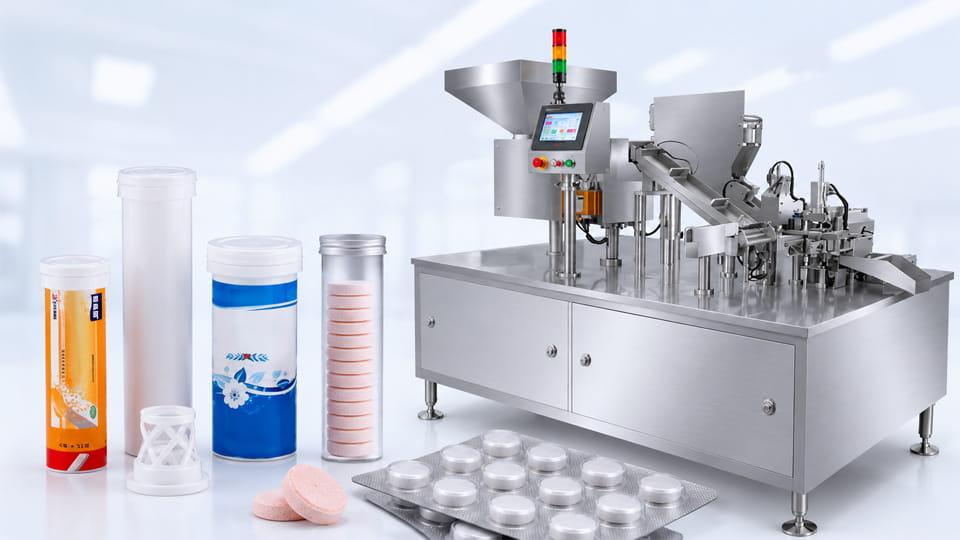
Figur: Brausetabletten werden oft in Plastikröhrchen mit trockenmittelhaltigen Deckeln verpackt, um einen starken Feuchtigkeitsschutz zu gewährleisten.
Der Kernmaschinenpark für die Brausetablettenverpackung entspricht dem gewählten Format. Die zwei Haupttypen von Verpackungsmaschinen sind Tubenfüllmaschinen (für Tuben/Flaschen) Und Blisterverpackungsmaschinen (für Folienblister). Wir betrachten auch das Vollintegrierte Verpackungslinie das verbindet das Zählen, Füllung, Capping, Beschriftung, und Kartonieren.
A Tubenfüllmaschine (manchmal auch als Abfüllmaschine für Tablettenflaschen bezeichnet) automatisiert den Vorgang des Befüllens einer starren Tube mit Tabletten, Bei Bedarf einen Trockenmitteldeckel hinzufügen, und versiegeln. Zu den wichtigsten Funktionen gehören:
[jl_youtube src=”https://www.youtube.com/embed/uNKQtVIApls”]
Beispiel – Jinlu JL-ZGJ-80Pro: Diese vollautomatische Brauseschlauch-Abfüllmaschine verarbeitet Tabletten mit großem Durchmesser. Es führt eine Sortierung durch, Zählen, Laden, und Begrenzung bei Geschwindigkeiten bis zu 80 Röhren pro Minute (≈4800 Röhrchen/Std), mit >99.98% Füllgenauigkeit. Es entspricht den cGMP-Standards und ist zur Reinigung aus Edelstahl gefertigt. Solche Maschinen stellen die Oberklasse der automatischen Tubenfüller dar.
Moderne Tubenfüller betonen Genauigkeit und Zuverlässigkeit. Sie beinhalten häufig eine GMP-gerechte Gestaltung (SUS316L-Konstruktion, geschlossene Systeme) und Schnellwechselwerkzeuge für Formatwechsel. Bei der Bewertung einer Maschine, Achten Sie auf bewährte Zählgenauigkeit (≥99,9 %), Servoantriebe für präzise Bewegungen, und einfache Reinigung/Zugang.
Anstelle eines eigenständigen Füllers, Viele Hersteller setzen ein Ganzes ein Verpackungslinie das vor- und nachgelagerte Geräte integriert. Eine typische Verpackungslinie für Brausetabletten könnte Folgendes umfassen::
Jinlu weist darauf hin, dass unser Tubenfüller „kombinierbar mit“ ist Tablet -Pressautomaten, Entstauber, Und Kartoniermaschinen” für eine vollständig integrierte Linie. Zum Beispiel, Der Tubenfüller übernimmt automatisch Tabletten von der vorgeschalteten Presse und führt die fertigen Tuben dem nachgeschalteten Kartonierer zu, Minimierung der manuellen Handhabung.
Durch die Automatisierung jedes Schritts – Zählens, Füllung, Capping, Beschriftung, Kartonieren – die Verpackungslinie steigert Produktivität und Rückverfolgbarkeit. Sensoren in jeder Phase erkennen Fehler frühzeitig, Sicherstellen, dass jeder Karton die Linie vollständig konform verlässt.
Für Alu-Alu-Blisterverpackungen, A Blisterverpackungsmaschine verwendet wird. Diese Maschinen formen Hohlräume thermo- oder kalt und versiegeln Tabletten in Blisterkarten. Wichtige Punkte:
Wenn Sie sich für eine Blisterverpackungslinie für Brausetabletten entscheiden, Man sollte sicherstellen, dass es für Materialien mit hoher Barriere geeignet ist. Das wichtigste Verkaufsargument ist Feuchtigkeitsbarriereleistung, nicht Geschwindigkeit. Eine kaltumgeformte Alu-Maschine bietet maximalen Schutz (nahezu null Eindringen) auf Kosten des Durchsatzes.
Die Wahl zwischen Röhren (mit Trockenmittelkappen) und Alu-Alu-Blisterkarten hängt von den Produktanforderungen ab. In der folgenden Tabelle werden diese Formate hinsichtlich der Schlüsselfaktoren verglichen:
| Faktor | Rohr (mit Trockenmittelkappe) | Alu-Alu-Blister |
| Feuchtigkeitsbarriere | Exzellent (Trockenmittel + Kunststoffwand) | Exzellent (MVTR nahe Null) |
| Licht-/Sauerstoffbarriere | Undurchsichtiges Rohr (gute Lichtblockierung) | Völlig undurchsichtig (100% Lichtschranke) |
| Sichtbarkeit des Tablets | Nicht sichtbar (Röhrchen sind normalerweise undurchsichtig) | Nicht sichtbar (Folie) |
| Patientenkomfort | Wiederverschließbar, tragbare Flasche | Einmalgebrauch pro Kavität (einmal kaputt, gegangen) |
| Typische Geschwindigkeit | Hoch (z.B. 60–80 Röhrchen/Min) | Mäßig (Kaltumformung langsamer als PVC) |
| Kosten pro Einheit | Medium (Rohr + Kappe, moderater Materialaufwand) | Hoch (teure Folie, 2–3× Materialkosten) |
| Haltbarkeit | Lang (mit Trockenmittel, oft 2+ Jahre) | Sehr lang (3+ Jahre, selbst in rauen Klimazonen) |
| Typische Verwendung | Tägliche Vitamine, Brausepräparate | Empfindliche Arzneimittel, Produkte exportieren |
Tisch: Vergleich von Brausetabletten Tubenverpackung (mit Trockenmittelkappe) vs. Alu-Alu-Blisterverpackung. Notiz: Alu-Alu-Blister sorgen für einen nahezu hermetischen Verschluss, wohingegen Röhren auf Trockenmittel angewiesen sind, um die Trockenheit aufrechtzuerhalten.
Zusamenfassend, Röhren (oder Flaschen) sind ein verbraucherfreundliches Format und in Kombination mit einem Trockenmittel vollkommen ausreichend. Sie sind schneller und günstiger zu verpacken. Alu-Alu-Blisterpackungen werden beispielsweise dann gewählt, wenn trotz der Kosten eine maximale Barriere erforderlich ist, für verschreibungspflichtige Brausetabletten oder in Märkten, die eine Haltbarkeitsdauer von 3 Jahren erfordern.
Bei der Bewertung von Verpackungsmaschinen für Brausetabletten, Konzentrieren Sie sich auf diese entscheidenden Merkmale – sie stellen in der Regel auch die häufigsten Kundenanfragen dar:
Nachfolgend finden Sie eine Vergleichstabelle mit einer Zusammenfassung der Material- und Verpackungsoptionen für die Feuchtigkeitsbarriereleistung:
| Verpackungsmaterial/Format | Feuchtigkeitsbarriere (MVTR) | Typische Verwendung |
| Kunststoffrohr (PP/PE) + Trockenmittel | Sehr niedrig (mit Kappe + Trockenmittel) | OTC-Vitamine, Ergänzungen (täglichen Gebrauch) |
| Kaltgeformter Alu-Alu-Blister | Nahezu Null (ultimative Barriere) | Hochwertige Brausetabletten, Exportmärkte |
| PVC-PVDC-Blister | Mäßig (0.5–1,0 g/m²·Tag) | Generische Tabletten (Wird verwendet, wenn die Alu-Kosten zu hoch sind) |
| PVC-Blister (kein PVDC) | Niedrig (3–6 g/m²·Tag) | Nicht empfohlen für hygroskopische Verbindungen |
| Streifen/Beutel (Folie/Film) | Variable (0.5–2,0 g/m²·Tag) | Einzeldosis- oder Reisepackungen (eine gewisse Barriere, weniger als starre Optionen) |
Tisch: Typische Feuchtigkeitsbarriere verschiedener Brauseverpackungen. Sogar PP/PE-Röhren sind für nahezu Null auf den Trockenmittelverschluss angewiesen Barriere, während Alu-Alu-Folie praktisch undurchlässig ist.
Auch mit der richtigen Ausrüstung, Bei Brauseverpackungen können Probleme auftreten. Hier finden Sie typische Probleme und deren Behebung:
Proaktive Wartung ist der Schlüssel: Bewahren Sie alle Futtertrichter auf (Tabletten, Röhren, Kappen) sauber und trocken, verschlissene Teile ersetzen (z.B. Pfannenschaber, Sternräder) planmäßig, und führen Sie beim Formatwechsel Testchargen durch.
Für einen zuverlässigen Brauseverpackungslinie, Jinlu Packing bietet eine Komplettlösung. Zu den Schlüsselkomponenten gehören:
Jede dieser Maschinen ist nach pharmazeutischen Standards gebaut (FDA/CE-konform, Kontaktteile aus SUS316L) und kommt mit Dokumentation. Durch die Wahl eines koordinierten Systems, Sie stellen sicher, dass jeder Schritt von der Tablette bis zum Karton für Brauseprodukte optimiert ist.
Das Richtige wählen Brausetabletten-Verpackungsmaschine geht es um mehr als nur um Geschwindigkeit. Es geht darum, Ihre Tabletten vor Feuchtigkeit zu schützen, Gewährleistung der Produktstabilität, und Einhaltung regulatorischer Standards. Wie wir besprochen haben, Brauseformeln sind hochempfindlich, also jeder Aspekt des Verpackungsmaterials, Maschine, und Prozess – müssen die Feuchtigkeit minimieren und eine dichte Abdichtung gewährleisten.
In praktischer Hinsicht, Das bedeutet, eine Maschine auszuwählen (oder Linie) das eine robuste Handhabung von Barrieren bietet (Trockenmittelkappen oder -folie), präzise Operationen (genaues Zählen und Verschließen), und volle Compliance (GMP-Design und Dokumentation). Automatisierte Tubenfülllinien (mit Zählen, Beschriftung, Kartonierung) sind heute im Allgemeinen die Arbeitspferde der Brauseindustrie.
Auf der Suche nach einer zuverlässigen Verpackungslösung für Brausetabletten? Kontaktieren Sie Jinlu Packing noch heute für fachkundige Beratung und ein maßgeschneidertes Angebot. Unser Team kann Ihnen bei der Auswahl der richtigen Maschine helfen und sicherstellen, dass sie den globalen Compliance-Standards entspricht – alles abgesichert durch umfassende Garantien und technischen Support.
Wegen ihrer Chemie (Säure + Base) reagiert bereits mit geringen Mengen Wasser, Brausemittel sind extrem hygroskopisch. Feuchtigkeit kann sie vorzeitig auslösen, Erweichen Sie die Tabletten, oder zum Abbau von Wirkstoffen führen. Eine spezielle Verpackung mit Trockenmitteln und dichten Verschlüssen verhindert, dass Feuchtigkeit an die Tabletten gelangt, Halten Sie sie bis zur Verwendung wirksam.
Es hängt von den Produktanforderungen ab. Röhren (mit Trockenmittelkappe) sind bei Verbrauchern als Vitamine und Nahrungsergänzungsmittel beliebt, weil sie praktisch sind, wiederverschließbar, und bieten hervorragenden Feuchtigkeitsschutz. Alu-Alu-Blisterpackungen sorgen für eine noch stärkere Barriere (nahezu kein Feuchtigkeitseintritt) und die Haltbarkeit verlängern, Dies ist ideal für sensible Arzneimittel oder hochwertige Exporte. Für die bequeme Einzeldosis werden auch Beutel verwendet, Sie bieten jedoch weniger Barriere als Tuben oder Folienblister.
Standard-PVC-Blisterverpackungen allein bieten meist keinen ausreichenden Feuchtigkeitsschutz für Brausetabletten. Sie haben eine mäßige Durchlässigkeit. Bei Verwendung von Blisterpackungen, Es ist besser, eine laminierte PVC+PVDC-Folie oder eine vollständige Alu-Alu-Folie zu verwenden, um Feuchtigkeit zu blockieren. Ansonsten, Eindringende Feuchtigkeit kann die Haltbarkeit drastisch verkürzen.
Sie benötigen eine Brausetabletten-Röhrchenfüllmaschine, was automatisch zählt, füllt Tuben, fügt Trockenmittelstopfen ein, und deckt sie ab. Suchen Sie nach Maschinen, die für Ihre Tubengröße geeignet sind, die gewünschte Geschwindigkeit haben (z.B. 60–80 Röhrchen/Min), und hohe Zählgenauigkeit (>99.9%). Zum Beispiel, Jinlus JL-ZGJ-80Pro füllt bis zu 80 Flaschen/min bei 99.98% Genauigkeit.
Die „beste“ Maschine hängt von Ihrer Größe und Ihrem Format ab. Für Tubenverpackungen, eine vollautomatische Brausetablettentubenfüllmaschine (mit integrierter Zählung und Verschließfunktion) ist ideal für mittlere bis große Volumina. Für Blisterverpackungen, Es wird eine Kaltform-Alu-Alu-Blistermaschine benötigt. Im Allgemeinen, Bevorzugen Sie Maschinen, die speziell für hygroskopische Produkte konzipiert sind – mit Merkmalen wie schonender Handhabung, feine Zählkontrolle, und desinfizierbare Designs. Überprüfen Sie, ob der Anbieter GMP-Compliance- und Validierungsunterstützung bietet.
Verwenden Sie hochpräzise Geräte mit Feedback-Steuerung. Moderne Maschinen nutzen Servoantriebe und Sensoren, um jede Aktion zu bestätigen. Zum Beispiel, Kameras oder Näherungssensoren können die korrekte Anzahl der Tabletten und das Vorhandensein jeder Kappe überprüfen. Prüfgeräte für die Integrität von Dichtungen (Vakuumzerfall, zum Beispiel) kann Teil der prozessbegleitenden Qualitätssicherung sein. Eine gleichmäßige Füllung ist auch auf einen guten Materialfluss zurückzuführen (antistatische Maßnahmen, sogar Tablettenfütterung). Wenn Sie Variationen sehen, Dies kann auf verschlissene Teile oder falsch ausgerichtete Sensoren hinweisen, die gewartet werden müssen.
Einige Maschinen sind für eine schnelle Umrüstung ausgelegt. Zum Beispiel, Der Tubenfüller von Jinlu verarbeitet Tuben mit einem Durchmesser von 23–29 mm (verschiedene Längen) mit modularen Formen, die in ca. 5 Minuten ausgetauscht werden können. Bestätigen Sie immer die Austauschteile und den Einstellbereich des Modells. Echte Flexibilität ist ein Premium-Feature; Budgetmaschinen unterstützen möglicherweise nur eine Tubengröße.
Zumindest, GMP-Konformität ist erforderlich (für Pharma). Achten Sie auf die CE-Kennzeichnung (für Europa), UL oder CSA (für elektrische Sicherheit in Nordamerika), und ISO 9001 Herstellung. Wenn Ihre örtliche Aufsichtsbehörde (z.B. FDA in den USA) erfordert bestimmte Kriterien (wie Teil 11 für elektronische Aufzeichnungen), Stellen Sie sicher, dass die Maschine dies unterstützt. In der Praxis, Auswahl von Geräten eines namhaften Herstellers (Sie, Novapak, Es gibt, usw.) das mit Pharmastandards wirbt, ist am sichersten. Die Ausrüstung von Jinlu ist CE-zertifiziert, Ul, Rohs, und cGMP-Konformität.
Referenzen:
1.Der Einfluss von Umgebungsfeuchtigkeit und -temperatur auf die physikalische Stabilität von Brausetabletten in Folienlaminatverpackungen mit winzigen Mängeln —— tandfonline.com
2.Verpackung von Brausetabletten —— pharmapproach.com
3.Aluminiumfolie mit hoher Barrierewirkung für die Verpackung von Brausetabletten —— Al-Folien
4.Die Auswirkungen der Verpackung auf die Stabilität einer feuchtigkeitsempfindlichen Verbindung —— ScienceDirect
5.Kaliumcarbonat als Trockenmittel in Brausetabletten —— ScienceDirect
6.Brausetabletten gehen in die Luft’ in Röhren —— packworld
7.Jüngste Fortschritte in der Brausetablettentechnologie: gewonnene Erkenntnisse und Zukunftsperspektiven —— ScienceDirect