

Comprando um máquina de embalagem de medicamentos é uma decisão importante para qualquer empresa farmacêutica, então fazer as perguntas certas antecipadamente pode economizar tempo, dinheiro, e dores de cabeça depois. Moderno linhas de embalagem farmacêutica são complexos (muitas vezes integrando preenchimentos de cápsula, máquinas de bolha, sistemas de contagem, cartonadores, e mais), e devem atender a rigorosas BPF e padrões regulatórios. Na verdade, estudos mostram que quase metade de todos recalls de drogas envolvem erros de embalagem ou rotulagem. Neste guia, reunimos as perguntas e considerações mais importantes para compradores de produtos farmacêuticos. Você aprenderá como avaliar a conformidade (BPF/FDA/OMS), formatos (comprimidos, líquidos, bolhas, etc.), velocidade e nível de automação, necessidades de limpeza e validação, serialização/rastreabilidade, TCO (custo total de propriedade), e suporte ao fornecedor. Também incluímos um prático Lista de verificação do comprador e destacar erros comuns de aquisição. Quer você administre um pequeno empacotador contratado ou uma grande fábrica, isso irá ajudá-lo a comparar máquinas sistematicamente e evitar armadilhas dispendiosas.
Por que isso importa: Na indústria farmacêutica, conformidade não é negociável. O equipamento deve atender ao FDA, UE, e padrões cGMP da OMS antes mesmo de executar o produto. As peças de contato da máquina devem ser de grau farmacêutico (tipicamente aço inoxidável 316L ou 304) com suave, superfícies soldadas – sem ferrugem, poços, ou lacunas onde o pó pode se esconder. O design deve ser higiênico (E.G.. módulos em balanço, superfícies inclinadas) então é fácil de limpar e inspecionar. Pergunte ao fornecedor de equipamentos de embalagem farmacêutica para documentação: você deve receber protocolos para QI (Qualificação de Instalação), QO (Qualificação Operacional), e QP (Qualificação de Desempenho). Estes validam que a máquina está instalada corretamente, é executado em todas as configurações pretendidas, e tem um desempenho consistente sob cargas reais de produção. Sem registros IQ/OQ/PQ, o equipamento não está “qualificado” para Uso de BPF. Confirme também o sistema de qualidade e as certificações do fornecedor: eles seguem ISO 9001? Eles podem fornecer certificados de materiais (E.G.. Vedações de silicone em conformidade com a FDA) e marcas CE/UL se necessário? Finalmente, garantir que o design suporte a integridade dos dados (E.G.. 21 Parte CFR 11 para registros eletrônicos) e esterilização se necessário.
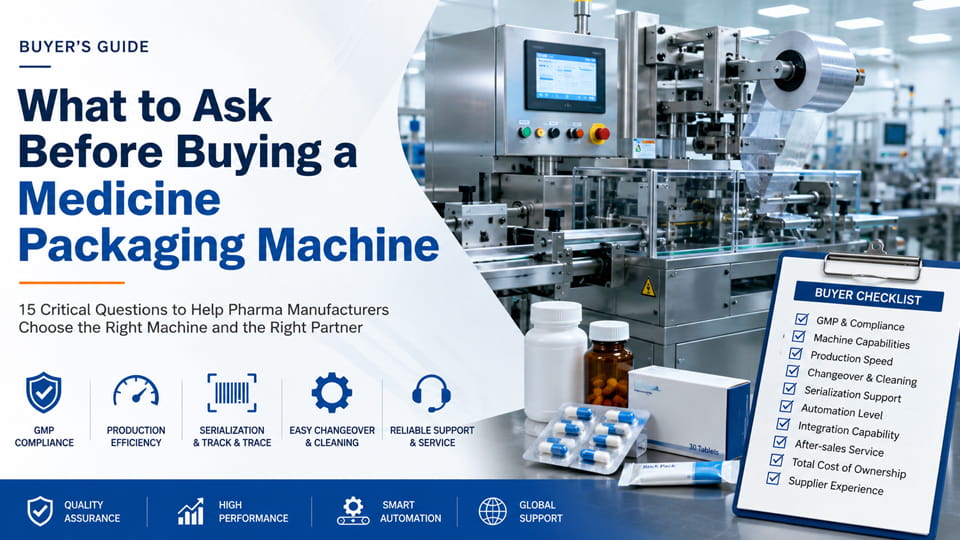
Imagem: Uma moderna linha de produção de embalagens de medicamentos, ilustrando a necessidade de máquinas integradas e design compatível com GMP.
Nem todas as máquinas lidam com todos os produtos. Você deve ser muito claro sobre seus tipos de produtos. Por exemplo, comprimidos e cápsulas muitas vezes usam linhas de contagem/envase de garrafas ou blisters, enquanto medicamentos líquidos precisa de máquinas dedicadas de enchimento e selagem de líquidos. Pós/grânulos pode ir em sachês ou embalagens stick. Abaixo está um guia simples – suas necessidades podem combinar várias máquinas em uma linha:
| Forma farmacêutica & Formatar | Tipo de máquina típico |
| Comprimidos sólidos (solto, em garrafas) | Contagem Automática & Linha de engarrafamento |
| Comprimidos sólidos (tira ou bolhas) | Máquina de embalagem de bolha (PVC/Alu-PVC) |
| Cápsulas (gel duro) | Máquina de enchimento de cápsulas + (linha de blister ou garrafa) |
| Líquidos/Xaropes (frascos ou garrafas) | Máquina de enchimento e tampagem de líquidos |
| Pós/Grânulos (bastão ou sachê) | Máquina de sachês ou stick-pack |
| Géis/gomas suaves | Máquina de contagem + Blister ou Engarrafamento |
| Caixas (secundário) | Máquina de encadernação para o boxe final |
As máquinas de embalagem de medicamentos são frequentemente vendidas como linhas integradas. Por exemplo, uma linha de cápsulas pode alimentar produtos de um enchimento em um Máquina de contagem, então através de um empacotador de bolhas ou cartonador.
Pergunte ao seu fornecedor de máquinas de embalagem de medicamentos: “A linha pode operar meus produtos?” Para cada formato, verificar a compatibilidade do material – por exemplo. uma máquina de blister deve passar papel alumínio e filmes (PVC, BICHO DE ESTIMAÇÃO, ALU-ALU) nas temperaturas certas. As linhas de garrafas devem ser ajustadas para diferentes alturas de garrafas e tipos de tampas. Se você planeja vários produtos (E.G.. cápsulas e comprimidos), você precisará trocar peças ou até mesmo máquinas diferentes. Algumas máquinas são multiformato, mas sempre confirme qual mudança é necessária (veja a próxima seção).
A velocidade nominal de uma máquina deve corresponder às suas metas de produção. Descubra quantas unidades por minuto/hora a máquina pode embalar de forma confiável. Certifique-se de considerar líquido saída (depois das rejeições) e não apenas o máximo. Pense nas necessidades atuais e crescimento futuro. Por exemplo, uma linha de blisters de comprimidos de tamanho médio pode ser avaliada em 40,000 bolhas por hora; uma grande linha totalmente automática pode exceder 100,000 por hora. No entanto, uma máquina de alta velocidade que trava frequentemente pode ser pior do que uma máquina um pouco mais lenta, estável.
Estime seu volume diário ou anual e escolha uma máquina que possa lidar com picos. Tenha em mente as tendências do setor: muitas empresas farmacêuticas agora operam lotes menores com trocas frequentes, portanto, a velocidade extremamente alta de SKU único é menos crítica do que a flexibilidade. Se você executar vários turnos, investir em maior rendimento pode ter retorno mais rápido por meio da economia de mão de obra. Mas se os lotes forem pequenos ou personalizados, uma máquina que permite trocas rápidas de receitas e trocas sem ferramentas (veja a seção 4) será mais valioso que a velocidade bruta.
Decida quanta automação você realmente precisa. Máquinas semiautomáticas exigir que os operadores carreguem contêineres, iniciar ciclos, ou realizar tarefas manuais (E.G.. deixando cair comprimidos em bolhas). Linhas de embalagem farmacêutica totalmente automáticas faça tudo, desde a alimentação até a selagem, com o mínimo de intervenção humana. Máquinas semiautomáticas custam menos no início e podem ser adequadas para trabalhos de baixo volume ou em lote. Linhas totalmente automáticas custam mais, mas economizam mão de obra e reduzem erros humanos.
| Recurso | Semi-automático | Totalmente automático |
| Envolvimento do Operador | Sim – carga/descarga, etc.. | Mínimo – uma pessoa supervisiona toda a linha |
| Velocidade de produção | Moderado | Alto |
| Mudança | Mais devagar (ajustes manuais) | Mais rápido (muitas vezes sem ferramentas, orientado por receita) |
| Investimento Inicial | Mais baixo | Mais alto |
| Complexidade de validação | Semelhante (IQ/OQ/PQ ainda é necessário) | Semelhante |
| Ideal para | Pequenas corridas, pilotos de laboratório | Grandes corridas, 24/7 produção |
Sistemas farmacêuticos totalmente automatizados geralmente incluem funis de alimentação, etiquetadoras automáticas, bonés, e transportadores todos sincronizados. Eles também integram verificações de erros (balanças, sistemas de visão) em tempo real. Equipamentos semiautomáticos podem ser adequados para um fabricante contratado começando, mas os planos de crescimento muitas vezes levam os compradores a escolher a automação completa.
As linhas farmacêuticas mudam de produto com mais frequência do que você imagina, e cada mudança requer uma limpeza completa (e muitas vezes revalidação). Um bom projeto de máquina tornará isso rápido. Procurar sem ferramentas peças removíveis, componentes leves (uma pessoa pode lidar com eles), e quadros abertos que permitem o controle de qualidade ver se algum resíduo permanecer. Não deve haver cavidades ocultas onde os comprimidos ou o pó possam se acumular. O fornecedor deve fornecer POPs claros para limpeza, desmontagem e remontagem. Validar procedimentos de mudança: pode produto receitas ser armazenado para que você recupere todas as configurações de um determinado SKU?
Na prática, uma máquina que pode ser limpa e validada rapidamente melhora diretamente a produtividade. Se você tiver medicamentos que exijam troca entre, dizer, uma substância controlada e um produto vitamínico, você fará uma limpeza e, muitas vezes, um teste de validação limpo (teste de produto no pior caso) toda vez. Pergunte sobre limpar no local (CIP) opções ou outros recursos higiênicos.
Regulamentações modernas (NÓS. DSCSA, febre aftosa na UE, etc.) exigir serializando cada unidade vendável de medicina. Antes de comprar, confirme se a linha pode integrar impressoras de codificação (jato de tinta/laser) e scanners de visão para aplicar e verificar códigos de barras 2D ou códigos QR em embalagens. O sistema de controle deve capturar cada número de série e vinculá-lo aos dados do lote. Na prática, os compradores costumam perguntar: “Esta máquina pode rejeitar qualquer item sem rótulo ou com código inválido?” e “Existe espaço reservado e fiação para adicionar um codificador ou câmera posteriormente?”. Mesmo que você não esteja exportando hoje, construir uma linha pronta para serialização é mais inteligente do que modernizar posteriormente.
Além da serialização, considere a integração digital. A máquina suporta comunicação industrial padrão (Ethernet/IP, OPC UA, Modbus, etc.) para que possa alimentar seu MES/ERP? Ele pode gerar trilhas de auditoria e registros eletrônicos de lote para controle de qualidade?? As fábricas inteligentes modernas esperam dados em tempo real: tempo de atividade, rejeitar contagens, alarmes, etc.. Uma linha farmacêutica “inteligente” ajuda a detectar problemas antecipadamente e atende aos requisitos de integridade de dados (sem registros manuais). Pergunte se a HMI/PLC pode ser conectada em rede, se houver logs de eventos, e se o serviço remoto (via VPN ou IoT) é oferecido. A prontidão digital prepara sua linha para o futuro e melhora a rastreabilidade.
O preço de etiqueta é apenas o começo. Compradores inteligentes calculam TCO durante a vida útil da máquina. TCO inclui o preço base mais envio, instalação, IR/WH/PQ, treinamento, peças de reposição, uso de energia, manutenção, e custos de tempo de inatividade. Por exemplo, um estudo descobriu que uma linha de embalagem de medicamentos fabricada na China, cara, mas confiável, economizou muito mais em três anos do que uma linha de embalagem de medicamentos mais barata., menos bem suportado. Faça uma mesa (como abaixo) comparar fornecedores:
| Fator de custo | Descrição | Comentários |
| Preço de compra | Máquina, acessórios, entrega | Único (mas pode variar amplamente) |
| Instalação & Comissionamento | Preparação do site, calibração, IR/WH/PQ | Passos perdidos aqui podem aumentar custos futuros |
| Treinamento | Operador & treinamento de manutenção | Um bom treinamento reduz erros do operador |
| Peças de reposição & Componentes | Peças de desgaste (cintos, sensores, etc.) | Peça lista; alta disponibilidade economiza tempo de inatividade |
| Energia/Utilidades | Eletricidade, ar, vazio, etc.. | Máquinas eficientes podem reduzir OPEX |
| Manutenção & Tempo de inatividade | Manutenção programada & correções não programadas | O serviço rápido e o design de baixa falha minimizam isso |
| Suporte/Serviço | Solução de problemas remota, visitas no local | Um SLA de serviço forte vale seu peso |
| Consumíveis & Ferramentas | Selos, lubrificantes, bicos sobressalentes, etc.. | Muitas vezes esquecido, mas pode somar |
Se dois fornecedores cotarem máquinas semelhantes, descubra o que cada lista inclui. Uma máquina com preço mais alto pode durar mais, tem peças de reposição mais baratas, ou use menos ar comprimido – reduzindo seu custo real. Certifique-se de perguntar a cada fornecedor sobre a duração da garantia e o que está coberto (peças, trabalho, viagens para técnicos).
Até a melhor máquina precisa de manutenção. Verifique o histórico do fornecedor da máquina de embalagem de medicamentos e a configuração do serviço. Uma máquina confiável possui recursos como códigos de falha claros na IHM, um gabinete elétrico bem rotulado, e um plano de manutenção preventiva fácil. Solicite o MTBF (tempo médio entre falhas) dados ou estudos de caso. Descubra também como as peças de reposição são tratadas: são peças prontas para uso ou personalizadas? Com que rapidez você pode obter componentes críticos – no dia seguinte ou nas semanas seguintes? Especialmente para compradores globais, suporte local é fundamental. O estudo da JinLu Packing mostrou que a entrega e o serviço rápidos de peças podem evitar perdas de seis dígitos devido ao tempo de inatividade.
[jl_youtube src=”https://www.youtube.com/embed/1Bb_J6rluac”]
Vídeo: Uma linha automatizada de enchimento e engarrafamento. Avalie recursos de confiabilidade (sensores de erro, armários claros) e facilidade de manutenção na escolha do equipamento.
Nem todos os fabricantes de máquinas de embalagem de medicamentos entendem as nuances farmacêuticas. Idealmente, escolha um fornecedor com experiência comprovada em farmacêutica/GMP. Pergunte sobre sua lista de clientes e projetos recentes. Eles abasteceram sua região ou mercados regulamentados (FDA dos EUA, EU EMA)? Eles fazem GORDURA (Testes de aceitação de fábrica) e relatórios FAT? Eles podem lidar com um processo de qualificação, se necessário? Fornecedores respeitáveis terão um SGQ de engenharia e poderão oferecer personalização (E.G.. inspeções visuais específicas para rotulagem OTC vs RX).
Você também deve considerar a logística: onde fica a fábrica deles? Se for no exterior, existem parceiros de canal ou instaladores em seu país? Quem cuida da alfândega e do transporte? Lembrar, a máquina mais barata não vale muito se estiver em um navio devido à falta de documentos ou não tiver suporte local.
Para encerrar, aqui está uma lista de verificação que você pode usar em reuniões ou solicitações de cotação:
Essas perguntas, enquanto numerosos, garantirá que você cubra os pontos mais críticos e compare os fornecedores em bases iguais.
Investir na máquina de embalagem de medicamentos certa significa equilibrar o desempenho, conformidade, e custou ao longo de muitos anos. Ao fazer essas perguntas, você esclarecerá suas necessidades e evitará surpresas. Lembrar, a melhor escolha nem sempre é a máquina mais barata, mas aquele que se adapta ao seu processo e mantém você em conformidade com tempo de inatividade mínimo.
Se você precisar de orientação, consulte especialistas em automação de embalagens – por exemplo, Embalagem Jinlu oferece design e suporte completos para linhas farmacêuticas, do layout da linha GMP à documentação de validação. Contate-nos para discutir seu projeto: podemos fornecer uma proposta personalizada ou organizar uma demonstração ao vivo. Vamos garantir que seu investimento proporcione sucesso regulatório e eficiência operacional.
Antes de comprar uma máquina de embalagem de medicamentos, você deve perguntar sobre conformidade com GMP, velocidade de produção, tipos de embalagem, suporte de validação, materiais de máquina, tempo de mudança, disponibilidade de peças de reposição, e serviço pós-venda. Também é importante verificar se a máquina pode suportar futuras necessidades de expansão e serialização da produção..
A máquina certa depende do seu tipo de produto, volume de produção, formato de embalagem, e requisitos de conformidade. Por exemplo, máquinas de embalagem blister são comumente usadas para comprimidos e cápsulas, enquanto as máquinas de sachês ou stick pack são melhores para pós e grânulos. Os compradores também devem considerar o nível de automação, custos de manutenção, e capacidade de integração de linha.
Um fabricante confiável de máquinas de embalagem farmacêutica deve fornecer documentos e certificações como:
• Certificação CE
• Documentação de projeto em conformidade com GMP
• Protocolos IQ/OQ/PQ
• Documentos FAT/SAT
• Certificados de materiais
• 21 Parte CFR 11 apoiar (se aplicável)
Esses documentos ajudam as fábricas farmacêuticas a passar em auditorias e atender aos requisitos regulatórios.
A conformidade com GMP ajuda a garantir a segurança do produto, qualidade consistente, e aprovação regulatória. Uma máquina compatível com GMP foi projetada para reduzir os riscos de contaminação, melhorar a capacidade de limpeza, e apoiar documentação e rastreabilidade adequadas. Isto é especialmente importante para os fabricantes farmacêuticos que exportam para mercados regulamentados..
Equipamentos modernos de embalagem farmacêutica podem suportar muitos formatos de embalagem, incluindo:
• Blisters
• Garrafas
• Sachês
• Pacotes de palitos
• Bolsas
• Caixas
A melhor opção depende da sua forma farmacêutica, requisitos do mercado, e metas de produção.
A serialização está se tornando essencial em muitos países devido às regulamentações de rastreabilidade farmacêutica, como DSCSA e EU FMD. Uma máquina com capacidade de serialização pode imprimir e verificar códigos exclusivos, ajudando os fabricantes a prevenir produtos falsificados e melhorar o rastreamento da cadeia de suprimentos.
Máquinas semiautomáticas geralmente são mais acessíveis e adequadas para pequenos volumes de produção ou startups. Máquinas de embalagem farmacêutica totalmente automáticas são melhores para produção em larga escala porque melhoram a eficiência, reduzir custos trabalhistas, e minimizar o erro humano.
O preço depende de vários fatores, incluindo tipo de máquina, nível de automação, velocidade de produção, e requisitos de personalização. Uma máquina semiautomática básica pode custar muito menos do que uma linha de embalagem farmacêutica totalmente automatizada com serialização e suporte de validação. Os compradores devem se concentrar no custo total de propriedade e não apenas no preço de compra inicial.
Sim. Muitas máquinas modernas de embalagem farmacêutica podem ser conectadas a máquinas de contagem, sistemas de rotulagem, máquinas de embalagem, transportadores, e sistemas ERP/MES. A integração ajuda a melhorar a automação e a eficiência geral da produção.
Um fornecedor profissional deve oferecer:
• Suporte de instalação
• Treinamento de operadores
• Solução de problemas on-line
• Fornecimento de peças de reposição
• Orientação de manutenção preventiva
• Assistência técnica remota
Um bom serviço pós-venda pode reduzir significativamente o tempo de inatividade e melhorar a estabilidade da produção a longo prazo.
Referências:
1.Boas Práticas de Fabricação Atuais (Cgmp) Regulamentos -- NÓS. Food and Drug Administration
2.Boas práticas de fabricação da OMS para produtos biológicos, Anexo 2, TRS Não 999 -- QUEM
3.Boas práticas de fabricação —— Agência Europeia de Medicamentos
4.Dez perguntas frequentes sobre serialização —— Sociedade Internacional de Engenharia Farmacêutica