×
オンラインサービス
✉️メール: 💬WhatsApp: +86 18011793320
💡
  • ブログ
  • 医薬品洗浄の検証: GMP コンプライアンスの完全ガイド, プロトコルとサンプリング方法

医薬品洗浄の検証: GMP コンプライアンスの完全ガイド, プロトコルとサンプリング方法

医薬品製造において, effective equipment cleaning is essential to maintain product quality and prevent cross-contamination between batches. A well-designed クリーニング検証 process helps manufacturers prove that their cleaning procedures can consistently remove product residues and meet GMP要件. For production teams and equipment buyers, 選択する 製薬機械 with easy-to-clean designs can also make validation easier, ダウンタイムを削減する, and improve overall manufacturing efficiency.

医薬品洗浄の検証


What Is Pharmaceutical Cleaning Validation?

簡単に言うと, クリーニング検証 provides objective evidence that a cleaning procedure consistently meets predefined standards. ある業界関係者はこう述べています。, cleaning validation is a “documented guarantee” that cleaning can be performed reliably and repeatedly to achieve a predetermined level of cleanliness. 実際に, this means showing that residues of previous products, cleaning agents, and microbes are removed to acceptable levels on all product-contact surfaces.

Regulators agree. 例えば, FDAの 21 CFR 211.67(ある) requires every piece of equipment (dedicated or multi-use) to be “cleaned… to prevent… contamination that would alter the safety, 身元, 強さ, 品質, or purity of the drug product”. The WHO similarly explains that the goal of cleaning validation is to prove the equipment is consistently cleaned of product, 洗剤, and microbial residues to an acceptable level to prevent contamination and cross-contamination. 言い換えると, cleaning validation is about patient safety: ensuring one product batch cannot “carry over” and contaminate the next.


Why Is Cleaning Validation Important in Pharmaceutical Manufacturing?

A thorough cleaning validation program gives manufacturers confidence (and regulators assurance) that 相互汚染 is controlled. それがなければ, residues of a potent API or allergen from one batch could end up in the next product, potentially harming patients or causing a 想起. The FDA explicitly states that firms “must validate that cleaning procedures are adequate to ensure that cross-contamination does not occur”. This is especially critical in multiproduct facilities (common in CDMO and supplement makers). WHO guidance emphasizes that cleaning validation is especially important in multiproduct plants, and should be applied to all production equipment and sanitation procedures.

Beyond contamination, cleaning validation is about ensuring 製品の品質. If equipment isn’t properly cleaned, residual chemicals or microbial growth could compromise the 身元, 強さ, そして純粋さ of subsequent batches. 要するに, cleaning validation safeguards product quality and patient health. It’s also a regulatory must. Whether you’re under FDA jurisdiction (21 CFRパート 211) or EU GMP (EMA/I), authorities require documented cleaning validation as part of a complete GMP program. Failure to validate cleaning can lead to warning letters, product holds, and even recalls.


GMP Requirements for Cleaning Validation

規制要件: FDA, エマ, 誰が, 写真/S. All major guidelines demand cleaning validation, but with slightly different emphasis. で 私たち, FDA の CGMP (タイトル 21 CFR 211.67) lays out the basic requirement: equipment must be cleaned to prevent cross-contamination. FDA’s guidance recommends using effective sampling and analytical methods to prove cleanliness. 特に, the FDA clarifies that “rinses alone… would not be acceptable” 検証用; firms should directly swab surfaces when feasible. In practice this means you usually combine swab and rinse sampling to cover all areas.

欧州連合, the EMA’s EU GMP 付属書 15 (2015) and EMA guidance require cleaning validation as part of process validation. 別館 15 explicitly states “Cleaning validation should be performed in order to confirm the effectiveness of any cleaning procedure for all product contact equipment.”. It also says carry-over limits must be justified by toxicological (health-based) evaluation. 言い換えると, define your acceptance criteria scientifically (以下を参照してください) and document the rationale. The EU approach emphasizes a risk-based, health-based strategy: calculate Maximum Allowable Carryover (MACO) or Permitted Daily Exposure (PDE) values for active residues.

WHO and PIC/S also offer guidance. の WHO GMP TRS 1019 (2019) 別館 on validation spells out that cleaning validation “provides documented evidence that an approved cleaning procedure will provide clean equipment, suitable for its intended use”. This WHO document (a common reference worldwide) highlights that cleaning validation is not needed for trivial cleaning (床, 壁) しかし needed for critical product-contact equipment in multiproduct plants. The PIC/S committee (a consortium of regulators) likewise defines cleaning validation as evidence that residues will be removed “below the scientifically set maximum allowable carryover level”.

一緒に, these sources establish the essential elements: define acceptable residue limits, develop robust cleaning procedures, sample using validated methods, analyze with suitable assays, and demonstrate each piece of equipment can be cleaned consistently to those limits.

Swab sampling of pharmaceutical equipment contact surfaces during cleaning validation to confirm residue removal and prevent cross-contamination.
画像: Swab sampling of pharmaceutical equipment contact surfaces during cleaning validation to confirm residue removal and prevent cross-contamination. 注記: FDA explicitly states rinse samples alone aren’t enough; you should swab product-contact surfaces as well.


What Are the Key Steps in a Cleaning Validation Process?

Cleaning validation is essentially a project. Here is a step-by-step outline of the typical process:

  1. Identify Equipment, Products, and Worst-Case Scenarios. Begin by listing all production equipment that touches product (ミキサー, ブレンダー, カプセル充填剤, 打錠機, 充填ライン, 等) and the products run on each. For each piece of equipment, identify the worst-case product or scenario that would leave the toughest residues to remove (例えば. a potent API, a sticky formulation, or a red dye). 頻繁, a machine used for the highest-dosage or hardest-to-clean product is validated and then others are shown similar by logic. Equipment with similar designs may share validation data if justified.
  2. Define Acceptance Criteria (Residue Limits). Decide how clean is “clean enough.” The goal is to ensure any carryover of the previous product is not toxic or efficacious when used by a person taking the next product. A common approach is to calculate a Maximum Allowable Carryover (MACO) or apply a health-based limit (例えば. PDE) based on the potency and daily dose of the previous product. The EU GMP Annex 15 explicitly requires a toxicological justification for carryover limits. 例えば, one conservative rule is to allow no more than 10 ppm (0.001%) of the previous API relative to its normal dose. Acceptance criteria can also include visible cleanliness (例えば. no particles or stains), and limits on any cleaning agent residues. Be sure to document the rationale for your chosen limits (often in a risk assessment or protocol).
  3. Develop the Cleaning Procedure. Write a detailed cleaning procedure (often as an SOP) specifying cleaning agents, concentrations, contact times, 温度, and steps (rinsing, scrubbing, 等). This may involve multiple steps: 例えば. an organic solvent soak, followed by aqueous detergent wash, followed by multiple rinses. The procedure should be practical to perform repeatedly. Equipment design features (滑らかな表面, weldless joints, drainable hoppers) greatly assist here. Make sure the cleaning agents selected are compatible with machine materials (ステンレス鋼, アザラシ) and do not leave sticky residues themselves.
  4. Determine Sampling Methods and Locations. Plan how you will check cleanliness. Common sampling techniques include:
  5. Swab sampling: Using a wetted swab to wipe specific areas of the equipment surface (例えば. inside a discharge chute, gasket, バルブ, 等). Swabbing is direct but limited to accessible spots.
  1. Rinse sampling: Collecting the final rinse liquid after cleaning by running water or solvent through the equipment (or by rinsing parts). Rinse sampling can cover internal passages or complex shapes.
  2. Direct extraction: For disassembled parts, you may submerge a component in solvent and analyze that liquid.

FDA guidance is clear that “rinses alone would not be acceptable” as the only verification method. 実際に, a combination of swab and rinse samples is used. Choose representative sampling sites on each piece of equipment (usually the hardest-to-clean spots). Before testing, validate that your sampling methods recover enough of the target residues (known as recovery studies).

  1. Analytical Testing. Analyze samples for residues. The choice of method depends on the chemistry of residues: common choices include HPLC (high-performance liquid chromatography) for specific APIs or cleaning agents, UV-VIS spectroscopy, 目次 (total organic carbon) for organic matter, conductivity/pH for ionic detergents, or GC for volatile solvents. HPLC is often considered a “gold standard” for specificity. WHO and others note that TOC can be acceptable if target residues are organic and carbon-rich. Whatever methods you use, they must be validated or qualified for the intended use. Plan your method validation (linearity, 感度) and ensure detection limits are well below your acceptance criteria.
  2. Perform Validation Runs & Document Results. Execute the cleaning validation by manufacturing at least 3 consecutive full-scale batches (or campaign-run) under normal conditions and then applying the cleaning SOP, and sampling/analyzing each time. Collect data and show that all results are within acceptance limits. Document everything in a Cleaning Validation Report: protocol, SOP, raw data, calculations, 逸脱, and conclusions. If any test fails, investigate root causes and revise the cleaning until criteria are met. Once approved, the process is considered 検証済み.
  3. 継続的なモニタリング. After initial validation, continue to verify cleanliness over time. Periodic cleaning samples (especially after maintenance or formulation changes) are recommended. Also maintain thorough documentation (SOP revisions, バッチレコード). If equipment or processes change, you may need revalidation or partial validation (別館 15 advocates a lifecycle approach).
Vacuum cleaning a pharmaceutical tablet press before production as part of pharmaceutical cleaning validation and preventive equipment maintenance
画像: Vacuum cleaning a pharmaceutical tablet press before production as part of pharmaceutical cleaning validation and preventive equipment maintenance


Common Challenges and Pitfalls

Cleaning validation often faces obstacles. 主な課題には以下が含まれます::

  • Complex Equipment and Dead Zones: Modern machines have gaskets, crevices, or intricate parts that trap powder (例えば. inside auger housings or filling nozzles). These hard-to-reach spots require careful cleaning design and sampling. FDA and WHO stress choosing worst-case equipment and sampling all critical locations.
  • Operator Variability: Manual cleaning steps can be inconsistent if operators are not well-trained. ある業界記事によると, cleaning is often treated as an afterthought: “lack of clear SOPs… causes operators to interpret cleaning instructions differently”. Incomplete or rushed cleaning leads to failure. Good training, clear checklists, and supervision are vital.
  • Analytical Interference: Ensuring the assay only detects the target residue (not detergent or environmental contaminants) can be tricky. You may need specialized extraction or cleanup. また, some highly sensitive methods can find minute background “dust” – so acceptance criteria must be realistic. Remember FDA’s guidance: cleanliness need only meet safety and quality standards, not impossible “zero residue” levels.
  • Microbial Concerns: Especially for equipment exposed to moist environments, microbial biofilms can form that resist routine cleaning. While cleaning validation usually focuses on chemical residues, microbiological monitoring (swab cultures) may also be needed for sterile or sensitive products. Validating sanitization (例えば. caustic or heat) may be part of the process.

全体, the best defense is a リスクベースのアプローチ (as encouraged by ICH Q9 and industry guidance). Focus validation efforts on high-risk areas/products (potent APIs, shared equipment) and document that focus.


Equipment Design for Easy Cleaning (GMP-Friendly Features)

A huge enabler of successful cleaning validation is equipment design. FDA explicitly requires equipment to be designed to facilitate cleaning. 実際に, 探す:

  • Stainless Steel Contact Surfaces: 食品グレード ステンレス (304/316) is hygienic and non-porous. It doesn’t react with APIs and is easy to sterilize. All product-contact parts should be stainless steel or equivalent FDA-grade material. Avoid materials that could absorb or trap product (例えば. some plastics, ゴム).
  • スムーズ, Sloped Surfaces: Rounded corners and sloped trays help liquids drain and avoid standing pockets of powder. Welds should be smooth. The fewer “dead legs” or bolt-holes in the product path, the better.
  • Quick-Release/Disassemblable Parts: Hoppers, 蓋, covers, and filling plates that can be removed without tools (or with few hand screws) make it easy to access hidden areas. 例えば, choose machines where hoppers, オーガー, and trays snap or unbolt in minutes for manual cleaning. Reduced parts count generally speeds up the process.
  • CIP/SIP Capability (該当する場合): For larger installations, 自動化された 定置洗浄 (CIP) systems can rinse circuits. For most small to mid-size packaging machines, a manual clean-out is used, but some automated systems exist (like CIP manifolds on liquid fillers).
  • Certification and Documentation: Look for equipment from reputable suppliers that meet CE/FDA standards and come with cleaning validation support documentation. Good vendors often provide “cleanability” data or are willing to co-develop the cleaning protocol.

By specifying these design features, you drastically cut down cleaning time and validation effort. 例えば, Jinlu’s capsule filling machines are built with easily detachable hoppers, stainless chutes, and closed dust guards – all to minimize residue accumulation. 同様に, 水膨れ そして pouch packaging machines with tool-less access panels help operators reach all surfaces for cleaning. Choosing the right equipment upfront is half the battle in cleaning validation.


Capsule Filling Machine Cleaning: ケーススタディ

Capsule fillers deserve a special mention. These machines handle powders and capsules, so thorough cleaning is a must. Key points for cleaning a capsule filling line include:

  • Disassemble Critical Parts: 各バッチの後, components like the ガソリンスタンド, 投与ディスク, タンピングピン, そして capsule hoppers should be removed and cleaned separately. These parts directly contact product and often trap powder between runs. Jinlu machines use hopper catches and quick-release knobs to make this easy.
  • Dry and Wet Cleaning Steps: 初め, dry clean to remove bulk powders (圧縮空気, ブラシ). Then wet-clean using mild detergents or isopropyl alcohol for sanitizing. 例えば, wiping the dosing disc and tamping area with 70% IPA dissolves most organic dust without rusting metal. Always rinse thoroughly after detergent use.
  • Focus on Hard Spots: The capsule-separating trays and ejection areas collect capsule dust. Also check vacuum lines and capsule orientation units. In automated machines, any feeder or sieve should be cleared of fines.
  • Documented Procedure: Have a clear SOP for capsule line cleaning, including pictures of what a “clean” state looks like (no powder on machine surfaces or visual color of surfaces). Train operators to inspect as they go. Some firms even use media-fill or placebo trials to verify there’s no cross-contamination in capsule machines.
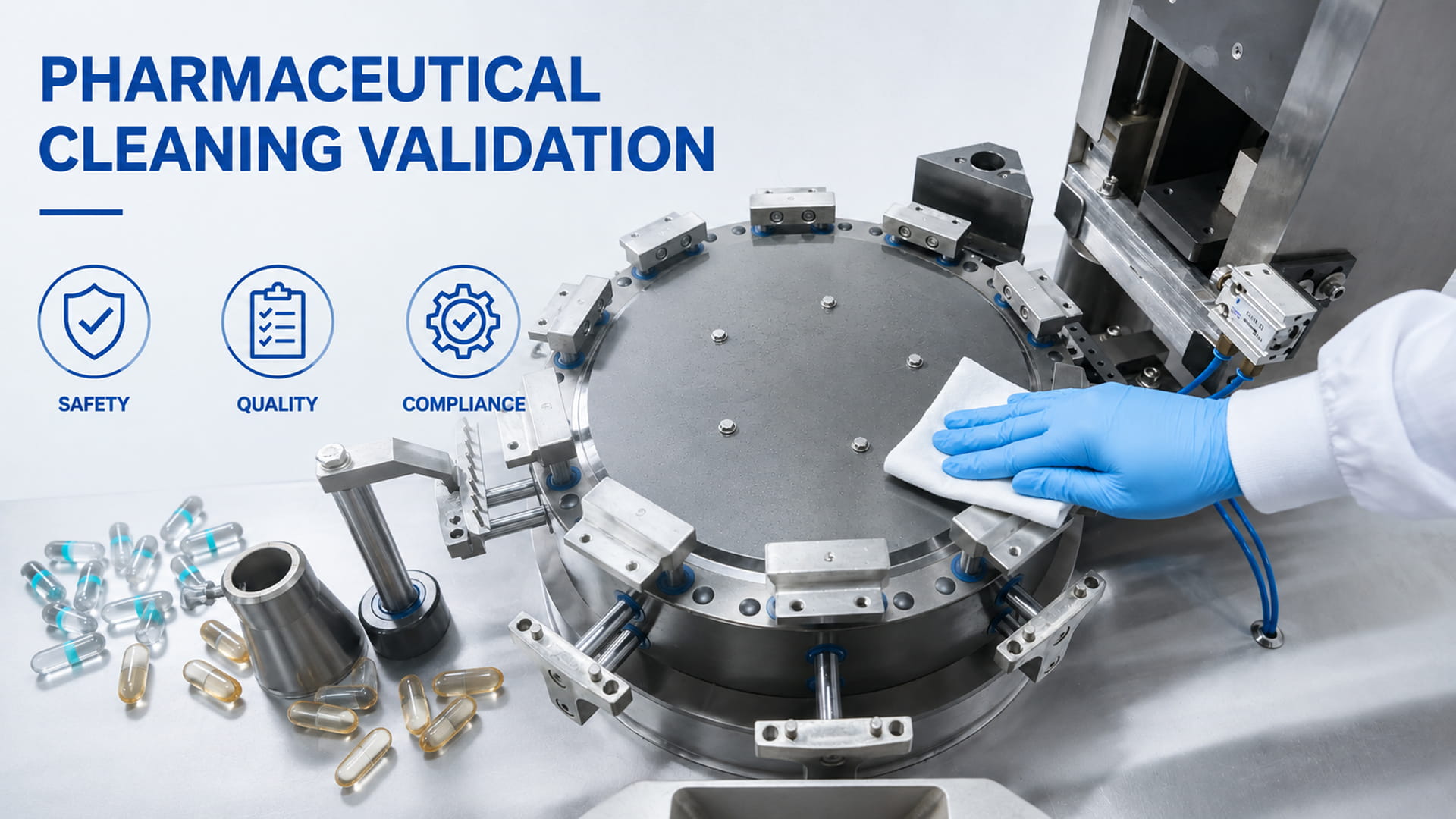
Operator wearing cleanroom garments cleaning the rotary table of a pharmaceutical capsule filling machine during pharmaceutical cleaning validation to prevent cross-contamination
画像: Operator wearing cleanroom garments cleaning the rotary table of a pharmaceutical capsule filling machine during pharmaceutical cleaning validation to prevent cross-contamination. 実際に, cleaning the fill hopper, 投与プレート, and tamping pins after each run is crucial for capsule machine GMP compliance.

Capsule machines in GMP service are often executed in harsh environments (dusty powder). Jinlu’s capsule fillers address this by using anti-static coatings and closed hoppers to limit powder escape, making cleaning safer and validation easier.


Best Practices for Successful Cleaning Validation

To tie it all together, here are some overarching best practices:

  • Use a Risk-Based Approach: As advocated by ICH Q9, focus on the riskiest compounds/equipment. Validating every piece of auxiliary equipment (壁, 床, 等) is unnecessary; concentrate on product-contact surfaces.
  • Train and Empower Your Team: Ensure operators and QC analysts understand the cleaning protocol fully. Regular training and clear checklists/SOPs reduce variability.
  • Maintain Detailed Documentation: Every validation study should have a protocol, raw data, and final report. 別館 15 and WHO demand these be approved by quality personnel. Keep logs of routine sanitation checks too.
  • Review and Revalidate: When you change formulations, extend campaigns, or upgrade equipment, revisit your cleaning validation. Even small changes can affect residue risk. Document all revalidation activities.
  • Collaborate with Suppliers: Equipment vendors often have cleaning recommendations. 例えば, if using specialized lubricants, ensure they’re compatible with the cleaning agents. Some companies provide cleaning validation protocols for their machines.

画像: A clean analytical lab environment (blister packing or QA lab). Good cleaning validation requires both proper cleaning procedures and accurate testing (例えば. HPLC, 目次) to confirm no residues remain. Cleaning Validation Checklist: A quick summary table of key items.

Item 要件
Equipment identified List all product-contact machines
Cleaning procedure Written, 承認された, そして続いた (SOP)
Sampling plan メソッド (swab/rinse), locations, frequency
Acceptance criteria Defined (MACO/PDE limits)
分析方法 Validated tests (HPLC, 目次, 等)
Validation report Protocol completed, results approved by QA

Proper cleaning validation is essential for GMP pharmaceutical production. It protects product quality and patient safety by preventing cross-contamination. Well-designed equipment greatly reduces validation headaches: smooth stainless steel contact parts, minimal dead zones, and quick disassembly mean cleaning is faster and more consistent. ジンルーパッキングにて, we design capsule fillers, ブリスターパッカー, and filling lines with these principles in mind to help manufacturers comply with global GMP standards.


結論

要約すれば, pharmaceutical cleaning validation is about proving “clean” with data and documentation. By following a structured process – selecting worst-case products, setting limits (like MACO), writing clear cleaning SOPs, sampling smartly, and testing with HPLC/TOC – you can demonstrate compliance to regulators and quality teams alike. 覚えて: invest in GMP-friendly equipment now (ステンレス, ergonomic design) to save time validating later. If you’re looking for capsule filling or packaging machines built for easy cleaning and compliance, consider Jinlu Packing’s lineup of カプセル充填機, ブリスターパッカー, そして pharmaceutical filling lines. Our equipment is engineered for quick changeover and thorough cleaning, helping ensure your validation goes smoothly.

Ready to streamline your cleaning validation? ジンルパッキングにお問い合わせください to learn how our GMP-compliant capsule filling and packaging machines can meet your pharmaceutical manufacturing needs.


FAQs on Pharmaceutical Cleaning Validation

What is cleaning validation in the pharmaceutical industry?

Cleaning validation is a documented process used to prove that pharmaceutical equipment cleaning procedures can consistently remove product residues, 医薬品有効成分 (API), cleaning agents, and potential contaminants to an acceptable level.

医薬品製造において, cleaning validation provides evidence that equipment is suitable for producing the next batch without causing cross-contamination or affecting product quality.

Why is cleaning validation important in pharmaceutical manufacturing?

Cleaning validation is important because pharmaceutical equipment is often used to manufacture different products or batches. Without effective validation, remaining residues may contaminate the next product and impact its safety, 身元, 強さ, or purity.

A properly performed cleaning validation process helps manufacturers:
• Prevent cross-contamination
• Meet GMP compliance requirements
• Improve production safety
• Reduce quality risks during product changeovers

What are the main steps of the cleaning validation process?

The cleaning validation process usually includes equipment assessment, cleaning procedure development, setting acceptance criteria, サンプリング, 分析試験, および検証ドキュメント.

What are cleaning validation acceptance criteria?

Cleaning validation acceptance criteria define the maximum allowable residue levels after cleaning, including API residues, cleaning agents, and potential contaminants.

What equipment requires cleaning validation?

Most pharmaceutical manufacturing equipment that contacts products requires cleaning validation, カプセル充填機を含む, 打錠機, ミキサー, and powder handling equipment.

What sampling methods are used for cleaning validation?

The two common sampling methods are swab sampling and rinse sampling. Manufacturers often select methods based on equipment design, アクセシビリティ, and residue characteristics.

How does equipment design affect cleaning validation?

Equipment design directly affects cleaning efficiency. Machines with smooth surfaces, fewer dead areas, and easy-to-remove parts are easier to clean and validate.

How often should cleaning validation be performed?

Cleaning validation frequency depends on equipment usage, product changes, process risks, および規制要件. Revalidation may be needed after major changes to equipment or cleaning procedures.

What is the difference between cleaning verification and cleaning validation?

Cleaning verification confirms that a specific cleaning operation meets requirements, while cleaning validation proves that the cleaning process is reliable and repeatable over time.

How can pharmaceutical equipment manufacturers support cleaning validation?

Equipment manufacturers can support cleaning validation by providing GMP-friendly machine designs, easy-to-clean structures, material specifications, and documentation needed for qualification and validation.


参考文献:
1.Validation of Cleaning Processes —— 私たち. 食品医薬品局
2.現在の適正製造基準要件に関する質問と回答 | 装置 —— 私たち. 食品医薬品局
3.ガイド: Cleaning Validation Lifecycle – アプリケーション, メソッド, & コントロール —— ISPE
4.Cleaning validation guide (GUI-0028) —— カナダ保健省
5.ユードラレックス – 音量 4 – 優れた製造業 (GMP) ガイドライン —— 欧州委員会
6.クリーニングの検証: Complete Guide for HealthBased Approach in Chemical CrossContamination Risk Assessment —— PDA JPST

この記事をシェアする:
の写真 ペティフー
ペティフー

ペティフー, 金魯包装の創設者, もたらす 20 製薬機械分野における長年の専門知識. 彼のリーダーシップの下で, Jinlu はデザインを統合する信頼できるサプライヤーに成長しました, 生産, と販売. ペティは、クライアントが医薬品包装の複雑さを乗り越えられるよう、業界の深い知識を共有することに情熱を持っています。, 機器だけでなく確実に受け取れるようにする, しかし、生産目標に合わせて調整された真のワンストップ サービス パートナーシップ.

目次

お問い合わせを送信してください

返信を残す

あなたのメールアドレスは公開されません. 必須フィールドにマークが付いています *

無料見積もりを取得する

*私たちはあなたの機密性を尊重し、すべてのデータは保護されます. あなたの個人データは、JL ソリューションのためにのみ使用および処理されます。.