In pharmaceutical R&D labs and pilot production, 右 ブリスター包装装置 は ない a massive production line, but a compact, versatile machine. a laboratory blister packing machine combines forming, 充填 (often manual), sealing and cutting in one bench-top unit to handle small runs of tablets, capsules or medical devices. It can work with both Alu-PVC and Alu-Alu ブリスター材料 and maintain consistent seal quality and traceability even for a few dozen to a few thousand doses. In this guide we explain what a lab-scale blister machine is, why labs need one, and the seven most important factors to consider when choosing the right equipment.
A lab blister packing machine typically includes a thermoformer (or cold-forming module), ヒートシールステーション, and a die-cutting unit, all sized for pilot-scale work. In thermoforming mode, a heated plastic film (usually PVC or PET) is vacuum-formed over molds, then filled and sealed. In cold-form mode, a layered aluminum foil is stamped into cavities and then lidded. Thermoforming yields clear blister pockets and high throughput; 冷間成形 (アルアル) yields opaque packs with maximum barrier protection. A single compact machine may handle both modes with different tooling. 実際に, a lab machine lets you quickly pack samples under realistic conditions – whether that means a transparent PVC pack or a high-barrier foil pack – without tying up a full production line.
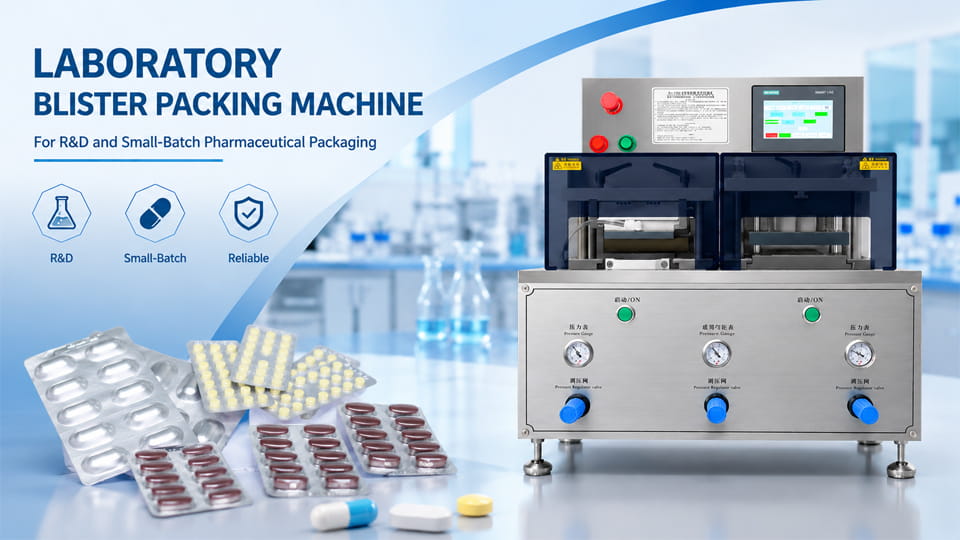
What Is a Laboratory Blister Packing Machine?
a laboratory blister packing machine is essentially a miniature blister packaging line designed for testing, development and small-batch runs. Unlike a full production line, which may run tens of thousands of packs per hour, a lab unit is meant for flexibility and repeatability on dozens or hundreds of packs. It often sits on a lab bench or small floor space, and it handles everything from forming (必要に応じて) through sealing and cutting in one pass. 例えば, Jinlu’s LDPP-140H – a typical compact small-batch blister machine – “thermoforms or cold-forms according to the exact specification of the product, seals with pre-cut lidding foil using heated sealing plates, then cuts and perforates using a precision die-cutter”. タブレット, カプセル, ampoules and similar items can all be packaged on such a system.
言い換えると, a lab blister machine automates the same functions a packaging line would, but at a smaller scale. It uses proven forming, sealing and cutting techniques to ensure packs have the same quality and integrity as those from a production line. This means every pocket is formed, filled and sealed under controlled conditions, with uniform temperature and pressure. The machine will also produce batch and date codes on the lidding foil, just as a production line would. Unlike manual hand-sealing (which yields widely varying seal quality), an automated lab machine delivers consistent seal temperature, pressure and dwell time each cycle. This repeatability is crucial for pharmaceutical samples: you want stability or shelf-life tests to reflect real production, not shaky hand seals. 要するに, a laboratory blister packing machine brings automated precision and record-keeping to small-volume runs, something a typical lab or pilot plant package developer needs.
Why Do Pharmaceutical Laboratories Need a Small-Batch Blister Machine?
Laboratories and pilot plants deal with many different formulations and small volumes. There are several key reasons a pharma lab needs its own ブリスター包装機:
- Reproducible Stability Samples:When conducting stability or stress tests, labs must use sample packs that truly represent the final product. Manual sealing (or ad-hoc pouching) introduces variability. ある情報源のメモとして, “manual sealing cannot deliver reproducible results – every hand-sealed pocket differs in temperature, pressure and dwell time.” A lab blister machine, 対照的に, “produces uniform seals on every pocket” and logs process parameters. This consistency is essential when regulators review how samples were packaged – the machine’s batch records provide proof of exact conditions, whereas hand-sealed “bags” leave too much uncertainty.
- Dual-Material Testing:Early in development, formulators must test both common blister materials. Aluminum-PVC (with transparent pockets) and aluminum-aluminum (コールドフォーム, 不透明な) each serve different needs. Alu-PVC packs allow visual inspection of tablets, while Alu-Alu gives the highest moisture and light barrier for sensitive drugs. A lab machine that can run both modes means you can pack stability samples in 両方 PVC and cold-foil blisters on the same equipment. ジンルさんが指摘するように, “a unit that handles Alu-PVC and Alu-Alu covers transparent and high-barrier packs with one investment”. This flexibility is crucial for R&D teams formulating multiple products.
- Clinical Trials and Small Production Runs:Many drug projects move to limited production (pilot or clinical batches) before full commercialization. These runs may only be hundreds or a few thousand packs. Waiting for a factory line for such small quantities is inefficient. A lab blister machine lets companies produce GMP-like packs in-house for clinical trials, product samples, or special drug orders. 実際には, demand for small batches has “exploded,” and companies historically had to use either lab bench units or tie up high-speed lines. A dedicated small-batch machine bridges that gap, giving an on-demand packaging line for micro-batches without the overhead of a full FFS (フォーム-充填-シール) 生産ライン.
- パイロット / 製剤開発:Lab machines are also ideal for developing new packaging designs or conducting pilot-scale manufacturing trials. Because the machine is small and easy to reconfigure, researchers can switch between products rapidly – helpful when testing a new blister layout or investigating a stability issue. Every small change (different tablet shape, add desiccant, new foil) can be tried immediately on the same machine without batch worth of waste. This nimbleness speeds up formulation development.
- 専門 & Niche Products:Orphan drugs, personalized medicines or seasonal products often ship in small runs. A lab blister machine can handle these specialty jobs cost-effectively. Its lower operating costs and smaller molds make it a better fit for orders that don’t justify a full production run. Even nutraceuticals or non-pharma healthcare items might be packed on the same equipment.
要約すれば, any situation that calls for frequent format changes, tight packaging validation or small-lot packaging will benefit from a laboratory blister packing machine. It complements your larger lines by keeping small runs local and traceable, without sacrificing the high sealing quality needed for pharmaceutical packaging.
Laboratory Blister Machine vs. Industrial Blister Packaging Line
It’s worth clearly distinguishing a lab-scale blister machine from the industrial equipment used for mass production. Both package tablets/capsules in blisters, but they solve different problems:
- Scale and Throughput:A production line is built for thousands to millions of packs per day, running continuously. Its forming station may produce 100+ cavities per cycle at high speed. A lab machine, 対照的に, typically makes a handful of blisters per cycle (its cycle rate may be tens or hundreds per minute). For a production team needing 50,000 パック/時間, only a high-speed line makes sense. But for an R&D lab needing 100–1000 packs/week, a large line is wastefully oversized.
- フットプリント:Industrial blister lines are big – they often include hoppers, コンベア, forming ovens, フィーダー, sealers and routers stretching across a factory bay. 対照的に, lab machines are compact, self-contained units. The LDPP-140H, 例えば, occupies about 0.4 cubic meters (64×58×70 cm) and weighs only ~118 kg. It can stand on a reinforced lab bench without special foundations. A large production machine needs dedicated floor space and utility lines, which most labs simply don’t have.
- Flexibility vs. Fixed Setup:Production lines run one product at a time (usually long runs of the same SKU). Changing over to a new tablet or pack format requires tool changes, calibration and re-validation – often hours or more. Lab machines are designed for frequent changeovers. They use modular molds and simpler setups so teams can swap products in minutes. Rの場合&D labs juggling many formulations, this flexibility means far shorter downtime. (例えば, a production-scale blister line might take 1–2 days to qualifiy after changeover, whereas a lab unit can often be cleaned and tested much faster.) ある情報源のメモとして, a high-speed line can make a pilot quantity “in seconds” then sit idle – the cleanup and changeover time doesn’t shrink just because the batch is small.
- 料金:The equipment cost of a full industrial FFS line is much higher than a lab unit. Not only is the capital outlay larger, but operating it involves more utility use and more personnel. A lab machine has lower energy needs and can often be run by one person. 反対側では, per-unit cost on a small batch tends to be higher (because the machine runs slower and molds cost the same). But overall investment is far less. 例えば, purchasing a desktop blister machine and several molds costs a fraction of buying a whole production line setup.
- Installation and Maintenance:Large machines require site preparation, rigging and often training. A lab machine is generally plug-and-play – you install it on a lab bench, plug in power (380V three-phase for many machines) and connect air/vent as needed. Maintenance is also simpler because there are fewer parts and lower loads. Technical support can be more straightforward due to the unit’s compact nature.
要するに, if your needs are 大容量, dedicated single-product runs, an industrial blister line is appropriate. しかし、のために small-batch research, trials or varied products, a laboratory blister packaging machine is the better fit. It sits on a lab bench, handles quick format shifts, and produces pharma-grade packs on demand without the overhead of a full manufacturing line.
7 Key Factors to Consider When Choosing a Laboratory Blister Packing Machine
When selecting a lab-scale blister machine, focus on the features that matter most for small-batch use. Here are the seven critical factors:
1. Compatible Packaging Materials: Alu-PVC vs Alu-Alu
材料の適合性 is often the first question. Your machine should handle the types of blister packs you need. The two main material families are:
- アルミニウム/PVC (熱成形された):A clear plastic sheet (usually rigid PVC or PET) is thermoformed into cavities, then sealed with an aluminum foil lidding. Alu/PVC blisters let you see the product and are generally cheaper and faster to run. They provide moderate protection against moisture and light. For most standard tablets and capsules, PVC-based packs are adequate and cost-efficient. Thermoforming also allows deeper, complex cavities since plastic can stretch and you can use plug-assist tools (例えば. for deep-pocket devices).
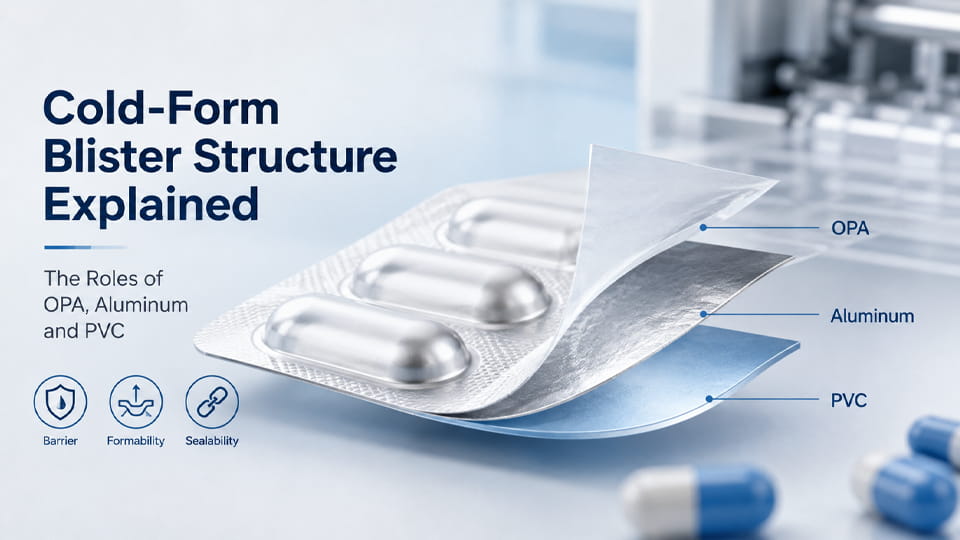
- 乳棒・乳棒 (コールドフォーム):Both the forming web and the lid are aluminum (often a multilayer foil laminator). The machine stamps this foil into blisters at room temperature (熱がない). The result is an opaque pack with a near-total barrier against moisture, 酸素と光. This is ideal for hygroscopic, light-sensitive or short-shelf-life drugs. The trade-off is cost and speed: cold-form foil and the forming process are more expensive and run slower. Tooling for Alu-Alu must be very precise, as aluminum doesn’t stretch like plastic.
A good laboratory blister machine should support both modes, or at least allow conversion between them. Many lab machines offer a dual mode: you swap out certain components or molds to switch from PVC thermoforming to Alu-Alu cold forming. When comparing models, check the supported materials. 例えば, Jinlu’s LDPP-140H explicitly handles both Alu-PVC および Alu-Alu プロセス. If your lab work includes product stability testing, the ability to run Alu-Alu can be important, because “the aluminum foil stops nearly all moisture, 酸素, 薬物に到達する光, which can greatly extend shelf life”.
When evaluating machine specs, note the maximum forming depth for each material, since foil typically limits you to shallower pockets. 例えば, the LDPP-140H can form up to 14 mm deep cavities in PVC, but only about 11 mm in Alu-Alu mode. If you have very thick tablets or devices, make sure the lab machine can create a cavity deep enough. Also consider that Alu-Alu tooling is heavier, so check that the machine’s drive system is robust enough for foil.
2. Product Compatibility: タブレット, Capsules and Medical Devices
次, 考慮する what products you’ll pack. A lab blister machine should accommodate your range of formats without needing a different machine for each type. 重要なポイント:
- サイズ範囲:Most lab units cover common tablet and capsule sizes. The LDPP-140H, 例えば, handles カプセルのサイズ 000 まで 5, and a variety of tablet shapes (ラウンド, 楕円形, even different thicknesses). Make sure the machine you choose can accept the largest and smallest products you plan to pack.
- Shapes and combination packs:If you have odd-shaped or highly variable tablets, see if special insert trays or cavities are needed. Some machines allow interchangeable cavity inserts for different shapes without swapping the entire mold base. Check with the manufacturer on whether custom tooling can be made. また, if you ever need to pack small medical devices (例えば. implants, 注射器), confirm suitability. The LDPP-140H advertises that its single-pass workflow “answers medical device packaging requests in the lab”.
- Product loading:For manual feed, the blister machine’s loading station should give operators easy access to insert tablets or capsules. If you need automation, some lab machines offer an option for a mini-robotic or mechanical feeder. Ask if the vendor can add a capsule or tablet orientation module. Just remember: any addition will raise complexity and cost. For a true “laboratory” machine, simple manual loading is often acceptable since batch sizes are small.
- Cohabitation of products:Will one shift run multiple products on the same machine? もしそうなら, look for features like memory for different pack profiles and the ability to store parameters for each product. ユーザーフレンドリーなコントロール (like a touchscreen with recipe storage) can speed switching.
3. Forming Depth and Blister Format Flexibility
A lot depends on mold design and forming capabilities. Think about:
- Forming depth:指摘したように, the maximum pocket depth matters if you pack thick tablets or a double-layer “sandwich” of two tablets per cavity. PVC thermoforming can go deeper (often 10–15 mm in a lab unit) than cold-form (commonly up to ~11 mm). If you have deep or tall products, ensure the lab machine’s forging plate or cold stamp can achieve that depth.
- Cavity geometry:Besides depth, the overall blister format (grid size, shape of cavities, pill count) should be considered. A lab machine often supports a standard mold section (like 110×120 mm as in the LDPP-140H), but within that, cavities can be arranged in various patterns (例えば。, 10×10 grid for small tablets or a few large pockets). Find out what standard layouts are available and whether custom mold plates can be made.
- Mold interchangeability:理想的には, each product gets its own mold cassette. We’ll cover changeovers in the next section, but it’s worth noting here that a good lab machine allows rapid swapping of completely different blister layouts. 例えば, one lab might have a 2×8 pack for one study and a 4×5 pack for another; each should just slide in.
If you have very unusual blister dimensions (例えば. wide single cavities), discuss this with the vendor early. Some small machines limit you to a maximum blister card width. 一般的に, it’s better to choose a machine with proven modular mold design (like slide-in plates or cassettes) – this ties into quick format flexibility. We discuss mold changes in factor 4.5 下に.
4. Sealing Temperature and Consistency
Even with good forming, の シールの品質 最も重要です. A lab blister machine should have a precise, controllable sealing system:
- Heating method:Most machines use a heated sealing plate or wheel. Check if it’s a 平板 (compresses the foil onto the thermoformed sheet) または roller system. A flat heated plate (as on the LDPP-140H’s “unique heat sealing station”) usually gives very uniform temperature distribution. Roller systems can allow continuous motion but may not be needed for small batches.
- 温度制御:You want adjustable temperature to match your materials. Good systems have PID temperature controllers and temperature feedback to maintain the set-point. This ensures each blister is sealed at the same temperature, which is critical for consistency.
- Pressure and dwell time:The force and time of sealing must also be consistent. The machine should let you set the pressure or force (sometimes by adjusting a spring or pneumatic cylinder) and a time for how long the plate presses. Reliable alignment of the sealing head is important to avoid incomplete seals or film wrinkles.
- 品質チェック:Some lab machines include a batch coder or date printer in the sealing station (Jinlu mentions “very clear” batch coding). If your process requires data codes, ensure this is integrated.
- 検証:理想的には, the machine can take records of every run, like a data log or history. This isn’t about performance per se, but it supports validation. 製薬向け, 探す 21 CFR Part 11-ready controls if needed.
要約すれば, your sealing station must deliver uniform heat and pressure, with easy parameter control and clear coding. A brief validated test run with your films (and a trained operator) is the best way to confirm a candidate machine meets your consistency needs.
5. Mold Design and Tooling Changeover
One of the biggest pain points in small-batch work is tooling changeovers. If your team will run many different blister formats, the machine’s mold design is critical:
- モジュラー, slide-in cassettes:The best lab machines use a “cassette” or “slot” system. This means each mold (forming plate, seal plate, cut plate) is a single piece that slides into the machine. Jinlu’s LDPP-140H uses this approach: the entire mold assembly slides in or out as one unit. This eliminates loose screws or fiddling with each plate.
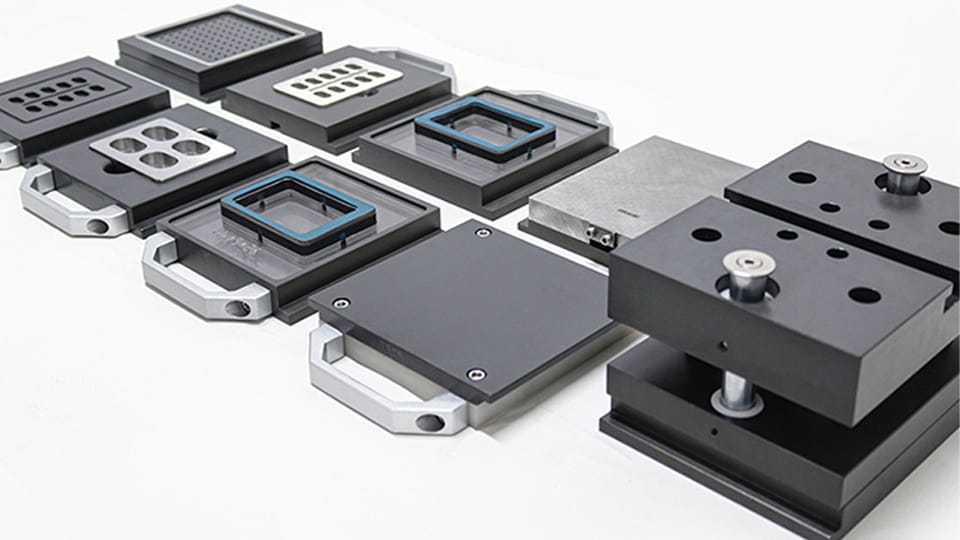
形: LDPP-140H’s modular slide-in blister molds allow quick mold changes (ジンルパッキング).
- Tool-free change:理想的には, you shouldn’t need wrenches for a mold swap. The LDPP-140H example notes “a standard changeover takes about two minutes” once the old mold is pulled out. これは mold change only (meaning replacing the tooling cassette). The overall product changeover (re-loading recipes, 等) might take longer, but quick mold swaps keep testing fast.
- Mold fabrication:Check who will make custom molds. A local supplier or the machine vendor? 金型 (even lab-sized) can be costly, so plan for it. Some companies standardize on quick-change small molds of given dimensions (例えば. 110×120 mm) to minimize tooling costs. Also note if the mold plate has alignment pins to ensure it’s always positioned exactly the same way – this helps with repeatability.
- Changeover features:Look for things like a cam-lock or lever that secures the mold cassette in place, so it can’t shift during forming/sealing. また, see if any fixtures (like ejector pins or core-release mechanisms) are adjustable or fixed. Some lab machines have manual jacking bolts for final leveling, while others auto-level.
覚えて: in a lab setting, every minute saved on changeovers is a minute more for R&D work. Assess vendors on their mold change procedure. もし可能なら, watch a demonstration or read a case study (Jinlu’s site has videos and images showing the LDPP-140H’s process). It can make a big difference in daily productivity.
[jl_youtube ソース=”https://www.youtube.com/embed/J4ayqFeaHzA”]
6. 機械の寸法, Weight and Installation
Practicalities matter. Where and how the machine will be installed is a key consideration:
- Footprint and bench space:Confirm the machine’s dimensions and ensure it fits where you intend. The LDPP-140H, 例えば, is 640×580×700 mm (length × width × height) and weighs 118 kg. It is designed to sit on a lab bench. その間 118 kg is not “tabletop light”, it’s still manageable for a sturdy bench. Make sure your bench can support the weight with a safety margin (例えば. 少なくとも 150 kg).
- Power and utilities:Check electrical requirements (often 380V three-phase, or convertible to 220/110V for some markets). The LDPP-140H uses a total power of only 2.6 kW, which is quite low. Air supply (もしあれば) and ventilation (for fumes from forming/sealing) should be considered. Some lab machines have built-in filtration or require external exhaust.
- Noise and safety:Smaller machines are typically quieter, but sealing heaters and motors will make some noise. Ensure ear protection if needed. 安全インターロック (例えば. lid locks, 緊急停止) are a must. Look for a fully enclosed forming and sealing station to protect operators from heat and moving parts.
- 人間工学:Since lab personnel (not heavy machine operators) will use it, the work height should be comfortable. Controls should be at a good angle and easy to read. The LDPP-140H’s “one-button” safety lock and anti-scalding handle is one design touch mentioned. Evaluate the controls: are they intuitive? Is training required?
- Mobility:While lab machines aren’t usually moved often, it can be useful if the unit has leveling feet or castors (locking wheels) for repositioning. しかし, castors on a 118 kg machine would require locking to prevent drift. If you plan to move it between labs, check if the vendor can arrange disassembly or pallet shipping.
一般的に, insist on the exact specs from the manufacturer. Don’t assume “bench-top” means “fits on any lab table”. Get the dimensions in advance. Also ask if the machine comes disassembled (例えば. motors off) or as a unit – this affects shipping.
7. Operation, Maintenance and Technical Support
ついに, 考慮する long-term usability:
- 使いやすさ:Lab users appreciate simple, clear controls. Look for machines with digital displays or touchscreens that guide you through parameter entry. Some have recipe memories or even barcode scanning to load settings automatically. If you are not a mechanical engineer, features like step-by-step on-screen guidance can be very helpful.
- Cleaning and maintenance:The machine should allow easy access for cleaning (especially in a regulated lab). Quick-release fasteners, removable trays for scrap, and simple guard removal can speed cleaning. Corrosion-resistant materials (stainless steel or coated) in contact with product materials are a plus.
- Spare parts and service:Check what parts wear out. Common wear parts on blister machines include sealing belts (使用されている場合), heater elements, cutting dies and blade, and possibly rollers or shafts. Ensure you can buy these locally or quickly from the vendor. Inquire about warranty terms, on-site training, and technical support response times. For a lab machine, good documentation (マニュアル, 配線図) is crucial for troubleshooting.
- Compliance and validation support:If you operate under GMP, ask what documentation is provided. Many suppliers give a qualification package (IQ/OQ) for equipment. While you’ll still need to do your own validation, having a vendor who understands pharma QA needs can ease implementation.
- Future needs:Think ahead. Could you want to add a printer module, a camera inspection or a labeling stage later? Some machines are designed to accept add-ons. Even if you don’t need them day one, check if upgrading is an option.
Each factor above is interrelated. 例えば, a compact machine (factor 4.6) might limit how many motors or servo axes it has, which affects how it seals (factor 4.4) or how fast you can run. There’s always a trade-off between simplicity and features. But by listing your must-haves (材料, 容量, 洗浄性, 等) and checking these key points, you’ll narrow the field to machines truly suited for small-scale pharmaceutical packaging.
LDPP-140H: A Laboratory Blister Packing Machine for Small-Batch Applications
To put this in context, let’s look at an example: の 彼らは LDPP-140H Laboratory Blister Packing Machine. This unit was specifically designed with the above criteria in mind. According to Jinlu’s specifications, the LDPP-140H has:
- 寸法:640 mm (l) × 580 mm (w) × 700 mm (H) – about 0.4 m³ total footprint.
- 重さ:~118 kg.
- Max forming depth:14 mm for PVC, 11 mm for Alu-Alu.
- Standard mold size:110 mm× 120 mm plate.
- 力:6 kW total (peak power draw).
- 材料:PVCに適しています, PS, PET forming films, and can run both Alu-PVC and Alu-Alu processes.
- 製品:Capable of 000–5 size capsules, plus various tablet shapes and small medical devices.
The LDPP-140H embodies many of our key factors:
- Compact Bench Design:It fits entirely on a lab bench (no foundation needed). Despite its desktop footprint, it integrates forming, sealing and cutting stations in one frame.
- Dual-Mode Operation:With a simple material change, it can switch between Alu-PVC and Alu-Alu packs. This means R&D teams can test either film on the same machine. 例えば, you could form a PVC pocket one day, ホイルでシールする, and the next day switch to stamping cold foil without changing the entire host machine.
- Broad Product Range:Its tooling accepts capsule sizes 000 に 5 and multiple tablet sizes/shapes. The single-pass workflow handles these products in Alu-PVC or Alu-Alu mode without extra conversions. This matches a lab’s need to pack “almost anything” in small batches.
- モジュラー金型:機械は、 pull-out slot design for molds. A whole mold can be replaced in about 2 分 (this is just the mold swap – it does ない include setting up parameters or re-qualifying, which of course takes longer). This quick-change mold system means your team can test different pack formats on one day, then completely different shapes the next, 最小限のダウンタイムで.
- User-Friendly Features:It includes safety touches like an anti-scalding handle and one-button lock for the mold slide. The heat-sealing station is designed for “very good sealing” and clear batch/date printing. 要するに, it’s meant to be easy to operate by lab personnel.
- Material and Build Quality:The frame is aluminum alloy and key components are stainless steel, aligning with pharma lab standards (though you would still do your own QA). Jinlu lists CE, RoHS, EMC and even “cGMP” logos on the spec page. (To be clear, these logos are company claims; users should verify compliance on their own as needed.)
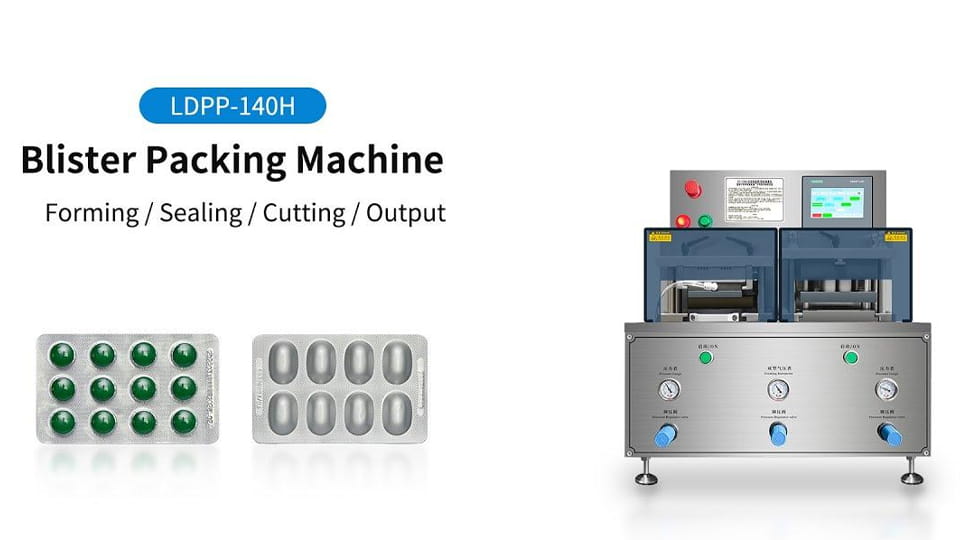
実際に, a machine like LDPP-140H would occupy minimal lab space but deliver much greater throughput and consistency than purely manual methods. While we don’t have exact output rates (it depends on the recipe and operator skill), compact lab machines are generally rated for small batches and intermittent runs, not continuous 24/7 手術.
Laboratory Blister Packaging vs. Manual Blister Sealing
A common question is: Can’t we just seal blisters by hand or with a simple bench-top sealer? The answer depends on your goals:
- 一貫性:As noted before, manual or semi-manual blister sealing is inconsistent. If someone hand-tucks pills in a PVC blister and uses an impulse sealer or oven, each pocket will vary slightly in temperature and pressure. This can invalidate stability data. A laboratory blister machine, 対照的に, holds set temperatures and pressures that repeat with every cavity.
- Volume and Labor:Hand-sealing or tabletop sealers might suffice for an very small number of samples (言う <50 packs for a prototype demo). But once you have more than that, an automated machine saves countless hours. 例えば, placing 100 tablets by hand and running an oven could take 30+ 分, whereas a machine might form, fill and seal 100 pockets in a fraction of that time (even if manually loading each cavity).
- Multi-Step Convenience:Some tabletop “blister sealers” only perform the heat-seal step – they require you to pre-fill the blisters manually from a pre-formed tray. 対照的に, a full lab blister machine (フォーム-充填-シール) handles everything. If your product handling is delicate or needs to be in an enclosed space (例えば. under a hood), the integrated cycle of a machine can reduce exposure and handling risk.
- Regulatory Records:Manual operations leave no electronic records of parameters. A machine can output a run report or be part of an MES, whereas hand methods do not. For regulated environments, that can be a deciding factor.
要するに, while nothing beats an operator’s flexibility, an automated lab blister machine vastly improves reliability and throughput for any significant batch. For small R&Dバッチ, it bridges the gap between doing zero automation and launching a full line.
How Much Does a Laboratory Blister Packing Machine Cost?
Quantifying cost is tricky without specific quotes, but here are the typical components of cost:
- Base Machine Price:The machine itself (like the LDPP-140H) is a capital expenditure. Prices vary widely by model and region. A basic tabletop sealer might be a few thousand USD, while a full lab-scale FFS blister machine could range from $20k to $50k or more, depending on features. (These are very rough ballparks; actual quotes are needed.)
- Tooling/Molds:Each blister format requires a set of molds (forming plate, seal plate, cutter). For small machines, molds might be smaller and cheaper than production molds, but still can cost from a few hundred to a few thousand dollars each, depending on complexity. Budget for at least one set per product. If you anticipate many SKUs, consider how many mold cassettes you need. Custom molds will add lead time and cost.
- Additional Options:Many lab blister machines offer add-ons that add to cost. 例えば:
- Feeder systems (for capsules or tablets) can be an extra.
- Integrated printers (for printing on lidding foil) might be optional.
- Scraps conveyor or collection tray systems.
- Environmental enclosures (if you need cleanroom compatibility). Each option might add 10–20% to the base machine price.
- Installation and Training:Often the manufacturer will include basic installation checks and operator training. Check if that’s included in the price or extra. A tech visit might be needed to calibrate or validate the machine.
- Maintenance and Spares:Factor in initial spare parts (sealing belt, fuse, cutter blades). Some vendors include a set of consumables with purchase. Also consider service contracts – some suppliers offer annual maintenance or extended warranty for an extra fee.
- 運営コスト:Don’t forget ongoing costs per pack. Blister film and foil typically dominate. 例えば, Alu-PVC foil blister laminate might cost on the order of $0.05–$0.10 per cavity in material (depending on film thickness), plus labor and overhead. Alu-Alu foil is higher, often 2–3× the cost of PVC. You’ll also use coding inks (必要に応じて) and energy (~2–3 kW during operation, very low when idle).
In discussing cost with vendors, treat their prices as a package: a slightly higher machine cost might come with free molds or testing, which could be a better deal. そして覚えておいてください, a lab machine is an investment in saving time and ensuring product quality. Many companies amortize small machines quickly because they replace manual processes and reduce failed experiments.
結論
正しい選択 laboratory blister packing machine means balancing your small-batch requirements against practical constraints. Remember the seven key factors: 材料の互換性 (Alu-PVC vs Alu-Alu), 製品範囲, 成形深さ, sealing consistency, mold design/changeover, machine footprint, and support. A machine like the Jinlu LDPP-140H is engineered to meet these needs, but you should verify details and test your own product samples.
By investing in a machine tailored to R&D and pilot-scale work, pharmaceutical and healthcare manufacturers can speed up development, ensure packaging quality and cut wasted time. If you have multiple drug formulations or frequent packaging trials, a compact lab blister machine will become an indispensable tool.
Ready to get started? Contact Jinlu Packing’s technical team to discuss your application and request a quote. We can help with product demos, sample runs, and custom mold design. Your next small-batch blister pack could be only a few clicks away.
FAQs on Laboratory Blister Packing Machine
What is the best blister packing machine for small batches?
There is no one-size-fits-all. The “best” machine depends on your specific needs (材料, バッチサイズ, 製品タイプ, lab space). 一般的に, look for a compact laboratory-scale FFS machine (not just a sealer) that matches your budget and has the features discussed above. Established brands (彼らは, Sepha, Mactec, Accupack, 等) make lab blister machines. Evaluate them by hands-on testing if possible. See the factors in this guide as your checklist.
Can a lab-scale blister machine handle Alu-Alu (コールドフォーム) パック?
はい, many lab machines support cold-form blistering, but check the specs. Cold-form requires a stronger forming system and a compatible die set. 例えば, the LDPP-140H can run Alu-Alu foils with a max cavity depth of ~11 mm. If you need high-barrier packs, confirm that the machine explicitly lists Alu-Alu compatibility. If it only lists PVC, it may not be rated for cold stamping.
What products can a laboratory blister machine package?
Typically tablets (all shapes) とカプセル (サイズ000~5) 標準です. Some machines also handle small medical devices like syringes, inhalers or strips. Check with the supplier: they often list compatible formats. For the LDPP-140H, Jinlu notes it can pack capsules (000–5), round/oval tablets, shaped tablets and “small medical devices”. 本質的には, if it fits in your chosen blister cavity and can lay flat, the machine can pack it.
How much bench space do I need for a lab blister machine?
A small lab blister machine needs roughly a 1 m² floor/bench footprint including operator space. As an example, the LDPP-140H is 640×580 mm in plan (について 0.37 ㎡). You’ll need extra space around it for access (clearance for safety guards, 製品の積み込み, unloading packs). Ensure you have room for film spools or rolls as well. Also plan for ventilation – blister forming can heat films, and if PVC is used, a fume hood might be required depending on your facility.
How long does it take to change molds on a lab machine?
It varies by design. With a modular slide-in mold, you might swap the entire mold cassette in 1–3 minutes as a quick changeover. 例えば, Jinlu advertises a ~2-minute mold replacement for their LDPP-140H. 覚えて, this is just the physical swap. その後, you’ll still need to load new parameters, test a few cycles, and calibrate if needed. But you should get a new blister format running in well under 30 minutes total on a well-designed lab machine.
Can I use a laboratory blister machine for commercial-scale production?
一般的にはありません, not at high output levels. Lab machines are not designed for continuous 24/7 production of large volumes. They excel at development and small-batch runs (tens to low hundreds per minute). If your need grows to thousands of packs per hour reliably, you’ll need a production-scale machine. しかし, some companies use lab machines for initial batches of a new product or for personalized medicine runs. Always consult capacity specs and consider regulatory validation: a lab machine may not have the same uptime or qualification documentation as a full production line.
参考文献:
1.TRS 1044 – 別館 6: WHO good practices for research and development facilities of pharmaceutical products —— 誰が
2.別館 13 to the Good manufacturing practices guide for drugs used in clinical trials (GUI-0036): Guidance —— カナダ保健省
3.固形医薬品のブリスター包装設計の最適化 —— サイエンスダイレクト
4.Questions and Answers: 優れた臨床実践 (GCP) —— 欧州医薬品庁