
Pembelian mesin farmasi bukan hanya tentang kecepatan, ketepatan, otomatisasi, dan ukuran mesin. Sebelum peralatan mencapai pabrik Anda, Anda juga perlu mengetahui apakah situs tersebut dapat mendukungnya.
Itu berarti memeriksa kebutuhan utilitas peralatan farmasi: daya listrik, udara terkompresi, kosong, air, pendinginan, knalpot, dan layanan khusus proses apa pun seperti uap atau nitrogen.
Suatu mesin dapat menjadi sempurna secara mekanis dan masih gagal mencapai kinerja terukurnya jika tegangannya salah, tekanan udara turun selama puncak produksi, kapasitas vakum terlalu kecil, atau air pendingin terlalu hangat. Untuk pengadaan, rekayasa, dan tim produksi, perencanaan utilitas harus dimulai sebelum pesanan pembelian—bukan selama pemasangan.
Poin Penting
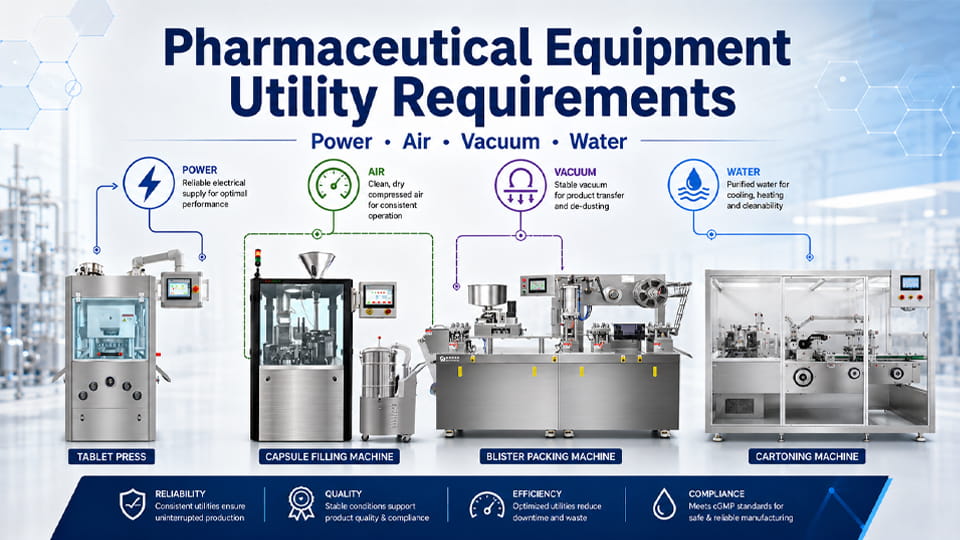
Persyaratan utilitas peralatan farmasi adalah layanan lokasi yang dibutuhkan mesin untuk beroperasi sesuai desain. Tenaga listrik hampir bersifat universal. Tergantung pada mesin dan prosesnya, Anda mungkin juga memerlukan udara bertekanan, kosong, air pendingin, air proses, knalpot, uap, nitrogen, drainase, atau kondisi lingkungan yang terkendali. Daftar pastinya bergantung pada peralatannya, proses, pilihan, dan tujuan penggunaan.
Tidak setiap utilitas secara otomatis a utilitas kritis dalam arti GMP. Pertanyaan kuncinya adalah apakah utilitas dapat mempengaruhi kualitas produk, kinerja proses, atau risiko kontaminasi.
FDA Q7 mengidentifikasi utilitas seperti uap, gas, udara terkompresi, pemanas, ventilasi, dan AC sebagai sistem yang harus memenuhi syarat dan dipantau secara tepat jika dapat mempengaruhi kualitas produk. Ini juga membahas ventilasi, penyaringan, knalpot, debu, kelembaban, suhu, kontrol tekanan, dan kesesuaian air.
Panduan WHO mengikuti prinsip penggunaan yang sama: utilitas seperti HVAC, air, nitrogen, dan udara bertekanan harus sesuai dengan peruntukannya dan tidak boleh berdampak negatif terhadap kualitas produk atau menjadi sumber kontaminasi.
Untuk pembeli, poin praktisnya sederhana: Persyaratan mesin dan kemampuan utilitas pabrik harus sesuai sebelum pemasangan.
Utilitas secara langsung mempengaruhi kinerja peralatan dan kualitas produk. Ketidaksesuaian utilitas sering terjadi karena pengadaan, produksi, rekayasa, dan tim validasi fokus pada bagian proyek yang berbeda. Itu Panduan GMP FDA (Q7A) secara eksplisit menyatakan hal itu “semua utilitas yang dapat mempengaruhi kualitas produk (MISALNYA., uap, gas, udara terkompresi, pemanas, ventilasi, dan AC) harus memenuhi syarat dan diawasi dengan tepat”. Dengan kata lain, jika pasokan udara atau air bertekanan Anda gagal, itu dapat menghentikan mesin atau bahkan mencemari produk. Misalnya, penyaringan udara bertekanan yang tidak memadai dapat memasukkan minyak atau mikroba ke dalam kapsul atau kemasan melepuh. Juga, tegangan yang terlalu rendah atau saluran udara tersumbat dapat menyebabkan kinerja motor dan katup buruk.
Konfirmasi utilitas sejak dini membantu mencegah tiga akibat yang merugikan:
Hal ini juga yang menyebabkan perencanaan utilitas dilakukan jauh lebih awal dalam siklus hidup peralatan dibandingkan perkiraan banyak pembeli. Selama instalasi (Sabtu/IQ), utilitas adalah fokus utama. Daftar periksa pemasangan peralatan Pengepakan Jinlu secara eksplisit memverifikasi “utilitas (tegangan listrik, tekanan pneumatik, air, dll.)” bertentangan dengan spesifikasi mesin. Dalam Pengujian Penerimaan Situs (DUDUK), para insinyur akan melakukannya mengukur tegangan sebenarnya, tekanan/aliran udara, suhu air, dll.. dari pasokan fasilitas untuk memastikannya tetap dalam kisaran yang ditentukan oleh mesin. Pendeknya, mencocokkan utilitas dengan spesifikasi peralatan sangat penting untuk menghindari kejutan: mesin tidak dapat berjalan dengan kecepatan penuh atau mungkin rusak jika, mengatakan, udara tanaman saja 3 bilah alih-alih yang diperlukan 6 batang, atau jika motor berada pada voltase yang salah.
Mulailah dengan kebutuhan daya peralatan farmasi dinyatakan pada lembar data akhir—bukan spesifikasi yang disalin dari model lain.
Konfirmasikan tegangan, lajang- atau pasokan tiga fase, frekuensi, daya terpasang/terukur, permintaan maksimal, koneksi utama, dan pasokan terpisah untuk pembantu. Peralatan ekspor seringkali dapat dikonfigurasi untuk pasar yang berbeda. Misalnya, Daftar pengisi kapsul NJP-2600D JinLu 220/380 V, 50/60 Hz daya yang dapat disesuaikan dan 8.0 kW daya total; daftar mesin melepuh DPP-260R-nya 380/220/110 V, 50/60 Hz dan 5.5 kW. Contoh-contoh ini menunjukkan mengapa pembeli tidak boleh berasumsi pada satu “voltase farmasi standar”.
Juga terpisah daya terpasang dari konsumsi pengoperasian normal. Daya terpasang atau terukur berguna untuk perencanaan infrastruktur kelistrikan, tetapi permintaan aktual berubah seiring dengan perubahan pemanas, motor, pompa vakum, konveyor, dan siklus modul opsional. Tanyakan pemasok peralatan farmasi untuk permintaan maksimum/puncak dan beban pengoperasian yang diharapkan jika tersedia. Kabel terakhir, pemecah, perlindungan, landasan, dan desain isolasi harus mengikuti peraturan kelistrikan negara tujuan dan desain kelistrikan proyek yang memenuhi syarat.
Poin Penting:
Silinder pneumatik, katup, gripper, menolak perangkat, fungsi pembersihan, dan mekanisme penanganan produk mungkin bergantung pada udara bertekanan.
Berapa banyak udara bertekanan yang dibutuhkan peralatan farmasi?
Tidak ada kebutuhan udara mesin farmasi yang universal. Tentukan tekanan pengoperasian—biasanya dinyatakan dalam bar atau MPa—dan konsumsi dalam NL/mnt, L/mnt, Nm³/jam, atau kondisi referensi lain yang didefinisikan dengan jelas. Dua mesin mungkin memerlukan tekanan yang sama tetapi aliran yang sangat berbeda, jadi ukuran kompresor berdasarkan tekanan saja tidak dapat diandalkan.
Udara kualitas penting secara terpisah dari tekanan dan kuantitas. ISO 8573-1:2010 mengklasifikasikan kemurnian udara terkompresi berdasarkan partikel, air, dan minyak; pada bulan Agustus 2026, edisi tersebut tetap diterbitkan sementara revisi sedang dikembangkan. ISO melakukannya bukan meresepkan satu kelas kemurnian universal untuk setiap aplikasi farmasi, jadi kelas yang diperlukan harus didasarkan pada tujuan penggunaan dan risiko kontaminasi.
Tentukan filtrasi, partikel yang diijinkan, minyak keseluruhan, kelembaban, Dan titik embun tekanan (PDIP) jika relevan. PDP menggambarkan suhu di mana uap air akan mengembun pada tekanan sistem; PDP yang lebih rendah berarti udara bertekanan lebih kering. Untuk udara yang dapat mempengaruhi produk terbuka atau permukaan kritis, menetapkan persyaratan kualitas dan verifikasi tempat penggunaan. Panduan inspeksi FDA secara khusus membahas peninjauan sistem udara bertekanan dan filtrasi partikulat di tempat penggunaan dalam operasi farmasi yang relevan.
Seharusnya begitu bebas minyak? Kadang-kadang, namun “kompresor bebas oli” tidak seharusnya menggantikan spesifikasi kualitas udara yang dapat diukur. Tentukan oli yang dapat diterima pada saat digunakan, mengevaluasi risiko kontak produk, dan gunakan pengeringan yang sesuai, penyaringan, pemantauan, dan kualifikasi. Sasarannya adalah pengiriman udara yang terkontrol—bukan sekadar label kompresor.
Poin Penting:
A sistem vakum farmasi mungkin mendukung pemisahan kapsul, dosis bubuk dengan bantuan vakum, penanganan lepuh atau material, pengambilan hisap, perpindahan produk, atau penghilangan debu. milik JinLu Mesin pengisian kapsul NJP-2600D, Misalnya, menggunakan pompa vakum untuk pemisahan tutup kapsul/badan.
Selalu minta dua parameter:
Tingkat vakum memberitahu Anda seberapa rendah tekanannya, atau berapa tekanan diferensial, proses tersebut memerlukannya. Aliran vakum/kecepatan pemompaan memberi tahu Anda berapa banyak gas yang dapat dikeluarkan sistem seiring waktu. Oleh karena itu, produsen pompa menerbitkannya secara terpisah; Mereka, Misalnya, menentukan kecepatan pemompaan dalam m³/jam dan tekanan yang dapat dicapai untuk peralatan vakumnya.
Pompa internal sederhana dan membuat satu mesin tetap independen. Sistem terpusat dapat mengurangi jumlah pompa dan memusatkan pemeliharaan, tapi kehilangan pipa, permintaan simultan, pemisahan kontaminasi, dan konsekuensi kegagalan harus dinilai. Tanyakan kepada pemasok mesin mengenai kevakuman yang diperlukan pada sambungan mesin—bukan hanya peringkat papan nama pompa.
Poin Penting:
Air apa yang dibutuhkan peralatan farmasi?
Kualitas air tergantung pada fungsi air tersebut. Air pendingin loop tertutup, air minum, Air Murni, dan WFI bukanlah spesifikasi yang dapat dipertukarkan. Tentukan apakah air bersentuhan dengan produk atau permukaan yang bersentuhan dengan produk, mendukung pembersihan atau pemrosesan, atau hanya menghilangkan panas; kemudian tetapkan kualitas yang sesuai, suhu, tekanan, mengalir, dan persyaratan pemantauan.
WHO menyatakan bahwa kadar air farmasi yang sesuai harus dipilih berdasarkan aplikasi yang dimaksudkan, produk, dan tahap manufaktur; WFI dikaitkan dengan penggunaan spesifik yang berisiko lebih tinggi dibandingkan setiap mesin farmasi. FDA Q7 juga mensyaratkan air proses agar sesuai dengan tujuan penggunaannya.
Ini sangat penting untuk kebutuhan air peralatan farmasi. Air pendingin mesin dapat bersirkulasi melalui penukar panas atau pelat pendingin dan tidak pernah menyentuh produk. Namun FDA Q7 mengharuskan cairan pemanas dan cairan pendingin dikontrol agar tidak bersentuhan atau mempengaruhi produk secara merugikan.
Pendingin/pendingin, uap, dan knalpot
A pengepakan melepuh, sistem pelapisan, atau peralatan penghasil panas lainnya mungkin memerlukan air pendingin atau pendingin eksternal tergantung pada desain. Sebelum memilih pendingin, mendapatkan suhu masuk yang diperlukan, mengalir, tekanan, beban penolakan panas, kompatibilitas air/glikol, dan ukuran koneksi. Jangan mengukurnya hanya dari kW listrik mesin.
Uap adalah bukan utilitas standar untuk setiap mesin pengemasan. Ini menjadi relevan khususnya dalam pemanasan, pembersihan, sterilisasi, lapisan, atau sistem proses. Bila uap dapat mempengaruhi kualitas produk, FDA dan ISPE memperlakukannya sebagai utilitas yang memerlukan pengendalian yang tepat.
Akhirnya, jangan lupa ekstraksi debu dan knalpot. Kompresi tablet, pengisian kapsul, granulasi, dan penanganan serbuk dapat menghasilkan muatan debu yang memerlukan ekstraksi atau penahanan lokal. FDA Q7 memerlukan ventilasi yang memadai, penyaringan, dan buang jika diperlukan, termasuk pengendalian debu dan risiko kontaminasi silang.
Poin Penting:
Di luar empat utilitas utama, pertimbangkan layanan umum ini:
Matriks berikut adalah alat perencanaan, bukan spesifikasi mesin. “Umum” artinya sering dijumpai; “Bergantung pada model” berarti konfigurasi akhir, produk, atau proses memutuskan.
| Peralatan | Kekuatan | Udara Terkompresi | Kekosongan | Air / Pendingin | Knalpot / Debu |
| Tekan tablet | Diperlukan | Umum | Tergantung pada model | Biasanya terbatas | Umum |
| Mesin pengisian kapsul | Diperlukan | Umum | Umum | Biasanya terbatas | Umum |
| Mesin pengepakan melepuh | Diperlukan | Umum | Tergantung pada model | Tergantung pada model | Tergantung pada model |
| Penghitung tablet/kapsul | Diperlukan | Tergantung pada model | Biasanya terbatas | Biasanya tidak | Tergantung pada model |
| Mesin karton | Diperlukan | Umum | Tergantung pada model | Biasanya tidak | Biasanya terbatas |
| Mesin pelapis | Diperlukan | Umum | Tergantung pada model | Umum/tergantung proses | Umum |
| granulator / sistem fluid-bed | Diperlukan | Umum | Bergantung pada proses | Bergantung pada proses | Umum |
Data produsen mendukung variasi tersebut, bukan hanya satu angka industri: JinLu mencantumkan pasokan listrik yang dapat disesuaikan di seluruh bagiannya Mesin pengisian kapsul Dan mesin pengepakan melepuh, dan menerbitkan udara bertekanan 6 bar untuk satu mesin press tablet dan nilai aliran spesifik untuk pengisi kapsul.
Menghadapi pemasok yang berguna contoh spesifikasi utilitas mungkin terlihat seperti ini:
| Kegunaan | Persyaratan Ilustratif | Apa yang Harus Diverifikasi Pembeli |
| Kekuatan | 380 V, 50 Hz, 3-fase | Pasokan lokal, toleransi, perlindungan |
| Daya terpasang | 8 kW | Permintaan puncak dan tambahan |
| Udara terkompresi | 6 bar di saluran masuk mesin | Tekanan selama produksi puncak |
| Konsumsi Udara | 200 tidak/menit | Aliran normal vs maksimum |
| Kualitas udara | ISO 8573-1 kelas: TBD oleh URS | Partikel, air/PDP, minyak |
| Kekosongan | −60 kPa(G), 80 m³/jam | Tingkat yang diperlukan Dan mengalir |
| Air pendingin | 15–20°C, 5 L/mnt | Beban panas, tekanan, suhu kembali |
| Knalpot | 500 m³/jam | Tekanan statis dan filtrasi |
| Koneksi | Pemasok untuk didefinisikan | Ukuran, samping, ketinggian, tepat |
Ini adalah nilai-nilai ilustratif yang sengaja dibuat, bukan spesifikasi untuk JinLu atau model pihak ketiga mana pun. Angka akhir harus berasal dari lembar utilitas yang disetujui dari mesin yang dipilih. Lembar pabrikan sebenarnya menunjukkan seberapa besar variasi nilai.
Untuk baris baru, jangan menambahkan setiap nilai papan nama secara membabi buta dan jangan mengukur hanya untuk satu mesin.
Untuk setiap utilitas, membuat jadwal pemuatan:
Permintaan desain ≈ Σ (permintaan peralatan × faktor penggunaan simultan yang diharapkan) + cadangan yang dibenarkan
Gunakan konsumsi operasional maksimum pemasok dimana mesin dapat berjalan terus menerus pada beban tersebut. Identifikasi pengguna intermiten secara terpisah. Kemudian uji skenario produksi terburuk yang kredibel—misalnya, mesin melepuh, pembuat karton, menangkal, dan perangkat penyortir pneumatik semuanya beroperasi saat saluran lain dimulai.
Sebelum instalasi, verifikasi semua utilitas di lokasi sesuai dengan spesifikasi peralatan. Daftar periksa mungkin mencakup:
Contoh: Sebelum pengiriman, pemasok dapat memberikan Lembar Spesifikasi Peralatan yang mencantumkan “Udara: 6.0 batang, 200 tidak/menit; Kekosongan: –60 kPa; Kekuatan: 380VAC 3 fase, 10 kW.” Gunakan ini untuk mengatur sirkuit dan perpipaan. Selama instalasi IQ, ukur setiap pasokan untuk memastikannya memenuhi spesifikasi tersebut.
URS yang menyeluruh harus mencantumkan secara eksplisit semua utilitas dan kondisi yang diperlukan. Di bagian “Utilitas dan Lingkungan”., tentukan nilai pastinya (misalnya. “Udara terkompresi: 6.0 batang ±0,2, 100 tidak/menit, Kelas ISO 8573‑1 1.0. Listrik: 400 V, 3-F, 50 Hz, 15 kW.”). Panduan peraturan (Lampiran GMP UE 15) memerlukan verifikasi persyaratan URS selama Kualifikasi Desain. Dalam praktiknya, memasukkan spesifikasi utilitas yang jelas dalam URS/gambar kontrak memaksa pembeli dan vendor untuk menyepakati kebutuhan terlebih dahulu. Itu juga berhasil IR/WH/PQ pengujiannya mudah – setiap sambungan utilitas dapat ditelusuri kembali ke item URS.
Selalu konfirmasikan daftar utilitas dengan vendor Anda sebelum memesan. Pemasok harus menyediakan a Lembar Persyaratan Utilitas atau pelat data untuk setiap mesin. Tinjau ini dalam pertemuan awal atau tambahkan ke pesanan pembelian. Misalnya, meminta pemasok untuk memasukkan spesifikasi utilitas dalam Data Vendor (sebagai bagian dari FAT). Selama SAT, verifikasi secara fisik setiap sambungan: mengukur tegangan situs, tekanan, dan mengalir bertentangan dengan spesifikasi pemasok. Simpan tanda tangan yang terdokumentasi (sering kali sebagai bagian dari laporan IQ) bahwa “utilitas terhubung dan sesuai spesifikasi” – ini adalah ekspektasi GMP (IQ biasanya mencakup pemeriksaan kekuasaan, pneumatik, sambungan air).
Jika ada yang tidak cocok (misalnya. situs ini hanya memiliki 200 V tapi kebutuhan mesin 400 V), segera atasi – sediakan trafo atau minta pemasok mengkonfigurasi ulang mesin. Ingat, masalah ketidakcocokan utilitas lebih mudah diperbaiki sebelum produksi dimulai daripada setelahnya.
Dalam ringkasan, perencanaan utilitas yang cermat sama pentingnya dengan memilih mesin yang tepat. Jalur peralatan hanya dapat berjalan pada kecepatan dan kualitas yang diinginkan jika kekuatan, udara, kosong, dan air tersedia dengan spesifikasi yang benar. Gunakan tabel panduan ini, daftar periksa dan formula untuk memperkirakan kebutuhan Anda dan memasukkannya ke dalam URS. Bekerja dengan Anda penjual peralatan (seperti Pengepakan Jinlu) untuk mendokumentasikan setiap kebutuhan utilitas dan memverifikasinya di lokasi.
Siap menyederhanakan perencanaan utilitas? Pakar Jinlu Packing dapat memberikan saran mengenai sambungan listrik dan utilitas untuk semua barang kami mesin pengemas farmasi. Kunjungi halaman produk Jinlu – misalnya Mesin Pengisian Kapsul, Mesin Press Tablet, Mesin Pengepakan Blister, Mesin penghitungan, Mesin Karton, Mesin pengemasan sachet atau Mesin pengepakan kantong premade – untuk spesifikasi utilitas dan informasi kontak. Untuk bantuan lebih lanjut, menghubungi dengan tim kami untuk memastikan fasilitas Anda siap digunakan untuk kelancaran pemasangan dan pengoperasian yang sesuai.
Dasarnya adalah tenaga listrik, udara terkompresi, kosong, dan air/pendingin. Banyak lini pengemasan juga menggunakan uap bersih (untuk alat sterilisasi), gas inert (N₂ untuk paket bantal), dan ekstraksi debu. Panduan peraturan (misalnya. FDA Q7A) secara eksplisit memanggil uap, gas (udara/nitrogen), AC, dll.. sebagai utilitas yang harus memenuhi syarat.
Sebagian besar peralatan adalah tenaga industri 3 fase. Umumnya 380–400 VAC (50 Hz) atau 480 VAC (60 Hz) dengan netral atau ground. Beberapa unit yang lebih kecil dapat beroperasi pada fase tunggal 220–240 VAC. Penting untuk memastikan voltase dan fasa yang tepat (Mesin Jinlu sering mendukung 380/220/110 VAC 50/60 Hz). Periksa juga apakah mesinnya 50 Hz vs 60 Hz atau jika dapat menerima keduanya (sebanyak yang bisa).
Tergantung mesin dan jumlah unitnya. Satu mesin melepuh atau karton mungkin memerlukan kecepatan 50–200 NL/menit (pada ~5–6 bar). Pengisi kapsul atau mesin penghitung mungkin menggunakan 30–100 NL/menit. Tekanannya biasanya ~5–6 bar (0.5–0,6 MPa). Periksa spesifikasi setiap mesin untuk mengetahui alirannya (sering diberikan dalam NL/mnt atau SCFM) dan tekanan. Jumlahkan semuanya untuk baris Anda (ingat faktor keberagaman). Selalu sediakan sedikit volume tambahan pada sistem kompresor pabrik untuk memenuhi permintaan puncak.
Standar farmasi mensyaratkan bebas minyak, udara kering. Biasanya ISO 8573-1 Kelas 2 (atau lebih baik) direkomendasikan untuk udara di area farmasi. Artinya pada dasarnya 0 minyak (Kelas 0 sertifikasi), titik embun air ≤–40 °C, dan filter partikel yang ketat (misalnya. 0.01 mikron). Tentukan ini di URS Anda. Misalnya: “Udara terkompresi: 6.0 batang, 99.995% bebas minyak, titik embun –40 °C, 0.01 filter µm pada titik penggunaan” adalah persyaratan yang jelas.
Umumnya tidak, kecuali itu adalah proses yang disterilkan. Untuk membilas atau mendinginkan, air minum biasa dapat diterima. Panduan FDA mengatakan minimal air proses harus memenuhi standar WHO untuk diminum (air minum) standar. Gunakan PW atau WFI berkualitas lebih tinggi hanya jika peralatan tersebut terlibat langsung dengan produk injeksi atau jika uap bersih dihasilkan darinya. Selalu klarifikasi di URS: "Persediaan air: dapat diminum (Disetujui NSF) untuk pendinginan; tidak ada kontak air dengan produk.”
Dedikasikan satu bagian untuk “Utilitas dan Lingkungan” dan cantumkan angka pastinya. Misalnya: “Listrik: 400 VAC, 3F, 50 Hz, 15 kW. Udara: 6.0 batang ±0,2, 100 tidak/menit. Kekosongan: –70 kPa (abs). Air: 30 psi, 20 L/mnt.” Panduan Jinlu URS menekankan pada utilitas (voltase, tekanan/aliran udara, air pendingin, kosong, dll.) harus ditentukan. Cantumkan persyaratan ini dalam pesanan pembelian sehingga pemasok dapat menjaminnya di FAT/SAT.
Pada akhirnya pembeli/fasilitas harus memastikan utilitas lokasi memenuhi spesifikasi, namun pemasok harus mendokumentasikan apa yang dibutuhkan. Selama FAT, vendor dapat mensimulasikan utilitas; tapi SAT/IQ adalah tempat Anda (pengguna) konfirmasi dengan persediaan nyata. GMP memerlukan tes IQ yang terdokumentasi untuk utilitas. Dalam praktiknya, tim pemeliharaan/rekayasa mempersiapkan lokasi, dan QA atau teknisi akan memverifikasi utilitas pada hari pemasangan.
Setiap ketidaksesuaian adalah “ketidaksesuaian.” Misalnya, jika kekuatan situs salah, Anda memerlukan tukang listrik untuk memodifikasi panel (atau pemasok untuk mengganti trafo). Jika tekanan udara rendah, Anda mungkin memerlukan booster atau regulator. Jangan menghidupkan mesin dalam kondisi seperti ini – mesin mungkin tidak dapat bekerja atau dapat merusak peralatan. Perbaiki masalahnya atau minta pemasok menyesuaikan desainnya. Idealnya, masalah seperti itu ditangkap di SAT dan diselesaikan sebelum dioperasikan.
Ya. Gunakan minyak food grade dalam sistem vakum atau pneumatik; memastikan semua pelumas kompatibel dengan penggunaan farmasi. Labeli jalur utilitas dengan jelas (pelabelan pipa membantu menghindari kesalahan). Sediakan pemberhentian darurat dan pastikan penghentian utilitas dapat diakses di ruang bersih. Hindari deadleg pada pipa (tidak ada zona stagnan). Dan ingat, pemeriksaan kualitas utilitas adalah bagian dari GMP – misalnya. Inspektur FDA akan melihat sertifikat udara terkompresi dan tes air Anda.
Referensi:
1.Panduan Praktek yang Baik: Kepatuhan GMP Utilitas Kritis —— ispe
2.Utilitas Kritis —— ispe
3.Q7A Panduan Cara Pembuatan yang Baik untuk Bahan Aktif Farmasi —— KITA. Badan Pengawas Obat dan Makanan
4.Ruang bersih dan lingkungan terkendali terkait —— ISO 14644-1:2015