

Membeli a mesin pengemas obat adalah keputusan besar bagi perusahaan farmasi mana pun, jadi mengajukan pertanyaan yang tepat terlebih dahulu dapat menghemat waktu, uang, dan sakit kepala di kemudian hari. Modern lini pengemasan farmasi rumit (sering kali berintegrasi pengisi kapsul, mesin melepuh, sistem penghitungan, kartoner, dan lebih banyak lagi), dan mereka harus memenuhi standar GMP dan peraturan yang ketat. nyatanya, penelitian menunjukkan hampir setengah dari semuanya penarikan kembali obat melibatkan kesalahan pengemasan atau pelabelan. Dalam panduan ini, kami telah mengumpulkan pertanyaan dan pertimbangan paling penting bagi pembeli farmasi. Anda akan mempelajari cara mengevaluasi kepatuhan (GMP/FDA/WHO), format (tablet, cairan, lepuh, dll.), kecepatan dan tingkat otomatisasi, kebutuhan pembersihan dan validasi, serialisasi/kemampuan penelusuran, Tco (total biaya kepemilikan), dan dukungan pemasok. Kami juga menyertakan berguna Daftar Periksa Pembeli dan menyoroti kesalahan pengadaan yang umum. Baik Anda menjalankan perusahaan pengemas kontrak kecil atau pabrik besar, ini akan membantu Anda membandingkan mesin secara sistematis dan menghindari kesalahan yang merugikan.
Mengapa itu penting: Di bidang farmasi, kepatuhan tidak dapat dinegosiasikan. Peralatan harus memenuhi FDA, UE, dan standar cGMP WHO sebelum menjalankan produk. Bagian kontak mesin harus berkelas farmasi (khas baja tahan karat 316L atau 304) dengan halus, permukaan yang dilas – tidak berkarat, lubang, atau celah tempat bedak bisa bersembunyi. Desainnya harus higienis (misalnya. modul kantilever, permukaan miring) sehingga mudah dibersihkan dan diperiksa. Tanyakan pemasok peralatan pengemasan farmasi untuk dokumentasi: Anda harus menerima protokol untuk IQ (Kualifikasi Instalasi), oke (Kualifikasi Operasional), Dan PQ (Kualifikasi Kinerja). Ini memvalidasi bahwa mesin telah diinstal dengan benar, berjalan di semua pengaturan yang diinginkan, dan bekerja secara konsisten di bawah beban produksi nyata. Tanpa catatan IQ/OQ/PQ, peralatan tersebut tidak “memenuhi syarat”. penggunaan GMP. Konfirmasikan juga sistem mutu dan sertifikasi pemasok: apakah mereka mengikuti ISO 9001? Bisakah mereka memberikan sertifikat materi (misalnya. Segel silikon yang sesuai dengan FDA) dan tanda CE/UL jika diperlukan? Akhirnya, memastikan desain mendukung integritas data (misalnya. 21 Bagian CFR 11 untuk log elektronik) dan sterilisasi jika diperlukan.
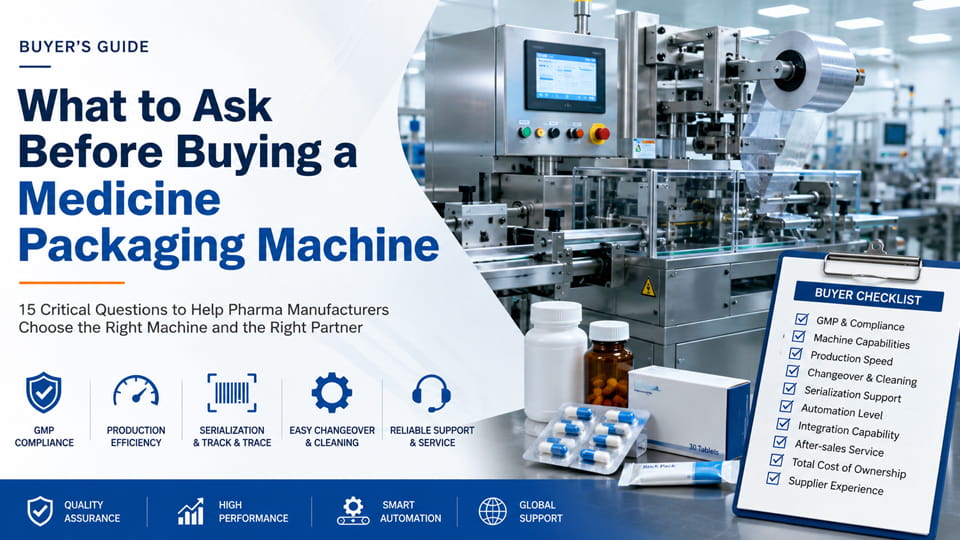
Gambar: Lini produksi pengemasan obat modern, menggambarkan perlunya mesin terintegrasi dan desain yang sesuai dengan GMP.
Tidak semua mesin menangani semua produk. Anda harus sangat jelas tentang jenis produk Anda. Misalnya, tablet dan kapsul sering menggunakan jalur penghitungan/pengisian botol atau pengepakan melepuh, sedangkan obat cair membutuhkan mesin pengisian dan penyegel cairan khusus. Bubuk/butiran bisa dimasukkan ke dalam sachet atau kemasan stick. Di bawah ini adalah panduan sederhana – kebutuhan Anda mungkin menggabungkan beberapa mesin dalam satu baris:
| Bentuk Dosis & Format | Tipe Mesin Khas |
| Tablet padat (longgar, dalam botol) | Penghitungan Otomatis & Garis Pengisian Botol |
| Tablet padat (strip atau lecet) | Mesin pengemasan blister (PVC/Alu-PVC) |
| Kapsul (gel keras) | Mesin Pengisian Kapsul + (garis lepuh atau botol) |
| Cairan/Sirup (vial atau botol) | Mesin Pengisian dan Pembatasan Cairan |
| Bubuk/Butiran (tongkat atau sachet) | Mesin Sachet atau Stick-Pack |
| Gel lembut/permen karet | Mesin penghitungan + Melepuh atau Pembotolan |
| Karton (sekunder) | Mesin Karton untuk tinju terakhir |
Mesin pengemas obat sering dijual sebagai jalur terpadu. Misalnya, lini kapsul mungkin memberi makan produk dari a batang menjadi a mesin hitung, kemudian melalui a pengepakan melepuh atau pembuat karton.
Tanyakan kepada pemasok mesin pengemas obat Anda: “Dapatkah lini tersebut menjalankan produk saya?” Untuk setiap format, memverifikasi kompatibilitas material – mis. mesin melepuh akan menjalankan foil dan film Anda (PVC, PELIHARAAN, ALU-ALU) pada suhu yang tepat. Garis botol harus disesuaikan dengan tinggi botol dan jenis tutup yang berbeda. Jika Anda merencanakan banyak produk (misalnya. kapsul dan tablet), Anda memerlukan suku cadang pengganti atau bahkan mesin yang berbeda. Beberapa mesin multi-format, tetapi selalu konfirmasikan pergantian apa yang diperlukan (lihat bagian selanjutnya).
Kecepatan terukur mesin harus sesuai dengan target keluaran Anda. Cari tahu berapa banyak unit per menit/jam yang dapat dikemas oleh mesin andal. Pastikan untuk mempertimbangkan bersih keluaran (setelah ditolak) dan tidak hanya maksimal. Pikirkan tentang kebutuhan saat ini Dan pertumbuhan di masa depan. Misalnya, garis lepuh tablet ukuran sedang mungkin dinilai 40,000 Lepuh per jam; jalur otomatis penuh yang besar bisa melebihi 100,000 per jam. Namun, mesin berkecepatan sangat tinggi yang sering mogok bisa lebih buruk daripada mesin yang sedikit lebih lambat, yang stabil.
Perkirakan volume harian atau tahunan Anda dan pilih mesin yang dapat menangani volume puncak. Ingatlah tren industri: banyak perusahaan farmasi sekarang menjalankan batch yang lebih kecil dengan pergantian yang sering, jadi kecepatan SKU tunggal yang sangat tinggi tidak terlalu penting dibandingkan fleksibilitas. Jika Anda menjalankan banyak shift, berinvestasi pada hasil yang lebih tinggi dapat menghasilkan keuntungan lebih cepat melalui penghematan tenaga kerja. Tetapi jika batchnya kecil atau custom, sebuah mesin yang memungkinkan peralihan resep dengan cepat dan pergantian tanpa alat (lihat bagian 4) akan lebih berharga daripada kecepatan mentah.
Putuskan berapa banyak otomatisasi yang benar-benar Anda perlukan. Mesin semi-otomatis mengharuskan operator untuk memuat kontainer, memulai siklus, atau melakukan tugas manual (misalnya. menjatuhkan tablet ke dalam lepuh). Jalur pengemasan farmasi sepenuhnya otomatis melakukan segalanya mulai dari memberi makan hingga menyegel dengan sedikit campur tangan manusia. Mesin semi-otomatis lebih murah di muka dan cocok untuk pekerjaan bervolume rendah atau batch. Jalur yang sepenuhnya otomatis lebih mahal namun menghemat tenaga kerja dan mengurangi kesalahan manusia.
| Fitur | Setengah otomatis | Sepenuhnya otomatis |
| Keterlibatan Operator | Ya – memuat/membongkar, dll.. | Minimal – satu orang mengawasi seluruh lini |
| Kecepatan Produksi | Sedang | Tinggi |
| Pergantian | Lebih lambat (penyesuaian manual) | Lebih cepat (seringkali tanpa alat, didorong oleh resep) |
| Investasi Awal | Lebih rendah | Lebih tinggi |
| Kompleksitas Validasi | Serupa (IQ/OQ/PQ masih dibutuhkan) | Serupa |
| Ideal untuk | Lari kecil, pilot laboratorium | Lari besar, 24/7 produksi |
Sistem farmasi yang sepenuhnya otomatis sering kali menyertakan feed hopper, pelabel otomatis, topi, dan konveyor semuanya tersinkronisasi. Mereka juga mengintegrasikan pemeriksaan kesalahan (timbangan, sistem penglihatan) dalam waktu nyata. Peralatan semi-otomatis mungkin cocok untuk perusahaan manufaktur kontrak yang baru memulai, namun rencana pertumbuhan sering kali mengarahkan pembeli untuk memilih otomatisasi penuh.
Lini farmasi mengganti produk lebih sering dari yang Anda kira, dan setiap perubahan membutuhkan pembersihan menyeluruh (dan sering kali validasi ulang). Desain mesin yang baik akan mempercepat hal ini. Mencari bebas alat bagian yang dapat dilepas, komponen ringan (satu orang bisa mengatasinya), dan buka frame yang memungkinkan QA melihat jika masih ada sisa. Tidak boleh ada rongga tersembunyi di mana pil atau bedak dapat menumpuk. Vendor harus memberikan SOP pembersihan yang jelas, pembongkaran dan perakitan kembali. Validasi prosedur pergantian: produk kaleng resep disimpan sehingga Anda mengingat semua pengaturan untuk SKU tertentu?
Dalam praktiknya, mesin yang dapat dibersihkan dan divalidasi dengan cepat secara langsung meningkatkan produktivitas. Jika Anda memiliki obat yang memerlukan peralihan antara, mengatakan, zat yang dikendalikan dan produk vitamin, Anda akan menjalani pembersihan dan seringkali tes validasi yang bersih (pengujian produk dalam kasus terburuk) setiap saat. Tanyakan tentang bersih di tempatnya (CIP) pilihan atau fitur higienis lainnya.
Peraturan masa kini (KITA. DSCSA, FMD UE, dll.) memerlukan membuat serialisasi setiap unit yang dapat dijual kedokteran. Sebelum membeli, konfirmasikan saluran dapat mengintegrasikan printer pengkodean (inkjet/laser) dan pemindai penglihatan untuk menerapkan dan memverifikasi kode batang 2D atau kode QR pada paket. Sistem kontrol harus menangkap setiap nomor seri dan menghubungkannya ke data batch. Dalam praktiknya, pembeli sering bertanya: “Dapatkah mesin ini menolak item yang tidak berlabel atau berkode tidak valid?” Dan “Apakah ada ruang dan kabel yang disediakan untuk menambahkan pembuat kode atau kamera nanti?”. Meskipun Anda tidak mengekspor hari ini, membangun jalur yang siap serialisasi lebih cerdas daripada melakukan retrofit nanti.
Di luar serialisasi, pertimbangkan integrasi digital. Apakah mesin mendukung komunikasi industri standar (Ethernet/IP, OPCUA, Modbus, dll.) sehingga dapat memberi makan MES/ERP Anda? Bisakah itu menghasilkan jejak audit dan catatan batch elektronik untuk QA? Pabrik pintar modern mengharapkan data real-time: waktu aktif, jumlah penolakan, alarm, dll.. Lini farmasi “pintar” membantu menemukan masalah sejak dini dan mendukung persyaratan integritas data (tidak ada log manual). Tanyakan apakah HMI/PLC dapat dijaringan, jika ada log peristiwa, dan apakah layanan jarak jauh (melalui VPN atau IoT) ditawarkan. Kesiapan digital akan membuktikan lini produk Anda di masa depan dan meningkatkan kemampuan penelusuran.
Harga stiker hanyalah permulaan. Pembeli yang cerdas menghitung Tco selama umur mesin. TCO sudah termasuk harga dasar plus pengiriman, instalasi, IR/WH/PQ, pelatihan, suku cadang, penggunaan energi, pemeliharaan, dan biaya waktu henti. Misalnya, sebuah penelitian menemukan bahwa lini pengemasan obat-obatan buatan Tiongkok yang mahal namun dapat diandalkan menghemat jauh lebih banyak dalam tiga tahun dibandingkan dengan yang lebih murah, yang kurang didukung dengan baik. Buatlah tabel (seperti di bawah ini) untuk membandingkan vendor:
| Faktor Biaya | Keterangan | Komentar |
| Harga Pembelian | Mesin, aksesoris, pengiriman | Satu kali (tetapi mungkin sangat bervariasi) |
| Instalasi & Commissioning | Persiapan lokasi, kalibrasi, IR/WH/PQ | Langkah-langkah yang terlewatkan dapat meningkatkan biaya di masa depan |
| Pelatihan | Operator & pelatihan pemeliharaan | Pelatihan yang baik mengurangi kesalahan operator |
| Suku cadang & Komponen | Kenakan suku cadang (ikat pinggang, sensor, dll.) | Minta daftarnya; ketersediaan tinggi menghemat waktu henti |
| Energi/Utilitas | Listrik, udara, kosong, dll.. | Mesin yang efisien dapat memotong OPEX |
| Pemeliharaan & Waktu henti | Pemeliharaan terjadwal & perbaikan yang tidak terjadwal | Pelayanan yang cepat dan desain dengan tingkat kegagalan yang rendah meminimalkan hal ini |
| Dukungan/Layanan | Pemecahan masalah jarak jauh, kunjungan di tempat | SLA layanan yang kuat sepadan dengan bobotnya |
| Bahan habis pakai & Peralatan | segel, Pelumas, nozel cadangan, dll.. | Sering diabaikan tetapi bisa bertambah |
Jika dua vendor mengutip mesin serupa, gali apa yang termasuk dalam setiap daftar. Mesin dengan harga lebih tinggi mungkin bertahan lebih lama, memiliki suku cadang yang lebih murah, atau menggunakan lebih sedikit udara bertekanan – sehingga menurunkan biaya sebenarnya. Pastikan untuk bertanya kepada setiap vendor tentang jangka waktu garansi dan apa saja yang tercakup (Bagian, tenaga kerja, perjalanan untuk teknisi).
Bahkan mesin terbaik pun perlu perawatan. Periksa rekam jejak dan pengaturan layanan pemasok mesin pengemasan obat. Mesin yang andal memiliki fitur seperti kode kesalahan yang jelas pada HMI, lemari listrik yang diberi label dengan baik, dan rencana pemeliharaan preventif yang mudah. Minta MTBF (waktu rata-rata antar kegagalan) data atau studi kasus. Cari tahu juga cara penanganan suku cadang: adalah bagian yang siap pakai atau dibuat khusus? Seberapa cepat Anda bisa mendapatkan komponen penting – hari atau minggu berikutnya? Khususnya untuk pembeli global, dukungan lokal adalah kuncinya. Studi JinLu Packing menunjukkan bahwa pengiriman dan servis suku cadang yang cepat dapat mencegah kerugian sebesar enam digit akibat downtime.
[jl_youtube src=”https://www.youtube.com/embed/1Bb_J6rluac”]
Video: Jalur pengisian dan pembotolan otomatis. Evaluasi fitur keandalan (sensor kesalahan, lemari yang jelas) dan kemudahan perawatan saat memilih peralatan.
Tidak semua pembuat mesin pengemasan obat memahami nuansa farmasi. Idealnya, pilih vendor dengan catatan yang terbukti farmasi/GMP. Tanyakan tentang daftar klien mereka dan proyek terkini. Apakah mereka memasok wilayah Anda atau pasar yang diatur (FDA AS, saya EMA)? Apakah mereka melakukan FAT (Tes Penerimaan Pabrik) dan laporan FAT? Bisakah mereka menangani proses kualifikasi jika diperlukan? Pemasok yang bereputasi baik akan memiliki QMS teknik dan mungkin menawarkan penyesuaian (misalnya. inspeksi penglihatan khusus untuk pelabelan OTC vs RX).
Anda juga harus mempertimbangkan logistik: di mana pabrik mereka? Kalau di luar negeri, apakah ada mitra saluran atau pemasang di negara Anda? Siapa yang menangani bea cukai dan pengiriman? Ingat, mesin termurah tidak bernilai banyak jika berada di kapal karena dokumen hilang atau tidak didukung secara lokal.
Untuk menyelesaikan, berikut daftar periksa yang dapat Anda gunakan dalam rapat atau RFQ:
Pertanyaan-pertanyaan ini, sementara banyak, akan memastikan Anda mencakup poin-poin paling penting dan membandingkan vendor secara setara.
Berinvestasi pada mesin pengemas obat yang tepat berarti menyeimbangkan kinerja, kepatuhan, dan biaya selama bertahun-tahun. Dengan menanyakan pertanyaan-pertanyaan ini, Anda akan memperjelas kebutuhan Anda dan menghindari kejutan. Ingat, pilihan terbaik tidak selalu merupakan mesin termurah, tapi yang itu cocok dengan proses Anda Dan membuat Anda tetap patuh dengan waktu henti minimal.
Jika Anda membutuhkan bimbingan, berkonsultasi dengan pakar otomasi pengemasan – misalnya, Pengepakan Jinlu menawarkan desain dan dukungan lini farmasi ujung ke ujung, dari tata letak garis GMP hingga dokumentasi validasi. Hubungi kami untuk mendiskusikan proyek Anda: kami dapat memberikan proposal khusus atau mengatur demo langsung. Pastikan investasi Anda memberikan keberhasilan regulasi dan efisiensi operasional.
Sebelum membeli mesin pengemas obat, Anda harus bertanya tentang kepatuhan GMP, kecepatan produksi, jenis kemasan, dukungan validasi, bahan mesin, waktu pergantian, Ketersediaan suku cadang, dan layanan purna jual. Penting juga untuk memeriksa apakah mesin dapat mendukung perluasan produksi dan persyaratan serialisasi di masa depan.
Mesin yang tepat tergantung pada jenis produk Anda, volume produksi, format kemasan, dan persyaratan kepatuhan. Misalnya, mesin pengepakan melepuh biasanya digunakan untuk tablet dan kapsul, sedangkan mesin kemasan sachet atau stick lebih baik untuk bubuk dan butiran. Pembeli juga harus mempertimbangkan tingkat otomatisasi, biaya pemeliharaan, dan kemampuan integrasi garis.
Produsen mesin pengemasan farmasi yang andal harus menyediakan dokumen dan sertifikasi seperti:
• sertifikasi CE
• Dokumentasi desain yang sesuai dengan GMP
• Protokol IQ/OQ/PQ
• Dokumen FAT/SAT
• Sertifikat materi
• 21 Bagian CFR 11 mendukung (jika berlaku)
Dokumen-dokumen ini membantu pabrik farmasi lulus audit dan memenuhi persyaratan peraturan.
Kepatuhan GMP membantu memastikan keamanan produk, kualitas yang konsisten, dan persetujuan peraturan. Mesin yang memenuhi standar GMP dirancang untuk mengurangi risiko kontaminasi, meningkatkan kebersihan, dan mendukung dokumentasi dan ketertelusuran yang tepat. Hal ini sangat penting bagi produsen farmasi yang mengekspor ke pasar yang diatur.
Peralatan pengemasan farmasi modern dapat mendukung banyak format pengemasan, termasuk:
• Paket melepuh
• Botol
• Sachet
• Paket tempel
• Kantong
• Karton
Pilihan terbaik tergantung pada bentuk sediaan Anda, persyaratan pasar, dan tujuan produksi.
Serialisasi menjadi penting di banyak negara karena peraturan ketertelusuran farmasi seperti DSCSA dan EU FMD. Mesin dengan kemampuan serialisasi dapat mencetak dan memverifikasi kode unik, membantu produsen mencegah produk palsu dan meningkatkan pelacakan rantai pasokan.
Mesin semi-otomatis biasanya lebih terjangkau dan cocok untuk volume produksi kecil atau startup. Mesin pengemasan farmasi yang sepenuhnya otomatis lebih baik untuk produksi skala besar karena meningkatkan efisiensi, mengurangi biaya tenaga kerja, dan meminimalkan kesalahan manusia.
Harganya tergantung pada beberapa faktor, termasuk jenis mesin, tingkat otomatisasi, kecepatan produksi, dan persyaratan penyesuaian. Mesin semi-otomatis dasar mungkin jauh lebih murah dibandingkan mesin pengemasan farmasi yang sepenuhnya otomatis dengan dukungan serialisasi dan validasi. Pembeli harus fokus pada total biaya kepemilikan, bukan hanya pada harga pembelian awal.
Ya. Banyak mesin pengemas farmasi modern dapat terhubung dengan mesin penghitung, sistem pelabelan, mesin karton, konveyor, dan sistem ERP/MES. Integrasi membantu meningkatkan otomatisasi dan efisiensi produksi secara keseluruhan.
Pemasok profesional harus menawarkan:
• Dukungan instalasi
• Pelatihan operator
• Pemecahan masalah daring
• Pasokan suku cadang
• Panduan pemeliharaan preventif
• Bantuan teknis jarak jauh
Layanan purna jual yang baik dapat secara signifikan mengurangi waktu henti dan meningkatkan stabilitas produksi jangka panjang.
Referensi:
1.Praktik Manufaktur yang Baik Saat Ini (CGMP) Peraturan -- KITA. Badan Pengawas Obat dan Makanan
2.Praktik manufaktur yang baik dari WHO untuk produk biologis, Mencaplok 2, Nomor TRS 999 -- SIAPA
3.Praktek manufaktur yang baik —— Badan Obat Eropa
4.Sepuluh Pertanyaan yang Sering Diajukan tentang Serialisasi —— Masyarakat Internasional untuk Teknik Farmasi