×
ऑनलाइन सेवा
✉️ईमेल: 💬व्हाट्सएप: +86 18011793320
💡
  • घर
  • ब्लॉग
  • Pharmaceutical Cleaning Validation: A Complete Guide to GMP Compliance, Protocols and Sampling Methods

Pharmaceutical Cleaning Validation: A Complete Guide to GMP Compliance, Protocols and Sampling Methods

फार्मास्युटिकल मैन्युफैक्चरिंग में, effective equipment cleaning is essential to maintain product quality and prevent cross-contamination between batches. A well-designed सफाई सत्यापन process helps manufacturers prove that their cleaning procedures can consistently remove product residues and meet जीएमपी आवश्यकताएँ. For production teams and equipment buyers, का चयन फार्मास्युटिकल मशीनरी with easy-to-clean designs can also make validation easier, डाउनटाइम कम करें, and improve overall manufacturing efficiency.

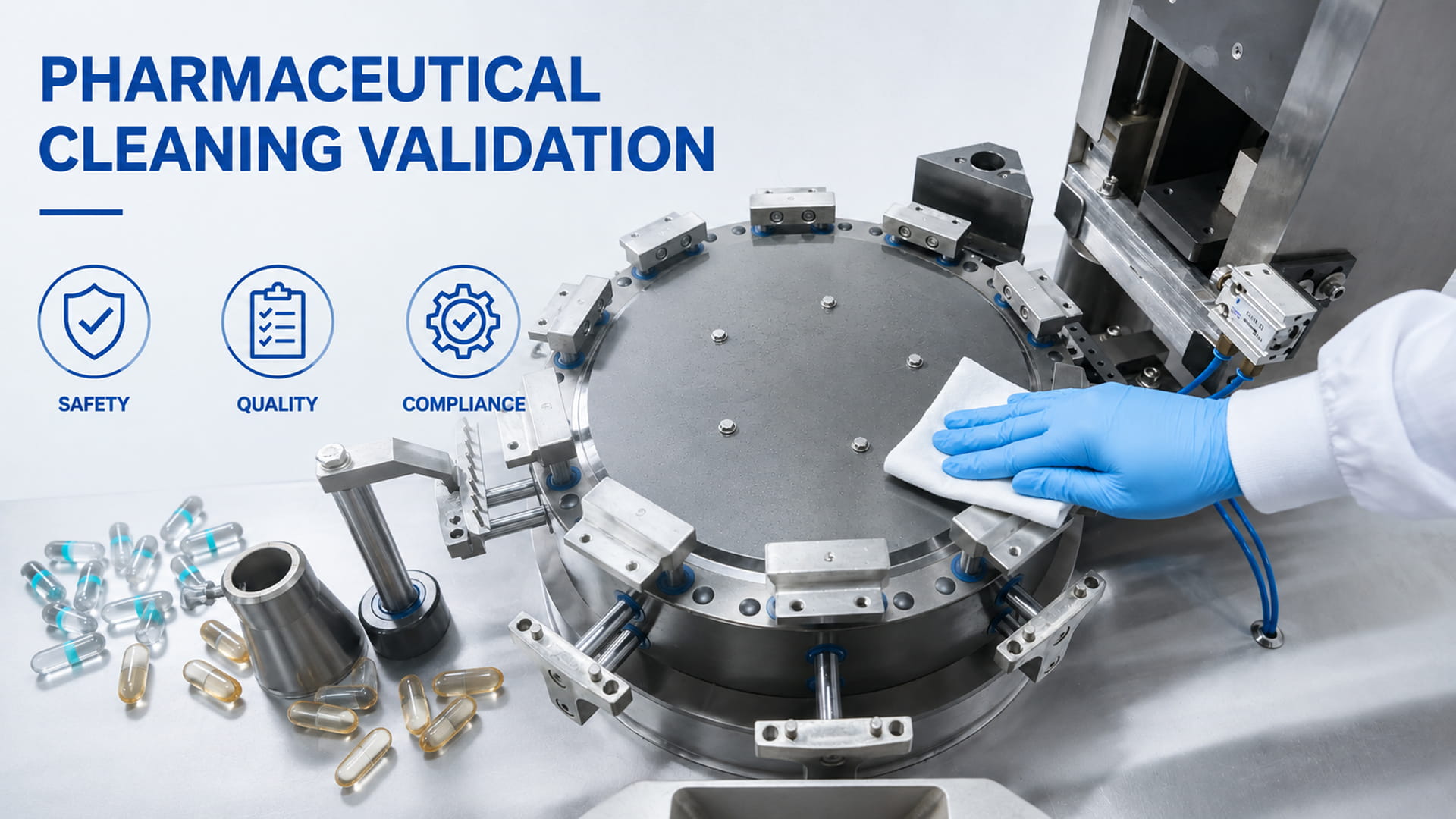
Pharmaceutical Cleaning Validation


What Is Pharmaceutical Cleaning Validation?

सामान्य शर्तों में, सफाई सत्यापन provides objective evidence that a cleaning procedure consistently meets predefined standards. जैसा कि एक उद्योग स्रोत कहता है, cleaning validation is a “documented guarantee” that cleaning can be performed reliably and repeatedly to achieve a predetermined level of cleanliness. व्यवहार में, this means showing that residues of previous products, cleaning agents, and microbes are removed to acceptable levels on all product-contact surfaces.

Regulators agree. उदाहरण के लिए, एफ.डी.ए 21 सीएफआर 211.67(ए) requires every piece of equipment (dedicated or multi-use) to be “cleaned… to prevent… contamination that would alter the safety, पहचान, ताकत, गुणवत्ता, or purity of the drug product”. The WHO similarly explains that the goal of cleaning validation is to prove the equipment is consistently cleaned of product, डिटर्जेंट, and microbial residues to an acceptable level to prevent contamination and cross-contamination. दूसरे शब्दों में, cleaning validation is about patient safety: ensuring one product batch cannot “carry over” and contaminate the next.


Why Is Cleaning Validation Important in Pharmaceutical Manufacturing?

A thorough cleaning validation program gives manufacturers confidence (and regulators assurance) that पार संदूषण is controlled. इसके बिना, residues of a potent एपीआई or allergen from one batch could end up in the next product, potentially harming patients or causing a याद करना. The FDA explicitly states that firms “must validate that cleaning procedures are adequate to ensure that cross-contamination does not occur”. This is especially critical in multiproduct facilities (common in सीडीएमओ and supplement makers). WHO guidance emphasizes that cleaning validation is especially important in multiproduct plants, and should be applied to all production equipment and sanitation procedures.

Beyond contamination, cleaning validation is about ensuring उत्पाद की गुणवत्ता. If equipment isn’t properly cleaned, residual chemicals or microbial growth could compromise the पहचान, ताकत, और पवित्रता of subsequent batches. संक्षेप में, cleaning validation safeguards product quality and patient health. It’s also a regulatory must. Whether you’re under FDA jurisdiction (21 सीएफआर भाग 211) or EU GMP (ईएमए/आई), authorities require documented cleaning validation as part of a complete GMP program. Failure to validate cleaning can lead to warning letters, product holds, and even recalls.


GMP Requirements for Cleaning Validation

विनियामक आवश्यकताएँ: एफडीए, ईएमए, कौन, तस्वीर/एस. All major guidelines demand cleaning validation, but with slightly different emphasis. में हम, एफडीए का सीजीएमपी (शीर्षक 21 सीएफआर 211.67) lays out the basic requirement: equipment must be cleaned to prevent cross-contamination. FDA’s guidance recommends using effective sampling and analytical methods to prove cleanliness. विशेष रूप से, the FDA clarifies that “rinses alone… would not be acceptable” सत्यापन के लिए; firms should directly swab surfaces when feasible. In practice this means you usually combine swab and rinse sampling to cover all areas.

में यूरोपीय संघ, the EMA’s ईयू जीएमपी अनुलग्नक 15 (2015) and EMA guidance require cleaning validation as part of process validation. उपभवन 15 explicitly states “Cleaning validation should be performed in order to confirm the effectiveness of any cleaning procedure for all product contact equipment.”. It also says carry-over limits must be justified by toxicological (health-based) evaluation. दूसरे शब्दों में, define your acceptance criteria scientifically (नीचे देखें) and document the rationale. The EU approach emphasizes a risk-based, health-based strategy: calculate Maximum Allowable Carryover (MACO) or Permitted Daily Exposure (PDE) values for active residues.

WHO and PIC/S also offer guidance. The WHO GMP TRS 1019 (2019) उपभवन on validation spells out that cleaning validation “provides documented evidence that an approved cleaning procedure will provide clean equipment, suitable for its intended use”. This WHO document (a common reference worldwide) highlights that cleaning validation is not needed for trivial cleaning (मंजिलें, दीवारों) लेकिन है needed for critical product-contact equipment in multiproduct plants. The PIC/S committee (a consortium of regulators) likewise defines cleaning validation as evidence that residues will be removed “below the scientifically set maximum allowable carryover level”.

एक साथ, these sources establish the essential elements: define acceptable residue limits, develop robust cleaning procedures, sample using validated methods, analyze with suitable assays, and demonstrate each piece of equipment can be cleaned consistently to those limits.

Swab sampling of pharmaceutical equipment contact surfaces during cleaning validation to confirm residue removal and prevent cross-contamination.
छवि: Swab sampling of pharmaceutical equipment contact surfaces during cleaning validation to confirm residue removal and prevent cross-contamination. टिप्पणी: FDA explicitly states rinse samples alone aren’t enough; you should swab product-contact surfaces as well.


What Are the Key Steps in a Cleaning Validation Process?

Cleaning validation is essentially a project. Here is a step-by-step outline of the typical process:

  1. Identify Equipment, Products, and Worst-Case Scenarios. Begin by listing all production equipment that touches product (मिक्सर, ब्लेंडर, कैप्सूल भराव, टैबलेट प्रेस, भरने वाली पंक्तियाँ, वगैरह।) and the products run on each. For each piece of equipment, identify the worst-case product or scenario that would leave the toughest residues to remove (उदाहरण के लिए:. a potent API, a sticky formulation, or a red dye). अक्सर, a machine used for the highest-dosage or hardest-to-clean product is validated and then others are shown similar by logic. Equipment with similar designs may share validation data if justified.
  2. Define Acceptance Criteria (Residue Limits). Decide how clean is “clean enough.” The goal is to ensure any carryover of the previous product is not toxic or efficacious when used by a person taking the next product. A common approach is to calculate a Maximum Allowable Carryover (MACO) or apply a health-based limit (उदाहरण के लिए:. PDE) based on the potency and daily dose of the previous product. The EU GMP Annex 15 explicitly requires a toxicological justification for carryover limits. उदाहरण के लिए, one conservative rule is to allow no more than 10 पीपीएम (0.001%) of the previous API relative to its normal dose. Acceptance criteria can also include visible cleanliness (उदाहरण के लिए:. no particles or stains), and limits on any cleaning agent residues. Be sure to document the rationale for your chosen limits (often in a risk assessment or protocol).
  3. Develop the Cleaning Procedure. Write a detailed cleaning procedure (often as an SOP) specifying cleaning agents, concentrations, contact times, तापमान, and steps (rinsing, scrubbing, वगैरह।). This may involve multiple steps: उदाहरण के लिए:. an organic solvent soak, followed by aqueous detergent wash, followed by multiple rinses. The procedure should be practical to perform repeatedly. Equipment design features (चिकनी सतहें, weldless joints, drainable hoppers) greatly assist here. Make sure the cleaning agents selected are compatible with machine materials (स्टेनलेस स्टील, सील) and do not leave sticky residues themselves.
  4. Determine Sampling Methods and Locations. Plan how you will check cleanliness. Common sampling techniques include:
  5. Swab sampling: Using a wetted swab to wipe specific areas of the equipment surface (उदाहरण के लिए:. inside a discharge chute, gasket, वाल्व, वगैरह।). Swabbing is direct but limited to accessible spots.
  1. Rinse sampling: Collecting the final rinse liquid after cleaning by running water or solvent through the equipment (or by rinsing parts). Rinse sampling can cover internal passages or complex shapes.
  2. Direct extraction: For disassembled parts, you may submerge a component in solvent and analyze that liquid.

FDA guidance is clear that “rinses alone would not be acceptable” as the only verification method. व्यवहार में, a combination of swab and rinse samples is used. Choose representative sampling sites on each piece of equipment (usually the hardest-to-clean spots). Before testing, validate that your sampling methods recover enough of the target residues (known as recovery studies).

  1. Analytical Testing. Analyze samples for residues. The choice of method depends on the chemistry of residues: common choices include HPLC (high-performance liquid chromatography) for specific APIs or cleaning agents, UV-VIS spectroscopy, टीओसी (total organic carbon) for organic matter, conductivity/pH for ionic detergents, or GC for volatile solvents. HPLC is often considered a “gold standard” for specificity. WHO and others note that TOC can be acceptable if target residues are organic and carbon-rich. Whatever methods you use, they must be validated or qualified for the intended use. Plan your method validation (linearity, संवेदनशीलता) and ensure detection limits are well below your acceptance criteria.
  2. Perform Validation Runs & Document Results. Execute the cleaning validation by manufacturing at least 3 consecutive full-scale batches (or campaign-run) under normal conditions and then applying the cleaning SOP, and sampling/analyzing each time. Collect data and show that all results are within acceptance limits. Document everything in a Cleaning Validation Report: शिष्टाचार, रियायतों, raw data, calculations, विचलन, and conclusions. If any test fails, investigate root causes and revise the cleaning until criteria are met. Once approved, the process is considered मान्य.
  3. चल रही निगरानी. After initial validation, continue to verify cleanliness over time. Periodic cleaning samples (especially after maintenance or formulation changes) are recommended. Also maintain thorough documentation (SOP revisions, बैच रिकॉर्ड). If equipment or processes change, you may need revalidation or partial validation (उपभवन 15 advocates a lifecycle approach).
Vacuum cleaning a pharmaceutical tablet press before production as part of pharmaceutical cleaning validation and preventive equipment maintenance
छवि: Vacuum cleaning a pharmaceutical tablet press before production as part of pharmaceutical cleaning validation and preventive equipment maintenance


Common Challenges and Pitfalls

Cleaning validation often faces obstacles. प्रमुख चुनौतियों में शामिल हैं:

  • Complex Equipment and Dead Zones: Modern machines have gaskets, crevices, or intricate parts that trap powder (उदाहरण के लिए:. inside auger housings or filling nozzles). These hard-to-reach spots require careful cleaning design and sampling. FDA and WHO stress choosing worst-case equipment and sampling all critical locations.
  • Operator Variability: Manual cleaning steps can be inconsistent if operators are not well-trained. जैसा कि एक उद्योग लेख नोट करता है, cleaning is often treated as an afterthought: “lack of clear SOPs… causes operators to interpret cleaning instructions differently”. Incomplete or rushed cleaning leads to failure. Good training, clear checklists, and supervision are vital.
  • Analytical Interference: Ensuring the assay only detects the target residue (not detergent or environmental contaminants) can be tricky. You may need specialized extraction or cleanup. भी, some highly sensitive methods can find minute background “dust” – so acceptance criteria must be realistic. Remember FDA’s guidance: cleanliness need only meet safety and quality standards, not impossible “zero residue” levels.
  • Microbial Concerns: Especially for equipment exposed to moist environments, microbial biofilms can form that resist routine cleaning. While cleaning validation usually focuses on chemical residues, microbiological monitoring (swab cultures) may also be needed for sterile or sensitive products. Validating sanitization (उदाहरण के लिए:. caustic or heat) may be part of the process.

कुल मिलाकर, the best defense is a जोखिम आधारित दृष्टिकोण (as encouraged by ICH Q9 and industry guidance). Focus validation efforts on high-risk areas/products (potent APIs, shared equipment) and document that focus.


Equipment Design for Easy Cleaning (GMP-Friendly Features)

A huge enabler of successful cleaning validation is equipment design. FDA explicitly requires equipment to be designed to facilitate cleaning. व्यवहार में, देखो के लिए:

  • Stainless Steel Contact Surfaces: भोजन पदवी स्टेनलेस (304/316) is hygienic and non-porous. It doesn’t react with APIs and is easy to sterilize. All product-contact parts should be stainless steel or equivalent FDA-grade material. Avoid materials that could absorb or trap product (उदाहरण के लिए:. some plastics, रबड़).
  • चिकना, Sloped Surfaces: Rounded corners and sloped trays help liquids drain and avoid standing pockets of powder. Welds should be smooth. The fewer “dead legs” or bolt-holes in the product path, the better.
  • Quick-Release/Disassemblable Parts: Hoppers, पलकों, covers, and filling plates that can be removed without tools (or with few hand screws) make it easy to access hidden areas. उदाहरण के लिए, choose machines where hoppers, ऑगर्स, and trays snap or unbolt in minutes for manual cleaning. Reduced parts count generally speeds up the process.
  • CIP/SIP Capability (यदि लागू हो): For larger installations, स्वचालित जगह स्वच्छ रखें (सीआईपी) systems can rinse circuits. For most small to mid-size packaging machines, a manual clean-out is used, but some automated systems exist (like CIP manifolds on liquid fillers).
  • Certification and Documentation: Look for equipment from reputable suppliers that meet CE/FDA standards and come with cleaning validation support documentation. Good vendors often provide “cleanability” data or are willing to co-develop the cleaning protocol.

By specifying these design features, you drastically cut down cleaning time and validation effort. उदाहरण के लिए, Jinlu’s capsule filling machines are built with easily detachable hoppers, stainless chutes, and closed dust guards – all to minimize residue accumulation. उसी प्रकार, छाला और pouch packaging machines with tool-less access panels help operators reach all surfaces for cleaning. Choosing the right equipment upfront is half the battle in cleaning validation.


Capsule Filling Machine Cleaning: एक केस स्टडी

Capsule fillers deserve a special mention. These machines handle powders and capsules, so thorough cleaning is a must. Key points for cleaning a capsule filling line include:

  • Disassemble Critical Parts: प्रत्येक बैच के बाद, components like the भरने की स्टेशन, डोजिंग डिस्क, टैम्पिंग पिन, और capsule hoppers should be removed and cleaned separately. These parts directly contact product and often trap powder between runs. Jinlu machines use hopper catches and quick-release knobs to make this easy.
  • Dry and Wet Cleaning Steps: पहला, dry clean to remove bulk powders (संपीड़ित हवा, ब्रश). Then wet-clean using mild detergents or isopropyl alcohol for sanitizing. उदाहरण के लिए, wiping the dosing disc and tamping area with 70% IPA dissolves most organic dust without rusting metal. Always rinse thoroughly after detergent use.
  • Focus on Hard Spots: The capsule-separating trays and ejection areas collect capsule dust. Also check vacuum lines and capsule orientation units. In automated machines, any feeder or sieve should be cleared of fines.
  • Documented Procedure: Have a clear SOP for capsule line cleaning, including pictures of what a “clean” state looks like (no powder on machine surfaces or visual color of surfaces). Train operators to inspect as they go. Some firms even use media-fill or placebo trials to verify there’s no cross-contamination in capsule machines.
Operator wearing cleanroom garments cleaning the rotary table of a pharmaceutical capsule filling machine during pharmaceutical cleaning validation to prevent cross-contamination
छवि: Operator wearing cleanroom garments cleaning the rotary table of a pharmaceutical capsule filling machine during pharmaceutical cleaning validation to prevent cross-contamination. व्यवहार में, cleaning the fill hopper, खुराक की थाली, and tamping pins after each run is crucial for capsule machine GMP compliance.

Capsule machines in GMP service are often executed in harsh environments (dusty powder). Jinlu’s capsule fillers address this by using anti-static coatings and closed hoppers to limit powder escape, making cleaning safer and validation easier.


Best Practices for Successful Cleaning Validation

To tie it all together, here are some overarching best practices:

  • Use a Risk-Based Approach: As advocated by ICH Q9, focus on the riskiest compounds/equipment. Validating every piece of auxiliary equipment (दीवारों, मंजिलें, वगैरह।) is unnecessary; concentrate on product-contact surfaces.
  • Train and Empower Your Team: Ensure operators and QC analysts understand the cleaning protocol fully. Regular training and clear checklists/SOPs reduce variability.
  • Maintain Detailed Documentation: Every validation study should have a protocol, raw data, and final report. उपभवन 15 and WHO demand these be approved by quality personnel. Keep logs of routine sanitation checks too.
  • Review and Revalidate: When you change formulations, extend campaigns, or upgrade equipment, revisit your cleaning validation. Even small changes can affect residue risk. Document all revalidation activities.
  • Collaborate with Suppliers: Equipment vendors often have cleaning recommendations. उदाहरण के लिए, if using specialized lubricants, ensure they’re compatible with the cleaning agents. Some companies provide cleaning validation protocols for their machines.

छवि: A clean analytical lab environment (blister packing or QA lab). Good cleaning validation requires both proper cleaning procedures and accurate testing (उदाहरण के लिए:. एचपीएलसी, टीओसी) to confirm no residues remain. Cleaning Validation Checklist: A quick summary table of key items.

Item मांग
Equipment identified List all product-contact machines
Cleaning procedure Written, अनुमत, और पीछा किया (SOP)
Sampling plan तरीकों (swab/rinse), locations, frequency
Acceptance criteria Defined (MACO/PDE limits)
विश्लेषणात्मक तरीकों Validated tests (एचपीएलसी, टीओसी, वगैरह।)
Validation report Protocol completed, results approved by QA

Proper cleaning validation is essential for GMP pharmaceutical production. It protects product quality and patient safety by preventing cross-contamination. Well-designed equipment greatly reduces validation headaches: smooth stainless steel contact parts, minimal dead zones, and quick disassembly mean cleaning is faster and more consistent. और jeinlu उठा, we design capsule fillers, ब्लिस्टर पैकर्स, and filling lines with these principles in mind to help manufacturers comply with global GMP standards.


निष्कर्ष

सारांश, pharmaceutical cleaning validation is about proving “clean” with data and documentation. By following a structured process – selecting worst-case products, setting limits (like MACO), writing clear cleaning SOPs, sampling smartly, and testing with HPLC/TOC – you can demonstrate compliance to regulators and quality teams alike. याद करना: invest in GMP-friendly equipment now (स्टेनलेस, ergonomic design) to save time validating later. If you’re looking for capsule filling or packaging machines built for easy cleaning and compliance, consider Jinlu Packing’s lineup of कैप्सूल भरने वाली मशीनें, ब्लिस्टर पैकर्स, और pharmaceutical filling lines. Our equipment is engineered for quick changeover and thorough cleaning, helping ensure your validation goes smoothly.

Ready to streamline your cleaning validation? जिनलू पैकिंग से संपर्क करें to learn how our GMP-compliant capsule filling and packaging machines can meet your pharmaceutical manufacturing needs.


FAQs on Pharmaceutical Cleaning Validation

What is cleaning validation in the pharmaceutical industry?

Cleaning validation is a documented process used to prove that pharmaceutical equipment cleaning procedures can consistently remove product residues, सक्रिय फार्मास्युटिकल सामग्री (एपीआई), cleaning agents, and potential contaminants to an acceptable level.

फार्मास्युटिकल मैन्युफैक्चरिंग में, cleaning validation provides evidence that equipment is suitable for producing the next batch without causing cross-contamination or affecting product quality.

Why is cleaning validation important in pharmaceutical manufacturing?

Cleaning validation is important because pharmaceutical equipment is often used to manufacture different products or batches. Without effective validation, remaining residues may contaminate the next product and impact its safety, पहचान, ताकत, or purity.

A properly performed cleaning validation process helps manufacturers:
• Prevent cross-contamination
• Meet GMP compliance requirements
• Improve production safety
• Reduce quality risks during product changeovers

What are the main steps of the cleaning validation process?

The cleaning validation process usually includes equipment assessment, cleaning procedure development, setting acceptance criteria, नमूना, विश्लेषणात्मक परीक्षण, और सत्यापन दस्तावेज.

What are cleaning validation acceptance criteria?

Cleaning validation acceptance criteria define the maximum allowable residue levels after cleaning, including API residues, cleaning agents, and potential contaminants.

What equipment requires cleaning validation?

Most pharmaceutical manufacturing equipment that contacts products requires cleaning validation, कैप्सूल भरने वाली मशीनों सहित, टैबलेट प्रेस, मिक्सर, and powder handling equipment.

What sampling methods are used for cleaning validation?

The two common sampling methods are swab sampling and rinse sampling. Manufacturers often select methods based on equipment design, अभिगम्यता, and residue characteristics.

How does equipment design affect cleaning validation?

Equipment design directly affects cleaning efficiency. Machines with smooth surfaces, fewer dead areas, and easy-to-remove parts are easier to clean and validate.

How often should cleaning validation be performed?

Cleaning validation frequency depends on equipment usage, product changes, process risks, और नियामक आवश्यकताएँ. Revalidation may be needed after major changes to equipment or cleaning procedures.

What is the difference between cleaning verification and cleaning validation?

Cleaning verification confirms that a specific cleaning operation meets requirements, while cleaning validation proves that the cleaning process is reliable and repeatable over time.

How can pharmaceutical equipment manufacturers support cleaning validation?

Equipment manufacturers can support cleaning validation by providing GMP-friendly machine designs, easy-to-clean structures, material specifications, and documentation needed for qualification and validation.


संदर्भ:
1.Validation of Cleaning Processes —— हम. खाद्य एवं औषधि प्रशासन
2.वर्तमान अच्छे विनिर्माण अभ्यास आवश्यकताओं पर प्रश्न और उत्तर | उपकरण —— हम. खाद्य एवं औषधि प्रशासन
3.मार्गदर्शक: Cleaning Validation Lifecycle – अनुप्रयोग, तरीकों, & नियंत्रण —— ISPE
4.Cleaning validation guide (GUI-0028) —— स्वास्थ्य कनाडा
5.यूड्रालेक्स – आयतन 4 – गुड मैनुफैक्चरिंग प्रैक्टिस (जीएमपी) दिशा निर्देशों —— यूरोपीय आयोग
6.सफ़ाई सत्यापन: Complete Guide for HealthBased Approach in Chemical CrossContamination Risk Assessment —— PDA JPST

इस लेख का हिस्सा:
का चित्र पेटी फू
पेटी फू

पेटी फू, जिनलुपैकिंग के संस्थापक, ऊपर लाता है 20 फार्मास्युटिकल मशीनरी क्षेत्र में वर्षों की विशेषज्ञता. उनके नेतृत्व में, जिंलू डिज़ाइन को एकीकृत करने वाला एक विश्वसनीय आपूर्तिकर्ता बन गया है, उत्पादन, और बिक्री. पेटी को ग्राहकों को फार्मा पैकेजिंग की जटिलताओं से निपटने में मदद करने के लिए अपने गहन उद्योग ज्ञान को साझा करने का शौक है, यह सुनिश्चित करना कि उन्हें न केवल उपकरण प्राप्त हों, बल्कि उनके उत्पादन लक्ष्यों के अनुरूप एक सच्ची वन-स्टॉप सेवा साझेदारी है.

विषयसूची

अपनी जांच भेजें

उत्तर छोड़ दें

आपकी ईमेल आईडी प्रकाशित नहीं की जाएगी. आवश्यक फ़ील्ड चिह्नित हैं *

एक नि: शुल्क उद्धरण प्राप्त

*हम आपकी गोपनीयता का सम्मान करते हैं और सभी डेटा सुरक्षित हैं. आपके व्यक्तिगत डेटा का उपयोग और प्रसंस्करण केवल जेएल समाधान के लिए किया जाएगा.