Machine d'emballage de poudre de protéines: Comment choisir le bon équipement pour les pochettes, Pots & Packs de bâtons
Machine d'emballage de poudre de protéines: Comment choisir le bon équipement pour les pochettes, Pots & Packs de bâtons
août 28, 2026
Sans commentaires
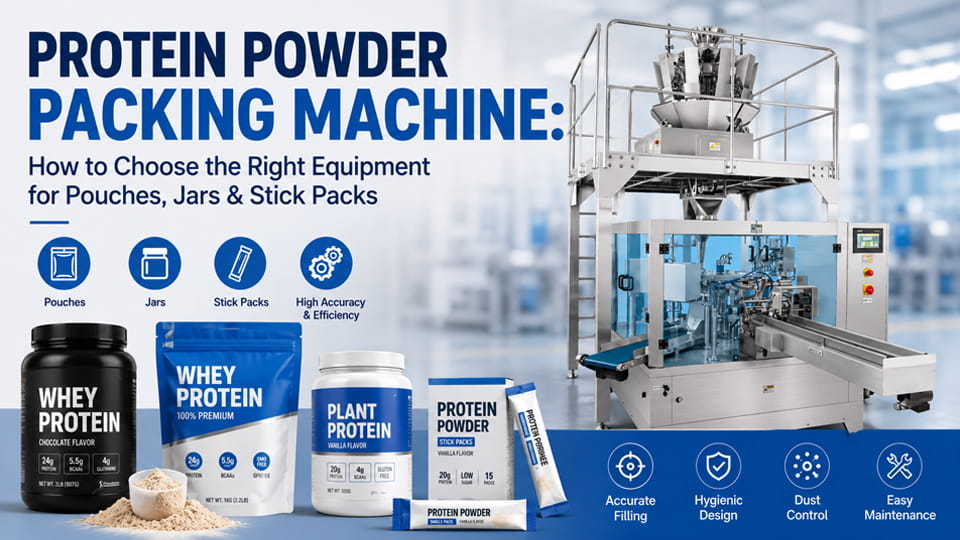
Emballer efficacement la poudre de protéines est essentiel pour les fabricants de suppléments et d’aliments. Que vous remplissiez de grands pots de protéines de lactosérum pour la vente au détail ou de minuscules portions individuelles sachets pour les clients en déplacement, choisir le bon machines d'emballage fait toute la différence. Un automatisé emballage de poudre de protéine la ligne peut doser, remplir, et scellez des centaines de conteneurs par heure avec une précision constante. Dans ce guide, nous vous expliquerons pourquoi les machines à grande vitesse sont essentielles à un emballage efficace des poudres, comparer les principaux formats d'emballage (pots, pochettes, paquets de bâtons), et parcourez les caractéristiques à rechercher lors de la sélection du bon équipement. Considérez cela comme votre « aperçu des machines » convivial : ce qu'un responsable des opérations ou un ingénieur des achats demanderait lors de la recherche d'un nouveau produit. ligne de conditionnement de poudre.
Pourquoi utiliser une machine d'emballage automatique pour la poudre de protéines?
Même les petites marques de poudres de protéines deviennent rapidement trop grandes pour être emballées à la main avec des cuillères.. Une machine d'emballage automatique peut augmenter considérablement les taux de production (souvent 10× ou plus que manuel) tout en garantissant que les poids de remplissage sont précis. Par exemple, les lignes de conditionnement de poudre entièrement intégrées peuvent produire de l'ordre de 200 unités par minute, contre ~15 unités lorsqu'elles sont emballées à la main. Cela réduit considérablement les besoins en main-d'œuvre (réduisant souvent les effectifs de 60 à 80 %) et accélère les lignes vers une productivité de classe mondiale.
Au-delà de la vitesse, les machines automatisées s'améliorent consistance et hygiène. Avec servocommande remplisseurs de tarières et trieuses pondérales, chaque pot ou sachet est rempli selon une tolérance stricte. Cela réduit les cadeaux (gaspiller de la poudre supplémentaire) et réclamations clients. Les machines fermées maintiennent également la poudre contenue, prévenir la contamination et le nettoyage désordonné. Pour les entreprises diététiques ou pharmaceutiques, réunion cgMP ou les normes FDA sont essentielles : l'extraction de poussière intégrée et les boîtiers scellés aident à maintenir un environnement de salle blanche. En bref, pour tout producteur de poudre de protéine de taille raisonnable, une machine d'emballage n'est pas un luxe mais une nécessité pour évoluer de manière rentable et sûre.
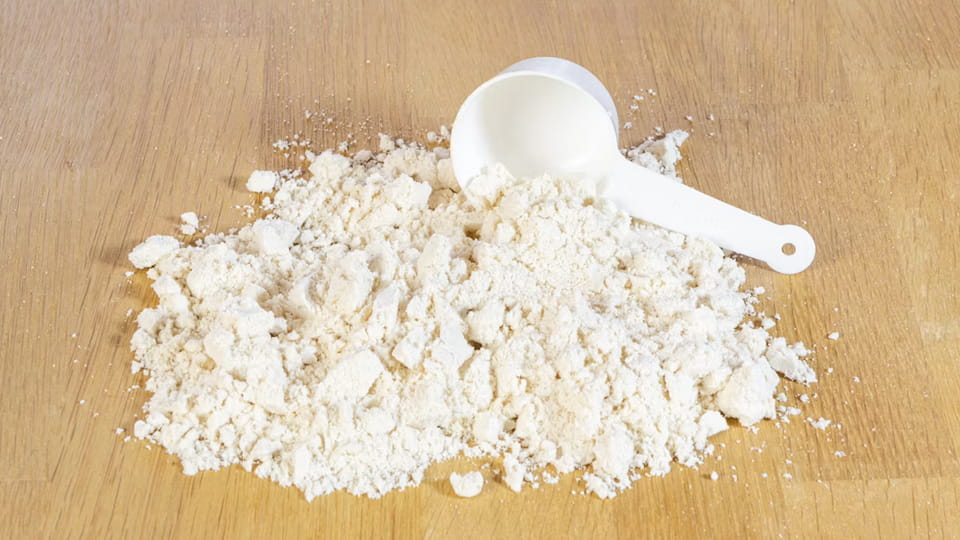
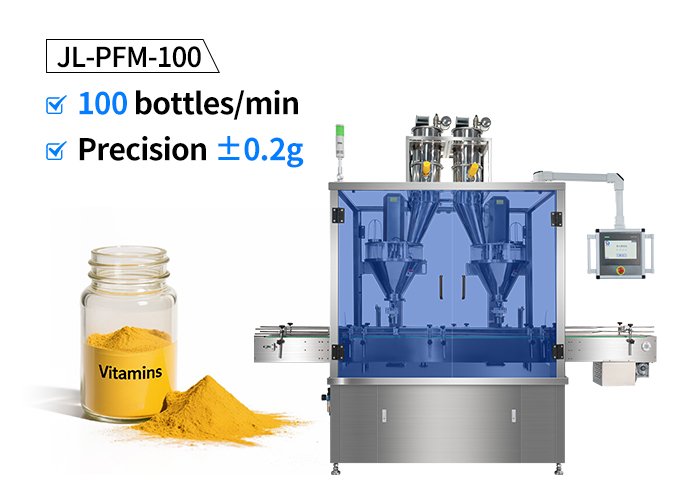
Chiffre: La poudre de protéine est une bonne chose, substance fluide qui peut facilement devenir poussiéreuse. Haute précisionremplisseurs de tarièressont couramment utilisés pour doser la poudre dans des pots, pochettes ou sachets.
Principaux formats d'emballage pour la poudre de protéines
La première décision est la format de conteneur. La poudre de protéine est généralement livrée sous l'une des trois formes suivantes: pots/bacs (conteneurs durs), pochettes debout (sacs), ou packs/sachets de sticks (bâtonnets en portion individuelle). Chacun a ses cas d'utilisation:
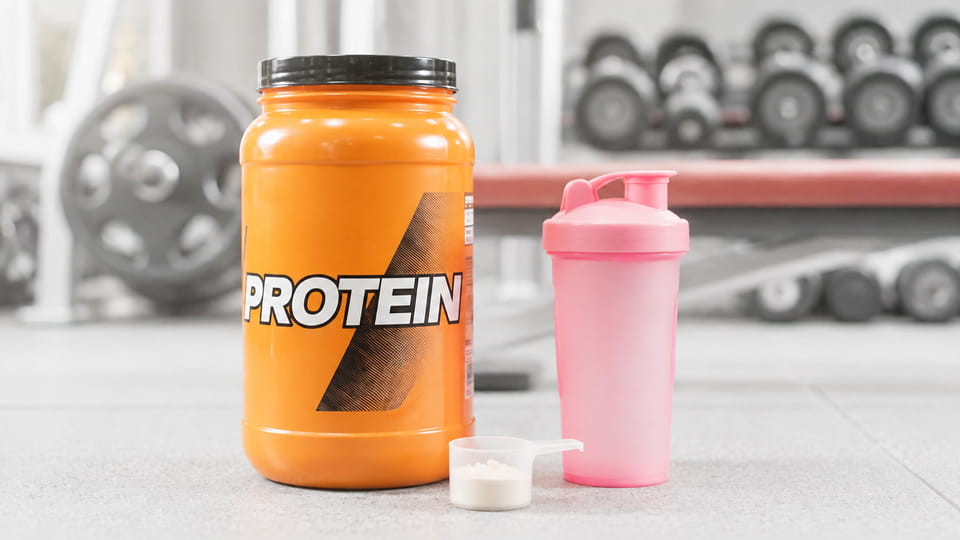
Pots & Baignoires (Conteneurs rigides): Emballage grand format classique (par exemple. 500 g, 1 kilos, 2 seaux en kg). Ceux-ci ont souvent des couvercles à visser et peuvent contenir des cuillères à l'intérieur.. Les clients attendent du durable, pots refermables pour poudres en vrac ou de grande valeur (comme un gain de masse de lactosérum ou des suppléments spécialisés). Les lignes de conditionnement utilisent un machine de remplissage à vis doser la poudre dans le pot, puis une station de bouchage et une scelleuse par induction pour la fraîcheur. Les bocaux peuvent fonctionner à 5–50 unités/min en fonction du niveau d'automatisation. Un exemple est celui de Jinlu Machine de remplissage de poudre, qui atteint une précision de ±0,1 g pour les poudres. Les pots conviennent aux marques souhaitant un look haut de gamme et une refermabilité facile.
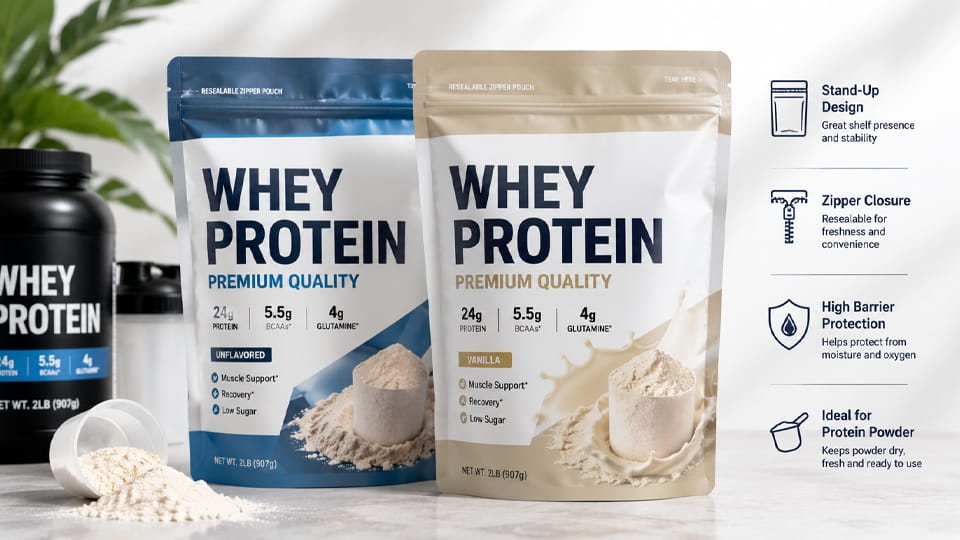
Pochettes verticales & Pochettes à fermeture éclair: Pochettes souples (doypacks ou stand-ups à soufflets) sont désormais très appréciés pour les poudres de protéines. Ils vont des petites tailles d'essai (100–250g) jusqu'aux plus grandes tailles de vente au détail (1–2 kg). Les pochettes sont souvent refermables joints de fermeture à glissière, idéal pour préserver la fraîcheur. Les remplir nécessite généralement un Machine d'emballage de poche prémade. La machine récupère les sacs vides préfabriqués, les ouvre, se remplit de poudre, et thermoscelle le dessus. Jinlu machines à sachets préfabriqués exécuter ~60 à 70 sacs/min avec Précision de ±0,4 % et prend en charge différents styles de sacs (fermeture éclair, bec, à fond plat). Les pochettes permettent d'économiser du plastique par rapport. bocaux et sont légers pour l’expédition. Ils permettent également des emballages imprimés attrayants. Ce format est idéal pour les rayons des magasins, commerce électronique direct au consommateur, ou épiceries.
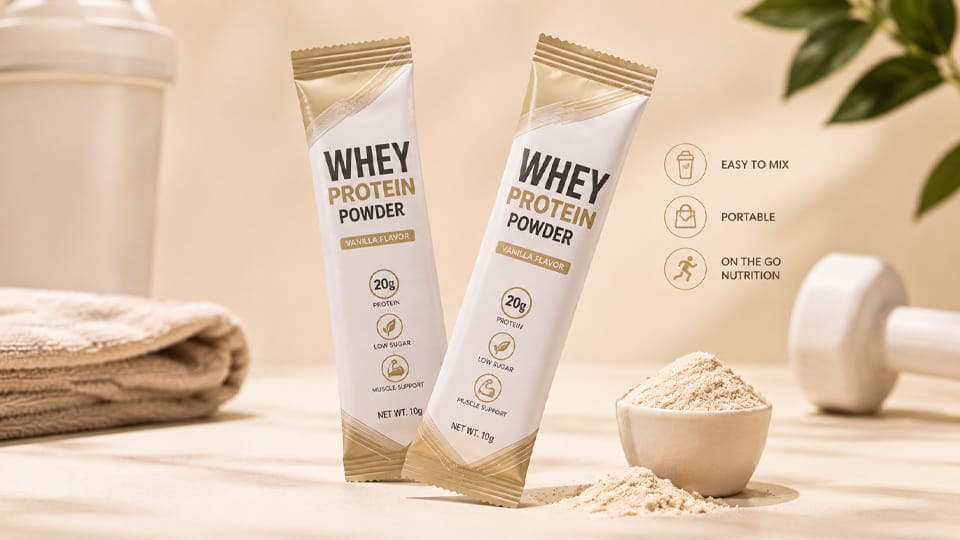
Packs/Sachets de sticks (Packs individuels): Ce sont longs, fines bandes scellées contenant une seule portion (souvent 10 à 30 g de poudre). Pensez aux sachets de protéines à emporter que les amateurs de gym ouvrent. Packs de bâtons (parfois appelés sachets) sont fabriqués à partir de stratifiés ou de films d'aluminium et remplis sur un machine à emballer des bâtonnets. Ils maximiser la portabilité et commodité – idéal pour les échantillons, packs de voyage, ou promotions. Les machines de stick pack à plusieurs voies peuvent produire des centaines de paquets par minute. Par exemple, Jinlu emballeurs de bâtons atteindre jusqu'à 240 bâtonnets/min (à travers les voies) et remplissez chacun avec une précision de ±0,02 g. Ce format minimise le poids de l'emballage et les déchets pour les petites portions mais ne se referme pas. Il est préférable de l'utiliser en portions uniques ou en portions d'essai..
Chaque format a des compromis (voir tableau ci-dessous). Choisir le mauvais conteneur peut entraîner des coûts de matériel supplémentaires ou une opération fastidieuse. Lisez la suite pour en savoir plus sur les machines et les facteurs pour chaque format..
Types de machines d’emballage de poudre de protéines
Une fois que vous connaissez le type de colis, la prochaine question est de savoir quelle machine va le remplir. Voici les principaux types d'équipements:
Machine de remplissage à tarière (Machine de remplissage de poudre) – Utilisé pour les récipients à bouche ouverte comme les bocaux, baignoires, des bouteilles ou même des petits sacs. La longue vis de la machine (tarière) tourne pour distribuer un volume de poudre précis dans chaque récipient. Les remplisseuses à vis peuvent atteindre une très grande précision (souvent ±0,1 à 1 % du poids de remplissage). Ils intègrent souvent des extras: désaération sous vide pour éliminer l'air de la poudre, détecteurs de métaux, et capsules après remplissage. Par exemple, Les remplisseuses à vis Jinlu sont livrées avec un manchon sous vide pour éviter les déversements et peuvent insérer automatiquement des cuillères à mesurer.. Utilisez-les pour les poudres de protéines en vrac ou pour tout besoin de remplissage de pots/bouteilles.
Machine de remplissage de poudre
Formage-Remplissage-Scellage Vertical (Vff) Machine – Un système d’emballage commun pour former des sacs à partir de films en rouleaux. La machine forme un sac plat (oreiller ou à soufflet) à partir d'un rouleau de film, le remplit avec le produit, puis thermoscelle le dessus. Machines VFFS peut être utilisé pour les sacs de poudre ordinaires (sans fermeture éclair). Ils sont très efficaces pour les courses à grande vitesse (par exemple. petits ou moyens formats à fort volume). Cependant, ils ne créent pas de pochettes à fermeture éclair à moins d'être équipés d'un applicateur de fermeture à glissière. (Le VFFS avancé peut appliquer des fermetures éclair en ligne, mais c'est spécialisé.)
Machine d'emballage de poche prémade – Idéal pour pochettes à fermeture éclair ou autres sacs préformés. La machine est dotée d'un mécanisme de sélection et de placement: il prend une pochette vide dans une pile, l'ouvre (utilisant souvent des jets d'air ou des pinces), puis une vis sans fin ou une peseuse dépose la poudre à l'intérieur, et enfin la pochette est thermoscellée. Parce que la pochette est déjà faite, l'étanchéité est très fiable et l'emballage fini semble de haute qualité. Les machines à sachets préfabriqués de Jinlu fonctionnent à environ 50 à 60 sachets/min avec une grande précision. Ils gèrent une large gamme de styles de pochettes (fermeture éclair, bec, doypack). Le compromis est le coût d'achat de sacs préfabriqués au lieu du film. Les machines préfabriquées sont idéales pour les volumes moyens à élevés d'emballages de sacs prêts à la vente au détail..
Dosage très précis, gère les poudres collantes, intègre le bouchage/scellement
Machine VFFS
Sacs d'oreiller, Sacs à gousset
Grandes séries de sacs filmés (500g–2kg)
Très grande vitesse, un minimum de déchets de matériaux
Machine d'emballage de poche prémade
Pochettes stand-up, Sacs à fermeture éclair
Sachets de protéines au détail (50g–2kg)
Aspect du forfait Premium, styles de pochettes flexibles, étanchéité
Machine à emballer des bâtons
Sachets sticks (1–50g)
Packs de protéines en portion individuelle (voyage/échantillons)
Rendement le plus élevé pour les petits paquets, faible coût des matériaux par unité
Pack de bâtons multivoies
Sachets sticks (multiple)
Production en série de petits paquets
Débit très élevé (voies multiples)
Choisir la bonne machine est crucial. Les sections suivantes détaillent leurs étapes de fonctionnement et les éléments à prendre en compte lors de la sélection d'un.
Comment fonctionne une machine de conditionnement de poudre de protéines?
Bien que les machines varient selon le type, le processus de base pour remplir la poudre de protéine est similaire: (1) Nourrir la poudre → (2) Dosage au poids → (3) Remplissage du colis → (4) Sceller le colis → (5) Sortie du package fini.
Alimentation en poudre: Une trémie d'approvisionnement contient la poudre en vrac. Pour poudres très fines, un élévateur à vide ou un distributeur à vis peut soulever la poudre dans une trémie principale au-dessus de l'unité de remplissage. Souvent un table vibrante ou agitateur permet à la poudre de couler régulièrement (éviter les amas ou les ponts à la sortie). Les bonnes machines ont des trémies en forme de cône et des vibrations ou des brosses pour décourager la courbure (pontage).
Dosage pondéral: Un remplisseur de tarière (vis) ou une peseuse multi-têtes mesure chaque dose. Pour le remplissage à vis, un servomoteur fait tourner la vis dans une trémie d'alimentation pour doser la poudre. Le volume déplacé est corrélé au poids de remplissage. Le système peut être en boucle ouverte (calibré volumétriquement) ou en boucle fermée (avec une échelle pour ajuster à la volée). Outillage de tarière approprié (pas, longueur, vitesse) est choisi en fonction du débit de poudre. Comme le note JinluPacking, La prévention du pontage et la conception de la trémie sont essentielles : une trémie bien conçue peut réduire le pontage de poudre d'environ 85 % à 12% de courses.
Positionnement du colis: Si vous remplissez un pot ou une bouteille, un redresseur ou un alimentateur organise les conteneurs vides. Si vous remplissez un sac, le sac est soit formé (Vff) ou cueilli/ouvert (machine à sachets ou à stick packs préfabriqués). Ouverture précise de la pochette (souvent avec des pinces à vide ou des jets d'air) garantit que la poudre ne se répand pas à l’extérieur.
Remplissage: La poudre est distribuée dans le récipient. De nombreuses machines utilisent alors un vibrateur ou étage de désaération sous vide secouer légèrement le récipient rempli, décantation de la poudre et élimination de l'air emprisonné. Cela améliore la densité et permet plus de poudre par paquet, et réduit la poussière.
Scellage/bouchage: Les sacs sont thermoscellés avec des rouleaux ou des mâchoires. Les pots sont bouchés (à presser ou à visser automatiquement). Parfois un scellant à induction applique un sceau fraîcheur en aluminium sous le bouchon (particulièrement fréquent dans les nutraceutiques). Le scellement doit être exempt de poussière – souvent, une dernière brosse rapide ou un coup d'air élimine la poudre de la lèvre..
Contrôle de qualité & Sortir: Une trieuse pondérale ou un système de vision peut vérifier le poids final et le sceau. Les colis sortent ensuite de la machine vers des convoyeurs de collecte ou directement dans des caisses.
Dans toutes les étapes, contrôle de la poussière est critique. L'emballage de plusieurs kilos de protéines crée de la poussière en suspension dans l'air. Les systèmes supérieurs sont dotés de hottes d'extraction de poussière locales et de filtres HEPA pour capturer les particules, garder les machines propres et protéger les travailleurs. Si rien n'est coché, la poussière peut recouvrir les joints ou contaminer d'autres produits. De nombreuses machines d'emballage de sachets incluent même des options pour rinçage à l'azote, remplacer l'oxygène à l'intérieur du sac pour prolonger la durée de conservation de la poudre de protéine.
Pourquoi les remplisseurs de tarière sont essentiels pour la poudre de protéines
Pour toute poudre sèche, ceux particulièrement collants ou fins comme les protéines, la tarière (vis) est souvent le meilleur choix pour le dosage. Contrairement aux remplisseurs de gobelets volumétriques, un remplisseur de tarière peut doser avec précision les poudres difficiles dans des conteneurs ou des sacs ouverts. Voici pourquoi les tarières excellent:
Haute précision: Avec le bon calibrage, les systèmes à vis modernes peuvent frapper Précision de ±0,1 à 1 %. Le pas de la vis, la longueur et la vitesse de rotation sont adaptées à la densité apparente et au poids de remplissage de la poudre. Les tarières servo-entraînées permettent un ajustement dynamique. Par exemple, Les remplisseuses à vis de Jinlu utilisent des servomoteurs pour obtenir une précision de remplissage de 0.01 g.
Gère les poudres difficiles: Les poudres de protéines constituent souvent un pont ou un trou de rat (former un coffre-fort) dans les trémies s'il n'est pas vibré. Vis combinées avec alimentateurs vibrants, les brosses ou les agitateurs peuvent briser ces ponts. Si les poudres sont collantes (comme le lactosérum) ou électrostatique, certaines machines proposent vis plus longues ou des vis enduites pour atténuer le collage. La variante à vis longue (et Jinlu propose) est conçu pour déplacer les poudres collantes sans se coincer.
Minimisation de la poussière: Les remplisseuses à vis sans fin pour poudres fonctionnent généralement dans des trémies semi-fermées. Beaucoup ont buses à manchon à insérer dans le pot ou le sachet avant/pendant le dosage. Les machines Jinlu utilisent un manchon d'aspiration qui s'enroule autour de la zone de remplissage pour capturer la poussière parasite., éliminant pratiquement les déversements. Combiné avec des hottes anti-poussière externes, cela garde la zone de remplissage bien rangée.
Fonctionnalités intégrées: Sur les lignes de bocaux, les remplisseuses à vis peuvent être associées à des machines automatiques inséreuses de cuillères. Ces appareils déposent une cuillère doseuse dans le pot avant de poudrer (commun avec les pots de protéines de lactosérum). La tarière remplit ensuite autour de la pelle. Après avoir rempli, une capsuleuse scelle le pot. Comme le note Jinlupacking, les remplisseurs de bocaux à vis incluent souvent exactement ces caractéristiques : placement de la cuillère, plafonnement, et même l'étiquetage sur une seule ligne intégrée.
En résumé, si votre produit principal est un ingrédient en poudre, une charge à vis est généralement la meilleure fondation. Il est polyvalent et peut être facilement intégré au reste de votre gamme. Par exemple, une ligne de pot typique pourrait être: redresseur de bouteilles → remplisseuse à vis → insertion de cuillère → capsuleuse → scelleuse par induction → étiqueteuse → trieuse pondérale. Cela gère tout, des suppléments de protéines en vrac aux poudres nutraceutiques fines..
Facteurs clés à considérer lors du choix d’une machine
La sélection du « bon » équipement dépend de nombreux détails de votre produit et de votre usine.. Voici les facteurs critiques que les équipes d’approvisionnement et d’ingénierie devraient prendre en compte:
Type de colis & Taille: Est-ce que vous remplissez des bocaux, baignoires, sacs debout, ou sachets stick? Et quels poids de remplissage? (par exemple. 20 g portion individuelle vs 1,000 g en vrac.) Les paquets plus petits nécessitent des machines différentes (emballeurs de bâtons ou emballeurs de petits sachets) que les grandes baignoires (remplisseurs de tarières et casquettes). Assurez-vous que la machine est conçue pour les dimensions et poids minimum et maximum de votre colis..
Capacité de production: De combien d'unités par minute ou par quart de travail avez-vous besoin? Projetez également la croissance future. Une machine pourrait gérer 20 pots/min ou 200 sachets/min – grande différence. Les lignes à grande vitesse utilisent souvent plusieurs voies (en particulier les stick packers ou VFFS) multiplier la production. Par exemple, une emballeuse à bâtons à 4 voies peut produire 4 fois le débit d'une seule voie. Confirmez si les vitesses indiquées sont testées avec votre poudre (certains fournisseurs indiquent un maximum théorique qui n'est réalisable que dans des conditions idéales).
Caractéristiques de la poudre: Votre poudre de protéine coule-t-elle librement (comme certains isolats de protéines de lactosérum) ou plus cohérent (isolats de protéines de pois, mélanges de collagène)? Est-ce que cela génère de l'électricité statique? Est-ce hygroscopique (absorbe l'humidité)? Ceux-ci affectent le choix de la technologie de remplissage. Les poudres à faible écoulement peuvent nécessiter buses de fluidisation ou assistance au vide. Si la statique est un problème, recherchez des mesures antistatiques (barres ionisantes, trémies conductrices). Discutez avec le fabricant s'il a de l'expérience avec des poudres similaires – beaucoup testeront d'abord votre produit..
Exigences de précision: Pour compléments alimentaires, les clients se soucient souvent du dosage exact. Si vous devez être à ± 1 % du poids cible, optez pour des systèmes avec peseuses associatives ou vis sans fin de haute précision. Certaines remplisseuses volumétriques ne peuvent tout simplement pas garantir des tolérances serrées avec un débit de poudre variable. N'oubliez pas que la densité apparente des poudres de protéines peut varier d'environ ± 25 % d'un lot à l'autre., une trémie de pesée avec retour en temps réel est donc plus sûre.
Automation & Intégration: Avez-vous besoin de lignes entièrement automatiques (une personne supervise plusieurs machines) ou est-ce que le semi-automatique est d'accord? Avez-vous besoin d'intégrer des équipements en amont/en aval (élévateurs à godets, détecteurs de métaux, encartonneuses)? Déterminez également si vous avez besoin de fonctionnalités supplémentaires telles que des machines de codage/étiquetage., rinçage à l'azote, ou CIP (nettoyage sur place). Une automatisation accrue augmente les coûts mais permet d'économiser de la main d'œuvre à long terme.
Passage & Flexibilité: À quelle fréquence changerez-vous de produit ou de taille de conditionnement? Si vous avez plusieurs SKU (différentes tailles de sachets ou mélanges de poudres), recherchez des fonctionnalités de changement rapide. Cela pourrait inclure des guides réglables, outils de tarière à changement rapide, et mémoire de recettes. Machines multiformats (comme certaines remplisseuses linéaires Jac ou peseuses associatives) vous permet de gérer à la fois les poudres et les granulés en échangeant les trémies.
Matériau de construction & Nettoyabilité: Surtout pour l'alimentation/pharmaceutique, acier inoxydable 304 ou 316 les pièces de contact sont indispensables. La conception doit être hygiénique (pas de piège à poudre). Un nettoyage facile entre les cycles est important si les saveurs changent. De nombreux fabricants proposent des chariots ou des vérins hydrauliques pour faire basculer les trémies pour le nettoyage., et rondelles de couverture ou boucles CIP.
Budget & Soutien: Les machines d'emballage vont du modeste (~ 20 000 $ pour de simples remplisseuses à vis autonomes) à six chiffres pour les lignes entièrement automatiques. Obtenez des devis incluant l'installation, entraînement, et un plan de service. Tenez compte des antécédents du fournisseur: est-ce qu'ils se spécialisent dans la poudre? Proposent-ils des tests avec votre produit? Une machine est aussi bonne que son support – vérifiez la certification CE/FDA si vous en avez besoin.
En parcourant ces points, vous pouvez adapter les fonctionnalités aux besoins. Il est souvent utile de travailler avec un consultant en emballage ou le vendeur de machines pour valider des hypothèses (par exemple. tests effectués dans un centre de démonstration).
Options d'emballage comparées: Pot vs pochette vs stick pack
Comparons les trois formats face à face. Cela peut clarifier ce qui convient à votre application:
Emballage en pot/poteau:
Mieux pour: Produits en vrac (500g+), suppléments haut de gamme (gagnants de masse, shakes tout-en-un).
Avantages: Refermable (couvercle à vis), robuste, forte présence en rayon pour le branding. Idéal pour les gros volumes.
Inconvénients: Coût d'emballage élevé par unité (pot en plastique ou en verre). Lourd. Débit inférieur à celui des sachets de même taille (à cause de la manipulation).
Machines: Typiquement, remplisseur de tarière + capsuleuse + Étiquetage. Le rendement peut être de 10 à 50 pots/min.
Emballage en pochette stand-up:
Mieux pour: Emballages de vente au détail de taille moyenne (100g–2kg). Marques qui souhaitent un attrait en rayon ou des expéditions e-commerce.
Avantages: Plus léger, moins cher que les pots. La fermeture éclair permet la réutilisation. Conception flexible (fenêtres claires, becs, formes uniques).
Inconvénients: Besoin d'acheter des pochettes préfabriquées (ou manipuler des bobines de film si VFFS). Les machines à fermeture éclair sont plus complexes. Pas aussi rigide (doit remplir soigneusement pour ne pas basculer).
Machines: Machine à sachets préfabriqués ou VFFS. Vitesses typiques de 40 à 60 sacs/min (préfabriqué). Bon compromis entre coût et rapidité.
Emballage en stick/sachet:
Mieux pour: Portions individuelles (10g–50g), paquets d'échantillons, packs de voyage (par exemple. sacs de sport).
Avantages: Ultra-portable, matériel d'emballage minimal, dosage facile. Vitesse de ligne élevée (surtout avec les machines à plusieurs voies, peut frapper des centaines de bâtons/min au total).
Inconvénients: Pas de refermeture. Ne convient pas aux gros volumes (les sachets de poudre perdent leur fraîcheur plus rapidement). Un remplissage plus précis est nécessaire pour des poids minuscules.
Machines: Emballeurs de bâtons (simple ou multivoie). Les machines modernes peuvent faire 200+ bâtonnets/min (total) facilement. Faible coût unitaire des matériaux (juste un petit film plastifié).
Facteur
Pot/Tub
Pochette verticale
Stick/Sachet
Plage de remplissage typique
Moyen–Grand (≥250g)
Petit–Grand (100g–2kg)
Petit (5–50g)
Portabilité
Moyen
Haut (pliant)
Très élevé
Refermer
Oui (bouchon à vis)
Oui (fermeture éclair)
Non
Coût d'emballage
Haut
Modéré
Faible par unité
Vitesse de production
Modéré (10-50/min)
Haut (50-80/min)
Très élevé (voies multiples)
Marque
Bien (étiquette sur le pot)
Très bien (imprimer sur le sac)
Bien (impression de pack de bâtons)
Mieux pour
Produits en vrac
Ventes au détail/en ligne
Promotions en portions individuelles
Choisir le mauvais format peut limiter votre marché ou votre efficacité. Par exemple, si les clients veulent un pack de voyage prêt pour la salle de sport, un pot de 2kg ne se vend pas. Inversement, mettre un 2 kg de protéines mélanger dans 200 les sachets ne sont pas pratiques. Alignez donc le format avec le cas d'utilisation du produit dès le début.
Défis courants dans le conditionnement des poudres de protéines
Emballer des poudres fines à grande vitesse peut comporter des pièges. Voici les problèmes à surveiller et comment les machines les résolvent:
Poids de remplissage incohérent: Les variations de densité apparente ou de débit peuvent entraîner un sous-remplissage ou un sur-remplissage de certains emballages.. Déchets de produit trop remplis. Le correctif: utiliser un dosage précis (peseuses multi-têtes ou vis sans fin en boucle fermée avec cellule de pesée), et calibrer par lot. Une tarière bien choisie (bon pas/longueur) est critique. Les trieuses pondérales automatisées détectent également immédiatement les valeurs aberrantes.
Dépoussiérage en poudre: La poudre fine a tendance à gonfler lors du remplissage. Sans contrôle, cela laisse des résidus et peut obstruer les joints. Les solutions incluent buses d'extraction de poussière au point de remplissage, buses d'aspiration autour des ouvertures des sacs, et même des convoyeurs à vide en ligne. De nombreuses machines à sachets disposent d'un système de dépoussiérage intégré autour des mâchoires de scellage.. La charge statique aggrave la fuite de poussière; certaines lignes ajoutent des ioniseurs antistatiques pour neutraliser les particules accrochées.
Pontage de poudre ou Rat-Holing: C'est à ce moment-là que la poudre forme une arche dans la trémie, arrêter le flux. C’est particulièrement fréquent avec les poudres collantes ou cohésives. Une bonne conception de la trémie peut presque l’éliminer. Les trémies optimisées peuvent réduire l'incidence des pontages d'environ 85 % à environ 12 %. Recherchez des machines avec des parois inclinées, agitateurs internes, ou des batteurs de bananes pour maintenir le produit en mouvement. Parfois, le simple fait d'augmenter le diamètre de la trémie ou d'ajouter un vibrateur résout le problème..
Défauts de joint (Joints ouverts ou qui fuient): Si de la poudre se trouve sur le rebord du sac lors du scellage, le sceau peut échouer. Les machines font généralement vibrer/brosser le sac après le remplissage pour déposer la poudre loin des bords.. Un joint arrière horizontal sur les packs de sticks avec contrôle de la température (et Jinlu utilise) assure un serrage, joint étanche à l'air. Un nettoyage régulier des mâchoires de scellage est essentiel.
Outillage incorrect: L’utilisation d’une mauvaise vis sans fin ou d’un mauvais entonnoir peut ruiner les performances. Assurez-vous que les pièces de la charge correspondent à la taille des granulés de votre poudre. Certaines machines permettent des forets à échange rapide pour différentes recettes.
Cadeau de produit: Pour éviter les sous-remplissages, certaines entreprises remplissent trop par défaut, ce qui gaspille de la poudre de protéine coûteuse. Le remède est l’étalonnage. Les remplisseuses modernes peuvent « apprendre » le poids de remplissage (en pesant brièvement chaque remplissage) et réglage automatique. Cela permet de minimiser les cadeaux.
Beaucoup de ces problèmes peuvent être évités grâce aux bonnes fonctionnalités de la machine.. Comme disent les experts, analysez toujours votre poudre spécifique et effectuez des tests: « s’attaquer à la cause profonde plutôt que de simplement traiter les symptômes ».
Construire une ligne complète de conditionnement de poudre de protéines
Pour un directeur de production, il est utile de visualiser la configuration complète de la ligne pour chaque format:
Ligne de bocaux/baignoires:
Démêleur/Dépalettiseur de bouteilles: oriente et nourrit les bocaux vides.
Remplisseur de tarière: remplit la poudre. Si nécessaire, Inserteur de cuillères dépose une cuillère à l'intérieur de chaque pot.
Table vibrante ou étage à vide: dépose la poudre et élimine l'air.
Capsuleuse: place et serre automatiquement les bouchons à vis.
Scelleuse à induction: applique un joint en aluminium sous le capuchon.
Étiqueteuse: étiquette d'enveloppes ou de tampons sur le pot.
Trieuse pondérale: vérifie le poids et l'intégrité du remplissage, rejette les pots hors poids.
Encartonneuse (facultatif): met en boîte les pots pour l'expédition.
Ligne de pochettes (Préfabriqué):
Mangeoire à pochettes/magazine: empile des sachets vides préfabriqués (souvent avec rechargement automatique).
Récupération/ouverture des pochettes: ouvre automatiquement chaque pochette.
Remplisseuse à vis/peseuse associative: distribue la poudre dans le sachet ouvert.
Fermeture éclair plus proche. (si nécessaire): ferme le rabat de la fermeture éclair emboîtable.
Thermoscelleuse: scelle le sac sur le dessus.
Codeur/imprimante de dates: lot de timbres et date sur pochette.
Trieuse pondérale & Rejeter: revérifier le poids.
Unité d'encartonnage: regroupe les sachets dans des boîtes.
Ligne de packs de bâtons:
Dérouleur de film: alimente le film multivoies vers l'épaulement de formation.
Unité de formage: crée plusieurs longs tubes (un par voie).
Remplisseur de tarière: remplit chaque tube à travers une tarière, soutenu par un vibrateur.
Scelleuse horizontale: scelle les tubes remplis en une longue bande continue.
Unité de coupe: coupe la bandelette en sachets individuels.
Inspection & Compte: vérifie le nombre et le poids.
Cartonnage & Emballeur de caisses: pour gros volume, les paquets collent les paquets dans des boîtes ou présentent des paquets.
Chaque configuration peut être personnalisée. Par exemple, une ligne de stick pack peut alimenter la sortie dans un Sachet Cartoning Machine qui les aligne et les insère dans des cartons. (Jinlu propose même des systèmes clés en main intégrés d’emballage et d’encartonnage de sticks.)
La clé pour les responsables des opérations est de s’assurer que chaque partie de la ligne est équilibrée. Le remplissage ne doit pas être 30% plus lent que le scellant, Par exemple. Lors de la citation de machines, les fournisseurs spécifient généralement des vitesses maximales; vérifiez-les avec votre produit.
Conclusion
Choisir le bon machine à emballer de poudre de protéine revient à faire correspondre les bizarreries de la poudre et vos objectifs d’emballage avec le bon équipement. Avez-vous besoin d'un grand, des pots refermables ou des dizaines de bâtonnets en portion individuelle? Vendez-vous principalement au détail avec des pochettes premium, ou bennes avec bacs à vrac? Chaque chemin a une solution adaptée. L'approche la plus intelligente est souvent une ligne personnalisée ou semi-personnalisée – une ligne qui intègre une remplisseuse à vis avec les alimentateurs et scellants exacts dont votre produit a besoin..
Dans tous les cas, le bon équipement sera rapidement amorti. Les lignes automatisées augmentent le débit, réduire les cadeaux, et assurez-vous que chaque sachet ou pot répond aux normes de qualité – toutes essentielles à la production compétitive de suppléments.. Si vous envisagez une nouvelle ligne de conditionnement de poudre (ou mettre à niveau un ancien), parler à des fournisseurs expérimentés. Par exemple, Jinlu Packing offre tout, de machines de remplissage de poudre pour les pots à emballeurs de sachets préfabriqués et emballeurs de bâtons. Nous pouvons vous aider à choisir la bonne combinaison de machines et de fonctionnalités pour vos produits protéinés en poudre..
Prêt à passer à l'étape suivante?Contactez l’expert en emballage de Jinlu pour obtenir une recommandation personnalisée. Une ligne de conditionnement de poudre de protéines bien conçue rendra votre production fluide, votre produit est cohérent, et vos acheteurs heureux.
FAQ sur l’emballage des protéines en poudre
Quelle machine est utilisée pour emballer la poudre de protéine?
Une machine de conditionnement de poudre de protéines utilise généralement un système de remplissage à vis pour mesurer et distribuer la poudre avant de la sceller dans un pot., poche, sachet, ou un pack de bâtonnets. La machine exacte dépend du format d'emballage. Les bocaux et les bacs utilisent généralement une remplisseuse à vis avec bouchage en aval, tandis que les pochettes peuvent utiliser une pochette préfabriquée ou un équipement VFFS, et les produits en portion individuelle peuvent utiliser une machine dédiée aux stick packs.
Une machine de remplissage à vis est-elle adaptée à la poudre de protéines?
Oui. Le remplissage par vis sans fin est couramment utilisé pour les protéines en poudre car le système de dosage à vis peut fournir une alimentation contrôlée en poudre et des poids de remplissage reproductibles.. La configuration de la vis sans fin doit être sélectionnée en fonction de la poudre’densité apparente, fluidité, caractéristiques des particules, poids de remplissage cible, et vitesse de production requise.
Pour les poudres fines, le contrôle de la poussière et la conception de la trémie sont également importants car une mauvaise manipulation de la poudre peut affecter à la fois la consistance du remplissage et la qualité du scellage..
Quel est le meilleur emballage pour la poudre de protéine?
Il n’existe pas de format d’emballage idéal pour chaque produit protéiné en poudre.. Les bocaux ou les pots conviennent aux grands emballages de vente au détail, tandis que les sachets debout peuvent réduire le poids de l'emballage et sont utiles pour une large gamme de tailles de remplissage. Les sachets et les stick packs sont mieux adaptés aux produits en portion individuelle, formats de voyage, et petits paquets de protéines en poudre.
Le bon choix dépend du poids de remplissage, marché cible, portabilité, volume de production, refermabilité, coût d'emballage, et le matériel d'emballage disponible.
Quelle est la meilleure machine pour la poudre de protéine en portion individuelle?
Pour les produits en portion individuelle, une machine à stick pack ou une machine à emballer des sachets avec un système de dosage à vis est souvent un choix pratique. Ces machines peuvent produire des paquets compacts de poudre de protéines dans des poids de remplissage relativement petits et conviennent aux produits conçus pour les salles de sport., voyage, échantillonnage, et consommation nomade.
Le nombre de voies requis dépend du rendement cible, remplir le poids, caractéristiques de la poudre, et espace de production disponible.
La même machine d'emballage de poudre de protéines peut-elle remplir à la fois des sachets et des pots?
Pas généralement avec la même configuration d'emballage complète. Les sachets et les pots nécessitent des systèmes de manutention d'emballage différents, même si les deux peuvent utiliser une remplisseuse à vis pour le dosage de poudre. Une ligne de bocaux nécessite la manutention de conteneurs, remplissage, plafonnement, et souvent l'étiquetage, tandis qu'une ligne de sachets nécessite une alimentation en sachets ou une formation de film, remplissage, et thermoscellage.
Pour les fabricants gérant les deux formats, il est généralement préférable d'évaluer le système de remplissage et les machines d'emballage en tant que modules séparés ou en tant que ligne d'emballage coordonnée.
Quelle est la précision d'une machine de remplissage de poudre de protéines?
La précision du remplissage dépend de la poudre’caractéristiques, poids de remplissage cible, méthode de dosage, conception de la tarière, paramètres de la machine, et les conditions de production. Les fabricants ne doivent pas sélectionner une machine sur la seule base d'un chiffre de précision indiqué.; il est préférable d'effectuer un test de produit en utilisant la poudre de protéine réelle et le poids de remplissage cible.
Pour des poudres de protéines de grande valeur, un dosage constant est important car un remplissage insuffisant ou excessif peut affecter la conformité du produit, coûts matériels, et l'efficacité de la production.
Comment empêcher la poudre de protéines de pénétrer dans la zone du joint?
L'approche principale consiste à contrôler la poudre pendant le remplissage et à maintenir la zone de scellage propre.. Selon la machine et le produit, cela peut impliquer une alimentation contrôlée à la vis sans fin, conception de buse de remplissage adaptée, dépoussiérage, mesures anti-dribble, et paramètres de scellage des sachets appropriés.
Ceci est important car la poudre emprisonnée dans la zone de scellage peut réduire la qualité du scellage et entraîner des fuites ou des emballages rejetés.. Les performances de contrôle de la poussière et d’étanchéité doivent donc être évaluées ensemble plutôt que traitées comme des fonctions machine distinctes..
Quels facteurs dois-je prendre en compte lors du choix d'une machine de conditionnement de poudre de protéines?
Les principaux facteurs comprennent: • fluidité de la poudre et densité apparente • poids de remplissage cible • format d'emballage • production requise • précision de remplissage • contrôle de la poussière • exigences d'étanchéité • temps de nettoyage et de changement • nombre de SKU • future expansion de la production La machine doit être testée avec la poudre de protéine réelle dans la mesure du possible.. Une machine qui fonctionne bien avec une formulation de poudre peut nécessiter des paramètres de dosage ou d'alimentation différents pour une autre..
Petit Fu, Fondateur de Jinlupacking, amène 20 années d'expertise dans le secteur des machines pharmaceutiques. Sous sa direction, Jinlu est devenu un fournisseur de confiance intégrant la conception, production, et ventes. Petty est passionné par le partage de ses connaissances approfondies de l'industrie pour aider ses clients à naviguer dans les complexités de l'emballage pharmaceutique., s'assurer qu'ils reçoivent non seulement du matériel, mais un véritable partenariat de services à guichet unique adapté à leurs objectifs de production.