¿Qué es la validación de envases en la industria farmacéutica?? Una guía completa para fabricantes farmacéuticos
¿Qué es la validación de envases en la industria farmacéutica?? Una guía completa para fabricantes farmacéuticos
Abril 29, 2026
No hay comentarios
En la industria farmacéutica, validación de embalaje es un subconjunto crítico de validación de procesos enfocado en garantizar que los equipos y procesos de empaque protejan consistentemente la calidad del producto farmacéutico. Se trata de un programa documentado de cualificación. (Instalación, Operacional, Actuación) y pruebas (p.ej. integridad del cierre del contenedor, estabilidad, transporte) Demostrar que los sistemas de embalaje funcionan según lo previsto en condiciones GMP.. La validación eficaz del embalaje garantiza la seguridad del paciente (evitando la contaminación, degradación o mezclas) y garantiza el cumplimiento normativo (FDA, EMA, OMS, I, ISO). Esta guía explica la definición, pasos, pruebas, estándares, y mejores practicas para validación de envases farmacéuticos, y muestra cómo los equipos automatizados (como Las máquinas de Jinlu Packing) está diseñado para cumplir con estos estrictos requisitos.
Definición de validación de envases
Validación de envases en medios farmacéuticos. demostrando con evidencia documentada que el proceso de embalaje (equipos y materiales) produce de manera confiable un paquete que protege el producto farmacéutico. En la práctica, Aplica los mismos conceptos de validación rigurosos utilizados en la fabricación. (IR/WH/PQ) a primario, secundario, y embalaje terciario operaciones. Según la guía GMP de la OMS, "Los procesos y equipos de envasado necesitan validación/calificación de la misma manera que cualquier otra parte del procesamiento dentro de una instalación farmacéutica".. En otras palabras, La validación del embalaje garantiza la sistema de cierre de contenedores, etiquetado, y líneas de envasado Cumplir constantemente con las especificaciones de calidad y los requisitos reglamentarios.. El objetivo es mantener la potencia del fármaco., Pureza y estabilidad a través del embalaje., distribución y vida útil, evitando confusiones, falsificaciones, o daño.
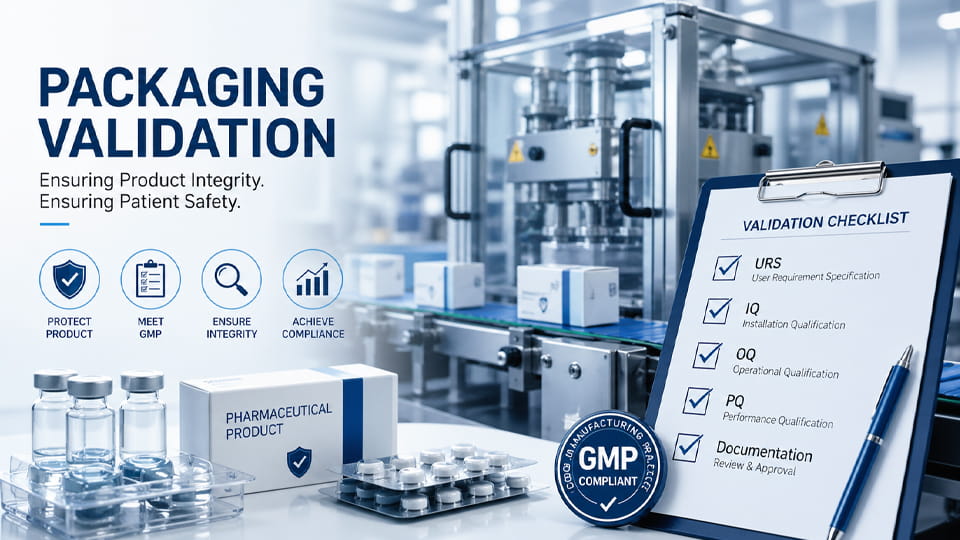
Los entregables típicos en la validación de empaques incluyen una Especificación de requisitos del usuario (URS) (el diseño & criterios de calidad), Protocolos de instalación/operacional/calificación de desempeño, y registros de pruebas. El proceso de validación cubre:
Embalaje primario (el contenedor o barrera en contacto directo con el medicamento, p.ej. viales, caries de ampolla, bolsitas)
embalaje secundario (p.ej. cajas de cartón, etiquetas, inserciones, serialización que agrupa paquetes primarios)
Embalaje terciario (contenedores de envío a granel, paletas, embalajes de cadena de frío para el transporte)
Cada nivel debe proteger el producto.. Por ejemplo, la TGA australiana define “envase primario” (el contenedor que cubre inmediatamente la mercancía) y distingue embalaje secundario como la caja exterior o envoltorio. Al final, La validación del embalaje se vincula con las GMP, lo que garantiza que Los envases y cierres no alteran el fármaco. y “proporcionar una protección adecuada contra factores externos” durante el almacenamiento y uso.
Por qué la validación de envases es fundamental en el sector farmacéutico
El embalaje farmacéutico es la defensa final de la calidad de los medicamentos. Validar los procesos de envasado es vital porque:
Garantiza la seguridad e integridad del producto: Un embalaje correctamente validado evita la contaminación, entrada de humedad, o exposición al oxígeno que podría degradar los ingredientes activos.. Por ejemplo, fugas o fallas en el sello podrían permitir la entrada de microbios o gases., estropear la esterilidad o la potencia.
Cumplimiento normativo: Agencias (FDA, EMA/I, OMS) Requiere embalaje validado.. A NOSOTROS. FDA 21 CFR 211.94 prohíbe cierres que alteren la calidad de los medicamentos y exige cierres “proporcionar una protección adecuada contra factores externos previsibles”. Anexo GMP de la UE 1 Del mismo modo insiste en que "Los contenedores deben cerrarse mediante métodos debidamente validados" (con 100% Pruebas de integridad para productos cerrados por fusión.). La OMS establece explícitamente que los sistemas de envasado deben calificarse como cualquier otro proceso GMP.. El incumplimiento puede significar recuerda, rechazos de importación o citaciones de auditoría.
Extiende la vida útil: Los materiales de embalaje y los sellos validados en condiciones de estabilidad ayudan a establecer declaraciones precisas de vida útil. La guía ICH Q1A incluso especifica que los estudios de estabilidad se realicen en el “sistema de cierre de contenedores” propuesto para el producto. Si el embalaje falla, los datos de estabilidad no son válidos.
Serialización y lucha contra la falsificación: Los envases farmacéuticos modernos a menudo incluyen serialización, sellos a prueba de manipulaciones, y funciones antifalsificación. Validando estas características (p.ej. escaneabilidad de códigos de barras, integridad de las cintas antisabotaje) ayuda a asegurar la cadena de suministro. Un error en el etiquetado o la serialización puede bloquear el lanzamiento del producto.
Calidad y rentabilidad: Las líneas validadas eficientes reducen los defectos (llena mal, errores de etiqueta, cajas trituradas) y chatarra. Inspecciones automatizadas (sistemas de visión para control de sellos/etiquetas) A menudo son parte de controles validados.. En general, Los procesos de embalaje validados minimizan el riesgo para el paciente y garantizan un suministro constante de productos eficaces., medicinas autenticas.
Impulsores clave para la validación
Seguridad del Paciente: Un embalaje inadecuado puede dañar a los pacientes (p.ej. inyectables contaminados). La validación documenta la barrera de seguridad..
Mitigación de riesgos regulatorios: Los procesos no validados tienen alto riesgo de retiros o sanciones. Los reguladores esperan datos de calificación para cada línea de producción.
Distribución global: Cumpliendo con los estándares internacionales (FDA/EMA/OMS) Requiere embalaje validado en todos los mercados..
Continuidad del negocio: Fallos de embalaje en la distribución del producto residual y en el tiempo.. La validación garantiza “bien a la primera” operación bajo GMP.
Preparación para la auditoría: Las auditorías realizadas por autoridades de calidad o reguladores de clientes revisarán los registros de validación de envases y las calificaciones de los equipos como parte de las inspecciones GMP..
Alcance de la validación de envases farmacéuticos
La validación del embalaje aborda todas las etapas del embalaje.. Típicamente, distinguimos:
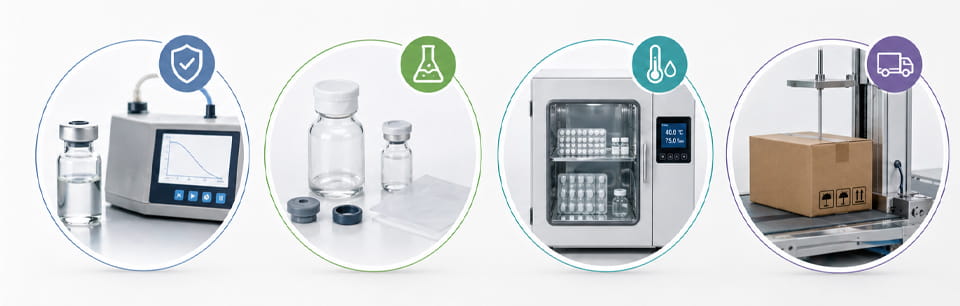
Validación del embalaje primario: Se centra en el cierre del contenedor. (viales, ampollas, caries de ampolla, botellas). Las pruebas incluyen la integridad del sello., compatibilidad de material (extraíbles/lixiviables) y rendimiento del cierre de contenedores. Para productos estériles, Pruebas de integridad del cierre de contenedores. (CCIT) son obligatorios para garantizar el mantenimiento de la esterilidad.
Validación de embalaje secundario: Cubre el paquete exterior inmediato. (cajas de cartón, etiquetas, folletos, desecantes). Esto incluye comprobaciones de legibilidad/precisión de las etiquetas., pruebas de caída de cartón, y pruebas de compresión de cajas (para transporte). La verificación de etiquetas garantiza que la información correcta del paciente se aplique de manera consistente.
Validación de envases terciarios: Implica embalaje a granel/transporte. Aquí, pruebas de rendimiento como vibración, gota, y ciclos térmicos (cadena de frio) Simule las tensiones de envío para verificar que las paletas y cajas de envío mantengan la integridad y el etiquetado del producto durante la distribución.. Protocolos estándar como ASTM D4169 (simulación de transporte) se utilizan a menudo.
Cada nivel requiere una evaluación de riesgos y pruebas adecuadas.: Por ejemplo, primario El embalaje puede implicar USP <1207>-pruebas de integridad de estilo, mientras secundario Las pruebas de embalaje pueden incluir la resistencia del cartón y la adherencia de las etiquetas., y terciario El embalaje utiliza protocolos de prueba ISTA/ASTM.. Todo debe estar documentado en el plan de validación..
Pasos clave en el proceso de validación de envases
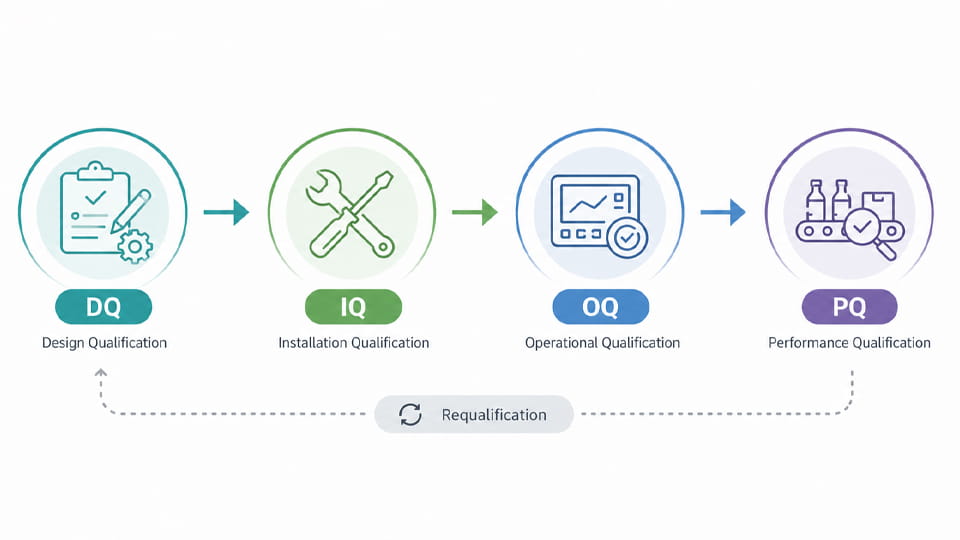
La validación del embalaje suele seguir el ciclo de vida de calificación del equipo/proceso., a menudo descrito como DQ/IQ/OQ/PQ. Estas etapas garantizan que una línea de envasado nueva o modificada cumpla con los requisitos en cada etapa..
Calificación de diseño (DQ): Fase inicial donde se evalúa el diseño frente a la URS. (Especificación de requisitos del usuario) y directrices GMP. Todos los aspectos del diseño. (funciones de la máquina, materiales, facilidad de limpieza, compatibilidad con el producto/materiales de embalaje) son revisados. Los documentos incluyen el URS y las especificaciones de diseño. (Especificación de diseño funcional FDS, Especificaciones de diseño de hardware/software). A menudo una evaluación de riesgos (p.ej. DFMEA) Se hace para anticipar los modos de falla del empaque..
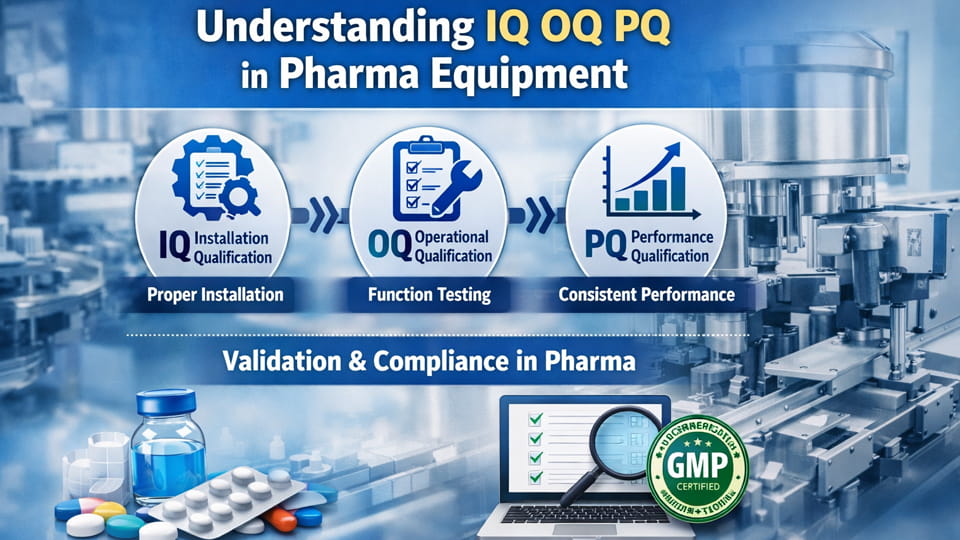
Calificación de instalación (coeficiente intelectual): Verifica que la máquina/línea esté instalada correctamente según las especificaciones del proveedor.. IQ incluye una lista de verificación que verifica la ubicación correcta, utilidades (fuerza, aire, agua), condiciones ambientales, y montaje adecuado. Todos los componentes están presentes y sin daños.. Se comprueba la calibración de los dispositivos de medición.. Entregables: Protocolos e informe de coeficiente intelectual., certificados de calibración.
Calificación operativa (OQ): Verifica que la máquina funcione según lo previsto en todas las condiciones especificadas.. Parámetros críticos (rangos de velocidad, temperaturas, presiones, niveles de vacío, esfuerzo de torsión, etc.) son desafiados en configuraciones mínimas/máximas o en el peor de los casos. Las pruebas en OQ podrían incluir sellado a velocidades extremas, funciones de sensor/alarma, cambios de velocidad del transportador, precisión de la etiquetadora, precisión de la bomba de llenado. El protocolo OQ registra que cada prueba funcional cumple con los criterios de aceptación..
Calificación de desempeño (PQ): Demuestra que en condiciones normales de producción, La línea produce constantemente productos que cumplen con las especificaciones de calidad.. La PQ se realiza en cantidades/lotes de producción reales.. Incluye ejecutar la línea durante un tiempo o cantidad definida y muestrear la salida.. Actividades típicas: ejecutando múltiples cajas de blister, botellas o bolsitas y realizar pruebas de control de calidad en muestras (P.EJ., integridad del cierre del contenedor (CCIT), controles de peso, inspección visual de defectos, fuerza del sello). PQ muestra que la línea puede funcionar continuamente manteniendo la calidad del producto.
La siguiente tabla resume las etapas DQ – IQ – OQ – PQ.:
Escenario
Objetivo
Documentos clave
Ejemplos de actividades/pruebas
Calificación de diseño (DQ)
Verificar que el diseño del sistema de embalaje cumpla con URS/GMP
URS (especificación de requisitos), especificaciones de diseño (FDS/HDS/SDS), Evaluación de riesgos
Revisión de diseño, comprobaciones de compatibilidad de materiales, DFMEA
Calificación de instalación (coeficiente intelectual)
Confirmar la instalación adecuada del equipo.
Protocolo/lista de verificación de coeficiente intelectual, registro de instalación, certificados de calibración
Verificar servicios públicos, montaje de equipos, calibración
Calificación operativa (OQ)
Verificar las funciones del equipo dentro de límites definidos
protocolo de calidad, planes de pruebas funcionales, Sops
Parámetros de prueba (velocidad, temperatura, presión); controles de sello
Calificación de desempeño (PQ)
Garantice una calidad constante durante los ciclos de producción.
protocolo PQ, registros de lotes, criterios de liberación
Ejecuciones de producción; prueba de muestra (CCIT, peso de relleno, inspección visual)
Como muestra el diagrama, La validación del embalaje es un proceso de ciclo de vida desde el diseño hasta el rendimiento.. Tenga en cuenta que recalificación puede ser necesario después de cambios importantes o periódicamente.
Pruebas clave en la validación de envases
Normalmente se realizan varias pruebas especializadas durante la validación del embalaje.:
Pruebas de integridad del cierre de contenedores (CCIT)
CCIT es esencial para productos estériles e incluso no estériles. Evalúa si el sistema de cierre de contenedores (p.ej. tapón+frasco+tapa, ampolla, sello de ampolla) forma una barrera perfecta. Los métodos incluyen la descomposición del vacío., caída de presión, ingreso de tinte, o desafío microbiano. Como explica una fuente de la industria, “Pruebas de integridad del cierre de contenedores (CCIT) Es un ensayo que evalúa la idoneidad de los sistemas de cierre de contenedores para mantener una barrera estéril contra posibles contaminantes”.. Documentos regulatorios (USP <1207>, FDA, Anexo EMA 1) enfatizar las pruebas de integridad del cierre para garantizar que no haya fugas ni infracciones. Por ejemplo, USP <1207> proporciona pautas sobre la selección de métodos de prueba de fugas para certificar paquetes sellados.
Pruebas de compatibilidad de materiales (Extraíbles/Lixiviables)
Materiales de embalaje (plástica, gomas, tintas, adhesivos) no debe interactuar negativamente con el medicamento. Extraíbles y lixiviables Los estudios simulan el contacto a largo plazo.: Los extraíbles son sustancias químicas expulsadas de los envases en condiciones adversas., y los lixiviables son aquellos que realmente migran al producto en condiciones normales.. Estas pruebas garantizan que el embalaje no introduzca impurezas tóxicas o que afecten a la estabilidad.. Guía de la farmacopea y de la FDA (p.ej. USP <661>, Q3E) describir las pruebas E/L para sistemas de cierre de contenedores. En la práctica, se comprueba que el polímero, revestimientos, y los materiales de las etiquetas cumplen con los estándares de la farmacopea (p.ej. Tipo de vidrio USP, Especificaciones de cierre de goma ISO). La OMS señala que las normas de la farmacopea para los cierres (como tapones de goma) son “requisitos mínimos” y enfatiza los estudios de estabilidad para demostrar la idoneidad.
Pruebas de estabilidad en envases
Según ICH Q1A, estudios de estabilidad debe realizarse en el producto farmacéutico en su configuración de embalaje final. Durante la validación, Se evalúa el impacto del embalaje en la estabilidad.: Por ejemplo, El embalaje final se somete a un envejecimiento acelerado. (alta temperatura/humedad) y condiciones en tiempo real para garantizar que no haya degradación (p.ej. Entrada de humedad en blisters., permeación de oxígeno en botellas). Ensayos indicadores de estabilidad. (químicos y microbianos) se realizan. El embalaje que no protege el producto bajo estrés invalida las declaraciones de vida útil. De este modo, La validación incluye confirmar que el embalaje elegido cumple con los requisitos de vida útil. (esto se superpone con los protocolos de estabilidad regulatoria).
Pruebas de transporte y distribución
Embalaje terciario Las pruebas simulan las condiciones de envío reales.. Las pruebas estándar incluyen pruebas de altura de caída., vibración (simulación de camión/ferrocarril), compresión (peso de apilamiento), y ciclos de temperatura (especialmente para cadena de frío). Por ejemplo, Norma ASTM D4169 (para productos envasados) o se pueden utilizar protocolos ISTA. Un sólido plan de validación de envases verifica que las cajas, Los estuches y cajas protegen los paquetes primarios durante su manipulación.: verificando que no haya roturas, pelado de etiquetas, o se producen daños por humedad en las condiciones de distribución. Para cadena de frío, El mapeo de temperatura y los transportistas aislados validados se prueban para mantener los rangos de temperatura requeridos durante el tránsito..
Normas y directrices reglamentarias
La validación de envases farmacéuticos debe cumplir múltiples expectativas regulatorias:
Regulaciones cGMP: en los estados unidos, FDA 21 Parte CFR 211 (subparte J) rige envases y cierres. Sección 211.94(anuncio) especifica que los contenedores/cierres no pueden alterar la calidad del medicamento y deben proteger contra la contaminación previsible.
BPF de la UE: directrices europeas (EudraLex Vol.. 4) exigir que "Los contenedores deben cerrarse mediante métodos debidamente validados" (Anexo 1) y que los procesos de envasado sigan las GMP (Anexo 15 en validación). Anexo GMP de la UE 11 exige la validación del sistema computarizado (incluyendo líneas de envasado con controles electrónicos).
BPM de la OMS: Serie de informes técnicos de la OMS 902 (Anexo 9) Indica explícitamente que el equipo de embalaje necesita validación como cualquier otro paso del procesamiento.. La OMS también proporciona orientación sobre la integridad de los paquetes. (similar a UE/ICH).
Directrices del PCI: Aunque el PCI (P7, P8, P9, Q10) no tener un documento de validación de embalaje específico, exigen gestión de riesgos (P9) y calidad por diseño (P8/P10) principios que se aplican. Por ejemplo, Evaluación de riesgos (Yo Q9) debe cubrir los atributos del empaque (tipo de cierre, control de etiquetas) que afectan los CQA del producto.
Estándares: Para productos estériles, ISO 11607 (para embalaje de dispositivos médicos esterilizados terminalmente) A menudo se utiliza por analogía.; Parte 2 de ISO 11607 define los requisitos de validación para los procesos de formado/sellado, que es relevante para los blisters o ampollas de medicamentos parenterales. Farmacopeas (USP, Ph. euros.) También contiene capítulos de prueba de embalaje. (p.ej. USP <381> para cierres de goma, <1207> para pruebas de fugas).
En resumen, cualquier línea de envasado debe cumplir con la farmacopea nacional y las normas GMP regionales. Las listas de verificación de cumplimiento suelen citar a la FDA, BPF de la UE, OMS y normas ISO pertinentes, y a menudo exigen POE y planes maestros de validación completamente documentados que cubran el embalaje..
Desafíos comunes en la validación de envases
La validación de envases plantea desafíos únicos en comparación con los procesos de fabricación.:
Tipo de datos y muestreo: El éxito de la línea de envasado a menudo está determinado por resultados discretos (p.ej. pasa/no pasa por un sello, lágrima) en lugar de mediciones continuas. Como señala un experto, “el tipo de datos obtenidos…crea un desafío importante. El éxito o el fracaso a menudo están determinados por los defectos. (lágrimas, agujeros, manchas, o sellos con fugas)… Esta falta de medidas (variable) Los datos a menudo requieren tamaños de muestra muy grandes para que un proceso de envasado sea validado estadísticamente”.. En otras palabras, Es posible que necesite muchas muestras para demostrar la confiabilidad..
Variedad de tecnología: Hay muchas tecnologías de embalaje. (ampollas, cartón, etiquetadoras, empacadoras de cajas, etc.) de diferentes proveedores. Cada uno tiene diferentes perfiles de riesgo., haciendo imposible un plan de validación único.
Control de cambios: Las líneas de envasado suelen procesar muchos tipos de productos. (tabletas, líquidos, polvos) y tamaños de envase en el mismo equipo (usando piezas de cambio o formatos). Cada cambio puede requerir una revalidación o un paréntesis en el plan de validación.. Manejando esto (el matriz de validación) puede ser complejo.
Controles ambientales: algunos envases (p.ej. Envasado en blíster de medicamentos sensibles a la humedad.) Requiere humedad controlada o atmósfera inerte.. Validar estos controles añade complejidad.
Integración con el proceso upstream: La validación del embalaje depende de la coherencia ascendente. Si los gránulos del medicamento varían en tamaño, El cambio de máquina de embalaje puede verse afectado. (p.ej. llenar mermelada). Esta interdependencia puede complicar el análisis de la causa raíz de las fallas del empaque..
Serialización/seguimiento: Regulaciones modernas (p.ej. DSCSA, Fiebre aftosa de la UE) requieren serialización y trazabilidad. Garantizar que las líneas automatizadas realicen un seguimiento adecuado de cada unidad (y validar esa captura de datos) añade una capa adicional de calificación (validación de software, pruebas de escáner de código de barras, comprobaciones de bases de datos).
Ambigüedad regulatoria: Paradójicamente, existe una guía limitada y explícita de la FDA/EMA únicamente sobre la "validación de envases","Por lo tanto, las empresas a menudo deben interpretar las GMP generales y las pautas de validación de procesos para el embalaje.. Esto puede causar incertidumbre sobre el alcance exacto o las pruebas necesarias..
A pesar de estos desafíos, el principio subyacente permanece: Trate el embalaje como cualquier otro proceso crítico., con cualificación exhaustiva y controles de calidad sólidos. Como concluye el documento ISPE, validación de embalaje "diferir de(s) poco de la validación de los procesos utilizados para la fabricación de medicamentos”..
Mejores prácticas para la validación de envases farmacéuticos
Para superar los desafíos y asegurar una validación exitosa, siga estas mejores prácticas:
Evaluación temprana de riesgos: Utilice la gestión de riesgos de calidad (Yo Q9) desde la fase de diseño. Identificar los atributos críticos del embalaje (p.ej. esterilidad, evidencia de manipulación, protección de la luz) y priorizar las pruebas en consecuencia. Un modo de fracaso & Análisis de efectos (AMEF) Se recomienda durante DQ para planificar el alcance de la validación..
Especificaciones de requisitos del usuario (URS): Documente claramente todos los requisitos por adelantado: capacidad de producción, formatos de paquete, puntos de integración (p.ej. vinculación de una máquina blister a una estuchadora), condiciones ambientales, requisitos de limpieza. Un URS bien definido mantiene la validación en marcha.
Procedimientos operativos estándar (Sops): Mantener SOP detallados para la operación del equipo., limpieza, cambio, y mantenimiento. La validación debe hacer referencia a estos POE para garantizar un uso coherente..
Inspección y controles automatizados: Incorporar controles de calidad en línea (p.ej. sistemas de visión para inspección de impresiones/etiquetas, controladoras de peso, escáneres de códigos de barras, detectores de fugas). Estas no son sólo herramientas de control de calidad, sino que también forman parte de la validación mediante la detección de defectos en tiempo real..
Documentación completa: Preparar un plan maestro de validación que describa la estrategia., y asegurar todos los protocolos de calificación (IR/WH/PQ) tener criterios de aceptación claros. Mantenga registros detallados de todas las ejecuciones, desviaciones, y vuelve a probar. Utilice listas de verificación para asegurarse de que no se pase nada por alto.
Formación y personal: Los operadores y el personal de control de calidad deben estar capacitados tanto en el equipo como en los procedimientos de validación.. Sólo personal calificado debe realizar pruebas de validación y registrar los resultados..
Software y registros electrónicos: Para controles computarizados, seguir la FDA 21 CFR Parte 11/Anexo GMP 11: validar software, pistas de auditoría, firmas electrónicas (garantizar la seguridad, copias de seguridad). Incluso las líneas de envasado no estériles suelen tener PLC/HMI que necesitan validación.
Diseño para validación: Siempre que es posible, Elija máquinas con características que simplifiquen la validación.: p.ej. servoaccionamientos con controles digitales (para precisa, parámetros reproducibles), marcos higiénicos de acero inoxidable (para una fácil limpieza), piezas de fácil cambio (para reducir el esfuerzo de limpieza entre formatos), y diseño modular (para limitar el número de configuraciones que requieren pruebas).
Verificación continua: La validación del empaque no es algo que se realiza una vez y se hace. Implementar activadores de revisión periódica o revalidación. (p.ej. después de un mantenimiento mayor, actualizaciones de equipos, o deriva significativa del proceso). Utilice el control estadístico de procesos (proceso estadístico) en métricas clave (variación del peso de relleno, tasa de defectos) para captar las tendencias temprano.
Integridad de datos: Aplicar los principios de ALCOA+: todos los datos de validación (registros de prueba, Informes de control de calidad, calibraciones) debe ser atribuible, legible, contemporáneo, original, y preciso. Utilice cuadernos encuadernados o sistemas electrónicos validados..
Al incorporar el pensamiento de validación en cada etapa, desde el diseño hasta la operación diaria, los fabricantes pueden garantizar que las líneas de envasado entreguen productos que cumplan con las expectativas de calidad y cumplimiento..
Papel de las máquinas de embalaje en la validación
La elección y el diseño del equipo de envasado influyen en gran medida en el éxito de la validación.. Las máquinas de envasado de alta calidad están diseñadas para cumplir con los requisitos GMP y admitir una calificación sencilla.. Por ejemplo, Jinlu Packing’s Las máquinas automatizadas están construidas con características que agilizan la validación.:
Precisión y consistencia: de Jinlu máquinas de ampolla, Los estuchadores y llenadores utilizan servomotores y mecánicas precisas para garantizar una presión de termosellado constante., llenar volúmenes, e indexación. Esta repetibilidad es crucial para pasar las pruebas de OQ y PQ. (p.ej. El dispositivo de alimentación servoaccionado proporciona “posicionamiento preciso” en su línea de ampolla).
Diseño higiénico: Los materiales y superficies son acero inoxidable o plásticos que cumplen con la FDA., diseñado para una fácil limpieza. Liso, Las superficies inclinadas evitan que se acumule polvo.. Esto respalda el cumplimiento de GMP y simplifica la validación de la limpieza..
Adaptabilidad a formatos: Jinlu ofrece alimentadores y rieles guía personalizados para diferentes tipos de paquetes (ver Comederos personalizados en páginas de productos). Tener las herramientas adecuadas reduce la variación y acelera el cambio de formato., lo que reduce las necesidades de recalificación al cambiar de formato.
Controles integrados: Las líneas modernas de Jinlu tienen controles PLC/HMI que pueden generar registros de lotes electrónicos. Por ejemplo, La máquina llenadora de líquidos tiene un AI Siemens PLC/HMI por sencillo, operación rastreable. Estos controles digitales admiten el registro de datos. (en línea con 21 CFR Parte 11/Anexo 11) – crucial para validar que los puntos de ajuste y las alarmas funcionen según lo diseñado.
Documentación de validación: Jinlu proporciona documentación completa (Hojas de datos, manuales, etc.). Por ejemplo, su lista de páginas de productos “Conjunto completo de documentos técnicos” y enfatizan el suministro de documentación detallada de diseño y pruebas.. Un proveedor dispuesto a realizar una prueba de aceptación en fábrica. (GORDO) protocolos o kits IOQ alivian enormemente la carga de validación del usuario.
Certificaciones de calidad: Máquinas de transporte Jinlu CE, cGMP y otras certificaciones, indicando que cumplen ciertos estándares de calidad y seguridad (vea el logotipo de cGMP en las imágenes de especificaciones del producto). El uso de equipos certificados puede agilizar la revisión regulatoria.
En la práctica, una línea de envasado validada podría incluir: un jinlu máquina empacadora de blister vinculado a un máquina estuchadora y líneas de conteo/llenado. Cada equipo debe estar calificado. (IR/WH/PQ). Los sistemas de Jinlu están diseñados para funcionar juntos a la perfección (p.ej. “Línea de estuchado de blister altamente automatizada” arriba a 320 cajas/min), reducir los problemas de integración durante la validación. También ofrecemos estudios de caso. (p.ej. un completo línea de conteo y embotellado, o un estuchado automático & línea de etiquetado) que demuestran soluciones validadas de extremo a extremo.
Máquina empacadora de blister con rodillos DPH-270Max
Al asociarse con Jinlu o fabricantes similares, Las empresas se benefician de equipos que son “Cumple con las buenas prácticas de fabricación”, admite un ciclo de vida de validación completo, y viene con soporte postventa (puesta en marcha, capacitación) para garantizar que la línea permanezca validada.
Conclusión
Validación de embalaje Es esencial para la calidad y el cumplimiento farmacéutico.. Tratando las operaciones de embalaje con el mismo rigor que los pasos centrales de fabricación., Las empresas garantizan que sus productos lleguen a los pacientes de forma segura.. El proceso abarca la definición. (URS, Evaluación de riesgos), calificación (DQ/IQ/OQ/PQ), pruebas (CCIT, estabilidad, transporte), y seguimiento continuo. Se rige por la normativa GMP. (FDA, EMA, OMS) y estándares de la industria.
Los equipos de envasado automatizados modernos, como las máquinas de Jinlu Packing, desempeñan un papel clave en la validación.. Diseñado para precisión, higiene y trazabilidad electrónica, ayudan a los fabricantes a cumplir los criterios de validación de manera eficiente. Al seleccionar líneas de envasado, Considere proveedores que brinden soporte y documentación de validación completa..
Al final, La validación exhaustiva del embalaje es “la salvaguardia final para la calidad del producto y la seguridad del paciente”, alinearse tanto con las demandas regulatorias como con los objetivos comerciales.
Preguntas frecuentes sobre la validación de envases en la industria farmacéutica
¿Cuál es la diferencia entre validación de empaque y validación de proceso??
La validación del proceso generalmente se refiere a los pasos que producen la sustancia farmacológica o el producto farmacéutico a granel. (p.ej. mezclando, granulación, compresión). La validación del embalaje aplica específicamente principios de validación a las operaciones de embalaje. (caza de focas, etiquetado, llenado de cartón, etc.). Sin embargo, Ambos siguen el mismo ciclo de vida DQ/IQ/OQ/PQ y requisitos GMP.. Esencialmente, La validación del embalaje garantiza el proceso de embalaje. (no sólo el proceso de fabricación) cumple consistentemente con los requisitos de calidad.
¿Qué pruebas se requieren para la validación de envases farmacéuticos??
Las pruebas clave incluyen la integridad del cierre del contenedor. (CCIT) para verificar sellos, compatibilidad de material (estudios de extraíbles/lixiviables), pruebas de estabilidad (medicamento en paquete final bajo estrés), y pruebas de distribución (choque, vibración, temperatura de tránsito). Verificaciones adicionales cubren la precisión de la etiqueta, sistemas de inspección visual, peso/control de peso, y cualquier prueba específica del contrato (p.ej. fuerza de la película estéril). Todas las pruebas deben tener criterios de aceptación predefinidos y estar documentadas..
¿Cuánto tiempo suele tardar la validación del embalaje??
El cronograma depende de la complejidad. (número de formatos, equipo, sitios). Un IQ/OQ/PQ de una sola línea podría variar desde unas pocas semanas hasta un par de meses.. Factores: el número de pruebas de parámetros OQ, tamaños de muestra requeridos en PQ, y tiempo para la ejecución de la prueba (p.ej. la estabilidad en condiciones aceleradas lleva semanas). Planificación de actividades paralelas (como preparar protocolos mientras llega el equipo) puede ahorrar tiempo.
¿Qué documentos rigen la validación del embalaje??
Las referencias principales son las regulaciones GMP.: 21 Parte CFR 211 (FDA de EE. UU.), EudraLex Vol.. 4 (BPF de la UE, Anexo 1 y 15), y Anexo GMP de la OMS 9. ICH Q7/Q10 proporciona principios generales de validación, ICH Q9 cubre la gestión de riesgos para las decisiones sobre embalaje, y ISO 11607-2 se aplica a la validación del proceso de paquetes estériles. Estándares farmacopeicos (USP, Ph. euros.) y directrices locales (p.ej. ANMP china, India Lista M) también influyen en los requisitos de embalaje. Alinearse siempre con las regulaciones del mercado objetivo.
¿Cómo admite Jinlu Packing la validación del embalaje??
Las máquinas de envasado de Jinlu están diseñadas para GMP. Proporcionan documentos de diseño. (URS, FDS), certificados de calibración, y soporte OQ/PQ. Su equipo (máquinas de ampolla, cartón, líneas de llenado) Cuenta con servocontrol preciso y diseño higiénico para cumplir con las especificaciones de validación.. Como se muestra en el sitio de Jinlu, Las máquinas llevan logotipos cGMP/CE y vienen con conjuntos de documentación técnica.. Jinlu también ofrece soporte de instalación y validación., soluciones personalizadas, y formación para ayudar a implementar líneas de envasado validadas. Para más información, consulte las páginas de la máquina empacadora de blister o de la máquina estuchadora de Jinlu.
Petty Fu, Fundador de Jinlupacking, trae 20 años de experiencia al sector de maquinaria farmacéutica. Bajo su liderazgo, Jinlu se ha convertido en un proveedor confiable que integra diseño, producción, y ventas. A Petty le apasiona compartir su profundo conocimiento de la industria para ayudar a los clientes a navegar las complejidades del empaque farmacéutico., garantizar que reciban no sólo equipos, sino una verdadera asociación de servicio integral adaptada a sus objetivos de producción..