
Φανταστείτε ότι έχετε ανεβάσει την ταχύτητα στο δικό σας περιστροφική μηχανή πρέσας ταμπλετών (μηχανή συμπίεσης χαπιών ή μηχανή συμπίεσης δισκίων) για να αυξήσετε την απόδοση – και ξαφνικά τα tablet αρχίζουν να γίνονται μαλακά, ραγισμένος, ή κάλυψη. Τι συνέβη? Σε περιστροφική πρέσα υψηλής ταχύτητας, χρόνος παραμονής – ο χρόνος που περνά κάθε ταμπλέτα υπό τη μέγιστη συμπίεση – έχει συρρικνωθεί. Ο χρόνος παραμονής είναι απλώς η περίοδος κατά την οποία η επίπεδη κεφαλή διάτρησης βρίσκεται σε πλήρη επαφή με τον κύλινδρο συμπίεσης. Με πρακτικούς όρους, είναι τα χιλιοστά του δευτερολέπτου συμπίεσης που δέχεται κάθε δισκίο. Ελέγξτε καλά τον χρόνο παραμονής, και γίνεσαι δυνατός, σταθερά δισκία; βιάσου, και κινδυνεύετε με ελαττώματα.
Ο χρόνος παραμονής στη συμπίεση του tablet είναι μια κρίσιμη παράμετρος. Επηρεάζει άμεσα τη σκληρότητα του tablet, αντοχή σε εφελκυσμό, και ποσοστά ελαττωμάτων (σαν καπάκι, λεπτό έλασμα, ή ευθρυπτότητα). Συνδέεται επίσης με την ταχύτητα πίεσης και επιλογές εργαλείων. Σε αυτό το άρθρο, θα αναλύσουμε τι είναι ο χρόνος παραμονής, πώς υπολογίζεται, γιατί έχει σημασία για την ποιότητα του tablet, και πώς μπορείτε να το διαχειριστείτε στην περιστροφική μηχανή tablet σας (μηχανή κατασκευής tablet). Θα μοιραστούμε γνώσεις του κλάδου και πρόσφατες μελέτες για να σας δώσουμε μια ξεκάθαρη εικόνα – χωρίς την ορολογία του σχολικού βιβλίου. Ας βουτήξουμε.
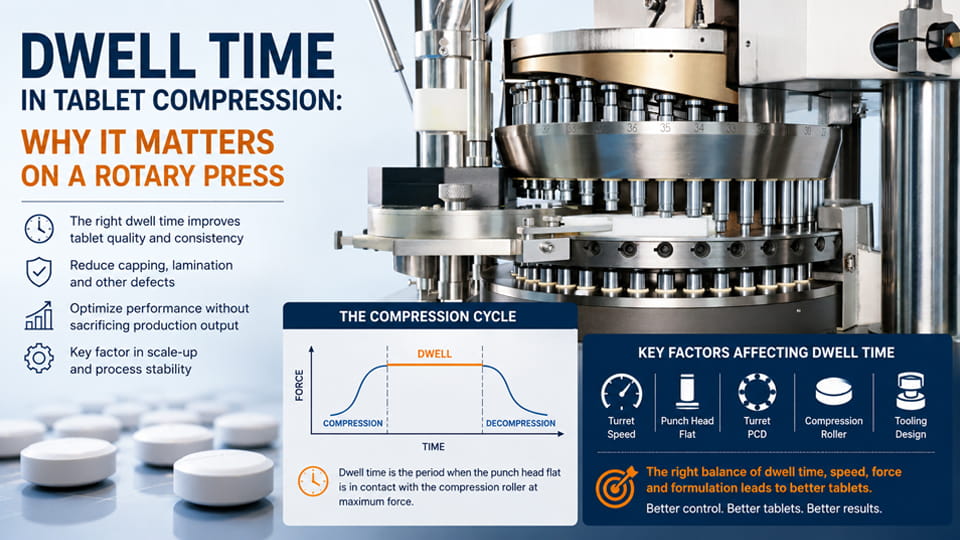
Ώρα παραμονής είναι ο χρόνος που η επίπεδη κεφαλή διάτρησης παραμένει σε επαφή με τον κύλινδρο συμπίεσης κατά τον σχηματισμό του δισκίου. Ένας κοινός ορισμός είναι: η περίοδος κατά την οποία η δύναμη συμπίεσης είναι πάνω από περίπου 90% της μέγιστης αξίας του. Σε περιστροφική μηχανή πρέσας ταμπλετών, που συμβαίνει αμέσως μετά το γέμισμα σε σκόνη και προ-συμπίεση, όταν και οι δύο γροθιές κλειδώνουν με πλήρη δύναμη και συμπιέζουν τη σκόνη.
Για παράδειγμα, μια πρέσα μηχανής tablet JinLu (410 mm PCD) τρέχει σε 50 RPM με στάνταρ 9.525 χιλ. γροθιά επίπεδη δίνει περίπου 8.9 ms της κατοικίας. Εάν κάνετε εναλλαγή σε εκτεταμένο 15 mm επίπεδη (ίδια ταχύτητα), dwell άλματα στα ~14,0 ms – περίπου α 50% αύξηση. Μπορείτε να δείτε πώς ο σχεδιασμός του εργαλείου παίζει μεγάλο ρόλο.
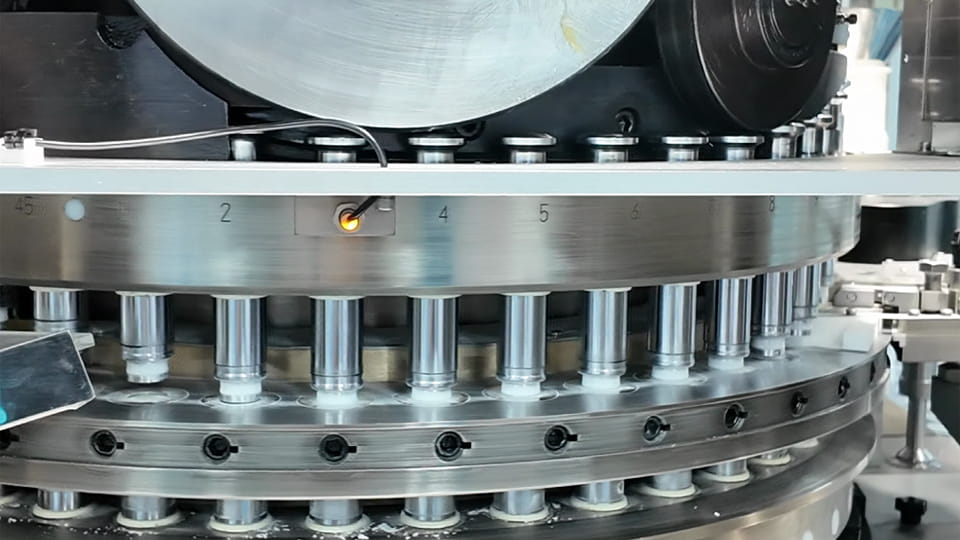
Σε περιστροφική πρέσα ταμπλετών, ταχύτητα πυργίσκου (Στροφές) και ο χρόνος παραμονής συνδέονται αντιστρόφως. Όσο πιο γρήγορα περιστρέφεται ο πυργίσκος, τόσο μικρότερος είναι ο χρόνος παραμονής ανά γροθιά. Σκεφτείτε το σαν κλείστρο κάμερας: τόσο πιο γρήγορα κινείται, τόσο λιγότερο χρόνο έχει κάθε λήψη για να εκτεθεί. Σε μια μηχανή tablet πολλαπλών σταθμών , όλες οι διατρήσεις περνούν κάτω από τον κύλινδρο μία φορά ανά περιστροφή του πυργίσκου, έτσι:
Για παράδειγμα, ένα πιεστήριο στο 30 RPM μπορεί να δώσει 15 ms κατοικώ (απλώς ως παράδειγμα), αλλά στο 60 RPM θα ήταν μόνο ~7,5 ms. Πολλοί κατασκευαστές tablet σημειώνουν αυτόν τον συμβιβασμό: επιταχύνετε το μηχάνημα, και τα tablet μπορεί να γίνουν πιο μαλακά ή να αρχίσουν να κλείνουν, εκτός αν προσαρμόσετε κάτι άλλο. Όπως επισημαίνει ένας οδηγός Jinlu, «Μεγαλύτερη ταχύτητα πυργίσκου σημαίνει μικρότερο χρόνο συμπίεσης, οπότε μπορεί να χρειαστεί περισσότερη προ-συμπίεση για να αντισταθμιστεί η απώλεια παραμονής». Εν συντομία, Η ώθηση των στροφών ανά λεπτό για έξοδο έρχεται σε βάρος του χρόνου παραμονής – μια βασική ποιότητα έναντι. ισοζύγιο ποσότητας.
Ο χρόνος παραμονής έχει σημασία γιατί ελέγχει πόσο καιρό το κρεβάτι σκόνης βρίσκεται υπό τη μέγιστη πίεση. Η μεγαλύτερη παραμονή επιτρέπει στα σωματίδια να παραμορφωθούν, τακτοποιώ, και δέσουμε πιο διεξοδικά. Πολύ σύντομο, και τα δισκία μπορεί να μην σχηματίζουν ισχυρούς δεσμούς. Εδώ είναι οι κύριοι λόγοι για τους οποίους ο χρόνος παραμονής είναι μια κρίσιμη παράμετρος στη συμπίεση του tablet:
Σημείο κλειδί: Ο χρόνος παραμονής είναι ένας από τους βασικούς παράγοντες (με δύναμη συμπίεσης και σύνθεση) που καθορίζει την ποιότητα του tablet. Οι κατασκευαστές συχνά επιλύουν προβλήματα τροποποιώντας το dwell: «Πολλά σκευάσματα δισκίων είναι ευαίσθητα στην παραμονή και απαιτούν περισσότερο χρόνο συμπίεσης για να διασφαλιστεί ότι αποκολλώνται από την πρέσα χωρίς σφάλματα». Εν ολίγοις, Ο κατάλληλος χρόνος παραμονής βοηθά στην επίτευξη της σκληρότητας του στόχου ενώ αποφεύγεται ελαττώματα όπως πώμα ή ρωγμές.
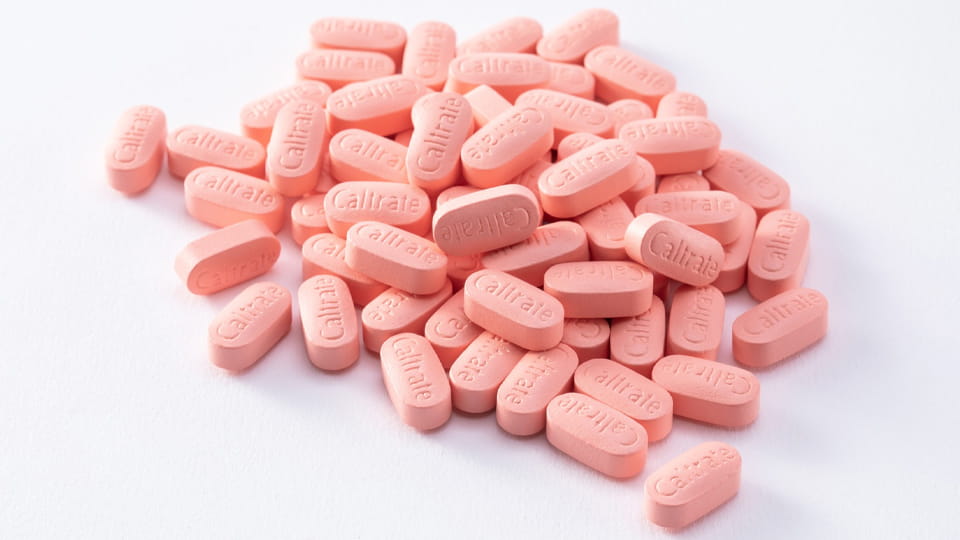
Όταν ο χρόνος παραμονής είναι πολύ μικρός για μια δεδομένη σύνθεση, μπορεί να εμφανιστούν κοινά ελαττώματα του tablet. Με απλούς όρους, η σκόνη δεν παίρνει αρκετό χρόνο συμπίεσης. Ορισμένες επιδράσεις περιλαμβάνουν:
Ωστόσο, είναι σημαντικό να σημειωθεί ότι το αποτέλεσμα μπορεί να είναι εξαρτώμενο από υλικό. Μια πρόσφατη μελέτη που χρησιμοποιεί έναν προσομοιωτή συμπίεσης διαπίστωσε ότι εντός του πραγματικού εύρους χρόνου παραμονής των σύγχρονων πιεστηρίων (περίπου 10-100 ms), ο αντίκτυπος στην ισχύ του tablet μπορεί να είναι “οριακό έως ανύπαρκτο ανάλογα με το υλικό”. Με άλλα λόγια, για ορισμένα υλικά, υπάρχει ένα όριο πέρα από το οποίο η επιπλέον παραμονή δεν αλλάζει πολύ. Η μελέτη αυτή καταλήγει μάλιστα ότι στην πράξη μόνο ρυθμός παραμόρφωσης (ταχύτητα) θέματα σε ρεαλιστικό χρονοδιάγραμμα. Αλλά γενικά, εάν τα tablet σας αρχίσουν να εμφανίζουν ρωγμές, μαλακά σημεία, ή ανομοιόμορφες ιδιότητες όταν επιταχύνετε την πίεση, Ο συντομευμένος χρόνος παραμονής είναι συχνά ο ένοχος.
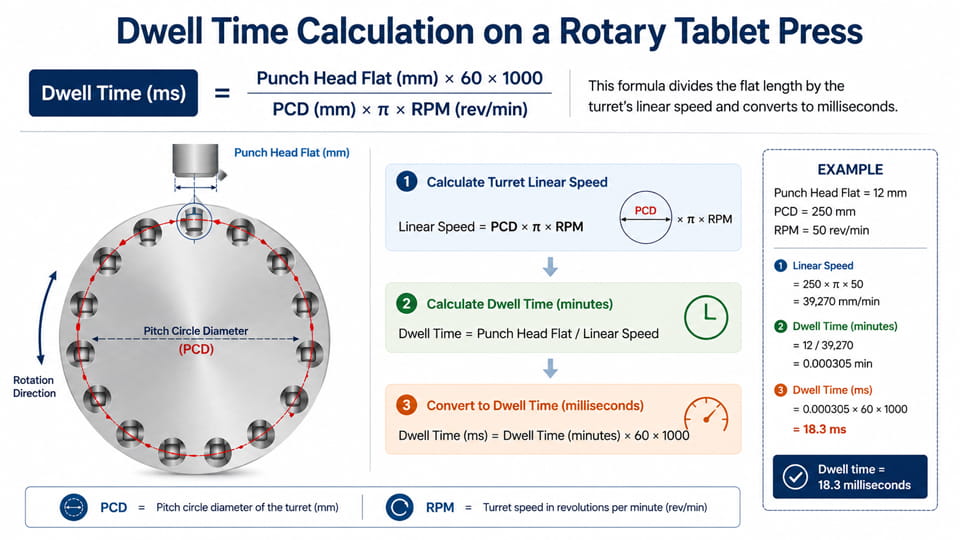
Δεδομένου ότι ο χρόνος παραμονής εξαρτάται από τη γεωμετρία και την ταχύτητα της διάτρησης, μπορούμε να το υπολογίσουμε με έναν απλό τύπο. Οι αναφορές στον κλάδο δίνουν το γεωμετρικός χρόνος παραμονής (GDT) ως:
Ώρα παραμονής (ms) = (Επίπεδη διάμετρος κεφαλής διάτρησης (mm) × 60 × 1000) / (π × PCD (mm) × RPM)
Οπου PCD είναι η διάμετρος του κύκλου βήματος του πυργίσκου, και Στροφές είναι η ταχύτητα του πυργίσκου σε στροφές ανά λεπτό. Αυτός ο τύπος διαιρεί βασικά το επίπεδο μήκος με τη γραμμική ταχύτητα του πυργίσκου και μετατρέπεται σε χιλιοστά του δευτερολέπτου.
Για παράδειγμα, ένα τεχνικό δελτίο JinLu δείχνει ότι σε α 410 mm πυργίσκος στο 50 Στροφές, ένα πρότυπο 9.525 χιλ. επίπεδες αποδόσεις περίπου 8.88 ms, ενώ α 15.0 mm εκτεταμένες επίπεδες αποδόσεις περίπου 13.98 ms. Αυτό ταιριάζει με τον παραπάνω τύπο. Στην πράξη, βλέπετε συχνά γραφήματα ή αριθμομηχανές που βασίζονται σε αυτόν τον τύπο; μεγαλύτερα μπουνιά και μεγαλύτεροι πυργίσκοι (μεγαλύτερο PCD) παραμονή περισσότερο στις ίδιες στροφές ανά λεπτό.
Παράδειγμα: Ας υποθέσουμε ότι έχετε μια γροθιά με ένα 6 mm επίπεδη σε πρέσα με 350 mm PCD που λειτουργεί σε 120 Στροφές. Συνδέστε τον τύπο:
Κατοικώ (ms) ≈ (6 × 60,000) / (π × 350 × 120) ≈ (360000) / (131946) ≈ 2.7 ms.
Μόνο 2.7 ms κατοικώ! Ρίξτε το RPM στο 60, και η παραμονή διπλασιάζεται στα ~5,4 ms. Ή αυξήστε την κεφαλή επίπεδη σε 12 mm, και ξανακατοικώ διπλά. Αυτοί οι απλοί υπολογισμοί βοηθούν τον R&Ο D και οι μηχανικοί παραγωγής κατανοούν πώς οι επιλογές σχεδίασης επηρεάζουν τη διαμονή.
Πέρα από την ταχύτητα του πυργίσκου, διάφοροι παράγοντες επηρεάζουν τον πραγματικό χρόνο παραμονής στο πιεστήριο:
Εν συντομία, για αύξηση του χρόνου παραμονής χωρίς να επιβραδύνει τον πυργίσκο, συνήθως αυξάνετε την κεφαλή διάτρησης επίπεδη (ή χρησιμοποιήστε εκτεταμένες/ελλειπτικές γροθιές) ή χρησιμοποιήστε πρέσα με μεγαλύτερη διάμετρο πυργίσκου. Σύγχρονοι πωλητές εργαλείων (όπως ο JinLu) προσφέρουν εκτεταμένες επίπεδες γροθιές που ταιριάζουν στις υπάρχουσες έκκεντρες. Η πιο εύκολη λύση είναι συχνά αυτή – όπως επισημαίνει ο JinLu, «Η αύξηση της διαμέτρου της κεφαλής επίπεδη είναι ο ευκολότερος τρόπος για να παραταθεί ο χρόνος παραμονής χωρίς να μειωθεί η ταχύτητα του πυργίσκου».
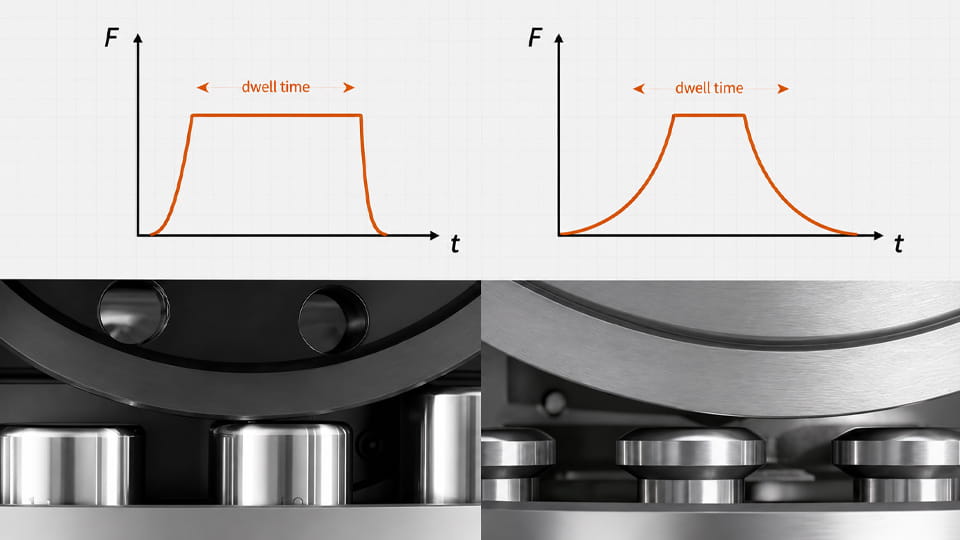
Είναι χρήσιμο να διακρίνετε γεωμετρικός κατοικώ (υπολογίζεται από τη γεωμετρία του εξοπλισμού) από με βάση τη δύναμη κατοικώ (την πραγματική ώρα που ένα tablet βλέπει τη μέγιστη δύναμη). Η γεωμετρική παραμονή είναι αυτό που υπολογίζετε με τον παραπάνω τύπο. Στην πράξη όμως, η μέγιστη δύναμη δεν είναι στιγμιαία – ανεβαίνει ελαφρώς, ειδικά με ελαστικά υλικά ή σε διαφορετικούς ρυθμούς συμπίεσης.
Πρόσφατο R&Ο Δ το τονίζει αυτό: ένα 2024 μελέτη συνέκρινε τη γεωμετρική κατοικία (GDT) στον χρόνο παραμονής που μετράται από έναν προσομοιωτή συμπίεσης (DTF) όταν η δύναμη είναι πάνω 90%. Βρήκαν ότι το DTF ποικίλλει τόσο με τη δύναμη συμπίεσης όσο και με τη σύνθεση. Με άλλα λόγια, εάν ρυθμίσετε την πίεση σε ένα συγκεκριμένο RPM, ο πραγματικός «χρόνος παραπάνω 90% δύναμη» μπορεί να είναι μικρότερη από το GDT εάν το tablet είναι άκαμπτο ή εάν η ράμπα δύναμης είναι αργή. Η διαφορά στο DTF μεταξύ των σκευασμάτων συρρικνώθηκε καθώς η δύναμη συμπίεσης αυξήθηκε, που σημαίνει ότι η υψηλή δύναμη τείνει να χρησιμοποιεί περισσότερο από τον διαθέσιμο γεωμετρικό χρόνο.
Υπαινιγμός: Οι γεωμετρικοί υπολογισμοί είναι μια καλή βάση, αλλά για ακριβείς προβλέψεις (ειδικά στο Ρ&Δ και κλιμάκωση) πρέπει κανείς να εξετάσει την πραγματική συμπεριφορά συμπίεσης. Πολλοί ειδικοί προτείνουν τη μέτρηση των προφίλ δύναμης έναντι χρόνου για μια σύνθεση, εάν η παραμονή είναι κρίσιμη. Ακόμη, για τις περισσότερες ανάγκες παραγωγής, Οι γεωμετρικές αλλαγές και οι εκτεταμένες αλλαγές εργαλείων επαρκούν για τη ρύθμιση της διαδικασίας.
Η επιβράδυνση του Τύπου είναι ο προφανής τρόπος για να παρατείνετε την παραμονή, αλλά μειώνει την απόδοση. Ακολουθούν στρατηγικές για να μείνετε περισσότερο διατηρώντας παράλληλα υψηλή απόδοση:
Εν συντομία: Τα εκτεταμένα επίπεδα κεφαλής και τα βελτιστοποιημένα εργαλεία είναι η καλύτερη λύση. Όπως λέει ένας ειδικός του κλάδου, «Ελλειπτικό επίπεδο εργαλείο… αυξάνει τον χρόνο παραμονής σε μια υπάρχουσα πρέσα χωρίς δαπανηρές τροποποιήσεις». Αυτό σας επιτρέπει να διατηρείτε την ίδια ταχύτητα πυργίσκου και έκκεντρα ενώ ενισχύετε την παραμονή. Τα ίδια τα προϊόντα της Jinlu διαφημίζουν σχέδια «πιεστικού χρόνου για μεγαλύτερη διάρκεια» για αυτόν ακριβώς τον λόγο.
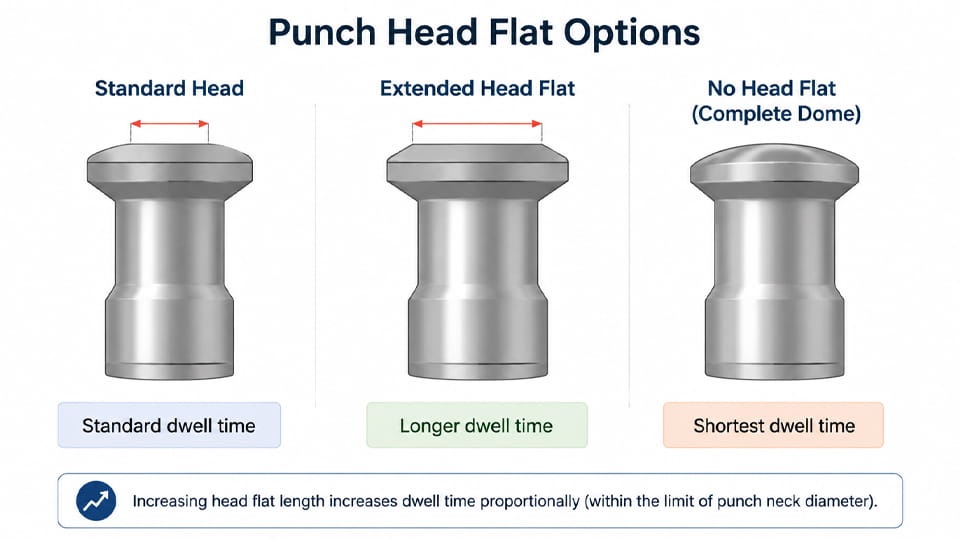
Είναι δελεαστικό να σκεφτείτε «απλώς εφαρμόστε περισσότερη δύναμη» για να αναπληρώσετε τη σύντομη παραμονή, αλλά αυτό έχει όρια. Η περισσότερη δύναμη μπορεί μερικές φορές να βελτιώσει την ισχύ του tablet, αλλά επίσης αυξάνει την πίεση στα εργαλεία και μπορεί να επιδεινώσει το πώμα εάν παγιδεύει αέρα. Ο Jinlu σημειώνει την αύξηση του χρόνου παραμονής μπορεί να μειώσει τη δύναμη που απαιτείται για μια δεδομένη σκληρότητα δισκίου. Αντίστροφως, αν σηκώσεις δύναμη χωρίς να μένεις, κινδυνεύετε με προβλήματα εκτίναξης και ελαττώματα ανάγλυφης εκτύπωσης.
Η σύγχρονη έρευνα προσθέτει μια απόχρωση: αντί να μένω μόνος, ρυθμός παραμόρφωσης (που σχετίζονται με την ταχύτητα συμπίεσης) είναι συχνά ο βασικός μοχλός σε κλίμακες παραγωγής. Το takeaway: Η απλή ανύψωση δύναμης δεν ισοδυναμεί πάντα με ένα καλύτερο tablet, ειδικά αν η διαμονή είναι πολύ μικρή. Μια ισορροπημένη προσέγγιση - μέτρια δύναμη συμπίεσης με επαρκή παραμονή - είναι συνήθως η καλύτερη για την ποιότητα και τη διάρκεια ζωής του εργαλείου.
Κλιμάκωση από ένα R&D ή πιλοτική πρέσα σε μια εμπορική περιστροφική πρέσα είναι γνωστό ότι είναι δύσκολο. Ένας βασικός λόγος: ο χρόνος παραμονής στο πιεστήριο του εργαστηρίου (συχνά χαμηλής ταχύτητας ή ενός σταθμού) είναι συνήθως πολύ μεγαλύτερο από ό,τι στην πρέσα παραγωγής υψηλής ταχύτητας. Εάν ένα σκεύασμα είναι ευαίσθητο στην παραμονή, μια συνταγή που φαινόταν ωραία στο εργαστήριο μπορεί να περιορίσει ή να μαλακώσει σε κλίμακα.
Για να το χειριστείτε αυτό, συμβουλεύουν οι ειδικοί:
Συνοπτικά, ελέγχετε πάντα την ισχύ του tablet όταν μεταβαίνετε στην ταχύτητα παραγωγής. Εάν τα δισκία εξασθενήσουν σε υψηλές στροφές ανά λεπτό, η χαμένη κατοικία είναι πιθανόν ο ένοχος. Κάποιοι Ρ&Οι ομάδες D προσαρμόζουν ακόμη και τα σκευάσματα (συνδετικά, λιπαντικά) για μείωση της ευαισθησίας παραμονής πριν από την κλιμάκωση.
Δεδομένου ότι ο χρόνος παραμονής συνδέεται άμεσα με τον σχεδιασμό του πιεστηρίου, επηρεάζει την επιλογή εξοπλισμού. Για παραγωγή υψηλής ταχύτητας, θεωρώ:
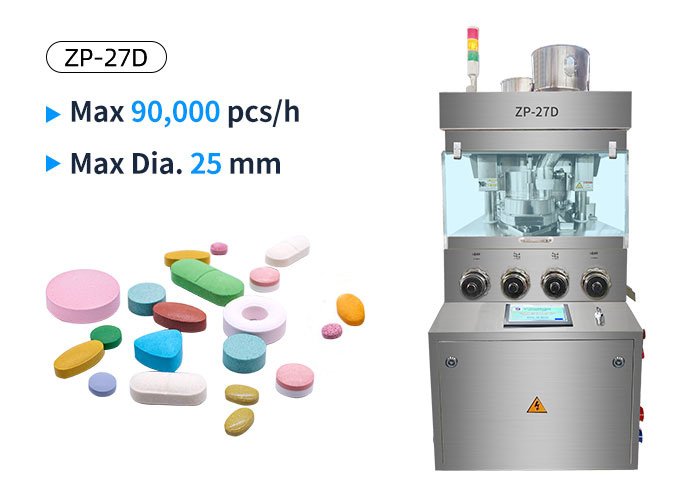
Τελικά, ρωτήστε τον εαυτό σας: χρειάζεστε 100.000 δισκία/ώρα σε 8 mm διάμετρος, ή θα αρκούν 60 χιλιάδες για την ίδια απόδοση? Η επιλογή του σωστού πιεστηρίου είναι μια αντιστάθμιση μεταξύ ταχύτητας και παραμονής, και το καλύτερο μηχάνημα είναι αυτό που σας δίνει την απαιτούμενη ποιότητα στην επιθυμητή απόδοση.
Ώρα παραμονής – τα χιλιοστά του δευτερολέπτου συμπίεσης στη συμπίεση του tablet – μπορεί να είναι μικρό πράγμα, αλλά έχει μεγάλο αντίκτυπο. Επηρεάζει σκληρότητα δισκίου, ευθρυπτότητα, και ελαττώματα όπως πώμα ή πλαστικοποίηση. Στην κατασκευή tablet υψηλής ταχύτητας, Ο χρόνος παραμονής συνδέει τις κουκκίδες μεταξύ της ταχύτητας πίεσης, σχεδιασμός εργαλείων, και ποιότητα tablet. Μια σύντομη παραμονή μπορεί να γράψει μαλακά ή ελαττωματικά δισκία; μια καλά διαχειριζόμενη κατοικία μπορεί να κάνει τις σκληρές συνθέσεις να λειτουργούν σε κλίμακα.
Τα καλά νέα είναι ότι ο χρόνος παραμονής είναι επίσης διαχειρίσιμος. Με την κατανόηση των παραγόντων (σ.α.λ. πυργίσκου, διάτρηση επίπεδο μέγεθος, σχέδιο τύπου) και εφαρμογή επιδιορθώσεων όπως εκτεταμένες διατρήσεις ή βελτιστοποιημένη προσυμπίεση, μπορείτε να πετύχετε τους στόχους ποιότητας και παραγωγής σας. Θυμηθείτε να υπολογίσετε την αναμενόμενη παραμονή χρησιμοποιώντας τις προδιαγραφές της επιφάνειας διάτρησης και του πυργίσκου, και επικυρώνετε πάντα σε κλίμακα με πραγματικές μετρήσεις. Όπως επιβεβαιώνει πρόσφατη έρευνα, ρυθμός παραμόρφωσης και σύνθεση είναι επίσης βασικά – αλλά ακόμα και τότε, Ο σωστός χρόνος παραμονής συχνά κάνει μια ποιοτική διαφορά.
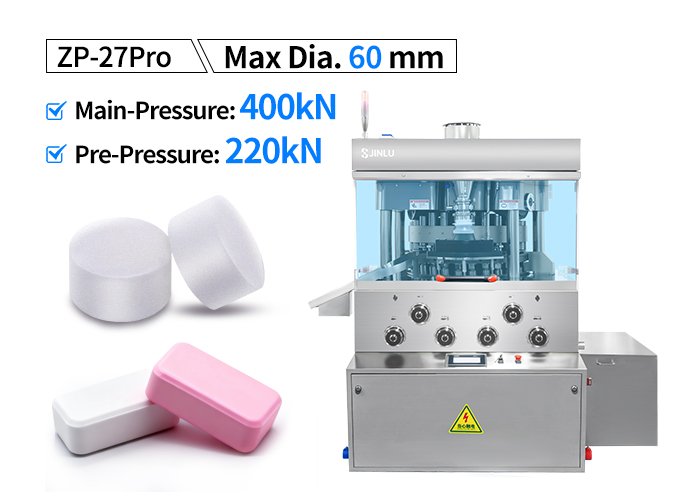
Εάν η παραγωγή σας έχει ευαίσθητα προβλήματα, αναλάβουν δράση. Δοκιμάστε μεγαλύτερα επίπεδα κεφαλιού, ρυθμίστε την προσυμπίεση, ή συμβουλευτείτε ειδικούς εξοπλισμού. Jinlu Packing's περιστροφικές πρέσες ταμπλετών υψηλής ταχύτητας και τα εργαλεία σχεδιάζονται έχοντας υπόψη αυτούς τους παράγοντες – για παράδειγμα, η μηχανή πρέσας δισκίων 400kN ενσωματώνει α «Σχεδίαση πιέσεως με μεγαλύτερη διάρκεια παραμονής» για να εξασφαλιστεί η πλήρης συμπίεση. Οι μηχανικοί μας μπορούν να σας βοηθήσουν να βρείτε το σωστό μηχάνημα και να το ρυθμίσετε Ο χρόνος παραμονής σε βοηθάει, δεν σε πληγώνει.
Έτοιμοι να βελτιστοποιήσετε την παραγωγή του tablet σας? Επικοινωνήστε με την Jinlu Packing σήμερα. Η ομάδα μας μπορεί να ελέγξει τη σύνθεσή σας και να πιέσει τις παραμέτρους, προτείνετε την ιδανική ταχύτητα πυργίσκου ή αλλαγές εργαλείων, και ακόμη και να εκτελέσετε δοκιμές στα εσωτερικά μας πιεστήρια. Προσφέρουμε μια σειρά από περιστροφικές μηχανές πρέσας δισκίων – από μοντέλα πάγκου έως συστήματα υψηλής απόδοσης – όλα σχεδιασμένα για αξιόπιστο έλεγχο του χρόνου παραμονής. Μην αφήσετε τη σύντομη παραμονή να υπονομεύσει τα tablet σας. Απευθυνθείτε τώρα και ας διασφαλίσουμε ότι κάθε χάπι που βγαίνει από την πρέσα σας είναι ισχυρό, άθικτος, και ακριβώς αυτό που χρειάζεστε.
Ο χρόνος παραμονής στη συμπίεση δισκίου είναι η περίοδος κατά την οποία το επίπεδο τμήμα μιας κεφαλής διάτρησης παραμένει κάτω από τον κύριο κύλινδρο συμπίεσης κατά τον σχηματισμό του δισκίου. Συνήθως μετριέται σε χιλιοστά του δευτερολέπτου (ms). Σε μια περιστροφική πρέσα ταμπλέτας, Ο χρόνος παραμονής επηρεάζεται κυρίως από τη γεωμετρία της κεφαλής διάτρησης, ταχύτητα πυργίσκου, και πατήστε γεωμετρία.
Ο χρόνος παραμονής είναι σημαντικός επειδή επηρεάζει τον τρόπο με τον οποίο ένα σκεύασμα ανταποκρίνεται στη συμπίεση, ιδιαίτερα σε υψηλότερες ταχύτητες παραγωγής. Ένας μικρότερος χρόνος παραμονής μπορεί να μειώσει τον διαθέσιμο χρόνο για ενοποίηση και μπορεί να συμβάλει σε χαμηλότερη αντοχή του δισκίου ή ελαττώματα όπως το πώμα και η πλαστικοποίηση σε σκευάσματα που είναι ευαίσθητα σε παραμονή. Ωστόσο, Η επίδρασή του εξαρτάται από τη σύνθεση και πρέπει να αξιολογείται μαζί με τη δύναμη συμπίεσης, ρυθμός παραμόρφωσης, εργαλεία, και άλλες παραμέτρους διαδικασίας.
Η αύξηση της ταχύτητας του πυργίσκου γενικά μειώνει τον χρόνο παραμονής επειδή οι κεφαλές διάτρησης κινούνται στους κυλίνδρους συμπίεσης πιο γρήγορα. Η μείωση των στροφών του πυργίσκου αυξάνει τον χρόνο παραμονής αλλά και μειώνει την απόδοση παραγωγής tablet. Επομένως, Οι κατασκευαστές ταμπλετών πρέπει να εξισορροπούν την ταχύτητα πίεσης με την ποιότητα και τη δυνατότητα επεξεργασίας του tablet αντί να τρέχουν απλώς την πρέσα tablet στις μέγιστες στροφές ανά λεπτό.
Ένας συνήθως χρησιμοποιούμενος γεωμετρικός υπολογισμός είναι:
Ώρα παραμονής (ms) = (Επίπεδη κεφαλή διάτρησης × 60 × 1000) / (PCD × π × RPM)
Εδώ, Η κεφαλή διάτρησης επίπεδη και το PCD μετρώνται σε χιλιοστά, ενώ το RPM αντιπροσωπεύει την ταχύτητα του πυργίσκου. Για παράδειγμα, με α 12 χιλ. κεφαλή διάτρησης επίπεδη, 250 mm PCD, και 50 Στροφές, ο υπολογισμένος γεωμετρικός χρόνος παραμονής είναι περίπου 18.34 ms. Αυτός ο υπολογισμός περιγράφει τον γεωμετρικό χρόνο παραμονής; Ο πραγματικός χρόνος παραμονής με βάση τη δύναμη μπορεί να διαφέρει ανάλογα με την πίεση και τις συνθήκες συμπίεσης.
Οι κύριοι παράγοντες περιλαμβάνουν την ταχύτητα του πυργίσκου, κεφαλή διάτρησης επίπεδη γεωμετρία, διάμετρος κύκλου βήματος (PCD), σχεδιασμός εργαλείων, και γεωμετρία πιεστηρίου tablet. Η αύξηση της ταχύτητας του πυργίσκου γενικά μειώνει τον χρόνο παραμονής, ενώ μια μεγαλύτερη επίπεδη κεφαλή διάτρησης γενικά αυξάνει τη γεωμετρική περίοδο παραμονής. Ο σχεδιασμός της πρέσας και η διαμόρφωση εργαλείων επηρεάζουν επίσης το πραγματικό προφίλ συμπίεσης.
Ο μεγαλύτερος χρόνος παραμονής μπορεί να βελτιώσει την αντοχή του δισκίου για ορισμένα σκευάσματα αφήνοντας περισσότερο χρόνο υπό συμπίεση, αλλά δεν παράγει αυτόματα πιο σκληρά tablet σε κάθε περίπτωση. Η σκληρότητα του δισκίου και η αντοχή σε εφελκυσμό εξαρτώνται επίσης από τις ιδιότητες της σύνθεσης, δύναμη συμπίεσης, ρυθμός παραμόρφωσης, εργαλεία, και άλλες συνθήκες διαδικασίας. Επομένως, Ο χρόνος παραμονής θα πρέπει να βελτιστοποιείται για τη συγκεκριμένη σύνθεση αντί να μεγιστοποιείται από προεπιλογή.
Ο ανεπαρκής χρόνος παραμονής μπορεί να συμβάλει στην επικάλυψη ή την πλαστικοποίηση σε σκευάσματα που είναι ευαίσθητα στην ταχύτητα συμπίεσης και στις μικρές περιόδους συμπίεσης. Ωστόσο, αυτά τα ελαττώματα μπορεί να έχουν πολλές αιτίες, συμπεριλαμβανομένης της παγίδευσης αέρα, ελαστική ανάκτηση, ιδιότητες σύνθεσης, ανεπαρκής προσυμπίεση, δύναμη συμπίεσης, λάδωμα, και κατάσταση εργαλείων. Επομένως, ο χρόνος παραμονής θα πρέπει να διερευνηθεί ως μέρος μιας ευρύτερης διαδικασίας αντιμετώπισης προβλημάτων συμπίεσης.
Οι επιλογές μπορεί να περιλαμβάνουν τη χρήση εργαλείων με μεγαλύτερη επίπεδη κεφαλή διάτρησης, βελτιστοποίηση της γεωμετρίας διάτρησης και συμπίεσης-ρολού, χρησιμοποιώντας κατάλληλη προσυμπίεση, ή επιλέγοντας μια περιστροφική πρέσα δισκίου σχεδιασμένη να παρέχει κατάλληλο προφίλ συμπίεσης. Η απλή μείωση της ταχύτητας του πυργίσκου είναι ο πιο άμεσος τρόπος για να αυξήσετε τον γεωμετρικό χρόνο παραμονής, αλλά μειώνει επίσης την απόδοση. Η καλύτερη λύση εξαρτάται από το σκεύασμα, εργαλεία, μέγεθος tablet, και απαιτούμενο ρυθμό παραγωγής.
Ο χρόνος παραμονής σχετίζεται ειδικά με την περίοδο κατά την οποία το επίπεδο τμήμα της κεφαλής διάτρησης είναι σε επαφή με τον κύλινδρο συμπίεσης και η διάτρηση δεν αλλάζει την κατακόρυφη θέση του σε σχέση με τον κύλινδρο. Ο χρόνος συμπίεσης είναι ένας ευρύτερος όρος που μπορεί να περιγράψει την περίοδο κατά την οποία συμβαίνει η συμπίεση. Επομένως, Ο χρόνος παραμονής δεν πρέπει να αντιμετωπίζεται αυτόματα ως πανομοιότυπος με τον συνολικό χρόνο συμπίεσης.
Ο χρόνος παραμονής είναι σημαντικός κατά τη διάρκεια της κλιμάκωσης επειδή η αλλαγή από ένα R&Η πρέσα ταμπλετών D ή εργαστηρίου σε περιστροφική πρέσα δισκίων παραγωγής μπορεί να αλλάξει την ταχύτητα του πυργίσκου, γεωμετρία διάτρησης, συνθήκες συμπίεσης, και ο διαθέσιμος χρόνος για συμπύκνωση. Εάν η πρέσα παραγωγής λειτουργεί με ένα ουσιαστικά διαφορετικό προφίλ συμπίεσης, σκληρότητα δισκίου, αντοχή σε εφελκυσμό, ευθρυπτότητα, ή τα ποσοστά ελαττωμάτων ενδέχεται να αλλάξουν. Επομένως, η σύγκριση των σχετικών συνθηκών συμπίεσης κατά τη διάρκεια της κλιμάκωσης μπορεί να βοηθήσει στον εντοπισμό πιθανών προβλημάτων πριν από την παραγωγή πλήρους κλίμακας.
Αναφορές:
1.Διερεύνηση των επιπτώσεων του χρόνου παραμονής και του ρυθμού παραμόρφωσης φόρτωσης στις ιδιότητες συμπίεσης σκόνης και δισκίων: Μελέτη προσομοιωτή συμπίεσης —— ScienceDirect
2.Μείνετε λίγο χρόνο στο tablet: χρόνος παραμονής σύμφωνα με τη δύναμη έναντι του γεωμετρικού χρόνου παραμονής —— Τέιλορ & Francis Online
3.Επιρροή του εκτεταμένου χρόνου παραμονής κατά την προ- και κύρια συμπίεση στις ιδιότητες των δισκίων ιβουπροφαίνης —— Εθνική Βιβλιοθήκη Ιατρικής
4.Επίδραση του σχεδίου της κεφαλής διάτρησης στη φυσική ποιότητα των ταμπλετών που παράγονται σε μια περιστροφική πρέσα —— Εθνική Βιβλιοθήκη Ιατρικής
5.Ο ρόλος της παραμονής στη συμπαγή παραμόρφωση κατά τη δισκιοποίηση: μια επισκόπηση —— Πανεπιστήμιο Monash
6.Φυσική συμπίεσης στην ανάπτυξη σκευασμάτων δισκίων —— Εθνική Βιβλιοθήκη Ιατρικής