
Σε φαρμακευτική παραγωγή, εξασφαλίζοντας προμηθευτές εξοπλισμού Η τήρηση των προτύπων GMP είναι εξίσου σημαντική με τον έλεγχο των πωλητών πρώτων υλών. Μια διεξοδική έλεγχος προμηθευτή βοηθά τις φαρμακευτικές εταιρείες να επαληθεύουν τα συστήματα ποιότητας ενός κατασκευαστή εξοπλισμού, απόδειξη με έγγραφα, και διαδικασίες, μείωση του κινδύνου ελαττωματικών ή μη συμμορφούμενων μηχανημάτων να εισέλθουν στην παραγωγή. Ρυθμιστική καθοδήγηση (FDA, EMA, εγώ, ΠΟΥ) τονίζει α πρόγραμμα ποιότητας προμηθευτή με βάση τον κίνδυνο: πραγματοποιήστε ελέγχους πιστοποίησης προμηθευτών για σημαντικούς προμηθευτές, ελέγξτε το σύστημα διαχείρισης ποιότητας και το ιστορικό συμμόρφωσής τους, και να συνεχίσει με διορθωτικές ενέργειες και εγκρίσεις.
Αυτό το άρθρο εξηγεί γιατί και πότε να ελέγχετε τους προμηθευτές εξοπλισμού, περιγράφει μια βήμα προς βήμα διαδικασία ελέγχου (με διάγραμμα ροής), παρέχει μια λίστα ελέγχου εστιασμένη στον εξοπλισμό, συγκρίνει επιτόπου vs. εξ αποστάσεως έλεγχοι, και δείχνει πώς FAT/SAT και IR/WH/PQ ταιριάζει στα προσόντα του προμηθευτή. Οι πίνακες συνοψίζουν τους τύπους ελέγχου και τα επίπεδα κινδύνου, και πρακτικές συμβουλές (με παραδείγματα από τον πραγματικό κόσμο και ρυθμιστικές αναφορές) θα βοηθήσει στην προμήθεια, Οι ομάδες QA και μηχανικών εκτελούν επιτυχείς ελέγχους. Εν συντομία, ένα δομημένο πρόγραμμα ελέγχου—υποστηριζόμενο από ολοκληρωμένη τεκμηρίωση από έναν προμηθευτή με γνώσεις GMP—βεβαιώνει ότι τα νέα σας μηχανήματα φτάνουν «έτοιμα για έλεγχο» για πιστοποίηση IQ/OQ και χρήση GMP.

Σε ρυθμιζόμενο φαρμακείο, τίποτα δεν μπορεί να αφεθεί στην τύχη. Ακόμα κι αν μια μηχανή είναι καλοφτιαγμένη, οποιαδήποτε έλλειψη ποιότητας στον προμηθευτή (φτωχό QMS, μη τεκμηριωμένες αλλαγές, μη βαθμονομημένα όργανα, και τα λοιπά.) μπορεί να θέσει σε κίνδυνο το προϊόν σας. Γιατί οι κατασκευαστές φαρμάκων είναι τελικά υπεύθυνος για την ποιότητα και τη συμμόρφωση του τελικού προϊόντος, Οι ρυθμιστικές αρχές αναμένουν από αυτούς να ελέγχουν σημαντικούς προμηθευτές. Για παράδειγμα, Οδηγίες ICH Q10 του FDA σημειώνει ότι οι ανάδοχοι «πρέπει να είναι υπεύθυνοι για την αξιολόγηση της καταλληλότητας και της ικανότητας» των προμηθευτών, και όλες οι δραστηριότητες που σχετίζονται με την ποιότητα πρέπει να ορίζονται σε γραπτές συμφωνίες. Στην πράξη, Αυτό σημαίνει έλεγχο των πωλητών εξοπλισμού για να διασφαλιστεί ότι ακολουθούν ελέγχους που μοιάζουν με GMP. Όπως εξηγεί ένας ειδικός του κλάδου, Οι έλεγχοι προμηθευτών είναι τακτικές επιθεωρήσεις που βελτιώνουν τις πρώτες ύλες, εξοπλισμός, και προμηθεύει μια εταιρεία που λαμβάνει…και βοηθά στην επίτευξη συμμόρφωσης με αυστηρές κανονιστικές απαιτήσεις.
Οι βασικοί λόγοι για τον έλεγχο των προμηθευτών εξοπλισμού περιλαμβάνουν:
«Ένας έλεγχος προμηθευτή είναι μια ανεξάρτητη αξιολόγηση των διαδικασιών ή των προϊόντων ενός προμηθευτή σε σχέση με κριτήρια συγκριτικής αξιολόγησης… που αποσκοπεί στην αποκάλυψη ευκαιριών βελτίωσης ενός προϊόντος, διαδικασία, ή σύστημα,” εξηγεί μια πηγή ποιοτικού κλάδου. Σε φαρμακευτική, Αυτό σημαίνει να ελέγξετε ότι το εγχειρίδιο ποιότητας του προμηθευτή του εξοπλισμού σας, αλλαγή ελέγχου, CAPA, και η τεκμηρίωση ανταποκρίνεται στις προσδοκίες GMP. Ένα σταθερό πρόγραμμα ελέγχου (αρχική και περιοδική) βοηθά στην επαλήθευση ότι ο εξοπλισμός θα λειτουργεί με ασφάλεια υπό συνθήκες GMP.
Οι έλεγχοι πρέπει να προγραμματίζονται σε βασικά στάδια. Οι τυπικοί χρονισμοί περιλαμβάνουν:
Ο παρακάτω πίνακας συνοψίζει τους κοινούς τύπους ελέγχου και τους σκοπούς τους:
| Τύπος ελέγχου | Σκοπός |
| Αρχικός (Προσόν) | Αξιολογήστε α νέος προμηθευτή πριν από την έγκριση; επαληθεύστε το QMS, απόδειξη με έγγραφα, και δυνατότητες. |
| Περιοδικός (Προγραμματισμένος) | Επαναξιολογήστε έναν υπάρχοντα προμηθευτή (π.χ.. ετησίως) για να διασφαλιστεί η συνεχής συμμόρφωση. |
| Για-Αιτία (Σκανδάλη) | Διερευνήστε συγκεκριμένα θέματα (π.χ.. παράπονα, αποκλίσεις, 483 παρατηρήσεις) σε προμηθευτή. |
| Παρακολούθηση | Επαληθεύστε ότι οι διορθωτικές/προληπτικές ενέργειες (CAPA) από προηγούμενο έλεγχο έχουν εφαρμοστεί. |
| Έλεγχος από απόσταση/επιτραπέζιο | Ελέγξτε τα συστήματα και τα έγγραφα ποιότητας προμηθευτών εικονικά; χαμηλότερο κόστος/γρηγορότερο, αλλά περιορισμένη εμβέλεια. |
Σε όλες τις περιπτώσεις, χρησιμοποιήστε α προσέγγιση με βάση τον κίνδυνο να αποφασίσει το πεδίο εφαρμογής. Προμηθευτές υψηλού κινδύνου (κρίσιμος εξοπλισμός) δικαιολογούν βαθύτερα, επιτόπιους ελέγχους, ενώ οι χαμηλού κινδύνου μπορεί να χρειάζονται μόνο επισκοπήσεις γραφείου ή δειγματοληψία. Το Q του EMA&Το Α μας υπενθυμίζει ότι ακόμα κι αν ένας προμηθευτής έχει πιστοποιητικό GMP ή έκθεση επιθεώρησης, Η νομική ευθύνη του κατασκευαστή δεν τηρείται μέχρι να πραγματοποιήσει το δικό του πρόγραμμα ελέγχου. Με άλλα λόγια, χρησιμοποιήστε εξωτερικές αξιολογήσεις για να ενημερώσετε τη λίστα προτεραιοτήτων σας, αλλά εμπιστευτείτε – και επαληθεύστε – μέσω των δικών σας ελέγχων.
Ένας απλός πίνακας κινδύνου βοηθά στην κατηγοριοποίηση των προμηθευτών και στην καθοδήγηση της συχνότητας ελέγχου. Για παράδειγμα:
| Επίπεδο Κινδύνου | Παραδείγματα | Ενέργειες ελέγχου |
| Ψηλά | Ασηπτικά υγρά πληρωτικά, αποστειρωτές, πλήρωση κάψουλας; προμηθευτές για πρώτη φορά ή μεμονωμένη πηγή | Ενδελεχής αρχικός επιτόπιος έλεγχος; ετήσιους ή διετές ελέγχους; πλήρους εμβέλειας (QMS, ευκολία, έγγραφα, ΛΙΠΟΣ). |
| Μέσον | Μη αποστειρωμένες μηχανές συσκευασίας (π.χ.. φουσκάλες, χαρτοκιβώτια); δεύτερους προμηθευτές ή γνωστούς προμηθευτές | Λεπτομερής αρχικός έλεγχος; επιθεωρήσεις τοποθεσίας κάθε 2-3 χρόνια; μέτρια εμβέλεια (εστίαση σε κρίσιμες διαδικασίες, συν τεκμηρίωση). |
| Χαμηλός | Βοηθητικός εξοπλισμός (π.χ.. μεταφορείς, βασικές αντλίες); πωλητές εμπορευμάτων | Βασικό προσόν (αναθεώρηση εγγράφων, ερωτηματολόγια); επιτόπιοι έλεγχοι μόνο εάν προκύψουν προβλήματα; περιοδική επαναξιολόγηση (3– 5 χρόνια ή όσο χρειάζεται). |
Αυτή η αξιολόγηση κινδύνου πρέπει να ληφθεί υπόψη σύγκρουση (πόσο σημαντικός είναι ο εξοπλισμός για την ασφάλεια/ποιότητα του προϊόντος?) και πιθανότητα (ο προμηθευτής είχε προβλήματα στο παρελθόν? νέο σχέδιο? πολύπλοκη τεχνολογία?). Για παράδειγμα, μια νέα γραμμή πλήρωσης κάψουλας σε ένα αποστειρωμένο φυτό φαρμάκων έχει μεγάλη επίδραση (άμεση επαφή, υψηλή ακρίβεια), άρα παραμένει στην κατηγορία υψηλού κινδύνου και απαιτεί πλήρεις ελέγχους. Αντίθετα, ένας απλός μεταφορέας που δεν έρχεται ποτέ σε απευθείας επαφή με το προϊόν μπορεί να είναι χαμηλού κινδύνου – ένας απομακρυσμένος έλεγχος ή ένα ερωτηματολόγιο μπορεί να αρκεί αρχικά, με επιτόπιους ελέγχους μόνο εάν αλλάξει το επίπεδο κινδύνου.
Ακολουθεί ένα διάγραμμα ροής υψηλού επιπέδου της διαδικασίας ελέγχου, ακολουθούμενη από λεπτομέρειες για κάθε βήμα:
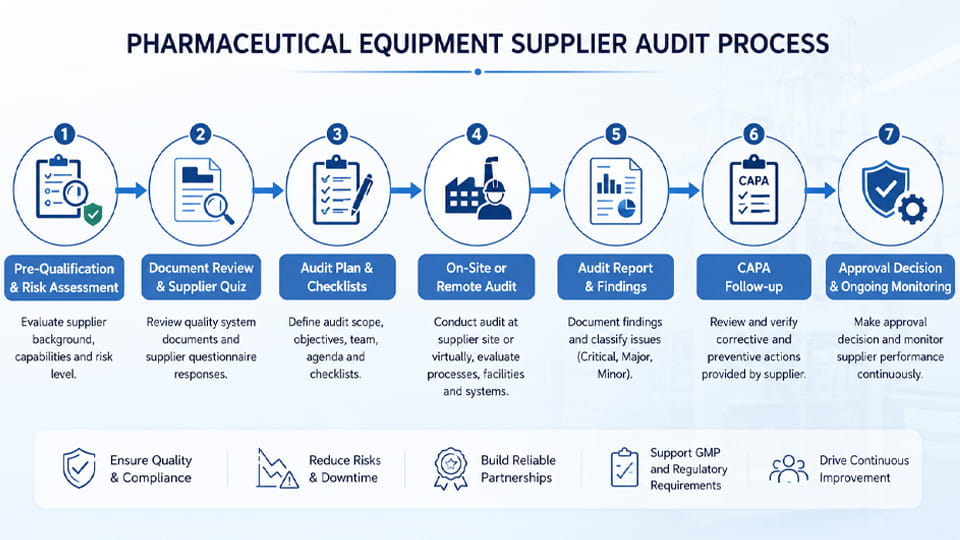
Κάθε βήμα περιγράφεται παρακάτω:
Εάν διεξάγετε α εξ αποστάσεως έλεγχος, εστίαση στην αναθεώρηση εγγράφων, ζωντανές περιηγήσεις βίντεο, και συνεντεύξεις. Όπως σημειώνει ο EMA, Οι απομακρυσμένοι έλεγχοι μπορούν να ενημερώσουν το πρόγραμμα ελέγχου σας, αλλά δεν είναι τόσο ενδελεχείς όσο οι επιτόπιες επιθεωρήσεις για προμηθευτές υψηλού κινδύνου. Να στοχεύετε πάντα να κάνετε πλήρεις επιτόπιους ελέγχους για πραγματικά κρίσιμο εξοπλισμό.
Ακολουθεί μια συνοπτική λίστα ελέγχου βασικών τομέων και δείγματα ερωτήσεων που πρέπει να ληφθούν υπόψη κατά τη διάρκεια ενός ελέγχου προμηθευτή εξοπλισμού. (Προσαρμόστε το στο συγκεκριμένο μηχάνημα και το επίπεδο κινδύνου.)
Αυτή η λίστα ελέγχου είναι ένα σημείο εκκίνησης. Προσαρμόστε το στον συγκεκριμένο εξοπλισμό: για παράδειγμα, ένα συσκευασία blister ο έλεγχος θα επικεντρωθεί στη βαθμονόμηση του θερμαντήρα, κωδικοποιητές ημερομηνίας, και χειρισμός φιλμ, ενώ α πληρωτικό κάψουλας Ο έλεγχος θα δώσει έμφαση στους ελέγχους ακρίβειας δόσης και στην επαλήθευση κλειδώματος της κάψουλας. Στόχος είναι να αξιολογηθούν και τα δύο τι υπάρχει στα χαρτιά (διαδικασίες, εγγραφές) και τι συμβαίνει στο πάτωμα (παρατηρηθείσα πρακτική).
Κατά τον έλεγχο προμηθευτών εξοπλισμού, μερικά από τα πιο συχνά παρατηρούμενα ζητήματα περιλαμβάνουν:
Εάν συναντήσετε κάποιο από αυτά, συνεργαστείτε με τον προμηθευτή για την ανάπτυξη διορθωτικών σχεδίων. Το σωστό κλείσιμο των ευρημάτων του ελέγχου είναι ζωτικής σημασίας πριν από την τελική έγκριση. Να καταγράφετε πάντα τα στοιχεία ενεργειών και να παρακολουθείτε - ένας προμηθευτής δεν είναι κατάλληλος έως ότου επαληθευτούν όλες οι κρίσιμες CAPA.
| Αποψη | Επιτόπιος Έλεγχος | Απομακρυσμένος έλεγχος |
| Εκταση | Πλήρης πρόσβαση (εγκαταστάσεις, άνθρωποι, έγγραφα). | Περιορίζεται σε έγγραφα, εγγραφές, και εικονικές περιηγήσεις. |
| Βάθος Επιθεώρησης | Ψηλά: μπορεί να επιθεωρήσει φυσικά μηχανήματα, νοικοκυριό, αόρατες πρακτικές. | Μέτριος: κυρίως ανασκόπηση τεκμηρίωσης και συνεντεύξεις. |
| Κόστος & Φορά | Άνω (χρόνο και έξοδα ταξιδιού, προκλήσεις προγραμματισμού). | Χαμηλότερος (κανένα ταξίδι; ταχύτερος προγραμματισμός). |
| Αποτελεσματικότητα | Το πιο εμπεριστατωμένο (προτιμάται για προμηθευτές υψηλού κινδύνου). | Καλό για παρακολούθηση ή για πωλητές χαμηλού κινδύνου; ενδιάμεση λύση για επείγουσες ανάγκες. |
| Ευκαμψία | Λιγότερο ευέλικτος (πρέπει να συγχρονίσει τα χρονοδιαγράμματα/διαθεσιμότητα). | Πιο ευέλικτο (μπορεί συχνά να ελέγξει πολλούς ιστότοπους μέσω βίντεο). |
| Αποδεικτικά Ελέγχου | Άμεση παρατήρηση διεργασιών, φωτογραφία/βίντεο; πιο εύκολο να εντοπιστούν οι αποκλίσεις. | Βασιστείτε σε αυτό που δείχνει ο προμηθευτής; κίνδυνος απώλειας κρυφών ζητημάτων. |
Γενικά, επιτόπιους ελέγχους παραμένει ο κανόνας του χρυσού, ειδικά για προμηθευτές υψηλού κινδύνου ή πρόσφατα ειδικευμένους προμηθευτές. Οι ρυθμιστικές αρχές σημειώνουν ότι οι απομακρυσμένοι έλεγχοι «βασισμένοι σε χαρτί» δεν αντικαθιστούν πλήρως τη διαβεβαίωση ότι είναι επιτόπου. Ωστόσο, Οι απομακρυσμένοι έλεγχοι μπορεί να είναι χρήσιμοι (για παράδειγμα, ως προσωρινό μέτρο εάν τα ταξίδια είναι περιορισμένα) και μπορεί να ελέγξει αποτελεσματικά τα αρχεία ποιότητας του προμηθευτή. Μια υβριδική προσέγγιση είναι κοινή: χρησιμοποιήστε απομακρυσμένους ελέγχους για τον βασικό έλεγχο τεκμηρίωσης, στη συνέχεια προγραμματίστε μια επιτόπια επίσκεψη για την τελική βαθιά κατάδυση, ή εναλλάξ μεταξύ επιτόπου και τηλεχειριστηρίου για τακτικούς ελέγχους.
Οι έλεγχοι εξοπλισμού πρέπει να δίνουν ιδιαίτερη προσοχή τεκμηρίωση επικύρωσης. Πριν αγοράσετε, επιβεβαιώστε ότι ο προμηθευτής έχει μια ισχυρή διαδικασία FAT. Ένα πλήρες FAT επαληθεύει ότι το μηχάνημα λειτουργεί στο URS σας υπό ελεγχόμενες συνθήκες. Κατά τον έλεγχο, ελέγξτε τις προηγούμενες αναφορές FAT του προμηθευτή για παρόμοια μηχανήματα: ελέγξτε ότι τα κριτήρια και τα αποτελέσματα των δοκιμών είναι σαφώς τεκμηριωμένα και πληρούν τις προδιαγραφές. Βεβαιωθείτε επίσης ότι ένα επίσημο σχέδιο SAT θα εκτελεστεί μετά την εγκατάσταση. Αυτές οι δοκιμασίες αποδοχής είναι κρίσιμες για την πιστοποίηση.
Επίσης, βεβαιωθείτε ότι ο προμηθευτής παρέχει πλήρη υποστήριξη IQ/OQ. Η εμπειρία του Jinlu δείχνει ότι αξιόπιστοι πωλητές παραδίδουν μηχανήματα "με πλήρη υποστήριξη IQ/OQ/PQ και υπηρεσίες επικύρωσης με το κλειδί στο χέρι". Στην πράξη, Αυτό σημαίνει ότι θα πρέπει να σας δώσουν λίστες ελέγχου IQ, Σενάρια δοκιμής OQ, και παραδείγματα πρωτοκόλλων PQ για την αναθεώρησή σας. Ο πωλητής εκτελεί συχνά το FAT και μπορεί να βοηθήσει με το IQ προ-ευθυγραμμίζοντας και εγκαθιστώντας το μηχάνημα υπό ελεγχόμενες συνθήκες. Αλλά θυμηθείτε: ο η ομάδα QA του αγοραστή είναι τελικά υπεύθυνη για τη συμπλήρωση επιτόπου IQ/OQ/PQ. Ο έλεγχός σας θα πρέπει να επιβεβαιώσει ότι ο προμηθευτής διαθέτει εκπαιδευμένο προσωπικό ή εργολάβους για την υποστήριξη της επικύρωσης και θα παράσχει τις απαραίτητες αναφορές, αναλήψεις, και εγγραφές βαθμονόμησης.
Κάντε άμεσες ερωτήσεις, για παράδειγμα: «Έχετε πρωτόκολλο FAT που βασίζεται στο URS μας;?”, «Θα παρακολουθήσετε τα τεστ IQ/OQ επί τόπου;, και στη συνέχεια προσκομίστε επικυρωμένη τεκμηρίωση?”. Ένας καλός προμηθευτής θα προετοιμαστεί με πρότυπα και θα το αντιμετωπίσει ως ρουτίνα - είναι μέρος της ετοιμότητας GMP.
Κατά τον έλεγχο (ή συζητήσεις πριν από τον έλεγχο), οι αγοραστές ρωτούν συχνά τους προμηθευτές:
Οι απαντήσεις σε αυτά βοηθούν να μετρηθεί η ωριμότητα του προμηθευτή. Για παράδειγμα, ένας έμπειρος προμηθευτής θα πρέπει να επιδείξει εύκολα πιστοποιητικά ποιότητας (ISO 9001/13485) και δεν έχετε κανένα πρόβλημα να αναφέρετε λεπτομερώς τη διαδικασία επικύρωσής τους. Εάν ένας προμηθευτής διστάζει ή εκτρέπει αυτές τις ερωτήσεις, θα μπορούσε να υποδεικνύει κενά στο σύστημά τους.
Μετά από έλεγχο και συλλογή απαντήσεων, το τελευταίο βήμα είναι η έγκριση προμηθευτή. Μόλις κλείσουν όλα τα ευρήματα του ελέγχου ή επιλυθούν με άλλο τρόπο, εγκρίνετε επίσημα τον προμηθευτή στο σύστημα ποιότητας σας. Αυτό μπορεί να περιλαμβάνει τη ρύθμισή τους σε μια λίστα εγκεκριμένων προμηθευτών και τον καθορισμό τυχόν προϋποθέσεων (για παράδειγμα, "Οι αρχικές παραγγελίες απαιτούν την υπογραφή μου για το QA μετά το SAT"). Κοινοποιήστε αυτήν την έγκριση στις ομάδες προμηθειών και έργων, ώστε να γνωρίζουν ότι ο προμηθευτής είναι κατάλληλος. Βεβαιωθείτε ότι ο προμηθευτής κατανοεί τις προσδοκίες που απομένουν (όπως η παροχή ενημερωμένων στοιχείων CAPA ή μετρήσεων απόδοσης σε μελλοντικές αναφορές).
Έστω και μετά από έγκριση, συνεχίσει την παρακολούθηση. Συνεχίστε να παρακολουθείτε βασικές μετρήσεις προμηθευτών (έγκαιρη παράδοση, ζητήματα πεδίου, βαθμολογίες ελέγχου). Ενσωματώστε τις νέες απαιτήσεις FDA ή EMA όπως έρχονται (αν αλλάξουν οι κανονισμοί, μπορεί να χρειαστεί να κάνετε επανέλεγχο ή να ζητήσετε νέα τεκμηρίωση). Ουσιαστικά, το πρόγραμμα ελέγχου δεν σταματά στην έγκριση - γίνεται μέρος της διαρκούς διασφάλισης ποιότητας για κάθε κρίσιμο εξοπλισμό.
Ένα δομημένο πρόγραμμα ελέγχου προμηθευτών είναι μια επένδυση στην ασφάλεια των προϊόντων και στην ρυθμιστική εμπιστοσύνη. Με μεθοδικό έλεγχο του συστήματος ποιότητας ενός κατασκευαστή εξοπλισμού, απόδειξη με έγγραφα, και διεργασίες—καθοδηγούμενες από τις αρχές GMP—ελαχιστοποιείτε τις εκπλήξεις και διασφαλίζετε ότι εισέρχονται στη γραμμή σας μόνο συμβατά μηχανήματα. Θυμάμαι: κοινή ευθύνη είναι κλειδί. Ο προμηθευτής θα πρέπει να φέρει μηχανήματα έτοιμα για GMP με πλήρη πακέτα FAT/SAT/IQ/OQ, αλλά η εταιρεία σας πρέπει να τα επαληθεύσει πριν από την παραγωγή. Μια προσέγγιση που βασίζεται στον κίνδυνο εστιάζει την προσπάθεια όπου έχει σημασία, και τυχόν ευρήματα πρέπει να οδηγούν σε CAPA και τελικές αποφάσεις έγκρισης.
Και jeinlu picking, κατανοούμε την αυστηρότητα των ελέγχων GMP: Οι μηχανές συσκευασίας μας έχουν σχεδιαστεί και τεκμηριωθεί για να καλύπτουν αυτές τις ανάγκες. Κάθε μηχάνημα παραδίδεται με πλήρες κιτ επικύρωσης (Πρωτόκολλα FAT/SAT/IQ/OQ) για να βελτιώσετε τα προσόντα σας. Επιλέγοντας προμηθευτή με εμπειρία στη συμμόρφωση με τα φάρμακα, απλοποιείτε τους ελέγχους και διατηρείτε τα έργα σας σε καλό δρόμο.
Έτοιμος για έλεγχο με σιγουριά? Επικοινωνήστε με την Jinlu Packing για εξοπλισμό φαρμακευτικής ποιότητας που έρχεται έτοιμη για έλεγχο. Η ομάδα μας μπορεί να σας βοηθήσει να ορίσετε το URS σας, τρέξτε FATs, και παρέχετε τεκμηρίωση IQ/OQ/PQ με το κλειδί στο χέρι, ώστε ο έλεγχος και η πιστοποίηση του προμηθευτή σας να πάνε ομαλά.
Ο έλεγχος προμηθευτή είναι μια συστηματική αξιολόγηση των συστημάτων ποιότητας ενός κατασκευαστή φαρμακευτικού εξοπλισμού, διαδικασίες παραγωγής, τεχνικές δυνατότητες, και πρακτικές συμμόρφωσης. Ο στόχος είναι να επαληθευτεί ότι ο προμηθευτής μπορεί να παραδίδει με συνέπεια μηχανήματα που πληρούν τις απαιτήσεις GMP, πρότυπα ποιότητας, και τις προδιαγραφές του έργου.
Ο έλεγχος προμηθευτών βοηθά τις φαρμακευτικές εταιρείες να μειώσουν τους κινδύνους του έργου, επαλήθευση των δυνατοτήτων του προμηθευτή, αξιολόγηση της ετοιμότητας συμμόρφωσης, και βεβαιωθείτε ότι ο κατασκευαστής του εξοπλισμού μπορεί να παρέχει την τεκμηρίωση και την υποστήριξη επικύρωσης που απαιτείται για την παραγωγή που ρυθμίζεται από την GMP.
Χωρίς σωστό έλεγχο προμηθευτή, Οι αγοραστές ενδέχεται να αντιμετωπίσουν ζητήματα όπως καθυστερημένη επικύρωση, κακή απόδοση του μηχανήματος, ελλιπή τεκμηρίωση, ή προκλήσεις κανονιστικής συμμόρφωσης.
Τα βασικά έγγραφα περιλαμβάνουν το εγχειρίδιο ποιότητας του προμηθευτή, Κοφτερός (CAPA, αλλαγή ελέγχου, και τα λοιπά.), Πιστοποιήσεις ISO/GMP, εγγραφές παρτίδας για ένα δείγμα προϊόντος, αρχεία εκπαίδευσης, αρχεία καταγραφής συντήρησης/βαθμονόμησης, και τυχόν προηγούμενες εκθέσεις ελέγχου. Πιστοποιητικά ανάλυσης (CoAs) για τις πρόσφατες παρτίδες και τα δεδομένα σταθερότητας του προμηθευτή είναι επίσης σημαντικά. Ουσιαστικά, ελέγξτε όλα όσα αποδεικνύουν τα συστήματα ποιότητας και τους ελέγχους κυκλοφορίας προϊόντων.
Ναί. Οι απομακρυσμένοι έλεγχοι προμηθευτών μπορούν να πραγματοποιηθούν χρησιμοποιώντας τηλεδιάσκεψη, αναθεωρήσεις ψηφιακών εγγράφων, και εικονικές περιηγήσεις στο εργοστάσιο.
Ωστόσο, για κρίσιμο φαρμακευτικό εξοπλισμό, όπως μηχανές πλήρωσης καψουλών, πρέσες δισκίων, Μηχανές συσκευασίας φουσκάλων, και εξοπλισμό ασηπτικής επεξεργασίας, Συνιστώνται γενικά οι επιτόπιοι έλεγχοι επειδή επιτρέπουν στους αγοραστές να αξιολογούν άμεσα τις κατασκευαστικές πρακτικές, ποιοτικούς ελέγχους, και συνθήκες εγκατάστασης.
Η πιστοποίηση προμηθευτή είναι η συνολική διαδικασία έγκρισης ενός προμηθευτή (περιλαμβάνει ερωτηματολόγια, αναθεώρηση εγγράφου, δοκιμή δείγματος, και ελέγχους). Ο έλεγχος προμηθευτή είναι ένα συγκεκριμένο βήμα σε αυτή τη διαδικασία (ή σε περιοδική παρακολούθηση). Η πιστοποίηση χρησιμοποιεί τόσο γραφειοκρατία όσο και επιτόπιους ελέγχους. Μετά από μια επιτυχημένη πρόκριση, οι έλεγχοι γίνονται επαναλαμβανόμενος έλεγχος (επανεπιλογή).
Τόσο ο FDA όσο και ο EMA αναμένουν από τους κατασκευαστές φαρμάκων να ελέγχουν την αλυσίδα εφοδιασμού τους. Το Q10 του FDA δίνει έμφαση στην αξιολόγηση προμηθευτή βάσει κινδύνου και ζητά συγκεκριμένα ελέγχους προμηθευτών για την επαλήθευση της ποιότητας του προμηθευτή. GMP της ΕΕ (Παράρτημα 16 και Μέρος Ι Κεφάλαιο 7) απαιτεί οι έλεγχοι όλων των τοποθεσιών που εμπλέκονται στην κατασκευή ή τη δοκιμή του προϊόντος να είναι διαθέσιμοι στο Εξουσιοδοτημένο Πρόσωπο. I Q7 (για API) και οι κατευθυντήριες γραμμές PIC/S επιβάλλουν επίσης ισχυρή εποπτεία προμηθευτών. Εν συντομία, Οι ρυθμιστικές αρχές υποθέτουν ότι ελέγχετε τους προμηθευτές σας ως μέρος της συμμόρφωσης με την GMP.
Η συχνότητα εξαρτάται από τον κίνδυνο του προμηθευτή και την προηγούμενη απόδοση. Προμηθευτές υψηλού κινδύνου (API, αποστειρωμένα συστατικά) συχνά λαμβάνουν ετήσιους ελέγχους, ενώ οι προμηθευτές χαμηλότερου κινδύνου μπορεί να είναι κάθε 2-3 χρόνια. Επίσης έλεγχος μετά από σημαντικές αλλαγές ή γεγονότα ποιότητας. Το σύστημα διαχείρισης ποιότητας που χρησιμοποιείτε θα πρέπει να ορίζει συγκεκριμένα διαστήματα ανά κατηγορία κινδύνου. Λάβετε υπόψη ότι η κακή απόδοση ή τα συμβάντα ασφάλειας σε έναν προμηθευτή δικαιολογούν έλεγχο "για την αιτία" ανεξάρτητα από το χρονοδιάγραμμα.
ΛΙΠΟΣ (Εργοστασιακή δοκιμή αποδοχής) είναι μια επίσημη δοκιμή που πραγματοποιείται στις εγκαταστάσεις του προμηθευτή πριν από την αποστολή του εξοπλισμού.
Το FAT το επιβεβαιώνει:
• Το μηχάνημα πληροί τις απαιτήσεις του χρήστη
• Οι κρίσιμες λειτουργίες λειτουργούν σωστά
• Τα συστήματα ασφαλείας λειτουργούν όπως αναμένεται
• Η τεκμηρίωση είναι πλήρης
Ένα επιτυχημένο FAT συμβάλλει στη μείωση των κινδύνων εγκατάστασης και απλοποιεί τις μεταγενέστερες δραστηριότητες πιστοποίησης.
Μερικές σημαντικές ερωτήσεις περιλαμβάνουν:
• Πόσα φαρμακευτικά έργα έχετε ολοκληρώσει?
• Μπορείτε να παρέχετε FAT, ΣΑΤ, και τεκμηρίωση IQ/OQ?
• Πώς διαχειρίζεστε τις αλλαγές σχεδιασμού?
• Τι πιστοποιήσεις κατέχει η εταιρεία σας?
• Πώς χειρίζεστε τα παράπονα πελατών και την CAPA?
• Ποια είναι η πολιτική σας για την υποστήριξη ανταλλακτικών?
• Ποιες υπηρεσίες εκπαίδευσης είναι διαθέσιμες μετά την εγκατάσταση?
• Πώς διασφαλίζετε την ιχνηλασιμότητα και τον έλεγχο τεκμηρίωσης?
Αυτές οι ερωτήσεις βοηθούν τους αγοραστές να αξιολογήσουν τόσο την τεχνική ικανότητα όσο και τις δυνατότητες μακροπρόθεσμης συνεργασίας.
Οι αγοραστές πρέπει να αξιολογήσουν:
• Εμπειρία ομάδας μηχανικών
• Εξειδίκευση στον αυτοματισμό
• Δυνατότητα προγραμματισμού PLC και HMI
• Εμπειρία προσαρμογής
• Γνώσεις σχεδιασμού GMP
• Προηγούμενα φαρμακευτικά έργα
• Εμπειρία υποστήριξης επικύρωσης
Η μηχανική ικανότητα ενός προμηθευτή έχει συχνά άμεσο αντίκτυπο στην αξιοπιστία του μηχανήματος, επεκτασιμότητα, και μακροπρόθεσμη απόδοση.
Αναφορές:
1.ICH Q10 Σύστημα Φαρμακευτικής Ποιότητας – Επιστημονική οδηγία — Ευρωπαϊκός Οργανισμός Φαρμάκων
2.Ε10 Σύστημα Φαρμακευτικής Ποιότητας — ΜΑΣ. Υπηρεσία Τροφίμων και Φαρμάκων
3.EudraLex – Τόμος 4 – Καλή πρακτική παραγωγής (GMP) κατευθυντήριες γραμμές — Ευρωπαϊκή Επιτροπή
4.VDI 6306 – Έλεγχοι Προμηθευτών στη Φαρμακευτική Βιομηχανία – VDI Association of German Engineers e.V.