×
온라인 서비스
✉️이메일: 💬WhatsApp: +86 18011793320
💡
  • 블로그
  • How to Balance Tablet Weight, 경도, Thickness and Friability: A tablet quality attributes (CQA) Map for Tablet Compression

How to Balance Tablet Weight, 경도, Thickness and Friability: A tablet quality attributes (CQA) Map for Tablet Compression

Consistent tablets require control of four key quality attributes: 무게, 경도, 두께, 그리고 부서지기 쉬움. These physical tablet quality attributes (CQA) play important roles in dose consistency, 기계적 강도, and downstream performance, 포함 태블릿 코팅, 포장, 그리고 약물 방출. But controlling one property does not guarantee overall tablet quality. A tablet can meet its target weight but still be too soft, too thick, or too fragile to withstand handling. Increasing compression force may improve hardness and reduce friability, but it can also decrease tablet thickness and affect disintegration or dissolution. The goal is not to maximize one property at the expense of another. It is to keep all relevant tablet quality attributes within their established ranges while maintaining consistent production.

그래서, how do you achieve that balance? You need to understand how powder properties, 충전물, 사전 압축, main compression force, 그리고 포탑 속도 influence tablet quality. This guide brings those relationships together in a practical CQA map, explains how to troubleshoot conflicting quality results, and shows how the right tablet press configuration can help manufacturers maintain consistent tablet quality at production speed.
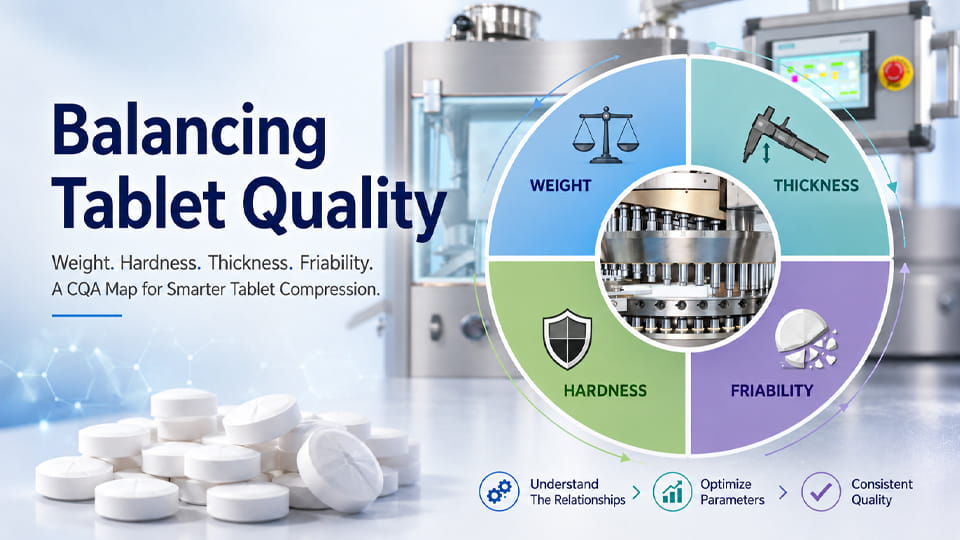
Balancing tablet quality attributes including weight, 경도, 두께, 그리고 부서지기 쉬움, illustrated with a rotary tablet press and tablet compression components.


What Are the Tablet Quality Attributes (CQA) for Compressed Tablets?

In Quality-by-Design terms, 에이 Critical Quality Attribute (CQA) is any property of the drug substance, 부형제, or drug product that “should be within an appropriate limit, range, or distribution to ensure the desired product quality.”. For solid oral tablets, typical product CQAs include potency (복용량), 용해, 안정, 그리고 중요한 것은 physical attributes like weight uniformity, 경도, 두께, 그리고 부서지기 쉬움. These attributes affect purity, 힘, and drug release.

  • Tablet Weight (Mass)/콘텐츠 통일성: Each tablet’s weight (and thereby its API 콘텐츠) must meet label claims. 약전 (예를 들어. USP <905>) enforce narrow weight variation limits (often ±5% for tablets >80Mg) to ensure content uniformity. 실제로, manufacturers routinely test individual tablet weight during production to catch fill-related issues.
  • 정제 경도 (파괴력): Hardness is the force needed to crack a tablet under compression. It reflects the internal particle bonding strength. Tablets must be hard enough to survive handling, 코팅, 그리고 포장, but not so hard that they fail to disintegrate appropriately. Typical breaking force specs might be on the order of 4–10 kg, but the target range depends on the formulation and therapeutic goals.
  • Tablet Thickness: Thickness is a key geometric check often correlated with weight and density. Consistent thickness indicates consistent fill volume and compression. If two tablets have the same weight, the thicker one is usually less dense and may have lower hardness. 거꾸로, under-compressed (thicker) tablets are often weaker. Thickness itself has no universal spec, but is usually monitored in-process as a surrogate for fill and hardness consistency.
  • 정제 취약성: Friability measures how much mass a tablet loses when tumbled, simulating abrasion and handling. It is usually reported as a percentage weight loss after a standardized test (예를 들어. USP <1216>). By convention, an acceptable limit is ≤1.0% weight loss. High friability indicates the tablet edge or coating will chip/dust during coating and packaging, which is unacceptable in production.

함께, these four CQAs – weight, 경도, 두께, friability – form the primary physical performance profile of a tablet. They link back to upstream material attributes (예를 들어. 분말 흐름, 입자 크기, binder levels) and process parameters (예를 들어. 채우기 깊이, 압축력, 속도). Later, we will present a CQA map that connects raw material traits and process variables to each tablet attribute. But first, let’s see how these four attributes influence each other.
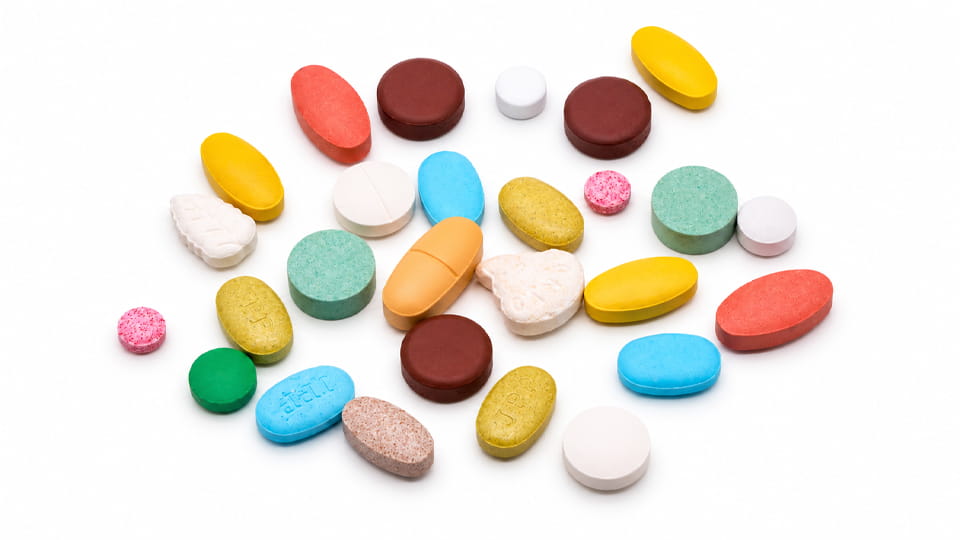
Assorted pharmaceutical tablets in different shapes, 크기, 그림 물감, and thicknesses, illustrating physical tablet quality attributes in tablet manufacturing.


How Are Weight, 경도, Thickness and Friability Related?

These tablet attributes are not independent. Changes to one often ripple into the others:

  • Weight vs. 두께: In a given tablet shape, a larger fill volume (die fill depth) produces heavier, thicker tablets. If all other conditions are fixed, increasing the fill depth linearly raises tablet mass (and usually thickness). 거꾸로, a higher compression force at the same fill will typically compact the powder more, yielding a 거룻배, 희석제 tablet of higher density and hardness. 실제로, die fill (무게) is the primary driver of tablet thickness and dose. 따라서, any weight control change (예를 들어. feeder adjustment) will also shift thickness and may affect hardness.
  • Hardness vs. 부서지기 쉬움: 일반적으로, a harder tablet will be less friable – it resists chipping and abrasion better. That’s because increasing compression force (or binder) usually increases hardness and lowers friability simultaneously. 하지만, hardness and friability are distinct tests: as JinLu Packing notes, “a tablet can be extremely hard—requiring significant force to crush—yet surprisingly brittle.”. 예를 들어, if a very hard tablet has uneven density or tiny surface cracks, it might lose >2% mass in a friability drum, even though it takes a lot of force to fracture it. 요컨대, hardness measures internal strength under a single compressive shock, whereas friability measures surface durability under repeated shocks. Both must meet criteria: you can’t safely assume “hard=low friability” in all cases.
  • Hardness vs. 두께: For tablets of the same weight, a thicker (thus lower-density) tablet usually has lower hardness, because the material is less consolidated. 거꾸로, at constant weight, increasing compression force will shorten (압박 붕대) the tablet and increase hardness. 또한, tablet shape matters: oblong or thicker tablets sometimes distribute compression stresses differently than thin rounds. 경험상, thicker or denser tablets require more force to break.
  • Weight vs. 경도: At the same fill depth, more compression force makes tablets heavier and harder (because rebound is reduced). But if weight increases by adding more powder without changing force, the tablet often ends up thicker and weaker (more friable) unless force is also increased. 실제로, weight control is usually handled by adjusting fill volume first, then fine-tuning hardness by tweaking compression force.

Given these interdependencies, we recommend mapping out the relationships. The diagram below (에이 CQA map) illustrates how key material attributes and compression parameters influence each tablet CQA:
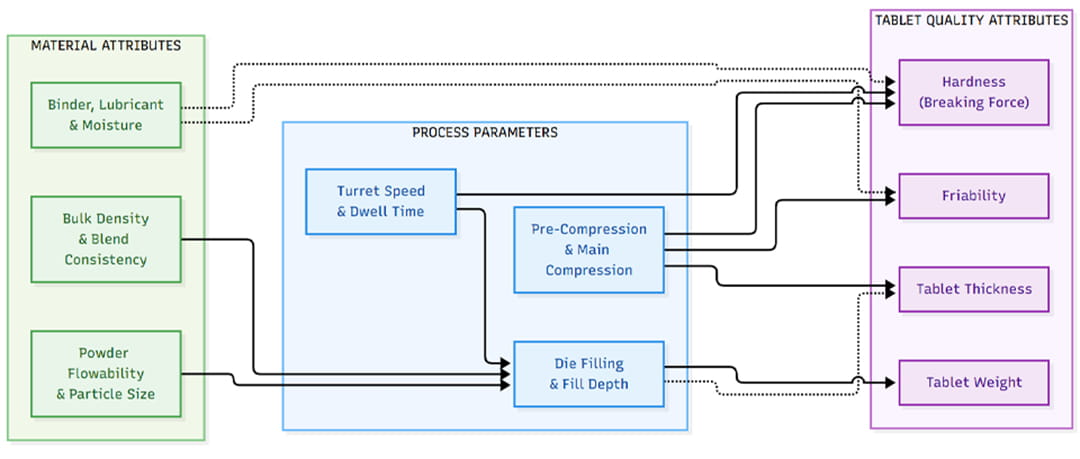
Flowchart showing how powder properties, 충전물, 압축력, and turret speed influence tablet weight, 경도, 두께, 그리고 부서지기 쉬움.

수치: How tablet weight, 경도, 두께, and friability are related during compression. 분말 유동성, 입자 크기, 부피 밀도, and formulation characteristics influence die filling and compaction behavior. Process parameters such as fill depth, 압축력, 포탑 속도, and dwell time affect tablet weight, 두께, 파괴력, 그리고 부서지기 쉬움. These relationships are interconnected and formulation-dependent, so manufacturers should evaluate the four attributes together rather than optimize them independently.


How Compression Parameters Affect Tablet CQAs

Understanding tablet CQAs means controlling the Critical Process Parameters (CPPs) on the tablet press. Key CPPs include fill depth (die fill volume), main compression force, 포탑 속도 (press output rate), and dwell/pre-compression settings. Table below (from JinLu’s reference guide) summarizes how each parameter influences tablet quality:

매개변수 Technical Meaning 태블릿 품질에 미치는 영향 문제 해결
Fill Depth (용량) Depth of powder in the die before compression Sets tablet weight (정량) 및 두께; key source of weight variation Incorrect feeder cam or poor powder flow causes weight shifts. Adjust cam profile or improve flow.
주요 압축력 Punch pressure (kn) exerted on tablet Directly increases hardness and density; higher force generally lowers 부서지기 쉬움. Too much force can cause capping or lamination. 정제가 너무 부드러운 경우, raise force; if capping occurs, reduce force or add pre-compression.
체류 시간 (Compression Duration) Time powder is under pressure (related to press speed) Longer dwell (slower speed or twin-stage press) improves interparticle bonding and hardness. Very short dwell at high speed risks poor compaction (캡핑). Slow down press or use two-stage (pre-comp) if tablets split or are weak.
포탑 속도 (RPM) Rotation speed of the turret Increases output but can degrade quality if too fast. High speed reduces fill time and can worsen weight uniformity and hardness consistency. Balance speed with powder flow. Slow down if weight/hardness fluctuate.
전 압축 Initial low-force compression before main press Helps remove air and make a more uniform tablet core. It generally 증가하다 final hardness and reduces capping/friability. Add or adjust pre-compression if capping or lamination occurs (allows trapped air to escape).

These relationships mean, 예를 들어, 저것 압축력 증가 will raise hardness and lower friability (good up to a point). 하지만, pushing force too far risks tablet failure modes (적층, tool wear). 거꾸로, changing the fill depth (to control weight) will shift thickness and may alter hardness indirectly. 표에서 볼 수 있듯이, setting each parameter requires balancing trade-offs, and troubleshooting often involves small tweaks (예를 들어. “try 1–2 kN more force” or “add a second compression stage” until tablets meet spec).


Balancing Tablet Weight, 경도, Thickness and Friability

실제로, you usually optimize one attribute at a time, while monitoring the others. Here’s a practical sequence to balance the four key CQAs:

  • Control Tablet Weight (Dose Accuracy): 첫 번째, lock down tablet weight (and by extension thickness) at the target. 사용 powder feeder or cam adjustment to set the correct 채우기 깊이 for the desired weight. Verify with scale checks or in-line weight control: if tablets are consistently off-target, adjust the feeder cam or refill settings. (Poor powder flow can cause weight drift; consider a forced feeder or 육아 step.) When weight uniformity is good, thickness should be stable, and dose content will meet spec.
  • Set Hardness (Compression Strength): With weight fixed, adjust main compression force. Weigh a sample tablet, then fine-tune force until tablets hit the target breaking force. If tablets feel too soft or crumble easily, incrementally increase force. If they’re overly hard (예를 들어. causing slow dissolution), reduce force or add a disintegrant. Remember that hardness relates to how tablets perform under stress: aim for your product’s sweet spot (often determined by preliminary studies). Modern presses allow monitoring and logging of compression force per turret to keep this stable.
  • Verify Friability: After setting force, test friability. If friability is too high (>1%), it means tablets have weak surface bonding. Remedies include increasing hardness (more force or binder) or adding a light coating layer. On the machine side, ensure a firm pre-compression to expel air and consolidate the tablet core. If tablets were already very hard, consider modifying excipients (더 접합재 or glidant) rather than force. 메모: a perfectly hard tablet can still pass the friability test if edges chip – so always do the tumble test.
  • Adjust Thickness as Needed: Thickness should now be a result of weight and hardness settings. If tablets ended up thicker than desired, it usually means they are under-compressed; you may need more force. If too thin, you might be over-compressing (or over-filling); in that case, check both fill depth and force. You can also adjust turret speed (slower speeds generally allow more compression time, slightly affecting thickness).
  • Iterate for Consistency: Run a short production batch with the current settings and sample-test tablets from start to finish. Check weight variation, 경도, 두께, and friability at regular intervals. If any CQA drifts during the run, note process shifts (powder temperature, filler feeding, turret wear, 등.) and correct. The goal is to keep all four attributes simultaneously within their target ranges through the run.

Throughout this optimization, good communication with formulation 매우 중요하다. 예를 들어, if you find you need excessive force to hit hardness, you might ask R&D to boost binder or granule density. If weight variation persists, consider re-granulating the blend for better flow. By following this sequence – fix weight, set hardness, validate friability, tweak thickness – you ensure the core quality needs are met first, then polish the tablet robustness.
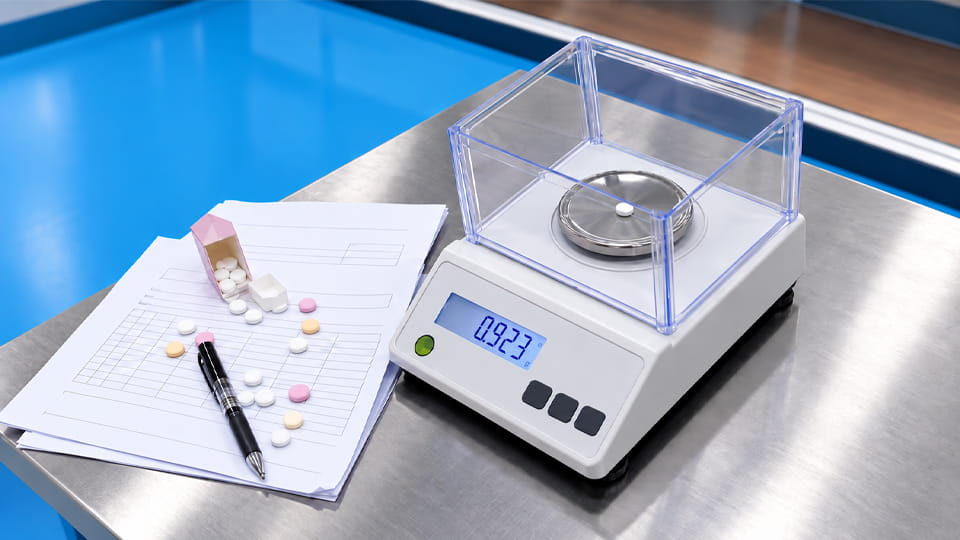
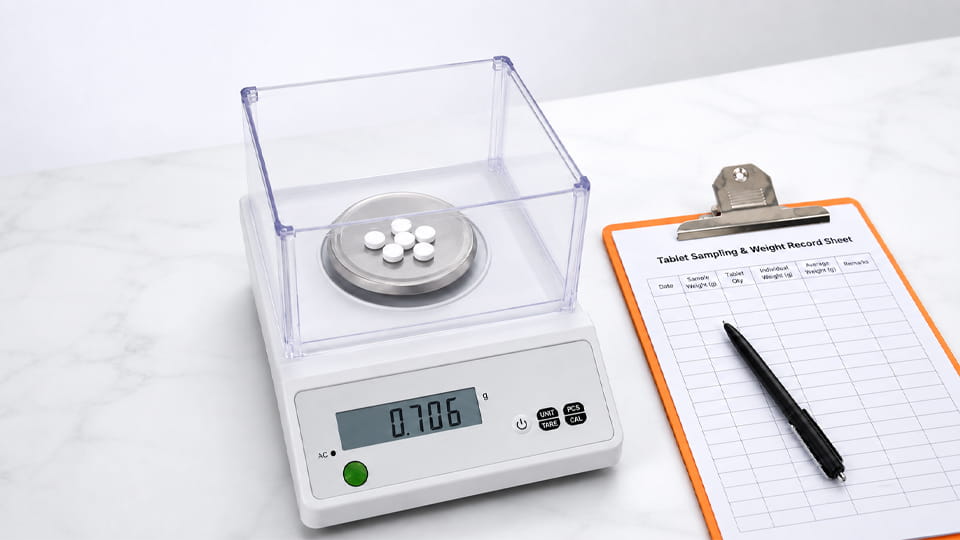
Laboratory electronic balance weighing a single round tablet beside quality control records and tablet samples during pharmaceutical tablet manufacturing.


Common Tablet Quality Problems and Troubleshooting

Even with careful planning, 태블릿 결함 happen. Here are common issues and quick fixes, organized like a decision tree:
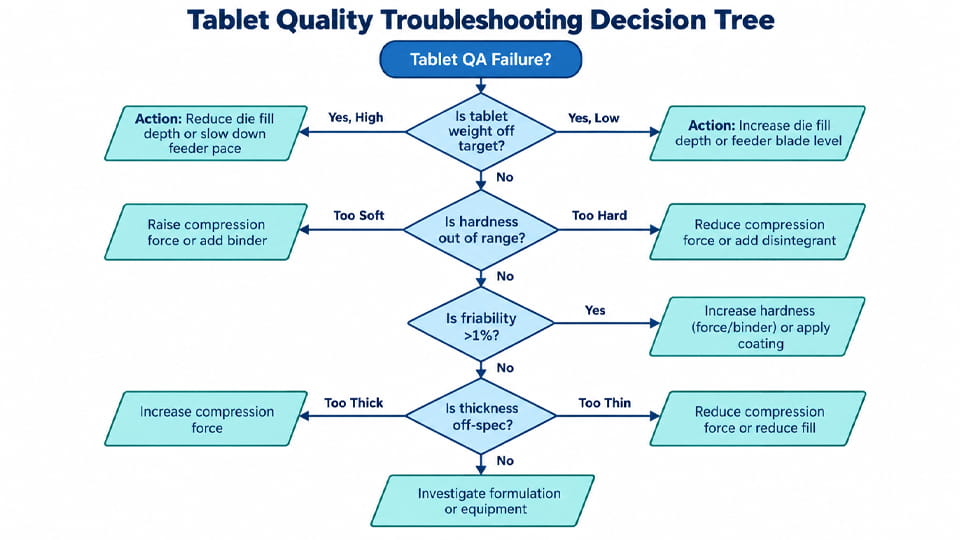
Tablet quality attributes troubleshooting decision tree showing how to identify and correct tablet weight, 경도, 부서지기 쉬움, and thickness problems during compression.

Interpretation: First check weight and thickness. High weight usually means overfill – reduce fill depth. Low weight means underfill – raise it. If weight is good, look at hardness. 부드러운 (낮은 경도) tablets need higher force or formulation tweaks (더 많은 바인더). Very hard tablets can cause downstream issues (like slow dissolution), so you might back off force or tweak disintegrant. If hardness is okay, test friability. 부서지기 쉬움 >1% typically means surface bonding is weak, so increasing hardness (힘) or applying a thin coating can help. 마지막으로, check thickness: overly thick tablets often mean under-compression, so increase force; too thin suggests over-compression or excessive fill. Each step should be followed by a small batch check to confirm the fix.

게다가, be alert for mechanical defects common on a press:

  • 캡핑/라미네이션: The tablet layers split during compression. This often happens when air is trapped or bonding is poor. A classic fix is adding or increasing 사전 압축 to let air escape, or reducing turret speed/dwell time. Also verify the formulation isn’t too elastic (insufficient binder or too much high-lubricant powder can worsen this).
  • 고집/따기: Material adheres to the punch face or die wall, causing missing pieces. This can reduce weight and alter hardness. Remedies include increasing punch pressure slightly, using a forced feeder to improve fill under the punch, or re-balancing lubrication (sometimes even removing a tiny bit of lubricant helps if there’s gluing). Proper punch/cam alignment and a clean press are also essential. 계속 붙어있는 경우, check that the tablet surface isn’t too moist or oily.
  • 체중 변화: Often traceable to powder flow in the feed frame. Poor flow or a worn feeder will make fill depth inconsistent. Ensure the feed frame vanes or forced-feed auger work correctly, and that fines aren’t sticking in the chute. 필요한 경우, a small extra glidant (예를 들어. 콜로이드 실리카) or adjusting feed frame height can stabilize the flow. 원본 Jinlu 노트, “Weight deviation is frequently traced back to inconsistent die filling from poor powder flow characteristics.”
  • High Friability Despite Good Hardness: Sometimes we see tablets that pass hardness but still chip in the friability test. This usually indicates a formulation issue (예를 들어. over-lubrication causing brittle surface, or a need for a light coating). 그러한 경우, adding a hydrophilic binder or changing granulation can tighten the particle bonds on the surface.


How Tablet Quality Affects Coating and Packaging

Remember that hardness and friability are critical 하류 QC checks, not just in-compression values. 딱딱한, durable tablets are easier to coat and package without breaking. 예를 들어, high friability means tablets will shed dust and chips in a coating pan or on packaging lines, causing visual defects and yield loss. 거꾸로, a tablet with the right hardness but uneven thickness could lead to over- or under-application of coating solution or inconsistent 블리스 터 팩 압축.

실제로, ensuring tablets have acceptable weight and strength beforehand streamlines coating. Tablets that meet hardness and friability specs typically survive the rigors of coating (spray and tumbling) and automated packaging. 거꾸로, if tablets are too soft (낮은 경도), you will see breakage and dust in the coating pan; too hard (높은 압축) might mean incomplete film formation (coatings may crack). 이상적으로는, tablet thickness should also be uniform so that coating weight is even. The Jinlu case study notes that “hardness (파괴력) checks internal strength, while friability checks surface durabilityBoth properties affect downstream processing – from how tablets are compressed to how they are coated and finally packed.”. 다시 말해서, always consider these attributes in the context of the whole line: a tablet that fails packing (broken pieces) or has streaked coating is often a symptom of poor compaction quality upstream.

Assorted coated pharmaceutical tablets in different shapes, 크기, and colors on a pink surface, illustrating tablet quality considerations for coating and packaging.


How Rotary Tablet Press Design Supports Consistent Tablet Quality

Modern rotary tablet presses are built with features that make balancing these CQAs easier:

  • Automatic Weight Control: Many high-end presses have closed-loop weight control systems. A sensor (often a load cell under the feed frame) continuously measures actual tablet weight or compression force, and the machine adjusts the feeder cam or paddle position to correct any drift. This can keep 태블릿 무게 and fill depth within tight tolerances without manual resets. 실제로, such systems “ensure consistent production that complies with cGMP requirements”, meaning your tablets stay on target even as ingredient batches vary.
  • 전 압축 (Two-Stage Compression): As shown in the CQA map, a separate low-pressure pre-compression phase can greatly improve tablet quality. In this approach, each tablet is lightly compressed first, ejecting trapped air and lightly densifying the powder, then the main compression follows. Jinlu’s guide explains that two-stage presses “first remove entrapped air and enhance particle consolidation, 그 다음에는 높은 힘의 주 압축이 뒤따릅니다.… This allows high throughput while maintaining the high-hardness molding required for product durability”. 요컨대, 사전 압축 often fixes capping/lamination issues and yields tablets with better hardness–friability balance.
  • Forced Feeder Systems: 까다로운 분말용 (예를 들어. fine, cohesive blends), 에이 강제 공급 장치 (a rotating screw or paddle in the feed frame) ensures a steady, uniform flow of powder into the die. By maintaining constant fill, these systems improve weight uniformity 및 처리량. If you’ve had variable fill rates at high speed, a forced feeder can tighten that variation. This directly helps tablet weight and content uniformity.
  • Servo Drives and Compression Monitoring: Electric (서보 구동) presses allow precise control of turret speed and punch motion. The turret can vary its speed profile to optimize fill and compression dwell. 예를 들어, a servo press can slightly slow down right at the highest compaction point to allow more 체류 시간. These tablet presses also enable real-time data capture – many record the actual compression force applied on every punch. This means you can immediately spot a punch yielding too high or low force. Servo control thus stabilizes 포탑 속도 그리고 압축력, reducing run-to-run variability. 원본 Jinlu 노트, “the modern 회전하는 정제 압축 기계, 고급 제어 시스템과 통합되어 2단계 압축이 가능합니다., is the defining technology that ensures critical quality parameters — including tablet weight, 경도, and content uniformity — are maintained at high throughputs.”.
  • Pre-Feed and Vacuum Options: Some lines include vacuum suction under the dies during filling to assist in packing the powder, improving weight control for very light or very tall tablets. Others have advanced paddle adjustments (sometimes programmable) to fine-tune the cam displacement. All these design features give process engineers tools to keep tablet weight and density on spec.

By leveraging these machine features — automatic weight adjustment, 사전 압축, forced feeders, and servo feedback — a production line can maintain consistent tablet CQAs even under stress (고속) or raw material variability. The net effect is fewer out-of-spec tablets and smoother coating/packing later on.

HZP-26D-40D 회전식 태블릿 프레스 기계


결론

Balancing tablet weight, 경도, thickness and friability is a classic Quality-by-Design challenge. By understanding how raw materials and compression settings drive each quality attribute, you can set up a robust control strategy. Use in-process checks on weight, 경도, and thickness to detect drift early, and perform the official friability test on finished batches to verify mechanical durability. 현대의 로타리 태블릿 프레스 (like the JinLu ZP-series) offer features — servo-driven cam control, weight-feedback, two-stage compression, forced feeders — that make this balancing act much easier.

Ready to streamline your tablet production? JinLu 포장에 문의 to explore our high-performance 회전식 태블릿 프레스 기계, equipped with automatic weight control and compression monitoring. We can arrange sample testing on your formulation to optimize your tablet quality attributes.


FAQs on tablet quality attributes (CQA)

What is an acceptable range for tablet weight variation?

약전 (like USP) require each tablet be close to the average weight. A common spec is that no more than 2 ~의 20 tablets can deviate outside ±5% of the average (태블릿용 >80Mg). For very small tablets (<80Mg), the limit is ±10%. 하지만, your own specification may be tighter depending on the API dose and potency. Always refer to USP or for your dosage form.

How is tablet hardness measured?

정제 경도 (파괴력) is measured by a hardness tester (manual or electronic). The tester compresses a single tablet until it cracks, reporting the peak force (in kg or Newtons). Modern digital testers often record diameter and thickness at the same time. According to USP , you take an average of multiple tablets and set a min/max range. 생산 중, hardness is usually monitored continuously and adjusted via the press settings as needed.

If tablets are too hard, what should I do?

첫 번째, reduce the compression force in small steps. Also check if you can decrease binder (or increase disintegrant). Very high hardness can slow dissolution or make tablets hard to swallow. After adjusting, always re-test friability and disintegration.

How can I reduce high friability?

High friability usually means tablets are under-compressed or poorly bonded. Increase tablet hardness by raising compression force or improving formulation (더 많은 바인더, 육아). Adding a thin film coating often solves minor friability, but the root is densification. Also ensure you have adequate dwell/pre-compression time to fully consolidate the tablet.

Does tablet shape affect these quality attributes?

예. Different shapes (round vs oblong, single vs double convex) distribute compression force differently. 예를 들어, very thick or tall tablets tend to be harder, whereas thin tablets may need less force. If you change tooling or die dimensions, you should re-qualify the fill and force settings. Always measure thickness for new tablet shapes, and watch how that impacts hardness and friability in trials.

How often should we test these attributes in-process?

It depends on regulatory guidance and risk. 일반적으로, 태블릿 무게 (or content) is sampled at least every hour (or more frequently) during a run. Hardness and thickness can be spot-checked similarly (예를 들어. 3–5 tablets per shift) or even continuously on-line if you have automatic testers. Friability is usually checked on a full batch at release. Good practice is to set in-process controls for weight and hardness with acceptance criteria, and only do friability at the end (since it’s destructive).

How can I improve tablet weight consistency?

Ensure the blend has good flow (consider slugging or granulation if not). Adjust the feed frame height and paddle, or use a forced feeder. Check the punch and die alignment. If variation persists, a servo press can actively control weight via a feedback loop. 요약: improve flow + fine-tune feeder cam.

What standards cover these tests?

The USP chapters are (Weight Variation/Content Uniformity), (Tablet Breaking Force, 즉. 경도), 그리고 (정제 취약성). These give standard methods (like number of tablets, rotation count for friability, 등.). We follow those protocols in our QC lab. 예를 들어, USP friability test is described in JinLu’s resource.


참고자료:
1.나는 Q8 (R2) Pharmaceutical development —— 유럽의약품청
2.품질 리스크 관리 —— 나 Q9(R1)
3.Pharmaceutical Quality System —— ICH Q10
4.Tablet Compression Force as a Process Analytical Technology (가볍게 두드리기): 100% Inspection and Control of Tablet Weight Uniformity —— 퍼브메드
5.Tablet disintegration performance: Effect of compression pressure and storage conditions on surface liquid absorption and swelling kinetics ——퍼브메드
6.투여량 단위의 균일성 —— USP <905>

이 기사를 공유하세요:
사진 사소한 푸
사소한 푸

사소한 푸, 진루패킹 창업자, 가져오다 20 제약 기계 부문에 대한 다년간의 전문 지식. 그의 리더십 아래, Jinlu는 디자인을 통합하는 신뢰할 수 있는 공급업체로 성장했습니다., 생산, 그리고 판매. Petty는 고객이 제약 포장의 복잡성을 헤쳐나갈 수 있도록 깊은 산업 지식을 공유하는 데 열정을 갖고 있습니다., 장비뿐만 아니라 제품도 받을 수 있도록 보장, 생산 목표에 맞춘 진정한 원스톱 서비스 파트너십.

목차

문의 보내기

답장을 남겨주세요

귀하의 이메일 주소는 공개되지 않습니다. 필수 입력란이 표시되어 있습니다 *

무료 견적 받기

*우리는 귀하의 기밀성을 존중하며 모든 데이터는 보호됩니다. 귀하의 개인정보는 JL 솔루션을 위해서만 사용 및 처리됩니다..