
제약 제조에서, Tablet disintegration and dissolution are two different tests used to evaluate tablet performance. Disintegration measures how quickly a tablet breaks apart after contacting a liquid, while dissolution measures how much of the 활성 제약 성분 (API) goes into solution over time. 간단히 말해서, disintegration tells you whether the tablet breaks up; dissolution tells you how the drug is released into the test medium.
These two results can be related, but they do not always match. A tablet may disintegrate quickly but still show slow dissolution because of poor API solubility, large particle size, poor wettability, excessive lubrication, or formulation factors. 거꾸로, a tablet with slower disintegration may still meet its dissolution requirements depending on the drug and dosage-form design.
제약 제조업체용, understanding this difference is important when investigating tablet disintegration or dissolution problems. This article explains what each test actually shows, why their results can diverge, and how formulation, 압축력, tablet porosity, 붕 해제, 매끄럽게 하기, and other manufacturing factors can affect tablet performance.
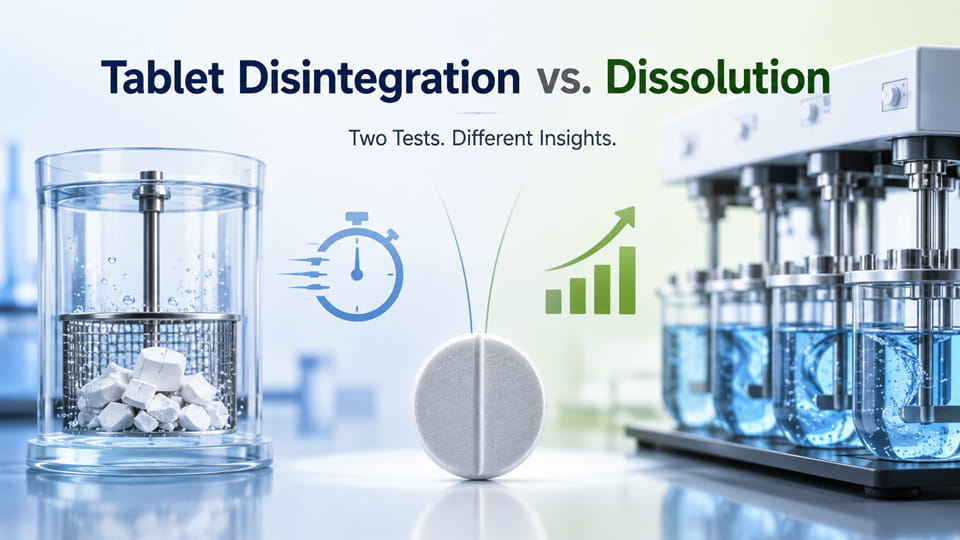
정의에 따르면, disintegration testing (USP <701>) assesses whether an immediate‑release tablet breaks into smaller fragments within a specified time in liquid (usually water). Dissolution testing (USP <711>) measures how much of the active drug goes into solution over time under controlled conditions. 간단히 말해서:
Disintegration is a mechanical break-up process. Without proper disintegration, only the API near the tablet surface can dissolve. Even if a tablet disintegrates fully, 그만큼 용해 depends on drug properties (용해도, 입자 크기, wettability) and test conditions. 실제로, the two tests often correlate but can diverge. 예를 들어, a tablet might break up rapidly (short disintegration time) but still release drug slowly if the API is poorly soluble. 거꾸로, a tablet might disintegrate slowly (long disintegration time) but still meet dissolution specs if the drug dissolves readily once particles are wetted.
The table below concisely compares the two tests:
| 측면 | Disintegration Test | Dissolution Test |
| 측정하다 | Physical breakup of tablet into small pieces | Amount (%) of drug released into solution over time |
| 목적 | Confirm tablet will disintegrate in GI tract | Confirm tablet releases drug at intended rate |
| 장비 | USP Basket-Rack (tube assembly, 29–32 cycles/min) | USP Dissolution Apparatus (예를 들어. 외륜, basket) |
| 결과 | Pass/Fail (all tablets must break up) | Continuous profile (예를 들어. % dissolved at 15, 30 분) |
| Typical Timeframe | 15–60 minutes per pharmacopeia | 30–60+ minutes (product-specific) |
| Compliance Basis | Monograph or compendial limits on max time | Monograph % 풀어 주다 (예를 들어. Q ≥ X % in Y min) |
| Correlation | “No disintegration = No dissolution”, but the converse isn’t guaranteed | Depends on formulation/excipients; influenced by solubility, 등. |
| Affected by | Binder level, disintegrant type, 경도, coating thickness | API solubility, surface area, 부형제, test medium, and also tablet hardness/lubricants |
| Analytical Role | Quality check that tablet breaks up (배치 일관성) | Performance test (생체 이용률, 배치 일관성) |
| 규제 | USP <701>, Ph.Eur. 2.9.1 (분해) | USP <711> (그리고 <1094> for capsules), Ph.Eur. 2.9.3 |
간단히 말해서: Fast disintegration ≠ fast dissolution unless the drug is soluble enough. As one expert review states, “Wetting and subsequent disintegration of the powder compact is the first step towards liberation of the API… without disintegration only the API near the surface… dissolves”. Thus a full tablet disintegration is usually needed for consistent dissolution, but other factors govern how quickly the drug then dissolves.
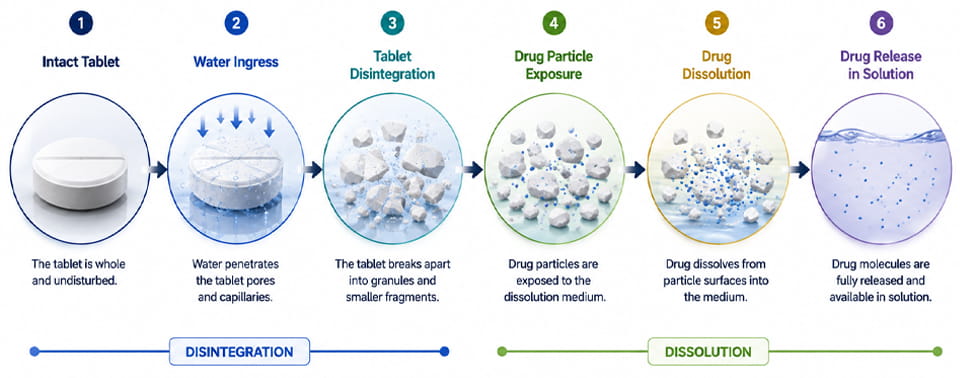
수치: Tablet → water penetration → disintegration → particle exposure → dissolution → drug release. Effective disintegration increases surface area for dissolution.
위에서 언급한 바와 같이, disintegration is only the 첫 번째 step towards drug release. A tablet can meet disintegration criteria (pass USP <701>) yet still fail dissolution if the drug fails to dissolve. 거꾸로, some formulations (like modified-release or mucoadhesive tablets) may intentionally not fully disintegrate – yet they dissolve as designed. 실제로, we often see these patterns:
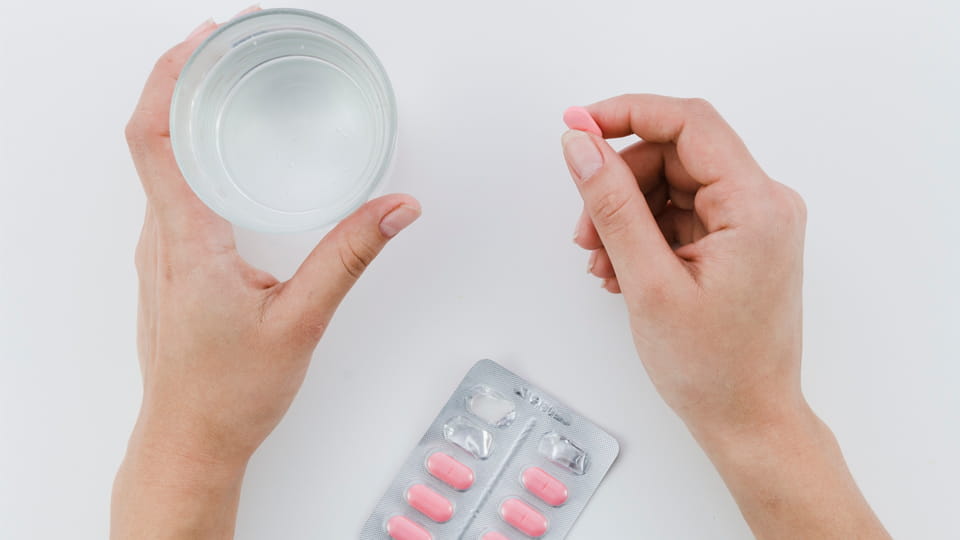
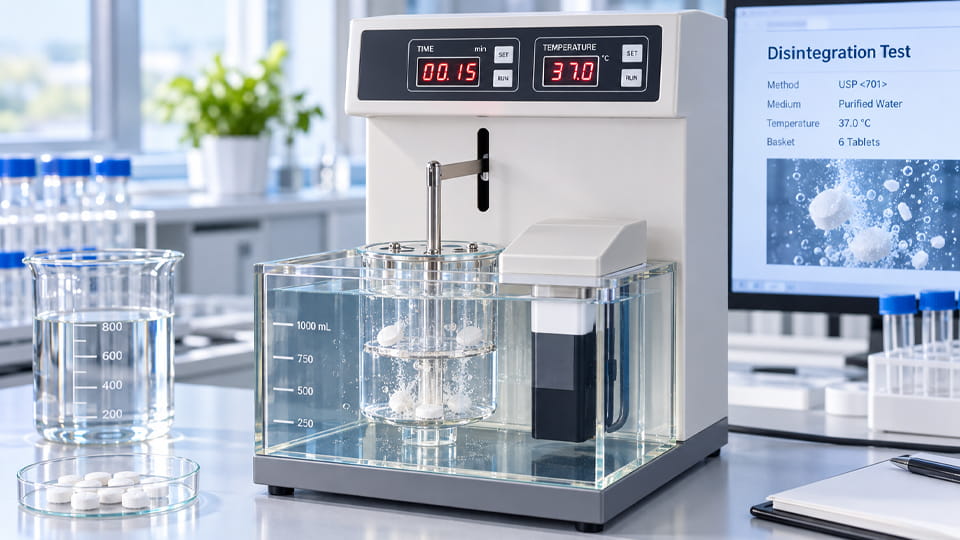
A tablet’s disintegration test measures how quickly liquid penetrates and breaks apart the tablet. In the standard apparatus, tablets sit in fluid on a disintegration tester; springs or perforated disks help agitate the sample. 요점:
In immediate‐release tablets, 붕 해제 (예를 들어. 크로스포비돈, 크로스카멜로스) promote rapid breakup. 예를 들어, Markus Markl and Greg Zeitler note that disintegrants create small granules and expose particles for dissolution. If a tablet fails disintegration (takes too long or doesn’t break), that indicates a formulation or equipment issue (예를 들어. excessive binder or force). 하지만, even a fast‑disintegrating tablet may not meet dissolution specs if the drug is insoluble or protected by coating.
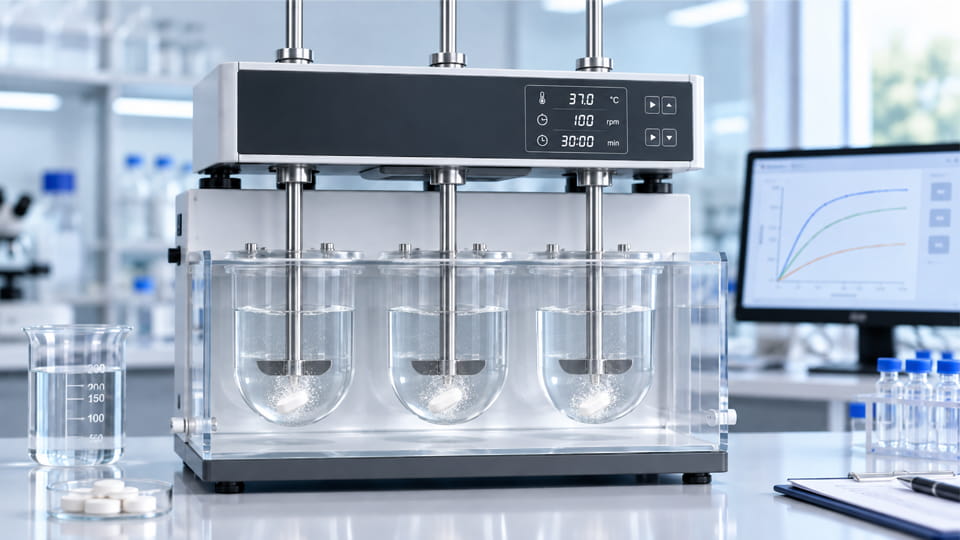
A tablet’s dissolution test evaluates drug release kinetics into a specified fluid (often water or buffer). Key aspects:
For immediate-release products, dissolution is the in vitro surrogate for in vivo drug availability. FDA guidance explains that dissolution tests (USP <711>) ensure consistent product quality and bioequivalence. Unlike disintegration, dissolution directly measures the amount of drug ready to be absorbed, and reflects both tablet breakup and API behavior. 요컨대, dissolution answers: “How much active ingredient actually dissolves over time?”
Different factors can cause a tablet to disintegrate and dissolve at mismatched rates. Below are 8 key causes of divergence. Each cause is explained with mechanism, likely test pattern, and what to investigate.
By analyzing each cause (with mechanism and expected outcomes), one can prioritize what to check when disintegration vs dissolution do not match expectations. 예를 들어, if tablets dissolve very slowly but disintegrate normally, focus on API properties or dissolution medium. If tablets barely break up, focus on formulation (binder/disintegrant) and compression.
The table below summarizes typical test outcome combinations and suggests where to look. These are general patterns; always compare against product-specific specifications and release mechanisms.
| Disintegration Result | Dissolution Result | What to Check |
| 빠른 (short time) | 빠른 (meets spec) | Likely normal – confirm both meet product criteria. |
| 빠른 | 느린 or incomplete | Check API solubility, 입자 크기, 윤활유; ensure dissolution method is correct. |
| 느린 | 느린 (fails spec) | Likely formulation/compression issue – check hardness, 접합재, 분해제, & 다공성. |
| 느린 | Acceptable (meets spec) | Compare against spec: if dissolution meets spec, this may be allowed; still check if compaction too high. |
| 변하기 쉬운 | 변하기 쉬운 | Inconsistent process: check manufacturing controls (예를 들어. 체중 변화, 블렌딩) and test consistency. |
예를 들어, a fast disintegration but slow dissolution often points to a low-solubility API or excessive hydrophobic lubricant – the tablet breaks up but drug goes into solution sluggishly. 거꾸로, a slow disintegration and slow dissolution suggest too strong or too dense a tablet. If disintegration is slow but dissolution actually meets product requirements, review whether the disintegration limit is overly strict for this formulation. Variable results usually mean batch-to-batch inconsistency or test error.
When tests diverge from expectations, a systematic investigation is needed. Here’s a recommended workflow with key checks (inspired by GMP Out-of-Spec procedures):
Throughout the troubleshooting, document each check. Below is a checklist of actions:
This systematic approach—from lab method to formulation to equipment—helps pinpoint why results diverge and ensures robust tablets.
Tablet press settings and tooling can significantly influence both tests. Key manufacturing variables and their effects include:
| Manufacturing Variable | Tablet Property Affected | Effect on Disintegration/Dissolution |
| Compression force | 경도, 밀도, Porosity | Higher force → harder, less porous tablets → slower disintegration and dissolution. |
| 사전 압축력 | Tablet uniformity | Pre-compression consolidates fill → often better consistency and less capping; can slightly reduce disintegration if overused. |
| 포탑 속도 (체류 시간) | Dwell time per tablet | Faster speed = shorter dwell time → less densification → softer tablets (may dissolve faster, but weight variation risk). Slower speed = longer dwell → harder tablets. |
| Feeding consistency | 무게 변화 | Fluctuations cause dose and dissolution variability. Uniform feeding yields consistent tablet weight and content. |
| Blending time | 콘텐츠 균일성 | Inadequate mixing can leave pockets of disintegrant or binder → variability in test results. |
| Lubrication process | Surface hydrophobicity | Longer blending with Mg-stearate coats particles more thoroughly → wetting slowed → slower dissolution. |
| Tooling condition | Tablet shape/surface | Worn punches (부서진 가장자리) or embossing changes can affect tablet porosity and breakage patterns; can alter disintegration behavior. |
예를 들어, 압축력 is a critical lever: increasing force will usually boost tablet hardness and reduce porosity, making water penetration slower. 거꾸로, a very high turret speed (짧은 체류 시간) might produce slightly softer tablets that release drug faster (though at risk of weight fluctuations). Jinlu’s literature (예를 들어. on 압축 체류 시간) explains how speed and turret design influence dwell. 비슷하게, 제복 급송 and proper lubrication ensure consistent tablet surfaces; any hiccup in these can cause unpredictable dissolution values.
아르 자형efer to Jinlu’s 태블릿 프레스 머신 product pages for compression settings, 사전 압축 특징, 그리고 태블릿 툴링 solutions to see how adjustable parameters can help achieve the desired tablet properties.
Regulators recognize that in some cases a disintegration test may suffice for immediate-release tablets, but strict criteria apply. FDA Q6A guidance notes that for highly soluble drugs in certain IR formulations, one might justify using disintegration as a surrogate if supported by data. 실제로, this is rare and requires demonstrating by test data that the drug is “truly rapidly dissolving.” USP <701> explicitly focuses on tablet breakup, ~하는 동안 <711> remains the gold standard for drug release.
다시 말해서, disintegration can never automatically replace dissolution testing. Any substitution must be justified by regulatory submissions, 예를 들어. by showing the drug is Class I (high solubility, high permeability) and formulation is “simple”. 그때도, pharmacopeia chapters suggest the disintegration test conditions must exactly match the dissolution specification (예를 들어, 중간, apparatus). Companies often keep both tests for full assurance.
Tablet disintegration and dissolution measure different aspects of tablet performance. Disintegration shows how a tablet breaks apart, while dissolution reveals how much of the active drug enters solution over time. When results diverge, the cause may lie in API properties, 공식화, compression settings, or testing conditions.
제약 제조업체용, understanding these differences is essential for maintaining consistent tablet quality. A well-controlled compression process helps reduce manufacturing variability, but achieving the desired dissolution profile also requires suitable formulation design and appropriate quality testing.
Need a more consistent tablet compression process?
그리고 Jeinlu 따기, we provide 회전식 태블릿 프레스 기계 and customized pharmaceutical manufacturing solutions. Whether you’re developing a new tablet formulation, 기존 장비 업그레이드, or scaling up production, our engineering team can help you evaluate suitable compression force, 사전 압축, 급송, and production capacity requirements.
지금 Jinlu Packing에 문의하세요. to discuss your tablet specifications, 재료 특성, 생산 목표.
Tablet disintegration measures how quickly a tablet breaks apart into smaller particles. Dissolution measures how much of the API is released into the test medium and becomes dissolved over time. They are related tests, but they evaluate different stages of tablet performance.
예. Fast disintegration does not necessarily mean fast dissolution. Poor API solubility, large particle size, poor wettability, excessive lubrication, or formulation factors can cause slow dissolution even when the tablet breaks apart quickly.
예. Higher tablet hardness can reduce porosity and make liquid penetration more difficult, potentially increasing disintegration time and slowing dissolution. 하지만, the actual effect depends on the formulation and product design.
Compression force can change tablet hardness, 다공성, and internal structure. Excessive compression may produce a denser tablet that takes longer to disintegrate, while insufficient compression can result in weak tablets with poor mechanical strength.
Common causes include poor API solubility or wettability, large API particle size, formulation issues, excessive lubrication, high tablet density, unsuitable coating, and inappropriate dissolution test conditions. Both formulation and manufacturing variables should be investigated.
Disintegration time only describes how quickly the tablet breaks apart. Dissolution also depends on API properties, 입자 크기, surface area, wettability, formulation composition, and the conditions of the dissolution method. 그러므로, similar disintegration times do not guarantee similar dissolution profiles.
예. Tablet porosity influences how easily the dissolution medium penetrates the tablet and how quickly particles become exposed to the liquid. Changes in compression and formulation can alter porosity and consequently affect disintegration and dissolution.
In some specific cases, disintegration may be used instead of dissolution testing when applicable regulatory and product-development criteria are satisfied. It should not be assumed that a passing disintegration test can generally replace dissolution testing.
First verify the dissolution method and test conditions, including the apparatus, 중간, 온도, 동요, 견본 추출, and analytical procedure. If the test is confirmed, investigate API properties, 공식화, 매끄럽게 하기, 육아, compression parameters, 정제 경도, 다공성, 그리고 코팅.
Manufacturing parameters such as compression force, 사전 압축, 포탑 속도, 체류 시간, feeding consistency, 매끄럽게 하기, and tooling condition can change tablet properties. These changes may affect hardness, 다공성, 분해, and ultimately dissolution performance.
참고자료:
1.Dissolution Testing of Immediate Release Solid Oral Dosage Forms —— FDA
2.Compilation of FDA Guidance and Resources for in vitro Dissolution Testing of Immediate Release Solid Oral Dosage Forms —— FDA
3.Exploring the performance-controlling tablet disintegration mechanisms for direct compression formulations —— 퍼브메드
4.Supporting Information for Dissolution / 약물 방출 / Disintegration Tests —— USP
5.ICH Q4B Annex 5 Disintegration Test —— 유럽의약품청
6.A Review of Disintegration Mechanisms and Measurement Techniques —— 스프링거 자연