×

オンラインサービス

💬WhatsApp: +86 1801179332
💡
  • ブログ
  • 医薬品製造における錠剤圧縮の主な問題とその解決方法

医薬品製造における錠剤圧縮の主な問題とその解決方法

医薬品製造, tablet compression looks simple on the surface — powder goes in, tablets come out. But anyone who has worked around a tablet press knows the reality is very different. Small changes in granule flow, moisture level, tooling condition, or machine speed can quickly create quality problems that slow production and increase waste.

Issues like capping, こだわり, ピッキング, 重量の変化, or weak tablet hardness are common during tablet compression. These problems not only affect product appearance, but can also impact dosage accuracy, dissolution performance, packaging efficiency, 規制遵守と. In a busy production environment, even a minor compression issue can lead to rejected batches, マシンのダウンタイム, and extra maintenance costs.

For production managers, 調達チーム, and pharmaceutical equipment buyers, understanding the root causes behind these tablet compression problems is important. The good news is that most compression defects are preventable when the formulation, granulation process, ツーリング, and tablet press parameters work together properly. この記事では, we’ll walk through the most common tablet compression issues in pharmaceutical manufacturing, explain why they happen, and share practical ways to solve them. Whether you operate a 高速回転式打錠機 or manage a complete tablet production line, these troubleshooting tips can help improve tablet quality and reduce production interruptions.

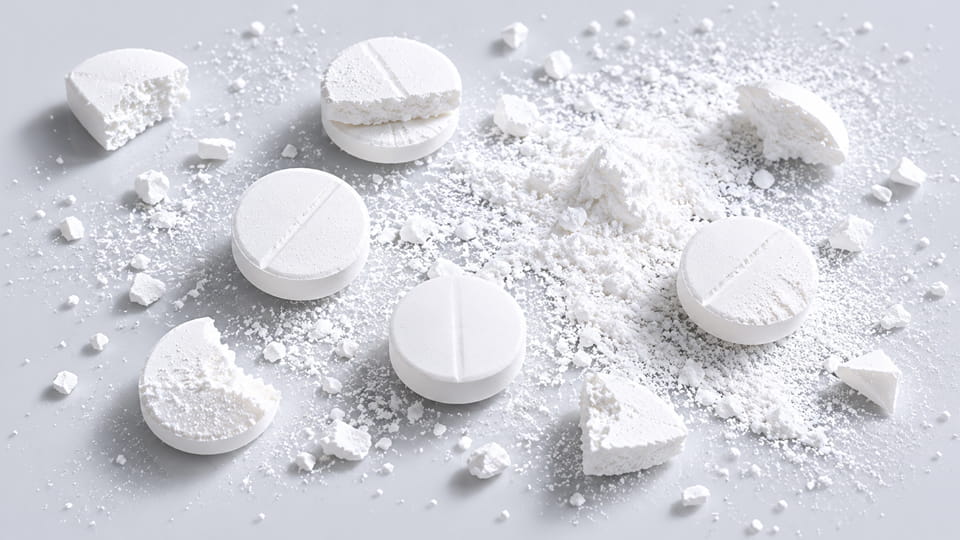
圧縮の問題がある壊れたタブレット


Overview of the Tablet Compression Process

Tablet compression is a critical step in solid-dose pharmaceutical manufacturing, where powder or granule formulations are filled into dies and compacted into tablets using punches and high pressure. Most production lines use rotary tablet presses, which have multiple stations on a rotating turret. Each station houses an upper punch, a lower punch, and a die. The process typically involves two stages: 圧縮前 (a light prefill force that primes the powder) and main compression (the final high force that forms the tablet).

HZP-26D-40Dロータリータブレットプレスマシン

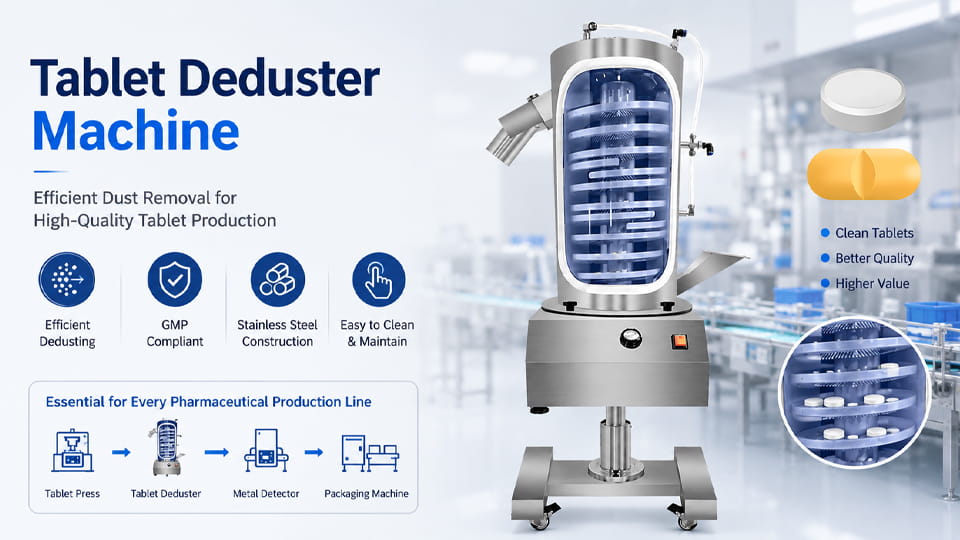
Manufacturers must also consider formulation and granulation quality. 例えば, good powder flow is essential for uniform die filling. Granules are often sized (例えば. <20% of die diameter) to avoid segregation. The powder blend usually contains APIs, バインダー, 潤滑剤, and flow enhancers to help it compress properly and eject from the tooling. Even after compression, a deduster or tablet polisher is often used to remove fines and improve tablet appearance. 実際に, after tablets exit the press, ある タブレット除塵機 installed between the press and coating/packaging line will vibrate and vacuum off loose dust and fragments, ensuring clean, dust-free tablets.

[jl_youtube ソース=”https://www.youtube.com/embed/bxodNZedxOE”]


Common Tablet Compression Issues

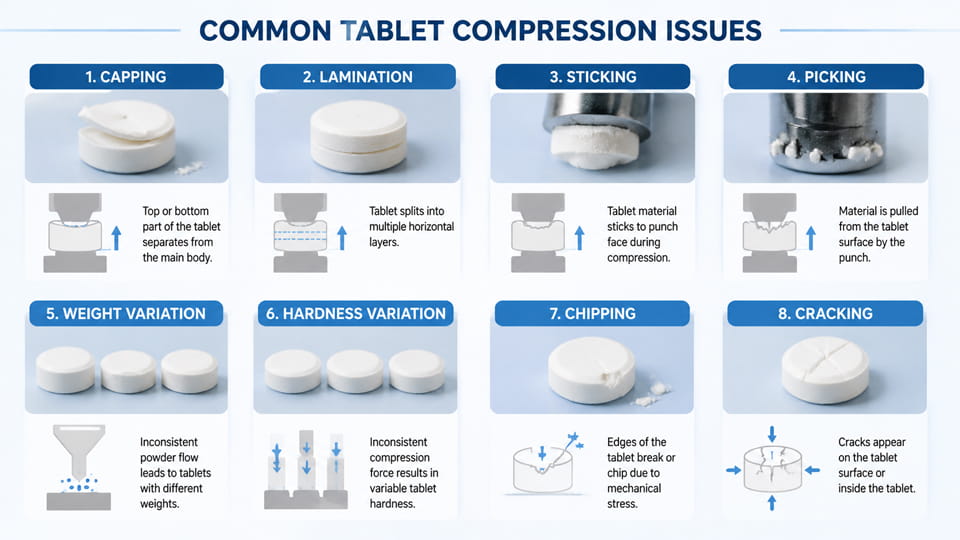
During tablet compression, several defects can arise. Below we cover the most frequent problems, their typical causes, and practical solutions.

キャッピングとラミネーション

What It Looks Like: Capping occurs when the top (または一番下) of a tablet breaks off, appearing as a “cap” that has separated from the main tablet body. Lamination is when a tablet splits into two or more horizontal layers. Both defects usually mean the tablet didn’t bond together fully during compression.

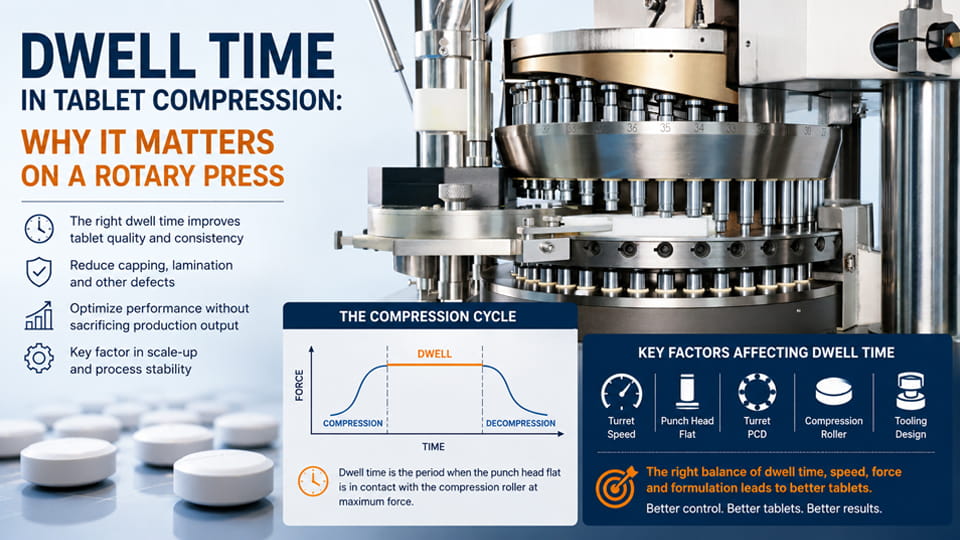
Common Causes: Capping often results from air entrapment and poor particle bonding. When punches compress the powder, air pockets at the top or middle of the die can prevent proper consolidation. High turret speed (short dwell time) and very high compression force can exacerbate this problem. 加えて, elastic or very low-density ingredients (例えば. some elastic binders) can “snap back” after compression, causing layers to separate. Too little binder or too low moisture in the granulation also weakens inter-particle binding.

ソリューション: To prevent capping and lamination, help trapped air escape and improve bonding. Using conical punch/die profiles lets air vent more easily. Slowing down the turret (increasing dwell time) or adding a mild pre-compression force pushes more material into the die before final compaction. Slightly reducing the main compression force can also avoid over-compression. Check tablet moisture and binder: adding a touch more moisture during 湿式造粒 or increasing binder content can enhance bonding. 要約すれば, adjusting punch/die shape and press parameters (and replacing worn tooling) allows trapped air to escape and greatly reduces capping.

固執してピッキング

What It Looks Like: Sticking happens when powder adheres to the punch face, leaving a deposit of material or an incomplete tablet face. Picking is a form of sticking that occurs around embossed logos or markings; the raised design on the punch grabs powder, leaving a defect in the tablet. Both result in tablets with rough faces and sometimes missing edges.

Common Causes: High friction or tackiness between powder and punch is the main culprit. Often this is triggered by excess moisture or high humidity. If granules are too wet or the compression room is humid, particles can film onto the punch face. 同じく, insufficient lubricant in the blend means nothing is helping the powder slip off the punches. If compression force is too low, tablets may be under-compressed and stick; 逆に, too high force can heat the powder slightly and make it tacky.

ソリューション: Improve release and reduce adhesion. 初め, maintain proper environmental control: dehumidify the press area if needed and keep granule moisture within specification. Ensure the blend contains enough lubricant (typically 0.5–2% magnesium stearate or similar) and mix it thoroughly (but not excessively) so particles are coated. Polish punch faces regularly to remove scratches, and consider applying a suitable punch polish or non-stick coating. If sticking persists, try slight parameter adjustments: sometimes a small increase in press speed (shorter contact time) or a decrease in compression force can help tablets eject before sticking.

重量の変化

What It Looks Like: Tablets are supposed to be uniform weight within a tight specification. When weight variation is high, tablets from the same batch come out noticeably light or heavy, risking dose inconsistency.

Common Causes: Excessive variation usually stems from inconsistent die filling. Rotary presses typically dose by volume, so any change in powder bulk density or fill dynamics causes weight shifts. Common issues include poor flowability (leading to bridging or uneven feed), segregation of mixed powders (coarse particles filling faster), or a worn/misaligned feed frame (giving an uneven powder supply). Running the press too fast can worsen this by not allowing enough time for each die to fill.

ソリューション: Improve powder flow and feed consistency. Optimize granulation to achieve a homogeneous, free-flowing blend. 流動促進剤を添加する (例えば. colloidal silica) or anti-caking agents to reduce sticking and bridging. Adjust feed frame settings and install baffles in the hopper to control flow. Consider using forced-feed punches (where the lower punch rises to actively fill the die) or vacuum-assisted filling if the powder is sluggish. Lowering turret speed (giving more fill time) often reduces variation. 要するに, ensure each die consistently receives the same amount of powder – this might mean changing the feed mechanism or press speed.

Hardness and Friability Problems

What It Looks Like: 硬度 (or breaking force) is the resistance of a tablet to crushing. If tablets are too soft, they may chip, break, or exhibit high friability (easily crumble). If too hard, they may resist coating or dissolve slowly. Friability tests (tumbling tablets and measuring weight loss) often reveal edge chipping or powdering.

Common Causes: Hardness is primarily controlled by compression force and formulation. Low compression force or too little binder yields soft, fragile tablets. 一方で, excessively high force can create very hard tablets that crack or resist disintegration. 例えば, one industry source notes that very high ejection force (from over-compression) can lead to tablets that are too hard, causing cracks or slow disintegration. Variation in tablet weight also causes hardness variation: lighter tablets are thinner/softer, heavier ones thicker/harder.

ソリューション: Tune compression and binding. Adjust the main compression to hit a target hardness (usually measured on a hardness tester). Modify the formulation: adding or optimizing a binder (例えば. PVP, HPMC, or starch) increases inter-particle bonding. Control granule moisture, as slightly damp granules often produce stronger tablets (but beware over-wetting). Replace worn ejector blades and ensure smooth ejection; a rough ejection stroke can crack tablets. If friability is high, check if tablets are too weak – you may need slightly more compression force or more binder. バランスが鍵です: aim for tablets hard enough to survive handling but not so hard that they fail dissolution tests.

Other Minor Issues

Other defects can occur. Edge chipping or cracks often happen if tablets expand suddenly after ejection or if dies are flat. Double impressions (ghost images) typically result from loose tooling or mechanical replay of the punch. Mottling or color variation (in uncoated tablets) can occur if colored excipients segregate. These often relate back to the above causes: 例えば, edge chipping can stem from over-compression or too-dry granules, and resolving it might involve a tiny lubricant or binder adjustment.

実際に, a structured troubleshooting approach is helpful. 例えば, stop the press when a defect appears and review any recent changes (like new batches, changed speed, or maintenance). Check tooling and operating conditions, and correct one factor at a time. Many manufacturers chart key parameters (タブレットの重量, 厚さ, 硬度, 等) in real-time so they see trends emerge. Visual inspection of tablets (表面仕上げ, edges) is also crucial. This systematic method – observe, isolate, adjust – quickly narrows the root cause.

Common Tablet Compression Issues


Factors Influencing Tablet Quality

Several upstream factors influence compression outcomes:

  • 材料特性: Different 賦形剤 compress differently. 例えば, microcrystalline cellulose and lactose compact well, whereas others (ステアリン酸マグネシウムのような) act as lubricants. Granule hardness and density matter: very fluffy or overly hard granules can cause flow or binding issues.
  • Formulation Composition: The ratio of binder/disintegrant/lubricant to API is key. High drug-loading can challenge bonding, so such formulas might require stronger binders or granulation aids.
  • Environmental Conditions: Temperature and humidity in the compression suite can’t be ignored. High humidity or moist granules can promote sticking/lamination, while overly dry conditions can cause static, 流れが悪い, or brittle tablets.
  • Machine Condition and Settings: Even minor misalignment on the press can spoil tablets. Regularly check turret alignment, turret cam (pre-compression vs main compression) 設定, and feeder adjustments. Worn punches/dies or loose tooling cause variability.
  • Operator Practices: Consistency in setup and maintenance is crucial. Human errors (wrong tooling, skipped cleaning) often cause defects.

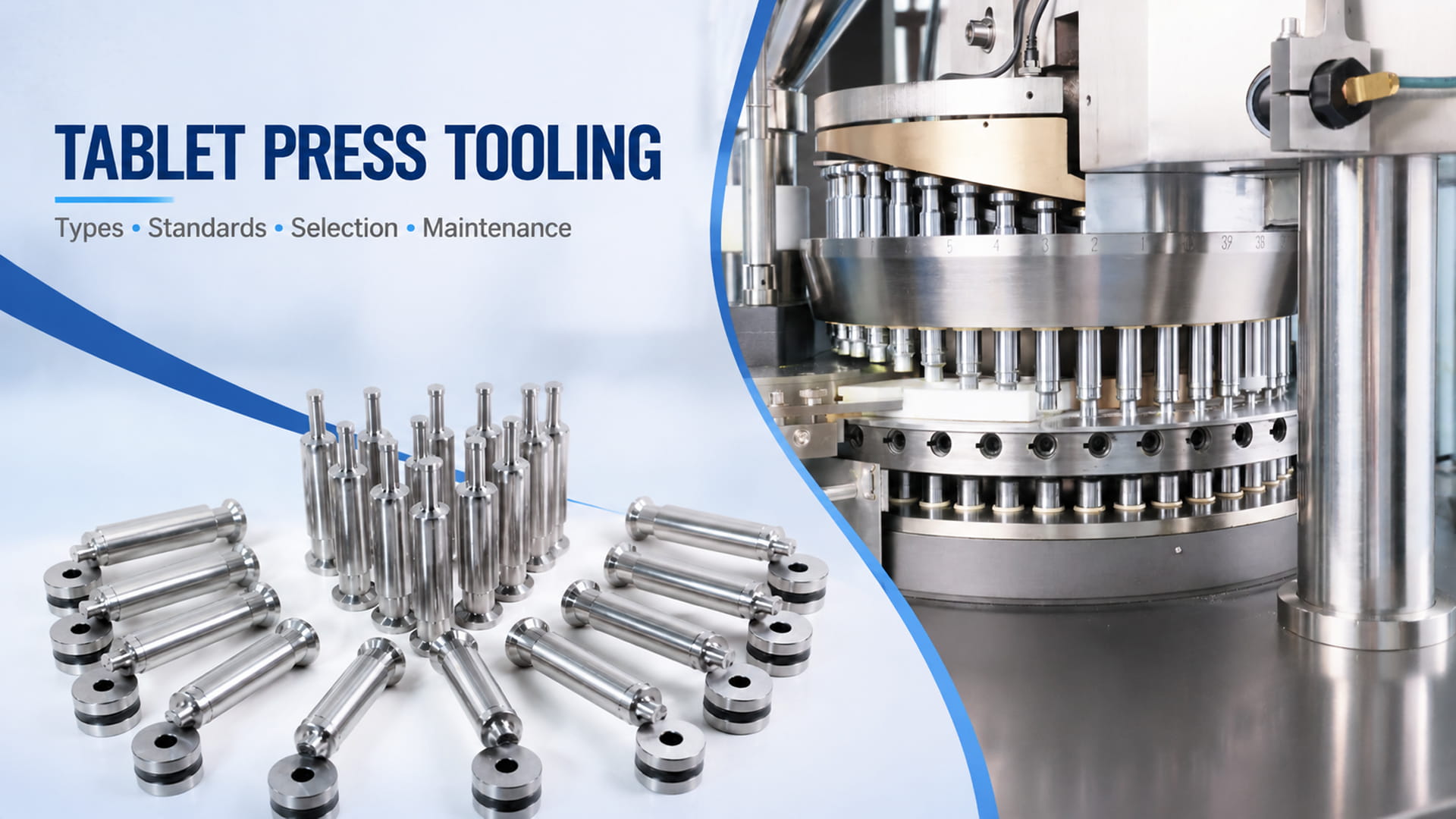
Proper tablet press maintenance is also crucial. A well-maintained machine – cleaned, lubricated, and calibrated – is far less likely to produce defects. Replace worn punches and dies before they degrade tablet quality. Document a regular cleaning schedule (removing powder buildup) and ensure technicians verify settings before each run.

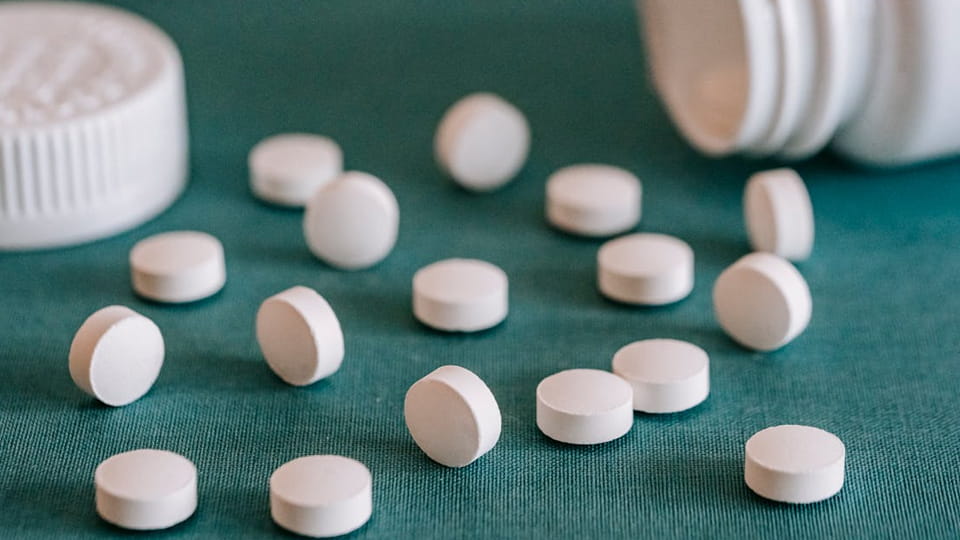
white tablets with pill bottle


Best Practices for Preventing Issues

Adopting robust preventive measures keeps defects at bay:

  • Optimize Formulation and Granulation: Use reliable granulation methods to produce uniform, flowable granules. Adjust binder and lubricant levels based on pilot trials. Incorporate flow aids (グライディングダンス) or dry binders if powders are sluggish.
  • Control the Environment: Maintain stable temperature and humidity in the press room. Store raw materials and intermediate granules in climate-controlled areas.
  • Setup and Calibration: Before production, verify tooling installation (secure punch locks, correct punch set-up). Calibrate fill depth and compression force scales. Make sure feed frame height and feeder speeds are set for the specific product.
  • Monitor In-Process Quality: Perform in-process checks (IPC) at regular intervals. Sample tablets for weight, 厚さ, 硬度, and friability. Modern presses may log compression force and displacement; use this data to detect drifts. Visual IPC (looking for capping, ピッキング, or surface issues) is also important.
  • 付帯設備: Use a タブレット除塵機 after the press. The deduster will remove loose dust and tablet fragments, improving coating adhesion and reducing dust in packaging. Inline metal detectors can remove any contaminated tablets before packing.
  • 定期的なメンテナンス: Clean the press regularly to prevent buildup. Lubricate moving parts as recommended. Replace tooling and wiper blades on schedule. Check for loose components or worn spares that could cause problems.
  • Training and Documentation: Train operators to recognize early warning signs (例えば. unusual sounds or tablet appearance) and to follow SOPs precisely. Keep thorough batch records and a troubleshooting log. After any defect, document the adjustments and outcomes to build process knowledge.

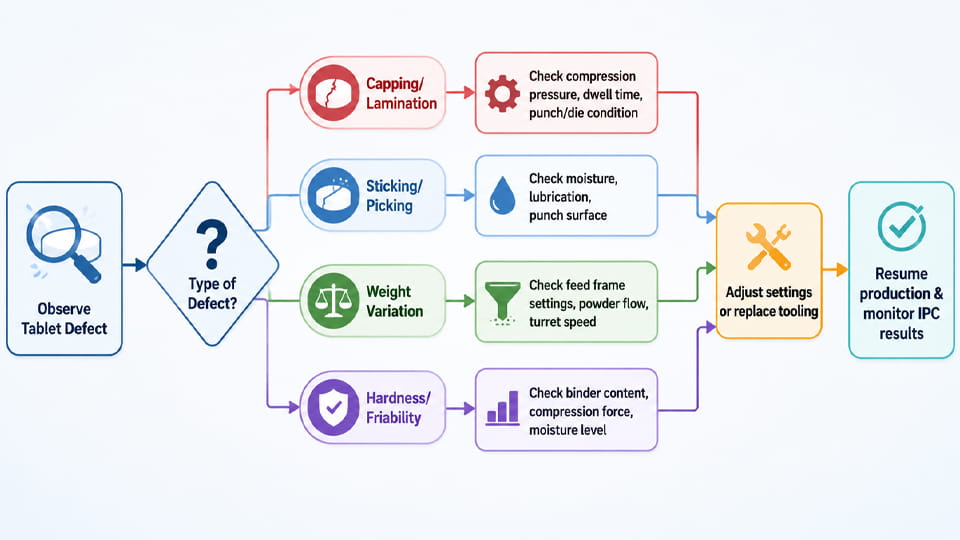
Mermaid flowchart: A decision-tree illustrating how to diagnose tablet defects by checking specific parameters (defect type → likely cause → corrective action).

A decision-tree illustrating how to diagnose tablet defects by checking specific parameters


結論

Tablet compression defects like capping, こだわり, 重量の変化, and friability are common challenges but can be effectively managed. Each problem usually stems from formulation properties, machine settings, or environmental factors. By methodically identifying the root cause – and then tweaking press parameters, refining granulation, controlling humidity, and keeping equipment in top shape – manufacturers can correct defects. Regular in-process checks (タブレットの重量, 硬度, 厚さ, 等) will catch trends early. Applying these best practices helps ensure that tablets leaving the press consistently meet quality standards, reducing waste and satisfying regulatory expectations.

If you are facing problems like tablet sticking, キャッピング, 重量の変化, or unstable tablet hardness, the right tablet compression equipment and production setup can make a huge difference. で ジンルパッキング, we help pharmaceutical and nutraceutical manufacturers improve tablet quality with reliable ロータリー打錠機, customized compression solutions, and professional technical support.

Whether you are upgrading an existing production line or planning a new tablet manufacturing project, our team can help you choose the right tablet press machine based on your product type, output requirements, およびGMP基準. Explore our tablet press solutions または contact us today to discuss your tablet compression challenges with our engineering team.


FAQs About Tablet Compression Issues in Pharmaceutical Manufacturing

What are the most common tablet compression problems?

The most common tablet compression issues include capping, ラミネート加工, こだわり, ピッキング, 重量の変化, friability problems, and inconsistent tablet hardness. These problems are usually linked to granule quality, machine settings, tooling condition, or environmental factors.

Why do tablets cap during compression?

Tablet capping happens when the top or bottom portion of a tablet separates after compression. Common causes include trapped air, over-dried granules, insufficient binder, excessive machine speed, or incorrect compression force. Proper granulation and pre-compression settings can help reduce capping.

What causes tablet sticking and picking?

Sticking occurs when formulation material attaches to punch faces or die walls during tablet compression. Picking is a specific type of sticking that usually affects embossed logos or engraved punches. High moisture content, insufficient lubrication, rough tooling surfaces, and sticky ingredients are common causes.

How can weight variation in tablets be reduced?

Weight variation is often caused by poor powder flow, inconsistent die filling, or unstable feeder speed. Improving granule flowability, controlling particle size distribution, and optimizing feeder settings can help maintain consistent tablet weight during production.

Why is tablet hardness important?

Tablet hardness directly affects product durability, packaging performance, disintegration time, and dissolution behavior. Tablets that are too soft may break during handling, while overly hard tablets may dissolve too slowly. Proper compression force and balanced formulation design are critical for stable hardness control.

How does granule quality affect tablet compression?

Granule quality plays a major role in tablet compression performance. Granules with poor flowability, uneven particle size, 過度の湿気, or low compressibility can lead to defects like sticking, キャッピング, and weight variation. High-quality granulation improves tablet consistency and production efficiency.

What environmental conditions are important during tablet compression?

Temperature and humidity inside the compression room significantly affect tablet quality. High humidity can increase sticking problems, while overly dry conditions may cause friability or capping. Many manufacturers maintain controlled humidity levels to stabilize tablet compression performance.

How often should tablet press tooling be maintained?

Tablet punches and dies should be inspected and maintained regularly to prevent defects and ensure stable production. Worn or damaged tooling can lead to sticking, poor tablet appearance, inconsistent weight, and increased downtime. Preventive maintenance schedules are strongly recommended for pharmaceutical production lines.

What is the best way to improve tablet compression efficiency?

Improving tablet compression efficiency usually requires a combination of optimized formulation, proper granulation, stable machine settings, trained operators, and regular equipment maintenance. Real-time monitoring of tablet weight, 硬度, and thickness also helps detect problems early before they affect large production batches.


参考文献:
1.錠剤の製造上の欠陥 – レビュー —— Journal of Drug Delivery and Therapeutics (JDDT)
2.医薬品錠剤圧縮におけるスティッキングとピッキング: IQ コンソーシアムのレビュー —— サイエンスダイレクト
3.ICH Q10 Pharmaceutical quality systemScientific guideline —— 欧州医薬品庁
4.Lubrication in tablet formulations —— 国立医学図書館
5.Solving Sticking and Picking Through Tablet Design —— Pharmtech
6.Advancing the understanding of tablet capping and lamination: a systematical review —— サイエンスダイレクト

この記事をシェアする:
の写真 ペティフー
ペティフー

ペティフー, 金魯包装の創設者, もたらす 20 製薬機械分野における長年の専門知識. 彼のリーダーシップの下で, Jinlu はデザインを統合する信頼できるサプライヤーに成長しました, 生産, と販売. ペティは、クライアントが医薬品包装の複雑さを乗り越えられるよう、業界の深い知識を共有することに情熱を持っています。, 機器だけでなく確実に受け取れるようにする, しかし、生産目標に合わせて調整された真のワンストップ サービス パートナーシップ.

目次

お問い合わせを送信してください

返信を残す

あなたのメールアドレスは公開されません. 必須フィールドにマークが付いています *

無料見積もりを取得する

*私たちはあなたの機密性を尊重し、すべてのデータは保護されます. あなたの個人データは、JL ソリューションのためにのみ使用および処理されます。.