- Macchine
- Competenza
- Risorse
- Certificati
- Di
- Contatto
- Macchine
- Competenza
- Risorse
- Certificati
- Di
- Contatto
Imballaggio blister relies on heat sealing the plastic cavity to its lidding foil. Getting that seal right means balancing four variables: temperatura di saldatura, pressione, contact (dimorare) tempo e il heat-seal coating. In pratica, a simple tweak to one setting (Dire, turning up the temperature) may not fix a bad seal if the others aren’t aligned. Instead of guessing, engineers use a design-of-experiments (DOE) approccio: methodically varying inputs and measuring outputs to find the sweet spot where seals are strong and leak-free. Insomma, optimizing blister heat sealing means identifying a process window – a safe combination of settings – through systematic testing. The payoff is consistent, high-quality seals without trial-and-error tinkering.
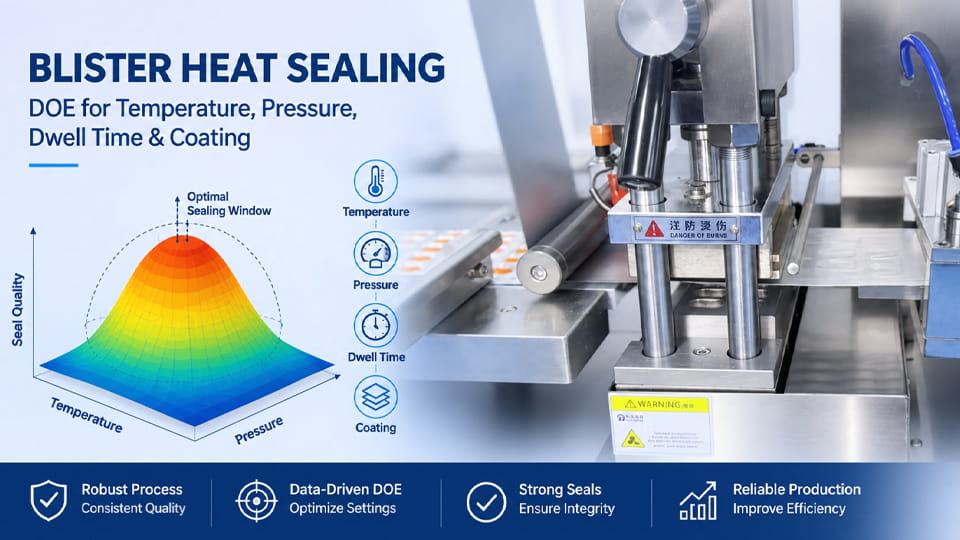
This guide covers what a blister heat-seal process window is, why each factor matters, and how to run a DOE experiment. We’ll look at heat-seal curve analysis and quality tests (like seal strength and leak testing) along the way. We also contrast forza della tenuta (forza di sbucciatura) con integrità della tenuta (leak-tightness), since both matter. Expect practical tips: Per esempio, how even a 2×2 DOE (two levels of temperature vs. tempo) can reveal the reliable operating zone. We’ll also touch on relevant standards (ASTM F88/F2338, FDA validation guidance, ecc.), ma ricorda: DOE supports understanding, suo non itself a validation. Think of this as an engineer-to-engineer how-to – clear and direct, not fluffy. Ready to cut seal failures and nail that blister process window? Immergiamoci.
UN heat-seal window (or process window) is the range of settings where blister seals meet quality specs. In altre parole, it’s the zone of temperature/pressure/time (e rivestimento) where seals are reliably good, even if conditions vary slightly. Below the window, the heat is too low or time too short for a tight seal; above it, you risk burning or deforming the materials. Within the window, minor fluctuations (a couple degrees or milliseconds) won’t break the seal. Defining that window is essential before ramping up production.
In blister heat sealing, the machine brings a hot platen or roller in contact with the formed plastic and foil. IL temperatura di saldatura (platen set point) makes the heat-seal coating melt or activate. Tempo di sosta is how long the heater is pressing on the pack. Pressione is the force applied. (On a roller machine, pressure comes from springs or pneumatic cylinders under the platen). Infine, rivestimento refers to the heat-seal lacquer on the foil (usually PVC-based, PVDC, acrilico, ecc.) – a material factor, not a machine dial. Each of these must be tuned together.
Secondo gli esperti di packaging, these factors are highly interactive. Per esempio, DuPont notes that time, temperature and pressure “are interactive – a change in one typically requires a change in one or more of the others”. This means that if you shorten dwell time (to boost speed), you usually need higher temperature or pressure to compensate. Allo stesso modo, switching to a heavier coating might allow a lower temperature but longer time. The task is to map out this multi-dimensional relationship.
Pragmatically, think of running trials at different temperature–time combinations and measuring seal quality. The result is often plotted as a heat-seal curve or a contour plot of seal strength vs. temperatura (for a given time). A typical test might show very low seal strength below some “initiation temperature” (say 120 °C), then a plateau of high strength, and eventually a decline if the polymer starts degrading. The breadth of that plateau is the “heat-seal window width”. A wide window (per esempio. >15 °C range) è l'ideale, as it tolerates variation. To find it, we rely on DOE.
ISO 11607-3:2026 (per confezioni sterili) puts it simply: process variables like temperature, pressure and dwell time “must be studied to see how they affect the output, and upper and lower limits have to be established… this is where a development team defines the usable process window”. Insomma, instead of one-factor-at-a-time tweaks, DOE systematically explores multiple factors. The goal is a stable window where seals meet specs even under small shifts in inputs. This is the heart of optimization.
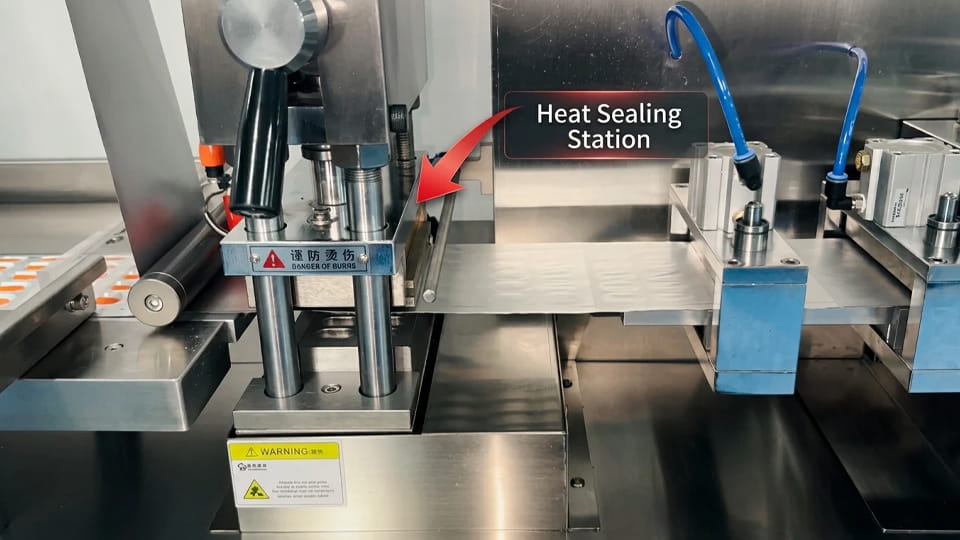
Blister seal quality hinges on four key factors. Each one influences how well the plastic and foil bond:
Each of these factors can also interplay with secondary elements, Piace velocità della macchina O raffreddamento. On roller blister machines, a higher line speed effectively reduces dwell time at a given temperature. This is why engineers treat speed as a control: per esempio. a mid-range speed is used in DOE trials, then increased gradually with parameter tweaks. Heat distribution (no hotspots) and machine flatness (no warped platens) are also crucial, as uneven tooling can cause weak lanes or pinholes. But for DOE purposes, temperatura, pressione, time and coating are the primary inputs we vary, while keeping everything else (materiale, utensileria, ambient humidity, ecc.) constant.
By varying these four factors in a designed experiment, we can see their main effects and interactions. Per esempio, you might find that at low temperature, raising pressure does little (since the polymer isn’t molten), whereas at high temperature, even short time yields strong seals. A useful approach is starting with a screening design (per esempio. 2-level factorial) to identify which factors matter most. Then move to a response surface design (central composite, Box-Behnken, ecc.) to map the peak region. Even a simple 2×2 DOE (two temps × two times) can reveal the safe zone boundaries. The FDA’s process validation guidance explicitly notes that DOE “can help develop process knowledge by revealing relationships, including multivariate interactions, between the variable inputs (PER ESEMPIO., parametri di processo) and the resulting outputs”. In altre parole, DOE is the recommended way to identify that sweet spot.
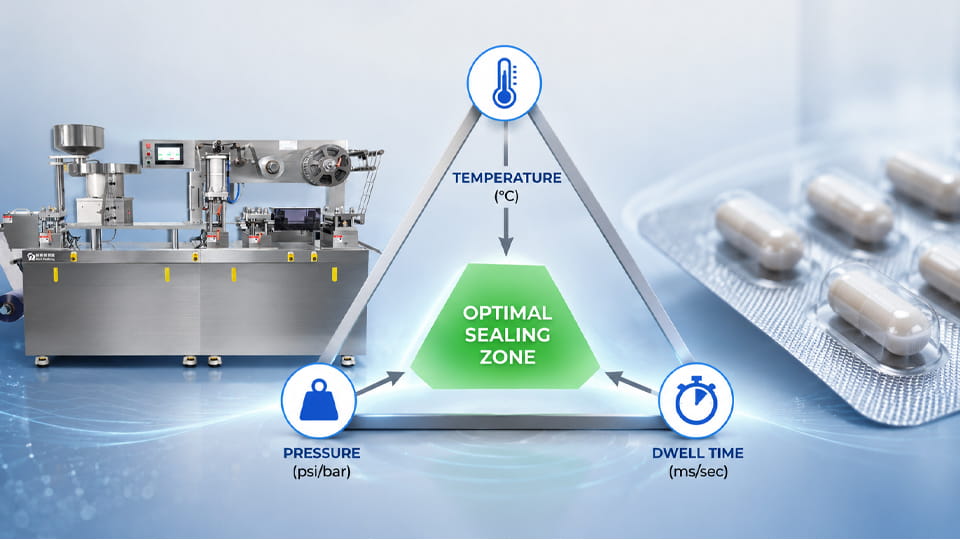
Designing a DOE means deciding which factors and levels to test, and how to measure response. Here’s a practical approach:
By planning the DOE carefully and analyzing the results, you replace guesswork with data. An often-cited approach (used by FDA/QbD) È: perform trials until the risk is tolerable. The goal is a robust process window that survives small perturbations. As DuPont advises, using DOE “consistently produces acceptable seals, and can optimize energy output and throughput”. In pratica, we also incorporate risk analysis: any factor not studied should be monitored. Per esempio, film thickness variation or platen wear might lurk outside the DOE; these require in-process checks or a risk mitigation plan.
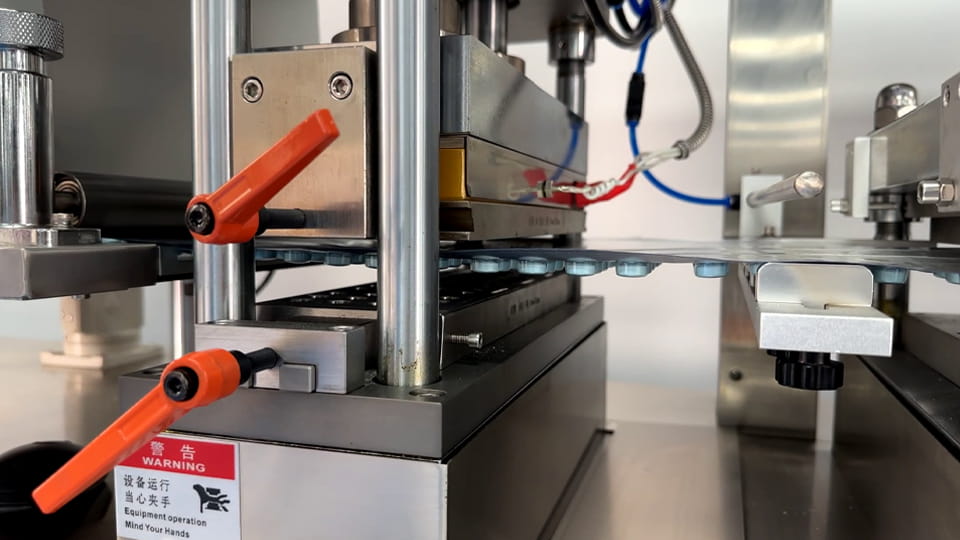
Imagine a case: you have PVC/PVDC blister film and a lacquered alu-foil, and you need to seal them. Supplier data says optimal seal is around 170 °C. You decide on 3 factors to study: Temperatura (150, 170, 190 °C), Dimorare (0.5, 1.0, 1.5 S), and Pressure (3, 4, 5 sbarra). A 3^3 full factorial would be 27 runs – a bit heavy. Invece, you set up a fractional factorial for the extremes (150, 190 × 0.5, 1.5 × 3, 5) plus center points (170,1.0,4) in triplicate.
From preliminary runs (sealed samples peel-tested), you might see:
Plotting results, a heat-seal strength surface (3D plot of temperature vs. time at 4 bar) could reveal a ridge of high peel force. In contours, it might show that 160–180 °C and 0.8–1.2 s all exceed spec. Outside that range, strength drops.
Per illustrare, here’s a hypothetical DOE summary (nota: for example purposes only):
| Correre | Temp (°C) | Tempo (S) | Pressione (sbarra) | Buccia (N/15mm) | Perdere (Superato/fallito) |
| 1 | 150 | 0.5 | 3 | 4.5 | F |
| 2 | 150 | 1.5 | 5 | 6.0 | F |
| 3 | 190 | 0.5 | 5 | 7.8 | P |
| 4 | 190 | 1.5 | 3 | 8.0 | P |
| 5 | 170 | 1.0 | 4 | 7.2 | P |
| 6 | 170 | 1.0 | 4 (ripetere) | 7.4 | P |
| … | … | … | … | … | … |
From this (hypothetical) matrix, one sees that at 170 °C, 1 S, 4 bar the peel force is around 7–7.4 N/15mm (above our target of 7 N). Varying one factor at a time: per esempio. lowering pressure to 3 bar drops peel slightly (6.8 N) but still passes, raising to 5 bar gives 7.0 N. Lowering time to 0.8 s or raising to 1.2 s still keeps above 7 N. We find the acceptable window is roughly 165–175 °C, 0.8–1.2 s, 3.5–4.5 bar.
During this DOE, one should also perform test di integrità della tenuta on at least the passing runs. Per esempio, take samples from run 5 (170 °C,1.0 S) and put them in a vacuum chamber (ASTM F2338) or a dye bath. If they show no leaks, that confirms integrity. It’s possible to have a high peel force yet have micro-holes that only leak under vacuum. In our example, suppose the vacuum test passed at the center condition. That means our process window yields ermetico sigilli, not just sticky ones.
If any run fails integrity (even if peel was okay), that region is ruled out. The DOE data is then used to plot response surfaces or “decision maps.” Modern DOE software can even overlay specs: per esempio. shading the region where peel>=7 N and no leaks. This becomes your safe operating chart.
Note on coatings: If you wanted to include coating weight as a factor, you could pre-cut foils of different lacquer thickness (Dire 3 g/m² vs 5 g/m²) and include that as a high/low factor. The DOE would then show if the chosen coating is robust. In pratica, lot-to-lot coating variation on foil is monitored rather than included in DOE, because coating weight is usually stable per reel.
In sintesi, the example shows a DOE leading to a blister heat-seal process window: a set of temperature/pressure/time limits that satisfy our quality metrics. The exact numbers will vary per material, but the approach – run a designed study, test seals, and draw the window – is universal.
After DOE trials define candidate settings, devi evaluate and confirm the process before full production. This includes both additional testing and formal documentation.
Check Seal Strength and Integrity: Forza della tenuta (ASTM F88 peel test) is often used for development, but the ultimate check is integrità della tenuta. Per blister farmaceutici, that usually means a nondestructive leak test. Vacuum decay (ASTM F2338) or tracer gas (per esempio. helium leak, ASTM F2391) sono comuni. Per esempio, vacuum decay is FDA-recognized: vials or sealed blister packs are placed in a chamber evacuated to a preset vacuum, and any pressure rise indicates a leak. (In-house, simpler methods like dye ingress under partial vacuum can work for acceptance.) The key is that the entire pack must be hermetic. A useful practice is to sample blisters from edge of tolerance: the thinnest film or thinnest foil found on line, worst-case dwell time, ecc., and test these for leaks.
Example of sterile vials undergoing a vacuum decay test to check for container leaks. Vacuum decay (ASTM F2338) is a nondestructive standard method for CCI, recognized by FDA, and can similarly be applied to blister packs (with masking to isolate a single cavity).
Contemporaneamente, test samples for peel strength. Use a calibrated peel tester on a few packs from each DOE corner and center. The requirement may come from pharmacopeial documents or customer specs (often ~7–10 N/15 mm for pharma blister seals). Record the values. A validated window should always exceed the minimum spec with margin. Also check seal width (per ISO 11607-1) and any allowed pinholes (pharma blister packs usually require zero leaks and very tight visual standards).
Confirmation (IR/WH/PQ): In FDA parlance, these studies feed into Qualification and Validation. Qualificazione dell'installazione (QI) ensures equipment (heater, pressure system) is set up; Qualificazione operativa (OQ) would cover running the machine through its range. OQ might explicitly verify that the heater actually reaches the commanded 170 °C ±2 °C across the platen, and that pressure sensors are accurate. Finalmente, Qualificazione delle prestazioni (PQ) means running at target speed and parameters for several runs (per esempio. three full batches) and showing consistent results. Durante il PQ, monitor process parameters and measure seal quality (both strength and leaks) on samples from each batch. FDA advises that a validated process have “consistent performance… so that it will consistently produce [prodotto] soddisfare questi attributi”.
Importante: DOE sviluppo itself is not GMP validation, but the data supports it. Always maintain good documentation: save the DOE plan and results, dati grezzi, and analysis. These become part of your process validation report or design history file. If you identified critical factors and set ranges (a “design space”), those should be recorded so QA can later control for them. Think of the DOE as part of Process Design (palcoscenico 1 della convalida della FDA), which flows into Stage 2 convalida (IR/WH/PQ) and Stage 3 continuous verification.
Even with DOE, issues can pop up. Here are frequent trouble spots and how a systematic approach resolves them:
Below are typical heat-seal issues and where to look in your parameters:
| Problema | Possibili cause | How DOE Helps Diagnose |
| Weak seals / low peel | Temperature too low or dwell too short;<fratello> pressione insufficiente;<fratello> incompatible coating; | DOE shows if raising T or D at fixed pressure fixes it (Temp×Dwell interaction). If all runs below a temp fail, you’ve found a boundary. |
| Seal delamination | Incompatible film & rivestimento;<fratello> foil–film adhesion issue; | DOE with coating type reveals if one coating fails. Check material compatibility. |
| Foil wrinkling | Overheating (T too high), or non-uniform pressure;<fratello> too much pressure on foil;<fratello> uneven plate temperature | If DOE shows defects at high T or high P, you’ll see it. Combine T vs P plots to find “Goldilocks” zone. |
| Incomplete seal (gaps) | Too low pressure or short dwell;<fratello> poor platen contact | DOE run with low pressure/high dwell vs high pressure/low dwell can identify which is needed. Also check machine alignment (maybe outside DOE). |
| Aluminum foil tears | Excess pressure on sharp edges;<fratello> film stuck to plate (no release coating) | If all else passes but tears only under high P, DOE might show a narrow safe P range. This suggests you should cap pressure. |
| Film scorching | Excess temperature or time beyond window | DOE data at high T or long D will have scorched seals. Use that to set upper limits. |
| Inconsistent seal strength across pack | Non-uniform pressure distribution or heater unevenness | Might not be DOE, but measure each zone. The DOE can highlight if average is low, but physical check of equipment likely needed. |
In troubleshooting, remember DOE is a tool – it tells you Come changing T/P/D affects outcomes. Ad esempio, Jinlu notes that inconsistent seal times in older machines “lead to weak seals, stropicciamento della pellicola, and leakers”. DOE would reveal that zone: maybe at a certain pressure the seal pattern becomes blurred. Once you see that, you either adjust equipment (for uniform pressure) or tighten that DOE factor range.
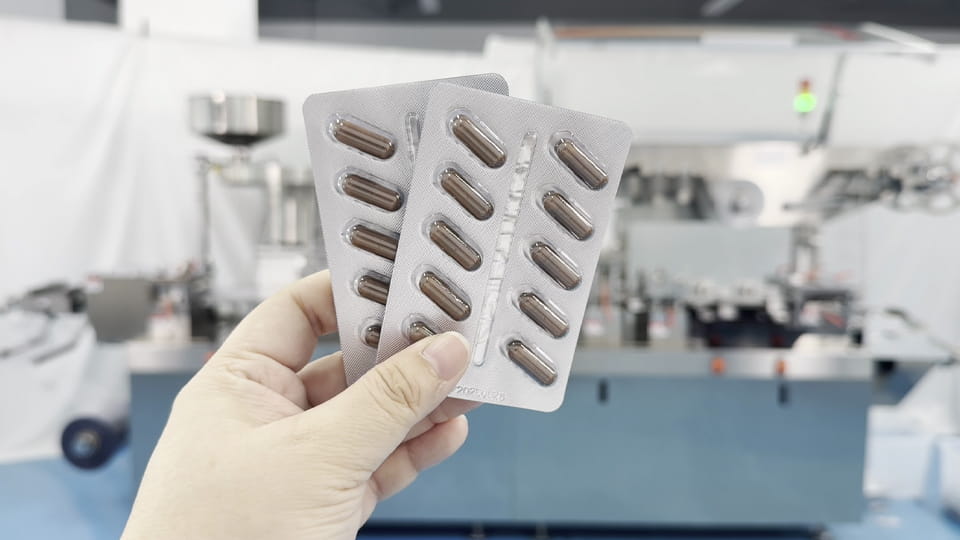
The equipment itself must be up to the task of maintaining tight control on those four factors:
Flat-plate vs. Roller blister machine: Both can do great seals, but roller machines (with continuous index motion) often have less dwell variation at speed – the platen is constantly at temperature. Flat machines (index with open/close) have to reheat between cycles. In scale-up, consider which matches your volume. Indipendentemente, the same DOE principles apply: you just map the platen settings that work at the chosen speed. (For very high-speed rotary lines, cooling time after sealing can also affect package distortion, so ensure packs have a brief rest before further handling.)
Insomma, a reliable blister line must deliver the process window defined by DOE. This means maintaining tight tolerances on the parameters and monitoring outputs. Come notato dagli esperti di packaging, all the system’s parts – mechanical, thermal, and control – should be checked during qualification (QI/OQ). Se, Per esempio, you switch from a bench blister sealer to a production roller machine, you must re-verify the window: the two might have different heat-transfer characteristics. ISO 11607-3 even covers this, stating alternate equipment can be considered equivalent only if all conditions (geometria, tecnologia, ecc.) match and outputs still meet spec.
Building a robust blister heat-seal process is about finestre, not bullets. By using DOE, you define a safe operating region in temperature, pressione, dwell time and coating – not just a one-off recipe. This means your linea del blister can accommodate normal variations (material lots, ambiente, Indossare) without a flood of rejects. You’ll achieve both strong peel force and full seal integrity across all blisters.
Ricordare: temperatura, pressure and dwell interact, and the foil coating dictates the bonding chemistry. Take the systematic approach: plan your DOE carefully, measure the right quality attributes, and analyze the results to set the boundaries. Then verify those limits with real production runs and validation tests.
Il diritto attrezzature per l'imballaggio in blister can help too. Modern machines with precise PID heating and servo-controlled rollers/plates make it easier to stay in your DOE-validated window. But whether flat-plate or roller, il principio è lo stesso: know your process window and keep production within it.
When you approach heat sealing this way, you’ll have not just a seal, ma a sealed process. That’s the path to consistent blister quality and peace of mind on the line.
Ready to optimize your blister heat-seal process? Contatta il team tecnico di Jinlu Packaging for guidance on your materials and equipment. We can help design and validate the right process window for your product and production needs.
Channel leaks can occur when the sealing surfaces do not make continuous contact, allowing a narrow leakage path to remain between the lidding foil and forming film. Contaminazione, rughe, uneven pressure distribution, or incompatible sealing materials may contribute to this defect.
Inspect seal patterns across different cavities and positions, including the edges and center of the pack. Compare peel-strength results from representative locations and use an appropriate leak test to identify areas with inconsistent sealing performance.
NO. Compressed air pressure is the supply pressure delivered to a pneumatic system, while sealing pressure refers to the actual contact force distributed across the sealing surfaces. Cylinder design, tooling area, mechanical alignment, and pressure distribution all affect the final contact conditions.
SÌ. The sealed materials may need sufficient time to stabilize after heat and pressure are removed. Inadequate cooling can contribute to deformation or handling-related damage, particularly when the material remains soft. Cooling conditions should be evaluated alongside sealing parameters when relevant.
SÌ. Polvere, polvere, or other particles trapped between the lidding foil and forming film can interrupt contact and create local weak spots or leakage channels. Keeping the sealing area clean and controlling product residue are important for consistent seal quality.
Use calibrated temperature sensors or suitable surface-temperature measurement equipment to check multiple positions across the sealing plate. Record differences between the center, bordi, and other critical areas rather than relying only on the machine controller’s displayed setpoint.
Sealing plate temperature is the temperature measured on the tooling surface, while heat-seal temperature refers to the thermal conditions experienced at the material interface. Heat transfer resistance, contact conditions, spessore del materiale, and dwell time can cause these temperatures to differ.
Uneven or excessive web tension can cause film misalignment, stretching, rughe, and inconsistent contact during sealing. Stable web transport helps maintain accurate registration and consistent contact between the forming film and lidding foil.
Sealing performance may vary across the web because of temperature gradients, pressione irregolare, allineamento degli utensili, or material variation. Sampling different positions helps identify localized defects that could be missed if testing is limited to one area.
NO. Visual inspection can identify obvious defects such as wrinkles, burns, deformazione, and incomplete seal patterns, but it cannot reliably detect every microscopic leakage path. Appropriate seal-strength and package-integrity tests are needed to evaluate sealing performance more thoroughly.
Riferimenti:
1.Influenze dello spessore della lacca termosaldata sulla qualità delle confezioni blister —— ScienceDirect
2.Promising advancements to the blue dye ingress test – Quantification of blister integrity by leakage rate —— PubMed
3.Confezione in blister farmaceutico, Parte 1 Motivazione e materiali. —— Burrasca
4.A new characterization approach for heat sealing of polymer packaging films identifying optimum sealing parameters using Pareto-based trade-off analysis —— Biblioteca in linea WILEY