
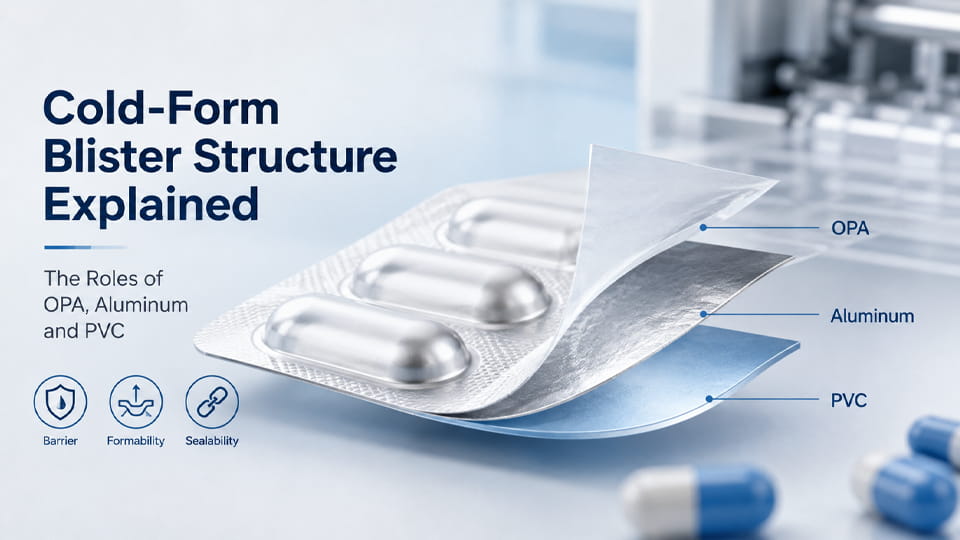
Cold-form blister packaging uses a multi-layer foil to form cavities for tablets or capsules at room temperature. Unlike clear thermoformed PVC blisters, cold-form blisters are opaque and rely on a laminated OPA/Aluminum/PVC foil that is stamped into cavities by a high-pressure punch. In this structure, each layer has a distinct job: le OPA (oriented polyamide) outer film gives strength and formability, le aluminium core provides the moisture/oxygen/light barrier, et le PVC inner layer supports the blister shape and provides a sealable surface. We’ll explain exactly what each layer does, how they work together, and why this foil is used for high-barrier emballage pharmaceutique.
En résumé, a typical cold-form foil is built as OPA/Aluminum/PVC (or sometimes PVC/Al/OPA), usually about 120–160 μm thick (par exemple. 25 μm OPA + 50 μm Al + 60 μm PVC). The foil is cold-formed (stamped) into cavities without heat, so it avoids thermal stress on the drug. The aluminum layer makes the cavity fully opaque but nearly impermeable – blocking nearly 100% of moisture, oxygène et lumière. In practice this foil is paired with a separate lidding foil (often also aluminum-backed) to complete the seal.
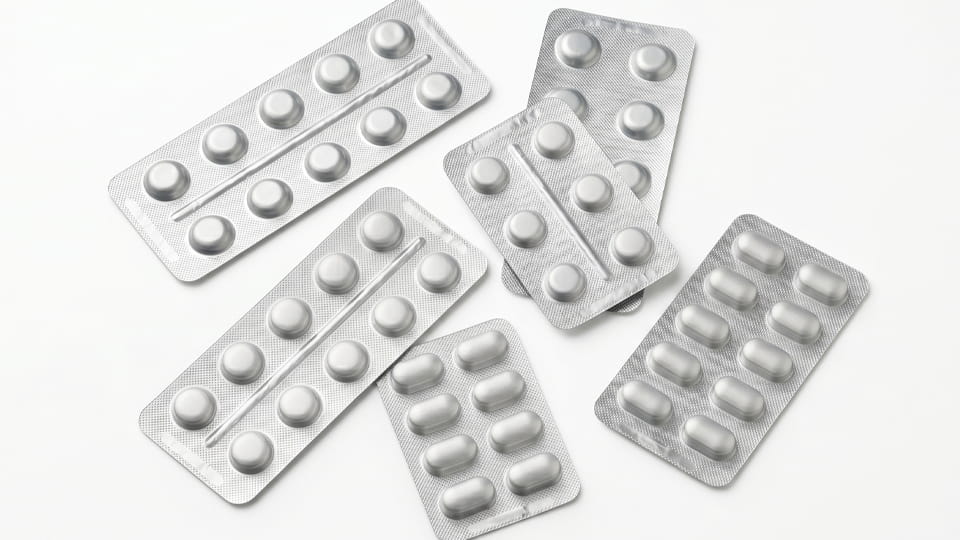
Cold-form blister packs are chosen when product protection is critical (par exemple. humidité- ou des médicaments photosensibles). We’ll walk through each layer’s role, comparer cold-form vs. thermoformed blisters, and cover selection tips and common issues so you can understand the full packaging system.
UN cold-form blister is a type of pharmaceutical blister pack whose base is made by stamping a laminated metal foil into cavities. Unlike thermoformed blisters (which use heated plastic films like PVC or PET to form cavities), cold-form blisters use a rigid foil that is pressed into shape at room temperature. This laminated foil typically consists of three main layers: un outer plastic film (oriented polyamide/OPA), un middle aluminum foil, et un inner plastic couche (usually PVC). The lid of the blister pack is then sealed on top (often by heat-sealing an aluminum or laminated foil to the PVC surface).
Cold-form blisters are also called Ampoules Alu-Alu because the metal base and the lidding can both be aluminum-based. The structure is specially designed for high barrier protection. The OPA and PVC layers allow the metal to be formed and sealed, but it’s the aluminum that actually blocks moisture, oxygène et lumière. A technical guide explains that the “classic OPA/Aluminium/PVC structure combines a form-supporting outer layer, a metallic barrier layer and a product-side layer for subsequent sealing”.
En pratique, you’ll see cold-form foil roll stock with nominal thickness like 25 µm OPA + 45–60 µm Al + 60 µm PVC (total ~130–150 µm). Each layer is laminated to the next with adhesives so that they act as one film during forming. Pendant la production, the flat foil is fed into a cold-forming machine, where a male/female mold pair stamps the foil into cavities. After forming and inserting the product, a heat-seal process closes each cavity.
Point clé: Cold-form blisters use an OPA/Al/PVC trilaminate comme toile de formation. This is different from a PVC thermoformed blister (which might use PVC/PVDC or PVC/Al side by side). Because the structure is opaque, cold-form blisters require printed or color foil if visibility of the product is needed.
For more on how this compares to clear blisters, voir notre article on cold forming vs. Thermoformage.
Oriented polyamide (OPA) – often a type of nylon film – is the outermost layer of cold-form blister foil. It faces the forming tool during stamping. The OPA layer’s main job is to give the foil strength and elasticity so it can be drawn into deep cavities without tearing. Oriented polyamide is very tough and has good puncture resistance, which helps protect the aluminum underneath.
In a typical structure, the OPA film is about 20–30 microns thick. Because it is biaxially oriented (stretch-processed nylon), it has high tensile strength in both directions. This means that when the mold punches stretch the foil, the OPA can elongate and take up strain, reducing stress on the aluminum layer. En vigueur, the OPA “supports the composite during molding” and helps prevent aluminum cracks.
Sur le site de production, you’ll notice that without OPA, a cold-form blister foil would be very fragile: the aluminum alone can crack easily during forming. The OPA acts like a formable “jacket” around the metal. One supplier description highlights that the OPA provides mechanical strength and forming toughness. Autrement dit, it makes the foil malleable enough to stamp without breaking and also withstands handling.
OPA also improves tear resistance if the formed blister pocket is pierced from the top. If a patient tries to push a tablet out, the outer OPA helps hold everything together until the foil is deliberately ruptured at a corner (many Alu-Alu blisters are designed to break cleanly on peeling).
Cependant, OPA is not a barrier material – it will let air and moisture through. Its purpose is purely structural in the cold-form foil. (Par contre, some thermoformed blisters might use PVDC-coated PVC to add barrier properties, but cold-form relies on the aluminum for that.) You’ll find OPA on the exterior side of the foil; the PVC is on the interior, contacting the product.
Conseils: Because OPA is a nylon layer, it can be sensitive to moisture during storage (nylons can absorb water). Always ensure the foil is kept dry to avoid foil sticking or delamination during storage or running. Also note that OPA can be printed or colored if desired (pour l'image de marque), but coloring can sometimes slightly reduce its strength.
Le aluminium layer is the heart of a cold-form blister foil. Typically a soft aluminum alloy (tel que 8021 in soft temper) of around 45–60 µm thickness, this metallic core provides nearly 100% protection contre les barrières. Aluminum is impermeable to water vapor, oxygen and UV/visible light, so a continuous aluminum layer effectively seals out air and moisture.
When the foil is stamped, the aluminum deforms plastically to hold the cavity shape. If it remains intact (no cracks or holes), the formed blister cavity is essentially closed off from the environment. A utility of aluminum is that even very thin foil gives an air-tight barrier. Par exemple, one source notes that aluminum “forms the essential barrier against water vapor, oxygène, other gases and light,” provided the layer stays unbroken. En pratique, this means a cold-formed blister pack can keep a tablet completely dry and in the dark.
The downside is that aluminum is opaque. Once formed, you cannot see through the blister pocket. This is both a pro and con: pro for blocking light (protecting photosensitive drugs) and con for requiring careful labeling since you can’t visually verify contents. (If visibility is needed, thermoformed PVC packs are used instead.)
Another consideration is that aluminum will crack if overstretched. Deep or narrow cavities can concentrate stress. Par exemple, if the punch has sharp corners or the foil is pulled too thin, the aluminum layer can fracture, creating pinholes. That’s one reason the OPA layer is so important – it helps prevent those cracks by reinforcing the foil. In good practice, the mold is designed with rounded corners and the foil is matched to the cavity depth so the aluminum isn’t stretched beyond its limit.
Despite its strength, the aluminum layer is very sensitive to defects during forming. Even a tiny pinhole can let moisture or oxygen through. That’s why cold-form blisters are often used with extremely sensitive medications (like hygroscopic or light-sensitive drugs). They can even keep reactive or biological drugs stable where plastic packs would fail. En bref, aluminum is the barrier layer – it is what makes cold-form blisters so protective.
On the product-contact side of the foil is a layer of PVC (chlorure de polyvinyle) or similar polymer (sometimes modified PVC or an alternate heat-seal polymer). In the classic OPA/Al/PVC foil, this PVC layer sits between the aluminum and the tablets. Its job is twofold: it helps retain the cavity shape and it provides a surface that can be heat-sealed to the lidding foil.
Mechanically, PVC is stiffer than OPA, so it actually helps the formed pocket hold its shape. Après avoir formé, the PVC supports the cavity walls and stops them collapsing once the tool is removed. En fait, one source notes that the PVC side “keeps the pocket shape and provides some elasticity,” making the pocket strong and stable. (Without the PVC, the thin aluminum alone could fold inward under slight pressure.)
The PVC layer also has the sealant formulation (often a heat-seal lacquer or coating). Pendant l'emballage, after filling the blister cavity, a separate lid foil (such as an aluminum lidding with heat-seal layer) is sealed onto this PVC surface. The PVC essentially links the base foil and the lid foil. If the PVC did not bond well with the lid, the package would leak. So the PVC (or its sealant layer) is chosen to be compatible with the chosen cover foil and sealing parameters. Par exemple, many systems use PVdC-coated alu lidding to match PVC base, but designs vary.
It’s important to distinguish the PVC layer in the base foil from the cover foil. The base PVC does not directly seal to itself; rather, the lid foil seals to the base PVC. That final seal line (around each cavity) is what ultimately keeps moisture out. Autrement dit, aluminum plus foil do the barrier, and PVC enables a good heat seal.
Beyond sealing, the PVC also provides some chemical resistance and a neutral surface for the drug (PVC is generally inert for many formulations). It also adds a bit more rigidity to the foil, since PVC is thicker (often ~60 µm) than OPA.
If a different material is used (Par exemple, some specialty films use PCTFE instead of PVC for extremely high barrier or even PVC-free foils), the basic role is similar: it’s the layer that contacts the product and bonds to the lid. But in most standard cold-form pharma foils, think of the PVC layer as the inner support/seal layer.
Each layer in the cold-form foil plays a specialized role, and together they form a système optimized for cold stamping and protection. One overview sums it up: OPA gives strength, aluminum gives barrier, PVC provides the sealable surface. En pratique, all three must remain intact and bonded through forming, remplissage et scellement.
Le adhesive between layers (not counted as a main functional layer) is critical too. Good lamination ensures the layers do not peel apart during high-pressure forming. If delamination occurs (for example due to moisture or adhesive failure), the pocket can lose integrity. Primers or adhesives are used to bind OPA-to-Al and Al-to-PVC so that the composite behaves as a single film.
During forming, the layers share the load. Par exemple, when the mold stretches the foil, the OPA and PVC both stretch and relieve some stress. The aluminum core yields plastically, but it is “supported” by the OPA so it doesn’t crack prematurely. Après avoir formé, the elastic memory of the OPA/PVC helps the cavity spring into shape, while the aluminum holds that shape. Then the lid foil is sealed: the PVC side bonds with the lid, completing the package.
The chart below summarizes their complementary roles:
| Layer | Primary Role in Cold-Form Blister | Avantage clé | Design/Quality Check |
| OPA (Oriented Polyamide) | Forms outer wall of blister, supports deep draw | High tensile strength and puncture resistance | Cavity depth vs. OPA elongation; lamination integrity |
| Feuille d'aluminium | Core barrier layer on outside face | Blocks moisture, oxygène et lumière | Foil thickness uniformity; absence of pinholes/cracks |
| PVC (Chlorure de polyvinyle) | Inner contact layer/heat-seal side | Provides bondable sealing surface and cavity stiffness | Seal performance (T/P/T compatibility); film rigidity |
When designing a blister pack, engineers must match the material properties to the cavity design. Par exemple, a very deep, narrow cavity will put more stress on the foil layers than a shallow wide pocket. You may need a thicker OPA or a more ductile aluminum to handle that. One guideline is to first set your barrier needs (how moisture-tight it must be) and cavity depth, then choose a foil structure and thickness that can survive forming.
En bref, cold-form blister foil is a synergistic laminate. The OPA/Al/PVC layers must be chosen and combined so that together they meet the drug’s protection requirements while still being formable.
To see why OPA/Al/PVC exists, it helps to compare with the common thermoformed blister. A thermoformed pack typically has a clear PVC or PET forming film and an aluminum lid. It is made by heating the plastic sheet, forming it in a mold, remplissage, then sealing. The plastic base gives transparency and speed, but by itself has only barrière modérée. Uncoated PVC, Par exemple, can let through around 3 g/m²·day of water vapor – far higher than aluminum foil. En fait, Wikipedia notes “the disadvantages [en PVC] sont une mauvaise barrière contre la pénétration de l’humidité et de l’oxygène ». Manufacturers often use PVDC- or PCTFE-coated films to improve barrier, but even then the overall protection is inferior to an all-aluminum structure.
Forme à froid (De tout le temps) blisters and thermoformed blisters (Alu-PVC or PVC/PVDC) serve different needs. Le tableau ci-dessous (adapted from Jinlu’s comparison) highlights the key differences:
| Facteur | Thermoformed Blister | Forme à froid (De tout le temps) Cloque |
| Forming Process | Heat-plastic-vacuum-form (PVC, ANIMAL DE COMPAGNIE) | Room-temp stamping of multi-layer aluminum laminate |
| Barrier Performance | Modéré (clear plastic base; typically PVC with coating) | Excellent – aluminum foil is nearly impermeable to water/oxygen/light |
| Protection contre la lumière | Limité (transparent unless pigmented) | Total – opaque foil blocks all light |
| Visibilité | Transparent – see product | Opaque – product hidden inside |
| Vitesse & Coût | Grande vitesse; low-cost material | Ralentissez; higher-cost foil and robust machines |
| Utilisation typique | High-volume OTC/vitamins, when transparency and cost are important | Humidité- or light-sensitive drugs needing long shelf life |
En vigueur, thermoforming favors throughput and product visibility, while cold forming favors maximum protection. Notes originales de Jinlu, cold-form packs sacrifice speed for “ultimate fortress” protection against external threats.
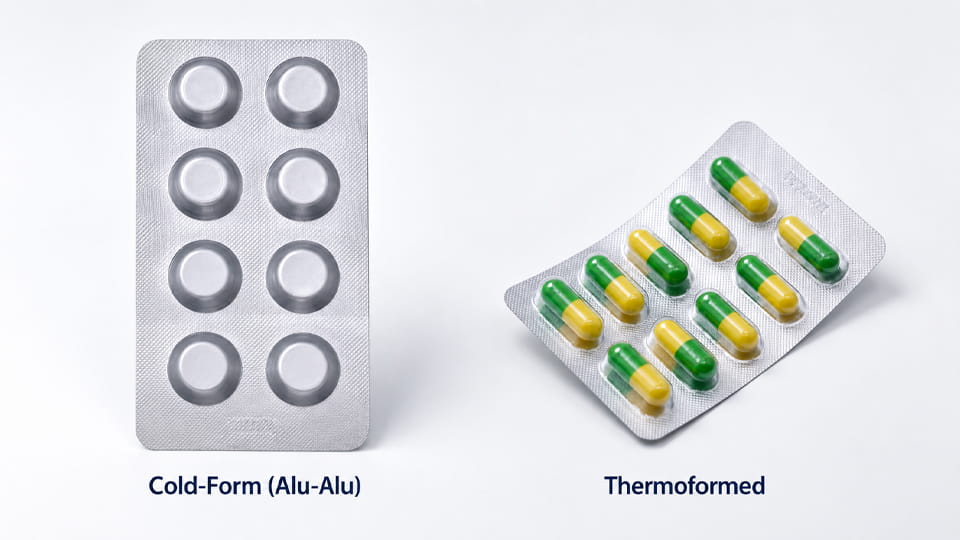
When deciding between the two, one should consider the API stability. If the drug is heat-sensitive or must last years in humid climates, the cold-form OPA/Al/PVC foil is often the safer choice. For less sensitive items, a PVC/PVDC base with a foil lid may be adequate and much cheaper.
Even with the best materials and machines, cold-form blister packs can have defects. Here are some frequent issues and typical causes:
Good production practice includes regular inspection for these defects. Par exemple, a quick visual check or vacuum decay test can catch pinholes early. Adjust the tooling or switch to a thicker foil if cracks recur. Dans de nombreux cas, troubleshooting defects involves a mix of material and process changes – for example, increasing OPA thickness for better formability, or polishing the mold to reduce friction.
Selecting the proper foil and blister equipment is key to success. Voici quelques lignes directrices:
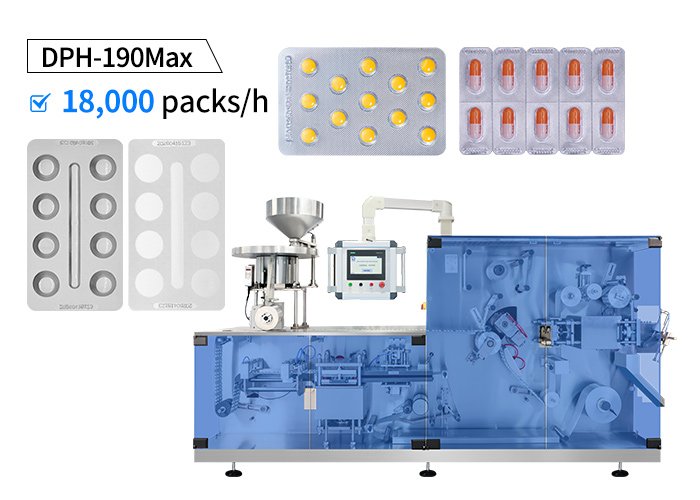
By starting with the product’s shelf-life needs and working backward through foil specs and machine capabilities, you can select a system that reliably produces tight, stable Alu-Alu blisters. Don’t cut corners on material quality – cheaper foil formulations may save cost initially but could lead to yield loss from defects.
In cold-form blister packaging, each layer matters. The OPA layer enables deep drawing without tearing, the aluminum core provides the ultimate barrier, and the PVC base enables sealing and shape retention. When chosen and combined correctly, these layers protect pharmaceuticals against humidity, oxygen and light far better than standard PVC blisters. Bien sûr, the foil’s performance also depends on good mold design, proper processing and an appropriate lidding foil.
If your product requires maximum protection or extended shelf life, a well-designed Alu-Alu (sous forme froide) blister system can be the answer. With the right foil structure and a compatible blister machine, you’ll achieve high integrity packaging.
À Emballage Jinlu, we specialize in both supplying high-quality cold-form blister foil and building blister packaging machines for Alu-Alu production. Talk to our team about your product’s stability needs, and we can help select the ideal foil formulation and machinery. Par exemple, our cold-form blister machines are engineered to handle the stresses of aluminum stamping and to produce consistent high-barrier packs.
Prêt à améliorer votre emballage? Consultez notre machines d'emballage en cloque et Contactez-nous to discuss a cold-form blister packaging solution tailored to your needs.
A cold-form (De tout le temps) blister foil is a laminated film made of (typiquement) OPA (nylon), feuille d'aluminium, and PVC layers. The layers are bonded together, forming a composite that is stamped into blisters.
OPA means Oriented Polyamide, which is a stretched nylon film. In cold-form foil, the OPA layer is on the outside and gives the foil its formability and puncture resistance.
The aluminum layer is used because it provides the moisture/oxygen/light barrier. Even thin aluminum foil is almost impermeable. This keeps sensitive drugs dry and protected from light.
The PVC layer (à l'intérieur) serves as a seal substrate and structural support. It maintains the cavity shape after forming and provides a heat-sealable surface for bonding with the lidding foil.
Yes – if properly formed and sealed, an Alu-Alu blister is essentially moisture-proof. The aluminum foil blocks water vapor; only the seal seam could allow diffusion. En pratique, Alu-Alu packs offer nearly 100% protection contre l'humidité.
Cold-forming uses a metal laminate (OPA/Al/PVC) and stamps cavities cold, resulting in opaque, high-barrier packs. Thermoforming uses heated plastic films (like PVC/PVDC) to form clear cavities. Thermoformed blisters are cheaper and faster to make, but offer lower barrier protection.
Oui, if the foil is overstressed. Sharp corners, very deep cavities, or using too-thin foil can cause the aluminum to crack and form pinholes. Designing the mold with gentle radii and using a strong OPA layer can minimize this. Proper forming pressure and controls are key.
Absolument. Since the aluminum layer is opaque, it blocks 100% of UV/visible light from reaching the product. Alu-Alu packs are ideal for light-sensitive drugs like nitroglycerin or riboflavin.
The formability depends on material properties (thickness of OPA, aluminium, PVC), cavity geometry, et outillage. Factors like cavity depth, corner radii, punch speed, and draw ratio all influence if the foil can stretch without damage.
You need a machine designed or convertible for cold forming. It must have a strong forming press and the right mold stations for foil. Many modern lines can run both thermoforming and cold forming (avec changement). Jinlu offers dedicated cold-form Alu-Alu blister machines (check our product pages) that support high-barrier packaging.
Références:
1.Cold-Formable Laminate for Blister Base Parts —— Brevets Google
2.Influences de l'épaisseur de la laque thermoscellée sur la qualité des emballages blister —— ScienceDirect
3.High barrier, pvc free, cold forming multilayer blister laminates —— Brevets Google
4.Aluminum cold-form foil for a blister pack and method for manufacturing such a foil —— Brevets Google