

comprando un máquina de envasado de medicamentos Es una decisión importante para cualquier empresa farmacéutica., por lo que hacer las preguntas correctas desde el principio puede ahorrar tiempo, dinero, y dolores de cabeza después. Moderno líneas de envasado farmacéutico son complejos (a menudo integrando rellenos de cápsula, máquinas de ampolla, sistemas de conteo, cartón, y más), y deben cumplir estrictos estándares regulatorios y de GMP. De hecho, Los estudios muestran que casi la mitad de todos retiradas de medicamentos Implican errores de embalaje o etiquetado.. En esta guía, Hemos recopilado las preguntas y consideraciones más importantes para los compradores farmacéuticos.. Aprenderá cómo evaluar el cumplimiento (GMP/FDA/OMS), formatos (tabletas, líquidos, ampollas, etc.), velocidad y nivel de automatización, necesidades de limpieza y validación, serialización/trazabilidad, TCO (costo total de propiedad), y soporte de proveedores. También incluimos un práctico Lista de verificación del comprador y resaltar errores comunes de adquisición. Ya sea que dirija un pequeño empaquetador por contrato o una gran planta de fabricación, Esto le ayudará a comparar máquinas sistemáticamente y evitar errores costosos..
Por qué es importante: en farmacia, el cumplimiento no es negociable. El equipo debe cumplir con la FDA, UE, y los estándares cGMP de la OMS antes de ejecutar el producto.. Las piezas de contacto de la máquina deben ser de calidad farmacéutica. (típicamente acero inoxidable 316L o 304) con suave, superficies soldadas – sin óxido, hoyos, o espacios donde el polvo puede esconderse. El diseño debe ser higiénico. (p.ej. módulos en voladizo, superficies inclinadas) por lo que es fácil de limpiar e inspeccionar. Pregúntale al proveedor de equipos de envasado farmacéutico para documentación: debe recibir protocolos para coeficiente intelectual (Calificación de instalación), OQ (Calificación operativa), y PQ (Calificación de desempeño). Estos validan que la máquina esté instalada correctamente., se ejecuta en todas las configuraciones previstas, y funciona consistentemente bajo cargas de producción reales. Sin registros IQ/OQ/PQ, el equipo no está “calificado” para Uso de buenas prácticas de fabricación. Confirmar también el sistema de calidad y las certificaciones del proveedor.: ¿Siguen ISO? 9001? ¿Pueden proporcionar certificados de materiales? (p.ej. Sellos de silicona que cumplen con la FDA) y marcas CE/UL si es necesario? Finalmente, Asegúrese de que el diseño admita la integridad de los datos. (p.ej. 21 Parte CFR 11 para registros electrónicos) y esterilización si es necesario.
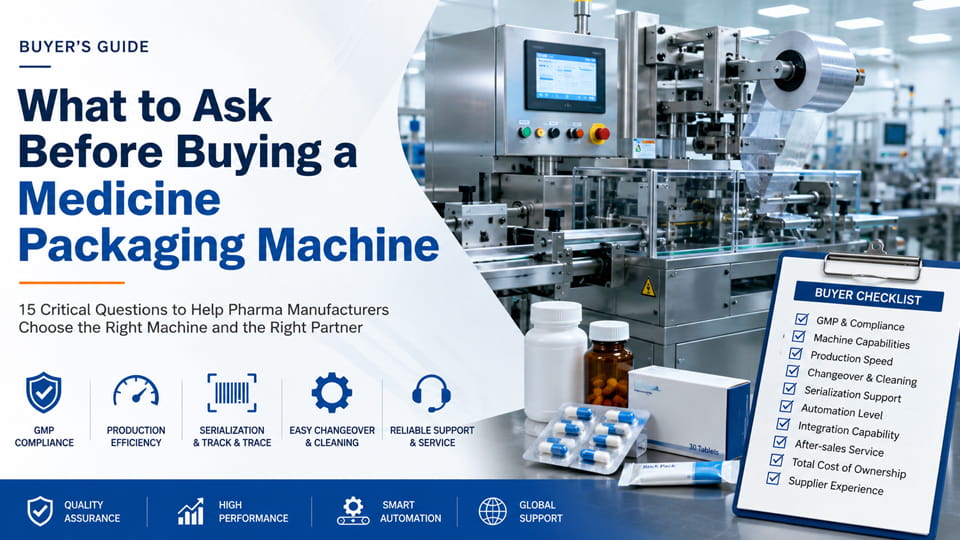
Imagen: Una moderna línea de producción de envases para medicamentos., que ilustra la necesidad de máquinas integradas y un diseño que cumpla con las GMP.
No todas las máquinas manejan todos los productos.. Debes tener muy claro tus tipos de productos.. Por ejemplo, tabletas y cápsulas A menudo se utilizan líneas de recuento/llenado de botellas o envasadoras de blister., mientras medicamentos líquidos Necesita máquinas dedicadas de llenado y sellado de líquidos.. Polvos/gránulos puede ir en sobres o paquetes de barras. A continuación encontrará una guía sencilla: sus necesidades pueden combinar varias máquinas en una sola línea.:
| Forma de dosificación & Formato | Tipo de máquina típica |
| Tabletas sólidas (perder, en botellas) | Conteo automático & Línea de llenado de botellas |
| Tabletas sólidas (tira o ampollas) | Máquina de envases de ampollas (PVC/Alu-PVC) |
| Cápsulas (gel duro) | Máquina de llenado de cápsulas + (línea de blister o botella) |
| Líquidos/Jarabes (viales o botellas) | Máquina llenadora y taponadora de líquidos |
| Polvos/Gránulos (palo o bolsita) | Máquina de bolsitas o paquetes en barra |
| Geles blandos/gomitas | Máquina de conteo + Blister o embotellado |
| cajas de cartón (secundario) | Máquina estuchadora para el boxeo final |
Las máquinas envasadoras de medicamentos suelen venderse como lineas integradas. Por ejemplo, una línea de cápsulas podría alimentar el producto desde un vara en un máquina de contar, luego a través de un empacador de blister o estuchador.
Pregunte a su proveedor de máquinas envasadoras de medicamentos: “¿Puede la línea ejecutar mis productos??" Para cada formato, verificar la compatibilidad del material, p. ej.. Una máquina de blister debe procesar el papel de aluminio y las películas. (CLORURO DE POLIVINILO, MASCOTA, ALU-ALU) a las temperaturas adecuadas. Las líneas de botellas deben ajustarse a diferentes alturas de botellas y tipos de tapas.. Si planeas varios productos (p.ej. cápsulas y tabletas), Necesitará cambiar piezas o incluso máquinas diferentes.. Algunas máquinas son multiformato, pero siempre confirme qué cambio se requiere (ver la siguiente sección).
La velocidad nominal de una máquina debe coincidir con sus objetivos de producción. Descubra cuántas unidades por minuto/hora puede envasar la máquina seguramente. Asegúrate de considerar neto producción (después de los rechazos) y no sólo el máximo. Piensa en las necesidades actuales y crecimiento futuro. Por ejemplo, una línea de blísteres de tabletas de tamaño mediano podría tener una clasificación de 40,000 ampollas por hora; una línea grande totalmente automática podría superar 100,000 por hora. Sin embargo, Una máquina de muy alta velocidad que se estrella con frecuencia puede ser peor que una ligeramente más lenta., uno estable.
Calcule su volumen diario o anual y elija una máquina que pueda soportar picos. Tenga en cuenta las tendencias de la industria: muchas empresas farmacéuticas ahora procesan lotes más pequeños con cambios frecuentes, por lo que la velocidad extremadamente alta de un solo SKU es menos crítica que la flexibilidad. Si ejecuta varios turnos, invertir en un mayor rendimiento puede amortizarse más rápido gracias al ahorro de mano de obra. Pero si los lotes son pequeños o personalizados, una máquina que permite cambios rápidos de recetas y cambios sin herramientas (ver sección 4) Será más valioso que la velocidad bruta..
Decide cuánta automatización necesitas realmente. Máquinas semiautomáticas Requerir que los operadores carguen contenedores., iniciar ciclos, o realizar tareas manuales (p.ej. dejar caer las tabletas en ampollas). Líneas de envasado farmacéutico totalmente automáticas Haga todo, desde alimentar hasta sellar con una mínima intervención humana.. Las máquinas semiautomáticas cuestan menos por adelantado y pueden ser adecuadas para trabajos de bajo volumen o por lotes.. Las líneas totalmente automáticas cuestan más pero ahorran mano de obra y reducen los errores humanos.
| Característica | Semiautomático | Totalmente automático |
| Participación del operador | Sí – carga/descarga, etc.. | Mínimo: una persona supervisa toda la línea |
| Velocidad de producción | Moderado | Alto |
| Cambio | Más lento (ajustes manuales) | Más rápido (a menudo sin herramientas, basado en recetas) |
| Inversión inicial | Más bajo | Más alto |
| Complejidad de validación | Similar (Todavía se necesita IQ/OQ/PQ) | Similar |
| Ideal para | Tiradas pequeñas, pilotos de laboratorio | Tiradas grandes, 24/7 producción |
Los sistemas farmacéuticos totalmente automatizados suelen incluir tolvas de alimentación., etiquetadoras automáticas, gorras, y transportadores todos sincronizados. También integran comprobaciones de errores. (balanzas, sistemas de visión) en tiempo real. Los equipos semiautomáticos podrían ser adecuados para un fabricante por contrato que comienza, pero los planes de crecimiento a menudo llevan a los compradores a optar por la automatización total.
Las líneas farmacéuticas cambian de producto con más frecuencia de lo que piensas, y cada cambio requiere una limpieza a fondo (y a menudo revalidación). Un buen diseño de máquina hará que esto sea rápido.. Buscar sin herramientas piezas removibles, componentes ligeros (una persona puede manejarlos), y marcos abiertos que permiten que el control de calidad ver si queda algún residuo. No debe haber cavidades ocultas donde se puedan acumular pastillas o polvo.. El proveedor debe proporcionar POE claros para la limpieza., desmontaje y montaje. Validar procedimientos de cambio: puede producto recetas se almacenará para que pueda recuperar todas las configuraciones para un SKU determinado?
En la práctica, una máquina que se puede limpiar y validar rápidamente mejora directamente la productividad. Si tiene medicamentos que requieren cambio entre, decir, una sustancia controlada y un producto vitamínico, realizará una limpieza y, a menudo, una prueba de validación de limpieza (prueba de producto en el peor de los casos) cada vez. Preguntar por limpieza en el lugar (PIC) opciones u otras características higiénicas.
Regulaciones modernas (A NOSOTROS. DSCSA, Fiebre aftosa de la UE, etc.) requerir serializar cada unidad vendible de medicina. Antes de comprar, Confirme que la línea puede integrar impresoras de codificación. (inyección de tinta/láser) y escáneres de visión para aplicar y verificar códigos de barras 2D o códigos QR en paquetes. El sistema de control debe capturar cada número de serie y vincularlo a los datos del lote.. En la práctica, Los compradores suelen preguntar: “¿Puede esta máquina rechazar cualquier artículo sin etiqueta o codificado de forma inválida??" y “¿Hay espacio reservado y cableado para agregar un codificador o una cámara más adelante??". Incluso si no estás exportando hoy, construir una línea lista para la serialización es más inteligente que modernizarla más tarde.
Más allá de la serialización, considerar la integración digital. ¿La máquina admite comunicación industrial estándar? (Ethernet/IP, OPC-UA, Modbus, etc.) para que pueda alimentar su MES/ERP? ¿Puede generar pistas de auditoría y registros electrónicos de lotes para el control de calidad?? Las fábricas inteligentes modernas esperan datos en tiempo real: tiempo de actividad, Rechazar recuentos, alarmas, etc.. Una línea farmacéutica "inteligente" ayuda a detectar problemas tempranamente y respalda los requisitos de integridad de los datos (sin registros manuales). Preguntar si el HMI/PLC se puede conectar en red, si hay registros de eventos, y si el servicio remoto (a través de VPN o IoT) se ofrece. La preparación digital prepara su línea para el futuro y mejora la trazabilidad.
El precio de etiqueta es solo el comienzo. Los compradores inteligentes calculan TCO durante la vida de la máquina. El TCO incluye el precio base más envío, instalación, IR/WH/PQ, capacitación, piezas de repuesto, uso de energía, mantenimiento, y costos de tiempo de inactividad. Por ejemplo, Un estudio encontró que una línea costosa pero confiable de envasado de medicamentos fabricada en China ahorró mucho más en tres años que una más barata., uno menos apoyado. hacer una mesa (como abajo) para comparar proveedores:
| Factor de costo | Descripción | Comentarios |
| Precio de compra | Máquina, accesorios, entrega | una sola vez (pero puede variar ampliamente) |
| Instalación & Puesta en marcha | Preparación del sitio, calibración, IR/WH/PQ | Los pasos omitidos aquí pueden aumentar los costos futuros |
| Capacitación | Operador & entrenamiento de mantenimiento | Una buena formación reduce los errores del operador |
| Piezas de repuesto & Componentes | Piezas de desgaste (cinturones, sensores, etc.) | pedir lista; la alta disponibilidad ahorra tiempo de inactividad |
| Energía/Utilidades | Electricidad, aire, vacío, etc.. | Las máquinas eficientes pueden reducir el OPEX |
| Mantenimiento & Falta del tiempo | Mantenimiento programado & arreglos no programados | El servicio rápido y el diseño con bajo nivel de fallas minimizan esto |
| Soporte/Servicio | Solución de problemas remota, visitas in situ | Un SLA de servicio sólido vale su peso |
| Consumibles & Herramientas | Sellos, lubricantes, boquillas de repuesto, etc.. | A menudo se pasa por alto, pero puede sumar |
Si dos proveedores cotizan máquinas similares, profundizar en lo que incluye cada lista. Una máquina de mayor precio podría durar más, tienen repuestos mas baratos, o utilizar menos aire comprimido, reduciendo su coste real. Asegúrese de preguntar a cada proveedor sobre la duración de la garantía y lo que está cubierto. (regiones, mano de obra, viajes para técnicos).
Incluso la mejor máquina necesita mantenimiento. Verifique el historial y la configuración del servicio del proveedor de la máquina envasadora de medicamentos. Una máquina confiable tiene características como códigos de falla claros en la HMI, un gabinete eléctrico bien etiquetado, y un sencillo plan de mantenimiento preventivo. Preguntar por MTBF (tiempo medio entre fallas) datos o estudios de caso. Descubra también cómo se manejan los repuestos.: son piezas disponibles en el mercado o personalizadas? ¿Qué tan rápido puede obtener componentes críticos? Al día siguiente o a las semanas siguientes.? Especialmente para compradores globales, el apoyo local es clave. El estudio de JinLu Packing demostró que la entrega y el servicio rápidos de piezas pueden evitar pérdidas de seis cifras debido al tiempo de inactividad..
[jl_youtube src=»https://www.youtube.com/embed/1Bb_J6rluac»]
Video: Una línea automatizada de llenado y embotellado. Evaluar características de confiabilidad (sensores de error, gabinetes claros) y facilidad de mantenimiento a la hora de elegir el equipo.
No todos los fabricantes de máquinas envasadoras de medicamentos entienden los matices farmacéuticos. Idealmente, Elija un proveedor con un historial comprobado en farmacéutica/GMP. Pregunte por su lista de clientes y proyectos recientes.. ¿Han abastecido a su región o mercados regulados? (FDA de EE. UU., Yo EMA)? ¿Hacen grasa? (Pruebas de aceptación en fábrica) y informes FAT? ¿Pueden manejar un proceso de calificación si es necesario?? Los proveedores acreditados tendrán un sistema de gestión de la calidad de ingeniería y podrán ofrecer personalización. (p.ej. Inspecciones de visión específicas para etiquetado OTC vs RX).
También debes considerar la logística.: ¿Dónde está su fábrica?? Si es en el extranjero, ¿Hay socios de canal o instaladores en su país?? ¿Quién se encarga de las aduanas y el envío?? Recordar, la máquina más barata no vale mucho si se encuentra en un barco debido a que faltan documentos o no es compatible localmente.
para terminar, aquí hay una lista de verificación que puede usar en reuniones o solicitudes de cotización:
Estas preguntas, mientras que numerosos, se asegurará de cubrir los puntos más críticos y comparar proveedores en igualdad de condiciones.
Invertir en la máquina envasadora de medicamentos adecuada significa equilibrar el rendimiento, cumplimiento, y costo durante muchos años. Al hacer estas preguntas, aclararás tus requerimientos y evitarás sorpresas. Recordar, La mejor opción no siempre es la máquina más barata., pero el que se adapta a tu proceso y te mantiene conforme con un tiempo de inactividad mínimo.
Si necesitas orientación, consultar con expertos en automatización de embalajes, por ejemplo, Embalaje de Jinlu ofrece soporte y diseño de línea farmacéutica de extremo a extremo, desde el diseño de la línea GMP hasta la documentación de validación. Contáctenos para discutir tu proyecto: Podemos proporcionar una propuesta personalizada u organizar una demostración en vivo.. Asegurémonos de que su inversión genere tanto éxito regulatorio como eficiencia operativa.
Antes de comprar una máquina envasadora de medicamentos, debe preguntar sobre el cumplimiento de GMP, velocidad de producción, tipos de embalaje, soporte de validación, materiales de la máquina, tiempo de cambio, disponibilidad de piezas de repuesto, y servicio postventa. También es importante comprobar si la máquina puede soportar futuros requisitos de serialización y expansión de la producción..
La máquina adecuada depende de su tipo de producto, volumen de producción, formato de embalaje, y requisitos de cumplimiento. Por ejemplo, Las máquinas empacadoras de blister se usan comúnmente para tabletas y cápsulas., mientras que las máquinas de envasado en bolsitas o barras son mejores para polvos y gránulos. Los compradores también deben considerar el nivel de automatización., costos de mantenimiento, y capacidad de integración de líneas.
Un fabricante confiable de maquinaria de envasado farmacéutico debe proporcionar documentos y certificaciones como:
• Certificación CE
• Documentación de diseño compatible con GMP
• Protocolos IQ/OQ/PQ
• Documentos FAT/SAT
• Certificados de materiales
• 21 Parte CFR 11 apoyo (si corresponde)
Estos documentos ayudan a las fábricas farmacéuticas a pasar auditorías y cumplir con los requisitos reglamentarios..
El cumplimiento de GMP ayuda a garantizar la seguridad del producto, calidad constante, y aprobación regulatoria. Una máquina que cumple con GMP está diseñada para reducir los riesgos de contaminación, mejorar la capacidad de limpieza, y respaldar la documentación y la trazabilidad adecuadas. Esto es especialmente importante para los fabricantes de productos farmacéuticos que exportan a mercados regulados..
Los equipos de envasado farmacéutico modernos pueden admitir muchos formatos de envasado., incluido:
• Blísteres
• Botellas
• Bolsitas
• Paquetes de barras
• Bolsas
• Cajas de cartón
La mejor opción depende de su forma farmacéutica., requisitos del mercado, y objetivos de producción.
La serialización se está volviendo esencial en muchos países debido a las regulaciones de trazabilidad farmacéutica como DSCSA y EU FMD.. Una máquina con capacidad de serialización puede imprimir y verificar códigos únicos, Ayudar a los fabricantes a prevenir productos falsificados y mejorar el seguimiento de la cadena de suministro..
Las máquinas semiautomáticas suelen ser más asequibles y adecuadas para pequeños volúmenes de producción o nuevas empresas.. Las máquinas de envasado farmacéutico totalmente automáticas son mejores para la producción a gran escala porque mejoran la eficiencia., Reducir los costos laborales, y minimizar el error humano.
El precio depende de varios factores., incluido el tipo de máquina, nivel de automatización, velocidad de producción, y requisitos de personalización. Una máquina semiautomática básica puede costar mucho menos que una línea de envasado farmacéutico totalmente automatizada con soporte de serialización y validación.. Los compradores deben centrarse en el coste total de propiedad y no sólo en el precio de compra inicial..
Sí. Muchas máquinas modernas de envasado de productos farmacéuticos se pueden conectar con máquinas contadoras., sistemas de etiquetado, máquinas estuchadoras, transportadores, y sistemas ERP/MES. La integración ayuda a mejorar la automatización y la eficiencia general de la producción.
Un proveedor profesional debe ofrecer:
• Soporte de instalación
• Capacitación del operador
• Solución de problemas en línea
• Suministro de repuestos
• Guía de mantenimiento preventivo
• Asistencia técnica remota
Un buen servicio posventa puede reducir significativamente el tiempo de inactividad y mejorar la estabilidad de la producción a largo plazo..
Referencias:
1.Buenas prácticas de fabricación actuales (CGMP) Reglamentos -- A NOSOTROS. Administración de Alimentos y Medicamentos
2.Buenas prácticas de fabricación de productos biológicos de la OMS, Anexo 2, TRS No 999 -- OMS
3.Buenas practicas de fabricacion —— Agencia Europea de Medicamentos
4.Diez preguntas frecuentes sobre la serialización —— Sociedad Internacional de Ingeniería Farmacéutica