Pruebas de aceptación en fábrica (GORDO) y pruebas de aceptación del sitio (SE SENTÓ) Son dos etapas complementarias de validación para equipos farmacéuticos.. La FAT se realiza en las instalaciones del fabricante del equipo. (antes del envío) para verificar que todas las especificaciones y funciones cumplan con los requisitos del cliente. El SAT se realiza después de la instalación en el sitio del cliente para confirmar que la máquina funciona correctamente en el entorno de producción real.. Juntos, FAT y SAT ayudan a detectar problemas a tiempo (ahorrando tiempo y costos) y asegurar Cumplimiento de GMP. Este artículo explica FAT vs SAT en detalle y cubre lo que verifica cada prueba., diferencias clave, cómo encajan en el ciclo de vida IQ/OQ/PQ, listas de verificación de muestra para líneas de embalaje (ampolla, cápsula, tableta, estuchado), y preguntas sobre mejores prácticas para compradores.
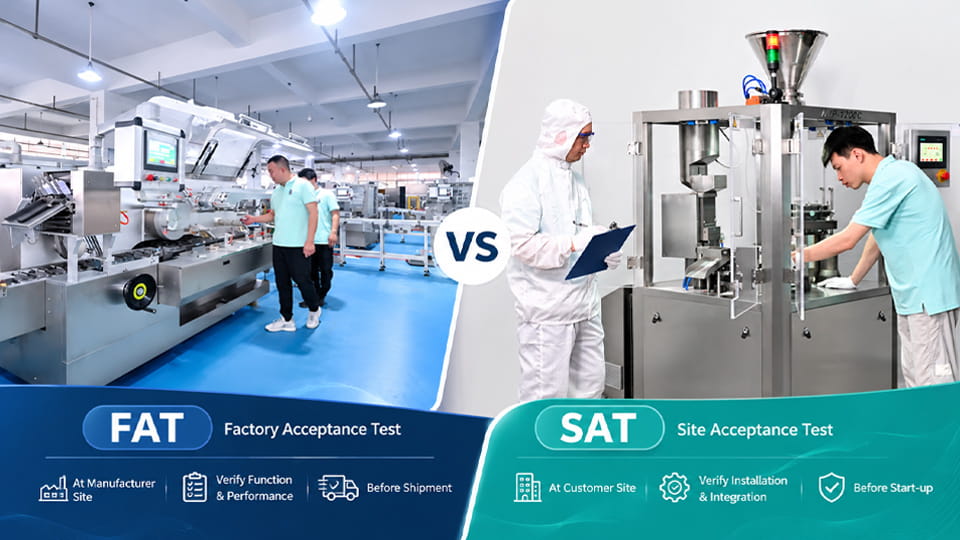
¿Qué es una prueba de aceptación en fábrica? (GORDO)?
A Prueba de aceptación de fábrica (GORDO) es un formal, Evaluación documentada del equipo en el sitio del fabricante., realizado antes de que la unidad se envíe al cliente. Verifica que la máquina ha sido construida según lo acordado. Especificación de requisitos del usuario (URS) y esta funcionando correctamente. Durante la grasa, el vendedor y el cliente (o sus representantes) ejecutar un protocolo FAT aprobado de casos de prueba y listas de verificación. Los objetivos típicos incluyen demostrar el cumplimiento de las especificaciones., detectar defectos temprano, y darle al comprador la confianza de que “el equipo está listo para enviarse”.
¿Qué verifica FAT??
En grasa, La atención se centra en el rendimiento independiente y el cumplimiento del diseño.. Generalmente incluye:
- Comprobaciones visuales y de construcción: Inspeccionar el conjunto mecánico., alineación del marco, alambrado, y construir calidad contra dibujos. Confirmar números de serie e ID de modelo.
- Pruebas eléctricas y de control: Verificar las conexiones eléctricas, Versiones de software PLC/HMI, sensores y actuadores. Comprueba que las pantallas de control, recetas, y las alarmas responden correctamente.
- Pruebas de funcionamiento (Ejecuciones sin carga o en seco): Ejecute cada función principal de la máquina (motores, conduce, comederos, calentadores) en toda su gama. Por ejemplo, Velocidades de ciclo al mínimo y al máximo., calentadores de prueba/rampas de presión, y accionar los enclavamientos intencionalmente.
- Comprobaciones de rendimiento: Utilice materiales de producción representativos si es posible.. Para un relleno o máquina de embalaje, ejecutar muestras de productos y verificar el rendimiento, exactitud, cambio, y otros objetivos de desempeño. (Se recomienda encarecidamente utilizar los productos reales del cliente durante FAT para revelar problemas específicos del material.)
- Seguridad y enclavamientos: Probar paradas de emergencia, cortinas de luz, guardias, válvulas de alivio de presión, etc., para confirmar que todos los sistemas de seguridad responden según lo previsto en condiciones de falla.
- Revisión de documentación: Confirme que todos los documentos requeridos estén listos: manuales de operación, diagramas electricos y neumaticos, guías de mantenimiento, listas de repuestos, certificados de calibración, etc..
- Criterios de aceptación: Todas las pruebas se evalúan según criterios de aceptación acordados previamente. (a menudo extraído de la URS). Cualquier desviación o punto abierto se registra en una lista de tareas pendientes para su resolución..
Un FAT exitoso termina con un informe FAT firmado, detallar las pruebas aprobadas y enumerar los problemas que se deben solucionar antes del envío. Esencialmente, FAT garantiza que "el sistema esté listo para ser enviado" al verificar sus funciones principales en condiciones controladas de fábrica..
Cuándo y quién ocurre la FAT?
La FAT generalmente se lleva a cabo después de que la máquina esté completamente ensamblada, pero antes de que salga del piso del fabricante.. Sigue la calificación del diseño. (si alguno) y precede a la entrega. Los participantes clave suelen incluir ingenieros y técnicos de proveedores., y representantes de la empresa compradora (Ingenieros de control de calidad/validación, personal de producción). El equipo del comprador debe llegar preparado., a menudo trayendo la URS, protocolos de prueba, y cualquier material especializado para ejecutar. El FAT es la última oportunidad que tiene el comprador de detectar discrepancias importantes bajo el control del proveedor..
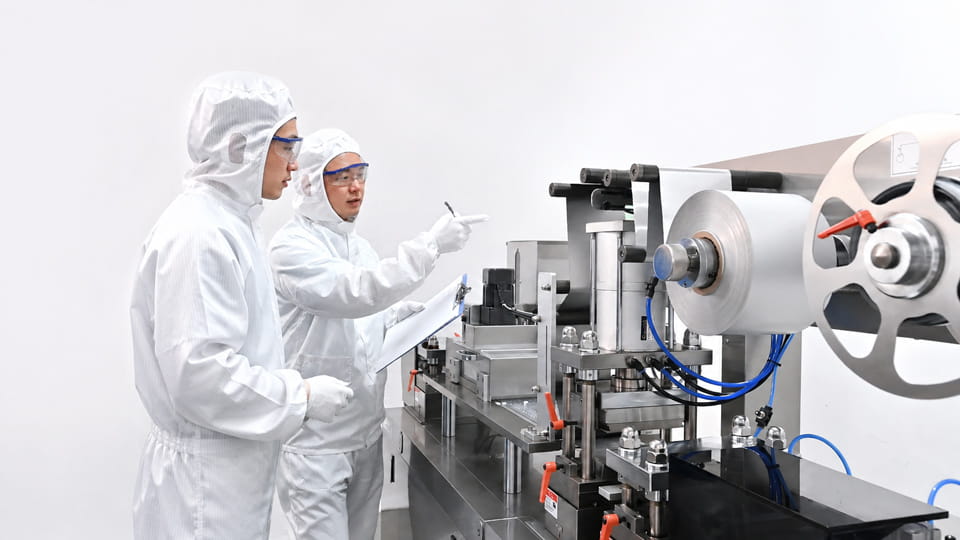
Cifra: un farmaceutico máquina de envases de ampollas sometido a pruebas de aceptación. En un FAT riguroso, cada subsistema (formación, caza de focas, alimentación, controles) se compara con la URS. Luego, un SAT posterior repite las pruebas funcionales clave después de la instalación en el entorno de uso final..
¿Qué es una prueba de aceptación del sitio? (SE SENTÓ)?
A Prueba de aceptación del sitio (SE SENTÓ) Es una prueba documentada realizada en las instalaciones del cliente después de que el equipo se entrega e instala, pero antes de su lanzamiento para producción.. El SAT vuelve a verificar que la máquina cumple con los requisitos en su contexto operativo real. En sábado, Se verifica que el equipo esté correctamente instalado., conexión de servicios públicos, integración del sistema, y actuación final.
¿Qué verifica el SAT??
El SAT normalmente incluye:
- Calificación de instalación (coeficiente intelectual) cheques: Verificar que el equipo esté instalado según el plan aprobado.. Esto incluye confirmar la ubicación correcta., arrasamiento, utilidades (voltaje de alimentación, presión neumática, agua, etc.), toma de tierra, y condiciones ambientales. Todos los componentes y la documentación de la máquina deben estar presentes e instalados correctamente..
- Verificación de servicios públicos: Asegúrese de que los servicios públicos del sitio cumplan con los requisitos de la máquina.. Por ejemplo, medir el voltaje real, presión/flujo de aire, temperatura del agua helada, o presión de vapor del suministro de la instalación. Confirme que se mantienen dentro del rango aceptable especificado por la máquina..
- Pruebas de integración: Verifique las interfaces con equipos y sistemas de construcción aguas arriba y aguas abajo. Verificar enlaces de comunicación (p.ej. a LIMS, MES, SCADA) si corresponde. Confirme que los transportadores se alineen, el traspaso entre máquinas es fluido, y cualquier alarma en red o recopilación de datos funciona bajo las condiciones del sitio.
- Repita las pruebas funcionales en condiciones reales: Realizar funciones básicas nuevamente, ahora con la máquina conectada a los servicios públicos y utilizando materiales de producción reales si es posible. Por ejemplo, ejecutar un lote de real tabletas o cápsulas a través de la máquina para confirmar que aún cumple con los criterios de velocidad y calidad. Asegúrese de que cualquier ajuste realizado para las condiciones del sitio sea efectivo..
- Controles de seguridad y medioambientales: Vuelva a probar los enclavamientos de seguridad y los dispositivos de protección en entornos de instalación reales. Verificar que los requisitos ambientales (clase de sala limpia, temperatura, humedad) se cumplen y no afectan negativamente el funcionamiento de la máquina..
- Criterios de aceptación final: Confirme que todos los criterios de aceptación del SAT (a menudo extraídos de URS y protocolos del sitio) estan satisfechos. Documente cualquier desviación restante en una lista de tareas pendientes.. Recopile aprobaciones de operadores y documentación de aceptación formal..
Un SAT exitoso finaliza con un informe o certificado del SAT firmado tanto por el proveedor como por el cliente.. Proporciona evidencia documentada de que “el equipo/sistema se entregó en buenas condiciones y no se vio afectado por el transporte” y ahora funciona correctamente en el sitio.. En la práctica, Un SAT completo da confianza de que la máquina está lista para la siguiente fase de validación. (IR/WH/PQ) o producción rutinaria.
GRASA vs SAT: 10 Diferencias clave
- Ubicación: La FAT se realiza en el sitio del fabricante.; SAT en casa del propietario (clientela) sitio.
- Momento: La grasa ocurre antes del envío (post-ensamblaje), mientras que SAT es después de la instalación (precomisionado).
- Ambiente: FAT está en una configuración controlada de fábrica (a veces no en condiciones de sala limpia); SAT se encuentra en el entorno de producción real con condiciones ambientales reales..
- Utilidades: En grasa, utilidades (aire, agua, fuerza) El proveedor puede simularlo a valores nominales.; en sábado, la máquina utiliza utilidades del sitio en vivo (aire real, agua, suministro electrico).
- Integración: FAT prueba la máquina de forma aislada (a veces con cargas ficticias). Las pruebas SAT incluyen la integración con los equipos circundantes. (p.ej. cargador ascendente, empacador aguas abajo, sistemas de datos).
- Alcance de la prueba: Los scripts FAT tienden a ser más exhaustivos (controles funcionales completos, velocidades máximas) para “sacudir” los problemas en el piso de proveedores. Los scripts SAT se centran en confirmar el rendimiento principal en las condiciones del sitio y comprobar las correcciones de FAT..
- Detalle de documentación: Los protocolos FAT suelen ser muy detallados con pruebas de elementos individuales (a menudo escrito a la UW). Los protocolos del SAT pueden hacer referencia a los resultados de URS y FAT, para que puedan ser más ágiles.
- Criterios de aceptación: La aceptación de FAT se basa estrictamente en criterios de prueba de fábrica acordados por adelantado.. La aceptación del SAT incluye cualquier criterio adicional del sitio. (p.ej. integración de línea completa, factores ambientales).
- Objetivo: El objetivo de FAT es "probar" que la máquina se construyó correctamente. El objetivo del SAT es “confirmar” que aún funciona después del tránsito y la instalación..
- Impacto: Los problemas encontrados en FAT se pueden solucionar con el proveedor (menor costo). Los problemas encontrados en SAT a menudo requieren tiempo de inactividad y pueden retrasar la producción. Un FAT completo minimiza las costosas sorpresas del SAT.
En breve, FAT y SAT son puntos de control secuenciales: FAT detecta defectos temprano en la fábrica; SAT detecta cualquier problema restante una vez que la máquina está en el sitio. Ambos son cruciales para el cumplimiento de las GMP y la gestión de riesgos..
FAT vs SAT de un vistazo
| Característica |
GORDO (Prueba de aceptación de fábrica) |
SE SENTÓ (Prueba de aceptación del sitio) |
| Dónde & Cuando |
En las instalaciones del proveedor, antes del envío. |
En el sitio del cliente, después de la instalación. |
| Objetivo |
Verifique que la máquina cumpla con las especificaciones de diseño/URS y funcione de forma independiente. |
Verificar que la máquina funcione correctamente en la línea de producción real. (utilidades, ambiente, integración). |
| Ambiente |
Condiciones de fábrica controladas (utilidades del proveedor). |
Condiciones reales de la planta (aire real, fuerza, temperatura). |
| Alcance de la prueba |
Pruebas funcionales detalladas frente a las especificaciones del contrato; Simular el proceso utilizando materiales representativos si es posible.. |
Comprobar instalación (coeficiente intelectual), luego repita la funcionalidad y el rendimiento principales con el producto/configuración final; integración de prueba con equipos upstream/downstream. |
| Criterios de aceptación |
Basado en los requisitos del usuario y el plan de prueba acordado. (p.ej. velocidad, exactitud). |
Confirma el rendimiento ajustado al sitio (p.ej. calidad de producción constante, parámetros de utilidad) cumplir con los criterios. |
| Documentación |
Protocolo FAT formal, registros de prueba, lista de pendientes, informe final FAT. |
Protocolo SAT formal (a menudo más simple), registro de desviaciones/lista de tareas pendientes, cerrar sesión, y trazabilidad a URS. |
| Resultado |
“Equipo aprobado para envío” (o lista de correcciones). |
“Máquina aceptada en el sitio” (o lista de problemas pendientes de solucionar). |
Esta tabla destaca las distinciones clave: FAT se trata de demostrar que la máquina está construida según las especificaciones antes sale de fabrica, mientras que el SAT demuestra que aún cumple con los requisitos después instalación en su entorno de trabajo. Por lo general, ambos se requieren según GMP/Anexo. 15 guía.
FAT vs SAT vs IQ vs OQ vs PQ
FAT y SAT son parte del ciclo de vida de calificación más amplio para equipos GMP. En un flujo de proyecto típico, comienza con la especificación de requisitos del usuario (URS) y calificación de diseño (DQ), luego proceda a FAT, entrega, instalación, SE SENTÓ, y finalmente IQ/OQ/PQ en sitio. El siguiente diagrama de sirena ilustra esta secuencia.:
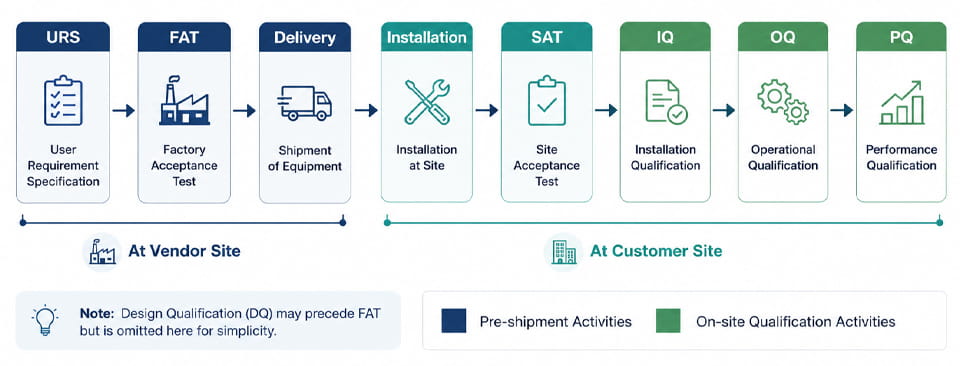
Cifra: Flujo del ciclo de vida de calificación. Después de definir URS, una prueba de aceptación en fábrica (GORDO) se realiza en el sitio del proveedor. Luego el equipo es enviado e instalado., seguido de una prueba de aceptación del sitio (SE SENTÓ). Finalmente, Calificación de instalación (coeficiente intelectual), Calificación operativa (OQ), y calificación de desempeño (PQ) se ejecutan en el sitio (nota: DQ puede preceder a FAT pero se omite aquí por simplicidad).
Este flujo está respaldado por la guía GMP.. Por ejemplo, según el anexo EU GMP 15 y ISPE C&practicas q, Los resultados FAT documentados a menudo se pueden aprovechar en IQ/OQ., reduciendo la duplicación. De hecho, Las pautas ISO/ISPE señalan que las “actividades de FAT contribuyen directamente a la calificación del diseño”. (DQ) y calificación de instalación (coeficiente intelectual) evidencia,“ayudando a comprimir el tiempo total de calificación. En la práctica, una FAT rigurosa con la documentación adecuada significa que su equipo de IQ puede reutilizar esos hallazgos (p.ej. comprobaciones de instalación ya realizadas) en lugar de volver a probar los mismos puntos.
Lista de verificación del protocolo FAT (Embalaje farmacéutico)
Un protocolo FAT integral para maquinaria de envasado farmacéutico generalmente incluye los siguientes elementos:
- Protocolo FAT preaprobado: Un documento escrito (basado en la URS) que enumera cada caso de prueba, criterios de aceptación, y responsabilidad. Esto es aprobado tanto por el comprador como por el vendedor antes de realizar la prueba..
- Inspección visual: Compruebe que la máquina coincida con los dibujos finales aprobados., sin piezas faltantes ni daños. Verifique los números de serie y el modelo de los componentes.
- Mecánico & Inspección eléctrica: Confirmar todos los componentes estructurales. (marcos, guardias, transportadores) y componentes electricos (motores, cables, paneles) están correctamente instalados y etiquetados.
- Pruebas de alarma y enclavamiento: Activar cada condición de alarma y verificar la respuesta adecuada. Activar cada bloqueo de seguridad (Molestar, guardia de la puerta, cortina de luz) para garantizar que la máquina se detenga o emita una alerta según lo diseñado.
- Comprobaciones de control/software: Confirmar la configuración del PLC/HMI, versiones de software, manejo de recetas, y los niveles de acceso de usuario funcionan. Pruebe las interfaces del operador y la lógica de control según los requisitos..
- Verificación de la calibración del instrumento: Verifique que todos los sensores e instrumentos tengan certificados de calibración válidos y cumplan con las especificaciones antes de su uso..
- El rendimiento se ejecuta con el producto: Haga funcionar la máquina a todas las velocidades operativas especificadas utilizando productos representativos o materiales del peor de los casos.. Medir resultados clave (llenar pesas, rendimiento, calidad de sellado, precisión del conteo, etc.) contra los criterios de aceptación.
- Demostraciones de cambio: Si se requieren múltiples formatos/SKU, demostrar cambio procedimientos y tiempos según el contrato.
- Simulación de utilidad: Simular las condiciones de servicios públicos del sitio (p.ej. hacer funcionar los motores a menor voltaje, aplicar una presión de aire más baja) para garantizar que la máquina pueda manejar las variaciones de utilidad esperadas.
- Revisión de documentación: Asegúrese de que todos los manuales, esquemas, guías de mantenimiento, y las listas de repuestos están completas y entregadas.
- Lista de tareas pendientes y aprobación: Documente cualquier problema pendiente en una lista de tareas pendientes. Después de volver a probar las correcciones, incluir la página de firma final de “Aceptación FAT” en el informe FAT.
Seguir esta lista de verificación ayuda a detectar desviaciones en la fábrica.. Por ejemplo, Los expertos de la industria advierten contra los registros FAT vagos, solo cuantitativos, Se deben aceptar datos de prueba específicos del equipo.. Aceptar meras declaraciones de “aprobado” del proveedor o listas de verificación incompletas puede enmascarar problemas. Registre siempre los valores medidos y rastree hasta el número de serie específico de la máquina..
Lista de verificación del protocolo SAT (Embalaje farmacéutico)
Un protocolo SAT para máquinas empacadoras de productos farmacéuticos generalmente cubre:
- Comprobaciones previas a la instalación: Verifique que el sitio esté listo (cuarto limpio, nivel de fundación), los servicios públicos están en su lugar (fuerza, aire comprimido, vacío, agua), y los planos de instalación coinciden con la máquina.
- Verificación de instalación: Confirme que todos los componentes mecánicos estén ensamblados correctamente en el sitio (sin daños por el envío). Verifique que los servicios públicos se conecten correctamente (Voltaje, presión, fluir) y que las condiciones ambientales (temperatura, humedad, clasificación) cumplir con los requisitos del equipo.
- Pruebas de función sin carga: Ejecute funciones clave vacías o con un producto ficticio para garantizar que el cableado y los motores permanezcan intactos después del transporte.. Verifique los enclavamientos de seguridad una vez más bajo las condiciones del sitio (p.ej. Aire de planta en lugar de aire de fábrica.).
- Prueba de conexión de servicios públicos: Mida los parámetros de servicios públicos reales en la máquina (p.ej. Confirme que la presión de aire real y el flujo cumplan con las especificaciones.).
- Pruebas de integración: Si corresponde, Pruebe la comunicación entre esta máquina y el equipo ascendente/descendente. (p.ej. comprobar que una máquina contadora indica correctamente a la estuchadora que indexe).
- Prueba de rendimiento de producción: Ejecute la máquina con un producto real o un producto simulado. (según la URS). Por ejemplo, alimente las ampollas o cápsulas de tabletas reales a través de la línea para confirmar que el rendimiento y la calidad sean los requeridos. Esto es esencialmente una ejecución de PQ del sitio..
- Capacitación del operador & Entregar: Asegúrese de que los operadores puedan operar la máquina. Revisar los procedimientos operativos y hacer que los operadores realicen tareas básicas bajo observación..
- Resolución de problemas: Registre cualquier desviación o hallazgo del SAT en un registro y verifique las acciones correctivas.. Sólo después de que se hayan cerrado todos los puntos críticos la máquina obtiene la aceptación formal..
- Aprobación final: Completar un informe o certificado del SAT, firmalo, e incluir datos de ejecución final. Esto se convierte en evidencia de cumplimiento..
En breve, El protocolo SAT vuelve a confirmar todas las funciones críticas en condiciones reales.. Es el último punto de control antes de la puesta en servicio.. Por ejemplo, Jinlupacking señala que un SAT completo a menudo genera datos de referencia que pueden ir directamente a los protocolos IQ/OQ., evitar volver a realizar pruebas de los servicios públicos y el medio ambiente.
FAT y SAT para máquinas de envasado farmacéutico
Líneas de envasado farmacéutico (ampolla, cápsula, tableta, máquinas estuchadoras) tener su propio énfasis FAT/SAT. Aquí hay algunos puntos típicos.:
- Máquina de envases de ampollas: FAT debe verificar las estaciones de formado y sellado.. Por ejemplo, medir la uniformidad de la temperatura en la platina de termoformado (±2°C en todo el molde) y matriz de sellado (±3°C) en las peores velocidades. Integridad del sello de prueba (pruebas de pelado según ASTM F88). Compruebe la precisión de la alimentación del blíster, indexación, alineación de la película, y que el sistema de rechazo elimina las ampollas deformes. SE SENTÓ Luego repetirá estas pruebas con el blíster y las tabletas reales en el sitio y confirmará que la máquina aún cumple con las especificaciones de resistencia del sellado y rendimiento bajo condiciones de humedad/temperatura locales..
- Máquina de llenado de cápsulas: Los puntos de control de FAT incluyen la orientación y alimentación de las cápsulas. (verificar que las tapas y los cuerpos se carguen correctamente), Precisión de llenado de polvo (medir el peso del llenado en rango bajo/alto), sistemas de detección (verifique la alineación del sensor para ver si está vacío, doble, o orientación incorrecta), y la integridad del bloqueo (asegúrese de que las cápsulas estén bien cerradas). Verifique la indexación de la torreta y la precisión del servo sin producto. SE SENTÓ Luego probará la precisión del llenado con las cápsulas y la mezcla de polvo del cliente., y confirmar que el mecanismo de rechazo de final de línea funciona cuando ocurren rechazos reales.
- Máquina de prensa de tabletas: Durante la grasa, Las pruebas incluyen calibración de herramientas. (peso de la tableta, espesor, dureza entre las posiciones de la torreta), funcionamiento del bastidor de alimentación y de la tolva, y consistencia de la fuerza de prensa. Haga funcionar la prensa bajo carga con las fuerzas de compresión más bajas y más altas para verificar la velocidad del ariete.. SE SENTÓ vuelve a verificar las especificaciones de la tableta mediante granulación real en el tamaño de lote deseado, Confirma que los niveles de lubricación y sonido son aceptables., y comprueba puertas protectoras y relés de sobrecarga in situ.
- Máquinas contadoras y estuchadoras: Para máquinas de contar, FAT se centra en la precisión y la velocidad con productos simulados, Verificación de sensores y canales de rechazo.. Para estuchadores, FAT verifica la formación de cajas de cartón, sincronización de alimentación, velocidad de salida, y calidad de sellado. SE SENTÓ probará el funcionamiento continuo: Introducir blisters o botellas reales en una estuchadora y garantizar que las cajas de salida sean correctas.. También comprueba que la máquina contadora y la estuchadora se sincronicen correctamente. (p.ej. no se pierden botellas).
en todos los casos, Tanto FAT como SAT verifican que la máquina funcione a la velocidad especificada y produzca el recuento/peso/calidad correctos. con el producto real. Saltarse pruebas (Por ejemplo, no ejecutar producto real en FAT) puede provocar fallos en el SAT. Como advierte un experto, “ejecutar un FAT con los materiales genéricos del OEM no es lo mismo que ejecutarlo con los suyos” – si no prueba materiales reales en FAT, Los problemas del sitio a menudo surgen más tarde..
¿Por qué una máquina puede aprobar FAT pero reprobar SAT??
Incluso si una máquina pasa todos los elementos de la lista de verificación FAT, aún puede reprobar el SAT si las condiciones cambian. Las razones comunes incluyen:
- Diferencias de utilidad: El voltaje, presión de aire, o la calidad del suministro en la planta puede estar fuera del rango utilizado en FAT. Un motor transportador podría dispararse en SAT si el voltaje de línea es ligeramente bajo, Por ejemplo.
- Cambio ambiental: Las diferencias de temperatura o humedad pueden afectar los procesos.. En un caso, una máquina de blister pasó FAT a humedad moderada. (45% RH) pero falla la integridad del sello en el sitio en 80% RH.
- Variaciones del producto: Si el proveedor no utilizó el producto exacto o el material de embalaje en la ejecución FAT, La máquina puede comportarse de manera diferente con el producto real.. (Le recomendamos presionar al OEM para que ejecute sus materiales en FAT.)
- Problemas de instalación: Errores en la configuración, alineación, o sujeción durante el envío puede introducir nuevas fallas que el SAT debe detectar. Por ejemplo, Es posible que no se note un codificador flojo o un riel guía empujado hasta que se realice la prueba en el sitio..
- Problemas de integración: Es posible que la máquina no se comunique correctamente con otros equipos de línea o con el sistema de control de la planta a menos que esas interfaces se prueben en el SAT..
- Lista de tareas pendientes no cerradas: Si el proveedor realizó una liberación parcial (p.ej. "Arreglaremos esto después de la entrega"), Es posible que un problema FAT no resuelto solo surja en el SAT.
En breve, FAT prueba la máquina de forma aislada; El SAT lo prueba en contexto. Cada diferencia en las condiciones o configuración del sitio es un modo de falla potencial.. Un SAT bien ejecutado, sin embargo, es la verificación final para descubrir estos problemas antes de la producción completa.
¿Qué deberían preguntarle los compradores a un proveedor sobre FAT y SAT??
Al seleccionar un proveedor de máquinas, Los compradores de la industria a menudo utilizan la preparación FAT/SAT como un calificador clave.. Por ejemplo, Guía de auditoría de proveedores de Jinlu recomienda preguntar:
- Disponibilidad de documentos: “¿Puede proporcionarnos la documentación completa del equipo?, incluyendo manuales, dibujos, Informes FAT/SAT, y plantillas IQ/OQ?". (Un proveedor compatible los proporciona de forma proactiva.)
- Soporte de validación: “¿Me ayudarás con instalación y calificación? ¿Ofrecen soporte o capacitación in situ durante FAT/SAT??". (Asegúrese de que envíen ingenieros a FAT y SAT.)
- Participación en el proceso: “¿Quién liderará el FAT y el SAT?? ¿Puede mi equipo de control de calidad/validación participar o presenciar las pruebas??"
- Uso de muestras: “¿Pasarás mi producto real y mis materiales de embalaje en el FAT??" (Como se señaló, El uso de materiales reales es fundamental.)
- Manejo de desviaciones: “Si algo falla en FAT, ¿Cómo se solucionará?? ¿Volverá a realizar la prueba en el sitio antes del envío??"
- Control de cambios: “¿Cómo se gestionan los cambios posteriores al pedido?? ¿Se pueden incluir actualizaciones menores de URS en los protocolos??".
- Experiencia & Referencias: “¿Ha entregado este modelo a otros clientes farmacéuticos?? ¿Podemos ver? estudios de caso o referencias de contacto?".
- Repuestos y Servicio: “¿Cuál es su política de soporte de repuestos?? ¿Ofrecen garantías extendidas o servicio local??".
Estas preguntas ayudan a medir la madurez de validación del proveedor.. Un proveedor experimentado debería responder fácilmente que entregan máquinas "listas para auditoría" con paquetes completos FAT/SAT/IQ/OQ..
Lista de verificación de aceptación FAT/SAT
Para garantizar un proceso de aceptación fluido, los compradores pueden utilizar esta lista de verificación rápida FAT/SAT:
- Acuerde el alcance por adelantado: Incluir planes FAT y SAT en la orden de compra o URS, definir exactamente qué pruebas se realizarán y qué criterios deben cumplirse.
- Pruebas de testigos: Asiste al FAT (idealmente en persona) para verificar que se realiza cada prueba. Si la presencia remota, garantizar video en vivo de las lecturas.
- Utilice dibujos/especificaciones finales: Confirme que la máquina se haya probado con los planos y URS más recientes. (no revisiones anteriores).
- Traiga evidencia de calibración: Asegúrese de que los instrumentos utilizados en FAT/SAT estén calibrados y sus certificados estén en el paquete de documentación..
- Recopilar datos sin procesar: Requerir que todos los valores medidos (pesas, efectivo, voltajes, etc.) estan grabados, no solo calificaciones de “aprobado/reprobado”.
- Cerrar las desviaciones rápidamente: Cualquier discrepancia encontrada debe tener una solución acordada y volver a probarse antes de la aceptación.. No aceptes un “esto lo arreglaremos más tarde” sin pruebas.
- Trazabilidad: Mantener una matriz de trazabilidad que vincule cada punto URS con los casos y resultados de las pruebas FAT/SAT..
- Aprobación final: No suelte la máquina hasta que se hayan resuelto todos los elementos de la lista de verificación FAT y se haya firmado el informe FAT.. Repetir para el SAT.
- Verificación previa al envío posterior a FAT: Opcionalmente, realizar una inspección previa al envío para confirmar que nada cambió después del FAT (Sugerimos esta verificación final después de empacar la máquina.).
- Archivo de documentación: Mantenga copias de todos los protocolos e informes FAT y SAT en sus archivos de validación.. Estos pasan a formar parte de los registros de Calificación de Equipos..
Seguir esta lista de verificación evita sorpresas. Por ejemplo, Ver las fotos del embalaje de un proveedor o las notas genéricas de control de calidad después del hecho es no prueba de cumplimiento. La evidencia más sólida es un conjunto completo de registros FAT/SAT vinculados a la máquina específica..
Conclusión
FAT y SAT son controles esenciales para garantizar que sus máquinas de envasado farmacéutico funcionen de manera confiable y cumplan con GMP.. Probando minuciosamente el equipo en el sitio del proveedor. (GORDO) y nuevamente después de la instalación (SE SENTÓ), minimizas sorpresas costosas y validas que se cumplan todos los puntos URS.
Listo para agilizar sus pruebas de aceptación? Jinlu Packing entrega equipo de calidad farmacéutica (envasadores de blister, rellenos de cápsula, prensas de tabletas, líneas de conteo y encartonado, etc.) con soporte completo FAT/SAT. Cada máquina se envía con un protocolo FAT/SAT completo y un kit IQ/OQ/PQ para que su calificación sea más rápida y fluida.. Póngase en contacto con Jinlu hoy para hablar sobre su URS y configurar planes FAT/SAT para su nuevo equipo., o visite nuestras páginas de productos para Máquinas de llenado de cápsulas, Máquinas empacadoras de blister, Prensas para tabletas, Máquinas de contar, Máquinas estuchadoras y más. Nuestro equipo lo ayudará a planificar los pasos FAT/SAT y le brindará documentación de validación llave en mano para que su proyecto se mantenga a tiempo y cumpla con las normas..
Ponte en contacto con los expertos de Jinlu para obtener orientación FAT/SAT y garantizar que su nueva línea de envasado esté lista para la validación desde el primer día.
Preguntas frecuentes sobre FAT vs SAT en el sector farmacéutico
¿Cuál es la diferencia entre FAT y SAT??
GORDO (Prueba de aceptación de fábrica) Se realiza en las instalaciones del fabricante del equipo antes del envío para verificar que la máquina cumple con las especificaciones y requisitos funcionales acordados.. SE SENTÓ (Prueba de aceptación del sitio) Se realiza en las instalaciones del cliente después de la instalación para confirmar que el equipo funciona correctamente con los servicios públicos reales del sitio., ambiente, y sistemas conectados.
¿Por qué es importante la FAT antes de enviar equipos farmacéuticos??
FAT permite al comprador y al proveedor identificar el diseño, fabricación, control, o problemas de rendimiento antes de que la máquina abandone las instalaciones del fabricante. Los problemas encontrados en esta etapa generalmente son más fáciles de investigar y corregir porque el equipo, equipo de ingeniería, herramientas, y el entorno de prueba están fácilmente disponibles. Por lo tanto, una FAT bien planificada puede reducir los retrasos en la puesta en servicio y evitar retrabajos innecesarios en las instalaciones del cliente..
¿Se requiere FAT antes del SAT??
La FAT se realiza comúnmente antes del SAT, pero si es obligatorio depende del proyecto, contrato, equipo, y requisitos de calidad. FAT verifica el equipo antes del envío, mientras que el SAT verifica el equipo luego de su instalación en el sitio del cliente. Para maquinaria farmacéutica, Las dos pruebas pueden complementarse entre sí en lugar de reemplazarse..
¿Puede el equipo aprobar FAT pero no aprobar SAT??
Sí. Pasar FAT no garantiza que el equipo pase el SAT. La FAT generalmente se realiza bajo condiciones controladas de fábrica., mientras el SAT evalúa la máquina después del transporte, instalación, conexión a servicios públicos reales, e integración con otros equipos. Diferencias en el suministro de energía., aire comprimido, condiciones ambientales, alimentación del producto, o la integración de líneas puede crear problemas que no eran visibles durante FAT.
¿Qué debe incluir una lista de verificación FAT??
Una lista de verificación FAT de equipos farmacéuticos debe basarse en las especificaciones acordadas y puede incluir la identificación del equipo., inspección mecánica, sistemas electricos, Funciones PLC/HMI, alarmas, enclavamientos de seguridad, operación de la máquina, pruebas de rendimiento, documentación, y criterios de aceptación acordados. Para maquinaria de embalaje, La lista de verificación también puede cubrir la velocidad de producción., precisión de alimentación, caza de focas, codificación, rechazo, y otras funciones específicas de la máquina.
¿Qué debe incluir una lista de verificación del SAT??
Una lista de verificación SAT debe centrarse en el equipo después de la instalación en el sitio del cliente.. Dependiendo de la maquina, puede incluir el estado de la instalación, conexiones electricas, aire comprimido y otros servicios públicos, operación de la máquina, dispositivos de seguridad, alarmas, comunicación con equipos aguas arriba y aguas abajo, rendimiento de producción, y funciones del operador. El SAT debería utilizar criterios de aceptación acordados antes de las pruebas en lugar de depender únicamente de una demostración informal de una máquina..
¿Quién debería asistir a FAT y SAT??
FAT generalmente involucra a los ingenieros del proveedor y a los representantes del comprador. (Control de calidad/validación, ingeniería, operaciones). El SAT debe incluir al proveedor de instalación o al equipo de servicio., Control de calidad/validación, y el personal de operaciones del cliente. A veces se incluyen consultores o inspectores externos..
Qué documentación se requiere para FAT y SAT?
Cada uno requiere un protocolo preaprobado que describe todas las pruebas., criterios de aceptación, y responsabilidades. Durante la prueba, completar el protocolo con datos y observaciones en tiempo real. Los entregables incluyen el protocolo ejecutado., una lista de verificación de cualquier desviación, y un informe o certificado final firmado. Para sábado, También prepare una matriz de trazabilidad que vincule las pruebas con los requisitos de URS..
¿Cuál es la diferencia entre FAT?, SE SENTÓ, coeficiente intelectual, y OQ?
FAT y SAT son pruebas de aceptación, mientras que IQ y OQ suelen ser parte de una estrategia de calificación de equipos. FAT verifica el equipo en las instalaciones del fabricante antes del envío.; El SAT lo comprueba después de la instalación en el sitio del cliente.. coeficiente intelectual (Calificación de instalación) Se centra en si el equipo se ha instalado de acuerdo con los requisitos aprobados., mientras que OQ (Calificación operativa) verifica que funciona según lo previsto en los rangos operativos especificados. La secuencia exacta y la documentación dependen de la estrategia de validación de la empresa y de los requisitos del proyecto..
¿La grasa es parte de la validación de GMP??
FAT puede respaldar una estrategia de calificación y validación de equipos farmacéuticos, pero la FAT en sí misma no debe ser tratada automáticamente como equivalente a la calificación GMP. Su función depende del equipo., requisitos del proyecto, Evaluación de riesgos, y sistema de calidad aplicable. en algunos proyectos, Las pruebas FAT apropiadas pueden proporcionar evidencia documentada que se aprovecha durante actividades de calificación posteriores., reducir potencialmente la duplicación innecesaria cuando esté justificada.
Referencias:
1.Sistemas de automatización en la industria de procesos. – Prueba de aceptación en fábrica (GORDO), prueba de aceptación del sitio (SE SENTÓ), y prueba de integración del sitio (SENTARSE) —— ANSI/ISA-62381-2026 / CEI 62381:2024
2.Ingeniería SOP-FAT : Prueba de aceptación de fábrica & SE SENTÓ : Prueba de aceptación del sitio —— academia.farmacia
3.Pruebas FAT y SAT en equipos farmacéuticos —— escribir
4.Estudios de calificación en etapa de aceptación SAT de la lavadora de envases farmacéuticos —— Puerta de investigación
5.Lista de verificación de pruebas de aceptación en fábrica y en sitio —— escribir



Un comentario
Es interesante cómo la distinción entre FAT y SAT puede afectar las operaciones farmacéuticas.. Durante las inspecciones de nuestros clientes, Con frecuencia descubrimos problemas de humedad que pueden comprometer el rendimiento del equipo.. Cuando utilizamos imágenes térmicas, encontramos fugas ocultas que podrían provocar costosos tiempos de inactividad. Siempre aconsejamos a los propietarios que consideren evaluaciones exhaustivas antes de finalizar la aceptación del equipo.. ¿Ha notado alguna tendencia en la forma en que las empresas abordan estos desafíos durante la fase de prueba de aceptación??