

Mit Flüssigkeit gefüllte Kapseln (auch flüssigkeitsgefüllte Hartkapseln oder LFHCs genannt) sind im Wesentlichen zweiteilige Hartschalenkapseln (Gelatine oder HPMC) die mit einer ölbasierten oder flüssigen Formulierung gefüllt wurden. Nach dem Befüllen, Kappe und Körper sind – oft mit einem dünnen Gelatineband – versiegelt, um ein Auslaufen zu verhindern. Mit anderen Worten, LFHCs sind eine Hybridform: eine feste Kapselhülle, die im Inneren eine flüssige Dosis enthält. Im Gegensatz dazu, Softgel-Kapseln werden in einem Schritt als hergestellt einzel, flexible einteilige Schale das bereits mit einer Flüssigkeit oder einem Halbfeststoff gefüllt ist. Softgels verwenden plastifizierte Gelatine (mit Glycerin oder Sorbit) weich machen, verschließbare Membran. Typischerweise werden sie beispielsweise für sehr ölige oder lösliche Zutaten verwendet, Fischöl oder fettlösliche Vitamine (D, E, K) fast immer in Kapselform.
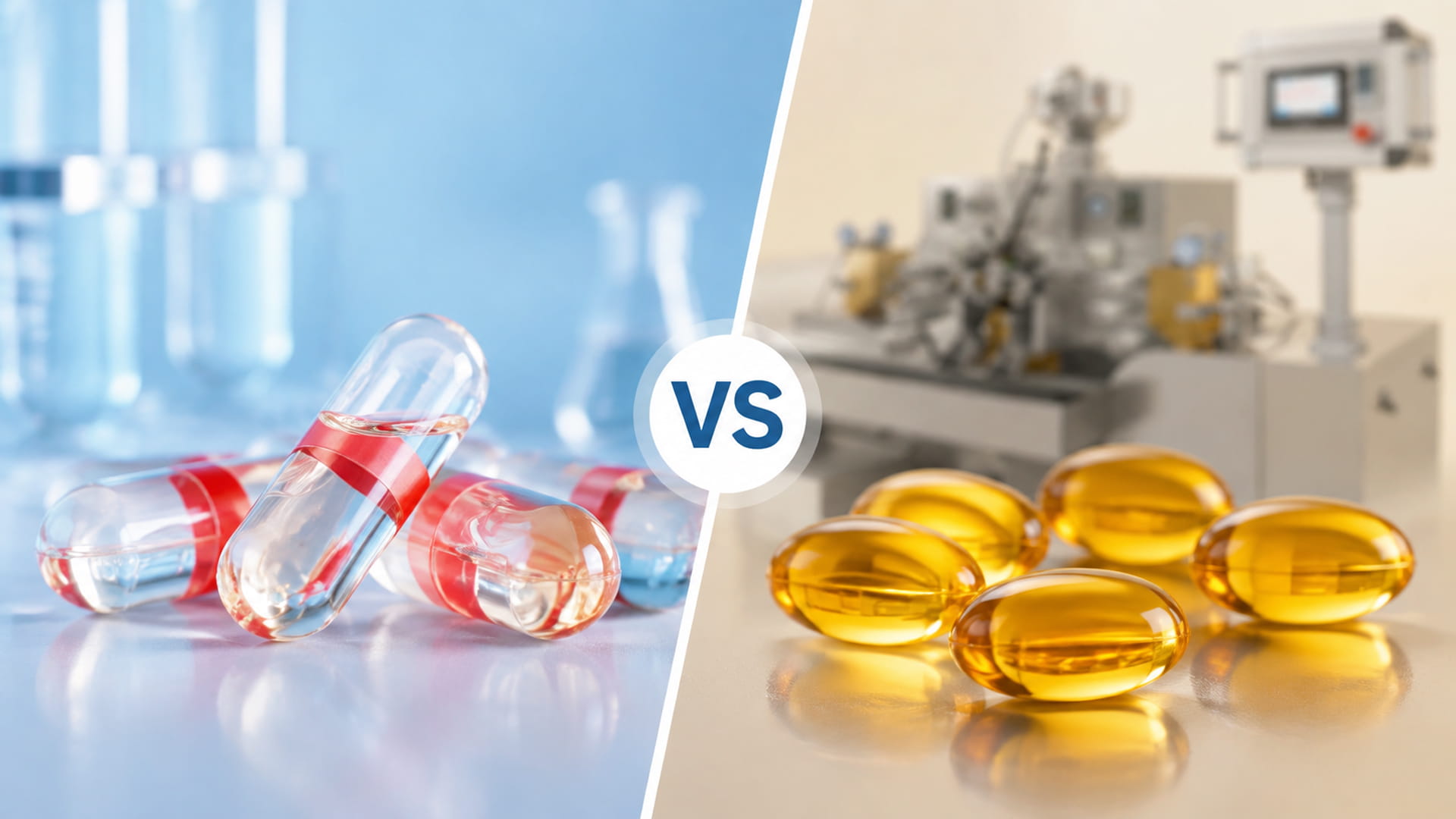
In praktischer Hinsicht, Beide Formate können flüssige Medikamente oder Nahrungsergänzungsmittel liefern, aber ihre Design und Produktion unterscheiden sich erheblich. Zu den Hauptunterschieden gehört die Kapselstruktur, Schalenmaterialien, kompatible Füllungen, und Fertigungsschritte. Wenn Pharmahersteller diese verstehen, können sie die richtige Form für ihr Produkt auswählen. Im Folgenden erläutern wir die wichtigsten Unterschiede und Vorteile jedes einzelnen.
Mit Flüssigkeit gefüllte Hartkapseln (LFHCs) sind Standard zweiteilige Kapselhülle (Kappe und Körper) nach der Herstellung der Schalen mit einer flüssigen oder ölbasierten Formulierung gefüllt. Die Schalen können aus Gelatine oder pflanzlichem HPMC bestehen (für vegetarische Kapseln). In Produktion, eine präzise Dosis Flüssigkeit (oft eine Öllösung, Suspension oder selbstemulgierende Mischung) wird in den geöffneten Kapselkörper injiziert, Anschließend wird die Kappe oben verschlossen und versiegelt. Spezielle Dichtungsmethoden sorgen dafür, dass nichts ausläuft (Zum Beispiel, Tragen Sie ein dünnes Gelatineband um das Gelenk auf, sogenannte „Bandversiegelung“).
Dieser zweiteilige Ansatz ermöglicht es LFHCs, die Vorteile von Flüssigkeiten und Kapseln zu kombinieren. Sie erhalten die schnelle Freisetzung und hohe Bioverfügbarkeit einer gelösten Flüssigkeit, mit dem einfachen Schlucken und der Geschmacksüberdeckung, die Kapseln bieten. LFHC-Granaten sind vorgefertigt, Daher ist beim Abfüllen kein kostspieliges Schmelzen der Gelatineblätter erforderlich. Zum Beispiel, Der Flüssigkapselfüller NJY-300C von JinLuPacking füllt Flüssigkeiten automatisch in Hartschalen der Größen #00–#4 und versiegelt sie in einer schnellen Linie mit einem Band.
Figur: Mit Flüssigkeit gefüllte Hartkapseln (Jedes hat ein farbiges Band, das die Kappe-Körper-Verbindung abdichtet). Diese zweiteiligen Kapseln enthalten Öl oder Flüssigkeit in einer festen Gelatine/HPMC-Hülle.
Softgel-Kapseln (oft nur angerufen Kapseln) Sind ein Stück, Gelbeschichtete Kapseln mit einer flüssigen oder halbfesten Füllung. Sie werden auf einer Rotationsform-Verkapselungsmaschine hergestellt, füllt, und versiegelt jede Kapsel in einem einzigen Schritt. In der Maschine, zwei Bänder aus plastifizierter Gelatine (Gelatine gemischt mit Glycerin oder Sorbit) werden gegossen und zusammengepresst, während ein dosierter Flüssigkeitsstrom dazwischen eingespritzt wird. Jede Kapsel wird gleichzeitig durch erhitzte Matrizen geschnitten und versiegelt. Das Ergebnis ist ein glatter, Oval, luftdichte Kapsel, die häufig für Nahrungsergänzungsmittel auf Ölbasis verwendet wird (Denken Sie an Vitamin E oder Omega-3-Pillen).
Softgels sind ideal für Öle und empfindliche Flüssigkeiten. Denn die gesamte Kapsel ist bei ihrer Bildung hermetisch verschlossen, Es ist kein separater Versiegelungsschritt erforderlich. Dadurch sind sie sehr schützend gegen Sauerstoff und Feuchtigkeit. Viel Fischöl, Vitamin D/K, und pflanzliche Ölprodukte verwenden Softgels aus Gründen der Bequemlichkeit und Haltbarkeit. Tatsächlich, Umfragen zeigen, dass Omega-3- und fettlösliche Vitaminpräparate am häufigsten als Kapseln verabreicht werden.
Figur: Bernsteinfarbene Softgelkapseln auf einem Teelöffel neben einer Tablettenfläschchen (häufig für Fischöl oder Vitamin D).
| Besonderheit | Mit Flüssigkeit gefüllte Kapseln (LFHCs) | Kapseln |
| Struktur | Zweiteilig (Kappe & Körper) | Einteilige versiegelte Kapsel |
| Schalenmaterial | Gelatine oder HPMC (vegetarische Option) | Weichgemachte Gelatine (Gelatine + Weichmacher) |
| Herstellungsmethode | Füllen und verschließen (auf Kapselfüller + Banden) | Rotationsmatrizenkapselung (Form-Füll-Siegel) |
| Ausrüstungskosten | Untere (Standard-Kapselfüller) | Höher (spezielle Softgel-Linie) |
| Skala (Mindestbestellmenge) | Niedrige Mindestbeträge (passt für kleine Chargen) | Normalerweise ist eine höhere Lautstärke erforderlich |
| Vegetarische Option | Ja (HPMC-Schalen verfügbar) | Beschränkt (Jetzt einige Stärke-/Gemüseoptionen) |
| Versiegelung | Mechanische Abdichtung (Streifenbildung/Fusion) | Eingebaute Dichtung (hermetisch durch die Matrize verschlossen) |
| Leckagerisiko | Niedrig (einmal richtig versiegelt) | Sehr niedrig (Keine Naht, die auslaufen könnte) |
| Produktionsflexibilität | Hoch (Kann Pulver oder Pellets mit Flüssigkeit mischen) | Medium (Nur Flüssigkeits-/Pastenfüllungen) |
| Scale-Up | Einfach (verwendet Standard-Kapselmaschinen) | Komplexer (Spezialtrocknung, usw.) |
Beide Formen liefern flüssige oder ölbasierte Wirkstoffe und können eine hohe Bioverfügbarkeit bieten, indem sie den Wirkstoff in einem Lipid gelöst präsentieren. Jedoch, LFHCs verwenden einfachere Linien (Muscheln sind vorgefertigt) wohingegen Softgels Koch- und Trocknungsschritte für die Gelatinebänder erfordern.
Schlüssel zum Mitnehmen: Softgel machines bilden, füllen, und in einem Schritt schneiden (Trocknung erforderlich machen), während LFHC-Linien vorgefertigte Schalen füllen und versiegeln (eine lange Aushärtungsphase überspringen). Wie ein Branchenführer feststellt, „Softgels härten 2–4 Tage nach der Befüllung aus. LFHCs haben keinen Härtungsschritt … Chargenverluste aufgrund von Füllfehlern sind bei Softgels höher.“.
Mit Flüssigkeit gefüllte Kapseln bieten mehrere Herstellungs- und Produktvorteile:
Diese Vorteile machen LFHCs sowohl auf dem Pharma- als auch auf dem Nahrungsergänzungsmittelmarkt attraktiv.
Softgels haben auch starke Vorteile, die sie für viele Nahrungsergänzungsmittel beliebt machen:
Zu den Branchen, die Softgels verwenden, gehören: Arzneimittel (Medikamente auf Ölbasis), Nutrazeutika (Nahrungsergänzungsmittel), Kosmetika (nutrazeutische Schönheitsöle), und sogar Veterinärprodukte. Zum Beispiel, Vegane oder Halal-Kapseln aus Stärke/Gellan sind auf dem Vormarsch.
| Bestandteil / Füllen | Mit Flüssigkeit gefüllte Kapsel | Softgel-Kapsel |
| Fischöl / Omega-3 | ✓ Geeignet | ✓ Geeignet |
| CBD oder Cannabisöl | ✓ Geeignet | ✓ Geeignet |
| Curcumin (Kurkuma-Extrakt) | ✓ Geeignet | ✓ Geeignet |
| Vitamin D (Öl) | ✓ Geeignet | ✓ Geeignet |
| Pflanzliche Flüssigextrakte | ✓ Geeignet | ✓ Geeignet |
| Probiotika | ✓ (wenn es in Öl suspendiert ist) | NEIN (Feuchtigkeit tötet Bakterien ab) |
| Feuchtigkeitsempfindliche APIs | ✓ (insbesondere in HPMC-Kapseln) | ✗ (Schale hohe Feuchtigkeit) |
Beide Kapseltypen kommen gut mit öllöslichen Wirkstoffen zurecht. Gängige nutrazeutische Öle (Fischöl, Vitamin D, Kräuterextrakte, CBD, usw.) werden effektiv entweder durch LFHCs oder Softgels abgegeben.
Vor allem, trockene oder feuchtigkeitsempfindliche Zutaten sind besser in mit Flüssigkeit gefüllten Hartkapseln. Zum Beispiel, Probiotika oder wasserempfindliche APIs sind in Kapseln unpraktisch. Im Gegensatz, HPMC-Hartkapseln können nichtwässrige Suspensionen von Probiotika oder sehr trockene Formulierungen enthalten, da HPMC eine geringe Feuchtigkeits- und Gasdurchlässigkeit aufweist. Softgel-Hüllen enthalten ca 30% Wasser- und höhere Sauerstoffdurchlässigkeit, die solche Inhaltsstoffe zersetzen können.
Zusamenfassend, Verwenden Sie LFHCs, wenn Flexibilität und Kleinserienproduktion wichtig sind; Wählen Sie Softgels wegen der Größe und der erstklassigen Verkaufsattraktivität.
Aus Herstellersicht, Die Entscheidung hängt oft vom Maßstab ab, Investition, und strategische Ziele:
Die folgende Tabelle fasst die Auswahl nach Szenario zusammen:
| Unternehmenstyp / Situation | Empfohlenes Format |
| Kleines Startup oder R&D-Projekt | Mit Flüssigkeit gefüllte Kapseln (niedrige Mindestbestellmenge, flexibel) |
| Nischen-Ergänzungslinie, <10k Einheiten | Mit Flüssigkeit gefüllte Kapseln |
| Vertragshersteller (Flexibilität) | Mit Flüssigkeit gefüllte Kapseln |
| Großer Pharmahersteller | Kapseln (hoher Durchsatz, konsistent) |
| Reichhaltige Omega-3-Fettsäuren oder Vitamine | Kapseln |
| Produkt, das eine vegane Kapsel benötigt | Mit Flüssigkeit gefüllte Kapseln (HPMC-Schalen) |
Figur: Nahaufnahme einer Füllmaschine für Flüssigkeitskapseln, die Flüssigkeit in Kapseln abfüllt.
JinLuPacking stellt ein komplettes Sortiment an Kapselausrüstung her. Zum Beispiel, unser NJY-300C flüssiger Kapselfüller Linie verarbeitet flüssige Füllungen, und wir bieten auch Softgel-Kapselmaschinen für eine einstufige Produktion. Diese Maschinen erfüllen die cGMP-Standards für pharmazeutische und nutrazeutische Zwecke.
Am Ende, beide flüssigkeitsgefüllt Hartkapseln Und Kapseln sind gut etabliert, wirksame Darreichungsformen. Softgels zeichnen sich dadurch aus, dass sie schnell auflösende Öle und öllösliche Wirkstoffe liefern, manipulationssichere Verpackung. Mit Flüssigkeit gefüllte Hartkapseln bieten Flexibilität, schneller R&D-Skalierung, und einfache Herstellung. Indem wir ihre Unterschiede verstehen, Vorteile und Produktionsanforderungen, Hersteller können den Kapseltyp auswählen, der am besten zu den chemischen und geschäftlichen Anforderungen ihres Produkts passt.
Wenn Sie eine neue Formulierung entwickeln oder Ihre Produktionslinie modernisieren, Erwägen Sie beide Optionen sorgfältig. Bereit, Ihre Kapselproduktion zu optimieren? Jinlu Packing bietet branchenführende Ausrüstung für beide Formate (Zum Beispiel, Unser NJP-1000C kann bis zu füllen 60,000 Hartkapseln pro Stunde) und kann Sie über die beste Lösung für Ihr Produkt beraten. Kontaktieren Sie uns um Ihr Projekt zu besprechen, Fordern Sie ein Angebot an, oder erfahren Sie mehr über unsere Flüssigkapsel und unser Softgel Verpackungsleitungen.
Ja. Spezialisierte Kapselfüller (wie die Flüssigkapselfüllmaschinen von JinLuPacking) kann Öle oder Flüssigkeiten in leere Hartkapseln injizieren, die dann versiegelt werden (z.B. durch Banderolieren) So halten sie die Flüssigkeit sicher fest. Dadurch entsteht eine „flüssigkeitsgefüllte Hartkapsel“.
Keines von beiden ist allgemein „besser“ – sie bedienen unterschiedliche Bedürfnisse. LFHCs gewinnen bei den Kosten, Geschwindigkeit, und Flexibilität (insbesondere für kleine Chargen), während Softgels eine nahtlose Abdichtung und ein bekanntes Format für Ölergänzungen bieten. Die beste Wahl hängt von Ihrem Füllmaterial ab, Produktionsvolumen, und Markt.
Ordnungsgemäß versiegelte LFHCs lecken nicht. Nach dem Befüllen, Die Kappe-Körper-Verbindung wird durch Aufbringen eines Gelatine- oder HPMC-Bandes hermetisch abgedichtet (oder mittels Schmelzversiegelung). Wenn es richtig gemacht wird, Die Kapseln halten die Flüssigkeit während des Trocknens fest, Lagerung, und benutzen. Qualitätslinien testen und polieren jede Charge, um die Integrität sicherzustellen.
Beide können eine hervorragende Bioverfügbarkeit für ölbasierte Wirkstoffe bieten. Die Füllformulierung (Öltyp, Emulgatoren) bestimmt normalerweise die Absorption, nicht der Shell-Typ. Softgels lösen sich schnell auf (~10–20 Min), während Hartschalenkapseln (LFHC) etwas langsamer auflösen (30–60 Min). In der Praxis, Gut gestaltete Füllungen in beiden Formen können eine ähnliche Wirksamkeit erzielen.
Ja. Pflanzliche HPMC-Hüllen werden häufig für mit Flüssigkeiten gefüllte Kapseln verwendet. Der geringe Feuchtigkeitsgehalt und die starke Struktur von HPMC lassen ölige Flüssigkeiten im Inneren zu. Tatsächlich, Die Verwendung von HPMC-Schalen ist eine Möglichkeit, eine vegetarische Kapsel in flüssiger Form anzubieten, was herkömmliche Gelatinekapseln nicht bieten können.
Als Gründe hierfür nennen die Unternehmen unter anderem niedrigere Herstellungskosten, kürzere Vorlaufzeiten, und Formulierungsflexibilität. Zum Beispiel, ein R&Das D-Team kann Dosierungen schnell anpassen oder Zutaten in LFHCs kombinieren, ohne dass eine Umrüstung erforderlich ist. Auch, VFHCs ermöglichen eine einfache Erweiterung der Produktlinien (da die gleichen Kapseln mit verschiedenen Flüssigkeiten gefüllt werden können).
Allgemein, Ja. Die Herstellung von Softgels erfordert teure Ausrüstung (Gelatinekocher, Rotationsmatrizen, Trockner) und mehr Arbeit über mehrere Tage. LFHCs verwenden einfachere Füllstoffe und weniger Energie. Branchenberichten zufolge kostet die Herstellung von LFHCs pro Einheit 15–35 % weniger als die von Softgels. Jedoch, Bei sehr hohen Volumina können Kapseln immer noch kostengünstig sein.
Flüssige Zutaten werden mit einer Flüssigkapselfüllmaschine abgefüllt (oft ein Aufsatz oder eine Variante eines Standard-Kapselfüllers). Zum Beispiel, Die Maschinen der NJY-Serie von JinLuPacking verwenden Präzisionspumpen (Keramikkolben oder Mikropumpe) Öl in Kapseln dosieren. Diese Maschinen können hohe Geschwindigkeiten erreichen (mehrere tausend Kapseln pro Stunde) mit einer Genauigkeit von besser als ±1 %.
Meist nichtwässrig, Füllmittel auf Öl- oder Lösungsmittelbasis. Häufige Beispiele: Fischöl, Vitamin-E-Öl, flüssige Vitamine, Kräuterölextrakte, Emulsionen, und bestimmte selbstemulgierende Arzneimittelabgabesysteme. Die Füllung muss pumpbar und grundsätzlich nicht korrosiv sein. Auf Flüssigkeiten auf Wasserbasis wird verzichtet (Sie können Dichtungen schwächen). Die Füllviskosität sollte kontrolliert werden, um Spritzer oder Tropfen während des Füllens zu verhindern.
Ja. Viele Kapselmaschinen sind umrüstbar: durch Austausch des Dosiersystems, Sie können Pulver/Granulat oder Flüssigkeiten abfüllen. In der Praxis, Die Pulverdosierplatte eines Standard-Kapselfüllers wird durch einen Flüssigkeitsfüllkopf und ein Pumpensystem ersetzt. Diese Vielseitigkeit bedeutet, dass eine einzige Linie zwischen Pulver- und LFHC-Produktion wechseln kann.
Referenzen:
1.Mit Flüssigkeit gefüllte und versiegelte Hartgelatinekapseln —— Taylor & Franziskus Online
2.Weiche Gelatinekapseln (Kapseln) —— ScienceDirect
3.Temperatureinflüsse auf die Bandeigenschaften bei der Herstellung von Weichgelatinekapseln —— Nationalbibliothek für Medizin
4.Umfassende Rezension zu Weichgelatinekapseln: Industrielle Fertigung, Technologische Fortschritte, und regulatorische Perspektiven —— Journal of Drug Delivery & THERAPEUTIKA
5.Mit Flüssigkeit gefüllte Hartgelatinekapsel —— Journal of Drug Delivery & THERAPEUTIKA
6.Bestimmung der optimalen Wassermenge in flüssigen Füllmassen für Hartgelatinekapseln mittels Texturanalyse und Versuchsplanung —— Nationalbibliothek für Medizin