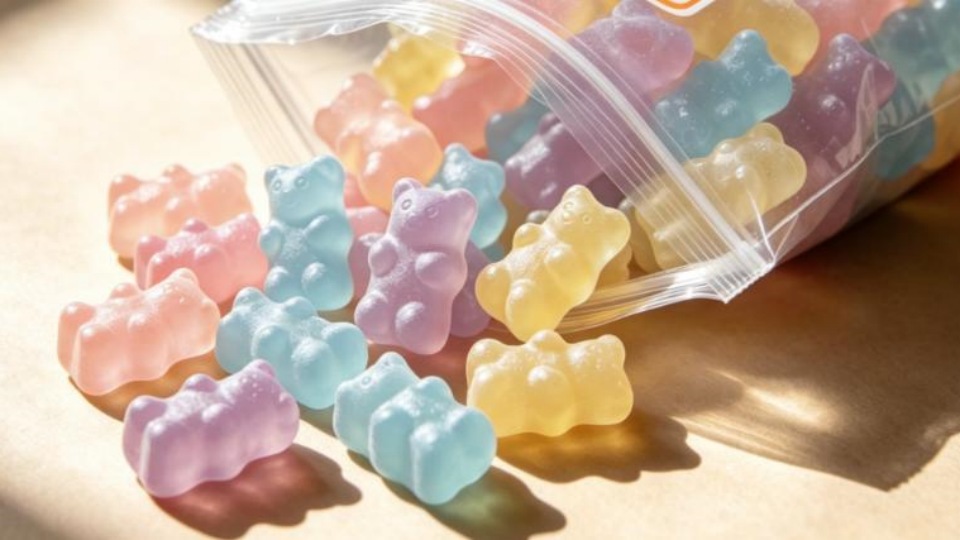

Packaging soft gummies (often dietary supplements) raises a key question: should you use a counting filler or a weigh-filling machine? Zusamenfassend, each approach has its trade-offs. A Zählmaschine dispenses an exact number of gummies into each bottle, ensuring precise piece-count (with very little “giveaway”), but the total weight can vary slightly from bottle to bottle. A weigh-filling machine measures out a precise net weight, so the total mass of gummies is consistent, but the number of pieces may fluctuate by one or two pieces each fill. Which method is best depends on your priorities. If exact piece count per container (and minimal product giveaway) ist kritisch, a counting system usually wins. If strict adherence to a weight label or handling irregular mixes is more important, a weigh-filler might be better.
Wichtig, labeling requirements also come into play. In den USA, Zum Beispiel, the FDA mandates that packaged supplements show a net quantity by weight or count (oder beides). That means if you count-fill, your label must state the number of gummies (z.B. “30 Gummies”), and if you weigh-fill, the label needs the weight (z.B. “Net Wt. 100 g”). Many companies list both (“30 gummies, Net Wt. 90 g”) to satisfy both consumer expectation and regulations. Weigh-filling can simplify meeting tight weight tolerances, but counting may align better with consumer perception – retailers often expect a count-based label. We’ll explore these factors – accuracy, Geschwindigkeit, kosten, and labeling – to help you choose the right solution for gummy packaging.
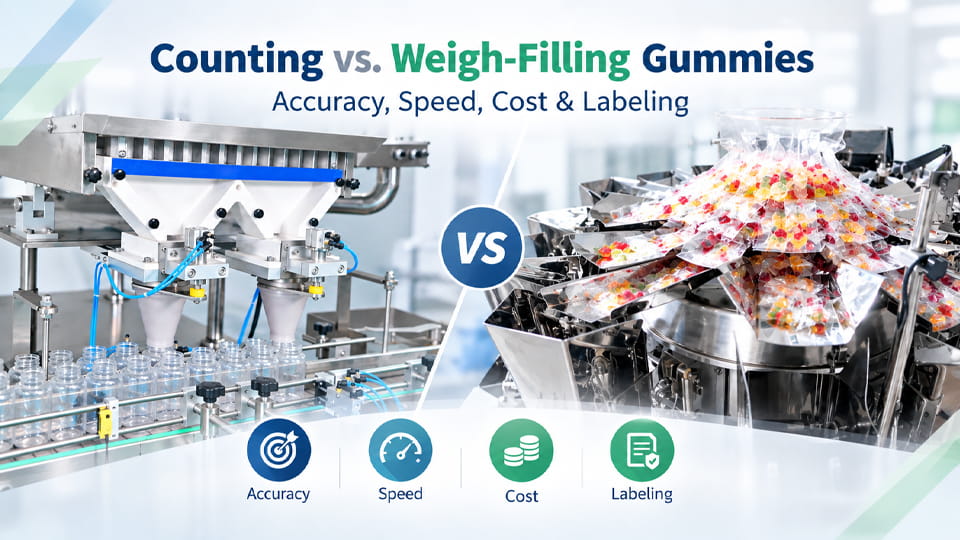
Zählmaschinen use sensors or vision systems to count individual gummies as they drop into bottles. Zum Beispiel, photoelectric or CCD vision counters let gummies flow down vibrating lanes in single file; each piece breaks a light beam or is imaged, and the machine tallies them one by one. Once the preset count (sagen, 60 Gummis) erreicht ist, the machine shuts off the flow into that bottle. This means every bottle gets the same number of pieces. Counting machines often include anti-clumping features (like special tracks or vibratory mechanisms) to prevent sticky gummies from jamming the system.
Weigh-filling machines (often called net-weigh fillers) use scales (Wägezellen) to dose by weight. A weigh-filler typically holds the empty bottle on a scale, then dispenses gummies until a target weight is reached. It may operate by net-weight (taring the empty container first) or gross-weight (measuring container plus contents). Multi-head weighers (common in snack and candy lines) split the product into several weigh buckets and combine them for each fill. Weigh-fillers are great when you must deliver an exact weight (Zum Beispiel, to meet a “90 g” net weight on the label), but they don’t guarantee the same count each time – one bottle might get 59 Gummis, the next 61, as long as the weight is correct.
Both systems can be automated and synchronized with bottle feeds. For gummies, vibratory feeders and specialized guiding tracks are used so that the sticky, pliable candies flow reliably. High-quality machines use food-grade stainless steel and meet cGMP hygiene standards. In der Praxis, a full gummy packaging line might include a bulk feeder, the counting or weighing system, bottle indexing, Capping, und Etikettierung.
Count-fill accuracy: Modern counting machines can be extremely precise on a per-bottle piece count. Top-rated counters boast error rates well under 1%, meaning almost every bottle has the exact target count. Zum Beispiel, JinLuPacking’s gummy counters claim accuracies up to >99.9% (only a few bottles in a thousand would have an off-count). Industry guides report that vision-based counters typically achieve ±1 piece tolerance per fill, with overall error rates below 0.5% at rated speeds. This is why most gummy makers prefer counting: each bottle reliably holds the same number of gummies, which matches retail expectations („30 Gummibärchen pro Flasche“). If a stray piece jams or a gummy overlaps, many machines automatically remove or reject the off-count gummy (z.B. sending it to a reject conveyor) to keep accuracy high.
Jedoch, because each gummy can vary slightly in weight, counted fills will have some weight variation. If pieces are very uniform, the weight swing is usually small. But if you count-fill a mix of sizes (large and small gummies) without weighing, some weight variation per bottle is inevitable. This is usually acceptable for retail goods sold by count, but it can be an issue if your label must guarantee net weight.
Weigh-fill accuracy: Weigh-filling machines excel at delivering consistent weight. A well-tuned multi-head weigher or gain-in-weight system often holds weight within fraction-of-percent error. Zum Beispiel, high-end multihead weighers used in snack packaging can achieve about 0.2–1% accuracy. Im Gegensatz, simpler volumetric fillers (not using weight) might vary by 2–5% in weight. Weigh-fillers ensure each bottle is at or very near the target gram amount. This reduces “giveaway” (Überfüllung) and ensures compliance with a net-weight label.
The trade-off is count consistency. Because weigh-fillers shut off based on weight, the gummy count can fluctuate by a piece or two. In a full-speed line, one bottle might stop at 90 g with 58 Gummis, the next at 90 g with 62 Gummis, depending on how those piece weights happened to fall. For most gummy producers, this is acceptable if they’re labeling by weight; but it means you can’t promise “exactly 60 gummies each bottle” unless you check counts after fill.
When one method dominates: Allgemein, for straight gummies or candies, counting technology dominates the market. Gummies are inherently individual items, and retailers (and consumers) expect a count on the package (“30 per bottle”). Counting also eliminates extra giveaway. Auf der anderen Seite, weigh-fillers dominate in situations where products have high variability or mixes. Zum Beispiel, if your product is a bagged snack mix of nuts and gummies, weight filling handles different item densities better. Ähnlich, very irregular or handmade gummies may suit weighing, since precise shape makes counting harder.
Zusammenfassend, counting machines give piece accuracy, and weigh machines give Gewichtsgenauigkeit. Counts are typically near-perfect with a counter (Fehler <0.5%), while weights are exactly hit with a scale. Modern counters can approach multi-head speeds, and advanced weighers can handle high throughput too – we’ll compare speed next.
Counting machine speed: The throughput of a counter depends on how many parallel lanes it has and the technology (photoelectric vs. Vision). Most rigid bottle counters are rated by bottles per minute (BPM). Zum Beispiel, a basic 4–8 channel photoelectric counter might do 20–50 BPM. More advanced lines use 10–16 channels or rotary designs: JinLuPacking’s gummy counters range from 50 Zu 100 BPM depending on model. Industry benchmarks show single-head systems doing 20–80 BPM, and multi-head rotary lines easily exceeding 200 BPM. In der Praxis, expect a high-speed counting line to run anywhere from 50 Zu 150 BPM for gummies in bottles, assuming no bottleneck downstream.
Weigh-filler speed: Weighing systems tend to be a bit slower, because each fill involves precise weighing and combination logic. Single-head weighers for bottles often fill only 10–30 bottles/min on average. Multi-head weighers (often used for free-flow products like nuts) can be faster, with cycle times on the same order as fast counters, especially when integrated with high-speed pouchers. But for a straight bottle line, weighers typically cannot match the top speed of optical counters. The example of snack packaging shows multihead weighers doing 30–120 weighments per minute, whereas a simple cup filler (analogous to a basic volumetric or simple count system) does 20–80 fills/min.
Practical note: Throughput always depends on product specifics and line configuration. Sticky or very soft gummies may require a gentler pace. Auch, remember that handling speeds (filling rate) are only part of the story: upstream (Futterspender) und stromabwärts (Capping, Beschriftung) stations must also run at that speed. High-speed rotary counting machines are available but at higher cost.
For most mid-sized pharma or nutraceutical lines, machines that handle 50–100 bottles per minute sind üblich. JinLu’s examples (50–100 BPM) match that, and they tout 58% faster speed on their PTFE feed system. If you need ultra-high throughput (>150 BPM), rotary counters or combination weigh-fillers must be considered, though these are large systems. Im Gegensatz, a weigh-filler running even 30 BPM might suffice for smaller production runs or where weight compliance is mandated.
Machine cost: Counting and weighing systems both range widely in price based on sophistication. Allgemein, A basic counting machine (simple photoelectric counter for bottles) can be relatively economical. For a budget example, small semi-automatic counters may start in the low thousands USD. Fully automatic multi-lane counters run higher. According to one industry comparison, cup/volumetric fillers (simpler machines) are low-to-medium cost, while multi-head weighers (more complex) are medium-to-high. So count-fillers tend to be less expensive than high-end dynamic weighers. Zum Beispiel, a well-equipped 16-channel gummy counter from JinLu might be in the low five-figure USD range, whereas a multi-head weigher system could be a multiple thereof.
Operating cost and throughput: Because counters typically use less complex hardware (sensors and vibrators), their maintenance and spare parts can be simpler and cheaper. Weighers with many load cells and gates require calibration and occasionally more upkeep. Jedoch, weigh-filling can reduce waste. If your product is expensive and you care about giveaway, the higher up-front cost of a precise weigher can pay off by consistently hitting the minimum net weight. A snack packaging example notes that a small weight giveaway per bag (z.B. 3 g overweight on a 100 g target) across thousands of units could cost more cumulatively than the initial price difference of machines. Zusamenfassend, weigh-fillers can save product costs over time by minimizing giveaway.
Throughput cost: Schnellere Maschinen (whether counting or weighing) kosten mehr. Upgrading from an 8-channel to a 16-channel counter doubles capacity and price. Adding more heads to a weigher likewise increases cost. An important metric is cost per piece of capacity. Sometimes it may be more economical to use two mid-speed counters in parallel rather than one ultra-fast machine.
Conclusion on cost: Counting systems generally have a lower entry price and simpler maintenance than weigh systems, making them attractive for tighter budgets. Weighing systems justify their cost if precise net-weight control is vital or if combining products. For most nutraceutical gummy lines, customers find that the ROI of a counting system is quick if it eliminates manual counting labor and reduces giveaway.
One non-technical factor is package labeling laws. In vielen Märkten, regulators require a net-quantity declaration on the label. In den USA, the FDA requires the net content of dietary supplements to be stated in weight, measure or count. If you choose count-filling, your label must state the number of gummies (z.B. “60 gummies”). If you choose weight-filling, the label must show the weight (z.B. “Net Wt. 120 g”) in both metric and customary units. Often manufacturers include beide: zum Beispiel, “60 Gummies, Net Wt. 120 g”. This covers all bases and matches consumer expectations.
Zum Beispiel, FDA guidance says a numerical count statement must include the count of units in the container. So if your gummies are counted into each bottle, you should declare the count exactly. Auf der anderen Seite, if you label by weight, you must list only the product’s weight (not including bottle weight). In Europa, similar rules apply under Regulation (EU) NEIN 1169/2011: prepackaged foods must list net quantity (usually by weight for solids), though some foods (like fruits) allow count. Gummies often appear as supplements or confectionery, so listing in grams is common. So oder so, the machine’s output should be consistent with the label: a weight-based line should aim for a target net weight, and a count-based line should aim for an exact count.
Because of these rules, many gummy producers actually lean toward counting if their marketing focuses on “pieces per bottle”. Retailers often like seeing “30 pieces” on the pack. That consumer expectation was noted in an industry guide: “Retail markets expect count-based labels (‘30 Gummies per Bottle’), not weight metrics”. Weigh-filling is more common when gummies are sold in loose pouches by weight (like candy bags) or in mixed product lines where pieces vary.
Endlich, accuracy ties into labeling compliance: for a weight-based label, the average fill weight must meet the target (and often legal tolerances allow slight underfill if average is above declared weight). A weigh-filler inherently controls this. For a count-based label, each bottle needs the correct piece count (or it’s considered mislabeling if short). daher, whichever method you choose, your production QA must check both count and weight regularly to ensure the label claims are always true.
In der Praxis, the decision between counting and weigh-filling depends on product and business needs:
Remember JinLuPacking’s perspective: we design both types of machines (counters and fillers) für Arzneimittel. A quick internal example: our 16-channel gummy counter handles up to 100 Flaschen pro Minute mit >99.98% Genauigkeit – ideal for large supplement lines counting by piece. If you choose a weigh-filler instead, you’d trade some speed and piece precision for perfect weight.
Often the best approach is to run pilot tests. Many manufacturers offer line demos using your product. Check specifications like “fills per minute” and “weight deviation” with your actual gummy mix. As a rule of thumb from the industry, A fully automatic counting line might do 40–120+ fills/min and cost $8,000–$25,000+ (for production-scale equipment), wohingegen a weigh-filler with equivalent throughput could be more expensive and slower.
Letztlich, both technologies can work well for gummies. Counting wins for speed and count accuracy; weighing wins for weight accuracy and handling mixed content. Align your choice with what matters most to your operations and customers.
Deciding between a gummy Zählmaschine und a weigh-filler hinges on your priorities. If exact gummy count, high throughput and retail-friendly labeling are key, count-filling is usually better. It guarantees the number of pieces and minimizes waste by matching the bottle’s count target with extremely high accuracy. If precise net weight or multi-component products drive your process, weigh-filling ensures every bottle meets the declared weight, though the count will float. Both methods require attention to labeling laws: count-fill lines should prominently state the number of gummies, and weight-fill lines must mark net weight in appropriate units.
Choosing wisely will optimize your production speed, accuracy and compliance. Bei JinLuPacking, we offer both gummy counting machines and weight filling systems, each with cGMP-grade design and global certifications. Our experts can help match the right machine to your gummy formulation, speed requirement and label needs. Ready to automate your gummy line? Kontaktieren Sie noch heute unser Team for a consultation or quote.
Counting machines dispense a preset number of gummies into each container. Weigh-filling machines dispense gummies until they reach a target weight, so the number of pieces may vary.
Counting is designed to control the number of gummies per container, while weighing controls the net fill weight. The better option depends on the product specification and the accuracy requirement.
Ja, some gummy counting machines are designed to handle sticky products. Suitable feeding tracks, anti-clumping features, and product-specific testing help improve counting stability.
Speed varies by machine model, gummy size, product flow, and bottle configuration. Ask the supplier to test your gummies and confirm the actual bottles-per-minute rate for your required format.
It can help reduce overfilling by controlling the target net weight. Actual savings depend on the product’s weight variation, Maschineneinstellungen, and the fill-weight limits used in production.
A counting machine may be more economical when each bottle needs a fixed number of gummies. Weigh-filling may be worth the investment when net-weight control and reduced giveaway are the main priorities.
NEIN. A weigh-filling machine controls weight rather than piece count. If each bottle must contain an exact number of gummies, use a counting system or add a separate count-verification step.
The correct declaration depends on the product category and destination market. In den Vereinigten Staaten, FDA guidance for dietary supplements allows net quantity to be expressed by weight, messen, numerical count, oder eine Kombination, subject to applicable requirements.
Potentially, but performance depends on the machine design and the characteristics of each product. Test different sizes and coatings—including sugar-coated and oil-coated gummies—and confirm changeover, Reinigung, and counting performance before purchase.
Test actual production gummies at the required speed. Check fill accuracy, Produktschäden, Verklumpung, giveaway, Umstellungszeit, cleaning needs, and performance over multiple batches.
Referenzen:
1.Dietary Supplement Labeling Guide: Chapter III. Net Quantity of Contents —— FDA
2.Handbuch 133 Checking the Net Contents of Packaged Goods. —— NIST
3.Prepacked products in the EU —— Europäische Kommission
4.Packaged goods: weights and measures regulations —— UK Government
5.Quantity of Product in Prepackages —— OIML R 87:2016