
Trong sản xuất dược phẩm, CIP (Làm sạch tại chỗ) Và Nhâm nhi (Sterilization-in-Place) serve complementary roles in maintaining product safety. Nói một cách đơn giản, CIP removes product and process residues from equipment surfaces without disassembly, while SIP uses pressurized steam to sterilize those already-cleaned surfaces. CIP employs circulating water and detergents to chemically clean pipes, tanks and vessels, achieving validated removal of soils to health-based limits. SIP follows by applying saturated steam (typically above 121 °C) to kill any remaining microorganisms. Về bản chất, CIP cleans, and SIP sterilizes; neither process alone accomplishes the other’s job. Vì lý do này, in sterile or aseptic processes CIP is normally performed before SIP to avoid any residues shielding microorganisms during the sterilization step.
CIP systems spray heated cleaning solutions through nozzles and spray balls to wet all product-contact surfaces, then rinse them clean. Cái này automated cleaning sequence typically includes pre-rinsing, alkaline detergent washing, intermediate rinses, optional acid wash, and a final rinse. Four key parameters – temperature, chemical concentration, flow rate and time – govern CIP efficacy. CIP equipment usually consists of chemical preparation and recovery tanks, supply and return pumps, lưu lượng kế, sanitary valves and instrumentation, all controlled by a PLC or control panel. By circulating cleaning agents through the fixed pipeline and process equipment (xe tăng, máy trộn, bộ lọc, vân vân.), CIP systems clean the interior surfaces without having to take the equipment apart. This not only reduces manual labor and downtime, but also minimizes the risk of contamination from human intervention. Điều quan trọng, Tuy nhiên, CIP is a cleaning process only – it does not achieve sterility.
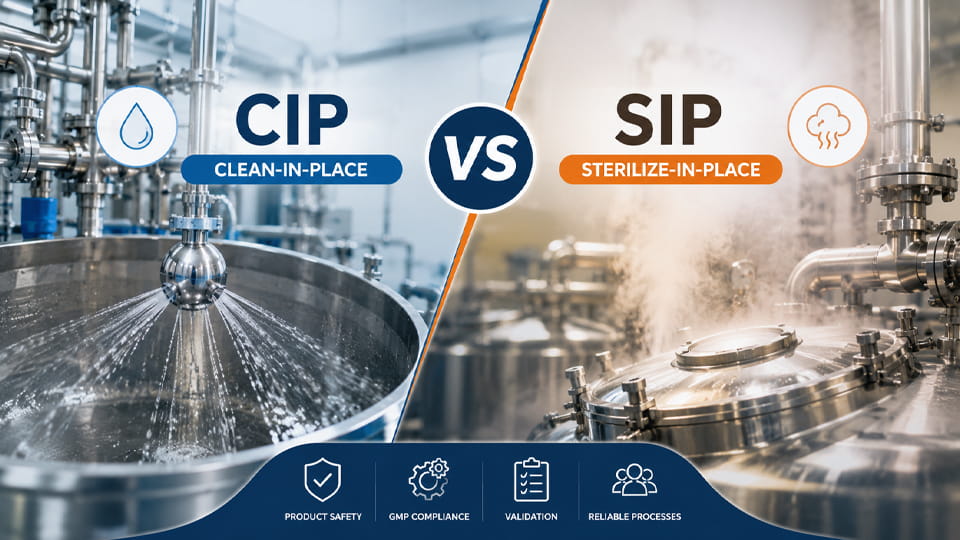
Definition and Purpose: CIP (Làm sạch tại chỗ) is a method of cleaning the interior product-contact surfaces of processing equipment in situ, without dismantling the system. During a CIP cycle, clean water and cleaning solutions (chất tẩy rửa, chất kiềm, axit, sanitizers, vân vân.) are pumped through the equipment (xe tăng, đường ống, van) in a pre-defined sequence of steps. The goal is to dissolve and flush out residues from the previous batch – including API, tá dược, chất tẩy rửa, and biofilms – until the system is visibly clean and meets validated residue limits. Điều quan trọng, CIP is focused on dọn dẹp, not sterilization: while a CIP step may include a sanitizing rinse, it is not sufficient by itself to guarantee a sterile state.
Typical CIP Cleaning Stages: A standard CIP cycle usually consists of:
Each stage has controlled parameters: nhiệt độ, chemical concentration, flow rate/velocity, and contact time are all specified and monitored. Ví dụ, higher temperatures and sufficient flow (usually above a critical velocity) improve cleaning efficiency by increasing solubility and ensuring turbulence.
Key CIP System Components: A CIP system typically includes storage tanks for fresh and spent cleaning fluids, dosing/heat-exchange systems, máy bơm, flow meters and valves to circulate cleaning solutions, spray balls or jet heads inside tanks, and instrumentation (conductivity, nhiệt độ, flow sensors) to monitor each step. The system is usually automated via a control panel to execute set “recipes” of rinse, wash, and rinse. A well-designed CIP system follows hygienic design principles (smooth pipes, không có chân chết, drains) so that cleaning solutions can reach all wetted surfaces and drain completely.
Definition and Purpose: Nhâm nhi (Sterilize-In-Place), also called Steam-In-Place (when using steam), is a method of khử trùng the internal surfaces of equipment in situ, without disassembly. In pharmaceutical operations, SIP is used after cleaning to inactivate (destroy) any remaining microorganisms on product-contact surfaces. Tiêu biểu, SIP involves circulating saturated clean steam through the system at a specified temperature and pressure, holding it long enough to achieve the required sterility assurance level. The main aim of SIP is microbial kill - Ví dụ, achieving a sterility assurance level (SAL) of 10^-6 for aseptic processes.
Common SIP Sterilization Stages: A typical SIP cycle includes:
Key SIP Parameters: Critical factors in SIP are steam quality Và nhiệt độ. The steam must be saturated (no liquid water droplets) and “clean” (không dầu, filtered) to avoid contamination. The pressure is usually set just above what is needed to maintain the target temperature (Ví dụ, ~2.0 bar for 121°C). Các temperature distribution must be uniform; cold spots (ví dụ. dead legs, pockets) are avoided through design and by possibly using vacuum or pulsation to purge air. Exposure time (hold time) at temperature must be long enough to achieve microbial kill throughout the equipment. Thường, validation will use biological indicators and multiple thermocouples at the worst-case points to confirm this.
CIP and SIP are often used together, but they are fundamentally different processes. The table below summarizes their main differences:
| Diện mạo | CIP (Làm sạch tại chỗ) | Nhâm nhi (Sterilization-in-Place) |
| Tên đầy đủ | Làm sạch tại chỗ | Sterilization-in-Place (often using steam) |
| Mục đích chính | Remove product and chemical residues | Destroy viable microorganisms (sterilize equipment) |
| Primary Medium | Recirculated water and detergents | Hot saturated steam (often 100–130 °C) |
| Target Contamination | Product soils, dirt, cleaning agent residues | Microbial contamination (vi khuẩn, spores, viruses) |
| Validation Focus | Cleaning effectiveness (residue limits, rinse/swab tests) | Sterility (temperature distribution, biological indicators, F₀ value) |
| Trường hợp sử dụng điển hình | Non-sterile processes (xe tăng, pipelines, non-sterile equipment) | Sterile processes (aseptic lines, closed reactors, filling skids) |
Nói cách khác, CIP’s job is to make equipment visibly clean and chemically free of residue, while SIP’s job is to make it microbiologically sterile. CIP leaves behind no harmful dirt or detergents beyond validated limits. SIP leaves behind no viable organisms, achieving a high sterility assurance level (often 10^-6) on equipment surfaces. Because they address different hazards, both processes are often required: Ví dụ, an aseptic filling line usually uses CIP to clean between product batches and then SIP to sterilize the filling manifold and tank before filling.
Trong thực tế, pharmaceutical manufacturing lines that require sterility will implement CIP followed by SIP as a coordinated sequence. First a CIP cycle removes all product residues to health-based limits; sau đó, after draining, a SIP cycle exposes the system to sterile steam. Automation can lock out the SIP step until the CIP pass is confirmed successful. This ensures steam sterilization is not attempted on a dirty system (residues could insulate microbes from heat). In a well-designed process, both cycles are validated and run routinely between production runs.
Ví dụ, a pharmaceutical tank may be cleaned by CIP (washing with caustic and rinsing with purified water) and then sterilized by SIP (steam injection at 121 °C for a validated hold time). Different equipment may require different approaches: an aseptic powder line might have a combined CIP/SIP skid, while an aseptic liquid filler often includes integrated steam jackets. Điều quan trọng, CIP precedes SIP but is not required for every piece of equipment. Non-sterile process equipment (like many tablet presses or capsule filling machines) often only use CIP or even manual cleaning, whereas critical sterile equipment (like fermenters, chất đông khô, or filling tunnels) will use both CIP and SIP.
Not all pharma equipment has built-in CIP/SIP capabilities. Nói chung là, process equipment – such as tanks, lò phản ứng, đường ống, heat exchangers, and filtration skids – is CIP-cleaned and often SIP-sterilized. Ví dụ, large mixing vessels or buffer tanks in a sterile production area will typically be connected to a CIP/SIP loop. Ngược lại, Máy đóng gói giống như máy ép máy tính bảng, capsule fillers or blister machines are usually cleaned by Clean-Out-of-Place (COP) phương pháp (manual disassembly, bàn chải, foams) rather than CIP, because their multi-part mechanical designs make full CIP circuits impractical. If such equipment must support aseptic processing, it may be installed in a cleanroom and sterilized by separate means (ví dụ. hydrogen peroxide), but typically they do not run internal CIP/SIP cycles.
Như một ví dụ, JinLuPacking's máy làm đầy viên nang tự động Và Máy tính bảng tốc độ cao là GMP-compliant equipment được thiết kế để dễ dàng làm sạch (with polished surfaces and 316thép không gỉ L), but they rely on validation per batch rather than an internal SIP system. Mặt khác, dedicated aseptic fillers or lyophilizer tanks often incorporate full CIP/SIP skids. When designing a new line, engineers must consider which components will use CIP, which will use SIP, and which will be cleaned manually, all based on contamination risk and process requirements.
Both CIP and SIP must be validated and documented according to GMP. quy định GMP (chẳng hạn như FDA 21 CFR 211.67 Và 211.113) mandate that equipment be cleaned and, when needed, sterilized by written procedures. Trong thực tế, điều này có nghĩa:
Each CIP and SIP system is treated as a critical process: it should have a defined scope, tiêu chí chấp nhận, and requalification schedule. Routine verification (ví dụ. conductivity or TOC monitoring of rinse water) ensures ongoing control. In inspections, regulators often focus on issues like inadequate cleaning before SIP or poor steam penetration. By properly validating CIP (ensuring no cross-contamination) and SIP (ensuring sterility), manufacturers comply with the spirit of cGMP rules without claiming that “every piece of equipment must have CIP/SIP” – rather, equipment must be cleaned and sterilized as appropriate.
Deciding whether to implement CIP, Nhâm nhi, or an integrated CIP/SIP system depends on the product and process. Các yếu tố chính bao gồm:
Cuối cùng, the choice is driven by a GMP risk assessment: evaluate the contamination hazards and verify that cleaning or sterilization methods mitigate them. For many sterile pharma lines, the answer is an integrated CIP/SIP system – as one industry guide summarizes, “CIP must prove cleaning to a health-based limit… SIP must prove lethality at every cold spot with saturated steam and biological indicators”. In non-sterile lines, simpler CIP or manual cleaning may be sufficient.
Even experienced facilities can stumble on CIP/SIP execution. Some typical pitfalls include:
Avoiding these errors requires good engineering and procedures. Ví dụ, industry experts highlight that thiết kế hợp vệ sinh (bề mặt 316L mịn, properly sloped drain, certified valves) is a prerequisite for effective CIP/SIP. Regular training and documentation help operators follow the validated procedures precisely.
Tóm lại, CIP and SIP are sequential and complementary steps in pharmaceutical equipment cleaning. CIP removes soils and residues to prepare equipment for the sterile state, and SIP then ensures that all remaining microorganisms are inactivated. Neither process replaces the other – both must be applied as appropriate per GMP to protect product quality.
Tại Đóng gói JinLu, we specialize in pharmaceutical production and packaging equipment built for rigorous cleaning protocols. Our capsule filling machines, máy tính bảng ấn, and turnkey aseptic lines use hygienic design and premium stainless steel to facilitate effective cleaning and sterilization. Whether you need GMP-compliant mixing tanks with CIP/SIP capability or reliable high-speed fillers and packers, we can advise on the right solutions. Liên hệ với nhóm của chúng tôi to discuss how to integrate proper CIP and SIP processes into your production and ensure compliance with all GMP requirements.
CIP (Làm sạch tại chỗ) is a cleaning process that removes soils and residues from equipment using detergents and rinses. Nhâm nhi (Sterilization-in-Place) follows by applying high-temperature steam to kill any microorganisms. CIP achieves cleanliness; SIP achieves sterility.
KHÔNG. CIP is designed to clean, not to sterilize. It removes visible dirt, dư lượng sản phẩm, and helps reduce the microbial load, but it does not ensure a sterile condition. If sterility is required, a dedicated SIP cycle (or other sterilization) is needed after CIP.
In most cases where both are used, Đúng. Performing CIP first removes soils that could shield microbes during sterilization. Tuy nhiên, not all processes require SIP, so CIP may stand alone for non-sterile lines.
Only if the equipment has a sanitary design that supports CIP. Xe tăng, reactors and closed piping are CIP-friendly. Nhiều máy móc (ví dụ. máy tính bảng ấn, chất độn viên nang, Máy đóng gói) require disassembly and cleaning of parts (COP) because their internals cannot be cleaned by simple recirculation.
Common SIP cycles use saturated steam at 121 °C (or sometimes 134 °C) for a specified hold time (often 15–30 minutes). The exact temperature and time depend on the system design and must be validated. Regulatory expectations (like EU GMP Annex 1) demand that every point in the system be shown to reach the target temperature for the full duration.
Cleaning validation typically involves establishing a worst-case residue (ví dụ. the hardest-to-clean drug or highest potency API) and demonstrating its removal. This is done by sampling (swabs or rinse water) and analyzing for residues, as well as visually inspecting. Acceptance limits are usually based on toxicological thresholds (MACO/HBEL).
F₀ is a measure of sterilization lethality (the equivalent time at 121 °C). SIP validation often uses F₀ calculations or D-values of spores to quantify that the cycle provides sufficient kill. Trong thực tế, many plants just ensure the validated time/temperature is reached everywhere.
No regulation explicitly says “you must use SIP,” but GMP requires that sterile products be manufactured in a way that ensures microbial control. Trong thực tế, if your process involves sterile drug products, Nhâm nhi (or other sterilization) becomes a necessary part of your validated contamination control strategy (as per FDA 211.113 và Phụ lục EU 1).
CIP cleans equipment in place without disassembly. COP means equipment is taken apart and cleaned manually or in a washer. CIP is faster and less labor-intensive for suitable equipment, but not all machines can be CIP-cleaned.
Key challenges include ensuring complete coverage (không có chân chết), uniform heating (no cold spots in SIP), and consistent drainability. Other issues: choosing materials compatible with aggressive cleaners and steam; calibrating sensors for high accuracy; and coordinating utilities (enough steam and clean water capacity). In integrated lines, making sure sequence controls and interlocks (CIP complete before SIP) are reliable is also crucial. These challenges must be addressed in engineering design and documented in qualification protocols.
Tài liệu tham khảo:
1.Khối lượng EudraLex 4, Phụ lục 1 — Manufacture of Sterile Medicinal Products —— Ủy ban Châu Âu
2.21 CFR § 211.67 – Equipment cleaning and maintenance. —— CHÚNG TA. Cục Quản lý Thực phẩm và Dược phẩm
3.WHO Good Manufacturing Practices for Sterile Pharmaceutical Products —— WHO — TRS 1044, Phụ lục 2
4.Hướng dẫn: Làm sạch vòng đời xác thực – Ứng dụng, phương pháp, & Điều khiển —— ISPE
5.Guide to Inspections: Xác nhận quy trình làm sạch —— FDA
6.Sterilization and Cleaning in Place —— GIAI ĐOẠN J