
Comprando maquinaria farmacêutica não se trata apenas de velocidade, precisão, automação, e tamanho da máquina. Antes que o equipamento chegue à sua fábrica, você também precisa saber se o site pode suportá-lo.
Isso significa verificar o requisitos de utilidade de equipamentos farmacêuticos: energia elétrica, ar comprimido, vazio, água, resfriamento, escape, e quaisquer serviços específicos do processo, como vapor ou nitrogênio.
Uma máquina pode ser mecanicamente perfeita e ainda assim não atingir seu desempenho nominal se a tensão estiver errada, a pressão do ar cai durante o pico de produção, a capacidade de vácuo é subdimensionada, ou a água de resfriamento está muito quente. Para compras, engenharia, e equipes de produção, o planejamento da utilidade deve começar antes do pedido de compra - não durante a instalação.
Principais conclusões
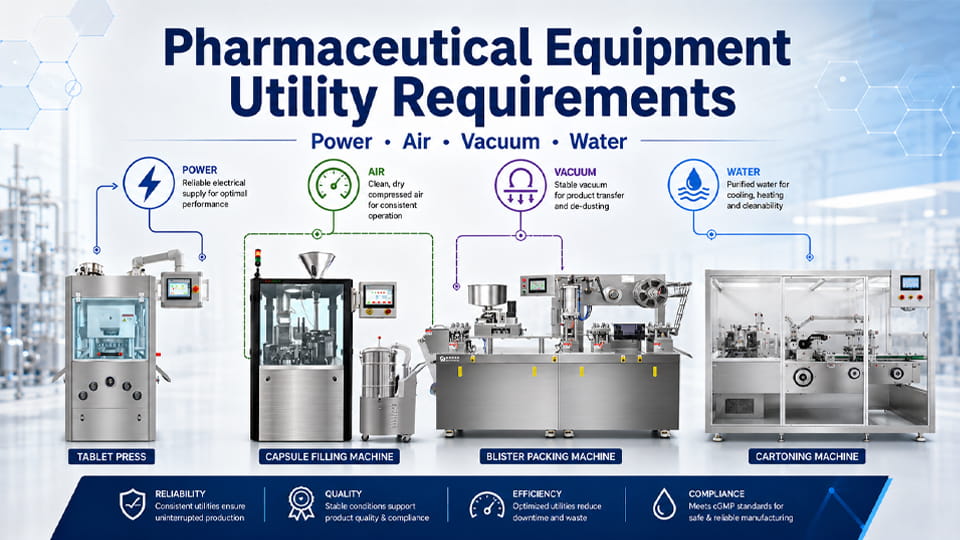
Os requisitos de utilidade do equipamento farmacêutico são os serviços locais que uma máquina precisa para operar conforme projetado. A energia elétrica é quase universal. Dependendo da máquina e do processo, você também pode precisar de ar comprimido, vazio, água de resfriamento, água de processo, escape, vapor, azoto, drenagem, ou condições ambientais controladas. A lista exata depende do equipamento, processo, opções, e uso pretendido.
Nem todo utilitário é automaticamente um utilidade crítica no sentido GMP. A questão chave é se a utilidade pode afetar a qualidade do produto, desempenho do processo, ou risco de contaminação.
FDA Q7 identifica utilitários como vapor, gás, ar comprimido, aquecimento, ventilação, e ar condicionado como sistemas que devem ser qualificados e monitorados adequadamente quando podem afetar a qualidade do produto. Também aborda a ventilação, filtração, escape, pó, umidade, temperatura, controle de pressão, e adequação da água.
A orientação da OMS segue o mesmo princípio de uso pretendido: utilitários como HVAC, água, azoto, e o ar comprimido devem ser adequados ao fim a que se destinam e não devem afetar negativamente a qualidade do produto ou tornar-se uma fonte de contaminação.
Para compradores, o ponto prático é simples: Os requisitos da máquina e a capacidade de utilidade da planta devem corresponder antes da instalação.
As utilidades afetam diretamente o desempenho do equipamento e a qualidade do produto. As incompatibilidades de serviços públicos acontecem frequentemente porque a aquisição, produção, engenharia, e as equipes de validação se concentram em diferentes partes do projeto. O Orientação GMP da FDA (Q7A) afirma explicitamente que “todas as utilidades que possam afetar a qualidade do produto (Por exemplo, vapor, gás, ar comprimido, aquecimento, ventilação, e ar condicionado) devem ser qualificados e devidamente monitorados”. Em outras palavras, se o fornecimento de ar comprimido ou água falhar, pode parar a máquina ou até contaminar o produto. Por exemplo, a filtragem inadequada do ar comprimido pode introduzir óleo ou micróbios em cápsulas ou embalagens blister. Da mesma maneira, tensão muito baixa ou uma linha de ar obstruída podem causar desempenho inferior de motores e válvulas.
A confirmação antecipada da utilidade ajuda a prevenir três resultados dispendiosos:
É também por isso que o planejamento de utilidades ocorre muito mais cedo no ciclo de vida do equipamento do que muitos compradores esperam. Durante a instalação (SAT/QI), serviços públicos são o foco principal. Uma lista de verificação de instalação de equipamentos da Jinlu Packing verifica explicitamente “utilitários (tensão de alimentação, pressão pneumática, água, etc.)” contra as especificações da máquina. Teste de aceitação no site (SENTADO), engenheiros vão medir a tensão real, pressão/fluxo de ar, temperatura da água, etc.. do fornecimento da instalação para confirmar que permanecem dentro dos intervalos especificados pela máquina. Resumidamente, combinar os utilitários com as especificações do equipamento é vital para evitar surpresas: uma máquina não pode funcionar a toda velocidade ou pode quebrar se, dizer, o ar da planta é apenas 3 barra em vez do necessário 6 bar, ou se o motor estiver na tensão errada.
Comece com o requisitos de energia de equipamentos farmacêuticos declarada na folha de dados final – não uma especificação copiada de outro modelo.
Confirme a tensão, solteiro- ou alimentação trifásica, freqüência, potência instalada/avaliada, demanda máxima, conexão principal, e qualquer fornecimento separado para auxiliares. Os equipamentos de exportação muitas vezes podem ser configurados para diferentes mercados. Por exemplo, Listas de enchimento de cápsulas NJP-2600D da JinLu 220/380 V, 50/60 Potência personalizável Hz e 8.0 kW de potência total; suas listas de máquinas blister DPP-260R 380/220/110 V, 50/60 Hz e 5.5 kW. Esses exemplos mostram por que os compradores nunca devem assumir uma “tensão farmacêutica padrão”.
Também separado potência instalada do consumo operacional normal. A potência instalada ou nominal é útil para o planejamento da infraestrutura elétrica, mas a demanda real muda à medida que os aquecedores, motores, bombas de vácuo, transportadores, e ciclo de módulos opcionais. Pergunte ao fornecedor de equipamentos farmacêuticos para demanda máxima/de pico e carga operacional esperada, quando disponível. Cabo final, disjuntor, proteção, aterramento, e o projeto de isolamento devem seguir as regras elétricas do país de destino e o projeto elétrico qualificado do projeto.
Pontos-chave:
Cilindros pneumáticos, válvulas, pinças, rejeitar dispositivos, funções de limpeza, e mecanismos de manuseio de produtos podem depender de ar comprimido.
Quanto ar comprimido o equipamento farmacêutico precisa?
Não há exigência universal de ar para máquinas farmacêuticas. Especifique a pressão operacional – geralmente indicada em bar ou MPa – e o consumo em NL/min, L/min, Nm³/h, ou outra condição de referência claramente definida. Duas máquinas podem exigir a mesma pressão, mas fluxos muito diferentes, portanto, o dimensionamento do compressor apenas com base na pressão não é confiável.
Ar qualidade importa separadamente da pressão e da quantidade. ISO 8573-1:2010 classifica a pureza do ar comprimido por partículas, água, e óleo; a partir de agosto 2026, essa edição permanece publicada enquanto uma revisão está em desenvolvimento. ISO faz não prescrever uma classe de pureza universal para cada aplicação farmacêutica, portanto, a classe exigida deve ser baseada no uso pretendido e no risco de contaminação.
Especifique a filtragem, partículas permitidas, óleo total, umidade, e ponto de orvalho de pressão (PDP) quando relevante. PDP descreve a temperatura na qual a umidade condensaria na pressão do sistema; um PDP mais baixo significa ar comprimido mais seco. Para ar que pode afetar produtos expostos ou superfícies críticas, estabelecer requisitos e verificação de qualidade no ponto de uso. A orientação de inspeção da FDA discute especificamente a revisão de sistemas de ar comprimido e filtragem de partículas no ponto de uso em operações farmacêuticas relevantes.
Deveria ser sem óleo? Às vezes, mas o “compressor isento de óleo” não deve substituir uma especificação mensurável de qualidade do ar. Definir óleo aceitável no ponto de uso, avaliar o risco de contato do produto, e use secagem adequada, filtração, monitoramento, e qualificação. O objetivo é o fornecimento de ar controlado - não apenas uma etiqueta de compressor.
Pontos-chave:
UM sistema de vácuo farmacêutico pode apoiar separação de cápsula, dosagem de pó assistida por vácuo, blister ou manuseio de material, captador de sucção, transferência de produto, ou remoção de poeira. JinLu's Máquina de enchimento de cápsulas NJP-2600D, por exemplo, usa uma bomba de vácuo para separação tampa/corpo da cápsula.
Sempre peça dois parâmetros:
Nível de vácuo informa quão baixa é a pressão, ou quanta pressão diferencial, o processo exige. Fluxo de vácuo/velocidade de bombeamento informa quanto gás o sistema pode remover ao longo do tempo. Os fabricantes de bombas, portanto, publicam-nas separadamente; Ascender, por exemplo, especifica a velocidade de bombeamento em m³/h e a pressão alcançável para seu equipamento de vácuo.
Uma bomba integrada é simples e mantém uma máquina relativamente independente. Um sistema central pode reduzir o número de bombas e centralizar a manutenção, mas perdas na tubulação, demanda simultânea, segregação de contaminação, e as consequências da falha devem ser avaliadas. Peça ao fornecedor da máquina o vácuo necessário na conexão da máquina – não apenas a classificação da placa de identificação da bomba.
Pontos-chave:
Que água o equipamento farmacêutico necessita?
A qualidade da água depende do que a água faz. Água de resfriamento em circuito fechado, água potável, Água Purificada, e WFI não são especificações intercambiáveis. Determine se a água entra em contato com o produto ou com as superfícies de contato com o produto, suporta limpeza ou processamento, ou apenas remove o calor; em seguida, atribua a qualidade apropriada, temperatura, pressão, fluxo, e requisitos de monitoramento.
A OMS afirma que o grau apropriado de água farmacêutica deve ser selecionado de acordo com a aplicação pretendida, produto, e estágio de fabricação; A WFI está associada a usos específicos de alto risco, e não a todas as máquinas farmacêuticas. Da mesma forma, o FDA Q7 exige que a água do processo seja adequada ao uso pretendido.
Isto é especialmente importante para requisitos de água para equipamentos farmacêuticos. A água de resfriamento da máquina pode simplesmente circular através de um trocador de calor ou placa de resfriamento e nunca tocar no produto. No entanto, o FDA Q7 exige que os fluidos de aquecimento e refrigerantes sejam controlados para que não entrem em contato ou afetem adversamente o produto..
Resfriamento/resfriador, vapor, e escapamento
UM empacotador de bolhas, sistema de revestimento, ou outro equipamento gerador de calor pode exigir água de resfriamento ou um resfriador externo, dependendo do projeto. Antes de selecionar um resfriador, obter a temperatura de entrada necessária, fluxo, pressão, carga de rejeição de calor, compatibilidade água/glicol, e tamanho da conexão. Não dimensione apenas a partir do kW elétrico da máquina.
Vapor é não é um utilitário padrão para todas as máquinas de embalagem. Torna-se relevante em particular o aquecimento, limpeza, esterilização, revestimento, ou sistemas de processo. Quando o vapor pode afetar a qualidade do produto, FDA e ISPE tratam-no como uma utilidade que requer controle apropriado.
Finalmente, não se esqueça extração de poeira e exaustão. Compressão de comprimidos, recheio de cápsula, granulação, e o manuseio de pó pode gerar cargas de poeira que exigem extração ou contenção local. FDA Q7 exige ventilação adequada, filtração, e exaustão quando apropriado, incluindo controle de poeira e risco de contaminação cruzada.
Pontos-chave:
Além dos quatro utilitários principais, considere estes serviços comuns:
A matriz a seguir é uma ferramenta de planejamento, não é uma especificação de máquina. “Comum” significa frequentemente encontrado; “Dependente do modelo” significa a configuração final, produto, ou o processo decide.
| Equipamento | Poder | Ar Comprimido | Vácuo | Água / Refrigerador | Escape / Pó |
| Pressione para comprimidos | Obrigatório | Comum | Dependente do modelo | Geralmente limitado | Comum |
| Máquina de encher de cápsula | Obrigatório | Comum | Comum | Geralmente limitado | Comum |
| Máquina de embalagem em blister | Obrigatório | Comum | Dependente do modelo | Dependente do modelo | Dependente do modelo |
| Contador de comprimidos/cápsulas | Obrigatório | Dependente do modelo | Geralmente limitado | Geralmente não | Dependente do modelo |
| Máquina de encadernação | Obrigatório | Comum | Dependente do modelo | Geralmente não | Geralmente limitado |
| Máquina de revestimento | Obrigatório | Comum | Dependente do modelo | Comum/dependente do processo | Comum |
| Granulador / sistema de leito fluidizado | Obrigatório | Comum | Dependente do processo | Dependente do processo | Comum |
Os dados do fabricante apoiam a variação em vez de um único número do setor: JinLu lista suprimentos elétricos personalizáveis em seus Máquinas de preenchimento de cápsulas e Máquinas de embalagem de bolha, e publica ar comprimido de 6 bar para uma prensa de comprimidos e valores de vazão específicos para um enchedor de cápsulas.
Um recurso útil voltado para o fornecedor exemplo de especificação de utilitário pode ser assim:
| Utilitário | Requisito ilustrativo | O que o comprador deve verificar |
| Poder | 380 V, 50 Hz, 3-fase | Fornecimento local, tolerância, proteção |
| Potência instalada | 8 kW | Demanda de pico e auxiliares |
| Ar comprimido | 6 barra na entrada da máquina | Pressão durante o pico de produção |
| Consumo de ar | 200 NL/min | Fluxo normal vs fluxo máximo |
| Qualidade do ar | ISO 8573-1 aula: A definir por URS | Partículas, água/PDP, óleo |
| Vácuo | -60kPa(g), 80 m³/h | Nível necessário e fluxo |
| Água de resfriamento | 15–20ºC, 5 L/min | Carga térmica, pressão, temperatura de retorno |
| Escape | 500 m³/h | Pressão estática e filtração |
| Conexões | Fornecedor a definir | Tamanho, lado, elevação, encaixe |
Estes são valores deliberadamente ilustrativos, não especificações para qualquer modelo JinLu ou de terceiros. Os valores finais devem vir da folha de utilidades aprovada da máquina selecionada. As fichas reais do fabricante demonstram o quanto os valores podem variar.
Para uma nova linha, não adicione todos os valores da placa de identificação às cegas e não dimensione apenas para uma máquina.
Para cada utilitário, construir um cronograma de carga:
Demanda de projeto ≈ Σ (demanda de equipamento × fator esperado de uso simultâneo) + reserva justificada
Use o consumo operacional máximo do fornecedor onde uma máquina pode funcionar continuamente naquela carga. Identifique usuários intermitentes separadamente. Em seguida, teste o pior cenário de produção confiável – por exemplo, máquina de bolhas, cartonador, contador, e dispositivos de rejeição pneumáticos, todos operando enquanto outra linha é iniciada.
Antes da instalação, verifique se todos os utilitários no local correspondem às especificações do equipamento. Uma lista de verificação pode incluir:
Exemplo: Antes do envio, um fornecedor pode fornecer uma Folha de Especificações do Equipamento listando “Ar: 6.0 bar, 200 NL/min; Vácuo: –60kPa; Poder: 380VAC trifásico, 10 kW.” Use isto para configurar circuitos e tubulações. Durante a instalação QI, meça cada suprimento para confirmar se ele atende a essas especificações.
Um URS completo deve listar explicitamente todos os utilitários e condições necessários. Na seção “Utilitários e Meio Ambiente”, especifique valores exatos (E.G.. “Ar comprimido: 6.0 barra ±0,2, 100 NL/min, Classe ISO 8573-1 1.0. Elétrica: 400 V, 3-f, 50 Hz, 15 kW.”). Orientação regulatória (EU GMP Annex 15) exige a verificação dos requisitos do URS durante a qualificação do projeto. Na prática, incluir especificações claras de utilidade nos URS/desenhos do contrato força o comprador e o fornecedor a concordar antecipadamente com as necessidades. Também faz IR/WH/PQ teste simples – cada conexão de utilitário pode ser rastreada até um item URS.
Sempre confirme a lista de utilidades com seu fornecedor antes de fazer o pedido. Os fornecedores devem fornecer um Folha de requisitos de serviços públicos ou placa de dados para cada máquina. Revise-os em uma reunião inicial ou adicione-os ao pedido de compra. Por exemplo, solicitar ao fornecedor que inclua especificações de utilidade nos dados do fornecedor (como parte do FAT). Durante o SAT, verificar fisicamente cada conexão: medir a tensão do site, pressão, e fluir de acordo com as especificações do fornecedor. Mantenha a assinatura documentada (frequentemente como parte do relatório de QI) que “os serviços públicos estão conectados e dentro das especificações” – esta é uma expectativa do GMP (O QI normalmente inclui verificações de poder, pneumático, conexões de água).
Se alguma coisa não corresponder (E.G.. o site só tem 200 V mas a máquina precisa 400 V), resolva-o imediatamente – forneça um transformador ou peça ao fornecedor para reconfigurar a máquina. Lembrar, problemas de incompatibilidade de utilitários são mais fáceis de corrigir antes do início da produção do que depois.
Resumindo, o planejamento cuidadoso da utilidade é tão importante quanto escolher a máquina certa. Uma linha de equipamentos só pode funcionar na velocidade e qualidade pretendidas se poder, ar, vazio, e água estão disponíveis nas especificações corretas. Use as tabelas deste guia, checklists e fórmulas para estimar suas necessidades e incluí-las na URS. Trabalhe com o seu vendedor de equipamentos (como Jinlu Embalagem) documentar cada requisito de utilidade e verificá-lo no local.
Pronto para simplificar o planejamento de serviços públicos? Os especialistas da Jinlu Packing podem aconselhar sobre conexões de energia e utilidades para todos os nossos máquinas de embalagem farmacêutica. Visite as páginas de produtos da Jinlu – por exemplo, o Máquina de enchimento de cápsulas, Máquina de prensagem de comprimidos, Máquina de embalagem em blister, Máquina de contagem, Máquina de encadernação, Máquina de embalagem de sachet ou Máquina de embalagem de bolsas pré-fabricadas – para especificações de utilidades e informações de contato. Para mais assistência, entre em contato com nossa equipe para garantir que sua instalação esteja pronta para uso para uma instalação tranquila e operação compatível.
O básico é energia elétrica, ar comprimido, vazio, e água/resfriamento. Muitas linhas de embalagem também usam vapor limpo (para esterilizadores), gás inerte (N₂ para pacotes de travesseiros), e extração de poeira. Guias regulatórios (E.G.. FDA Q7A) chamar explicitamente o Steam, gás (ar/nitrogênio), AVAC, etc.. como utilidades que devem ser qualificadas.
A maioria dos equipamentos é de energia industrial trifásica. Geralmente 380–400 VCA (50 Hz) ou 480 VAC (60 Hz) com neutro ou terra. Algumas unidades menores podem funcionar com alimentação monofásica de 220–240 VCA. É importante confirmar a tensão e a fase exatas (As máquinas Jinlu geralmente suportam 380/220/110 VAC 50/60 Hz). Verifique também se a máquina está 50 Hz versus 60 Hz ou se pode aceitar ambos (quantos puderem).
Depende da máquina e do número de unidades. Um único blister ou máquina de embalagem pode precisar de cerca de 50–200 NL/min (em ~5–6 bar). Um enchedor de cápsulas ou uma máquina de contagem pode usar 30–100 NL/min. A pressão é geralmente de ~5–6 bar (0.5–0,6 MPa). Verifique as especificações de cada máquina quanto ao fluxo (frequentemente dado em NL/min ou SCFM) e pressão. Some-os para sua linha (lembre-se do fator diversidade). Sempre forneça um pouco de volume extra no sistema de compressor da planta para atender aos picos de demanda.
Os padrões farmacêuticos exigem produtos isentos de óleo, ar seco. Normalmente ISO 8573-1 Aula 2 (ou melhor) é recomendado para ar em áreas farmacêuticas. Isto significa essencialmente 0 óleo (Aula 0 certificação), ponto de orvalho da água ≤–40 °C, e filtros de partículas apertados (E.G.. 0.01 µm). Especifique-os em seu URS. Por exemplo: “Ar comprimido: 6.0 bar, 99.995% sem óleo, ponto de orvalho –40 °C, 0.01 filtro µm no ponto de uso” é um requisito claro.
Geralmente não, a menos que seja um processo esterilizado. Para enxaguar ou resfriar, água potável regular é aceitável. A orientação da FDA diz que no mínimo a água do processo deve atender à OMS potável (água potável) padrões. Use PW ou WFI de maior qualidade somente se o equipamento estiver diretamente envolvido com produto injetável ou se for gerado vapor limpo a partir dele. Sempre esclareça na URS: "Fornecimento de água: potável (Aprovado pela NSF) para resfriamento; nenhum contato da água com o produto.”
Dedique uma seção para “Utilitários e Meio Ambiente” e liste os números exatos. Por exemplo: "Elétrico: 400 VAC, 3f, 50 Hz, 15 kW. Ar: 6.0 barra ±0,2, 100 NL/min. Vácuo: –70 kPa (abdômen). Água: 30 psi, 20 L/min.” O guia Jinlu URS enfatiza que os serviços públicos (tensão, pressão/fluxo de ar, água de resfriamento, vazio, etc.) deve ser especificado. Incluir esses requisitos no pedido de compra para que o fornecedor possa garanti-los em FAT/SAT.
Em última análise, o comprador/instalação deve garantir que os utilitários do local atendam às especificações, mas o fornecedor deve documentar o que é necessário. Durante a gordura, o fornecedor pode simular utilidades; mas SAT/IQ é onde você (o usuário) confirme com suprimentos reais. GMP exige testes de QI documentados para serviços públicos. Na prática, equipes de manutenção/engenharia preparam o local, e o controle de qualidade ou a engenharia verificarão os utilitários no dia da instalação.
Qualquer incompatibilidade é uma “não conformidade”. Por exemplo, se a energia do site estiver errada, você precisará de um eletricista para modificar o painel (ou o fornecedor para trocar os transformadores). Se a pressão do ar estiver baixa, você pode precisar de um reforço ou regulador. Não ligue a máquina nestas condições – ela pode não funcionar ou danificar o equipamento. Corrija o problema ou peça ao fornecedor para ajustar o design. Idealmente, tais problemas são detectados no SAT e resolvidos antes do comissionamento.
Sim. Use óleos de qualidade alimentar em sistemas pneumáticos ou a vácuo; garantir que todos os lubrificantes sejam compatíveis com uso farmacêutico. Identifique claramente as linhas de serviços públicos (a rotulagem de tubos ajuda a evitar erros). Forneça paradas de emergência e garanta que os desligamentos de serviços públicos sejam acessíveis em uma sala limpa. Evite pontos mortos na tubulação (sem zonas estagnadas). E lembre-se que as verificações de qualidade dos serviços públicos fazem parte das BPF – por exemplo. Os inspetores da FDA analisarão seu certificado de ar comprimido e testes de água.
Referências:
1.Guia de boas práticas: Conformidade com GMP de serviços públicos críticos —— ispe
2.Utilitários Críticos —— ispe
3.Q7A Orientação de Boas Práticas de Fabricação para Ingredientes Farmacêuticos Ativos —— NÓS. Food and Drug Administration
4.Salas limpas e ambientes controlados associados —— ISO 14644-1:2015