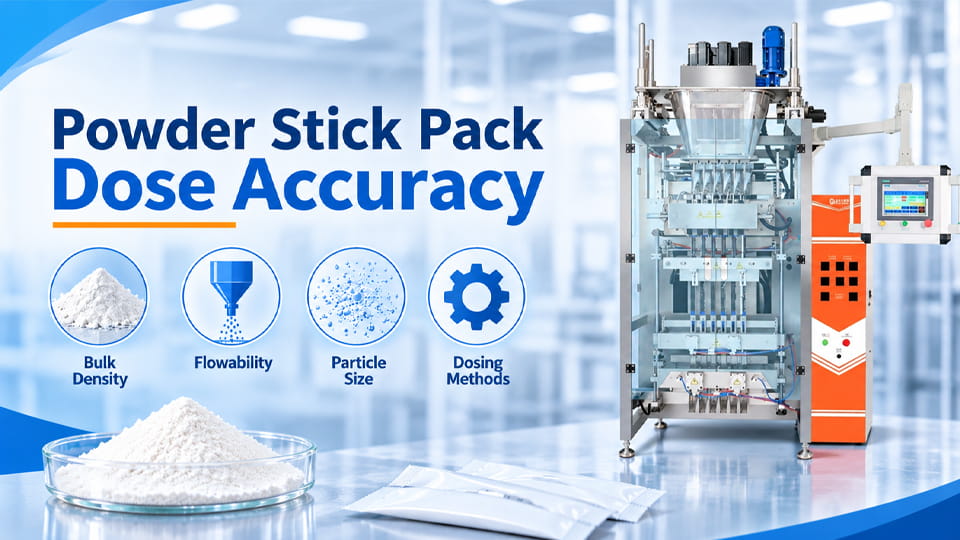
In single-serve stick pack production, dokładność dawki means each sachet gets the correct amount of powder. W rzeczywistości, variations often arise from the powder’s own properties and the way we feed it. Na przykład, two different powders – say a free-flowing vitamin mix versus a spoisty protein powder – can behave very differently in the same machine. If one powder has a lower bulk density or tends to clump, the fill weight will drift. Krótko mówiąc, gęstość nasypowa, płynność, wielkość cząstek, i metoda dozowania work together to determine the actual fill weight. Understanding and controlling these factors is key to keeping each stick pack within tolerance.
I zbieranie Jeinlu, we often show customers how these factors play out. In a recent on-site test, our engineers helped a French nutraceutical firm fill 10 g stick packs (30–35 packs/min) of vitamin powder and proszek białkowy. Using an interchangeable auger projekt (short screw for the vitamin, long for the protein), the machine hit an impressive 98.7% fill consistency for that trial. This one case highlights that with the right setup, even tricky powders can meet tight accuracy – but it also makes clear that precision depends on the powder and settings. In this article we’ll explain the main causes of fill variability and practical ways to improve powder dosing accuracy in stick-pack machines.
Accurate dosing is critical in industries like pharmaceuticals and nutraceuticals. Underfilling a sachet risks regulatory non-compliance or unsatisfied customers; overfilling wastes expensive material. Na przykład, A 0.5% reduction in giveaway (excess powder dispensed) can save thousands of dollars per month. Manufacturers often target a fill error within ±1–2% or better. One way to quantify this is by the fill error formuła:
Fill Error (%) = (|Actual Weight − Target Weight| / Target Weight) × 100
Na przykład, a 10 g target with ±0.1 g variation is a 1% błąd. Meeting these specs means accounting for all sources of variation. Bulk density shifts or a change in particle flow can easily push a standard volumetric auger off-target by more than 1%. That’s why we must understand Co causes inconsistent fills:
Getting each sachet right means combining good machine design with the right settings and procedures. We’ll discuss each factor in turn, then cover seven practical tips to tighten up dosing consistency.
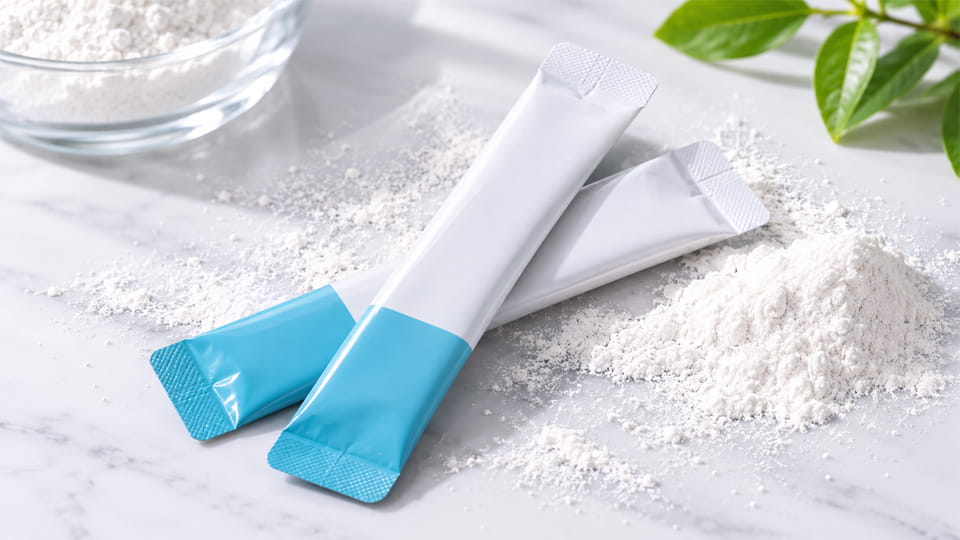
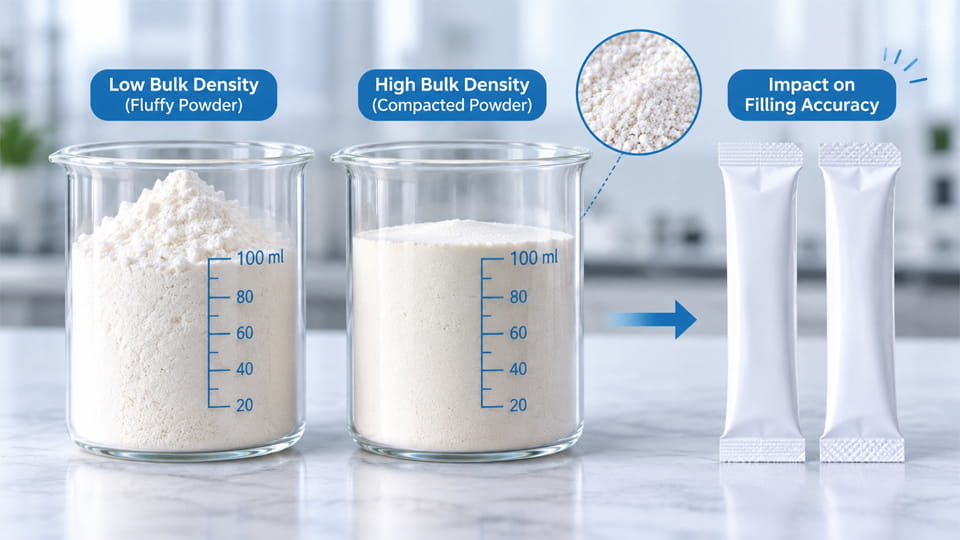
Gęstość nasypowa is the mass of powder per unit volume (g/ml). W opakowaniu, powders may have a “loose” (fluffed) density and a “settled/tapped” density. If powder in the hopper shifts from a loosely packed state to a more compact one, the weight per turn of the auger changes. W istocie, an auger filler meters a volume – if that volume suddenly holds more or less powder, the fill weight varies.
Na przykład, imagine a vitamin powder with a bulk density of 0.5 g/ml. One auger turn moves X ml, so you expect 5.0 g (Do 10 Ml). But if during production the powder vibrates and its tapped density increases to 0.55 g/ml, the same volume now holds 5.5 g – a +10% overshoot unless corrected. Odwrotnie, aeration or refill could loosen it and cause underfill.
Factors like hopper refill, wibracja, or moisture can change density between refills. W rzeczywistości, operators measure both loose and tapped densities during trials. A common index (the Hausner ratio or Carr’s index) quantifies how much bulk density can change under tapping or compression – higher values mean more variability. If a powder shows large density swings, the auger must be re-calibrated for every batch, or a gravimetric system with weight feedback should be used.
Control tips: To minimise density-induced error, keep the hopper consistently filled and minimise vibration/amplitude after filling. Use level sensors and agitation to reduce settling. Do produktów wrażliwych, a loss-in-weight (weighing hopper) system can continuously adjust for density drift. Zazwyczaj, stable bulk density means easier volumetric dosing; variable density demands careful testing and compensation.
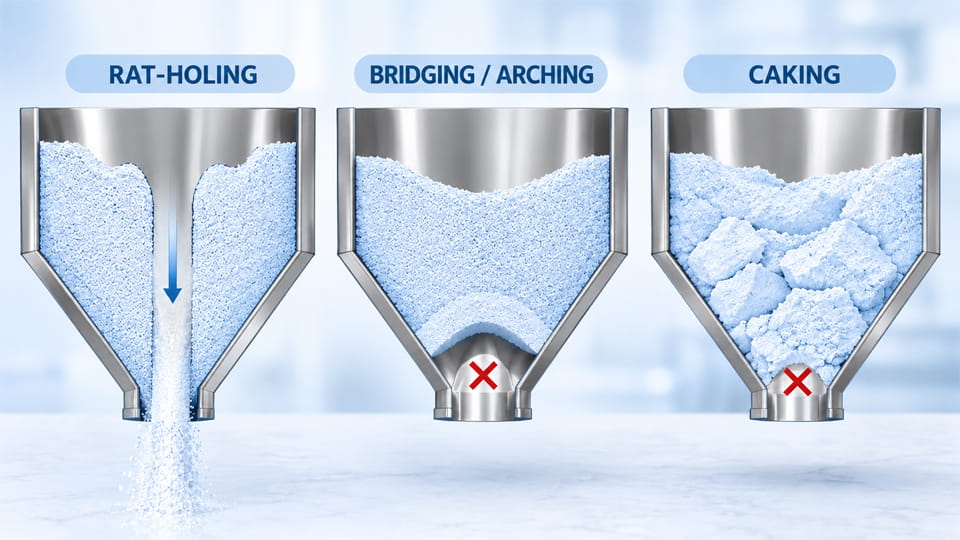
Poor powder flowability can cause unpredictable stops and starts during filling. Common flow problems include:
Each of these flow issues translates to dosing error or downtime. Bridging and rat-holing cause missing fills; caking requires line clearing; aeration causes drift; speed-dependence causes inconsistency. To guard against them, many machines use agitators or vibrators in the hopper, proper hopper wall angles (steep sloping) and even inserts (paddles) to break cohesive clumps. Incorporating sensors or high-precision checkweighers in-line can catch if one lane is underperforming due to a flow issue, prompting immediate correction.
The mix of particle sizes in your powder blend can greatly affect fill uniformity. Zazwyczaj, fine particles pack more tightly – they can flow into the voids between larger particles. This raises bulk density (do pewnego momentu) but also tends to make the powder more cohesive. Think of very fine flour vs. coarse sugar: mąka (tiny particles) compacts and clumps easily, while coarse crystals pour easily but leave more voids. Fine particles can fill the voids between larger particles and change the blend’s bulk density. Jednakże, excessive fines may also increase cohesion and reduce flowability, making consistent auger feeding more difficult.
A broad particle size distribution can also lead to segregacja podczas napełniania. Coarser particles might roll or separate from fines in a hopper or during vibration, so some sticks get more fines and some get more coarse granules. This uneven mix means the active ingredient per stick can vary even if total powder weight is correct. Na przykład, if a blend of vitamins and fibers segregates, some sticks may carry less vitamin just because the tiny vitamin particles settled differently. Consistent fill weight does not automatically guarantee content uniformity. If a powder blend segregates during handling or feeding, individual stick packs may contain different proportions of active ingredients even when their total weights are similar.
Podsumowując, an ideal powder for stick packs often has a controlled blend of sizes: enough fines to pack well but not so many that it cakes or binds. Manufacturers often test with representative powders to catch these effects – what looks uniform in bulk may behave very differently during filling.
The dosing system (how the machine meters the powder) is equally crucial. The main approaches are wolumetryczny (świder) I grawimetryczny (fill-by-weight), Auger describes the feeding mechanism, while volumetric and gravimetric describe how the dose is measured or controlled. Jakiś wypełniacz ślimakowy can operate as a volumetric system or be integrated with gravimetric feedback. Each with pros and cons:
| Dosing Method | Jak to działa | Speed vs Accuracy | Notatki |
| Volumetric Auger (open-loop) | Dispenses a fixed volume per auger turn (preset revolutions or time). | Wysoka prędkość, moderate accuracy: Depends heavily on powder density and feeding consistency. | Simple and fast. Accuracy drops if powder density or flow changes (no feedback). Best for free-flowing, uniform powders or when ±2% is sufficient. |
| Auger with Weight-Feedback | Starts volumetric, then uses a scale to fine-tune each dose. | Medium speed, wysoka dokładność: Can compensate for weight deviations through feedback control. | Two-stage fill: fast bulk portion, then slow “dribble” to target. Mitigates density shifts via closed-loop control. Slower cycle due to weighing. |
| Volumetric Cup or Piston | Fixed cavity or piston volume (mechanical stroke) per fill. | Wysoka prędkość, moderate accuracy: Depends on consistent bulk density and cavity filling. | Good for granules or pellets. Subject to similar density issues as augers. Often used for free-flowing products. |
| Gravimetric (Loss-in-Weight) | Continuously weighs hopper and stops when target mass dispensed. | Medium speed, highest accuracy: Measures actual mass and can provide tighter weight control. | True closed-loop: measures actual mass out. Excellent for varied densities. More complex and costly. Best for pharma/regulated. |
Fill-by-Weight vs. Volumetric: W rzeczywistości, “fill-by-weight” systems refer to augers coupled to a weigh cell (grawimetryczny). These start fast and automatically slow/stop at target weight, giving exceptional accuracy (often ±0.5% or better). They cost more and run slightly slower due to the weigh-feedback step. Traditional volumetric augers simply turn the screw a set amount, relying on powder consistency. They can be very fast (no pause for weighing) but typically average ±1–2%.
Auger = mechanism, not a mutually exclusive method. An “auger filler” is basically a volumetric system, but you can also have an auger with closed-loop feedback. Gravimetric dosing may use augers, wagi wielogłowicowe, or other methods. Kluczem jest: dozowanie objętościowe depends on bulk density; gravimetric dosing depends on real weight. You often see machines advertised as either volumetric or “augment fill-by-weight”.
W obu przypadkach, advanced auger systems use servo motors and smart controls to improve consistency. High-resolution servo drives ensure each screw revolution is precise and repeatable. Ale pamiętaj: even a servo won’t magically fix a powder that densifies or bridges. It just runs the screw exactly as told. A system can combine a servo auger with a load cell: the servo handles precise volume, and the weigh cell confirms or fine-tunes the weight in real time.
Implementing these steps – good screw selection, stable hopper flow, careful cycle control, and diligent testing – can dramatically cut variation. Nawet wtedy, some variation is inevitable; the goal is to know and control it. In Jinlu’s on-site test with a French customer, they demonstrated this: by switching to the right auger for each powder, they hit 98.7% of sticks within target at 30–35 sticks/min, 10 g dose. This shows the difference smart setup and feedback can make.
When selecting a machine, consider both the powder and your production needs:

Podsumowując, match the machine to the product and line speed. When accuracy is paramount, look for machines that allow realistic product trials before purchase. Wzrastać, na przykład, often conducts customer trials with client powder. And remember the trade-off: a Gravimetric (ważyć) machine will usually beat a pure Volumetric one on accuracy, but at the cost of speed and complexity. Decide whether your priority is absolute weight control (pharma standard) or maximum throughput (high-volume consumer goods).
Consistent stick-pack dosing starts with understanding your powder’s properties and choosing the right filling approach. Gęstość nasypowa, flowability and particle size can each cause weight variations – but by preparing (testing powder behavior, selecting appropriate augers, using agitation and feedback), you can greatly tighten fill precision. As seen in Jinlu’s case, even challenging powder combinations reached 98.7% consistency once the right augers and controls were used.
If you’re sourcing a stick-pack machine, look for features that match your product: adjustable or interchangeable screws, servo-driven dosing, and integrated weighing or checkweigher systems. Always test with real product samples. I pamiętaj, published specs (like ±0.02 g accuracy) are usually under ideal lab conditions – confirm with the supplier what materials, speeds and methods were used to achieve that.
With informed setup and tuning, your stick packs can reliably hit target dose – minimising waste and meeting both quality standards and customer expectations.
Looking for a reliable powder stick-pack solution? Contact Jinlu Packing’s team to discuss your powders, target fill weight and output needs. We can help configure a stick-pack machine with the right auger, feeding system and controls to achieve the accuracy your production requires.
By far the biggest culprits are changes in bulk density and flow behavior. If the powder settles or aerates, the same auger rotation delivers different mass. Bridging or rat-holing stops flow unexpectedly. Even small changes – a few percentage points in bulk density, or a slight humidity gain – can shift fill weight. Mechanical factors like loose feeders or speed changes also cause variation. W rzeczywistości, any time the powder’s state or the machine settings change, you should re-check the fill weight.
Bulk density sets the conversion between volume and mass. Auger fillers deliver a fixed volume per turn. If bulk density increases, the delivered weight rises in proportion. Na przykład, a 0.10 g/mL increase in density in a 10 mL dose adds 1.0 g to a 10 g pack (10% błąd). This is why volumetric systems assume steady density; any fluctuation directly turns into weight error.
Servos improve repeatability (each turn is exact), but they cannot change the powder’s physics. A servo auger will spin exactly N turns every cycle, but if the powder has compacted or bridged more this cycle, the mass in those turns is just different. Servo control reduces mechanical error (backlash, slip) but a cohesive powder can still underfill or jam. That’s why good design (hopper shape, podniecenie) and sometimes weight feedback are also needed.
Focus on process adjustments: ensure the hopper is kept at a stable level and agitated so density stays uniform. Add a gentle vibration or aeration between runs. Slow the fill-down speed for critical fills. Use anti-bridging inserts in the hopper. Calibrate often with the actual powder condition. And don’t forget the checkweigher – adding a weight check after filling can catch outliers and allow rejection or correction without a big hardware upgrade.
An auger filler refers to the mechanism (a rotating screw). Augers are usually volumetric by default – they deposit a set volume. “Volumetric” means open-loop (no weight feedback) – the machine doses by preset auger turns or time. “Gravimetric” means fill-by-weight – it uses a scale. Many modern auger fillers combine both: they run quickly then use a scale to fine-tune (sometimes called “weigh-fill”). So an auger machine can be volumetric-only or outfitted with weighing for gravimetric feedback.
It depends on the model and conditions. Some high-end stick packers advertise ±0.02–0.1 g tolerance. Na przykład, Jinlu’s single-lane stick packer specs claim ±0.02 g accuracy with a long auger. In real operations, the actual percent error also depends on your fill weight. A ±0.02 g error in a 10 g pack is ±0.2% – very good. Bulkier packs (say 100 g) might expect around ±0.1–0.5 g (±0.1–0.5%). Multi-lane systems often quote a percentage (like ±2%) based on trials. Always check if the spec is volumetric-only or with scale feedback, and test with your powder.
Tak, but with caution. Many stick packers allow quick changeover of the feed parts. In the French case above, one machine ran both free-flowing vitamin powder and sticky protein by swapping the auger screw and re-tuning settings. Modern machines use quick-release feed hoppers, tools and vacuum feeders so cleanout and reconfiguration take minutes. Jednakże, each new powder usually needs its own calibration. To smoothly handle multiple SKUs, use separate augers/nozzles and keep changeover procedures precise (and document them).
Dla <±1% accuracy, consider a fill-by-weight system or at least auger plus checkweigher. Also prioritize powder conditioning: remove air (np. mild vacuum), avoid bridging (wibracja), and use a fine 2-stage fill. Powder uniformity and pre-blending matter too – a consistent blend will fill more consistently. Wreszcie, invest in good sensors (ogniwa obciążnikowe, level probes) i systemy sterowania. Even the best auger won’t outdo a gravimetric filler with a dynamic feedback loop if sub-0.5% jest potrzebne.
Calibration frequency depends on usage. For critical applications, it’s wise to do a brief verification (catch-and-weigh) at the start of each run or batch. If the machine has a gravimetric system, it self-calibrates continuously. But even then, periodic verification with a known weight sample is good practice. Whenever you switch powders or fill weights, re-calibrate in case the relationship has changed.
Use mechanical agitation or vibration to break up arches. Keeping the hopper well-packed (with sidewall scrapers) and avoiding sharp corners reduces bridging. Some stick pack hoppers have flexible rubber inserts or shaking devices for this purpose. Also ensure the powder isn’t too moist or compacted – controlling humidity and handling helps.
Referencje:
1.Załącznik 13 Bulk Density and Tapped Density of Powders General Chapter —— FDA / ICH Q4B
2.A systematic comparison of four pharmacopoeial methods for measuring powder flowability —— ScienceDirect
3.An investigation into the effects of excipient particle size, blending techniques and processing parameters on the homogeneity and content uniformity of a blend containing low-dose model drug —— Centrala PubMedu
4.Risks of Powder Flow Obstruction in Hopper and Bin Discharge in Solid Dosage Form Manufacture should be Predicted Under The Active Stress State —— ScienceDirect
5.Investigation on the impact of powder arching in small die filling —— PubMed
6.Continuous powder feeding for pharmaceutical solid dosage form manufacture: a short review —— PubMed
7.Influence of refilling on dosing accuracy of loss-in-weight powder feeders in continuous manufacturing —— ScienceDirect