
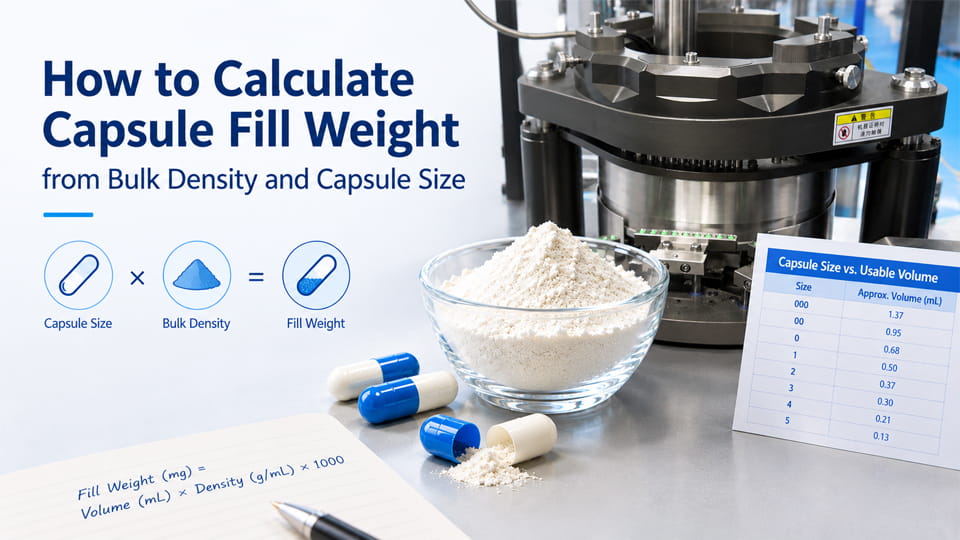
In capsule formulation and manufacturing, a common question is: given a powder’s bulk density and the capsule’s internal volume, how do we calculate the theoretical fill weight? The short answer: use the capsule’s volume (in mL) and the powder’s density (g/ml) in the formula Waga (Mg) = Volume (ml) × Density (g/ml) × 1000. This gives an estimated fill weight in milligrams. Na przykład, a size 0 capsule has about 0.68 mL of volume. If your powder’s bulk density is 0.6 g/mL, the calculation is 0.68×0.6×1000 ≈ 408 mg. (If the density were 1.0 g/mL, it would be 680 mg at most.) Right away you get a rough figure. Jednakże, it’s crucial to note: this is a theoretical number under ideal conditions. In real production, factors like powder settling, particle shape, moisture and machine tamping can make actual capsule weights differ. Innymi słowy, the formula shows what could pasować; careful testing on your capsule filler is needed to see what Właściwie fits.
W tym przewodniku, we’ll explain how to apply the fill-weight formula, give real examples, and show a capsule size chart with estimated weights. We’ll also cover why actual capsule weights differ from the theory, and how to verify fills on a capsule machine. Do końca, you’ll have a clear, step-by-step understanding of how to estimate capsule fill weight from bulk density and capsule size – without wasting time or material.
A capsule’s fill weight (how much powder it holds) depends on three main factors: the capsule’s size (and its internal volume), the powder’s bulk density, i sposób napełniania (including any compaction).
Podsumowując: rozmiar kapsułki gives you the volume, powder density (and behavior) tells you how much mass fits that volume, I machine/setup determines how the powder actually packs. All three must be considered. Na przykład, if you just did the simple formula (Volume×Density), you might get 408 mg for a size 0 at 0.6 g/mL. But in production you often see that bulk powder isn’t fully tapped into place, so actual filled capsules may weigh less (lub więcej, if tamped heavily). We’ll get into those caveats later, but first let’s put the formula front and center.
W swoim rdzeniu, the formula is straightforward:
Fill Weight (Mg) = Volume (ml) × Density (g/ml) × 1000
Expressed in words, weight in mg = volume × density × 1000.
It’s also useful to rearrange the formula when targeting a fill weight:
Wskazówka: Always use consistent volume. The “volume” should be the actual internal capacity of the fully closed kapsułka (both cap and body) that can be filled. Do nie use the outer dimensions or container volume. Use published capsule volume charts (zobacz następną sekcję) or measure with a graduated cylinder if uncertain.
Suppose you have:
Then theoretical fill weight = 0.68 mL × 0.60 g/mL × 1000 = 408 Mg.
This 408 mg is the amount of powder that should fit if the powder settled naturally. W rzeczywistości, the actual fill might be a bit more or less (see Section 6). But this gives you the baseline.
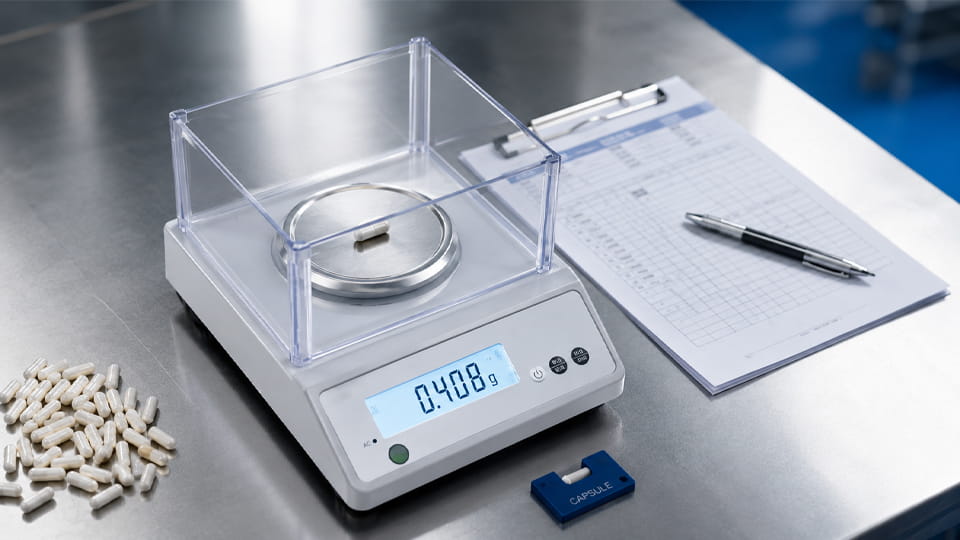
Let’s work through a few scenarios to see how the formula applies:
Przykład 1 – Size 0 Kapsułka:
Przykład 2 – Comparing Sizes:
Przykład 3 – Target Dose:
These examples show how to plug in numbers. W rzeczywistości, always cross-check the calculated volume against a capsule’s capacity chart (next section).
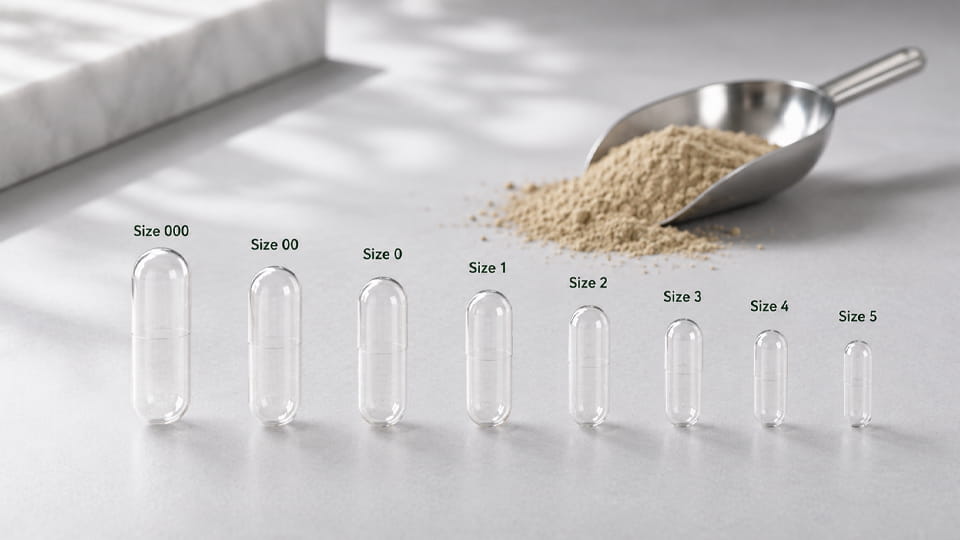
To make quick estimates, use a capsule capacity chart. Below is a simplified reference for common hard capsule sizes (000–5). Note the volumes and approximate fill weights at different densities:
Postać: Hard capsule sizes (000 largest to 5 najmniejszy) vary widely in volume and fill capacity. Even at the same density, a size 5 holds far less than a size 0.
| Rozmiar kapsułki | Tom (ml) | ~Weight @ 0.6 g/mL (Mg) | ~Weight @ 0.8 g/mL (Mg) | ~Weight @ 1.0 g/mL (Mg) |
| 000 | 1.37 | ~822 | ~1096 | ~1370 |
| 00 | 0.90 | ~540 | ~720 | ~900 |
| 0 | 0.68 | ~408 | ~544 | ~680 |
| 1 | 0.48 | ~288 | ~384 | ~480 |
| 2 | 0.37 | ~222 | ~296 | ~370 |
| 3 | 0.27 | ~162 | ~216 | ~270 |
| 4 | 0.20 | ~120 | ~160 | ~200 |
| 5 | 0.13 | ~78 | ~104 | ~130 |
These numbers come from published capsule specifications and simply multiply volume by density×1000. Na przykład, rozmiar 0 at 1.0 g/mL is 0.68 mL×1.0×1000 ≈ 680 mg.
Why it’s only an estimate: Real powders often have voids, nieregularne kształty, or compression differences. Również, capsule suppliers’ volumes can vary slightly, and measuring volume precisely is tricky. Use the chart as a starting point. For any critical formulation, confirm by actual weighing tests.
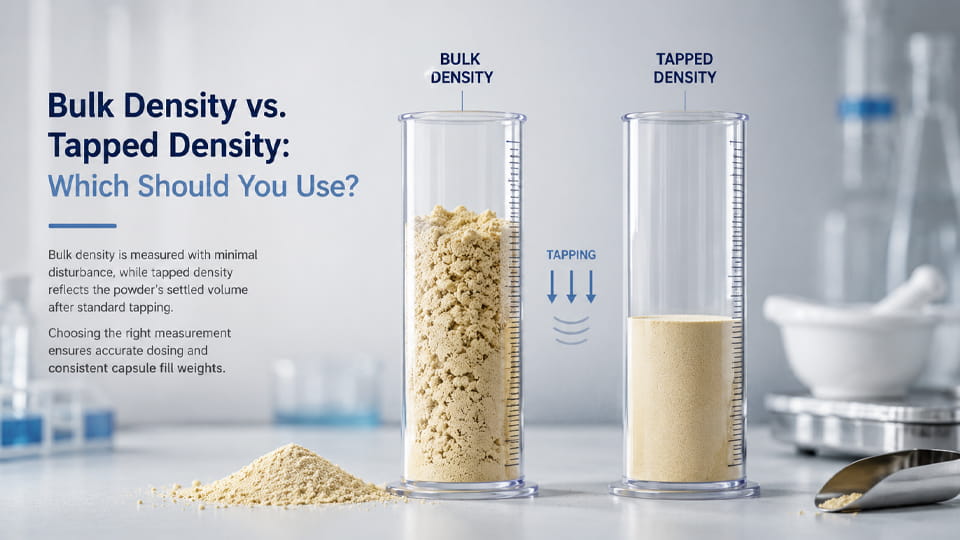
Gęstość nasypowa is the mass of powder divided by the total volume it occupies when poured freely (including voids). Tapped density is measured after mechanically tapping/vibrating the container, allowing the powder to settle and pack more densely. W praktyce:
For capsule filling, the difference matters. Filling machines typically vibrate or tamp the powder, so the effective packing density increases. That means if you use the loose bulk density in the formula, you may under-estimate how much will actually fit (the machine can pack more). Odwrotnie, using tapped density (higher number) yields a more conservative estimate. Choose the density measure that matches your filling process.
We cited pharma-machinery’s description:
“Bulk density refers to how a powder packs naturally without compression, and tapped density measures how much powder settles when tapped or vibrated”.
Most recommendations for capsule fill calculations suggest using the gęstość utarta or a tapped-like density if your machine tamping significantly densifies the powder. Jeśli nie jesteś pewien, measure both: fill one capsule using a sample, weigh it, and compare with the two calculated values as a quick check.
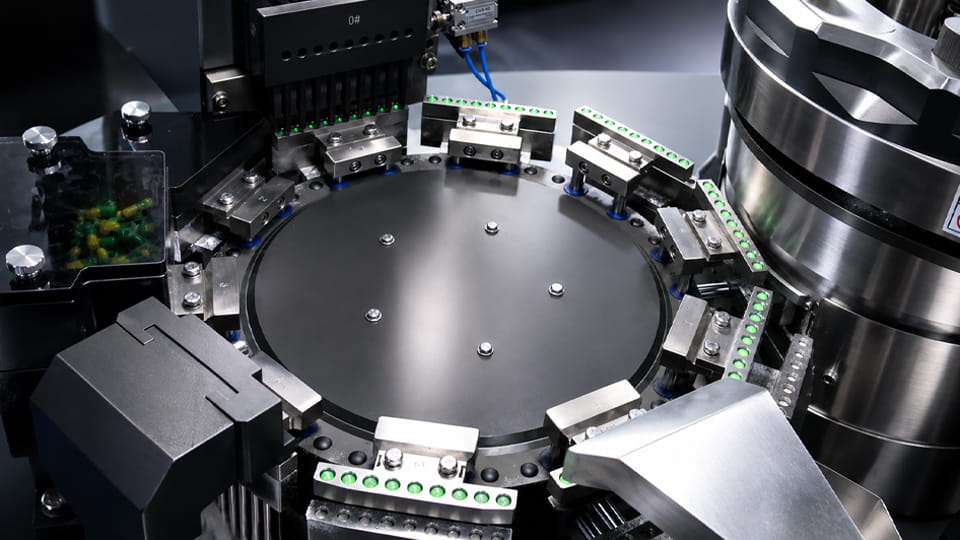
Even with a precise formula, many factors can cause actual filled weight to diverge:
W rzeczywistości, one often finds the actual fill weight is slightly lower than the theoretical bulk calculation, because the powder can’t be packed to the crystal density and some voids remain. Or it may be higher if the machine overfills or compresses strongly. The key is to treat the formula as a guide, then adjust by fine-tuning your machine settings and blend consistency.
To bridge the gap between theory and practice, follow a simple verification process on your capsule filling machine:
By iterating this process, your fill weight will converge to the desired target. Once you’re satisfied, document the settings and conditions for skalowanie or future runs.
Podsumowując, estimating capsule fill weight starts with a simple formula: capsule volume × powder density. By knowing your capsule’s internal volume (np. ~0.68 mL for size 0) and the powder’s bulk (or tapped) gęstość, you can calculate a theoretical fill weight. Use examples and charts to pick the right capsule size or target weight. Always remember that real-world factors (płynność, ubijanie, wilgotność, itp.) will affect the outcome.
Once you have an estimate, confirm it on your capsule filling machine by test-weighing filled capsules and adjusting machine settings as needed. This approach avoids trial-and-error waste and leads to precise dosing – whether you’re using a manual device or a high-speed capsule filler.
Do produkcji na dużą skalę, choosing the right equipment is crucial. Jinlu Packing automatyczny I półautomatyczne napełniacze kapsułek, na przykład, offer precise dosing mechanisms to achieve accurate fill weights. (Our auto-fillers can handle up to 468,000 capsules/hour.) If you need a robust solution, explore Jinlu’s maszyny do napełniania kapsułki and get a tailored recommendation.
Ready to optimize your capsule filling? Use this guide’s formula and tips, I skontaktuj się z Jinlu Packing for advanced capsule filling equipment or customized support. Your accurate, efficient capsule production awaits!
Use the formula Fill Weight (Mg) = Volume (ml) × Bulk Density (g/ml) × 1000. Plug in your capsule’s internal volume and the powder’s bulk density. Na przykład, 0.68 ml× 0.8 g/ml = 0.544 G, Lub 544 Mg.
Roughly, rozmiar 0 holds about 400–700 mg depending on powder density. Na 0.6 g/mL it’s ~408 mg; Na 1.0 g/mL it’s ~680 mg. Always calculate using your blend’s density and leave room for practical variations.
Bulk density is the mass per volume of powder in a loose state. Tapped density is after mechanically tapping the container (particles settle, volume decreases). Tapped density will be higher. Capsules filled with tamping use tapped density for calculations; simple volumetric fills use bulk density.
Indirectly – capsule size sets the volume. Larger size (np. 00 vs. 0) gives more space, so at the same density it will hold more weight. But the powder density and fill mechanism are equally crucial. Two capsules of the same size can have different fill weights if the powders differ in density.
Absolutnie. A light fluffy powder (niska gęstość nasypowa) will have a lower fill weight than a heavy dense powder of the same volume. Na przykład, A 0.68 mL capsule holds ~408 mg of a 0.6 g/mL powder, but ~680 mg of a 1.0 g/mL powder.
Calculate the volume needed: Volume = (target mg) / (1000 × density). Then pick the smallest capsule size with that volume or larger. Remember to leave a safety margin (don’t max out the capsule’s volume).
Practical factors – powder flow, particle shape, wilgotność, statyczny, and machine settings – all affect the final fill. Some trapped air or imperfect settling usually means actual weight is lower than the ideal calculation. Odwrotnie, too much tamping can make it higher.
They determine how much the powder is compressed and how consistently capsules are filled. Settings like tamp pin depth, auger speed, and disc alignment all impact the final weight. Nowoczesne maszyny (jak Jinlu) allow fine-tuning, and they often specify in their manuals how to set up for a given density. Some machines even offer feedback loops to maintain weight.
Referencje:
1.Wpływ właściwości przepływu proszku na jednorodność masy wypełnienia kapsułki —— Taylora & Franciszek w Internecie
2.Badanie różnych czynników wpływających na kapsułkowanie w automatycznej maszynie do napełniania kapsułek In-Cap —— PubMed Central(PMC)
3.Napełnianie proszków w dwuczęściowe, twarde kapsułki —— ScienceDirect
4.Rational design of powder formulations for tamp filling processes —— PubMed
5.Płynność proszku jako wskaźnik wydajności napełniania kapsułki —— ScienceDirect
6.The filling of powders into two-piece hard capsules —— ScienceDirect