×

온라인 서비스

💬 왓츠앱: +86 1801179332
💡
  • 블로그
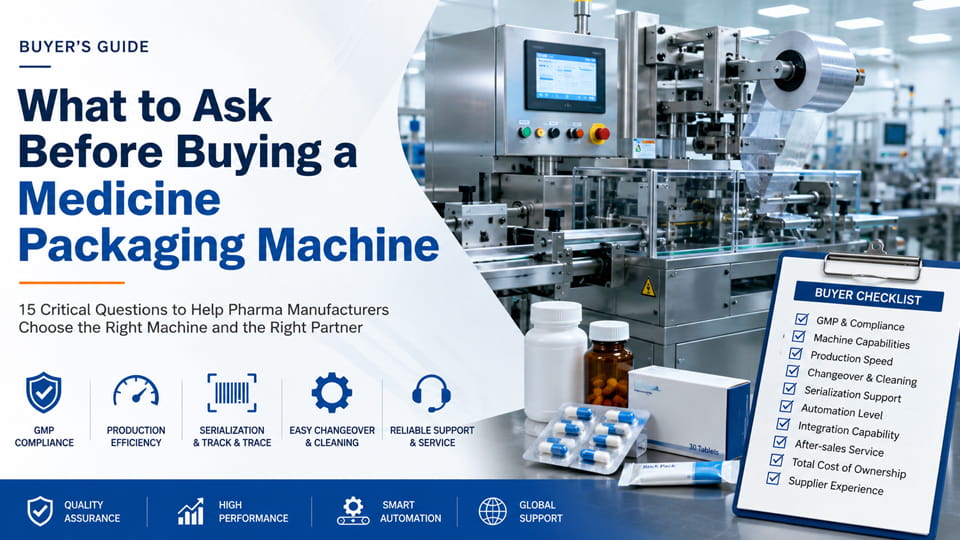
  • 의약품 포장 기계를 구입하기 전에 물어봐야 할 사항: 10 제약회사에 대한 중요한 질문

의약품 포장 기계를 구입하기 전에 물어봐야 할 사항: 10 제약회사에 대한 중요한 질문

Buying a medicine packaging machine is a major decision for any pharmaceutical company, so asking the right questions up front can save time, 돈, and headaches later. 현대의 pharma packaging lines are complex (often integrating 캡슐 필러, 물집 기계, 계산 시스템, 탑승자, 그리고 더), and they must meet strict GMP and regulatory standards. 사실은, studies show nearly half of all 마약 리콜 포장 또는 라벨링 오류가 포함됨. 이 가이드에서는, we’ve gathered the most important questions and considerations for pharma buyers. You’ll learn how to evaluate compliance (GMP/FDA/WHO), 형식 (정제, 액체, 물집, 등.), speed and automation level, cleaning and validation needs, serialization/traceability, TCO (총 소유 비용), 및 공급업체 지원. We also include a handy 구매자 체크리스트 and highlight common procurement mistakes. Whether you run a small contract packager or a large manufacturing plant, this will help you systematically compare machines and avoid costly pitfalls.

의약품 포장 기계 구매 가이드


1. Is the Medicine Packaging Machine Fully GMP-Compliant?

Why it matters: 제약 분야에서, compliance is non-negotiable. Equipment must meet FDA, EU, and WHO cGMP standards before it ever runs product. The machine’s contact parts should be pharma-grade (일반적으로 stainless steel 316L or 304) 매끄럽게, welded surfaces – no rust, pits, or gaps where powder can hide. The design should be hygienic (예를 들어. cantilevered modules, sloped surfaces) so it’s easy to clean and inspect. Ask the pharmaceutical packaging equipment supplier for documentation: you should receive protocols for IQ (설치 자격), OQ (운영 자격), 그리고 PQ (성능 자격). These validate that the machine is installed correctly, runs at all intended settings, and performs consistently under real production loads. Without IQ/OQ/PQ records, the equipment isn’t “qualified” for GMP use. Also confirm the supplier’s quality system and certifications: do they follow ISO 9001? Can they provide material certificates (예를 들어. FDA-compliant silicone seals) and CE/UL marks if needed? 마지막으로, ensure the design supports data integrity (예를 들어. 21 CFR 부분 11 for electronic logs) and sterilization if required.

  • Key questions: Is the construction 316L SS, FDA-grade? Are there no dead zones or hard-to-clean spots? Can I get full IQ/OQ/PQ packages and SOPs for cleaning/validation? Does the machine meet 21 CFR 부분 11 (computer validation) and EU Annex 11 requirements?

Worker in protective suits operate a pharmaceutical packaging production line

영상: A modern medicine packaging production line, illustrating the need for integrated machines and GMP-compliant design.


2. What Dosage Forms and Packaging Formats Will The Pharma Packaging Machine Handle?

Not all machines handle all products. You should be very clear about your product types. 예를 들어, 정제 및 캡슐 often use counting/bottle-filling lines or blister packers, 반면 액체 약물 need dedicated liquid filling and sealing machines. Powders/granules may go into sachets or stick packs. Below is a simple guide – your needs may combine several machines in one line:

복용 형태 & 체재 Typical Machine Type
Solid tablets (loose, 병에) 자동 계산 & Bottle Filling line
Solid tablets (strip or blisters) 물집 포장 기계 (PVC/Alu-PVC)
캡슐 (hard gel) 캡슐 충전물 기계 + (blister or bottle line)
Liquids/Syrups (vials or bottles) Liquid Filling and Capping Machine
분말/과립 (스틱이나 향 주머니) Sachet or Stick-Pack Machine
Softgels/Gummies 계산 기계 + Blister or Bottling
판지 (반성) 포장 기계 for final boxing

Medicine packaging machines are often sold as integrated lines. 예를 들어, a capsule line might feed product from a 막대 into a 계산기, then through a 블리스 터 패커 또는 카토너.

capsules blister packs pill bottles and gummies

Ask your medicine packaging machine supplier: “Can the line run my products?” For each format, verify material compatibility – e.g. a blister machine should run your foil and films (PVC, 애완 동물, ALU-ALU) at the right temperatures. Bottle lines should adjust for different bottle heights and cap types. If you plan multiple products (예를 들어. 캡슐 및 정제), you’ll need change parts or even different machines. Some machines are multi-format, but always confirm what changeover is required (다음 섹션을 참조하세요).


3. What Production Speed and Capacity Do You Need?

A machine’s rated speed must match your output targets. Find out how many units per minute/hour the machine can package reliably. Be sure to consider net 산출 (after rejects) and not just the maximum. Think about current needs 그리고 future growth. 예를 들어, a mid-size tablet blister line might be rated at 40,000 시간당 물집; a large fully-auto line could exceed 100,000 시간당. 하지만, a very high-speed machine that crashes often can be worse than a slightly slower, stable one.

Estimate your daily or annual volume and pick a machine that can handle peaks. Keep in mind industry trends: many pharma firms now run smaller batches with frequent changeovers, so extremely high single-SKU speed is less critical than flexibility. If you run multiple shifts, investing in higher throughput can pay back faster through labor savings. But if batches are small or custom, a machine that allows quick recipe switches and tool-less changeovers (see section 4) will be more valuable than raw speed.

  • Key questions: What is the medicine packaging machine’s throughput (units/minute or bottles/hour)? What is its uptime reliability at that speed? Can it scale (예를 들어. adding another unit) or be upgraded for higher speed later?


4. 반자동 대. 완전 자동?

Decide how much automation you really need. Semi-automatic machines require operators to load containers, start cycles, or perform manual tasks (예를 들어. dropping tablets into blisters). Fully automatic pharma packaging lines do everything from feeding to sealing with minimal human intervention. Semi-auto machines cost less upfront and can be fine for low-volume or batch work. Fully-auto lines cost more but save on labor and reduce human errors.

특징 반자동 완전 자동
Operator Involvement Yes – loading/unloading, 등. Minimal – one person oversees entire line
생산 속도 보통의 높은
전환 느리게 (manual adjustments) 더 빠르게 (often tool-less, 레시피 중심)
초기투자 낮추다 더 높은
Validation Complexity Similar (IQ/OQ/PQ still needed) Similar
Ideal for Small runs, lab pilots Large runs, 24/7 생산

Fully automated pharmaceutical systems often include feed hoppers, automatic labelers, 모자, and conveyors all synchronized. They also integrate error checks (weighing scales, 비전 시스템) in real time. Semi-automatic equipment might be suitable for a contract manufacturer starting out, but growth plans often lead buyers to choose full automation.

  • Key questions: Can one operator run the whole line? Does it have recipe-based controls (so an operator doesn’t tweak settings each time)? Is there an option to upgrade modules (예를 들어. add a feeder or scanner)?


5. How Easy Is Cleaning, 전환, and Validation?

Pharma lines change products more often than you might think, and each change requires thorough cleaning (and often re-validation). A good machine design will make this fast. 찾아보세요 도구가 필요 없는 removable parts, light components (one person can handle them), and open frames that let QA 보다 if any residue remains. There should be no hidden cavities where pills or powder can accumulate. The vendor should provide clear SOPs for cleaning, disassembly and reassembly. Validate changeover procedures: can product 조리법 be stored so you recall all settings for a given SKU?

실제로, a machine that can be cleaned and validated quickly directly improves productivity. If you have drugs that require changeover between, 말하다, a controlled substance and a vitamin product, you’ll run through cleaning and often a clean validation test (worst-case product test) 매번. Ask about 제자리 청소 (CIP) options or other hygienic features.

  • Key questions: Which parts come off without tools? Can the supplier show an IQ/OQ step of a changeover? Are cleaning SOPs included? How long does a typical changeover take?


6. Does It Support Serialization & Track-and-Trace?

현대 규정 (우리를. DSCSA, EU FMD, 등.) 필요하다 serializing each saleable unit of medicine. 구매하기 전에, confirm the line can integrate coding printers (inkjet/laser) and vision scanners to apply and verify 2D barcodes or QR codes on packages. The control system should capture each serial number and link it to batch data. 실제로, buyers often ask: “Can this machine reject any unlabeled or invalidly coded item?” 그리고 “Is there reserved space and wiring to add a coder or camera later?”. Even if you’re not exporting today, building a serialization-ready line is smarter than retrofitting later.

  • Key questions: Does the medicine packaging machine vendor offer a built-in coder and camera? Can it connect to your ERP/MES or a cloud track-and-trace system? Has it been used in markets requiring DSCSA or FMD compliance?


7. How Will It Integrate with Your Systems (MES, ERP, Data)?

Beyond serialization, consider digital integration. Does the machine support standard industrial communication (이더넷/IP, OPC UA, 모드버스, 등.) so it can feed your MES/ERP? Can it generate audit trails and electronic batch records for QA? Modern smart-factories expect real-time data: uptime, reject counts, 경보, 등. A “smart” pharma line helps spot issues early and supports data integrity requirements (no manual logs). Ask if the HMI/PLC can be networked, if there are event logs, and whether remote service (via VPN or IoT) is offered. Digital readiness future-proofs your line and improves traceability.

  • Key questions: Can the medicine packaging machine share data over Ethernet/IP or OPC-UA? Is there an API or data export? Are alarms and batch records logged electronically with audit trail capability? Can your IT/security team audit the software?

Workers in protective suits are operating the HMI&PLC


8. What Is the Total Cost of Ownership (TCO)?

The sticker price is just the start. Smart buyers calculate TCO over the machine’s life. TCO includes the base price ...을 더한 해운, 설치, IR/WH/PQ, 훈련, 예비 부품, 에너지 사용, 유지, and downtime costs. 예를 들어, one study found that an expensive but reliable Chinese-made medicine packaging line saved far more in three years than a cheaper, less well-supported one. Make a table (as below) to compare vendors:

Cost Factor 설명 Comments
구매 가격 기계, 부속품, 배달 One-time (but may vary widely)
설치 & 커미셔닝 Site prep, 구경 측정, IR/WH/PQ Missed steps here can raise future costs
훈련 Operator & maintenance training Good training reduces operator error
예비 부품 & 구성요소 Wear parts (벨트, 센서, 등.) Ask for list; high availability saves downtime
Energy/Utilities Electricity, 공기, 비어 있는, 등. Efficient machines can cut OPEX
유지 & 중단 시간 Scheduled maintenance & unscheduled fixes Fast service and low-failure design minimize this
Support/Service 원격 문제 해결, on-site visits A strong service SLA is worth its weight
Consumables & 도구 물개, 윤활제, spare nozzles, 등. Often overlooked but can add up

If two vendors quote similar machines, dig into what each list includes. A higher-priced machine might last longer, have cheaper spare parts, or use less compressed air – lowering its actual cost. Be sure to ask each vendor about warranty length and what’s covered (부분품, 노동, travel for techs).

  • Key questions: What are the expected power and air requirements? What’s the hourly cost of downtime (ask them how quickly they respond to issues)? Do they offer remote diagnostics to fix problems faster? How many technicians or spare parts do they stock locally?


9. What about Reliability and After-Sales Support?

Even the best machine needs upkeep. Check the medicine packaging machine supplier’s track record and service setup. A reliable machine has features like clear fault codes on the HMI, a well-labeled electrical cabinet, and an easy preventive maintenance plan. Ask for MTBF (mean time between failures) data or case studies. Also find out how spare parts are handled: are parts off-the-shelf or custom? How quickly can you get critical components – next day or weeks? For global buyers especially, local support is key. JinLu Packing’s study showed that fast parts delivery and service can prevent six-figure losses from downtime.

  • Key questions: What preventive maintenance schedule do you provide? Is remote or phone support available 24/7? What training do you offer on troubleshooting? Can you put me in touch with an existing customer as a reference?

[jl_youtube src=”https://www.youtube.com/embed/1Bb_J6rluac”]

동영상: An automated filling and bottling line. Evaluate reliability features (error sensors, clear cabinets) and ease of maintenance when choosing equipment.


10. Is the Supplier Experienced in Pharma Packaging?

Not all medicine packaging machine builders understand pharmaceutical nuance. 이상적으로는, choose a vendor with a proven record in pharma/GMP. Ask about their client list and recent projects. Have they supplied your region or regulated markets (미국 FDA, EU EMA)? Do they do FAT (Factory Acceptance Tests) and FAT reports? Can they handle a qualification process if needed? Reputable suppliers will have an engineering QMS and may offer customization (예를 들어. specific vision inspections for OTC vs RX labeling).

You should also consider logistics: where is their factory? If it’s overseas, are there channel partners or installers in your country? Who handles customs and shipping? 기억하다, the cheapest machine isn’t worth much if it sits on a ship due to missing docs or isn’t supported locally.

  • Key questions: How many pharma packaging lines have you delivered to pharma customers? Can I tour a similar working line (or watch a video/demo)? What is the typical lead time from order to shipment? Do you handle shipping and installation, or will I coordinate that?


구매자 체크리스트: Questions to Ask Your Medicine Packaging Machine Vendor

마무리하기, here’s a checklist you can use in meetings or RFQs:

  • 규정 준수: Is the machine fully GMP/ISO certified? Can you provide IQ/OQ/PQ and material certificates?
  • 기능: Can it package my products (list your dosage forms and pack types)? Does it meet my speed requirements?
  • 유연성: What is the 전환 시간? Are change parts tool-less? Can recipes be saved and recalled?
  • 직렬화: Does it include printers/inspection, or is it “serialization-ready”? How are codes stored and tracked?
  • 완성: Does it connect to MES/ERP (이더넷/IP, OPC-UA)? Are data and audit trails supported?
  • 지원하다: What is the warranty period? Are installation and training included? What is your spare parts guarantee (list availability and pricing)?
  • 비용: What are the payment terms? Is there an ROI calculator or TCO analysis? (Some vendors provide ROI tools to justify investment.)
  • 배달: When can you ship? What are shipping costs and responsibilities? Will you assist with customs/clearance?
  • Trials: Do you offer FAT (at your factory) or SAT (현장) 테스트? Can we see the machine in operation at a customer site?

These questions, while numerous, will ensure you cover the most critical points and compare vendors on an equal basis.


피해야 할 일반적인 실수

  • 가격에만 집중: A cheap machine may cost more in the long run. Always compare TCO and support levels.
  • Skipping validation readiness: Buying a machine without IQ/OQ/PQ plans is a recipe for audit failures.
  • Ignoring changeover needs: A fast machine that takes hours to switch sizes can kill productivity. Prioritize ease of changeover.
  • Overlooking compliance details: Don’t assume “industrial” machines meet pharma standards. Check materials and finish carefully.
  • Neglecting future growth: If you plan new products or markets, factor in extra modules (예를 들어. extra feeders, 직렬화). It’s cheaper to add features now than to rebuild the line later.
  • Underestimating training: Poorly trained operators cause more line stoppages and quality issues. Ensure your contract includes thorough training for both operation and basic maintenance.

The pills and capsules were poured out of the medicine bottle


결론 & 다음 단계

Investing in the right medicine packaging machine means balancing performance, 규정 준수, and cost over many years. By asking these questions, you’ll clarify your requirements and avoid surprises. 기억하다, the best choice is not always the cheapest machine, but the one that fits your process 그리고 keeps you compliant 최소한의 가동 중지 시간으로.

If you need guidance, consult with packaging automation experts – for example, 진루 포장 offers end-to-end pharma line design and support, from GMP line layout to validation documentation. 저희에게 연락하십시오 to discuss your project: we can provide a custom proposal or arrange a live demo. Let’s make sure your investment delivers both regulatory success and operational efficiency.


FAQs About Buying a Medicine Packaging Machine

What should I ask before buying a medicine packaging machine?

Before buying a medicine packaging machine, you should ask about GMP compliance, 생산 속도, 포장 유형, 검증 지원, machine materials, 전환 시간, 예비 부품 가용성, 그리고 판매 후 서비스. It’s also important to check whether the machine can support future production expansion and serialization requirements.

올바른 의약품 포장 기계를 선택하려면 어떻게 해야 합니까??

The right machine depends on your product type, 생산량, 포장 형식, 및 규정 준수 요구 사항. 예를 들어, blister packing machines are commonly used for tablets and capsules, while sachet or stick pack machines are better for powders and granules. Buyers should also consider automation level, maintenance costs, and line integration capability.

What certifications should a pharma packaging machinery manufacturer provide?

A reliable pharma packaging machinery manufacturer should provide documents and certifications such as:
• CE certification
• GMP-compliant design documentation
• IQ/OQ/PQ protocols
• FAT/SAT documents
• Material certificates
• 21 CFR 부분 11 지원하다 (해당되는 경우)
These documents help pharmaceutical factories pass audits and meet regulatory requirements.

Why is GMP compliance important for medicine packaging machines?

GMP compliance helps ensure product safety, consistent quality, and regulatory approval. A GMP-compliant machine is designed to reduce contamination risks, improve cleanability, and support proper documentation and traceability. This is especially important for pharmaceutical manufacturers exporting to regulated markets.

What packaging formats can a medicine packaging machine handle?

Modern pharmaceutical packaging equipment can support many packaging formats, 포함:
• Blister packs
• 병
• Sachets
• Stick packs
• Pouches
• Cartons
The best option depends on your dosage form, market requirements, 생산 목표.

How important is serialization and track & trace capability?

Serialization is becoming essential in many countries due to pharmaceutical traceability regulations such as DSCSA and EU FMD. A machine with serialization capability can print and verify unique codes, helping manufacturers prevent counterfeit products and improve supply chain tracking.

Should I choose a semi-automatic or fully automatic packaging machine?

Semi-automatic machines are usually more affordable and suitable for small production volumes or startups. Fully automatic pharmaceutical packaging machines are better for large-scale production because they improve efficiency, 인건비를 줄입니다, and minimize human error.

How much does a medicine packaging machine cost?

The price depends on several factors, including machine type, 자동화 수준, 생산 속도, and customization requirements. A basic semi-automatic machine may cost much less than a fully automated pharmaceutical packaging line with serialization and validation support. Buyers should focus on total cost of ownership rather than only the initial purchase price.

Can pharmaceutical packaging machines be integrated into existing production lines?

예. Many modern pharmaceutical packaging machines can connect with counting machines, labeling systems, 카톤 기계, 컨베이어, and ERP/MES systems. Integration helps improve automation and overall production efficiency.

What after-sales support should a packaging machine supplier provide?

A professional supplier should offer:
• Installation support
• Operator training
• Online troubleshooting
• Spare parts supply
• Preventive maintenance guidance
• Remote technical assistance
Good after-sales service can significantly reduce downtime and improve long-term production stability.


참고자료:
1.현행 우수제조관리기준 (CGMP) 규정 -- 우리를. 식품의약품안전청
2.WHO good manufacturing practices for biological products, 신관 2, TRS No 999 -- WHO
3.Good manufacturing practice —— European Medicines Agency
4.Ten Frequently Asked Questions about Serialization —— International Society for Pharmaceutical Engineering

이 기사를 공유하세요:
사진 사소한 푸
사소한 푸

사소한 푸, 진루패킹 창업자, 가져오다 30 제약 기계 부문에 대한 다년간의 전문 지식. 그의 리더십 아래, Jinlu는 디자인을 통합하는 신뢰할 수 있는 공급업체로 성장했습니다., 생산, 그리고 판매. Petty는 고객이 제약 포장의 복잡성을 헤쳐나갈 수 있도록 깊은 산업 지식을 공유하는 데 열정을 갖고 있습니다., 장비뿐만 아니라 제품도 받을 수 있도록 보장, 생산 목표에 맞춘 진정한 원스톱 서비스 파트너십.

목차

문의 보내기

답장을 남겨주세요

귀하의 이메일 주소는 공개되지 않습니다. 필수 입력란이 표시되어 있습니다 *

무료 견적 받기

*우리는 귀하의 기밀성을 존중하며 모든 데이터는 보호됩니다. 귀하의 개인정보는 JL 솔루션을 위해서만 사용 및 처리됩니다..