
モダンな 小袋 and stick-pack packaging lines often include an inert gas flush to protect oxygen-sensitive powders. 実際に, 窒素フラッシング simply means purging the empty sachet pouch with N₂ before sealing. This displaces most of the air (and thus oxygen) in the headspace. The result is a much lower residual oxygen level inside the sealed sachet, Nitrogen flushing can help reduce oxygen exposure and may improve product stability when oxidation is a significant degradation pathway. 例えば, if you’re packing a pharmaceutical powder or a food ingredient that oxidizes easily, nitrogen flush can be crucial. By optimizing the flush (流れ, プレッシャー, nozzle position and timing) and verifying the residual oxygen after sealing, you ensure the sachet meets its oxygen specification. Proper oxygen control may involve testing each batch with a headspace analyzer and comparing to product-specific limits (often derived from stability studies). 要するに, we flush sachets with nitrogen whenever the product’s quality or shelf life demands it, then measure the headspace oxygen to confirm it’s within the allowed range.
キーポイント: Nitrogen flushing simply replaces the air in a sealed sachet with inert N₂. The goal is to get the residual O₂ down as low as needed for that product. There’s no universal “magic number” for residual O₂ – every formulation and shelf-life target is different. (Some low-O₂ processes do aim for <2% O₂, but the exact limit should come from stability data.) Below we explain how nitrogen flush works, when it’s used, and how to measure and control residual oxygen in sachets.
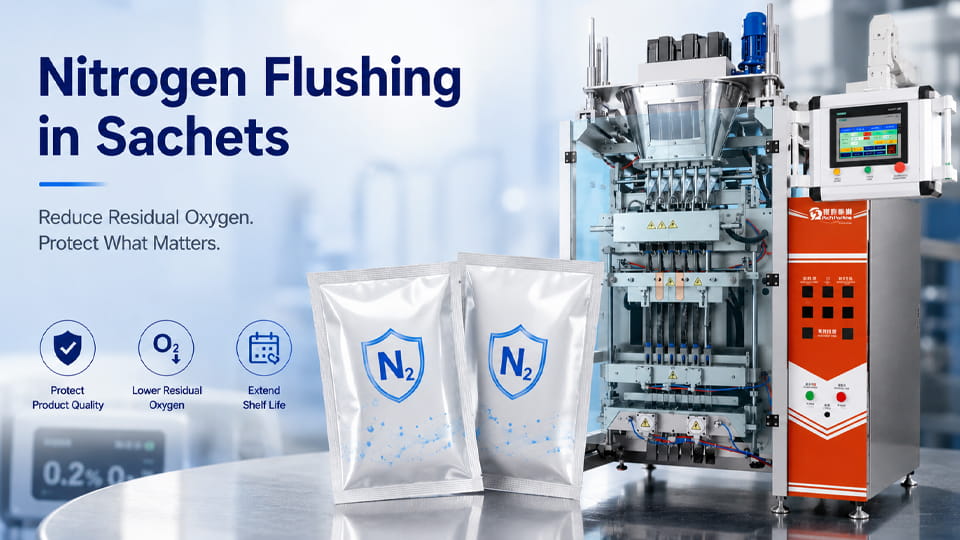
Nitrogen flushing is a simple but effective form of Modified Atmosphere Packaging (MAP). Instead of sealing a sachet with ambient air inside (which is about 21% 酸素), the packer injects or displaces that air with inert nitrogen gas just before sealing. で 縦型フォーム充填シール (VFFS) sachet machine, a nozzle delivers nitrogen into the open bag mouth so that most of the surrounding air is pushed out through vents or controlled gaps, leaving a “blanket” of N₂ around the powder. Since nitrogen is about 78% of normal air and chemically inactive, it doesn’t react with your product and simply sits around it. This inert atmosphere greatly slows oxidation or moisture-driven reactions. Many industries do this – for example, coffee roasters flush beans, and chip makers cushion and protect fragile snacks with nitrogen. For sachets of pharmaceuticals or supplements, 考えは同じです: eliminate oxygen from the headspace so the contents stay stable.
実際に, you’ll use high-purity nitrogen (頻繁 99%+ 食べ物- or medical-grade) and control the flow and timing on your machine. A typical VFFS sachet line will have a dedicated N₂ injector just above the forming tube or next to the filling chute. When the pre-measured dose of powder is in place and before the final seal, a burst of nitrogen fills the void. The flush needn’t remove 100% of oxygen, but it should dilute and displace most of it. Well-optimized systems routinely drive residual O₂ below 2% – often under 1% with multiple lanes or higher purge flow. The exact performance depends on purge time, nozzle placement, product bulk, and bag shape (see later), but properly done it creates a controlled, mostly oxygen-free atmosphere in each sachet.
簡単に言うと, nitrogen flushing takes advantage of the fact that N₂ is inert and makes up 78% of air. By flooding the headspace with N₂, you leave almost no oxygen when you seal the pouch. 技術的には, the process is like this: after filling the sachet with powder, ある pressurized nitrogen stream flows into the top of the pouch (often through one or more nozzles aimed inside the open bag). The nitrogen displaces the air (and O₂) that was originally in that volume. Once enough gas has flowed (usually a fraction of a second to a few seconds), the pouch is heat-sealed. The result is a package whose ヘッドスペース is now rich in N₂ and very low in O₂. If done correctly, the residual O₂ level is mainly from any oxygen remaining trapped in the powder or mixed in quickly during sealing.
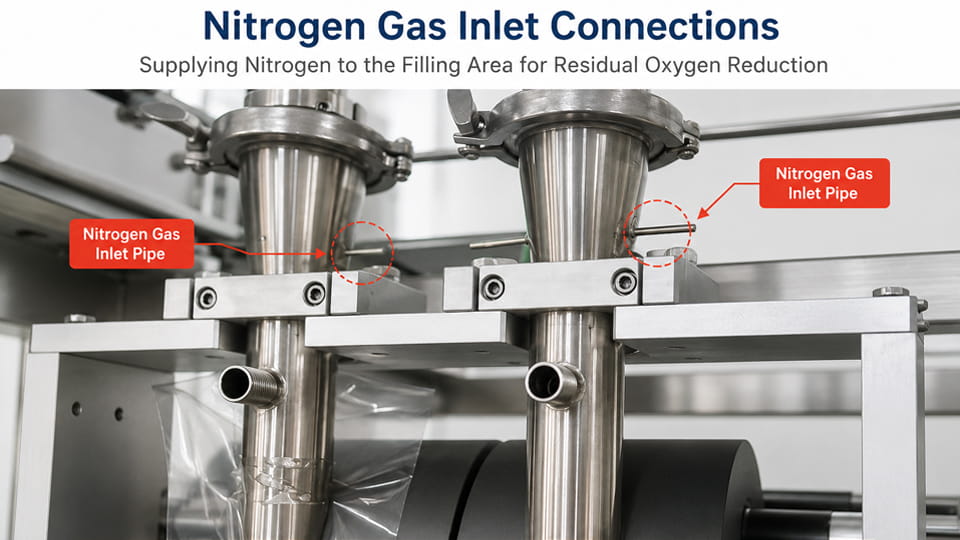
Several factors determine how well the flush works (see later section). 実際に, you set the machine so that nitrogen flow and duration match the bag volume and fill speed. 例えば, a larger pouch or a high-speed machine will need higher flow or a more efficient nozzle to keep O₂ low. 酸素に非常に敏感な製品向け, the equipment may even perform a quick vacuum first, then backfill with N₂ (次のセクションを参照してください). But most often a direct N₂ purge is used on sachet lines to avoid excessive bag collapse.
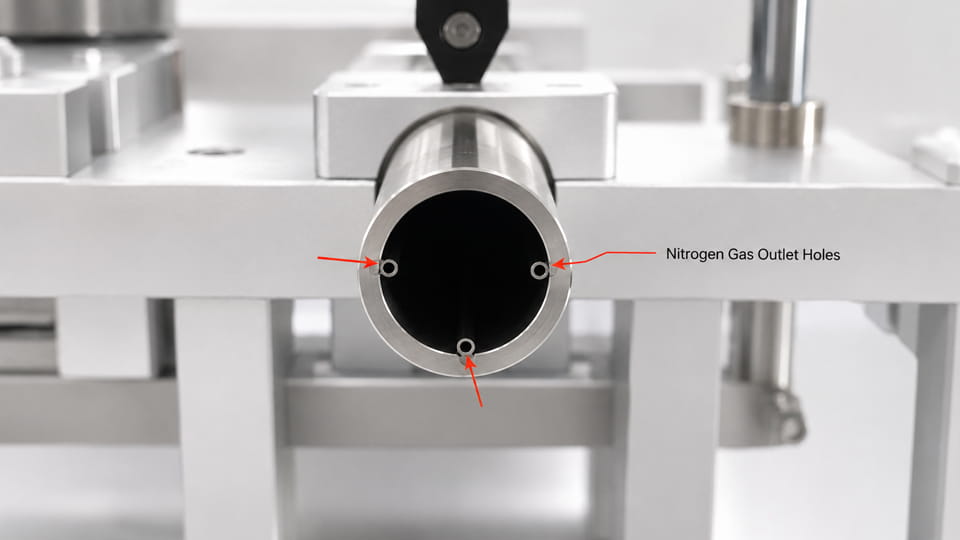
It’s worth comparing nitrogen flush to vacuum sealing. Both aim to reduce oxygen, but they work differently: vacuum packaging pulls air out by creating negative pressure, 一方 窒素フラッシュ replaces air with N₂ while keeping pressure near atmospheric. Each method has trade-offs. で サシェマシン, a full vacuum can cause the pouch to collapse tightly around the powder, potentially disturbing the product or even damaging very fragile items. 対照的に、, a nitrogen flush keeps the pouch “plump,” maintaining its shape during sealing. ある業界関係者は次のように説明しています。, “vacuum sealing removes air by creating negative pressure, which flattens bags and can damage delicate items. Nitrogen maintains package volume”.
場合によっては, manufacturers use a combination: 例えば, they might briefly evacuate the pouch and then backfill with N₂ before sealing. This can yield even lower oxygen levels (since first vacuum removed most air) while still protecting the package shape with N₂. しかし, that approach requires more complex equipment (vacuum pump plus nitrogen injection) そして慎重なコントロール. 要約すれば:
We won’t claim one is always better – it depends on the product. For fragile powders or when bag appearance matters, N₂ flushing is often preferred. For very short-term shelf-life or non-delicate items, vacuum sealing might suffice. ジンル パッケージライン can be configured either way – for example, ジンル ドイパック (既成ポーチ) 機械 are compatible with auxiliary vacuum or gas flush modules if needed.
Why not just leave room air in the pouch? Nitrogen is used because it is essentially inert. Air is 21% 酸素, which can oxidize or react with the product over time. Displacing air with nearly 100% N₂ dramatically cuts the oxygen exposure. Nitrogen won’t react with the drug, spice or サプリメントパウダー, and it doesn’t support microbial growth. Another practical benefit is regulatory: since N₂ is not considered a food/pill “ingredient,” using it as a flush gas usually doesn’t have to be declared on the label (unlike filling with carbon dioxide or other gases).
Nitrogen flushing is a tool, not a requirement for every packaging job. Use it when the product or market demands the extra protection. 通常, consider flushing in these cases:
When you might skip flushing:
キーポイント: There is no universal “safe O₂ level” for all sachets. Each product should be evaluated. Many food items target <1–2% O₂, but a pharmaceutical formulation might need tighter control or could tolerate a bit more if it’s inherently stable. Use stability studies to decide: run some packs at various O₂ levels and see how the product holds up. That will tell you whether you truly need flush, and if so, what residual oxygen is acceptable.
Even with flushing, some oxygen will remain in each sealed sachet. The final O₂ level depends on many factors in your process and package design:
要約すれば, achieving low residual O₂ is a balance of equipment setup and product characteristics. For a given set of sachet dimensions and powder load, you can play with purge settings (flow/time) until tests show diminishing returns. Keep in mind that if, even under normal purge settings, your initial oxygen readings are higher than expected, it’s often a sign that more N₂ or better nozzle positioning is needed.
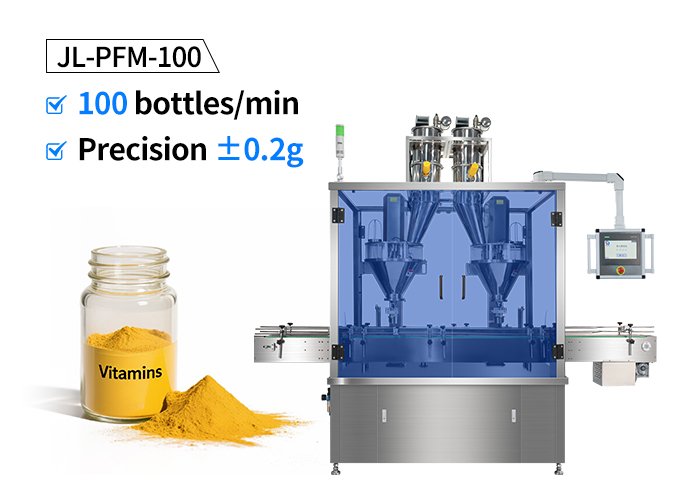
形: Jinlu automatic powder filling machine, ensuring precise powder dosing before sealing. Consistent powder dosing helps maintain a repeatable fill volume and headspace across sachets, making nitrogen flushing performance easier to evaluate and control. Precise filling machines (like the one above) help reduce residual headspace oxygen by minimizing air pockets. 例えば, Jinlu’s high-speed powder filler can dose a wide range of powders with ±0.1g accuracy. Consistent fill weight and density mean each sachet has less empty space that needs purging.
Other factors include the sachet shape and volume – a 枕ポーチ with lots of free space will need more N₂ to sweep out air than a stick pack tightly packed with powder. Also remember that nitrogen mainly displaces the bulk air; tiny air bubbles between powder granules may remain trapped. 時間とともに, oxygen can still migrate through the film (depending on its OTR) or a faulty seal. 実際に, your measured “residual O₂” is influenced by all these factors. If you find it’s higher than targets, check both process parameters (流れ, 時間, nozzle alignment) と材料 (film barrier, シール).
After flushing and sealing, you need a reliable headspace oxygen test to know how much air is left. The most common method is a destructive headspace gas analyzer that punctures the package with a hollow needle. Here’s how it works in principle: a small septum or adhesive port is attached to the sachet wall. A needle pierces the seal and extracts gas from the headspace. An electrochemical or zirconia sensor reads the O₂ percentage in that gas sample. The reading on the instrument gives you the residual oxygen in the pack. The whole process takes a few seconds. This is the industry-standard approach for opaque or metallized sachets.
When using a needle-based analyzer, follow best practices carefully:
Most headspace analyzers only measure O₂ (and often CO₂). They usually do not directly measure N₂ – they infer N₂ by difference. So make sure your instrument is specified for the gases you care about.
For some applications, non-destructive optical methods exist (例えば, ASTM F2714 fluorescent sensors). These involve a tiny oxygen-sensitive sticker placed inside the package before sealing, then an optical fiber or handheld reader measures fluorescence through the pouch wall. In theory this lets you check without opening the pack. しかし, this only works if you have a clear window or transparent film at the sensor spot. Most metalized or foil sachets won’t allow a reading. 言い換えると, optical sensing is not a universal solution for opaque pharma sachets. It also requires you to include the sensor patch in every bag during fill – impractical for long production runs.
For everyday production, the needle method remains the workhorse. Whether you do measurements at-line (integrated on the line) or off-line (in QC) depends on your speed and budget. If you have a high-speed multi-lane line, you might invest in an in-line headspace tester that automatically samples every X seconds. さもないと, sample several packs manually at regular intervals. A good start is to test several sachets at run startup, after any formula change, and at periodic shifts to catch drift. Always record the details: 製品のアイデンティティ, sachet size, machine and lane, シール時間, test time/temp, and the O₂ reading. These records help troubleshoot if something goes wrong.
What should your target O₂ level be? The short answer is: it depends on the product. There is no magic number that works for all sachet-packed goods. その代わり, use a combination of scientific data and risk management:
実際に, many manufacturers start with an internal “control” target (例えば. <1% O₂) and an acceptance spec (例えば. <2-3% O₂), then refine these with real stability results. Keep in mind that a headspace reading is not the same as product oxygen content – if you have entrapped O₂ within the powder, the headspace reading reflects the net effect of that and the bag’s geometry. There are no pharmacopeia limits for sachet O₂, so treat it like any other critical process parameter: justify it based on science and quality risk.
コンテキストについて, food-industry values can be illustrative. 例えば, snack foods often aim for <2% O₂, and packtest guides mention keeping O₂ under 1.5–2% for good shelf life. But those are for preventing rancidity or staling, 薬効ではない. We must ない assume a 2% limit is universally safe. いくつかのビタミン, 例えば, might oxidize at even <1% over long storage. そうは言っても, if you have no data, using 1–2% as a preliminary target is a reasonable starting point. Then validate it with real product testing.
Quality control vs. 仕様: Decide whether O₂ will be a release specification または 工程内制御. Often it’s monitored like a QC test – any batch above a set O₂ level might trigger an investigation or rejection. You could also use it purely as a line control: 例えば。, keep average O₂ below 0.5% to ensure more sachets hit a 2% limit at shelf end. Whatever approach, document your limit and rationale in the quality system.
要約すれば: set your residual O₂ limits based on your product’s needs, not generic rules. Use headspace oxygen measurements and shelf-life results to back up whatever threshold you pick. And always use consistent test methods as described above when evaluating compliance.
If you flush properly, initial O₂ levels should be low. If you see high readings in finished packs, something is off. 一般的な原因には次のようなものがあります。:
要するに, any reading higher than expected right after sealing means the purge step didn’t work as planned, and a gradual rise means the bag isn’t holding vacuum. If headspace oxygen is higher than expected soon after packaging, the gas flushing process may not be working as expected. If oxygen is increasing faster than expected over time, suspect a leak. Use that guidance when troubleshooting.
To achieve the best flush performance, work with your machine settings and accessories:

When commissioning a machine with nitrogen flushing, you’ll want a validation protocol:
本質的には, treat residual O₂ as a critical quality attribute just like fill weight or seal strength. Validate it just as thoroughly. Keep records of your O₂ measurements at various speeds and product lots; this will build confidence and allow you to spot drift over time.
Nitrogen flushing is a powerful way to protect oxygen-sensitive powders in sachets, but its success relies on good process control. For each new product or packaging format, 聞く: Does this product benefit from an inert atmosphere? はいの場合, install a proper N₂ purge system on your stick packer. それから measure and verify – don’t guess. Use a headspace analyzer to test residual oxygen after packaging, and set your acceptance criteria based on real stability data and risk assessment.
要するに, flush if your product or stability data demand it, and back that up with testing. If done correctly, your sachets will leave the factory with only a tiny fraction of the original air inside. And if you ever see oxygen levels creeping up, use the troubleshooting tips above to diagnose flow, タイミング, or sealing issues.
Ready to discuss your needs? Jinlu Packing has three decades of experience supplying stick sachet packaging lines with integrated nitrogen flushing. 私たちのチームに連絡してください with details about your product (用量, 流量, film structure, desired shelf life, 等) とスループット. We’ll help tailor a machine with the right purge configuration and QA plan to keep your residual O₂ under control.
Residual oxygen (O₂) is simply the amount of oxygen left in the bag’s headspace after sealing. It’s usually expressed as a percentage of the headspace gas (with the rest being nitrogen or other gases). 例えば, if we measure 1% O₂, that means 99% of the gas inside is inert (mostly nitrogen).
It depends on the product. Some sensitive powders may require <1% O₂ to maintain full potency, while others might be fine at 5–10%. The right level comes from stability/shelf-life studies. Note that even 1% O₂ is usually a significant reduction from 21% (空気).
Typically you use a headspace oxygen analyzer (a lab instrument). These are commercially available machines (pneumatic or electronics based) with a sharp needle. They puncture the bag and report the O₂%. No special FDA approvals are needed for the instrument itself – it’s like any QC lab device.
Neither is universally “better” – they suit different needs. 真空 (no gas) may give slightly lower O₂ but at the cost of collapsing the pouch. Nitrogen flush keeps the pouch shape and is gentler on fragile products. Many operators use nitrogen flush on stick packs because it’s easier on the product.
はい, you can flush any pouch regardless of material. But optical (非破壊的) O₂ meters usually need a transparent window or film. Foil is opaque, so those won’t work. You would use a piercing sensor for foil sachets.
一般的にはありません. Nitrogen is considered part of “packaging atmosphere” and usually doesn’t need to be listed as an ingredient in food or drugs. しかし, always check local regulations.
Nitrogen is by far the most common because it’s cheap and inert. Carbon dioxide is sometimes used (it can absorb some moisture too) but it can make powders acidic or carbonated. Argon is another inert gas but is more expensive. We usually recommend sticking with nitrogen for sachets.
少なくとも, do a test when changing product or film or machine setup. In stable production, a periodic check (例えば. every few hours or a few batches) is wise. If the product is very critical, you could test every shift. Use statistical sampling: more frequent checks for high-risk products.
間接的に, はい. Moisture can make powders clump, trapping air. また, a humid environment can cause static or condensation that draws oxygen into the pouch after sealing. It’s best to run in controlled humidity (Sharp Services suggests 30–60% RH for pharma suites).
Nitrogen is non-toxic but it can displace oxygen in the air. In small sachet machines, the amount is usually low and the area is ventilated. まだ, operators should ensure there’s adequate ventilation and avoid tight, enclosed spaces without airflow. Large-scale purging might require O₂ monitors or precautions. Always follow your site’s gas-handling safety rules.
参考文献:
1.Standard Test Methods for Pressure Decay Leak Test for Flexible Packages With and Without Restraining Plates —— ASTM F2095-07(2021)
2.Stability testing of new drug substances and drug products – 科学的ガイドライン —— 質問1A(R2)
3.Standard Test Method for Oxygen Headspace Analysis of Packages Using Fluorescent Decay —— ASTM F2714-08(2021)
4.Predicting changes in oxygen concentration in the headspace of nitrogen flushed packages by the ambient oxygen ingress rate method —— ワイリーオンラインライブラリ
5.Effect of nitrogen flushing and storage temperature on flavor and shelf-life of whole milk powder —— Journal of Dairy Science
6.Predicting Changes in Oxygen Concentration in the Headspace of Nitrogen Flushed Packaging Technolog and Science —— Nofima – Research Publication