O que é validação de embalagens na indústria farmacêutica? Um guia completo para fabricantes farmacêuticos
O que é validação de embalagens na indústria farmacêutica? Um guia completo para fabricantes farmacêuticos
abril 29, 2026
Sem comentários
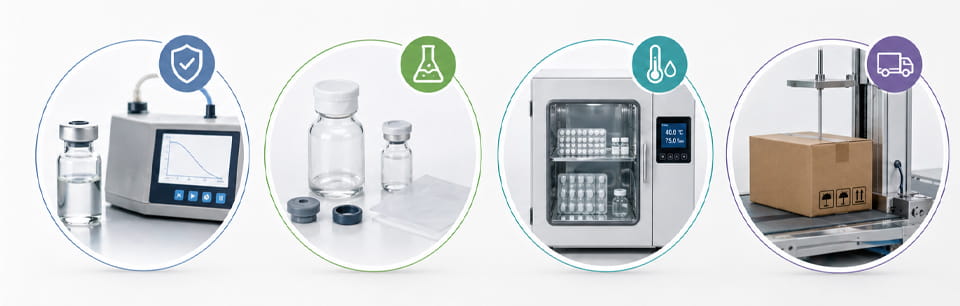
Na indústria farmacêutica, validação de embalagem é um subconjunto crítico de validação de processo focado em garantir que os equipamentos e processos de embalagem protejam consistentemente a qualidade do medicamento. Envolve um programa documentado de qualificação (Instalação, Operacional, Desempenho) e testes (E.G.. integridade do fechamento do contêiner, estabilidade, transporte) para provar que os sistemas de embalagem funcionam conforme pretendido sob condições GMP. A validação eficaz da embalagem protege a segurança do paciente (evitando a contaminação, degradação ou confusões) e garante a conformidade regulatória (FDA, Ema, QUEM, EU, ISO). Este guia explica o definição, passos, testes, padrões, e melhores práticas para validação de embalagens farmacêuticas, e mostra como equipamentos automatizados (como Máquinas da Jinlu Packing) foi projetado para atender a esses requisitos rigorosos.
Definição de Validação de Embalagem
Validação de embalagens em meios farmacêuticos demonstrando com evidências documentadas que o processo de embalagem (equipamentos e materiais) produz de forma confiável uma embalagem que protege o medicamento. Na prática, aplica os mesmos conceitos rigorosos de validação usados na fabricação (IR/WH/PQ) para primário, secundário, e embalagens terciárias operações. De acordo com as orientações GMP da OMS, “Os processos e equipamentos de embalagem precisam de validação/qualificação da mesma forma que qualquer outra parte do processamento dentro de uma instalação farmacêutica.”. Em outras palavras, a validação da embalagem garante a sistema de fechamento de contêiner, rotulagem, e linhas de embalagem atender consistentemente às especificações de qualidade e aos requisitos regulatórios. O objetivo é manter a força do medicamento, pureza e estabilidade através da embalagem, distribuição e prazo de validade, evitando confusões, falsificações, ou dano.
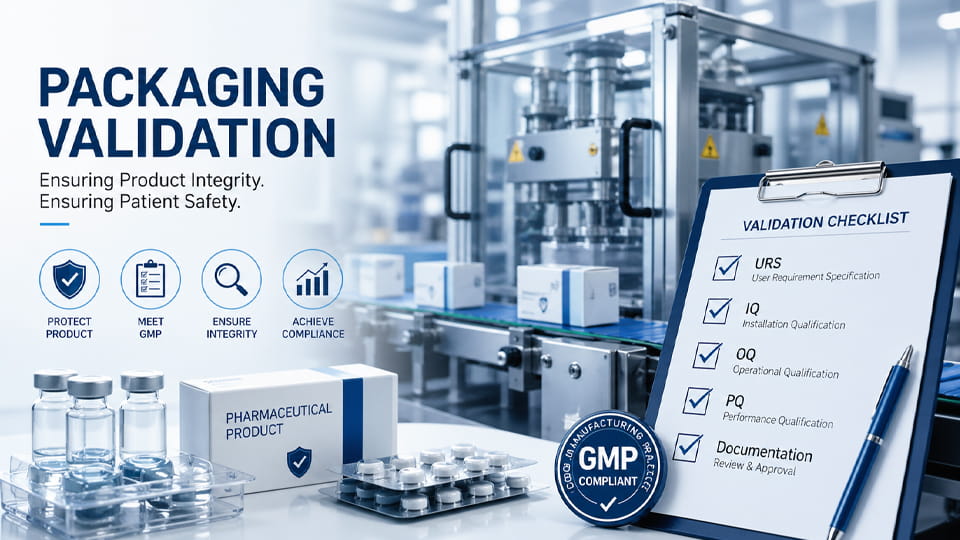
Os resultados típicos na validação de embalagens incluem um Especificação de requisitos do usuário (URS) (o projeto & critérios de qualidade), Protocolos de instalação/operacional/qualificação de desempenho, e registros de testes. O processo de validação abrange:
Embalagem primária (o recipiente ou barreira em contato direto com o medicamento, E.G.. frascos, cavidades de bolhas, saquetas)
Embalagem terciária (contêineres de transporte a granel, paletes, embalagens de cadeia de frio para transporte)
Cada nível deve proteger o produto. Por exemplo, a TGA australiana define “embalagem primária” (o contêiner que cobre imediatamente a mercadoria) e distingue embalagem secundária como a caixa externa ou invólucro. Em última análise, a validação da embalagem está vinculada às GMP – garantindo que recipientes e tampas não alteram o medicamento e “fornecer proteção adequada contra fatores externos” durante o armazenamento e uso.
Por que a validação de embalagens é crítica na indústria farmacêutica
A embalagem farmacêutica é a defesa final da qualidade dos medicamentos. Validar processos de embalagem é vital porque:
Garante a segurança e integridade do produto: Embalagem devidamente validada evita contaminação, entrada de umidade, ou exposição ao oxigênio que pode degradar os ingredientes ativos. Por exemplo, vazamentos ou falhas de vedação podem permitir a entrada de micróbios ou gases, estragando a esterilidade ou potência.
Conformidade regulatória: Agências (FDA, EMA/I, QUEM) exigem embalagem validada. NÓS. FDA 21 CFR 211.94 proíbe fechamentos que alterem a qualidade dos medicamentos e exige fechamentos “fornecer proteção adequada contra fatores externos previsíveis”. EU GMP Annex 1 da mesma forma insiste que “os contêineres devem ser fechados por métodos devidamente validados” (com 100% testes de integridade para produtos fechados por fusão). A OMS afirma explicitamente que os sistemas de embalagem devem ser qualificados como qualquer outro processo GMP. O não cumprimento pode significar lembra, importar rejeições ou citações de auditoria.
Prolonga a vida útil: Os materiais de embalagem e os selos validados sob condições de estabilidade ajudam a definir declarações precisas de prazo de validade. A orientação ICH Q1A especifica até mesmo que estudos de estabilidade sejam feitos no “sistema de fechamento de contêineres” proposto para o produto. Se a embalagem falhar, dados de estabilidade são inválidos.
Serialização e Antifalsificação: As embalagens farmacêuticas modernas geralmente incluem serialização, selos invioláveis, e recursos antifalsificação. Validando esses recursos (E.G.. escaneabilidade de códigos de barras, integridade das fitas adulteradas) ajuda a proteger a cadeia de abastecimento. Um erro na rotulagem ou serialização pode bloquear o lançamento do produto.
Qualidade e eficiência de custos: Linhas validadas eficientes reduzem defeitos (preenchimentos incorretos, erros de etiqueta, caixas esmagadas) e sucata. Inspeções automatizadas (sistemas de visão para verificação de selo/etiqueta) muitas vezes fazem parte de controles validados. Geral, processos de embalagem validados minimizam o risco do paciente e garantem o fornecimento consistente de produtos eficazes, medicamentos autênticos.
Principais motivadores para validação
Segurança do Paciente: Embalagem inadequada pode prejudicar os pacientes (E.G.. injetáveis contaminados). A validação documenta a barreira de segurança.
Mitigação de riscos regulatórios: Processos não validados são de alto risco para recalls ou sanções. Os reguladores esperam dados de qualificação para cada linha de produção.
Distribuição Global: Atendendo aos padrões internacionais (FDA/EMA/OMS) requer embalagens validadas em todos os mercados.
Continuidade de Negócios: Falhas de embalagem na distribuição de resíduos de produto e tempo. A validação garante “certo na primeira vez” operação sob GMP.
Preparação para auditoria: Auditorias realizadas por autoridades de qualidade ou reguladores de clientes analisarão registros de validação de embalagens e qualificações de equipamentos como parte das inspeções de BPF.
Escopo de Validação de Embalagens Farmacêuticas
A validação da embalagem aborda todas as etapas da embalagem. Tipicamente, nós distinguimos:
Validação de embalagem primária: Concentra-se no fechamento do contêiner (frascos, ampolas, cavidades de bolhas, garrafas). Os testes incluem integridade do selo, compatibilidade de materiais (extraíveis/lixiviáveis) e desempenho de fechamento de contêineres. Para produtos estéreis, testes de integridade de fechamento de contêineres (CCIT) são obrigatórios para garantir a manutenção da esterilidade.
Validação de embalagem secundária: Cobre a embalagem externa imediata (caixas, rótulos, folhetos, dessecantes). Isso inclui verificações de legibilidade/precisão dos rótulos, testes de queda de caixa, e testes de compressão de caixa (para transporte). A verificação do rótulo garante que as informações corretas do paciente sejam aplicadas de forma consistente.
Validação de embalagens terciárias: Envolve embalagens a granel/transporte. Aqui, testes de desempenho como vibração, derrubar, e ciclagem térmica (cadeia de frio) simular tensões de transporte para verificar se os paletes e as caixas de transporte mantêm a integridade e a rotulagem do produto durante a distribuição. Protocolos padrão como ASTM D4169 (simulação de transporte) são frequentemente usados.
Cada nível requer avaliação de risco e testes apropriados: por exemplo, primário embalagem pode envolver USP <1207>-testes de integridade de estilo, enquanto secundário testes de embalagem podem incluir resistência da caixa e adesão do rótulo, e terciário embalagem usa protocolos de teste ISTA/ASTM. Tudo deve ser documentado no plano de validação.
Principais etapas no processo de validação de embalagens
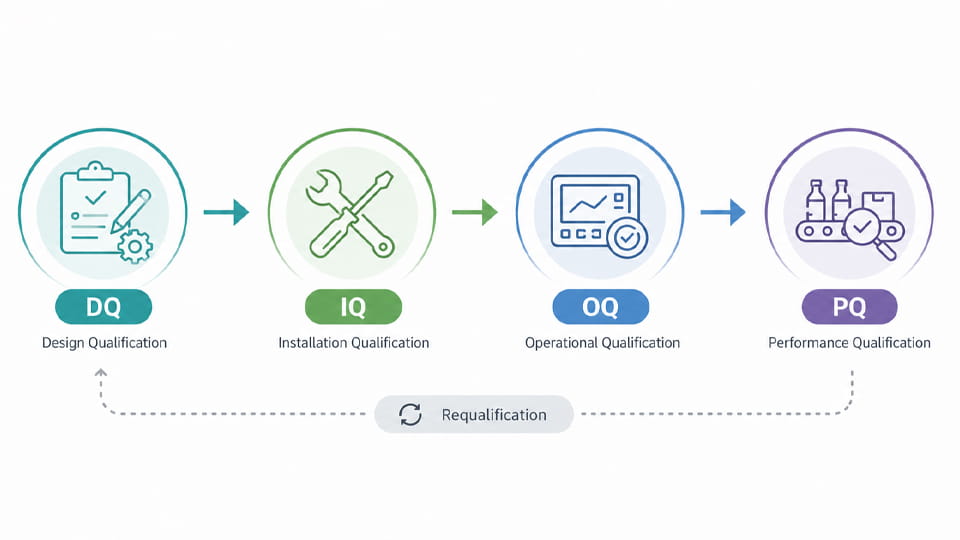
A validação da embalagem normalmente segue o ciclo de vida de qualificação do equipamento/processo, frequentemente descrito como DQ/IQ/OQ/PQ. Esses estágios garantem que uma linha de embalagem nova ou modificada atenda aos requisitos em cada estágio.
Qualificação de Projeto (DQ): Fase inicial onde o projeto é avaliado em relação ao URS (Especificação de requisitos do usuário) e diretrizes de BPF. Todos os aspectos do design (funções da máquina, Materiais, facilidade de limpeza, compatibilidade com produtos/materiais de embalagem) são revisados. Os documentos incluem o URS e especificações de projeto (Especificação de Design Funcional FDS, Especificações de design de hardware/software). Muitas vezes uma avaliação de risco (E.G.. DFMEA) é feito para antecipar modos de falha de embalagem.
Qualificação de Instalação (QI): Verifica se a máquina/linha está instalada corretamente de acordo com as especificações do fornecedor. IQ inclui lista de verificação para verificar a localização correta, utilitários (poder, ar, água), condições ambientais, e montagem adequada. Todos os componentes estão presentes e sem danos. A calibração dos dispositivos de medição é verificada. Entregáveis: Protocolos e relatório de QI, certificados de calibração.
Qualificação Operacional (QO): Verifica se a máquina funciona conforme pretendido sob todas as condições especificadas. Parâmetros críticos (faixas de velocidade, temperaturas, pressões, níveis de vácuo, torque, etc.) são desafiados em configurações mínimas/máximas ou de pior caso. Os testes em OQ podem incluir vedação em velocidades extremas, funções de sensor/alarme, mudanças na velocidade do transportador, precisão da etiquetadora, precisão da bomba de enchimento. O protocolo OQ registra que cada teste funcional atende aos critérios de aceitação.
Qualificação de Desempenho (QP): Demonstra que sob condições normais de produção, a linha produz consistentemente produtos que atendem às especificações de qualidade. PQ é feito em quantidades/lotes de produção reais. Inclui operar a linha por um tempo ou quantidade definida e amostrar a saída. Atividades típicas: executando várias caixas blister, garrafas ou saquetas e realização de testes de controle de qualidade em amostras (Por exemplo, integridade do fechamento do contêiner (CCIT), verificações de peso, inspeção visual de defeitos, força de vedação). PQ mostra que a linha pode operar continuamente enquanto mantém a qualidade do produto.
A tabela abaixo resume os estágios DQ – IQ – OQ – PQ:
Estágio
Propósito
Documentos-chave
Exemplos de atividades/testes
Qualificação de Projeto (DQ)
Verifique se o design do sistema de embalagem atende ao URS/GMP
URS (especificação de requisitos), especificações de design (FDS/HDS/SDS), avaliação de risco
Revisão de projeto, verificações de compatibilidade de materiais, DFMEA
Qualificação de Instalação (QI)
Confirme a instalação adequada do equipamento
Protocolo/lista de verificação de QI, registro de instalação, certificados de calibração
Verifique utilitários, montagem de equipamentos, calibração
Qualificação Operacional (QO)
Verifique as funções do equipamento dentro dos limites definidos
Protocolo OQ, planos de testes funcionais, POPS
Parâmetros de teste (velocidade, temperatura, pressão); verificações de selo
Qualificação de Desempenho (QP)
Garanta qualidade consistente durante as execuções de produção
Protocolo PQ, registros em lote, critérios de lançamento
Execuções de produção; teste de amostra (CCIT, preencher peso, inspeção visual)
Como mostra o diagrama, a validação da embalagem é um processo de ciclo de vida, desde o design até o desempenho. Observe que requalificação pode ser necessário após grandes mudanças ou periodicamente.
Testes-chave na validação de embalagens
Vários testes especializados são comumente realizados durante a validação de embalagens:
Teste de integridade de fechamento de contêiner (CCIT)
CCIT é essencial para produtos estéreis e até mesmo não estéreis. Avalia se o sistema de fechamento de contêineres (E.G.. frasco+rolha+tampa, ampola, selo de bolha) forma uma barreira perfeita. Os métodos incluem decadência de vácuo, queda de pressão, entrada de corante, ou desafio microbiano. Como explica uma fonte da indústria, “Teste de integridade de fechamento de contêiner (CCIT) é um ensaio que avalia a adequação dos sistemas de fechamento de recipientes para manter uma barreira estéril contra potenciais contaminantes.”. Documentos regulatórios (USP <1207>, FDA, Anexo da EMA 1) enfatizar o teste de integridade do fechamento para garantir que não haja vazamentos ou violações. Por exemplo, USP <1207> fornece diretrizes sobre a seleção de métodos de teste de vazamento para certificar embalagens seladas.
Teste de compatibilidade de materiais (Extraíveis/Lixiviáveis)
Materiais de embalagem (plásticos, borrachas, tintas, adesivos) não deve interagir adversamente com o medicamento. Extraíveis e lixiviáveis estudos simulam contato de longo prazo: extraíveis são produtos químicos retirados da embalagem sob condições adversas, e lixiviáveis são aqueles que realmente migram para o produto em condições normais. Estes testes garantem que a embalagem não introduz impurezas tóxicas ou que afetem a estabilidade. Orientações farmacopéicas e da FDA (E.G.. USP <661>, Q3E) delinear testes E/L para sistemas de fechamento de contêineres. Na prática, verifica-se se o polímero, revestimentos, e materiais de rótulo atendem aos padrões farmacopéicos (E.G.. Tipo de vidro USP, Especificações de fechamento de borracha ISO). A OMS observa que os padrões farmacopéicos para fechamentos (como rolhas de borracha) são “requisitos mínimos” e enfatiza estudos de estabilidade para comprovar adequação.
Teste de estabilidade em embalagens
De acordo com ICH Q1A, estudos de estabilidade deve ser feito no medicamento em sua configuração final de embalagem. Durante a validação, o impacto da embalagem na estabilidade é avaliado: por exemplo, a embalagem final está sujeita a envelhecimento acelerado (alta temperatura/umidade) e condições em tempo real para garantir nenhuma degradação (E.G.. entrada de umidade em blisters, permeação de oxigênio em garrafas). Ensaios indicadores de estabilidade (química e microbiana) são realizados. A embalagem que não protege o produto sob estresse invalida as reivindicações de prazo de validade. Por isso, a validação inclui a confirmação de que a embalagem escolhida atende aos requisitos de prazo de validade (isso se sobrepõe aos protocolos de estabilidade regulatória).
Testes de Transporte e Distribuição
Embalagem terciária testes simulam condições reais de envio. Os testes padrão incluem testes de altura de queda, vibração (simulação de caminhão/trilho), compressão (empilhando peso), e ciclagem de temperatura (especialmente para cadeia de frio). Por exemplo, ASTM D4169 (para produtos embalados) ou protocolos ISTA podem ser usados. Um plano robusto de validação de embalagens verifica se as caixas, caixas e engradados protegem as embalagens primárias durante o manuseio: verificando se não há quebra, descascamento de etiqueta, ou danos por umidade ocorrem sob condições de distribuição. Para cadeia de frio, mapeamento de temperatura e transportadores isolados validados são testados para manter as faixas de temperatura exigidas durante o trânsito.
Normas e Diretrizes Regulamentares
A validação de embalagens farmacêuticas deve atender a diversas expectativas regulatórias:
Regulamentos cGMP: Nos EUA, FDA 21 Parte CFR 211 (subparte J) rege contêineres e fechamentos. Seção 211.94(anúncio) especifica que os recipientes/fechos não podem alterar a qualidade do medicamento e devem proteger contra contaminação previsível.
EU GMP: Diretrizes europeias (EudraLex Vol.. 4) exigir isso “os contêineres devem ser fechados por métodos devidamente validados” (Anexo 1) e que os processos de embalagem sigam as GMP (Anexo 15 na validação). EU GMP Annex 11 exige validação de sistema informatizado (incluindo linhas de embalagem com controles eletrônicos).
BPF da OMS: Série de relatórios técnicos da OMS 902 (Anexo 9) afirma explicitamente que o equipamento de embalagem precisa de validação como qualquer outra etapa de processamento. A OMS também fornece orientações sobre a integridade da embalagem (semelhante à UE/ICH).
Diretrizes do ICH: Embora o ICH (Q7, Q8, Q9, Q10) não possui documento específico de validação de embalagem, eles exigem gerenciamento de risco (Q9) e qualidade por design (Q8/Q10) princípios que se aplicam. Por exemplo, avaliação de risco (Eu Q9) deve cobrir atributos de embalagem (tipo de fechamento, controle de rótulo) que afetam CQAs de produtos.
Padrões: Para produtos estéreis, ISO 11607 (para embalagem de dispositivos médicos com esterilização terminal) é frequentemente usado por analogia; Papel 2 da ISO 11607 define requisitos de validação para processos de formação/selagem, o que é relevante para blisters ou ampolas de medicamentos parenterais. Farmacopeias (USP, Ph.. EUR.) também contém capítulos de teste de embalagem (E.G.. USP <381> para fechos de borracha, <1207> para teste de vazamento).
Resumindo, qualquer linha de embalagem deve estar em conformidade com a farmacopeia nacional e os padrões regionais de GMP. As listas de verificação de conformidade normalmente citam a FDA, EU GMP, OMS e padrões ISO relevantes, e muitas vezes exigem POPs totalmente documentados e planos diretores de validação que abranjam embalagens.
Desafios comuns na validação de embalagens
A validação de embalagens apresenta desafios únicos em comparação com os processos de fabricação:
Tipo de dados e amostragem: O sucesso da linha de embalagem é frequentemente determinado por resultados discretos (E.G.. aprovado/reprovado para um selo, rasgar) em vez de medições contínuas. Como observa um especialista, “o tipo de dados obtidos…cria um desafio significativo. O sucesso ou o fracasso são muitas vezes determinados por defeitos (lágrimas, buracos, manchas, ou vazamento de vedações)… Essa falta de mensurável (variável) os dados geralmente exigem tamanhos de amostra muito grandes para que um processo de embalagem seja validado estatisticamente.”. Em outras palavras, você pode precisar de muitas amostras para demonstrar confiabilidade.
Variedade de tecnologia: Existem muitas tecnologias de embalagem (bolhas, cartonadores, rotuladores, embaladores de caixas, etc.) de diferentes fornecedores. Cada um tem perfis de risco diferentes, tornando impossível um plano de validação de tamanho único.
Controle de mudanças: As linhas de embalagem geralmente executam muitos tipos de produtos (comprimidos, líquidos, pós) e tamanhos de embalagens no mesmo equipamento (usando alterar peças ou formatos). Cada alteração pode exigir revalidação ou agrupamento no plano de validação. Gerenciando isso (o matriz de validação) pode ser complexo.
Controles ambientais: Algumas embalagens (E.G.. embalagem blister de medicamentos sensíveis à umidade) requer umidade controlada ou atmosfera inerte. Validar esses controles adiciona complexidade.
Integração com Processo Upstream: A validação da embalagem depende da consistência upstream. Se os grânulos do medicamento variam em tamanho, a troca da máquina de embalagem pode ser afetada (E.G.. encher geléia). Essa interdependência pode complicar a análise da causa raiz das falhas de embalagem.
Serialização/rastreamento: Regulamentações modernas (E.G.. DSCSA, febre aftosa na UE) exigem serialização e rastreabilidade. Garantir que linhas automatizadas rastreiem adequadamente cada unidade (e validando essa captura de dados) adiciona uma camada extra de qualificação (validação de software, testes de scanner de código de barras, verificações de banco de dados).
Ambiguidade Regulatória: Paradoxalmente, há orientação explícita limitada da FDA/EMA apenas sobre “validação de embalagens,”portanto, as empresas devem frequentemente interpretar as diretrizes gerais de GMP e validação de processo para embalagens. Isso pode causar incerteza sobre o escopo exato ou os testes necessários.
Apesar desses desafios, o princípio subjacente permanece: trate a embalagem como qualquer outro processo crítico, com qualificação completa e verificações de CQ robustas. Como o artigo do ISPE conclui, validação de embalagem “diferem(é) pouco da validação de processos utilizados para fabricação de medicamentos.”.
Melhores práticas para validação de embalagens farmacêuticas
Para superar desafios e garantir uma validação bem-sucedida, siga estas práticas recomendadas:
Avaliação Precoce de Risco: Use o gerenciamento de riscos de qualidade (Eu Q9) desde a fase de projeto. Identifique atributos críticos da embalagem (E.G.. esterilidade, evidência de adulteração, proteção contra luz) e priorize os testes de acordo. Um modo de falha & Análise de Efeitos (FMEA) é recomendado durante DQ para planejar o escopo de validação.
Especificações de requisitos do usuário (URS): Documente claramente todos os requisitos antecipadamente: capacidade de produção, formatos de pacote, pontos de integração (E.G.. ligando uma máquina de blister a uma cartonadora), condições ambientais, requisitos de limpeza. Um URS bem definido mantém a validação no caminho certo.
Procedimentos Operacionais Padrão (POPS): Manter POPs detalhados para operação do equipamento, limpeza, mudança, e manutenção. A validação deve fazer referência a esses POPs para garantir o uso consistente.
Inspeção e controles automatizados: Incorpore verificações de qualidade em linha (E.G.. sistemas de visão para inspeção de impressão/etiqueta, controladores de peso, leitores de código de barras, detectores de vazamento). Estas não são apenas ferramentas de controle de qualidade, mas também fazem parte da validação, detectando defeitos em tempo real.
Documentação Abrangente: Prepare um plano mestre de validação descrevendo a estratégia, e garantir todos os protocolos de qualificação (IR/WH/PQ) ter critérios de aceitação claros. Mantenha registros detalhados de todas as execuções, desvios, e retestes. Use listas de verificação para garantir que nada seja esquecido.
Treinamento e Pessoal: Os operadores e a equipe de CQ devem ser treinados tanto no equipamento quanto nos procedimentos de validação. Somente pessoal qualificado deve realizar testes de validação e registrar resultados.
Software e registros eletrônicos: Para controles computadorizados, siga a FDA 21 CFR Parte 11/Anexo GMP 11: validar software, trilhas de auditoria, assinaturas eletrônicas (garantir a segurança, cópias de segurança). Mesmo as linhas de embalagem não estéreis geralmente possuem CLPs/IHMs que precisam de validação.
Design para Validação: Sempre que possível, escolha máquinas com recursos que simplifiquem a validação: E.G.. servo drives com controles digitais (para preciso, parâmetros reproduzíveis), molduras higiênicas em aço inoxidável (para fácil limpeza), peças de fácil troca (para reduzir o esforço de limpeza entre formatos), e design modular (para limitar o número de configurações que requerem testes).
Verificação contínua: A validação da embalagem não é “uma vez feita”. Implementar gatilhos de revisão periódica ou revalidação (E.G.. após grande manutenção, atualizações de equipamentos, ou desvio significativo do processo). Use controle estatístico de processo (CEP) nas principais métricas (variação de peso de preenchimento, taxa de defeito) para capturar tendências antecipadamente.
Integridade de dados: Aplicar os princípios ALCOA+: todos os dados de validação (registros de teste, Relatórios de controle de qualidade, calibrações) deve ser atribuível, legível, contemporâneo, original, e preciso. Use cadernos encadernados ou sistemas eletrônicos validados.
Ao incorporar o pensamento de validação em todas as etapas – desde o design até a operação diária – os fabricantes podem garantir que as linhas de embalagem forneçam produtos que atendam às expectativas de qualidade e conformidade.
Papel das máquinas de embalagem na validação
A escolha e o design do equipamento de embalagem influenciam fortemente o sucesso da validação. Máquinas de embalagem de alta qualidade são projetadas para atender aos requisitos de GMP e facilitar a qualificação. Por exemplo, Jinlu Packing's máquinas automatizadas são construídas com recursos que agilizam a validação:
Precisão e consistência: Jinlu's máquinas de bolha, cartonadoras e enchedoras usam servomotores e mecânica precisa para garantir uma pressão consistente de selagem a quente, preencher volumes, e indexação. Esta repetibilidade é crucial para passar nos testes OQ e PQ (E.G.. o dispositivo de alimentação servo-acionado fornece “posicionamento preciso” em sua linha de bolha).
Design Higiênico: Os materiais e superfícies são de aço inoxidável ou plásticos em conformidade com a FDA, projetado para fácil limpeza. Suave, superfícies inclinadas evitam armadilhas de poeira. Isto apoia a conformidade com GMP e simplifica a validação de limpeza.
Adaptabilidade a Formatos: Jinlu oferece alimentadores personalizados e trilhos-guia para diferentes tipos de embalagens (ver Alimentadores personalizados nas páginas dos produtos). Ter as ferramentas certas reduz a variação e acelera a mudança de formato, o que reduz as necessidades de requalificação ao mudar de formato.
Controles Integrados: As linhas modernas da Jinlu possuem controles PLC/HMI que podem gerar registros eletrônicos de lote. Por exemplo, a máquina de envase de líquidos tem um AI Siemens PLC/HMI para simples, operação rastreável. Esses controles digitais suportam registro de dados (de acordo com 21 CFR Parte 11/Anexo 11) – crucial para validar que os pontos de ajuste e alarmes funcionam conforme projetado.
Documentação de validação: Jinlu fornece documentação completa (Fichas técnicas, manuais, etc.). Por exemplo, sua lista de páginas de produtos “Conjunto completo de documentos técnicos” e eles enfatizam o fornecimento de documentação detalhada de projeto e teste. Um fornecedor disposto a fornecer Teste de Aceitação de Fábrica (GORDO) protocolos ou kits IOQ facilitam muito a carga de validação do usuário.
Certificações de Qualidade: Máquinas de transporte Jinlu CE, cGMP e outras certificações, indicando que atendem a certos padrões de qualidade e segurança (veja o logotipo cGMP nas imagens de especificações do produto). O uso de equipamentos certificados pode agilizar a revisão regulatória.
Na prática, uma linha de embalagem validada pode incluir: um Jinlu máquina de embalagem blister vinculado a um máquina de encadernação e contando/preenchendo linhas. Cada equipamento deve ser qualificado (IR/WH/PQ). Os sistemas da Jinlu são projetados para funcionar perfeitamente juntos (E.G.. “linha de embalagem blister altamente automatizada” até 320 caixas/min), reduzindo problemas de integração durante a validação. Também oferecemos estudos de caso (E.G.. um completo linha de contagem e engarrafamento, ou um embalagem automática & linha de rotulagem) que demonstram soluções validadas de ponta a ponta.
Máquina de embalagem de bolhas de rolo DPH-270max
Fazendo parceria com Jinlu ou fabricantes similares, empresas se beneficiam de equipamentos que são “Compatível com cGMP”, suporta um ciclo de vida de validação completo, e vem com suporte pós-venda (comissionamento, treinamento) para garantir que a linha permaneça validada.
Conclusão
Validação de embalagem é essencial para a qualidade e conformidade farmacêutica. Ao tratar as operações de embalagem com o mesmo rigor que as principais etapas de fabricação, empresas garantem que seus produtos cheguem aos pacientes com segurança. O processo abrange a definição (URS, avaliação de risco), qualificação (DQ/IQ/OQ/PQ), teste (CCIT, estabilidade, transporte), e monitoramento contínuo. É regido pelos regulamentos GMP (FDA, Ema, QUEM) e padrões da indústria.
Equipamentos modernos de embalagem automatizada – como as máquinas da Jinlu Packing – desempenham um papel fundamental na validação. Projetado para precisão, higiene e rastreabilidade eletrônica, eles ajudam os fabricantes a atender aos critérios de validação de forma eficiente. Ao selecionar linhas de embalagem, considere fornecedores que forneçam documentação de validação completa e suporte.
Em última análise, validação completa da embalagem é “a salvaguarda final para a qualidade do produto e segurança do paciente”, alinhamento com as demandas regulatórias e as metas de negócios.
Pronto para validar sua linha de embalagens?Contate os especialistas da Jinlu Packing para discutir soluções de embalagem em conformidade com GMP ou solicitar um orçamento.
Perguntas frequentes sobre validação de embalagens na indústria farmacêutica
Qual é a diferença entre validação de embalagem e validação de processo?
A validação do processo normalmente se refere às etapas de produção da substância medicamentosa ou do medicamento a granel (E.G.. misturando, granulação, compressão). A validação de embalagens aplica especificamente princípios de validação às operações de embalagem (vedação, rotulagem, enchimento de caixa, etc.). No entanto, ambos seguem o mesmo ciclo de vida DQ/IQ/OQ/PQ e requisitos de GMP. Essencialmente, a validação da embalagem garante o processo de embalagem (não apenas o processo de fabricação) atende consistentemente aos requisitos de qualidade.
Quais testes são necessários para validação de embalagens farmacêuticas?
Os principais testes incluem integridade do fechamento do contêiner (CCIT) para verificar selos, compatibilidade de materiais (estudos de extraíveis/lixiviáveis), testes de estabilidade (medicamento em embalagem final sob estresse), e testes de distribuição (choque, vibração, temperatura para trânsito). Verificações adicionais cobrem a precisão da etiqueta, sistemas de inspeção visual, peso/verificação de peso, e quaisquer testes específicos do contrato (E.G.. resistência do filme estéril). Todos os testes devem ter critérios de aceitação predefinidos e ser documentados.
Quanto tempo normalmente leva a validação da embalagem?
O cronograma depende da complexidade (número de formatos, equipamento, sites). Um QI/OQ/PQ de linha única pode variar de algumas semanas a alguns meses. Fatores: o número de testes de parâmetros OQ, tamanhos de amostra necessários em PQ, e tempo para execução do teste (E.G.. estabilidade em condições aceleradas leva semanas). Planejando atividades paralelas (como preparar protocolos enquanto o equipamento chega) pode economizar tempo.
Quais documentos regem a validação de embalagens?
As principais referências são regulamentos GMP: 21 Parte CFR 211 (FDA dos EUA), EudraLex Vol.. 4 (EU GMP, Anexo 1 e 15), e Anexo BPF da OMS 9. ICH Q7/Q10 fornece princípios gerais de validação, ICH Q9 cobre gestão de risco para decisões de embalagem, e ISO 11607-2 aplica-se à validação do processo de embalagem estéril. Padrões farmacopéicos (USP, Ph.. EUR.) e diretrizes locais (E.G.. NMPA Chinês, Cronograma M da Índia) também influenciam os requisitos de embalagem. Sempre se alinhe com as regulamentações do mercado-alvo.
Como a Jinlu Packing oferece suporte à validação de embalagens?
As máquinas de embalagem da Jinlu são construídas de acordo com GMP. Eles fornecem documentos de design (URS, FDS), certificados de calibração, e suporte OQ/PQ. Seu equipamento (máquinas de bolha, cartonadores, linhas de enchimento) apresenta servocontrole preciso e design de higiene para atender às especificações de validação. Conforme mostrado no site de Jinlu, as máquinas possuem logotipos cGMP/CE e vêm com conjuntos de documentação técnica. Jinlu também oferece suporte de instalação e validação, soluções personalizadas, e treinamento para ajudar a implementar linhas de embalagem validadas. Para mais informações, consulte as páginas da máquina de embalagem blister ou da máquina de encadernação da Jinlu.
Petty Fu, Fundador da Jinlupacking, traz 20 anos de experiência para o setor de máquinas farmacêuticas. Sob sua liderança, Jinlu tornou-se um fornecedor confiável que integra design, produção, e vendas. Petty é apaixonado por compartilhar seu profundo conhecimento do setor para ajudar os clientes a navegar pelas complexidades das embalagens farmacêuticas, garantindo que eles recebam não apenas equipamentos, mas uma verdadeira parceria de serviços completa, adaptada às suas metas de produção.