

Selecionando o ideal máquina de embalagem de comprimidos efervescentes é crucial para produtores farmacêuticos e nutracêuticos. Comprimidos efervescentes (como vitamina C ou comprimidos antiácidos) são extremamente sensíveis à umidade, portanto, a embalagem deve garantir uma barreira confiável contra umidade. Este guia explica por que os efervescentes precisam de embalagens especializadas, compara formatos de embalagens comuns (tubos, Blister pacotes, saquetas/tiras), e descreve o 7 principais fatores a serem considerados ao comprar uma máquina. Você também encontrará tabelas úteis comparando tipos de máquinas e um fluxograma fácil para orientar sua decisão. Finalmente, consulte nossas perguntas frequentes e uma introdução sem pressão sobre por que os equipamentos e serviços da Jinlu Packing podem ser a escolha certa para suas necessidades de produção.
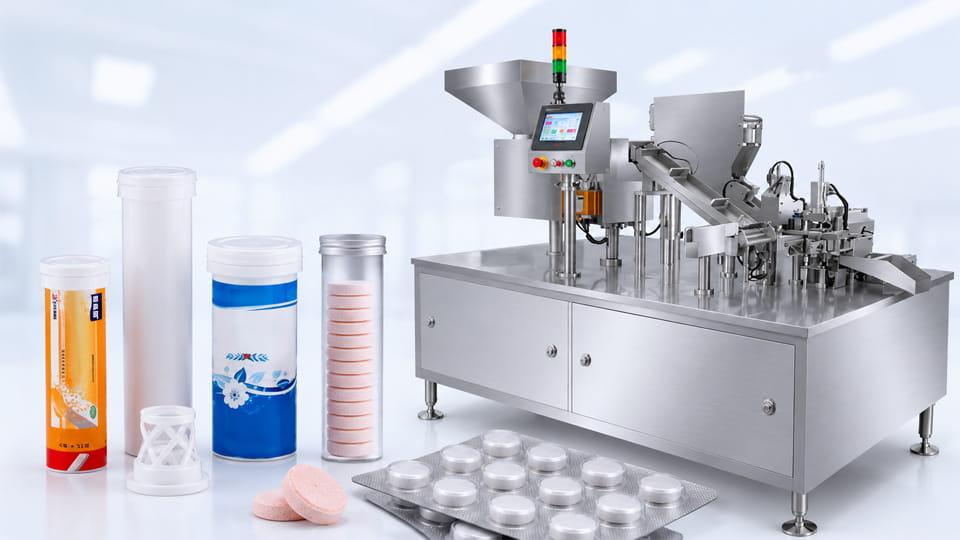
Os comprimidos efervescentes contêm química ácido-base reativa que libera CO₂ quando dissolvido em água, fazendo entrega rápida de nutrientes ou medicamentos. Isto é o que cria a efervescência, mas também significa que eles são extremamente sensível à umidade. Na prática, até mesmo vestígios de umidade pode desencadear prematuramente a reação, suavizar comprimidos, ou reduzir a potência. Para evitar isso, produtos efervescentes são fabricados e embalados em condições de umidade muito baixa (muitas vezes <20–25% UR).
Além disso, efervescentes são geralmente não revestido (dissolver rapidamente), então não há película protetora para bloquear a umidade. A sua estabilidade depende inteiramente da embalagem. Como observa um especialista, se a umidade entrar antes do uso, “a reação pode começar cedo demais” e estragar o produto. Resumidamente, os comprimidos efervescentes diferem dos comprimidos comuns porque o design da embalagem deve priorizar as barreiras contra umidade e oxigênio acima de tudo. O objetivo principal é manter os comprimidos completamente secos e selados – mantendo a integridade e o prazo de validade.
A química única dos comprimidos efervescentes torna qualidade da embalagem é uma questão de qualidade do produto. As principais razões pelas quais uma boa embalagem é crítica incluem:
Resumindo, selecionando o certo embalagem de comprimidos efervescentes não se trata apenas de conveniência ou marca – trata-se fundamentalmente de Proteção de umidade, potência, e conformidade. A embalagem robusta mantém os comprimidos efervescentes estáveis e eficazes até o final do prazo de validade.
Os comprimidos efervescentes são normalmente vendidos em um dos três formatos de embalagem primária: tubos (com bonés), bolhas (frequentemente folha de Alu-Alu), ou tiras/sachês descartáveis. Cada um tem vantagens e desvantagens na barreira contra umidade, conveniência, e custo.
Muitos produtos efervescentes utilizam tubos ou garrafas (feito de plástico, vidro, ou metálico) com um parafuso ou tampa de encaixe. Tubos de plástico (PP ou PE) são os mais comuns para vitaminas e suplementos. Esses contêineres geralmente incluem tampas de torção que são à prova de umidade ou contêm uma inserção dessecante interna de sílica gel. A combinação do tubo de polímero e uma tampa dessecante proporciona excelente proteção contra umidade (o dessecante absorve ativamente qualquer umidade interna). Os tubos normalmente fornecem forte proteção contra umidade, o que é crítico para esses comprimidos hidroscópicos.
Capacidade e enchimento: Os tubos geralmente são preenchidos com qualquer lugar 10 até ~20 comprimidos cada (dependendo do tamanho do comprimido e da altura do tubo). As máquinas automáticas de enchimento de tubos contam e carregam esta quantidade de comprimidos por tubo.
Conveniência e marca: Os tubos são portáteis e fáceis de usar – fáceis de abrir com uma mão – e oferecem bastante espaço para etiquetas. As vantagens incluem portabilidade, capacidade de religamento, e amplo espaço para marcas e instruções. As desvantagens são que eles podem ser mais volumosos (pacotes e caixas maiores) e geralmente carregam menos comprimidos por embalagem do que uma embalagem blister completa.
Comprimidos efervescentes de alta qualidade (especialmente em produtos farmacêuticos ou mercados de exportação) costuma usar Blisters de Alu-Alu formados a frio. Em uma bolha de Alu-Alu, a cavidade e a tampa são ambas de papel alumínio (às vezes laminado em plástico). Isto cria um barreira quase total: sem luz, praticamente nenhuma umidade ou oxigênio pode penetrar. Jinlupacking descreve o Alu-Alu como o “padrão ouro” para medicamentos higroscópicos, alcançando transmissão de vapor de umidade quase zero. Na prática, Blisters de Alu-Alu podem estender a vida útil para vários anos mesmo no calor, climas úmidos.
Quando usado: Alu-Alu é comum na Europa ou em regiões onde a longa vida útil é crítica. É ideal para fórmulas de alta potência ou sensíveis à umidade.
Compensações: A desvantagem é o custo e o tamanho. A folha de Alu-Alu é cara, e a conformação a frio requer processos mecânicos mais lentos. Os blisters resultantes são frequentemente 30-50% maiores do que os blisters de plástico padrão, o que significa caixas maiores e mais volume de remessa. O custo por dose pode ser 2–3 vezes maior que o custo das bolhas de plástico. Portanto, o Alu-Alu costuma ser reservado para casos em que seus benefícios de barreira justificam o gasto.
Pacotes de tiras (saquetas de papel alumínio) são outra opção. Estas são teias de folha contínua seladas em todos os lados em bolsas. Destaques:
Figura: Os comprimidos efervescentes são frequentemente embalados em tubos de plástico com tampas dessecantes para forte proteção contra umidade..
O maquinário principal para embalagem de comprimidos efervescentes corresponde ao formato escolhido. Os dois principais tipos de máquinas de embalagem são Máquinas de enchimento de tubos (para tubos/garrafas) e Máquinas de embalagem de blister (para blisters de alumínio). Consideramos também o sistema totalmente integrado Linha de embalagem que une a contagem, enchimento, limite, rotulagem, e embalagem.
UM máquina de enchimento de tubos (às vezes chamada de máquina de enchimento de garrafas para comprimidos) automatiza o processo de enchimento de um tubo rígido com comprimidos, adicionando uma tampa dessecante, se necessário, e selando-o. Os principais recursos incluem:
[jl_youtube src=”https://www.youtube.com/embed/uNKQtVIApls”]
Exemplo – Jinlu JL-ZGJ-80Pro: Esta máquina de envase de tubos efervescentes totalmente automática lida com comprimidos de grande diâmetro. Ele realiza a classificação, contando, carregando, e limitação em velocidades de até 80 tubos por minuto (≈4800 tubos/hora), com >99.98% precisão de preenchimento. Ele atende aos padrões cGMP e é construído em aço inoxidável para facilitar a limpeza. Essas máquinas representam o que há de mais sofisticado em enchedoras automáticas de tubos.
Os enchimentos de tubos modernos enfatizam precisão e confiabilidade. Eles geralmente incluem design compatível com GMP (Construção SUS316L, sistemas fechados) e ferramentas de troca rápida para trocas de formato. Ao avaliar uma máquina, procure precisão de contagem comprovada (≥99,9%), servo drives para movimento preciso, e fácil limpeza/acesso.
Em vez de um preenchimento independente, muitos fabricantes implantam um sistema completo linha de embalagem que integra equipamentos upstream e downstream. Uma linha típica de embalagem de comprimidos efervescentes pode incluir:
Jinlu observa que nosso enchedor de tubos pode ser “combinado com máquinas de prensagem de comprimidos, despoeiradores, e máquinas de embalagem”para uma linha totalmente integrada. Por exemplo, o enchedor de tubos receberá automaticamente os comprimidos da prensa a montante e alimentará os tubos acabados para a encartuchadora a jusante, minimizando o manuseio manual.
Automatizando cada passo – contando, enchimento, limite, rotulagem, cartonagem – a linha de embalagens aumenta a produtividade e a rastreabilidade. Sensores em cada estágio detectam erros antecipadamente, garantindo que cada caixa saia da linha totalmente compatível.
Para embalagens blister Alu-Alu, um máquina de embalagem blister é usado. Estas máquinas termoformam ou moldam cavidades a frio e selam comprimidos em blisters. Pontos-chave:
Se escolher uma linha de embalagem blister para comprimidos efervescentes, deve-se garantir que ele seja classificado para materiais de alta barreira. O principal ponto de venda é desempenho de barreira contra umidade, não velocidade. Uma máquina de Alu moldada a frio oferece proteção máxima (entrada quase zero) ao custo do rendimento.
A escolha entre tubos (com tampas dessecantes) e os cartões blister Alu-Alu dependem das necessidades do produto. A tabela abaixo compara esses formatos em fatores-chave:
| Fator | Tubo (com tampa dessecante) | Blister Alu-Alu |
| Barreira de umidade | Excelente (dessecante + parede de plástico) | Excelente (MVTR próximo de zero) |
| Barreira de luz/oxigênio | Tubo opaco (bom bloqueio de luz) | Completamente opaco (100% barreira luminosa) |
| Visibilidade do tablet | Não visível (os tubos são geralmente opacos) | Não visível (frustrar) |
| Conveniência do paciente | Fechável novamente, garrafa portátil | Uso único por cavidade (uma vez quebrado, perdido) |
| Velocidade Típica | Alto (E.G.. 60–80 tubos/min) | Moderado (forma a frio mais lenta que o PVC) |
| Custo por Unidade | Médio (tubo + cap, custo moderado de material) | Alto (folha cara, 2–3× custo de material) |
| Vida de validade | Longo (com dessecante, muitas vezes 2+ anos) | Muito longo (3+ anos, mesmo em climas rigorosos) |
| Uso típico | Vitaminas diárias, suplementos efervescentes | Produtos farmacêuticos sensíveis, exportar produtos |
Mesa: Comparação de efervescente embalagem de tubo (com tampa dessecante) vs.. Embalagem blister Alu-Alu. Observação: As bolhas de Alu-Alu proporcionam uma vedação quase hermética, enquanto os tubos dependem de dessecante para manter a secura.
Resumidamente, tubos (ou garrafas) são um formato amigável ao consumidor e perfeitamente adequados quando combinados com um dessecante. Eles são mais rápidos e baratos para embalar. Bolhas de Alu-Alu são escolhidos quando a barreira máxima é necessária apesar do custo - por exemplo, para efervescentes com prescrição médica ou em mercados que exigem prazo de validade de 3 anos.
Ao avaliar máquinas de embalagem para comprimidos efervescentes, concentre-se nesses recursos cruciais - eles também tendem a ser os que mais solicitam os clientes:
Abaixo está uma tabela de comparação que resume as opções de materiais e embalagens para desempenho de barreira contra umidade:
| Material/Formato de Embalagem | Barreira de umidade (MVTR) | Uso típico |
| Tubo de plástico (PP/PE) + dessecante | Muito baixo (com boné + dessecante) | Vitaminas OTC, suplementos (uso diário) |
| Blister de Alu-Alu em forma fria | Perto de zero (barreira final) | Efervescentes de alta qualidade, mercados de exportação |
| Blister PVC-PVDC | Moderado (0.5–1,0 g/m²·dia) | Comprimidos genéricos (usado se o custo do Alu for muito alto) |
| Blister de PVC (sem PVDC) | Baixo (3–6 g/m²·dia) | Não recomendado para compostos higroscópicos |
| Tira/Saqueta (Folha/Filme) | Variável (0.5–2,0 g/m²·dia) | Pacotes de dose única ou de viagem (alguma barreira, opções menos que rígidas) |
Mesa: Barreira de umidade típica de várias embalagens efervescentes. Até mesmo os tubos PP/PE contam com a tampa dessecante para temperaturas próximas de zero barreira, enquanto a folha de Alu-Alu é virtualmente impermeável.
Mesmo com o equipamento certo, problemas podem surgir em embalagens efervescentes. Aqui estão os problemas típicos e como corrigi-los:
A manutenção proativa é fundamental: mantenha todos os funis de alimentação (comprimidos, tubos, bonés) limpo e seco, substituir peças desgastadas (E.G.. raspadores de panela, rodas estreladas) dentro do cronograma, e execute lotes de teste ao alterar formatos.
Para um confiável linha de embalagens efervescentes, Jinlu Packing oferece uma solução completa. Os principais componentes incluem:
Cada uma dessas máquinas é construída de acordo com padrões farmacêuticos (Compatível com FDA/CE, Peças de contato SUS316L) e vem com documentação. Ao escolher um sistema coordenado, você garante que cada etapa do comprimido à embalagem seja otimizada para produtos efervescentes.
Escolhendo o direito máquina de embalagem de comprimidos efervescentes é mais do que velocidade. Trata-se de proteger seus tablets da umidade, garantindo a estabilidade do produto, e atendendo aos padrões regulatórios. Como já discutimos, fórmulas efervescentes são altamente sensíveis, então todos os aspectos da embalagem – material, máquina, e processo – deve minimizar a umidade e manter uma vedação hermética.
Em termos práticos, isso significa escolher uma máquina (ou linha) que oferece manuseio robusto de barreiras (tampas dessecantes ou papel alumínio), operações precisas (contagem e limite precisos), e total conformidade (Projeto e documentação de BPF). Linhas automatizadas de enchimento de tubos (com contagem, rotulagem, embalagem) são geralmente os burros de carga da indústria efervescente hoje.
Procurando uma solução confiável de embalagem de comprimidos efervescentes? Entre em contato com a Jinlu Packing hoje para orientação especializada e um orçamento personalizado. Nossa equipe pode ajudá-lo a escolher a máquina certa e garantir que ela atenda aos padrões de conformidade globais – tudo respaldado por garantias completas e suporte técnico.
Porque a química deles (ácido + base) reage mesmo com pequenas quantidades de água, efervescentes são extremamente higroscópicos. A umidade pode ativá-los prematuramente, suavizar os comprimidos, ou fazer com que os ingredientes ativos se degradem. Embalagem especial com dessecantes e selos herméticos evita que qualquer umidade chegue aos comprimidos, mantendo-os potentes até o uso.
Depende das necessidades do produto. Tubos (com tampa dessecante) são populares para vitaminas e suplementos de consumo porque são convenientes, reutilizável, e fornecem excelente proteção contra umidade. Os blisters Alu-Alu proporcionam uma barreira ainda mais forte (entrada de umidade quase zero) e prolongar a vida útil, que é ideal para produtos farmacêuticos sensíveis ou exportações de alto valor. Os sachês também são usados para conveniência de dose única, mas oferecem menos barreira do que tubos ou blisters.
Os blisters de PVC padrão por si só geralmente não oferecem proteção suficiente contra umidade para comprimidos efervescentes. Eles têm permeabilidade moderada. Se estiver usando bolhas, é melhor usar filme laminado de PVC + PVDC ou folha totalmente Alu-Alu para bloquear a umidade. De outra forma, a entrada de umidade pode reduzir drasticamente a vida útil.
Você precisa de uma máquina de enchimento de tubos para comprimidos efervescentes, que conta automaticamente, enche tubos, insere rolhas dessecantes, e os tampa. Procure máquinas que atendam ao tamanho do seu tubo, tenha a velocidade desejada (E.G.. 60–80 tubos/min), e alta precisão de contagem (>99.9%). Por exemplo, O JL-ZGJ-80Pro da Jinlu enche até 80 garrafas/min em 99.98% precisão.
A “melhor” máquina depende da sua escala e formato. Para embalagem em tubo, uma máquina de enchimento de tubo de comprimido efervescente totalmente automática (com contagem e limite integrados) é ideal para volumes médios a grandes. Para blisters, é necessária uma máquina de blister Alu-Alu de forma fria. Em geral, priorize máquinas projetadas especificamente para produtos higroscópicos – com recursos como manuseio cuidadoso, controle de contagem fina, e designs higienizáveis. Verifique se o fornecedor fornece conformidade com GMP e suporte de validação.
Use equipamentos de alta precisão com controles de feedback. Máquinas modernas usam servo drives e sensores para confirmar cada ação. Por exemplo, câmeras ou sensores de proximidade podem verificar o número correto de tablets e a presença de cada tampa. Testadores de integridade de vedação (decadência de vácuo, por exemplo) pode fazer parte do controle de qualidade em processo. O preenchimento consistente também vem de um bom fluxo de material (medidas antiestáticas, até mesmo alimentação com comprimidos). Se você ver variação, pode indicar peças desgastadas ou sensores desalinhados que precisam de manutenção.
Algumas máquinas são projetadas para troca rápida. Por exemplo, O enchedor de tubos da Jinlu lida com tubos de 23 a 29 mm de diâmetro (comprimentos diferentes) com moldes modulares que trocam em aproximadamente 5 minutos. Sempre confirme as peças de troca e a faixa de ajuste do modelo. A verdadeira flexibilidade é um recurso premium; máquinas econômicas podem suportar apenas um tamanho de tubo.
No mínimo, A conformidade com GMP é necessária (para indústria farmacêutica). Procure a marcação CE (para a Europa), UL ou CSA (para segurança elétrica na América do Norte), e ISO 9001 fabricação. Se o seu órgão regulador local (E.G.. FDA nos EUA) exige critérios específicos (como Parte 11 para registros eletrônicos), certifique-se de que a máquina suporta isso. Na prática, escolhendo equipamentos de um fabricante confiável (Ascender, Novapak, Há, etc.) que anuncia padrões farmacêuticos é mais seguro. O equipamento de Jinlu lista CE, Ul, Rohs, e conformidade com cGMP.
Referências:
1.O efeito da umidade e da temperatura ambiental na estabilidade física de comprimidos efervescentes em embalagens de folha laminada contendo pequenas imperfeições —— tandfonline.com
2.Embalagem de comprimidos efervescentes —— farmapproach.com
3.Folha de alumínio de alta barreira para embalagem de comprimidos efervescentes —— al-foils
4.Os efeitos da embalagem na estabilidade de um composto sensível à umidade —— Ciência Direta
5.Carbonato de potássio como dessecante em comprimidos efervescentes —— Ciência Direta
6.Comprimidos efervescentes vão para o ar’ em tubos —— packworld
7.Avanços recentes na tecnologia de comprimidos efervescentes: lições aprendidas e perspectivas futuras —— Ciência Direta