
医薬品製造において, CIP (定置洗浄) そして SIP (Sterilization-in-Place) serve complementary roles in maintaining product safety. 簡単に言えば, CIP removes product and process residues from equipment surfaces without disassembly, while SIP uses pressurized steam to sterilize those already-cleaned surfaces. CIP employs circulating water and detergents to chemically clean pipes, tanks and vessels, achieving validated removal of soils to health-based limits. SIP follows by applying saturated steam (typically above 121 °C) to kill any remaining microorganisms. 本質的には, CIP cleans, and SIP sterilizes; neither process alone accomplishes the other’s job. このため, in sterile or aseptic processes CIP is normally performed before SIP to avoid any residues shielding microorganisms during the sterilization step.
CIP systems spray heated cleaning solutions through nozzles and spray balls to wet all product-contact surfaces, then rinse them clean. これ automated cleaning sequence typically includes pre-rinsing, alkaline detergent washing, intermediate rinses, optional acid wash, and a final rinse. Four key parameters – temperature, chemical concentration, flow rate and time – govern CIP efficacy. CIP equipment usually consists of chemical preparation and recovery tanks, supply and return pumps, 流量計, sanitary valves and instrumentation, all controlled by a PLC or control panel. By circulating cleaning agents through the fixed pipeline and process equipment (タンク, ミキサー, フィルター, 等), CIP systems clean the interior surfaces without having to take the equipment apart. This not only reduces manual labor and downtime, but also minimizes the risk of contamination from human intervention. 重要なこと, しかし, CIP is a cleaning process only – it does not achieve sterility.
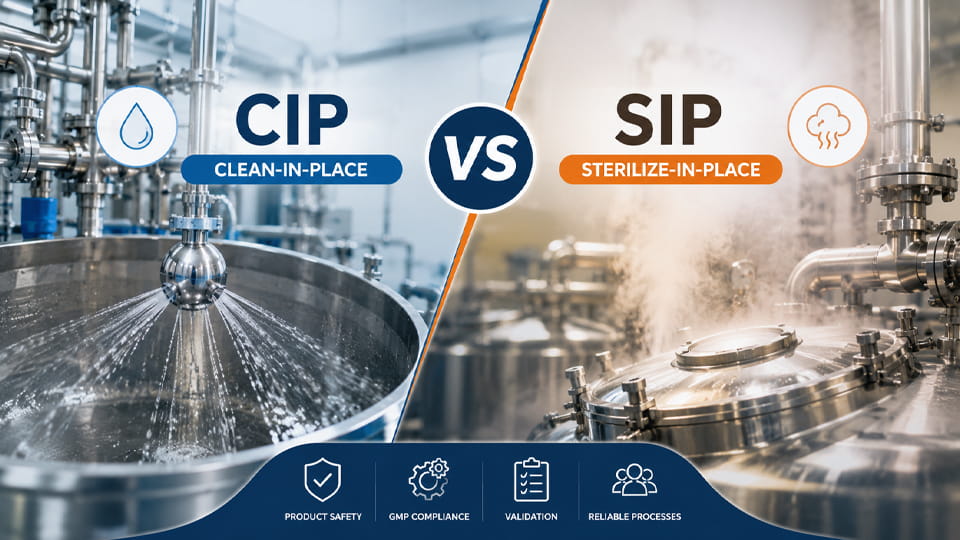
Definition and Purpose: CIP (定置洗浄) is a method of cleaning the interior product-contact surfaces of processing equipment in situ, without dismantling the system. During a CIP cycle, clean water and cleaning solutions (洗剤, アルカリ, 酸, sanitizers, 等) are pumped through the equipment (タンク, パイプ, バルブ) in a pre-defined sequence of steps. The goal is to dissolve and flush out residues from the previous batch – including API, 賦形剤, 洗浄剤, and biofilms – until the system is visibly clean and meets validated residue limits. 重要なこと, CIP is focused on クリーニング, not sterilization: while a CIP step may include a sanitizing rinse, it is not sufficient by itself to guarantee a sterile state.
Typical CIP Cleaning Stages: A standard CIP cycle usually consists of:
Each stage has controlled parameters: 温度, chemical concentration, flow rate/velocity, and contact time are all specified and monitored. 例えば, higher temperatures and sufficient flow (usually above a critical velocity) improve cleaning efficiency by increasing solubility and ensuring turbulence.
Key CIP System Components: A CIP system typically includes storage tanks for fresh and spent cleaning fluids, dosing/heat-exchange systems, パンプス, flow meters and valves to circulate cleaning solutions, spray balls or jet heads inside tanks, and instrumentation (conductivity, 温度, flow sensors) to monitor each step. The system is usually automated via a control panel to execute set “recipes” of rinse, wash, and rinse. A well-designed CIP system follows hygienic design principles (smooth pipes, 死んだ足がない, drains) so that cleaning solutions can reach all wetted surfaces and drain completely.
Definition and Purpose: SIP (Sterilize-In-Place), also called Steam-In-Place (when using steam), is a method of 滅菌 the internal surfaces of equipment in situ, without disassembly. In pharmaceutical operations, SIP is used after cleaning to inactivate (destroy) any remaining microorganisms on product-contact surfaces. 通常, SIP involves circulating saturated clean steam through the system at a specified temperature and pressure, holding it long enough to achieve the required sterility assurance level. The main aim of SIP is microbial kill - 例えば, achieving a sterility assurance level (SAL) of 10^-6 for aseptic processes.
Common SIP Sterilization Stages: A typical SIP cycle includes:
Key SIP Parameters: Critical factors in SIP are steam quality そして 温度. The steam must be saturated (no liquid water droplets) and “clean” (オイルフリー, filtered) to avoid contamination. The pressure is usually set just above what is needed to maintain the target temperature (例えば, ~2.0 bar for 121°C). の temperature distribution must be uniform; cold spots (例えば. dead legs, ポケット) are avoided through design and by possibly using vacuum or pulsation to purge air. Exposure time (hold time) at temperature must be long enough to achieve microbial kill throughout the equipment. 頻繁, validation will use biological indicators and multiple thermocouples at the worst-case points to confirm this.
CIP and SIP are often used together, but they are fundamentally different processes. The table below summarizes their main differences:
| 側面 | CIP (定置洗浄) | SIP (Sterilization-in-Place) |
| フルネーム | 定置洗浄 | Sterilization-in-Place (often using steam) |
| 主な目的 | Remove product and chemical residues | Destroy viable microorganisms (sterilize equipment) |
| Primary Medium | Recirculated water and detergents | Hot saturated steam (often 100–130 °C) |
| Target Contamination | Product soils, dirt, cleaning agent residues | Microbial contamination (細菌, spores, viruses) |
| Validation Focus | Cleaning effectiveness (residue limits, rinse/swab tests) | Sterility (temperature distribution, biological indicators, F₀ value) |
| 典型的な使用例 | Non-sterile processes (タンク, pipelines, non-sterile equipment) | Sterile processes (aseptic lines, closed reactors, filling skids) |
言い換えると, CIP’s job is to make equipment visibly clean and chemically free of residue, while SIP’s job is to make it microbiologically sterile. CIP leaves behind no harmful dirt or detergents beyond validated limits. SIP leaves behind no viable organisms, achieving a high sterility assurance level (often 10^-6) on equipment surfaces. Because they address different hazards, both processes are often required: 例えば, an aseptic filling line usually uses CIP to clean between product batches and then SIP to sterilize the filling manifold and tank before filling.
実際に, pharmaceutical manufacturing lines that require sterility will implement CIP followed by SIP as a coordinated sequence. First a CIP cycle removes all product residues to health-based limits; それから, after draining, a SIP cycle exposes the system to sterile steam. Automation can lock out the SIP step until the CIP pass is confirmed successful. This ensures steam sterilization is not attempted on a dirty system (residues could insulate microbes from heat). In a well-designed process, both cycles are validated and run routinely between production runs.
例えば, a pharmaceutical tank may be cleaned by CIP (washing with caustic and rinsing with purified water) and then sterilized by SIP (steam injection at 121 °C for a validated hold time). Different equipment may require different approaches: an aseptic powder line might have a combined CIP/SIP skid, while an aseptic liquid filler often includes integrated steam jackets. 重要なこと, CIP precedes SIP but is not required for every piece of equipment. Non-sterile process equipment (like many tablet presses or capsule filling machines) often only use CIP or even manual cleaning, whereas critical sterile equipment (like fermenters, 凍結乾燥機, or filling tunnels) will use both CIP and SIP.
Not all pharma equipment has built-in CIP/SIP capabilities. 一般的に, process equipment – such as tanks, 原子炉, 配管, heat exchangers, and filtration skids – is CIP-cleaned and often SIP-sterilized. 例えば, large mixing vessels or buffer tanks in a sterile production area will typically be connected to a CIP/SIP loop. 対照的に, 包装機 打錠機のような, capsule fillers or blister machines are usually cleaned by Clean-Out-of-Place (警官) メソッド (manual disassembly, ブラシ, foams) rather than CIP, because their multi-part mechanical designs make full CIP circuits impractical. If such equipment must support aseptic processing, it may be installed in a cleanroom and sterilized by separate means (例えば. hydrogen peroxide), but typically they do not run internal CIP/SIP cycles.
例として, JinLuPacking’s 自動カプセル充填機 そして 高速打錠機 は GMP-compliant equipment 簡単に掃除できるように設計されています (with polished surfaces and 316Lステンレス), but they rely on validation per batch rather than an internal SIP system. 一方で, dedicated aseptic fillers or lyophilizer tanks often incorporate full CIP/SIP skids. When designing a new line, engineers must consider which components will use CIP, which will use SIP, and which will be cleaned manually, all based on contamination risk and process requirements.
Both CIP and SIP must be validated and documented according to GMP. GMP規制 (のような FDA 21 CFR 211.67 そして 211.113) mandate that equipment be cleaned and, when needed, sterilized by written procedures. 実際に, これはつまり:
Each CIP and SIP system is treated as a critical process: it should have a defined scope, 合格基準, and requalification schedule. Routine verification (例えば. conductivity or TOC monitoring of rinse water) ensures ongoing control. In inspections, regulators often focus on issues like inadequate cleaning before SIP or poor steam penetration. By properly validating CIP (ensuring no cross-contamination) and SIP (ensuring sterility), manufacturers comply with the spirit of cGMP rules without claiming that “every piece of equipment must have CIP/SIP” – rather, equipment must be cleaned and sterilized as appropriate.
Deciding whether to implement CIP, SIP, or an integrated CIP/SIP system depends on the product and process. 主な要因には以下が含まれます::
最終的に, the choice is driven by a GMP risk assessment: evaluate the contamination hazards and verify that cleaning or sterilization methods mitigate them. For many sterile pharma lines, the answer is an integrated CIP/SIP system – as one industry guide summarizes, “CIP must prove cleaning to a health-based limit… SIP must prove lethality at every cold spot with saturated steam and biological indicators”. In non-sterile lines, simpler CIP or manual cleaning may be sufficient.
Even experienced facilities can stumble on CIP/SIP execution. Some typical pitfalls include:
Avoiding these errors requires good engineering and procedures. 例えば, industry experts highlight that 衛生的なデザイン (滑らかな 316L 表面, properly sloped drain, certified valves) is a prerequisite for effective CIP/SIP. Regular training and documentation help operators follow the validated procedures precisely.
要約すれば, CIP and SIP are sequential and complementary steps in pharmaceutical equipment cleaning. CIP removes soils and residues to prepare equipment for the sterile state, and SIP then ensures that all remaining microorganisms are inactivated. Neither process replaces the other – both must be applied as appropriate per GMP to protect product quality.
で ジンルパッキング, we specialize in pharmaceutical production and packaging equipment built for rigorous cleaning protocols. Our capsule filling machines, 打錠機, and turnkey aseptic lines use hygienic design and premium stainless steel to facilitate effective cleaning and sterilization. Whether you need GMP-compliant mixing tanks with CIP/SIP capability or reliable high-speed fillers and packers, we can advise on the right solutions. 私たちのチームに連絡してください to discuss how to integrate proper CIP and SIP processes into your production and ensure compliance with all GMP requirements.
CIP (定置洗浄) is a cleaning process that removes soils and residues from equipment using detergents and rinses. SIP (Sterilization-in-Place) follows by applying high-temperature steam to kill any microorganisms. CIP achieves cleanliness; SIP achieves sterility.
いいえ. CIP is designed to clean, not to sterilize. It removes visible dirt, 製品残留物, and helps reduce the microbial load, but it does not ensure a sterile condition. If sterility is required, a dedicated SIP cycle (or other sterilization) is needed after CIP.
In most cases where both are used, はい. Performing CIP first removes soils that could shield microbes during sterilization. しかし, not all processes require SIP, so CIP may stand alone for non-sterile lines.
Only if the equipment has a sanitary design that supports CIP. タンク, reactors and closed piping are CIP-friendly. たくさんの機械 (例えば. 打錠機, カプセル充填剤, 包装機) require disassembly and cleaning of parts (警官) because their internals cannot be cleaned by simple recirculation.
Common SIP cycles use saturated steam at 121 °C (or sometimes 134 °C) for a specified hold time (often 15–30 minutes). The exact temperature and time depend on the system design and must be validated. Regulatory expectations (like EU GMP Annex 1) demand that every point in the system be shown to reach the target temperature for the full duration.
Cleaning validation typically involves establishing a worst-case residue (例えば. the hardest-to-clean drug or highest potency API) and demonstrating its removal. This is done by sampling (swabs or rinse water) and analyzing for residues, as well as visually inspecting. Acceptance limits are usually based on toxicological thresholds (MACO/HBEL).
F₀ is a measure of sterilization lethality (the equivalent time at 121 °C). SIP validation often uses F₀ calculations or D-values of spores to quantify that the cycle provides sufficient kill. 実際に, many plants just ensure the validated time/temperature is reached everywhere.
No regulation explicitly says “you must use SIP,” but GMP requires that sterile products be manufactured in a way that ensures microbial control. 実際には, if your process involves sterile drug products, SIP (or other sterilization) becomes a necessary part of your validated contamination control strategy (as per FDA 211.113 およびEU附属書 1).
CIP cleans equipment in place without disassembly. COP means equipment is taken apart and cleaned manually or in a washer. CIP is faster and less labor-intensive for suitable equipment, but not all machines can be CIP-cleaned.
Key challenges include ensuring complete coverage (死んだ足がない), uniform heating (no cold spots in SIP), and consistent drainability. Other issues: choosing materials compatible with aggressive cleaners and steam; calibrating sensors for high accuracy; and coordinating utilities (enough steam and clean water capacity). In integrated lines, making sure sequence controls and interlocks (CIP complete before SIP) are reliable is also crucial. These challenges must be addressed in engineering design and documented in qualification protocols.
参考文献:
1.EudraLex ボリューム 4, 別館 1 — Manufacture of Sterile Medicinal Products —— 欧州委員会
2.21 CFR § 211.67 – Equipment cleaning and maintenance. —— 私たち. 食品医薬品局
3.WHO Good Manufacturing Practices for Sterile Pharmaceutical Products —— WHO — TRS 1044, 別館 2
4.ガイド: クリーニング検証ライフサイクル – アプリケーション, メソッド, & コントロール —— IPE
5.Guide to Inspections: 洗浄プロセスの検証 —— FDA
6.Sterilization and Cleaning in Place —— J-ステージ