La granulación es un paso clave en fabricación de tabletas que transforma polvos finos en más grandes, gránulos uniformes. Sin granulación, muchos polvos (API y excipientes) Tienen poca fluidez y compresibilidad., lo que lleva a problemas como la segregación, llenado desigual del troquel, y tabletas débiles. En la práctica, la mayoría de las formulaciones no puedo ser comprimido directamente porque los polvos crudos tienden a ser demasiado finos e inconsistentes. Granulación (mojado o seco) Mejora el flujo de polvo, control de polvo, Mezclar uniformidad y unión., lo que a su vez produce comprimidos de peso constante, dureza y distribución activa. Aunque la compresión directa es más sencilla (menos pasos, menor costo), exige propiedades excepcionales de la materia prima. Este artículo explica ¿Por qué suele ser necesaria la granulación antes de comprimir?, cubre los beneficios y compensaciones de granulación húmeda versus seca, y ofrece orientación práctica para seleccionar el proceso adecuado.
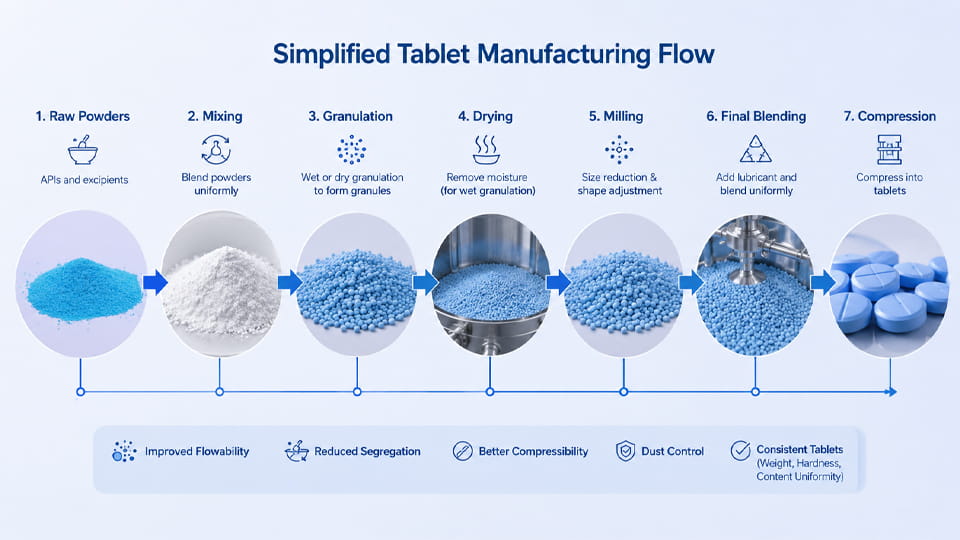
Cifra: Diagrama de flujo de fabricación de tabletas simplificado. Polvos crudos + los excipientes están mezclados, granulado (mojado o seco), seco (si está mojado), molido, mezclado con lubricante, luego comprimido en tabletas.
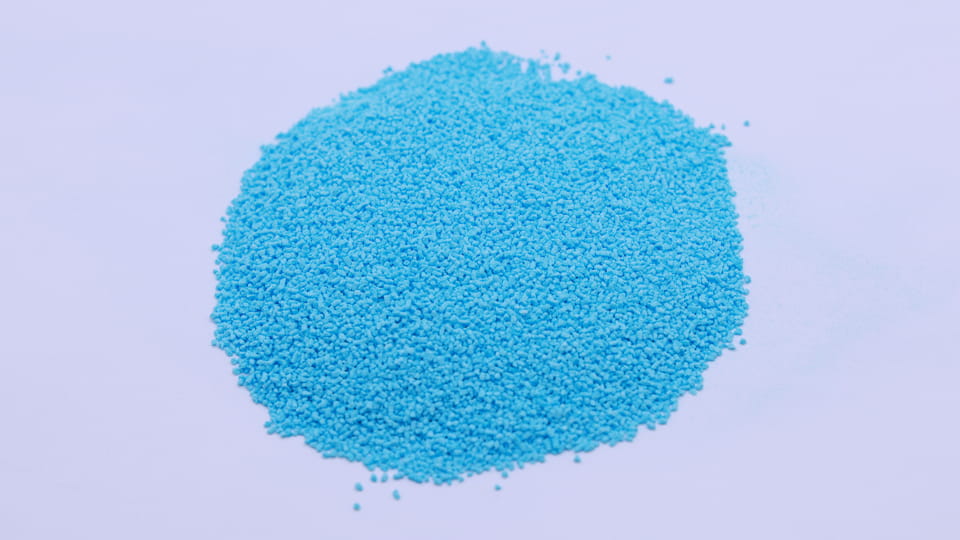
La granulación es una ingeniería de partículas proceso que “transforma polvos finos en polvos más grandes, partículas uniformes llamadas gránulos”. En la fabricación farmacéutica, granulación (mojado o seco) Se utiliza para aglomerar polvos en gránulos con mejor fluidez, compresibilidad, y uniformidad. Por ejemplo, a granulador mezclador de alto cizallamiento (granulador húmedo) agrega aglutinante solución al polvo, formando una masa húmeda, que luego se seca (comúnmente en un secador de lecho fluido) y molido en gránulos. Alternativamente, La granulación seca utiliza presión mecánica. (compactación con rodillo o golpe) comprimir y romper el polvo en gránulos.
Tanto la granulación húmeda como la seca tienen como objetivo producir gránulos que sean denso, fluido y homogéneo. Estos gránulos se introducen en el prensa de tabletas más confiable que el polvo suelto. Los gránulos también generan menos polvo y tienden a comprimirse formando tabletas más fuertes.. En breve, la granulación es un paso fundamental para garantizar que las tabletas cumplan con los atributos de calidad (peso uniforme, fortaleza, precisión de la dosis) cuando los polvos crudos por sí solos no son ideales para la tableta directa.
Teóricamente si (para algunas formulaciones): Ciertas API y excipientes (p.ej. celulosa microcristalina, lactosa secada por aspersión) tener excelente inherente fluidez y compresibilidad. Estas raras formulaciones pueden ser compresión directa (corriente continua) comprimidos sin granulación previa. La compresión directa es la ruta más sencilla.: mezclar polvos + lubricante, luego alimente directamente en una prensa de tabletas. Evita equipos y pasos adicionales. (sin secado), ahorrando tiempo y costos.
Pero en la práctica, la mayoría de los polvos no pueden: La mayoría de las API de molécula pequeña son muy finas y cohesivas., con malas propiedades de flujo y compresión. Si los polvos no fluyen suavemente, la cavidad del troquel se llenará insuficiente o excesivamente, causando variación en el peso de la tableta. Si los polvos no se comprimen bien, las tabletas serán suaves, tapando o rompiendo. Pequeñas dosis (pocos mg API) mezclados con grandes volúmenes de excipientes a menudo sufren segregación (API fino se separa del portador grueso). En breve, excepto excipientes de compresión directa altamente especializados, la mayoría de las mezclas farmacéuticas necesidad granulación para solucionar problemas de flujo/compresibilidad.
La compresión directa sólo es viable cuando la mezcla ya tiene muy buen flujo y compactación. Por ejemplo, Las mezclas binarias de excipientes de flujo muy libre con una tableta de dosis alta pueden funcionar.. La compresión directa también se elige para medicamentos que son extremadamente calientes.- o sensible a la humedad, ya que omite los pasos de mojado y secado. Sin embargo, esto exige una cuidadosa selección de excipientes (P.EJ., lactosa de compresión directa, MCC, excipientes coprocesados) y a menudo formulaciones personalizadas.
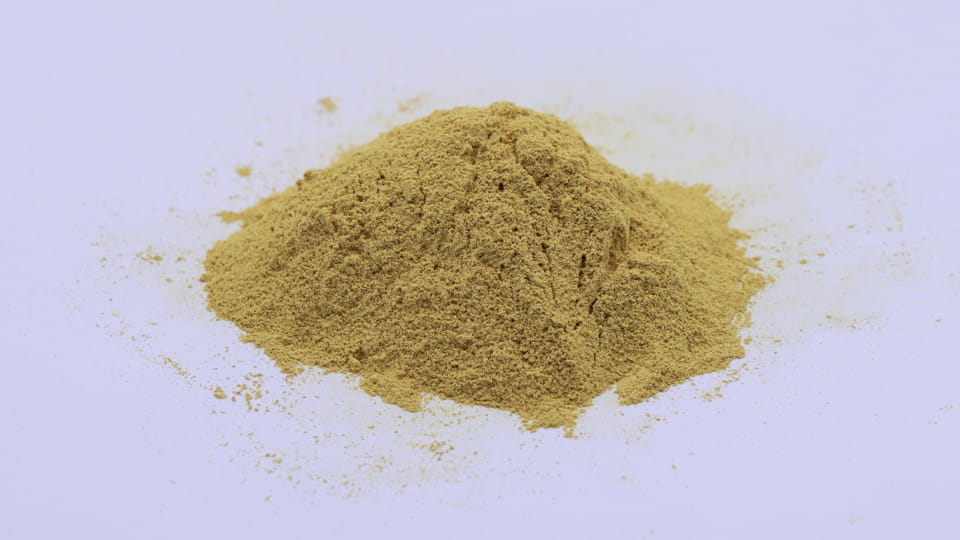
En resumen, la granulación resuelve los principales desafíos de flujo/compresión de los polvos crudos. sin eso, Las tabletas tendrían una variación inaceptable en el peso., dureza y dosis. La compensación son pasos adicionales (mezclando, el secado, molienda), pero para la mayoría de los productos farmacéuticos, La granulación es la forma fiable de garantizar la calidad del producto..
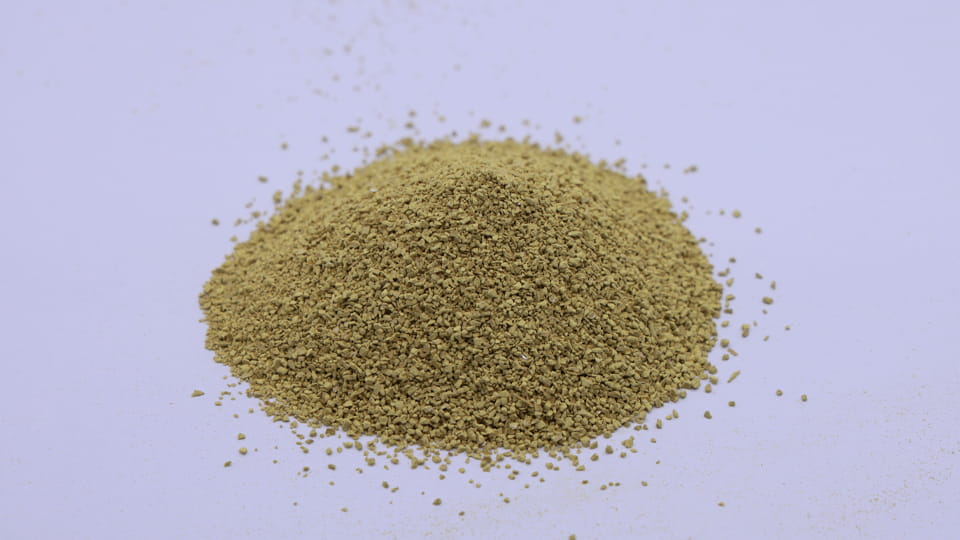
Compresión directa (corriente continua) es el mas simple, proceso de tableta más rentable, y eso se prefiere cuando funcionará. DC minimiza los pasos (sólo mezcla y compactación), requiere menos equipo (licuadora + prensa) y evita el secado. Es el método de referencia si la API y los excipientes ya fluyen libremente., altamente compresible, y mezclar uniformemente. Excipientes altamente solubles como lactosa o alcoholes de azúcar secados por aspersión., combinado con una dosis alta de API, a menudo permiten DC. También se elige para medicamentos sensibles a la humedad o al calor que se degradarían en un proceso húmedo..
Sin embargo, cumplir con esos requisitos materiales es un desafío. Los excipientes para DC deben seleccionarse "críticamente" para que presenten un flujo y una compresibilidad excelentes.. Si esas condiciones no se cumplen, Las tabletas DC sufren variaciones de peso y baja resistencia. De este modo, En realidad, DC sólo es adecuado para alrededor del 10 al 20% de formulaciones; la mayoría requiere el paso de ingeniería de granulación.
Ventajas de la compresión directa: menos operaciones unitarias, menor costo de capital/equipo, sin paso de secado (ahorra tiempo/energía), y la validación más simple. También se utiliza a menudo en productos combinados de dosis fija con una alta fracción de rellenos directamente comprimibles.. Pero para cualquier mezcla con flujo deficiente o riesgo de segregación, la granulación suele ser inevitable.
Ambas rutas pueden fabricar tabletas., pero difieren ampliamente en complejidad y rendimiento.. La siguiente tabla resume las diferencias clave:
| Parámetro | Compresión directa (corriente continua) | Granulación (Mojado/Seco) |
| Complejidad del proceso | Bajo (mezcle y luego presione) | Más alto (mezcla, granular, seco, molino, luego presione) |
| Equipo | Licuadora, prensa de tabletas | Granulador o compactador de alto cizallamiento, secadora, molino, prensa de tabletas |
| Requisitos de fluidez | debe ser excelente | La granulación mejora notablemente el flujo |
| Compresibilidad | Limitado por las propiedades del polvo crudo. | Mejorado por la unión de gránulos |
| Uniformidad de contenido | Más difícil de lograr (riesgo de segregación) | Mejor (segregación minimizada) |
| Generación de polvo | Alto (polvos finos) | Bajo (gránulos, menos multas) |
| Adecuado para la mayoría de las API | No (pocas excepciones) | Sí (amplia gama, especialmente. API de flujo deficiente) |
| Calidad de la tableta | Moderado (depende de la formulación) | Alto (peso constante, fortaleza) |
En general, la granulación es más compleja y costosa, pero ofrece propiedades de polvo superiores. DC es eficiente y rentable, pero sólo cuando las materias primas cumplen inherentemente criterios estrictos.
Una vez que se necesita granulación, la siguiente pregunta es húmedo versus seco. Cada uno tiene pros y contras..


Elegir mojado versus seco: Si su API puede soportar la humedad/calor y el producto exige una uniformidad de primer nivel, se prefiere la granulación húmeda. Si la energía y el capital son limitados o la droga es sensible, la granulación seca es atractiva. En la práctica, la granulación húmeda es más común para las tabletas tradicionales, mientras que la granulación seca se utiliza para casos específicos (p.ej. metformina, aspirina).
Los equipos clave de la línea de fabricación de tabletas se alinean con el proceso elegido. Para granulación húmeda, a granulador mezclador de alto cizallamiento (máquina granuladora húmeda) Se utiliza para mezclar polvo y aglutinante., seguido por un secador de lecho fluido secar los gránulos. Para granulación seca, a compactador de rodillos (máquina granuladora seca) Se utiliza para compactar el polvo en cintas.. los gránulos (de mojado o seco) Luego se muelen si es necesario y finalmente se introducen en un prensa rotatoria de tabletas, que los comprime en tabletas. Después de la compresión, Las tabletas pueden ir a un cubierta de tableta o máquina de embalaje.
| Equipo (Ejemplo de Jinlu) | Función primaria |
| Granulador mezclador de alto cizallamiento | Mezcla polvos y aglutinante líquido para formar gránulos húmedos.. (Granulación húmeda) |
| Secador de lecho fluido | Seca los gránulos húmedos uniformemente (a menudo después de una mezcla de alto cizallamiento). |
| Compactador de rodillos (Granulador seco) | Compacta el polvo en cintas o trozos para granulación en seco.. |
| Prensa rotatoria para tabletas | Comprime polvo o gránulos en tabletas a alta velocidad.. |
Cada uno de los anteriores está disponible en Jinlu Packing. (ver Granulador mezclador de alto cizallamiento, Compactador de rodillos (Granulador seco), y Máquina rotatoria de prensa de tabletas en nuestro catálogo de productos).
Señales de que una fórmula necesita granulación: Si nota problemas como peso inconsistente, desempolvamiento del polvo, tapado de tabletas, o mezclas segregadas durante las pruebas, Es probable que se necesite granulación.. Por ejemplo, si al mezclar el API con el excipiente se obtiene un resultado muy esponjoso, mezcla ligera, a menudo no se comprime bien. También, API en dosis muy bajas (<<50 mg) Normalmente requieren granulación para garantizar una distribución uniforme.. En breve, si hay alguna propiedad a granel (fluir, densidad) es pobre en una combinación de viabilidad, planea granular.
Consejos para mejorar la fluidez/compresibilidad: Además de la granulación, Los formuladores pueden intentar: ingeniería de tamaño (molienda o grados más gruesos para evitar finos excesivos), danza deslizante (p.ej. 0.5–2% de sílice coloidal o talco agregado justo antes de la compresión para reducir la fricción), o lubricantes (estearato de magnesio) juiciosamente. A veces puede ayudar el secado por aspersión o el uso de aglomerados esféricos.. Reducir el contenido de humedad y controlar la humedad también evita la formación de grumos.. Adecuado mezclador diseño (p.ej. alimentación al vacío) puede mitigar el polvo. Finalmente, optimización de los parámetros de la prensa de tabletas (profundidad de relleno, tiempo de permanencia) ayuda a compensar el flujo marginal.
Producción a alta velocidad: En una prensa rotativa moderna, Incluso los pequeños problemas de flujo provocan una desviación del peso.. La retroalimentación de peso en tiempo real y la calibración frecuente se vuelven esenciales. Las máquinas de alta velocidad suelen utilizar compresión de dos etapas. (rollo de precompresión) y alimentadores tipo paleta para mejorar la consistencia del llenado. Si usted debe tableta un polvo que fluye mal, considere actualizar a una máquina con alimentadores forzados o levas de llenado gemelas. Valide siempre que la uniformidad del contenido se mantenga a toda velocidad. Un alimento bien granulado simplifica drásticamente los procesos de alta velocidad: los gránulos mantienen un llenado constante incluso a 200,000 tabletas por hora.
En resumen, Se necesita “granulación antes de la formación de tabletas” porque la mayoría de los API y excipientes no se pueden prensar directamente en tabletas de calidad.. La granulación soluciona problemas fundamentales del polvo: flujo, polvo, Segregación y compresibilidad: que los polvos crudos no pueden manejar.. Si bien la compresión directa tiene su lugar para formulaciones muy especializadas, el paso de granulación proporciona seguridad para una calidad constante de la tableta. Eligiendo la técnica de granulación adecuada (mojado vs. seco) y optimización de los parámetros del proceso, Los fabricantes garantizan que las tabletas cumplan con todas las especificaciones. (peso uniforme, dureza, disolución) en la escala requerida. La granulación no es sólo un gasto extra: es la clave para una fiabilidad, producción de tabletas de alta velocidad.
Ya sea que esté construyendo una nueva línea de producción de tabletas, actualizar el equipo existente, o evaluar el mejor proceso para una formulación específica, Seleccionar la tecnología de granulación adecuada es una decisión importante..
En Embalaje de Jinlu, ayudamos a los fabricantes farmacéuticos, productores nutracéuticos, y organizaciones de fabricación por contrato (CMO) Elija soluciones adecuadas para la granulación húmeda., granulación seca, compresión de tabletas, revestimiento, y embalaje. Nuestro equipo de ingeniería Puede proporcionar recomendaciones prácticas basadas en su capacidad de producción., características de formulación, Requisitos GMP, y objetivos de automatización. Envíenos su especificación de requisitos del usuario (URS), objetivos de producción, o detalles del producto, y le ayudaremos a identificar la solución de granulación y fabricación de tabletas más adecuada para su proyecto..
La granulación antes de la formación de tabletas se utiliza para mejorar la fluidez del polvo., compresibilidad, y uniformidad de contenido. Los polvos finos a menudo no fluyen consistentemente hacia la matriz de la prensa de tabletas., lo que puede resultar en una variación de peso, mala dureza de la tableta, y defectos de fabricación. Convirtiendo polvos en gránulos uniformes., Los fabricantes pueden lograr una producción de tabletas más estable y eficiente..
Sí, Algunas formulaciones se pueden comprimir directamente sin granulación.. Este proceso se conoce como compresión directa.. Sin embargo, La compresión directa sólo funciona cuando el ingrediente farmacéutico activo (API) y los excipientes tienen una excelente fluidez y compresibilidad. Muchos polvos farmacéuticos requieren granulación para lograr una calidad constante de las tabletas..
Los principales beneficios incluyen:
• Mejora de la fluidez del polvo
• Mejor compresibilidad
• Segregación de ingredientes reducida
• Uniformidad de contenido mejorada
• Menor generación de polvo
• Dureza mejorada de la tableta
• Mayor eficiencia de producción
Estas ventajas ayudan a los fabricantes a producir tabletas con una calidad constante y menos problemas de producción..
La mala fluidez puede causar un llenado inconsistente del troquel durante la compresión.. Como resultado, las tabletas pueden tener diferentes pesos, contenido de droga inconsistente, y mayores tasas de rechazo. Un flujo deficiente de polvo también puede reducir la eficiencia de la prensa de tabletas y aumentar el tiempo de inactividad..
La granulación implica convertir polvos en gránulos antes de la compresión., mientras que la compresión directa omite el paso de granulación y comprime el polvo mezclado directamente.
La granulación generalmente proporciona una mejor fluidez., compresibilidad, y uniformidad de contenido, Considerando que la compresión directa ofrece un proceso más simple y rentable cuando la formulación es adecuada..
La granulación húmeda se utiliza normalmente cuando los polvos tienen características de flujo deficientes., pobre compresibilidad, o una tendencia a segregar. También se selecciona comúnmente cuando los fabricantes necesitan mejorar la dureza de la tableta y la uniformidad del contenido.. La granulación húmeda es uno de los métodos más utilizados en la producción de comprimidos farmacéuticos..
Se prefiere la granulación seca para formulaciones que son sensibles al calor o la humedad.. Dado que no se utiliza aglutinante líquido, Ayuda a proteger los API sensibles a la humedad o térmicamente inestables y al mismo tiempo mejora la fluidez y compresibilidad del polvo..
Sí. La granulación puede mejorar la unión de partículas durante la compresión., dando como resultado tabletas más fuertes con mejor integridad mecánica. Los materiales granulados adecuadamente a menudo producen tabletas con mayor dureza y menor friabilidad, al tiempo que reducen defectos como el taponado y la laminación..
La granulación ayuda a distribuir el API de manera más uniforme en toda la formulación y reduce la segregación durante la manipulación y el transporte.. Esto es especialmente importante para formulaciones de dosis bajas., donde incluso pequeñas variaciones en la distribución de API pueden afectar la calidad del producto y el cumplimiento normativo.
El equipo de granulación farmacéutica común incluye:
• Granuladores mezcladores de alto cizallamiento
• Granuladores de lecho fluido
• Compactadores de rodillos
• Granuladores oscilantes
• Secadores de lecho fluido
La elección del equipo depende de las características de la formulación., escala de producción, y si se requiere granulación húmeda o granulación seca.
Referencias:
1.Q7A Guía de buenas prácticas de fabricación para ingredientes farmacéuticos activos -- A NOSOTROS. Administración de Alimentos y Medicamentos
2.Anexo 2 Buenas prácticas de fabricación de productos farmacéuticos de la OMS: principios fundamentales -- OMS
3.Una revisión crítica sobre la granulación de productos farmacéuticos y excipientes.: Principio, Análisis y aplicaciones típicas. —— Ciencia Directa
4.Compresión directa versus granulación —— www.pharmtech.com
5.Un estudio de compresibilidad y compactibilidad de mezclas reales de tabletas.: El impacto de la granulación húmeda y seca frente a una mezcla directa de comprimidos —— Ciencia Directa
6.Influencia de las variables del proceso de granulación y compresión en el caudal de los gránulos y en las propiedades de las tabletas., con especial referencia a la variación de peso —— Ciencia Directa
7.Ingeniería de partículas de excipientes para compresión directa.: Comprender el papel de las propiedades de los materiales —— Biblioteca Nacional de Medicina