×

บริการออนไลน์

💌 วอทส์แอพพ์: +86 1801179332
💡
  • บ้าน
  • บล็อก
  • คู่มือแท็บเล็ต Bilayer: เชี่ยวชาญการผลิตแท็บเล็ตหลายชั้นความเร็วสูงตอนนี้

คู่มือแท็บเล็ต Bilayer: เชี่ยวชาญการผลิตแท็บเล็ตหลายชั้นความเร็วสูงตอนนี้

Bilayer tablets (also called two-layer or multi-layer tablets) combine two distinct formulations in one pill. ในสาระสำคัญ, a bilayer tablet is made by compressing two different powder blends into a single tablet, keeping each blend physically separate in two layers. This design lets manufacturers put two medicines or two release profiles into one pill. ตัวอย่างเช่น, one layer might provide an immediate dose while the other layer delivers a sustained release of the same or another drug. ในทางปฏิบัติ, a bilayer tablet is like pressing two compatible tablets together so that patients only have to swallow one.

Manufacturing of bilayer tablets occurs in clean, controlled facilities to ensure quality. These unique two-layer tablets are more convenient for patients, since they combine multiple medications (or extended-release and fast-release doses) in one pill – improving patient compliance. กล่าวอีกนัยหนึ่ง, by layering drugs in one tablet, bilayers can simplify a treatment regimen. This approach allows delivering multiple active ingredients while reducing the total number of pills a patient needs.
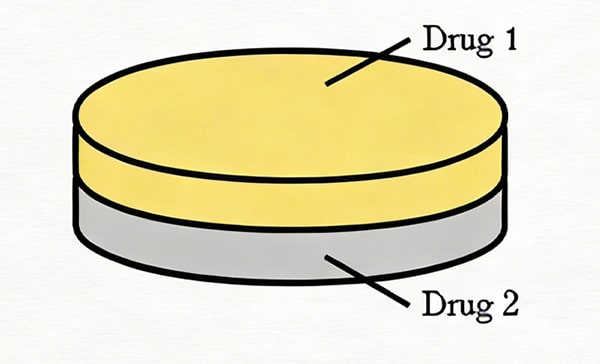
what is a bilayer tablet


Why Use Bilayer Tablets? (Benefits and Uses)

Bilayer tablets offer several key advantages in drug delivery and pharmaceutical manufacturing:

  • Combination Therapy: They can deliver two APIs in one dosage form. By placing different drugs in separate layers, even incompatible ingredients can be combined without chemically reacting. เช่น, one layer could contain a drug that needs to release immediately, while the other layer has a drug for slow release. This dual-layer design is especially valuable for fixed-dose combinations and complex therapies.
  • Customized Release Profiles: Manufacturers can fine-tune how each layer dissolves. As one expert puts it, bilayers “offer the option of differentiating release times” – e.g. an initial “loading dose” in one layer and a prolonged dose in the other. This means better control over drug levels in the body.
  • ปรับปรุงการปฏิบัติตามข้อกำหนดของผู้ป่วย: By combining multiple drugs or release stages into one tablet, bilayers reduce pill burden. AbbVie notes that this can simplify medication regimens – reducing the number of daily doses patients need. Patients often find it easier to take one tablet instead of two or more, which can lead to better adherence to treatment.
  • Handling Incompatible Drugs: Some active ingredients cannot be mixed in the same tablet because they react or degrade. Bilayer tablets solve this by physically separating them into two layers. Each layer is formulated on its own, which prevents direct contact.
  • Efficiency and Marketing: Technically, bilayers can be more efficient than making two separate tablets or a complex release coating. They can also differentiate a product (ตัวอย่างเช่น, two-color tablets or special shapes) which helps with branding and dose identification.

These pill bottles illustrate how bilayer tablets can combine multiple medicines into one dose. ตัวอย่างเช่น, instead of taking two separate pills for morning and evening doses, a single bilayer tablet can be formulated to release a drug immediately (one layer) and then release additional drug later (second layer). This convenience and versatility are why bilayer tablets are called an “integral advancement” in oral drug delivery.
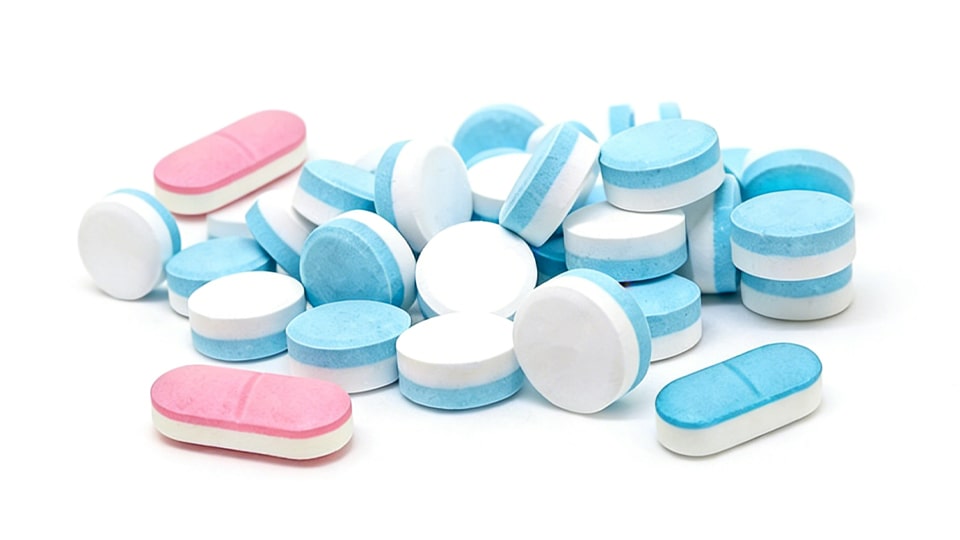
multi layered tablets


Formulation Considerations for Bilayer Tablets

Formulating a bilayer tablet is more complex than a regular single-layer tablet. Think of it as formulating two tablets at once: each layer needs its own granulation (blend of API and excipients) that will compress well and stick together. Key points include:

  • Separate Granulations: You must develop two distinct blends (layer 1 and layer 2) that flow well and compress properly on their own. Each powder should be free-flowing and uniformly sized so it can fill the die cavity evenly. Good flow is especially critical for the second layer, which must fall cleanly onto the first layer without mixing.
  • Compatibility and Incompatibility: If two drugs or excipients are incompatible, they must go in separate layers. Compatibility is a crucial factor in formulation. ตัวอย่างเช่น, if one drug tends to absorb moisture or react, it would be kept in its own layer with suitable stabilizers.
  • Layer Adhesion: The bond between the two layers must be strong immediately after compression and remain strong during shipping and storage. เพื่อให้บรรลุเป้าหมายนี้, formulators often include adhesives or adjust compressive forces. The first layer is usually compressed with a slight tamping force so its surface stays a bit rough, which helps the second layer stick better. If the first layer is over-compressed and becomes too smooth, the layers may not adhere well and the tablet can split (delaminate).
  • Excipient Selection: Excipient choice is critical. Manufacturers often use direct-compression-friendly excipients that flow and compress easily. Some experts recommend selecting coarser excipients or reducing lubricant (เช่น แมกนีเซียม สเตียเรต) that might “migrate” and weaken the interlayer bond. ในทางปฏิบัติ, each layer’s excipients are optimized so that when they’re pressed together, they form a robust interface.
  • พารามิเตอร์กระบวนการ: Tamping force, การบีบอัดล่วงหน้า, and compression speed must be fine-tuned. เช่น, compression force for the first layer should be enough to shape it but still allow some surface roughness. The second-layer force is then calibrated to firmly lock the layers together without causing capping. Modern tablet presses even allow different forces for each layer to optimize adhesion.

โดยสรุป, imagine each layer as its own mini-tablet formulation. You design two compatible “recipes” and then stack them. Getting uniform weight and good bonding requires careful attention to powder flow, ขนาดอนุภาค, and compression settings.
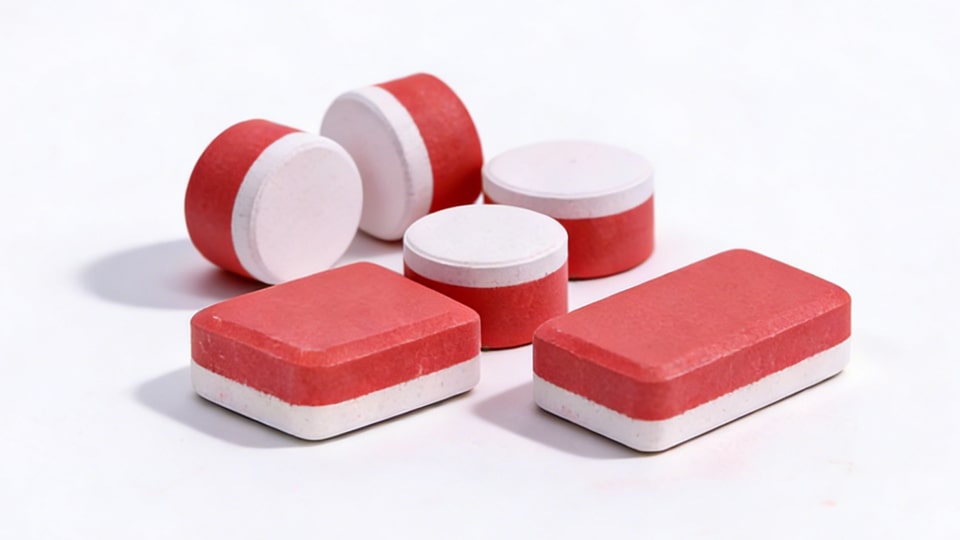
แท็บเล็ต Bilayer


อุปกรณ์: Multi-Layer (Bilayer) Tablet Press Machines

Making bilayer tablets requires a specialized เครื่องกดแท็บเล็ต – often called a multi-layer tablet press or bilayer tablet press. Unlike a normal tablet press with a single hopper, a bilayer press typically has two hoppers and feed frames. Here’s how it works:

A rotary multi-layer tablet press has a die cavity that passes beneath two (หรือมากกว่านั้น) hoppers in sequence. The first hopper drops the granulation for layer 1 into the die; the machine partially compresses it. แล้ว, as the turret turns, the second hopper adds the granulation for layer 2 on top of the first layer. ในที่สุด, the press applies the main compression to fuse the layers into a single tablet. This dual-hopper system ensures each layer stays separate until final compaction.

Modern multi-layer tablet presses are very high-speed. ตัวอย่างเช่น, laboratory-scale bilayer presses might run at 8,000–20,000 tablets per hour, while commercial-scale presses can produce up to roughly 600,000 เม็ดต่อชั่วโมง. These machines include electronic controls for punch displacement and force, allowing tight control of each layer’s weight. Notable equipment manufacturers (like Jinlupacking, Korsch, Fette, Kilian, Courtoy, ฯลฯ) have developed presses with features like sealed feeders, pre-compression rolls, and weight sensors to address bilayer-specific challenges.
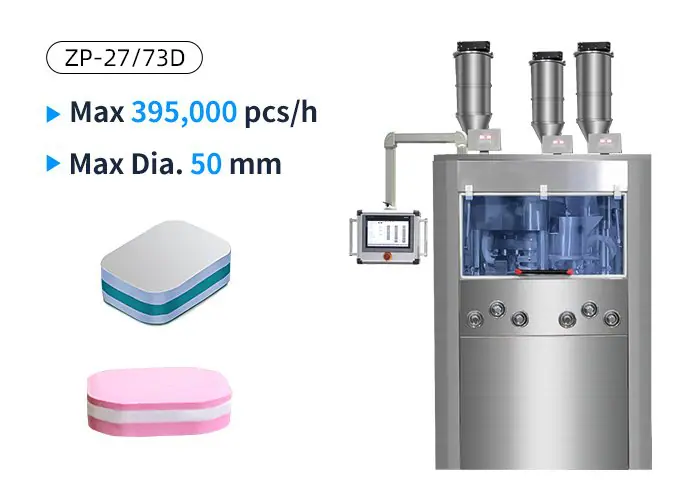
ZP-27/73D Multi Layered Tablet Press Machine

Brief Equipment Example – Jinlu Packing’s ZP-27/73D: As a real-world example, Jinlu Packing’s ZP-27/73D Multi Layer Tablet Press is designed for exactly these tasks. It’s a three-layer-capable machine (i.e. it can even make tri-layer tablets) and boasts an output up to 395,000 เม็ด/ชั่วโมง. This press can produce large tablets (ขึ้นไป 50 mm diameter) และ, with custom tooling, can make various shapes – from effervescent and ball tablets to two-color or three-layer designs. Its robust construction (E.G. a nodular cast iron turntable) เป็นไปตามมาตรฐาน CGMP, and it uses a special force-feeding system to handle sticky materials. ในระยะสั้น, equipment like this ensures the complex layering process runs smoothly in production.


กระบวนการผลิต: How to Make Bilayer Tablets

The basic steps to manufacture a bilayer tablet are:

  1. Prepare Each Layer’s Granules: อันดับแรก, create two separate granulations. Each blend contains its own API (และสารเพิ่มปริมาณ) and is granulated or mixed into a free-flowing powder.
  2. Feed First Layer: The tablet die passes under Hopper 1, which dispenses the powder for Layer 1 into the die cavity. The press then partially compresses this layer. (A light pre-compression keeps the layer shape but preserves surface roughness for good bonding.)
  3. Feed Second Layer: ต่อไป, the die rotates under Hopper 2, which drops the powder for Layer 2 onto the still-partially-compressed first layer.
  4. Final Compression: The press applies the main compression force, simultaneously compressing both layers into a single two-layer tablet.
  5. Ejection and Inspection: The finished bilayer tablet is ejected from the press. It’s then inspected for uniform weight, ความแข็ง, ความหนา, and layer integrity.

Throughout this cycle, the press must precisely control die fill and compression for each layer. Modern presses often have sensors to monitor layer weight and turret speed in real time. This ensures each layer is filled correctly and each tablet is consistent. By carefully synchronizing the hoppers and punches, the machine fuses the layers without mixing them. The key is that partial compression of the first layer creates a foundation for the second layer to adhere properly.

[jl_youtube src=”https://www.youtube.com/embed/w0QdN2TGbiw”]

In production, continuous monitoring is essential. ตัวอย่างเช่น, if too much powder is metered from the second hopper, the top layer can become too thick, throwing off dosage. Many high-end tablet presses automatically adjust fill depth and force on the fly to keep layers uniform.


Common Challenges and Solutions

Bilayer tablet manufacturing comes with special challenges:

  • Delamination (การแยกชั้น): The most critical issue is preventing the two layers from separating. Delamination can occur if adhesion is weak or if mechanical stresses exceed the bond strength. Factors like moisture, mismatched layer hardness, or uneven compression can all contribute. To mitigate this, formulators ensure the first layer’s surface stays rough (through lighter compression) and optimize excipients to promote bonding.
  • การเปลี่ยนแปลงน้ำหนัก: Ensuring both layers have the correct weight is tricky. Inconsistent powder flow or fill depths can cause one layer to be over- or under-dosed. Accurate dosing pumps and advanced sensing can help. Some presses even sample the weight of each layer before final compaction (though fully separate layer sampling is still an area for future tech).
  • Cross-Contamination: When filling the second layer, there’s a risk of dust or powder from Layer 1 contaminating Layer 2. Manufacturers use good ventilated hoppers, aspiration (vacuum) around the feed frames, and sometimes coarser granules to minimize dust.
  • คุณสมบัติของวัสดุ: If one layer uses a very brittle or very plastic excipient and the other uses the opposite, the layers may have different compression behaviors. This mismatch can lead to uneven compaction or stress at the interface. Choosing materials with similar compressibility or adjusting formulations (E.G. adding a shared excipient) can harmonize the properties.
  • Lubrication Issues: Excess lubricant (E.G. แมกนีเซียมสเตียเรต) can weaken the bond between layers. One solution is external lubrication: spraying a fine mist of lubricant on punches or dies so less powder in the layers is premixed with it. This helps ensure each layer bonds well.
  • Environmental Control: High humidity can soften certain excipients and cause tablets to swell, which hurts layer adhesion. Production often uses dehumidified air and quickly dries granules to avoid moisture buildup. Some manufacturers pre-condition materials to storage humidity levels before compression.

ในระยะสั้น, successful bilayer production demands careful control at every step. With the right equipment and expertise, these challenges can be overcome. As AbbVie notes, state-of-the-art equipment, thorough formulation work, and process optimization are key to commercializing bilayers.


Practical Tips for Bilayer Tablet Manufacturing

  • Optimize Flow: Ensure each powder blend has excellent flow properties. Good flow is especially important for the second layer, so it fills the die evenly after the first layer is seated.
  • Balance Compression Forces: Use a softer pre-compression for layer 1 and calibrate the main compression to avoid over-compressing the first layer. This creates a proper bond. You may need to experiment with punches (E.G. deeper vs. shallower dies) and pressures for best results.
  • Test for Delamination: After tableting, check every batch for any signs of layer separation. Even small splits can ruin the release profile. Mechanical testing (like tensile strength across the interface) helps confirm each bilayer is sound.
  • Consider Post-Compression Coating: If needed, bilayer tablets can be film-coated as usual. Coating also seals the edges and can further lock the layers together.
  • Work with Experienced Suppliers: Partnering with equipment and excipient suppliers that understand bilayers can save time. Many provide formulation guides or software (E.G. IMA’s IMAGO or BASF’s ZoomLab) to help select excipients and predict layer behavior.


Why Jinlu Packing for Multi-Layer Tablet Equipment

When it comes to choosing machinery, reliability is crucial. Jinlu Packing is a trusted manufacturer of tablet presses and other pharma equipment. Our ZP-27/73D Multi Layer Tablet Press is specifically engineered for complex dosage forms. It uses high-quality materials and precise engineering – for example, a wear-resistant cast-iron turret that meets GMP standards and a special force feeder to handle sticky blends. Jinlu also offers comprehensive after-sales support (การว่าจ้าง, การฝึกอบรม, อะไหล่) so production runs smoothly long-term. กล่าวอีกนัยหนึ่ง, as you look to implement bilayer tableting, you can count on equipment like Jinlu’s to meet the demands of high-speed, multi-layer production.


บทสรุป

Bilayer tablets open up creative possibilities in oral drug delivery. By packaging two formulations in one tablet, you can improve patient convenience, optimize release profiles, and combine medications that would otherwise be hard to pair. Making bilayer tablets involves careful formulation and specialized equipment, but the payoff is significant. You’ll need dual-hopper tablet presses (like Jinlu Packing’s ZP-27/73D) and a well-planned process, but the result is a reliable, high-quality dosage form. With the right strategy and machinery, bilayer tablet manufacturing can be seamlessly integrated into modern pharmaceutical production lines.


FAQs on Bilayer Tablet

What is a bilayer tablet?

A bilayer tablet is a compressed oral dosage form that contains two distinct layers of powder, each with its own formulation. These layers are compressed together into a single tablet, allowing different release profiles or multiple active ingredients in one pill.

What are the main benefits of bilayer tablets?

Bilayer tablets can combine two active ingredients, provide different release profiles (เช่น, immediate and sustained release), improve patient compliance by reducing pill burden, and help physically separate incompatible drugs.

How does a bilayer tablet differ from a single-layer tablet?

A single-layer tablet contains only one formulation compressed at once. A bilayer tablet has two separate layers, each with its own formulation and properties, requiring specialized compression and manufacturing techniques.

What is the role of a bilayer tablet compression machine?

A bilayer tablet compression machine has dual hoppers and feeders. It fills and compresses each layer separately before fusing them into a single tablet. This equipment ensures accurate dosing and strong interlayer bonding during manufacturing.

What are the common challenges in bilayer tablet manufacturing?

Key challenges include layer adhesion issues, weight variation, cross-contamination between layers, and differences in material compressibility. Careful formulation and optimized machine parameters help address these challenges.

How are bilayer tablets made step by step?

The bilayer manufacturing process includes:
1.Preparing two separate granulations;
2.Filling and lightly compressing the first layer;
3.Filling the second layer on top;
4.Applying final compression to fuse layers;
5.Ejecting and inspecting the finished tablet.

What key factors should be considered in bilayer tablet formulation?

Critical formulation factors include powder flow, excipient compatibility, layer adhesion, particle size distribution, and compression force settings to ensure consistent quality and structural integrity.

What quality controls are important for bilayer tablets?

Quality controls focus on uniform weight, ความแข็ง, layer integrity (no delamination), content uniformity, and adherence to manufacturing standards. Regular testing minimizes defects.

Can bilayer tablets combine incompatible drugs?

ใช่. A bilayer tablet can physically separate incompatible ingredients into different layers. This prevents direct contact while still delivering both drugs in one dosage form.

What industries use bilayer tablets?

Bilayer tablets are widely used in pharmaceutical manufacturing, โภชนเภสัช, and therapy combinations requiring customized release profiles or multi-drug delivery in one tablet.


อ้างอิง:
1.A Review on Bilayer Tablet Technology – National Library of Medicine
2.A Review on Bilayer Tablets and Its Technology – International Journal of Pharmacy and Pharmaceutical Research
3.Bilayer tablets: A developing novel drug delivery system – ไซแอนซ์ไดเร็กต์
4.Comprehensive Reviews on Bilayer Tablet Formulation Issues – WJPS Online

แบ่งปันบทความนี้:
รูปภาพของ เพตตี้ ฟู
เพตตี้ ฟู

เพตตี้ ฟู, ผู้ก่อตั้ง Jinlupacking, นำมาซึ่ง 30 ความเชี่ยวชาญหลายปีในภาคส่วนเครื่องจักรยา. ภายใต้การนำของเขา, Jinlu เติบโตเป็นซัพพลายเออร์ที่เชื่อถือได้โดยผสมผสานการออกแบบ, การผลิต, และการขาย. Petty มีความกระตือรือร้นในการแบ่งปันความรู้เชิงลึกในอุตสาหกรรมของเขา เพื่อช่วยลูกค้าจัดการกับความซับซ้อนของบรรจุภัณฑ์ยา, รับรองว่าพวกเขาจะได้รับไม่ใช่แค่อุปกรณ์เท่านั้น, แต่เป็นพันธมิตรด้านบริการแบบครบวงจรที่แท้จริงซึ่งปรับให้เหมาะกับเป้าหมายการผลิต.

สารบัญ

ส่งคำถามของคุณ

ทิ้งคำตอบไว้

ที่อยู่อีเมลของคุณจะไม่ถูกเผยแพร่. ช่องที่ต้องกรอกถูกทำเครื่องหมายไว้ *

รับใบเสนอราคาฟรี

*เราเคารพการรักษาความลับของคุณและข้อมูลทั้งหมดได้รับการคุ้มครอง. ข้อมูลส่วนบุคคลของคุณจะถูกนำมาใช้และประมวลผลสำหรับโซลูชัน JL เท่านั้น.