
Stickpack-machines (also called stick packaging machines or stick sachet machines) are a type of flexible packaging equipment designed for single-dose or slim, bar-shaped pouches. These machines are popular in the food, drank, and pharmaceutical industries for packing powders, vloeistoffen, or granules into narrow stick pouches. A stick pack machine turns a roll of plastic or laminated film into individual stick-sized bags: it unwinds the film, forms narrow tubes (one tube per lane), fills them with product, seals them, cuts them apart, and then discharges the finished pouches. This entire process happens vertically (like a vertical form-fill-seal machine) and can run extremely fast. Bijvoorbeeld, modern machines with multiple lanes can produce hundreds to over a thousand stick packs per minute. The portability and precise portioning of stick packs make them ideal for things like instant coffee sticks, sugar or spice sachets, and single-dose medicines.
Stick pack machines come in single-lane or multi-lane configurations. Multi-lane models have several forming tubes side by side, each creating its own stick pouch simultaneously. By running in parallel, an 8-lane machine (shown below) can output around 300–320 packs per minute. Larger machines exist too: some high-end systems can have up to 10 of zelfs 20 rijstroken, yielding well over 1,000 sticks per minute. This multi-lane design lets manufacturers maximize throughput while minimizing floor space. The image below shows a multi-head stick pack machine with several lanes for high-speed packaging:
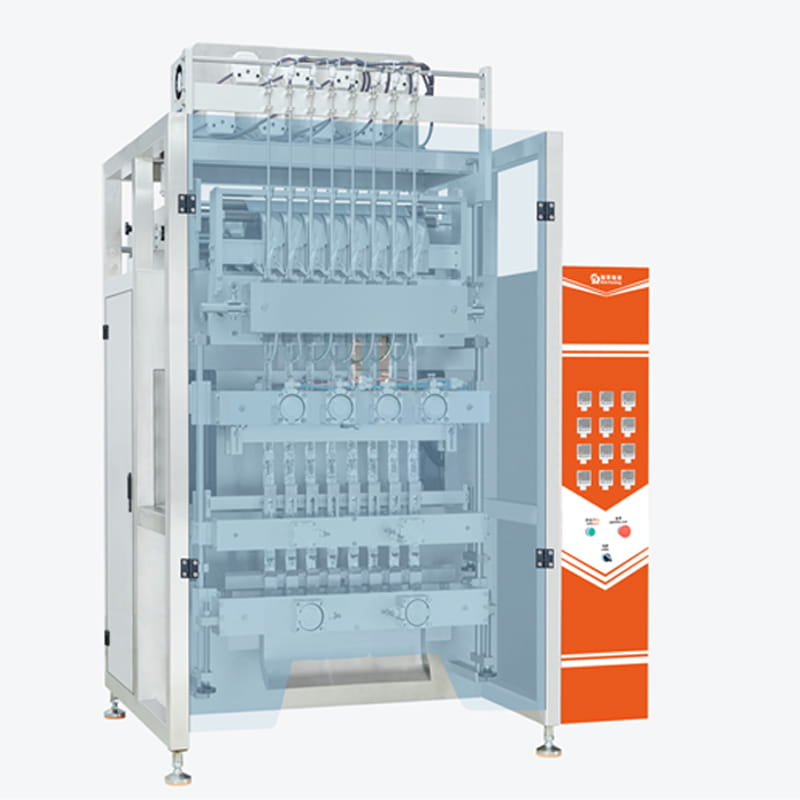
An 8-lane stick pack packaging machine filling multiple stick sachets at once – each lane has its own forming tube and sealer to increase output.
In de praktijk, a stick pack machine follows a step-by-step cycle. Below is an overview of the key steps and components. Each part works together to form, vullen, zegel, and cut the stick pouches in one continuous motion. We’ll also see how the machine handles different product types (powders vs. vloeistoffen) and maintains film tension and timing.
Before diving into the process, it helps to know the main components of the machine. The table below lists the typical parts and their roles:
| Onderdeel | Functie |
|---|---|
| Film Unwind & Reel | Holds a large roll of flexible film (laminated plastic/aluminum). Feeds the film into the machine from the rear while controlling tension. Often uses a dancer arm (pivoting weight) to keep tension steady. |
| Printing/Registration | (Optioneel) A date/time or batch coder. Indien aanwezig, the film passes a printer and registration sensor. The sensor tracks printed marks to synchronize bag lengths. |
| Film Tensioning System | Nip rollers and the dancer arm hold the film taut. Nip rollers grip the film evenly to keep it from wrinkling, and the dancer arm moves up/down to prevent lateral wandering. |
| Film Slitter/Cutter | Cuts the wide roll film into narrower stroken (one strip per lane). Rotating blades slice the film into the correct width for each forming tube. |
| Forming Tubes/Collars | Each narrow strip of film is wrapped around a forming tube. De forming collar shapes the film into a tube whose end is overlapped. Depending on the set-up, this creates a lap seal of fin seal on the back of the stick. |
| Vertical Sealer Bars | Heat bars that press against the overlapping film edges on each tube’s side. This makes a continuous vertical seal along the length of each tube. |
| Vulsysteem (Filler) | The dosing mechanism for the product. Common types are vijzel (volumetrisch) vulstoffen for powders and pump or piston fillers for liquids. It drops the exact dose of powder or liquid down the center of each forming tube into the open pouches. |
| Horizontal Sealer Jaw | A hot jaw that clamps and seals across the film. It seals the top of one stick pack and simultaneously seals the bottom of the next one, creating individual sealed pouches. |
| Cutting Knife/Notcher | Na afdichting, a blade (knife) or notcher cuts the film to separate each stick pack. Some machines cut right below a seal; others notch through the seal line. |
| Outfeed Chute/Conveyor | Receives the filled stick packs as they are cut. A timed flap drops the pouches onto a conveyor belt or collection bin. Individual chutes can guide packs in an organized stream. |
| Controlesysteem (PLC/HMI) | Programmable logic controller and touch-screen. Automates the sequence (timing of film pull, zeehonden, vulling, snijden) and lets operators set bag length, snelheid, enz. High-end machines use PLC control for precision. |
Most modern stick pack machines are built with stainless steel and meet industry hygiene standards (especially for food/pharma). They include features like PLC control, servo motors for precise motion, en veiligheidswachten. The excerpt below (from a manufacturer) highlights typical features including PLC control and adaptable filling systems:
“Designed to automatically package free-flowing products… complete with PLC control, servo auger, agitator and hopper, stepping motor control of bag length, printed film registration control.”
This table and list clarify how each part contributes to the machine’s function. Volgende, let’s put it all together in the sequence of operation.
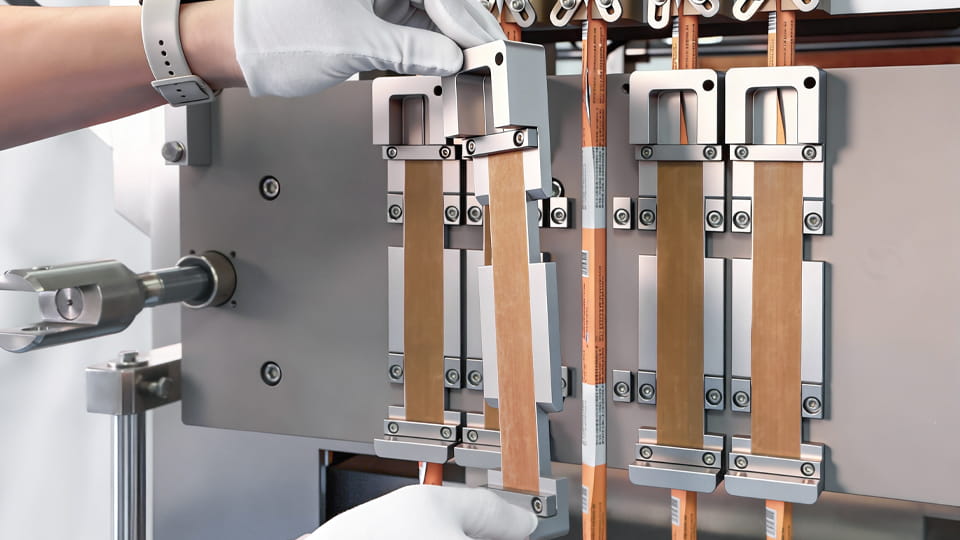
Below is a simplified step-by-step flow of the packaging cycle. Each cycle starts with a new length of film and ends with finished zakjes plakken ready for collection. (In de praktijk, all lanes operate simultaneously, so multiple packs are made in each cycle.)
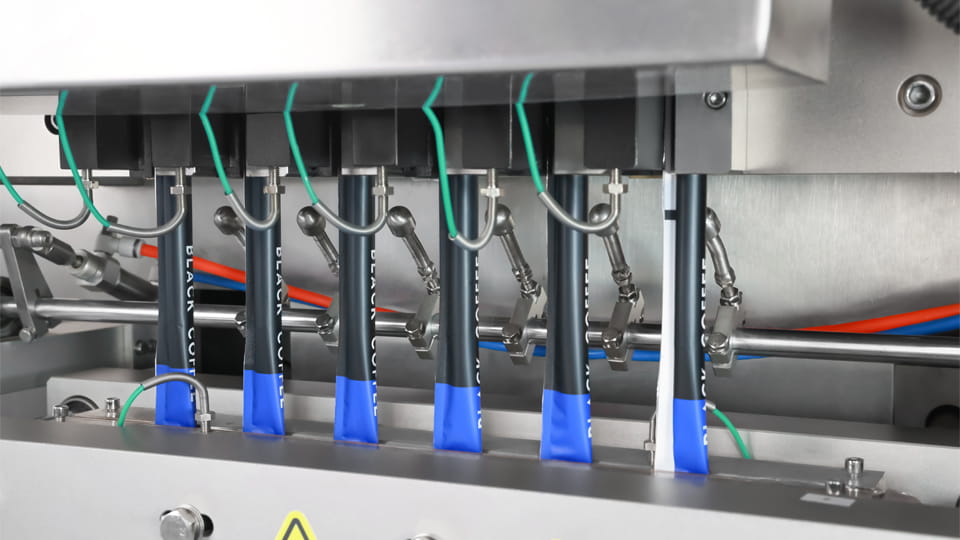
A 6-lane stick pack machine in mid-cycle: you can see multiple forming tubes and a row of vertical seal jaws. All lanes run in parallel to multiply output.
This step-by-step flow is very similar to a standard verticale vorm-vul-afdichting (Vffs) machine, but specialized for narrow stick pouches. Because everything is vertical, products naturally drop by gravity into the forming bags, and the entire operation is compact. After the packs exit, they often move on to downstream equipment (like check-weighers or case packers) for final packaging.
[jl_youtube src=”https://www.youtube.com/embed/_R4bycltkso”]
Every machine allows adjustment of the fill volume (dose) and pouch length (via the stepping motor controlling film feed). Operators use the PLC interface to set the desired stick length and speed. Eenmaal opgezet, the machine runs continuously, producing identical stick packs in each cycle.
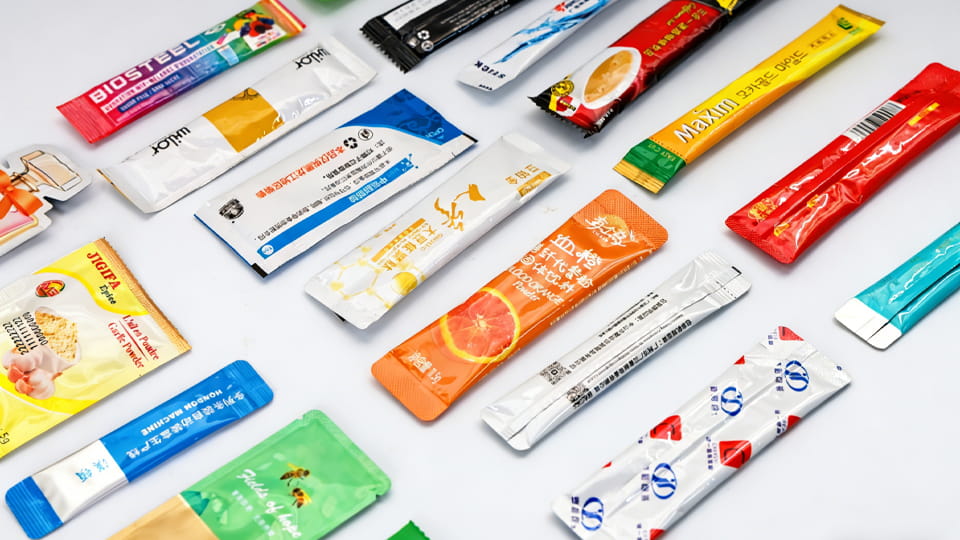
Because stick packs are so easy for consumers to use (simply tear and pour or squeeze), they are popular for single-use portions. Foods (koffie, suiker, drink mixes, specerijen), persoonlijke verzorging (cream sachets, shampoo), en farma (powdered medicines, supplementen) all use stick packs. As noted by Jinlu -verpakking, the stick format has become popular because of its portability, gebruiksgemak, Nauwkeurige dosering, and cost-efficiency.
Bovendien, modern stick pack machines can run extremely fast. Low-end machines might do tens of sticks per lane per minute, but high-end multilane machines can do dozens per lane. Bijvoorbeeld, a two-lane machine might run 2×80 bags/min, while an eight-lane system could push 8×40 or 8×50. As one industry article notes, “with machines that can accommodate up to 20 rijstroken, a single stick pack machine can produce up to 1,600 stick packs per minute – over 26 sticks per second!”. Such throughput is invaluable for large-scale producers who need consistent high-speed packaging.
Stick pack machines also save space. Even an 8-lane machine occupies far less floor area than eight separate single-lane machines. This compact design is a big reason co-packers and food companies love them. Aan het eind van de dag, the combination of high output and small footprint makes stick pack machines a favorite in the packaging world.
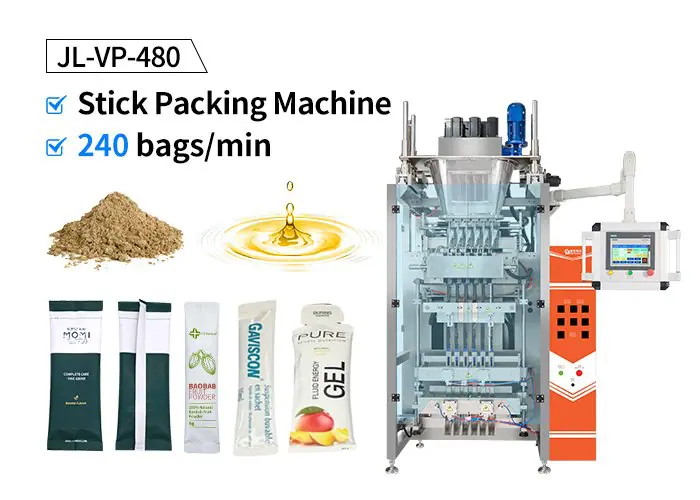
Samengevat, a stick pack machine automates the entire pouch-making and filling process: film unwinds, forms narrow tubes, product is dosed in, seals are made, and stick packs are cut and conveyed out – all in one smooth operation. By understanding the steps above, engineers and buyers can better specify or troubleshoot these machines. The inner workings (film handling, forming collars, seal bars, enz.) are based on well-proven form-fill-seal technology, but optimized for the tiny, stick-shaped pouch.
| Onderdeel | Wat het doet |
|---|---|
| Film Unwind | Holds film roll and feeds film into machine; dancer arm keeps tension steady. |
| Printing/Registration | Prints batch/date codes and detects marks to align seals with printing. |
| Nip Rollers/Dancer | Grips film to ensure smooth feed; dancer arm moves to keep film tension even. |
| Film Slitter | Cuts roll film into narrower strips, one per lane, matching bag width. |
| Forming Tube/Collar | Shapes each strip into a tube and overlaps edges for sealing. |
| Vertical Seal Bars | Heat-weld the overlapping edges on each tube’s back to seal it vertically. |
| Filler (Auger/Pump) | Delivers measured product into each stick (auger for powder, pump for liquid). |
| Horizontal Seal Jaw | Clamps across all lanes to seal top of one stick and bottom of next, completing the pouch. |
| Cutting Knife/Notcher | Separates the sealed stick packs by cutting or notching right below the seal. |
| Outfeed Conveyor | Collects finished sticks onto belt or bin after a flap drops them from the machine. |
| PLC/HMI Control | The brains of the machine; lets operators set speed, bag length, and sequences; automates all timing. |
Each of these parts is adjusted to match the product and bag size. Bijvoorbeeld, changing film grade or width, adjusting seal bar temperature, or swapping filler heads (pump vs. screw) can adapt the machine for different materials (korrels, poeders, pasta's, enz.). But fundamentally, the cycle described above remains the same: formulier, vullen, zegel, cut, repeat.
Eindelijk, note that stick pack machines must meet hygienic design standards in food and pharma. Sealing temperatures and speeds are tightly controlled (often via solid-state controllers and touchscreens), and the machine frame is built to allow quick cleaning. This ensures product safety and consistent bag quality.
A stick pack machine is an automated flexible packaging system that forms, vult, zeehonden, and cuts narrow stick-shaped pouches (stick pack packaging) from a film roll. It transforms roll stock film into individual sticks and fills them with powder, korrels, or liquids in a continuous process.
The machine unwinds a roll of film, slits it into narrow strips, forms each strip around a tube, fills it with product, seals the pack vertically and horizontally, and cuts it to create individual stick packs. This entire cycle runs continuously in multiple lanes for high throughput.
Stick pack machines can package a wide range of products, inclusief poeders (like instant coffee or pharmaceuticals), korrels (suiker, seasoning), vloeistoffen (energie drankjes, sauzen), and even gels or pastes, depending on the filler system used.
Yes — most stick pack machines are flexible and can handle different sizes of sticks. Operators adjust settings and change forming tubes or tooling to adapt the machine to different bag widths and lengths.
Industrieën zoals voedsel en drank, farmaceutische producten, nutraceutica, cosmetica, and daily chemicals widely use stick pack packaging due to its convenience and precise portion control.
Stick pack machines are known for high speed, compact footprint, reduced film usage, en nauwkeurige dosering. They produce single-serve portions efficiently and consistently, saving material and production costs compared to larger pouch formats.
Depending on the number of lanes, stick pack machines can produce anywhere from hundreds to over a thousand packs per minute — for example, tot aan 1,600 stick packs/min on 20-lane models. This makes them ideal for high-volume production lines.
Different products require different fillers:
• Auger fillers for powders
• Pump or piston fillers for liquids
• Cup or piston systems for granules or pastes
These ensure accurate dosing for each stick pack.
Yes — many machines include optional date, partij, or logo printing systems. A registration sensor ensures printed elements are aligned correctly with the seals on each stick pack.
Stick packs are sealed vertically along the back seam and horizontally at top/bottom edges. Heat-sealing jaws apply pressure and heat to bond the film edges, creating secure seams for product protection and shelf life retention.
Referenties:
1. Stick Pack Machines Deliver High Output in Small Space — Packaging Strategies
2.Vertical Form Fill Seal (Vffs) — Wikipedia
3.How Vertical Form-Fill-Seal (Vffs) Machines Are Revolutionizing the Industry — Packaging-Tech-Today