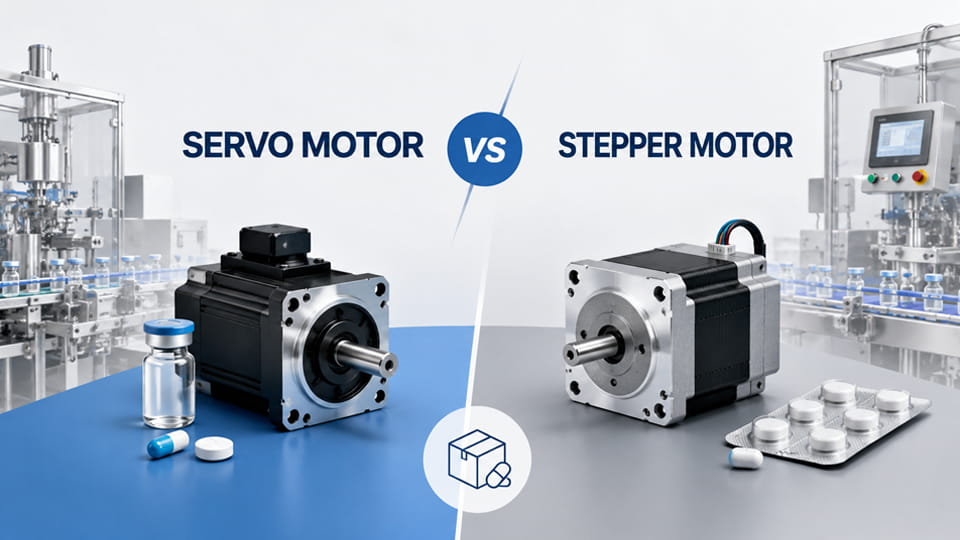
The operational stability, metering accuracy, and production efficiency of pharmaceutical packaging lines are fundamentally determined by their drive motor configuration. 최대 pharmaceutical machinery manufacturers offer two drive solutions: servo motor 그리고 stepper motor, leaving many pharmaceutical factory procurement and maintenance engineers struggling to distinguish their advantages and disadvantages. Common production failures, including blister sealing misalignment, often stem from mismatched motor selection. This article combines the working conditions of all types of pharmaceutical packaging equipment, provides a full comparison of servo motor vs stepper motor from working principles, operating performance, applicable models, and long-term operation and maintenance costs, and helps enterprises select the right drive solution for pharmaceutical and packaging machines.

To understand the core differences between Servo motor vs stepper motor, we first break down their fundamental operating logic, starting with the basics of each system.
What is a stepper motor? A stepper motor rotates at a fixed step angle driven by pulse signals, and it uses a pure open-loop control system. The stepper motor and driver only send pulse commands, with no encoder on the motor to feed back actual position data in real time. The system defaults to “the motor will rotate the corresponding number of steps for the number of pulses sent”.
In low-speed auxiliary mechanisms, stepper motors have sufficient static holding torque, simple structure, and low supporting driver cost, making them suitable for auxiliary stations with low load, low start-stop frequency, and no high precision requirements, such as the film feeding auxiliary shaft of small pouch packing machines, and the material receiving roller of simple blister machines.
하지만, it has fatal flaws: when load fluctuates or speed increases, it is extremely prone to step loss. The equipment cannot automatically correct position errors, and deviations accumulate over long-term operation, directly undermining the consistency of pharmaceutical production metering and failing to meet cGMP pharmaceutical production precision specifications.
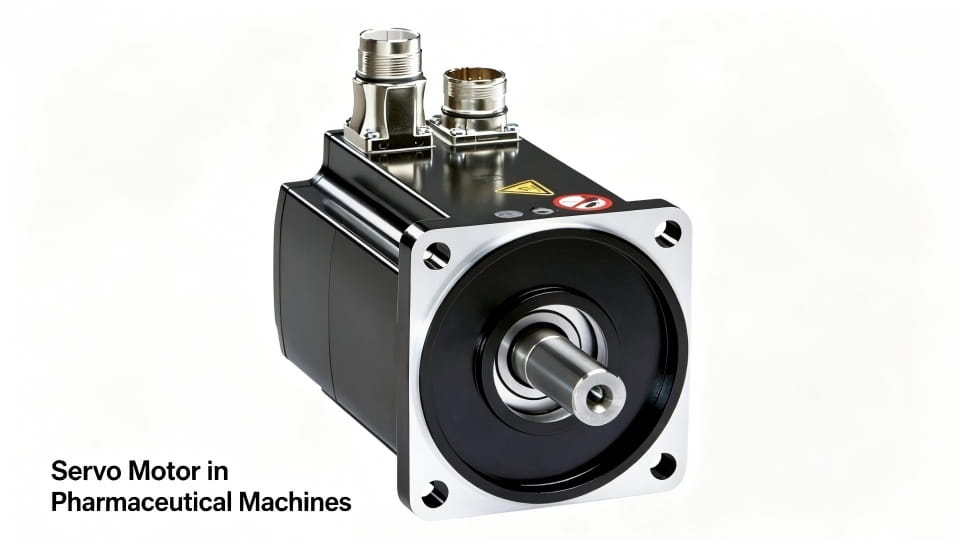
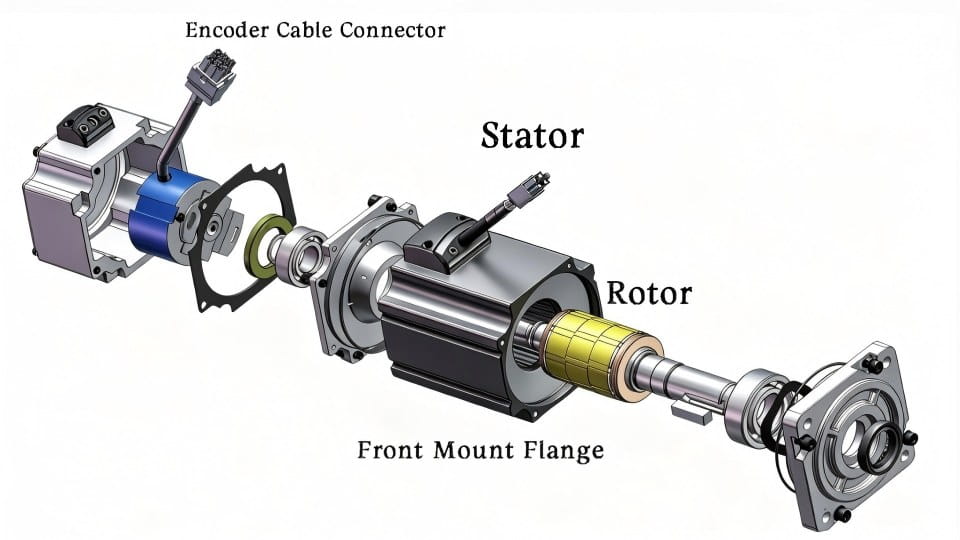
What is servo motor? A servo motor is equipped with a high-precision encoder, forming a complete closed-loop control system. How does a servo motor work? The driver collects the actual position, 속도, and torque data of the motor in real time, continuously compares it with the preset command, dynamically adjusts the output current through the PID algorithm, and automatically compensates for position deviation, with no step loss problem. How do servo motors work in practice? For automatic cartoning machine carton folding mechanisms, which require frequent start-stop and high-speed synchronous positioning, the closed-loop feedback of servo motors can dynamically correct errors in real time, and it is the standard drive solution for high-end pharmaceutical equipment.
Industrial servo motor systems, including ac servo motor models, are widely used in regulated production environments, with small servo motor and mini servo motor options available for compact equipment layouts.

오버 30 years of experience in the pharmaceutical and packaging equipment industry, Jinlu Packing has summarized the core performance differences between Servo vs stepper motor across six critical dimensions for pharmaceutical production.
Servo Motor Delivers Consistent Micron-Level Precision, Stepper Motor Only Performs Well at Static Low-Speed
Stepper motor only has no cumulative error at no-load and low speed. Once step loss occurs due to load change or acceleration, the positioning deviation is irreversible. Industrial servo motors are equipped with encoders with up to 24-bit resolution, with micron-level repeat positioning accuracy, and remain stable under high-speed and heavy-load conditions. 예를 들어, regarding high speed blister machine, servo motor is strongly recommended to eliminate the misalignment of form traction; simple manual auxiliary packaging mechanisms can use stepper motors.

The stepper motor has poor torque-frequency characteristics. When the speed exceeds 1000RPM, the output torque drops sharply, and it is prone to stalling and jamming at high speed. Servo motors maintain constant torque in the rated speed range of 3000-6000RPM, with an overload capacity of 3-5 times the rated torque, which is suitable for high-speed continuous production lines. For large 물집 포장 기계, 고속 포장 기계, and continuous pouch packing machines with high capacity requirements, which need to run at high speed for a long time, stepper motors cannot support stable production capacity, and servo drive can increase the production efficiency of the whole machine by 20%-40%.


Driven by step-by-step pulses, stepper motors have obvious resonance in the low-speed range, with large vibration and noise, which easily causes the pills to collide and be damaged. Servo motors adjust the dynamic torque in real time, run smoothly in the whole speed range, with low vibration and low noise, which meets the noise reduction and material loss-free production requirements of clean pharmaceutical workshops, and is especially suitable for fragile medicine production equipment such as 소프트 캡슐 and crispy tablets.
Whether it is static, no-load or full-load, the stepper motor continuously outputs rated current, with serious standby heating, and a large heat dissipation burden for long-term production. The servo one outputs current on demand, and only maintains a very small holding torque at no-load static, reducing the energy consumption of the whole machine by more than 15%, reducing the heat dissipation loss of the equipment and extending the service life of the whole machine. For pharmaceutical factories with 24-hour continuous production, servo motors can significantly reduce electricity bills and equipment maintenance frequency.
When the stepper motor is overloaded, it directly loses steps and stops, with no automatic error correction mechanism. When the servo motor is overloaded for a short time, it will not shift the station. When the load changes suddenly, it can quickly compensate the torque, and even a slight material jam will not cause batch pharmaceutical waste, greatly reducing the material loss in pharmaceutical production.
Short-term hardware cost: The stepper motor complete system has a lower price, with simple wiring and debugging, which is suitable for low-speed simple packaging lines with limited budget. The servo one is matched with an encoder and a special servo motor driver, with higher initial procurement cost, and debugging requires professional technicians to set parameters.
Long-term comprehensive cost: Servo motor equipment has lower failure rate, lower material loss, and lower energy consumption. For large-scale pharmaceutical factories, the comprehensive use cost of servo motors is better than that of stepper motors in 3-5 연령.
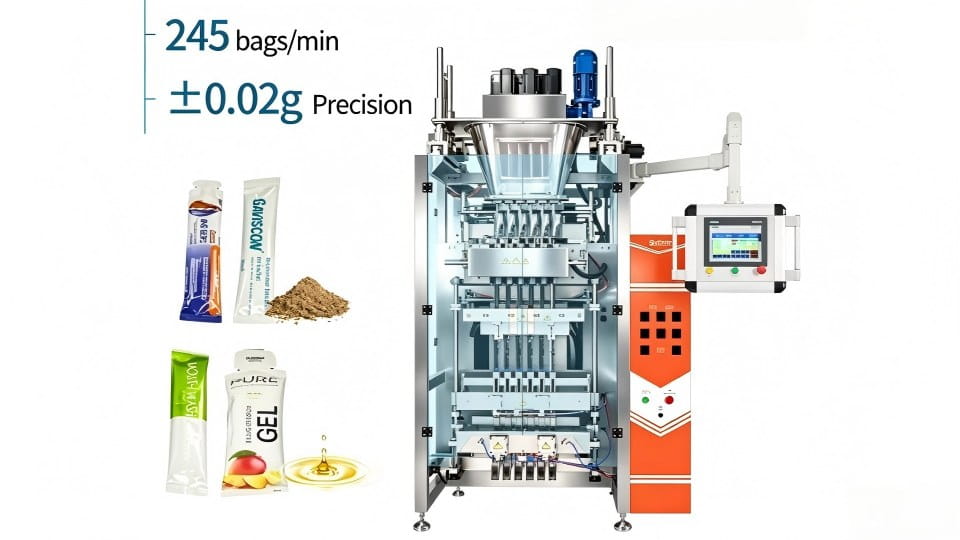
(블리스 터 패커, 포장 기계, Stick Pack Packaging Machine, 미리 메이드 파우치 포장 기계)
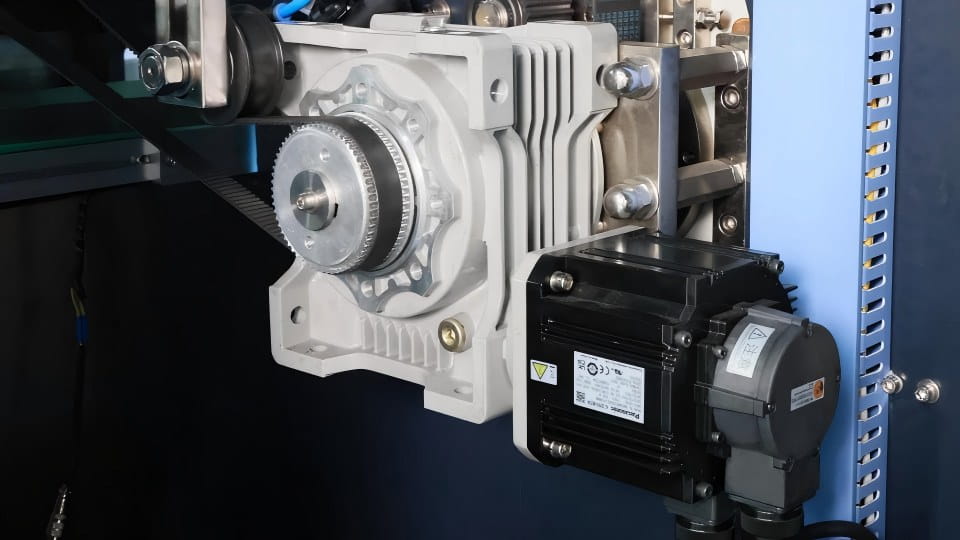
Jinlu Packing’s machines are commonly equipped with servo motors from international top brands: Japan Omron, Germany Siemens, 등. The following pharmaceutical equipment is recommended to use servo motor first, while stepper motors are only suitable for specific scenarios.


It is only suitable for low-speed, 저부하, secondary auxiliary stations: small simple blister machine material receiving shaft, laboratory small manual auxiliary mechanism, low-speed simple pouch packing machine film feeding roller, single machine small auxiliary conveying mechanism, and laboratory prototype without continuous high-speed mass production demand.
The core difference between servo motor and stepper motor lies in the difference in precision, 속도, and stability brought by closed-loop feedback and open-loop control. For mainstream pharmaceutical packaging equipment such as automatic strip packing machines, 물집 기계, 자동 포장 기계, and horizontal pouch packing machines, servo motor is the best choice for large-scale compliant production; stepper motor is only suitable for low-speed, low-precision, auxiliary simple equipment.
As a professional 제약 포장 기계 제조업체, Jinlu Packing has equipped multiple types of machines with servo motor drive systems, and can also customize stepper motor auxiliary configuration schemes according to customer capacity, 예산, 그리고 GMP compliance requirements, covering from laboratory prototypes to large-scale automatic whole line equipment, providing one-stop motor selection, equipment customization, and after-sales commissioning services, including servo motor control, servo motor repair, and servo motor controller and servo motor driver matching.
High-end high-speed and fully automatic blister machines use servo motors, which performs with accurate traction.
The closed-loop positioning has no step loss, synchronous induction detection, no carton opening without material, high precision and no waste of raw materials.
It is used for low-precision, low-speed auxiliary stations. Step loss will cause misalignment of blister sealing, batch scrapping of a large number of pharmaceuticals, and failure to meet the medicine regulatory quality requirements.
The short-term accessory cost is slightly higher, but it has low heat generation, low failure rate, and low material loss, and the long-term operation and maintenance cost of large-scale factories is lower.
The core difference lies in the closed-loop feedback control of servo motor and the open-loop control of stepper motor, which brings differences in precision, 속도, 안정, and fault tolerance.
사소한 푸, 진루패킹 창업자, 가져오다 20 제약 기계 부문에 대한 다년간의 전문 지식. 그의 리더십 아래, Jinlu는 디자인을 통합하는 신뢰할 수 있는 공급업체로 성장했습니다., 생산, 그리고 판매. Petty는 고객이 제약 포장의 복잡성을 헤쳐나갈 수 있도록 깊은 산업 지식을 공유하는 데 열정을 갖고 있습니다., 장비뿐만 아니라 제품도 받을 수 있도록 보장, 생산 목표에 맞춘 진정한 원스톱 서비스 파트너십.