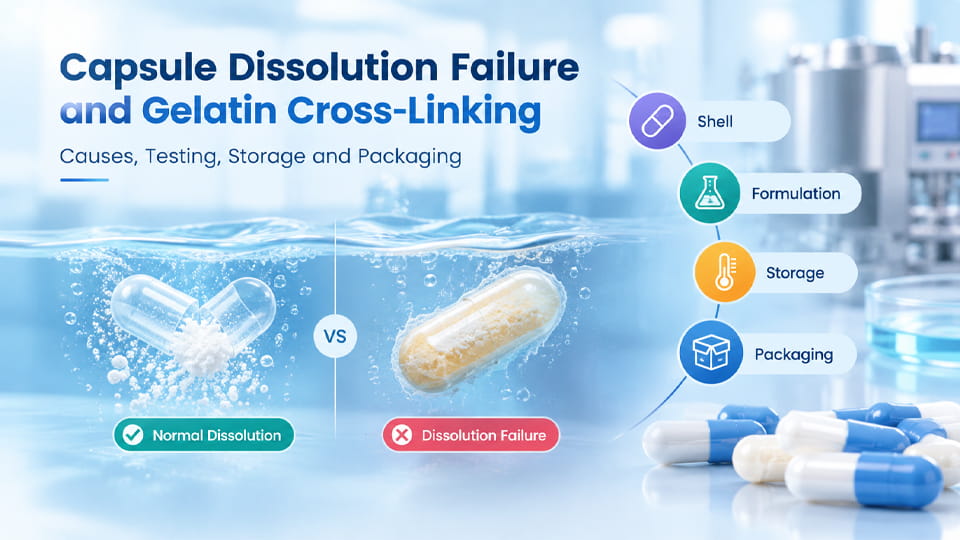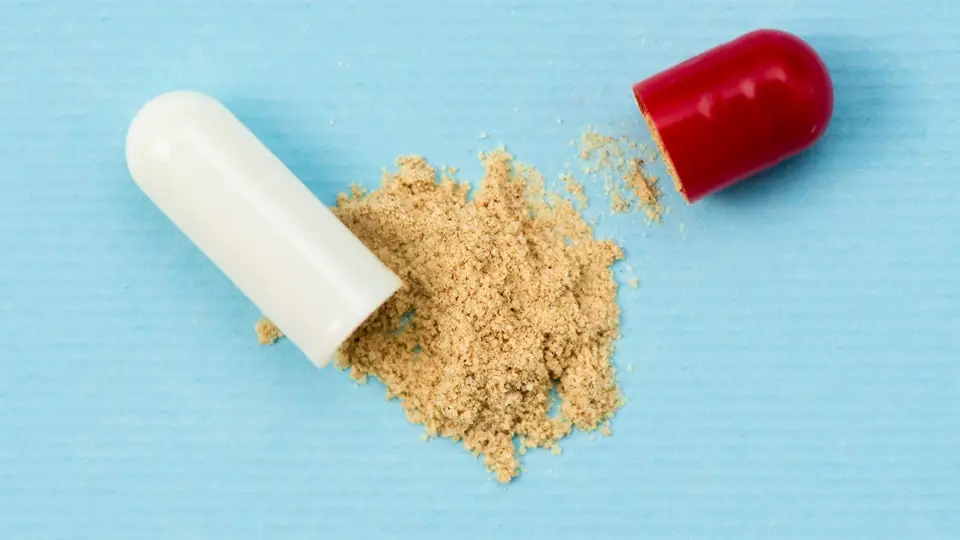

Separación de cápsulas (sacando la tapa del cuerpo) es un paso crítico en las máquinas de llenado de cápsulas, y las fallas en esta etapa causan tiempo de inactividad y desperdicio. Las causas comunes incluyen cápsulas defectuosas o fuera de tolerancia., presión de vacío insuficiente, y desajustes mecánicos. Otros factores, como la humedad incorrecta de la cápsula o la acumulación de estática, también interfieren con la separación.. Este artículo explica el proceso de separación de cápsulas y enumera diez causas comunes de fallas en la separación., junto con consejos de prevención y solución de problemas.
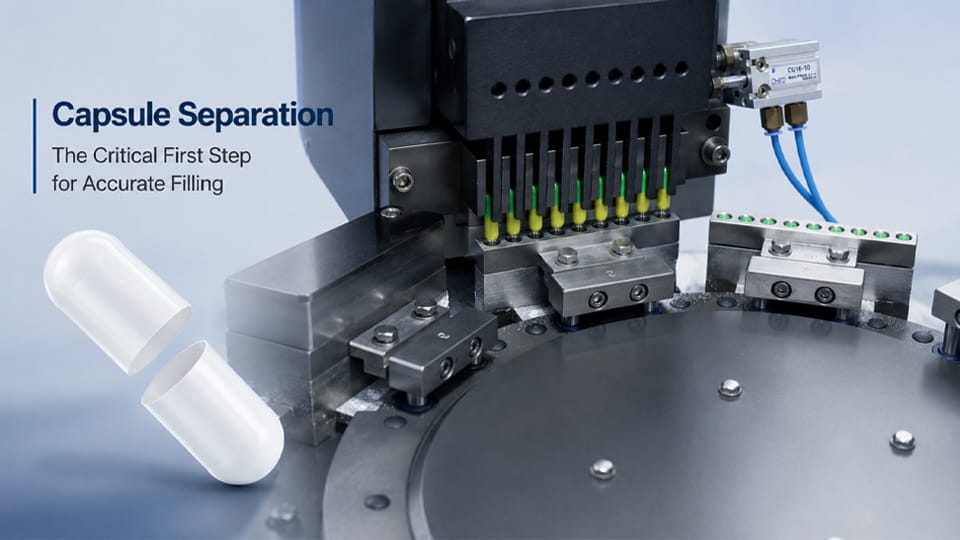
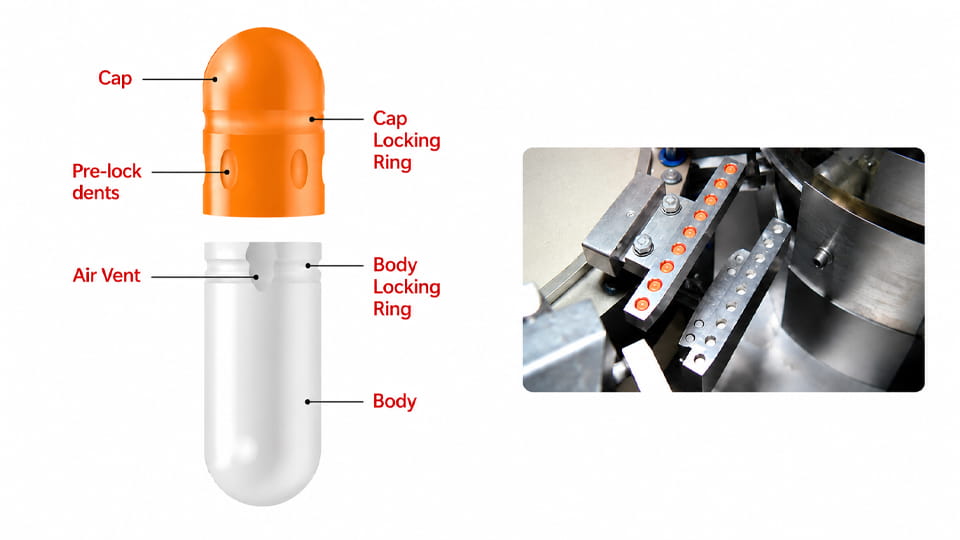
Rellenos de cápsulas use vacío para separar las tapas de las cápsulas de los cuerpos. En la estación de clasificación de cápsulas, Las cápsulas vacías se orientan en una bandeja de modo que las tapas miren hacia arriba y los cuerpos miren hacia abajo.. Una bomba de vacío aspira debajo de la bandeja., tirando de los cuerpos de las cápsulas hacia abajo en la placa de alineación, que separa cada cuerpo de su sombrero. El resultado es una división limpia: la tapa permanece en el útil superior y el cuerpo se asienta en el útil inferior.
En un ciclo exitoso, La tapa y el cuerpo de cada cápsula terminan en sus respectivos lugares sin sufrir daños.. La presión de vacío adecuada es clave: muy poca succión no logra separar el cuerpo, y demasiado vacío puede agrietar o mal asentar las cápsulas. La alineación de las bandejas y módulos también debe ser precisa para que las tapas y los cuerpos se asienten correctamente en los orificios de las herramientas..
Examinemos las razones más comunes por las que la tapa no se retira limpiamente del cuerpo.. Para mayor claridad, discutimos diez causas potenciales:
Las cápsulas defectuosas o fuera de tolerancia son una de las principales causas de problemas de separación. Cápsulas que están deformadas., distorsionado, o tiene tapa/cuerpo mal ajustado puede que no se separe suavemente. Por ejemplo, cápsulas con longitudes desiguales, conchas dobladas, o los defectos de fabricación pueden persistir durante la recogida por vacío. Las cápsulas demasiado blandas o demasiado quebradizas también fallan.: una cáscara quebradiza puede romperse en lugar de deslizarse, mientras que un caparazón demasiado blando podría colapsar o quedarse atascado.
Solución: Utilice cápsulas de alta calidad de proveedores acreditados y verifique las tolerancias dimensionales.. Reemplace cualquier cápsula que esté deformada o fuera de las especificaciones.. Solicite informes de humedad y precisión dimensional a su proveedor de cápsulas para garantizar la coherencia.
La presión de vacío estable es fundamental para la separación. Si la bomba de vacío es débil, las tapas y los cuerpos no se separarán. Los problemas comunes de vacío incluyen fugas en mangueras o tuberías., una bomba fallando, un filtro obstruido, o simplemente no hay suficiente capacidad de succión. Por ejemplo, una línea de vacío agrietada o una membrana de filtro bloqueada reducirán la succión dramáticamente. Muchas máquinas utilizan sistemas de vacío de anillo de agua.; si el flujo de agua de refrigeración es demasiado bajo, las gotas de vacío efectivas.
Solución: Verifique el vacuómetro e inspeccione todo el sistema de vacío.. Repare o reemplace cualquier manguera rota, Limpiar o cambiar filtros obstruidos., y asegúrese de que la bomba tenga el tamaño correcto. Mida el vacío en la máquina. (no solo en la bomba) para verificar que cumple con las especificaciones OEM. Algunos operadores comienzan con una configuración de vacío más baja y aumentan lentamente hasta que las cápsulas se separan., para evitar la sobresucción. Instalar una válvula de alivio de vacío o un medidor en la estación de llenado puede ayudar a marcar el nivel de vacío óptimo.
El módulo de separación (zapato de vacío) debe estar a la altura correcta con respecto a la bandeja de cápsulas. Si el espacio entre la placa de vacío y el módulo de cápsulas es demasiado grande, El vacío se filtrará y no sujetará eficazmente los cuerpos.. Asimismo, si la bandeja o plato está desigual, Algunas cápsulas no forman un sello debajo de la zapata de vacío.. En la práctica, Esto a menudo se muestra como cuerpos que no son bajados o gorras y cuerpos aún unidos..
Solución: Ajuste la altura del separador de cápsulas según las especificaciones de la máquina., creando un sello hermético alrededor de cada anillo de cápsula. Inspeccionar y limpiar la placa de separación y las superficies del módulo., eliminar cualquier residuo o polvo que pueda levantar la placa. Asegúrese de que todos los pasadores telescópicos o resortes estén funcionando para que la placa entre en contacto directo con la bandeja de cápsulas..
Las cápsulas deben coincidir exactamente con la configuración de la máquina.. Usar el tamaño incorrecto (Por ejemplo, #00 en un #0 máquina) significa que las herramientas no los sujetarán correctamente. Las cápsulas demasiado grandes no se asientan, y los demasiado pequeños no sellan, causando fugas de vacío. Incluso con el tamaño nominal correcto, muchos pueden variar: un lote de cápsulas puede estar ligeramente fuera de tolerancia debido a diferencias de almacenamiento o fabricación.
Solución: Verifique que esté ejecutando la máquina para el tamaño de cápsula especificado. Verifique las cápsulas entrantes con calibradores para asegurarse de que estén dentro de la tolerancia.. Si cambia el tamaño de las cápsulas, intercambie las bandejas del tamaño adecuado y realinee la máquina en consecuencia. Siempre haga coincidir el formato de las herramientas de la máquina con el tamaño de la cápsula..
El desgaste con el tiempo puede provocar fallos de separación. Segmentos de cápsula desgastados, casquillos, o los pasadores expulsores pueden desalinear las cápsulas o no tirar de ellas correctamente. Por ejemplo, Es posible que un pasador de expulsión desgastado que empuja el cuerpo de la cápsula ya no alcance la altura correcta., haciendo que el cuerpo permanezca atrapado. Similarmente, si las varillas o casquillos de alineación están desgastados, los módulos pueden desalinearse.
Solución: Inspeccionar y reemplazar las piezas desgastadas según lo programado.. Los elementos clave incluyen eyector (cierre) patas, casquillos de alineación, rieles de alimentación, y sellos de vacío. Asegúrese de que la placa de alimentación de cápsulas y el elevador se muevan suavemente. Lubrique las piezas móviles con aceites de calidad alimentaria según lo recomendado.. Por ejemplo, apretar o reconstruir las varillas y guías de soporte puede restaurar la alineación adecuada.
La acumulación de polvo y pólvora es un culpable común. El polvo residual en las superficies del módulo de cápsulas aumenta la fricción y puede evitar que las cápsulas se asienten debajo de la zapata de vacío.. En casos severos, una capa de polvo puede bloquear completamente los orificios de la cápsula, haciendo que los cuerpos se queden atrapados en los residuos.
Solución: Limpiar los módulos superior e inferior con frecuencia., idealmente al menos diariamente, para eliminar residuos de polvo. Usa pinceles secos, aire comprimido, o una aspiradora para limpiar agujeros y superficies. Si el polvo es muy fino o adhesivo, considere agregar una campana de vacío localizada o una cortina de aire para atraparlo. Mantener los módulos limpios evita fallas de separación relacionadas con la acumulación.
Las cápsulas deben tener la humedad adecuada.. Las cápsulas de gelatina requieren aproximadamente entre un 13 y un 16 % de humedad., mientras que HPMC (verdura) las cápsulas apuntan al 3-8%. Cuando las cápsulas están demasiado secas, se vuelven quebradizos. A continuación sobre 13% (gelatina) o 3% (HPMC), Las cápsulas pueden agrietarse o romperse bajo la presión del vacío.. En cambio, si las cápsulas están demasiado húmedas o la humedad es alta, Las cápsulas de gelatina se hinchan y se vuelven pegajosas., haciéndolos difíciles de deslizar.
Solución: Controlar la humedad en el almacén y en la sala de llenado.. Guarde las cápsulas en un almacén seco y llévelas a condiciones ambientales en bolsas selladas.. Durante la operación, Mantenga el área de llenado a una humedad moderada. (alrededor del 45-60 % de humedad relativa) usar humidificadores o deshumidificadores según sea necesario. Controle el contenido de humedad de las cápsulas y evite el uso de lotes que se hayan secado o humedecido más allá de las especificaciones..
Las cargas estáticas pueden hacer que las cápsulas se peguen entre sí o a la máquina., derrotar la separación por vacío. En aire muy seco, Las cápsulas ganan rápidamente electricidad estática.. Tanto las cápsulas de gelatina como las de HPMC pueden adherirse si se cargan. La estática causa problemas como tapas y cuerpos que se pegan hacia los lados, o las cápsulas se acumulan en lugar de separarse limpiamente.
Solución: Utilice medidas de control de estática. El aumento de la humedad ambiental ayuda (como arriba). Además, Instale sopladores o barras ionizantes cerca de las zonas de alimentación y separación de la cápsula para neutralizar la carga.. Poner a tierra el bastidor de la máquina y las herramientas.. Estos pasos disipan la acumulación de estática para que las cápsulas no se adhieran durante la separación..
Hacer funcionar la máquina más rápido de lo recomendado puede desestabilizar la separación.. A RPM muy altas, Las cápsulas experimentan más vibración y menos tiempo de permanencia debajo de la zapata de vacío.. Esto puede hacer que las tapas reboten o se desalineen justo cuando se aplica el vacío.. El exceso de velocidad también expone cualquier ligera desalineación o desgaste., lo que lleva a atascos más frecuentes.
Solución: Observe las pautas de velocidad del fabricante. (RPM). Si se producen problemas de separación a mayor velocidad, reducirlo ligeramente. Las máquinas modernas permiten el ajuste de la velocidad mediante controles de frecuencia. Encuentre la velocidad más rápida que aún rinda 100% separación exitosa. Por lo general, reducir un poco la velocidad resuelve el problema sin afectar gravemente el rendimiento..
El mantenimiento descuidado a menudo es la causa de muchas fallas de separación. Por ejemplo, un filtro de aspiradora quedó sucio, pernos sueltos, o la falta de una junta tórica puede resultar evidente solo cuando se rompe la separación. Sin controles regulares, el desgaste y la acumulación pueden acumularse.
Solución: Implementar un cronograma de mantenimiento. Inspeccionar el vacuómetro, mangueras, y filtros diarios. Limpiar el polvo de todas las superficies en cada turno.. Semanal o mensual, Desmontar y limpiar a fondo el disco dosificador., pasadores de apisonamiento, y módulos de cápsula. Cada 200 a 300 horas, Lubrique los cojinetes e inspeccione los casquillos.. Mantenga un registro de los problemas: si un determinado lote de cápsulas muestra signos de desgaste, cambiar por piezas nuevas. El cuidado preventivo garantiza un rendimiento constante.
Antes de desmontar cualquier cosa, Los operadores a menudo pueden diagnosticar problemas de separación observando los síntomas.. La siguiente tabla vincula los síntomas comunes con las causas probables y las soluciones rápidas.:
| Síntoma | Posible causa | Solución rápida |
| Las tapas y los cuerpos permanecen pegados | vacío bajo; gran espacio separador; cápsula pegajosa | aumentar el vacío; separador inferior; reemplazar las cápsulas |
| Cuerpos expulsados vacíos (tapas pegadas en la parte superior) | Problema con la bomba de vacío; disparo incorrecto del sensor | Comprobar el vacuómetro; inspeccionar sensores |
| Falta la tapa de la cápsula o está atascada en la bandeja | Módulo desalineado; adherencia estática | Realinear módulos; agregar ionizador |
| Cuerpo de la cápsula agrietado o deformado | vacío excesivo; operación demasiado rápida | Reducir el vacío; ralentizar la máquina |
| Fugas de polvo en la estación de separación | Desalineación; sellos desgastados | Alinear placas; reemplazar sellos |
| Alta tasa de rechazo de cápsulas. | Cualquiera de los anteriores; sensor de rechazo defectuoso | Inspeccionar y solucionar las causas fundamentales |
Estos síntomas indican problemas subyacentes.. Por ejemplo, si la máquina expulsa constantemente cápsulas intactas (indicando que los cuerpos nunca se separan), centrarse en el vacío, brecha, o calidad de la cápsula. Si los cuerpos se agrietan con frecuencia, Considere que el vacío pudo haber sido demasiado fuerte o que las piezas estaban mal ajustadas..
Cuando surgen problemas de separación, utilizar un enfoque sistemático de resolución de problemas. El siguiente diagrama de flujo describe una secuencia lógica de comprobaciones.:
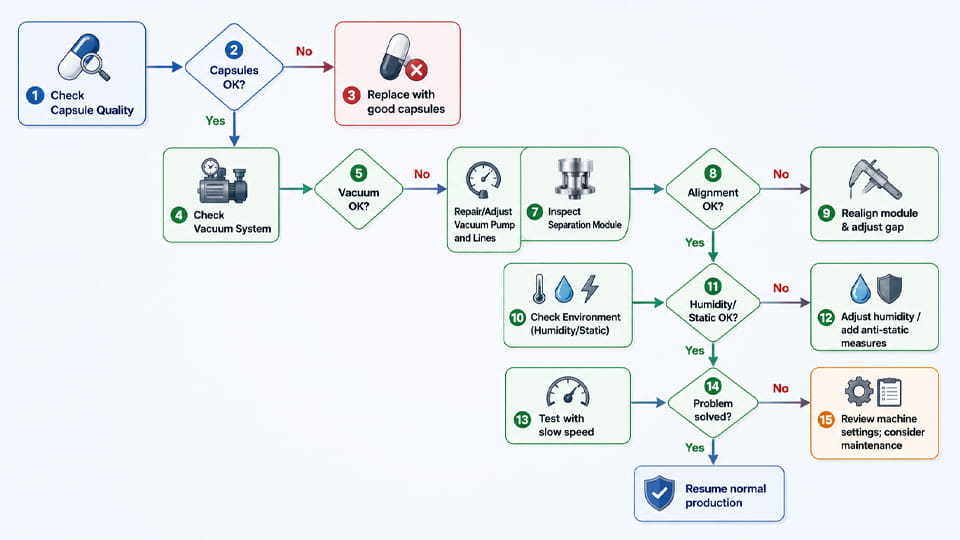
En la práctica, Comience con las soluciones más fáciles. (lote de cápsulas, ajustes de vacío) antes de desmantelar el hardware. Luego verifique la alineación mecánica de bandejas y placas.. Utilice el resultado de cada prueba para guiar el siguiente paso. Esto minimiza el ensayo y error y localiza la causa raíz de manera eficiente..
Prevenir es mejor que curar. Para evitar problemas de separación:
Al implementar estas mejores prácticas, Se pueden evitar muchos fallos de separación.. Las pruebas periódicas y los ajustes proactivos conducen a una producción estable.
Los fallos en la separación de cápsulas surgen de múltiples fuentes: calidad de la cápsula, rendimiento de vacío, ajuste mecánico, ambiente, y las rutinas de mantenimiento juegan un papel. Cuando la separación falla, Comience examinando el estado de la cápsula y la potencia de vacío., luego verifique metódicamente la alineación y la limpieza. La implementación de un régimen de mantenimiento disciplinado y controles ambientales reducirá en gran medida estas fallas..
Si tiene problemas frecuentes de separación, considere el equipo en sí. Los fabricantes de cápsulas de Jinlu Packing están diseñados para una separación confiable con sistemas de vacío robustos y funciones de fácil ajuste.. Por ejemplo, ver el NJP-400C y Máquinas llenadoras automáticas de cápsulas NJP-3800D en nuestro sitio, que ofrecen control de vacío avanzado y alineación precisa para minimizar las fallas de separación.
El fallo en la separación de las cápsulas suele deberse a una mala calidad de las mismas., presión de vacío insuficiente, ajustes incorrectos de la máquina, herramientas desgastadas, acumulación de polvo, o tamaños de cápsulas que no coinciden. En muchos casos, el problema resulta de una combinación de configuraciones de la máquina y condiciones de la cubierta de la cápsula en lugar de una sola falla.
Sí. La calidad de la cápsula es uno de los factores más importantes que afectan la separación de la cápsula.. Cápsulas con dimensiones inconsistentes., humedad excesiva, deformación, o las tolerancias de fabricación deficientes pueden no separarse correctamente, incluso cuando la máquina llenadora de cápsulas esté funcionando correctamente.
Absolutamente. El sistema de vacío es responsable de separar el cuerpo de la cápsula de la tapa durante el proceso de separación.. Si la presión de vacío es demasiado baja, inestable, o bloqueado por polvo o filtros obstruidos, Es posible que el cuerpo de la cápsula no se separe por completo., lo que provoca errores de llenado o paradas de la máquina.
Empiece por comprobar la calidad y el tamaño de la cápsula.. Luego inspeccione el sistema de vacío., incluyendo la bomba de vacío, filtros, mangueras, y superficies de sellado. Próximo, verificar la altura del separador, alineación de la máquina, y orientación de la cápsula. Finalmente, Limpie la máquina a fondo y realice una prueba antes de reanudar la producción..
La mayoría de las cápsulas de gelatina dura funcionan mejor cuando se almacenan a una humedad relativa de aproximadamente 35, que normalmente ayuda a mantener el contenido de humedad de la cáscara alrededor 12. Las cápsulas demasiado secas pueden volverse quebradizas., mientras que las cápsulas demasiado húmedas pueden volverse blandas y pegarse, aumentando el riesgo de fallo de separación.
Las cápsulas de HPMC son generalmente más sensibles a la electricidad estática y a la humedad ambiental que las cápsulas de gelatina.. En ambientes de producción secos, La acumulación de estática puede hacer que la tapa y el cuerpo se adhieran entre sí., haciendo la separación más difícil. Mantener la humedad adecuada y utilizar medidas antiestáticas puede mejorar significativamente el rendimiento..
Sí. Hacer funcionar la máquina llenadora de cápsulas más rápido de lo recomendado puede reducir el tiempo disponible para la orientación de las cápsulas., separación al vacío, y posicionamiento. Si la calidad de la cápsula o el estado de la máquina no pueden soportar el funcionamiento a alta velocidad, Los fallos de separación se vuelven más probables..
La limpieza de rutina debe realizarse después de cada lote de producción o cambio de producto.. Agujeros de vacío, segmentos de cápsula, placas de separación, y las piezas en contacto con el polvo deben inspeccionarse y limpiarse periódicamente. Mantenimiento preventivo, incluida la verificación del rendimiento del vacío., Reemplazo de componentes desgastados., y calibrar la configuración de la máquina: debe seguir el programa de mantenimiento del fabricante.
Sí. Segmentos de cápsula desgastados, varillas guía, casquillos, placas de separación, y otros componentes de herramientas pueden reducir la precisión del posicionamiento y el rendimiento del sellado al vacío.. Reemplazar las piezas desgastadas a tiempo ayuda a mantener una separación estable de las cápsulas y una calidad de llenado constante.
La mejor manera de evitar problemas de separación de las cápsulas es combinar cápsulas de alta calidad con un mantenimiento adecuado de la máquina.. Mantener el sistema de vacío en buenas condiciones., limpiar la máquina regularmente, mantener una temperatura y humedad adecuadas, Utilice el tamaño de cápsula correcto., inspeccionar las piezas de desgaste periódicamente, y capacitar a los operadores para que sigan los procedimientos operativos estándar. Un programa de mantenimiento preventivo puede reducir en gran medida el tiempo de inactividad y mejorar la eficiencia general de la producción..
Referencias:
1.Método para separar cuerpos y tapas de cápsulas. —— Patsnap Eureka
2.Mecanismo automático de separación de la tapa y el cuerpo de la cápsula. —— GooglePatentes
3.Dispositivo de equilibrio de separación al vacío de cápsulas para máquina llenadora —— GooglePatentes
4.Dispositivo para orientar las bases y tapas de cápsulas de gelatina dura. —— GooglePatentes
5.Solución de problemas de separación de cápsulas: Siguiendo cinco pasos para reducir el desperdicio y el tiempo de inactividad —— tabletascapsulas.com