
Las tabletas efervescentes son simplemente pastillas bebibles que burbujean y se disuelven cuando se dejan caer en agua.. En la práctica, tienen ganas de agregar una vitamina gaseosa o una tableta para aliviar el dolor a un vaso; lo revuelves, mira las burbujas, y bebe la solución. Estas tabletas se desarrollaron originalmente en la década de 1950 y su popularidad ha renacido a medida que los consumidores buscan dispositivos convenientes., suplementos y medicamentos de acción rápida. Por ejemplo, La vitamina C en dosis altas a menudo viene en forma de tableta efervescente., para que puedas disfrutar de una bebida vitamínica picante en lugar de tragar pastillas grandes. Porque las tabletas efervescentes se disuelven completamente, Los ingredientes activos ya están en solución antes de beberlos.. Esto significa una absorción rápida y, a menudo, un inicio de acción más rápido en comparación con tragar una tableta sólida.. Y seamos honestos: para muchas personas que beben un saborizado, una bebida gaseosa es simplemente más placentera que tragar una tableta seca.

Una tableta efervescente funciona mediante una simple reacción ácido-base.. En cada tableta hay una mezcla de un ácido comestible y un carbonato. (álcali) sal. Los ácidos comunes son el ácido cítrico o el ácido tartárico., y las bases comunes son el bicarbonato de sodio. (bicarbonato) o carbonato de sodio. El ingrediente activo (Por ejemplo, vitamina c, aspirina, o un suplemento mineral) se mezcla con estos agentes efervescentes. Cuando se agrega agua, El ácido y el carbonato reaccionan vigorosamente., liberando gas dióxido de carbono (CO₂) y disolver la pastilla en el agua. El resultado es una gaseosa., bebida efervescente que contiene el medicamento o nutriente disuelto.
La tableta también contiene excipientes para unirla., edulcorantes para el gusto, y aromas para hacer la bebida agradable. A diferencia de las pastillas normales, Las fórmulas efervescentes evitan los aglutinantes insolubles en agua. (como el estearato de magnesio), porque dejarían residuos y arruinarían la claridad de la bebida.. Los aglutinantes típicos en las tabletas efervescentes son polímeros solubles en agua como el polietilenglicol. (CLAVIJA) o JcJ, y los lubricantes se eligen por su solubilidad (p.ej. benzoato de sodio). Sabores de frutas, notas cítricas o de bayas, y edulcorantes (sacarosa, aspartamo, etc.) se agregan para enmascarar cualquier sabor amargo de los ingredientes activos.
| Tipo de ingrediente | Ejemplos | Papel en la tableta |
| Ácido Orgánico | Ácido cítrico, ácido tártarico | Reacciona con carbonato para liberar CO₂; agrega sabor amargo a la bebida. |
| Sal alcalina | bicarbonato de sodio, carbonato de sodio | Reacciona con ácido para producir efervescencia.; También proporciona iones de sodio.. |
| Ingrediente activo | vitamina c (ácido ascórbico), drogas, suplementos | El medicamento o nutriente entregado. (se disuelve completamente en agua). |
| Aglutinante | CLAVIJA 4000, JcJ, sorbitol | Mantiene la tableta unida durante la compresión.; debe disolverse limpiamente. |
| Lubricante | Benzoato de sodio, CLAVIJA, ácido adípico | Evita que se pegue en la prensa de tabletas.; debe ser soluble en agua. |
| Edulcorante/Sabor | Sacarosa, sucralosa, sabores de frutas naturales | Mejora el sabor y la sensación en boca de la bebida gaseosa.. |
| Antiapelmazamiento (opcional) | dióxido de silicio, carbonato de magnesio | Mantiene el flujo libre de polvos durante la fabricación. (también eliminador de humedad). |
| Embalaje | Tubo sellado o blister con desecante | Protege las tabletas de la humedad y el aire después de la producción.. |

Hacer tabletas efervescentes es más complejo que hacer pastillas comunes, porque la humedad debe mantenerse absolutamente mínima en cada paso. Incluso una mínima humedad puede desencadenar prematuramente la reacción ácido-base. Por esta razón, La producción a menudo se lleva a cabo en un lugar seco., habitación con humedad controlada (típicamente entre 10% y 25% de humedad relativa a temperaturas frías). Los polvos crudos se manipulan en sistemas cerrados.: Por ejemplo, El material se puede cargar en molinos o mezcladores usando IBC sellado. (contenedor intermedio para graneles) muelles bajo aire seco. Todos los equipos y recipientes se secan cuidadosamente., y se utiliza nitrógeno seco o aire filtrado para mantener la humedad fuera.. Estas precauciones especiales distinguen la producción efervescente de las líneas de tabletas estándar..
Los pasos clave de fabricación son los siguientes.:
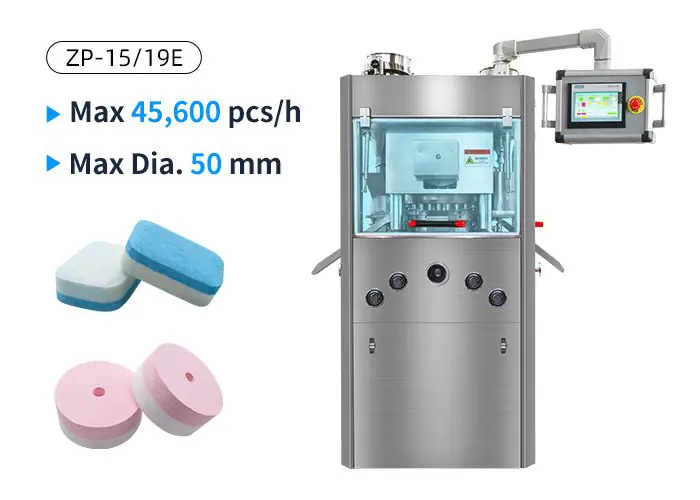
Cada paso utiliza maquinaria especializada.: Por ejemplo, después de mezclar los polvos, a máquina de prensa de tabletas (También llamada máquina de compresión de tabletas.) comprime la tableta, y luego una máquina empacadora de tabletas como una llenador de tubos o empacador de tiras completa el proceso. La maquinaria de envasado suele tener cubiertas de seguridad e integración para mantener la higiene y la sequedad.. En breve, La producción de comprimidos efervescentes requiere controles más estrictos que los comprimidos estándar., pero con el equipo y el entorno adecuados se puede hacer a escala.
Las tabletas efervescentes ofrecen varios beneficios que explican su popularidad en suplementos y productos farmacéuticos.:

Por supuesto, Las tabletas efervescentes también tienen inconvenientes que los fabricantes y usuarios deben considerar.:
A pesar de estos desafíos, Una adecuada ingeniería y control de calidad los superan.. Muchos productos exitosos (vitaminas, antiácidos, analgésicos, remedios para el resfriado) se venden como tabletas efervescentes.

Las tabletas efervescentes sirven a una amplia gama de mercados. Son comunes en productos farmacéuticos. (p.ej. Alka-Seltzer antiácido/analgésico), nutracéuticos/suplementos (vitaminas, minerales, sales de hidratación), e incluso algo de comida & áreas de bebidas (p.ej. tabletas sabor cóctel, aunque eso es un nicho). En los últimos años, El mercado mundial de productos efervescentes ha crecido rápidamente.. Un informe de la industria valoró el mercado mundial de tabletas efervescentes en alrededor de 5.300 millones de dólares en 2022, con proyecciones de superar $8.7 mil millones por 2030. Este crecimiento está impulsado por la demanda de comodidad de los consumidores., portabilidad, y suplementos premezclados.
Los principales ingredientes activos en este mercado incluyen vitamina C y vitaminas B. (para inmunidad y energía), calcio y magnesio (para la salud ósea), zinc y electrolitos (para inmunidad e hidratación), e incluso extractos botánicos para diversos beneficios para la salud.. Para fabricantes farmacéuticos e ingenieros de envasado, Esto significa una creciente demanda de equipos con capacidad efervescente.: concretamente, prensas para tabletas diseñadas para tabletas grandes, Granuladores de lecho fluido o compactadores de rodillos para granulación sensible a la humedad., y máquinas especializadas de llenado de tubos o envasadoras de blister que puedan manejar líneas efervescentes.. Empresas como Embalaje Jinlu especializarse en el suministro de dichos equipos, por ejemplo, Líneas de llenado de tubos efervescentes de alto rendimiento que cuentan, sello, y etiquetar las tabletas en tubos de aluminio, o sistemas de empaquetado en tiras que encierran cada tableta en un recipiente seco., ampolla hermética.
En general, Las tabletas efervescentes combinan una interesante ciencia farmacéutica con atractivos beneficios para el consumidor.. Al entender la química, proceso, y tendencias del mercado descritas anteriormente, Los fabricantes y compradores de la industria pueden tomar decisiones informadas sobre el uso de esta forma de dosificación dinámica..
Una tableta efervescente es una forma farmacéutica sólida que se disuelve en agua., crear una solución gaseosa que contiene el ingrediente activo. La efervescencia proviene de una reacción química entre un ácido comestible y una sal carbonato cuando se agrega agua..
Las tabletas efervescentes reaccionan con el agua mediante una reacción ácido-base. (típicamente entre ácido cítrico y bicarbonato de sodio), Liberando gas dióxido de carbono y provocando el efecto burbujeante..
Se utilizan comúnmente para vitaminas. (P.EJ., vitamina c), suplementos minerales, analgésicos, y medicamentos que se benefician de una disolución y absorción más rápidas..
Sí. Porque los ingredientes activos ya están disueltos en agua antes de la ingestión., Las tabletas efervescentes generalmente se absorben más rápido que las tabletas convencionales., lo que lleva a una aparición más rápida del efecto.
Suelen contener un ácido efervescente. (como el ácido cítrico), una base de carbonato (como bicarbonato de sodio), el ingrediente activo (como la vitamina C), carpetas, edulcorantes, y agentes aromatizantes.
Son fáciles de tragar, puede mejorar la absorción, enmascarar sabores desagradables, aumentar la ingesta de líquidos, y suelen ser los preferidos por personas que tienen dificultad para tragar pastillas.
Sí. Las tabletas efervescentes deben conservarse en un lugar a prueba de humedad., embalaje hermético ya que son muy sensibles a la humedad y pueden reaccionar prematuramente si se exponen a la humedad.
Tomarlos diariamente depende del ingrediente activo y de las necesidades de salud individuales.; Siga siempre las instrucciones del producto o consulte a un profesional de la salud., especialmente para vitaminas o medicamentos en dosis altas.
No siempre. Individuos con presión arterial alta, problemas renales, o con dietas restringidas en sodio se debe tener precaución debido al alto contenido de sodio en muchos efervescentes. Las mujeres embarazadas y los niños deben consultar a un médico antes de su uso..
Tragar una pastilla efervescente sin disolverla primero puede provocar molestias, exceso de gas, e irritación ya que la reacción efervescente puede ocurrir en la garganta o el estómago. Esta práctica no es recomendable.. (Inferido de principios efervescentes generales.)
Referencias:
1. Wikipedia – Tableta efervescente
2.Ciencia Directa – Tableta efervescente (Farmacia / Capítulo Remington)
3.Enfoque farmacéutico – Fabricación de Tabletas Efervescentes
4.Diario - Concepto, Fabricación y Caracterización de Tabletas Efervescentes

