
Pharmaceutical metal detectors are specialized inspection machines used throughout drug manufacturing lines to catch any stray metal in tablets, capsules or powders. Basit anlamda, they act like high-tech “airport scanners” for pills – automatically scanning every unit to ensure purity. Because even a tiny piece of steel or aluminum could threaten patient safety and regulatory compliance, these detectors have become essential equipment on modern tablet and capsule lines. They monitor products in real-time, alerting operators and triggering automatic ejection of any contaminated item before it reaches packaging. This process dramatically reduces risk: Örneğin, a pneumatic pusher can reject metal-contaminated tablets at >99.99% yeterlik, ensuring only pristine medication makes it out of the factory.
Metal contamination can enter a pharmaceutical process at many points – from worn punches and mixers to tiny bits of rusty agitator or broken packaging wire. Because we cannot see or feel metal shards by eye, an electronic inspection is vital. Modern detectors use high-frequency electromagnetic coils to sense ferrous and non-ferrous metal equally, giving clean tablets or capsules a “free pass” while flagging any contaminant. The result is a safe, compliant product that meets cGMP and pharmacopeial standards for purity.
Large-scale pharmaceutical production often features stainless-steel conveyor lines equipped with in-line detectors. These high-speed conveyors feed tablets (or capsule vials) under a metal-detection head, scanning each piece without slowing down the line. By integrating seamlessly with machines like rotary tablet presses or capsule fillers, a pharma metal detector can inspect hundreds of thousands of pills per hour. Örneğin, advanced systems can handle up to 30,000 dakikada tablet, while maintaining ultra-high sensitivity (on the order of 0.2–0.4 mm metal particles).
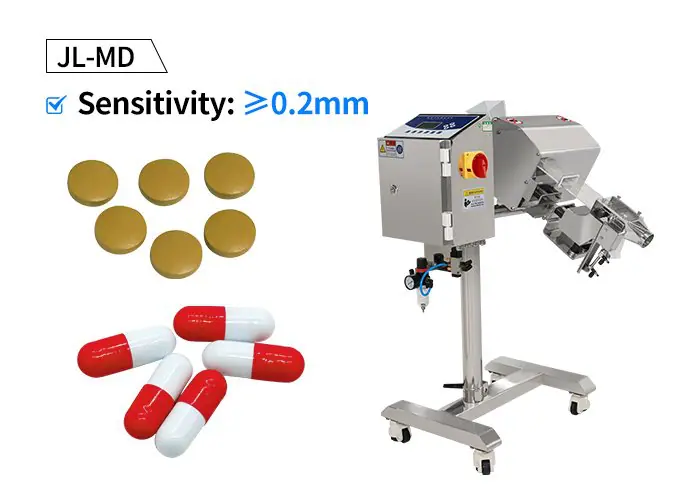
Pharmaceutical facilities use metal detectors as a core quality control step – think of them as a final safety net. Contamination from screws, valve fragments, pigment minerals, or even catalyst particles can make their way into products during mixing, granülasyon, or compression. Left unchecked, these metal shards can cause serious injury if ingested. Regulatory bodies like the FDA and international pharmacopeias expect manufacturers to implement such checks. Metal detector systems help companies comply with good manufacturing practices (CGMP) and avoid recalls or fines by catching unsafe batches before shipping.
Compared to manual inspection or even X-ray systems, metal detectors offer a balance of speed, sensitivity and cost-effectiveness. They can run inline on tablet or capsule lines at full production speeds with minimal footprint. They can detect sub-millimeter fragments of iron, copper or stainless steel – even non-magnetic 316L stainless – when properly calibrated. And because they gently scan products (no crushing or harmful radiation), they preserve delicate tablets and blister packs. Sonuç olarak: a pharmaceutical metal detector helps ensure patient safety, protect brand reputation, and prevent costly line shutdowns.
Most pharmaceutical metal detectors are based on electromagnetic induction and modern signal processing. Pratikte, each detector has one or more transmitter coils and matched receiver coils that create an oscillating magnetic field across a tunnel or aperture. When a non-metallic product passes through, the field remains undisturbed. But if a metallic impurity (ferrous or non-ferrous) enters the field, it induces tiny eddy currents that perturb both the amplitude and phase of the received signal. The machine’s electronics detect this anomaly, instantly flagging the product as contaminated.
A typical detection sequence can be outlined in steps:
[jl_youtube src=”https://www.youtube.com/embed/MKcGJwORkdc”]
Most of this occurs in fractions of a second. Örneğin, as described by one manufacturer, a tablet flows through the detector “via a small passage with a cowbell-shaped swivel” at the bottom; when metal is sensed, that swivel rapidly channels the bad pill into a rejection bin. Pratikte, the entire sensing-and-eject cycle takes only milliseconds, so a machine can easily keep up with very high output rates.
Pharmaceutical-grade metal detectors include features tailored to drug production:
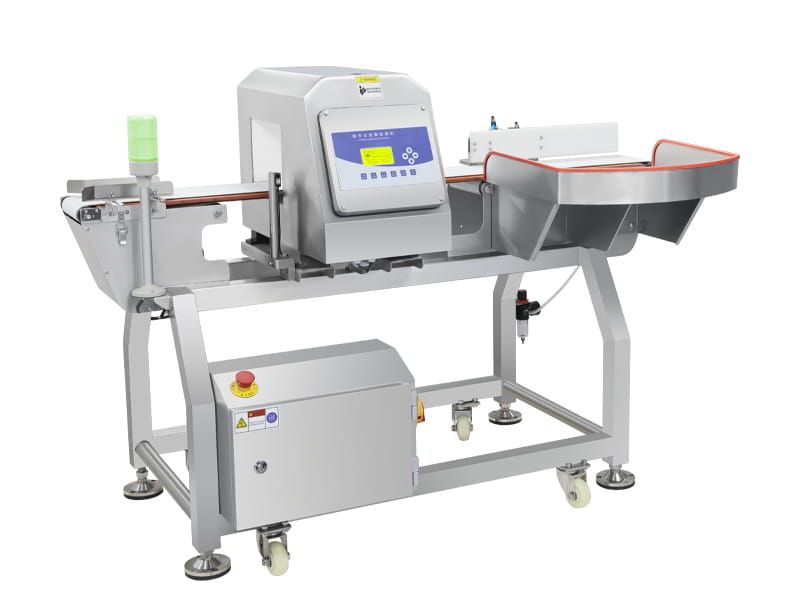
These features translate into clear benefits: manufacturers meet strict safety standards with confidence, avoid manual rework or batch holds, and save costs by preventing recalls. Because metal detection is accepted by auditors as a critical preventive control, using these machines demonstrates a commitment to quality that regulatory bodies expect.
Tablet Production: After mixing and granulation, tablets are compressed by high-speed presses. It’s here that wear on punches, feed frames or kneading paddles can generate stray filings. Placing a metal detector at the tablet basın exit (often right under a tablet deduster) catches any metal pieces before coating or packaging. Many lines also use detectors after the coating drum. Esasen, nearly every sub-process has a “critical control point.” JinLuPaketleme’s documentation notes detectors are used throughout: from raw-material feeding to final packaging, tailored to each phase. Detectors in tablet lines ensure “real-time rejection” – the system constantly screens tablets and immediately pushes bad ones aside, achieving ≥99.99% removal of contaminated tablets.
Kapsül İmalatı: Capsules introduce another layer of complexity. Capsules are composite (kabuk + doldurmak), so a single capsule could hide particles inside the powder or on the shell wall. Pharma detectors often provide “3D protection” – they inspect the shell surface and contents simultaneously. A detector placed after the kapsül dolgu (and polisher) will catch any metal lodged in the contents or shell. Bir kaynağın belirttiği gibi, this full-dimensional inspection ensures “all products leaving the factory are 100% free of excessive metal,” down to <0.2 mm particles. Başka bir deyişle, the final check before packaging acts as a “safety gate,” certifying that even hard-to-see fragments are caught.
[jl_youtube src=”https://www.youtube.com/embed/U1KbW9XeHK8″]
In both tablet and capsule lines, metal detectors are typically paired with automated reject systems. If an alarm sounds, an air blast or ejection flap diverts the single defective unit; the rest of the line keeps running. This automation replaces painstaking manual inspection and maintains smooth throughput – critical when lines can output over half a million doses per hour.
The heart of the pharmaceutical metal detector is its detection head. Let’s break down the physics simply: Imagine an oscillating magnetic field filling the detector tunnel. When a metal shard (magnetic or conductive) enters, it distorts that field. Esasen, the metal’s presence induces its own opposing magnetic field (eddy current), which the receiver coil picks up as a spike or phase shift. The system continuously compares this signal against the learned baseline of your normal product, flagging anything that stands out.
Some detectors use a single operating frequency optimized for sensitivity, while more advanced ones sweep or simultaneously use multiple frequencies. Multi-frequency detection helps distinguish metal from tricky backgrounds – for example, aluminum foil blisters produce a different pattern across frequencies than a little piece of steel. Digital signal processing then isolates true contaminant signals. Phase-tracking algorithms compensate for the “product effect” (many pharmaceuticals contain salts, moisture or metal in formula) so you don’t get nuisance rejects.
The machine’s electronics can also often determine if the contaminant is magnetic or non-magnetic. This helps in troubleshooting and quality logs. But regardless of type, the core idea is always the same: a metal fragment = a changed signal = instant rejection.
When adding a metal detector to a pharma line, a few practical points matter. Birinci, detectors are made to be hygienic and durable. Look for FDA- or CE-approved units. Örneğin, many are built to IP66/NEMA 4X standards (fully dust-tight and water-jet proof) and crafted from 316L polished stainless steel. This lets them survive rigorous cleaning regimes.
Saniye, compliance documentation is crucial. Pharmaceutical factories usually require IQ/OQ/PQ validation kits with any new equipment. Leading detectors come pre-validated for 21 CFR parts 210, 211, 11, vesaire. When a system is GMP-compliant “right out of the box,” it reduces qualification headaches.
Üçüncü, detectors must match your production speed and product. If your line runs 100 000 tablets/minute, choose a model rated for that throughput. Also ensure the detector aperture (head size) fits your tablets or capsules – too large an opening hurts sensitivity. Many manufacturers offer standard “tablet metal detector” models and “capsule detectors” with different tunnel dimensions.
Son olarak, good practice includes regular calibration with test pieces. Most pharmaceutical detectors support built-in test blocks so you can verify sensitivity easily. This ensures the machine stays tuned to the required detection limits for your tablets or capsules.
Implementing a pharmaceutical metal detector delivers clear advantages to global buyers and manufacturers:
Etraflı, a well-chosen pharma metal detector (whether marketed as a tablet metal detector or general industry model) becomes an indispensable part of the modern drug packaging line – quietly ensuring that every dose is safe before it leaves the factory.

In today’s highly regulated pharmaceutical environment, ensuring the absolute safety and purity of every tablet, capsule and powder batch isn’t just good practice — it’s a business necessity. With global market growth expected as manufacturers around the world adopt more automated quality systems and advanced detection technologies, the role of the pharmaceutical metal detector in drug production has never been more critical. According to industry forecasts, the market for metal detection in pharma is projected to expand steadily in the coming years, driven by stringent quality standards and rising demand for contamination-free medicines.
Whether you’re producing high-speed tablet lines, capsule formulations, or API powders, integrating reliable metal detection ensures your process aligns with global compliance requirements, protects end-users, and preserves your brand integrity. A well-implemented system minimizes costly recalls, reduces waste, and increases efficiency — giving you a measurable operational advantage.
A pharmaceutical metal detector is an in-line inspection machine designed specifically to detect and reject metal contaminants (ferrous, demir dışı, ve paslanmaz çelik) in pharmaceutical products like tablets, kapsüller, and powders before packaging and shipment. These systems help ensure product safety and compliance with quality standards.
These detectors use electromagnetic coils to create a magnetic field. When a product passes through, any metal contaminant disrupts this field, triggering a signal that the system interprets as contamination. The machine then activates a reject mechanism to remove the contaminated item.
They can inspect a range of materials including tablets, kapsüller, API powders, granüller, and other solid pharmaceutical forms. Some systems can be configured to work with liquids or semi-finished products as part of quality control.
Metal contamination can originate from worn machinery, processing equipment, or packaging lines. Detecting and removing metal fragments safeguards patient safety, protects brand reputation, and helps manufacturers comply with global regulatory standards.
Advanced pharmaceutical detectors are capable of identifying very small metal particles – often down to 0.2 mm for ferrous and 0.3 mm for non-ferrous metals – depending on the model and setup.
Evet, many modern systems can detect both types and often distinguish between magnetic and non-magnetic metal fragments without damaging the product, aiding troubleshooting and quality reporting.
Metal detectors are typically placed after tablet presses, capsule fillers or dedusters, and just before packaging to ensure that finished products are free of metal contamination before they reach final packaging or distribution.
Evet. By catching metal contaminants reliably, these systems help manufacturers meet cGMP requirements and support compliance with regulatory bodies such as the FDA and other international standards.
Look for machines with high sensitivity, robust reject mechanisms, hygienic stainless-steel design, digital controls (product profiling and memory), and easy integration with existing lines. These features improve detection accuracy and support efficient production workflow.
By detecting contaminants early and rejecting them automatically, metal detectors reduce the risk of contaminated products reaching customers, thus minimizing costly recalls, protecting patient safety, and safeguarding your company’s reputation.
Referanslar:
1. Pharmaceutical Metal Detector Market Size and Projections — Market Research Intellect.
2.How Metal Detection Works in Industrial and Pharmaceutical Processes — METTLER TOLEDO
3.Prioritizing metal detector for finished pharmaceutical formulation: Manufacturing safe, quality product – World Journal of Advanced Research and Reviews
4.Pharma Metal Detector (PH) – Magnetic Products, ANC

