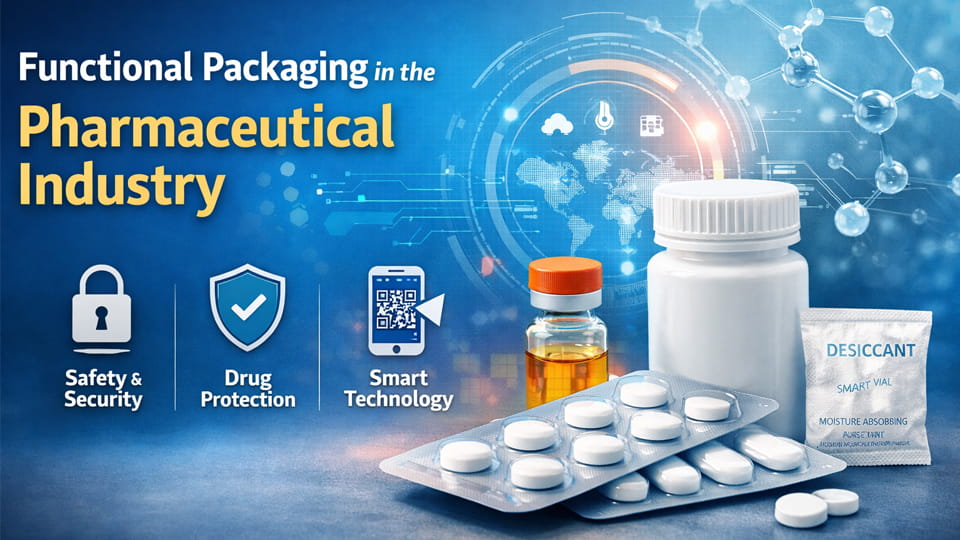

Do you know what is a desiccant and why desiccants are placed in pill bottles? 小さい, though, it can be a key factor in ensuring the stability of the entire product.
As is known to us that if something unrelated to the product is widely used in pouches, バッグ, またはボトル, it must have a reason for being there. Desiccants are exactly the one—seemingly small, strip-shaped or cylindrical items yet can protect pills and capsules from moisture, maintain their stability, and prevent unnecessary waste. This article will delve into the application of desiccants in the pharmaceutical and health supplement industries, providing insights into desiccant selection for your production line and related equipment.
重要なポイント
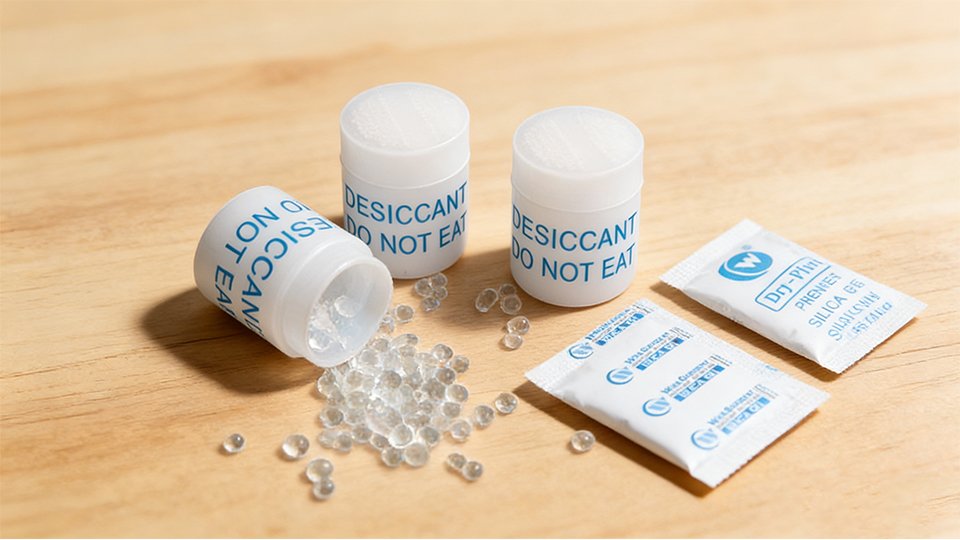
If you’re looking for the meaning of desiccant, it’s simply: a desiccant is a material that absorbs moisture to keep the inside of packaging dry. To define desiccant accurately, we must look at how it interacts with the environment. In terms of desiccant definition chemistry, the definition of a desiccant relates to adsorption which means water vapor is adsorbed onto porous surfaces rather than dissolved within the material itself. The U.S. 食品医薬品局 (FDA) has overturned the traditional view that the internal materials of a product are independent, pointing out that within a container’s sealing system, a packaged desiccant is no longer a small packet of material. It is part of the product’s protective system.
Moisture is a problem that is difficult to detect yet extremely easy to manifest. Pills can soften, capsule shells can absorb moisture, and many medications may become unstable before their expiration date if the packaging fails to function properly. This is why manufacturers include desiccants in medicine bottles. 最近, the FDA labels for medications have clearly demonstrated this practice: one label tells patients to keep the desiccant packet in the bottle and not to ingest it, while another label tells them to remove and discard the desiccant before use. The label always provides the final answer on what’s desiccant management for that specific drug.
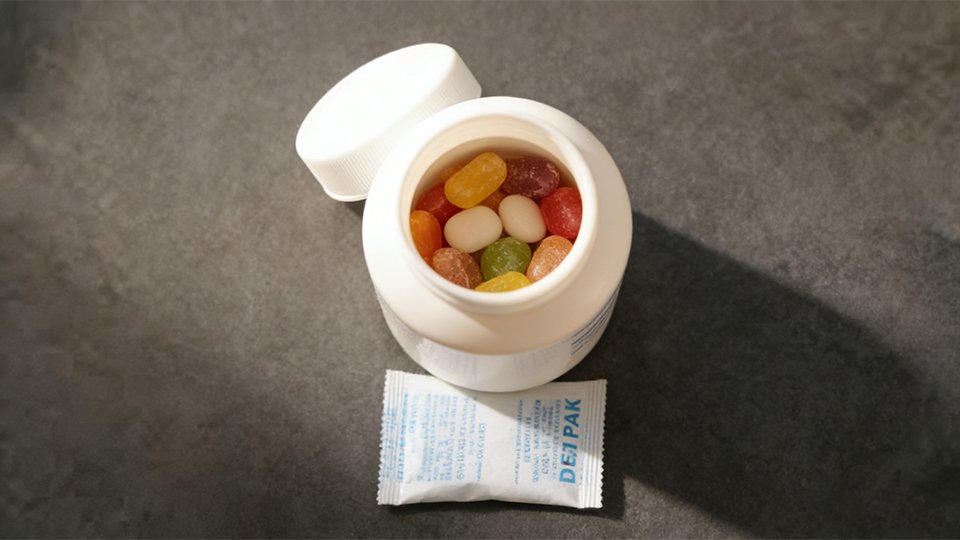
How do desiccants adsorb water molecules? Is it through a chemical reaction or some other property? 実際には, the working principle of desiccants is much simpler than you might imagine. You can think of a desiccant as a tiny sponge, but with a very large internal surface area. Solid desiccant materials are highly porous that can adsorb water molecules from the surrounding air. According to multiple technical reports, a single desiccant can adsorb approximately 35% に 40% of its own weight in moisture. これが理由です, even though it’s small, it can still produce a significant effect.
When you walk into any convenience store or supermarket, you’ll almost always find desiccants among the bottled goods on the shelves. But the desiccant packs uses extend far beyond medicine bottles; they are widely used in pharmaceuticals, エレクトロニクス, footwear, textiles, と交通, where excessive moisture can cause damage in any area. Desiccants, acting as moisture killers, effectively prevent products from clumping, softening, or even spoiling due to moisture absorption, thus extending their shelf life.
When we step into a pharmaceutical, 健康補助食品, or food manufacturing plant, the selection of desiccants is far more complex than its working principle. Manufacturers need to consider the bottle size, the diameter of the bottle neck, the sensitivity of the product, the speed of the production line, and even the desired texture of the finished packaging.
For any product on the market, a suitable desiccant is not just about effectively absorbing moisture from the packaging; it must also be suitable for the product’s positioning, bottle size, and bottle neck diameter. This is where the desiccant material, packaging format, and insertion method begin to become important.
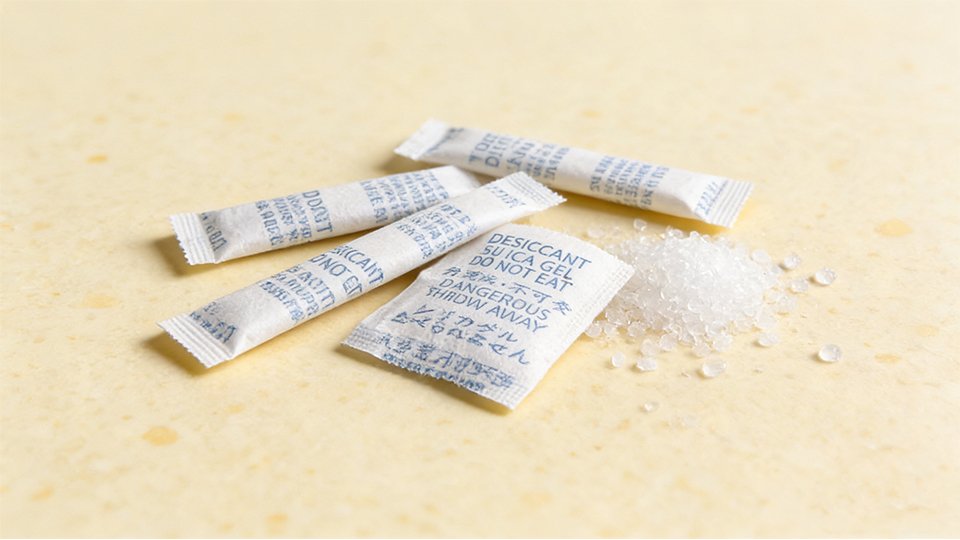
The desiccants in medicine bottles may seem simple, but there’s a lot more to them than meets the eye. In terms of form, they commonly come in small packets, cans, or cylinders, and some are simply filled directly.
In terms of materials, they are primarily made of silica gel, molecular sieves, clay (such as montmorillonite), and calcium oxide.
Multiple clinical packaging reviews confirm this: some indicate that desiccants are mostly in small packets or cylinders, composed of silica gel or calcium oxide; others list silica gel, molecular sieves, and montmorillonite clay as typical materials.
したがって, while the market may seem to have a clear product category, once you actually unscrew the cap, you’ll discover a wealth of details, far more complex than what appears on the surface.
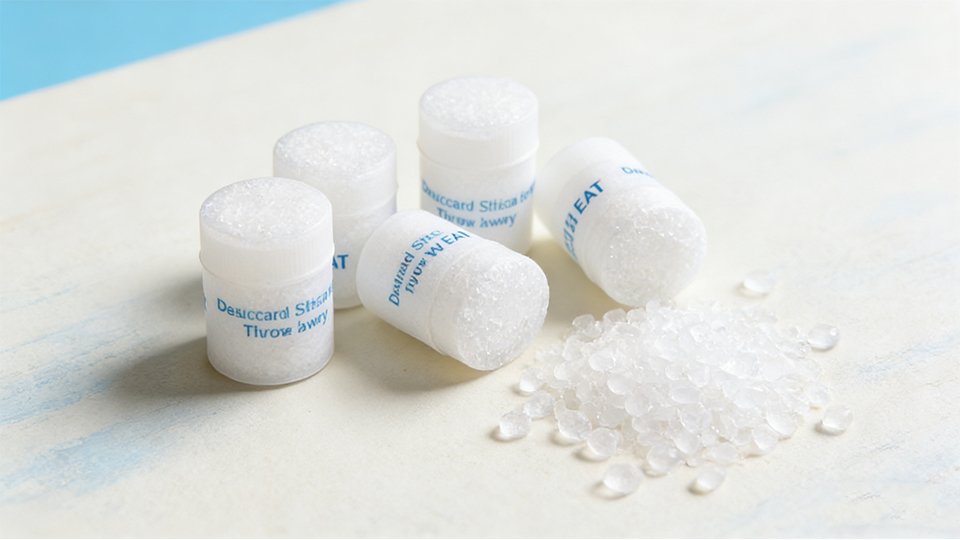
Desiccants can be categorized into several types based on their materials and shapes, and different desiccants are suitable for different production lines. 例えば, a high-end health product typically uses a columnar desiccant because it has better water absorption and the bottle is generally larger with more internal space. To provide a more intuitive understanding of the different types of desiccants, the following is a comparison table of several common desiccant types.
Table1- Comparison among Different Desiccant Formats
| Desiccant Format | 最適な用途 | 長所 | 短所 |
| Sticks/ Packets | Standard tablets, ビタミン, サプリメント | Fits narrow-neck bottles, easy to use, 費用対効果の高い | 外観: less premium |
| シリンダー | Premium pharma, larger bottles, wide-mouth containers | Cleaner look, low dusting, easy handling | Must be matched carefully to bottle design;
Swallowing risk |
| Reusable desiccant packs | Storage and logistics | Can be reused in some industrial settings | Usually not the first choice for retail pill bottles |
| Desiccant pouches | Food and daily chemical products | Suitable for large-scale, 大量生産 | Less premium feel than canisters |
In the food and daily chemical products industries, small bags and desiccant pouches are the primary packaging forms. They are generally more suitable for large-scale, 大量生産, especially when bottlenecks are small and production lines require high-speed operation.
Cans and cylinders, 一方で, convey a more premium feel and are more convenient to use in larger containers. さらに, there is a consideration for a safe desiccant: a recent case report indicated that ingestion of cylinder-type desiccant canisters could pose a blockage risk.
When products require a very dry environment, molecular sieves are a better choice because data suggests they perform better than ordinary silica gel at lower humidity levels.
The easiest way to choose is to think like both a manufacturer and a customer.
If you are going to manufacture a common vitamin or supplement in a standard bottle:
A desiccant pouch or desiccant sachet is usually the practical choice, for it:
If you are going to manufacture a premium pharmaceutical or high-end supplement:
A cylinder format may be a better match, for it:
If your product is especially moisture-sensitive:
Consider molecular sieve or another higher-performance material, for it:
したがって, we can see that when desiccants are used in commercial activities, they are no longer just a material, but also possess commercial value and reflect corporate decisions.
Take the same type of coffee product as an example: large-volume bulk coffee powder might only require a simple resealable bag and a small desiccant packet, but mushroom coffee with added mushrooms would likely use canned packaging and cylindrical desiccants. These choices of packaging and desiccants may seem insignificant in the overall production process, but they are the most crucial factors influencing consumers.
If the selection of desiccant is the initial step, then ensuring that each bottle or pouch contains a complete desiccant in mass production requires the assistance of machinery when the desiccant inserting machine steps on the stage.
a desiccant inserting machine, also called a desiccant filling machine, is responsible for the precise dispensing and insertion from a long desiccant roll into a bottle. The working principle is easy to be understood. When the filled bottles is detected when passing by a desiccant inserter machine, the machine will automatically run, cutting a desiccant and then filling it into the bottle. Some advanced models may also include a desiccant filter system to ensure no damaged packets enter the line.
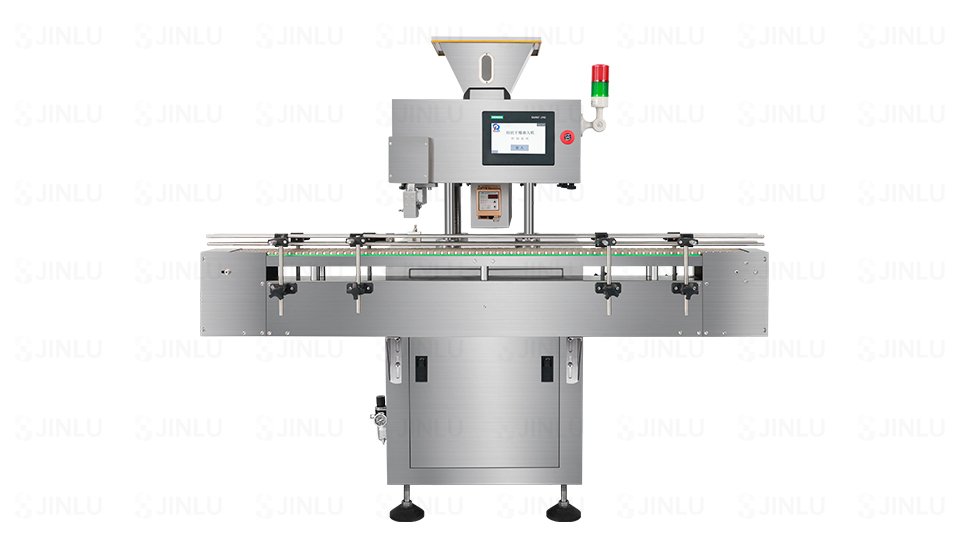
If you have been troubled with desiccant inserting for mass lines, Jinlu Packing’s desiccant machine is built for neat and dependable insertion.
If you are comparing a desiccant device or a basic automatic desiccant filling machine with a more basic setup, this is the kind of difference that becomes obvious after a few shifts.
Desiccants, tiny guardians found inside every bottle or pouch, protect products from moisture with their small size. On modern commercial production lines, they are no longer just assistants; as part of the product’s visual identity, they are also part of its identity. Now that you understand what is a desiccant and its importance, If you’re curious about how desiccants match with corresponding machines, お気軽に contact Jinlu Packing!
Although the desiccant is non-toxic, the real danger is asphyxiation. したがって, it should be kept away from children and not eaten at all.
If it is a small silica gel packet, nothing serious may happen. But it may cause suffocation, stomach upset, or blockage (if the silicone bag gets stuck).
Always follow the instructions or label. This is generally not recommended unless the label explicitly states it is permissible.
Silica gel are commonly seen in daily package, but in some cases, molecular sieve, or other moisture-absorbing materials may also be used.
参考文献:
[1] FDA: Guidance for Industry—Container Closure Systems for Packaging Human Drugs and Biologics.
[2] FDA DailyMed / Label: Tenofovir Disoproxil Fumarate Tablets.
[3] FDA Label: YEZTUGO—patient instructions on desiccant packet handling.